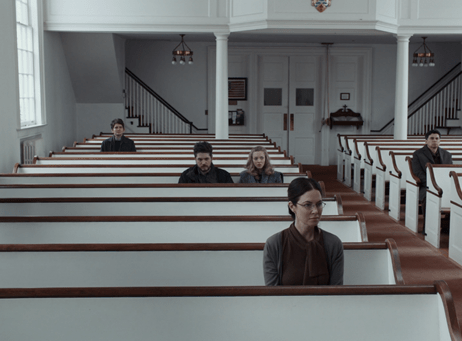
Madeline’s Madeline (2018)

madeline's madeline.png

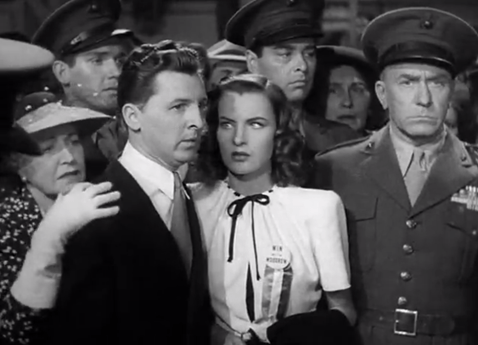
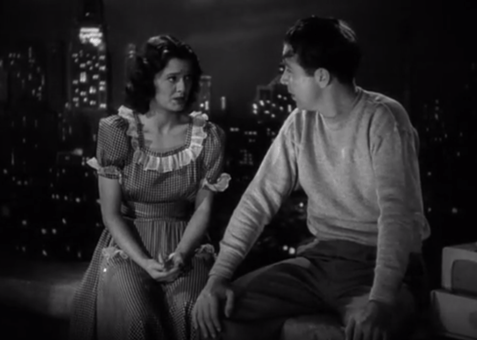
Madeline’ Madeline takes the very individualistic nature of its title and boldly realizes it through POV and metaphor to begin digging around in the perplexing head-space of a teenager. The first words we hear are as follows, “The emotions you are having are not your own, they are someone else’s. You are not the cat. You are inside the cat.” We are in a hospital and then within a feline pawing and purring, followed by a turtle sliding its way out to the ocean into the depths of the sea.

In the midst of the movie, I had an epiphany that I would have difficulty being an actor if the part strayed away from human qualities. Because when I look at animals there is wonderment there but I never feel like I could bring anything to them. I cannot understand or comprehend them.

Likewise, it would be difficult for me to invest in the perspective of a turtle and a cat, not that they are not important but they do not seem to operate, think, and act in the same way that we do as human beings. Because Madeline (Helena Howard) is a character who is playing a part and the metaphor is extended across this entire film. One could say she is playing a version of herself — the version that she perceives and wants to exist as — while others have another version of her that they want.

In playing her part, she willingly sheds her skin and puts on the guise of other creatures and gives herself over to them completely. One of the inherent fascinations in the showing Howard gives is the meta nature of playing the role of someone else playing a role.

So, in theory, we have the layers and the complexities of this whole patchwork of theater people and normal everyday humans playing their parts both real and fabricated based on the world around them. A certain ubiquitous Shakespeare quote is overwrought I know but it is also quite pertinent. “All the world is a stage and the people merely players.” We can break this film down to these more basic components as well.

Madeline’s involvement in her theater troupe not only facilitates this layering of a part on top of a part but it creates a visual dichotomy between the two women in her life who carry weight over her adolescent years. Her nervously concerned mother Regina (Miranda July) is always worried about her behavior, if she’s eating, taking her medicine, being safe about sex — all sorts of things. Her high-strung nature is a result of a daughter she deems to be unpredictable.

madeline's madeline 2.png

Then, there’s Evangeline (Molly Parker) the drama director and empowering free spirit who continually encourages Madeline in her physical expression and touts her in the devotion she gives to the stage. In this carefree communal environment, the girl feels truly herself and at ease with the beings existing around her.

They do some of the familiar improv, turning the story of an incarcerated man into literal expression. They do photo shoots and costume runs with giant pig heads and garish ensembles. When they sit in a circle together sharing their emotions and insights I could not help but feel the portrait epitomized the stereotypical acting experiences seen in a show such as Community. Needless to say, someone like me repressed and stunted as I am, looks on such a showing with a skeptical eye.

In one solitary scene, Evangeline even sits down with Madeline and starts expounding upon the philosophy of Jung. All is chaos in the cosmos. In the disorder, there is an order and the pendulum perpetually swings between sense and nonsense. While not necessarily reassuring, perhaps these words allow us to piece together a certain perspective to see the world. Maybe…

It becomes increasingly apparent — certainly beginning with the opening shot — this is meant to be a very intimate film. The camera hugs Madeline’s face and really provides close-ups for just about everyone while simultaneously blurring the screen artistically with exposure techniques to allow light to constantly seep into the frame. That’s when we’re not literally inside the camera’s viewpoint. Audio is often being funneled to us with dulled or hazed effects as if we are seeing the world through interference and distractions like others do.

At one point the stage performance is about prison and then it is a metaphor and then it morphs against into a piece on mental illness until Evangeline literally turns into a performance of Madeline’s most intimate details thinking they are all part of a character named Zia. Of course, the mask is only Madeline. She becomes a daughter regurgitating the words of her mother — imprinted on her brain — in a very public forum and it becomes a bit too real.

Then, Madeline winds up seeing a different side of Evangeline, not unlike her own mother, and once more we have drolling adults communicating on an altogether different wavelength than the teenagers.

The inevitable happens and Madeline and her troupe create a near funhouse of performance art all overtaken by an idea and rebelling against the forms their fearless leader imparted to them.

There is a unique voice and a vision that is unlike most anything else. But I’m not sure it even knows what it is striving for. There’s not necessarily an issue with this and yet it does lack what we would ascertain to be a central conceit for the rest of the film to orbit around.

If I had not just If I had not just recently seen A Bread Factory I would say this movie existed in a stratosphere totally its own. Regardless, it boasts a wholly original perspective from director Josephine Decker coupled with a mesmerizing performance by Helena Howard.

Whether we know what to make of it or not is up for contention. I still haven’t decided if this point is really worth dwelling on. The onus should not always be on a film to provide answers and if that is the case Madeline’s Madeline is a success because it arguably offers something more valuable — food for thought. For now, I am content ruminating over my multitude of questions.

3.5/5 Stars
Bend of The River (1952)

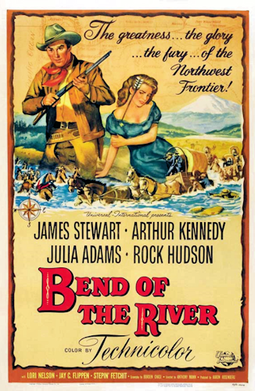
Bend_of_the_River_-_1952-_Poster.pngIn Bend of The River, there are glimpses of the man we knew before the war. Joking and smiling with that same face. The affable charm and so on. But it’s also starkly different.
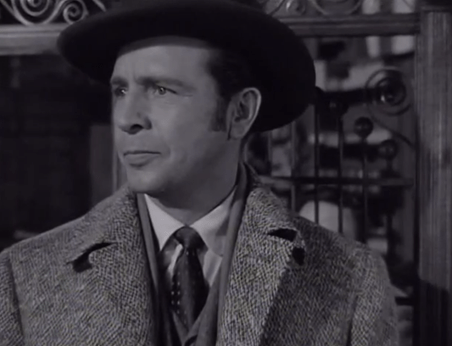
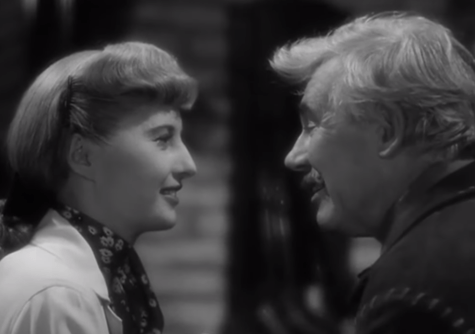
In this picture, James Stewart is on horseback leading a wagon train preoccupied with farming, cattle, ranching, and biscuits. His name is Glyn Mclyntock and this is the life he has crafted for himself.

Of course, when another man comes along to ride with them, a man named Emerson Cole (Arthur Kennedy), they trade glances and instantly know something about the other. Their names precede them as Glyn was once an infamous Missouri border raider and Cole had his own run-ins with the law for similar crimes.

However, no one knows about Mclyntock here and he’s bent on going straight. But with them together we have the perfect case study to test out the theories of one of the leaders of the caravan Jeremy Bailes. He believes a man can never change. “When an apple’s rotten there’s nothing you can do but throw it away or it will spoil the whole barrel.”

But these past sins as they were, give each man a time-tested wisdom about the real West. In one such scenario, they knowingly make talk to a pretty gal about bird calls coming from Orioles indigenous to Canada though they realize at that very moment some Shoshone are circling their camp. They’re ready for them.

The journey continues proving reminiscent of the pilgrims of old and that’s what these pioneers are, pilgrims of the Pacific Northwest. Occupied with grand visions of how they will cultivate the land and help build a prospering life for their families. But there’s also talk of stocking up enough food for the first winter and fears of the impending snows. Supplies haven’t been sent ahead yet nor have they gotten any word from Portland — the town where their supplies were supposed to come from.

It quickly becomes apparent following a return trip that the town has been swept by a frenzy of Gold Fever and things are noticeably different. We are conveniently reminded that it was Man who spoiled the land, tainting it with their many vices including pillaging and killing.

The part of the professional gambler in town — one Trey Hendricks — features Rock Hudson in a growing role as the pretty boy. He hasn’t quite reached true stardom yet but to have him in the picture is another stroke of luck in a project that is positively stacked with talent.

Julie Adams (billed as Julia) plays the main love interest, Laura, who is wounded by an arrow and laid up in the town of Bend only to fall for Cole who quickly took on a position at Trey’s establishment. As Glyn has no rightful claim to her, it looks like the two lovebirds will be married.

Mclyntock hires a group of wage laborers to help him peddle the goods back into the mountains as the riverboat they used before can only get them so far. The most memorable of the lot certainly include Harry Morgan, Royal Dano, and Jack Lambert. What’s more, they have no firm allegiances and their compensation amounts to a meager grubstake.

The uninhibited rage that burns in Stewart’s eyes with insurrection afoot becomes increasingly apparent and he’s about ready to administer a deathblow with one stab of a knife only to be stopped by the shriek of dismay from Laura. It brings him back to his senses but in no way ends his ordeal. Not by a long shot.

When a band of miners in desperate need of provisions is willing to pay an astronomical sum for the goods it all but seals the deal; we have a mutiny on our hands. That’s not altogether surprising; it’s how it goes down that proves a jolt.

But that trademark tension of Anthony Mann just will not leave us be and we find ourselves continually harried to the end of the picture because this mission of mercy is our mission. But again, we are reminded of what man is capable of left to his own devices. Avarice is a deadly beast and it brings out a fellow’s true colors.

Stewart is cast out with no horse and no gun. But he’s relentless in his pursuit. The objective clear and he makes sure his foes know it without a shadow of a doubt.

“You’ll be seeing me. You’ll be seeing me. Every time you bed down for the night, you’ll look back to the darkness and wonder if I’m there. And some night, I will be. You’ll be seeing me!”

First, it’s one man. Then two shots in the night and finally the confrontation that we’ve all been waiting for. Glyn reemerges to take back the supplies aided by Trey, Laura, and Mr. Baile. The bullets fly. The bodies fall into the stream. Horses scamper away. And our two stars have it out for good.

Mann captures it all for the maximum effect, the most striking visuals being contorted faces in the throes of hand-to-hand combat first in a wagon and finally, the bedraggled forms reeling in the depths of the water. It’s so visceral and physical even alarmingly so. But it gets to us.

Is this a western or what? My goodness. The final shots are so Hollywood — the epitome of its Technicolor glories with everyone getting together and evil conquered — but all this cannot quite rub out the images that preceded it. They are blistering with unmistakable antagonism.

Stewart’s performance might seem unprecedented and certainly, it was for all its psychological torment but his characterization is indebted to Arthur Kennedy who draws upon a vitality of his own. Together they make Bend of the River a tale well worth remembering.

4/5 Stars

The Tall Target (1951)

the tall target 1.png

To set the scene our storytellers enlist an opening crawl that runs over the unmistakable strains of train noise. The year is 1861. The event being dramatized is the alleged Baltimore Plot and our hero is New York policeman John Kennedy (Dick Powell).

Despite being common and coincidental I can’t but help to acknowledge the bitter irony of our protagonist’s name. But he is not here to thwart a plot against his own life but a man with a much longer shadow.

His in-depth report warning against an impending threat to Abraham Lincoln on the road to his inauguration in Baltimore is dismissed by his superior as alarmist drivel. Nevertheless, the man finagles a way onto the Baltimore-bound steam engine finding an agreeable ally in Colonel Caleb Jeffers (Adolph Menjou). Kennedy once guarded Lincoln for 48 hours and yet in this perilous hour, he will go great lengths for the same man. However, we will soon find out that not everyone feels that way. He’s a very polarizing figure.

I’ve come to the not so startling conclusion that anything Mann touches turns into noir which I readily agree too. Much like Reign of Terror (1948) before it, the director transforms this antebellum train thriller into a reconstruction of history painted in tight angles, smoke & shadows, and coiled with taut action. We grow embroiled in his composed world of greasy close-quartered combat with grimacing faces and flying fists. Far from being constricting these elements are where the story thrives, trapped in corridors and hidden away in side-compartments with the characters that dwell therein.

Because moving through such a space forces Kennedy to brush up against so many individuals. A conductor (soon-to-be blacklisted Will Geer) who is trying to make sure everything goes as smoothly as possible only to be inundated by troublemakers and drama. A young mother (Barbara Billingsley) who tries to control her antsy son. An incessant windbag constantly worrying about her prized “jottings” and all she’s going to inquire to Mr. Lincoln about. A southern gentleman sounding off in his dismay with the countries future. You get the idea.

Despite the vague difference in context, it’s quite understandable to place The Tall Target up against another film from the following year The Narrow Margin (1952). Rather than try and decide which one is superior, it’s safe to say that both excel far beyond what their budgets might have you suppose and they utilize the continual motion of a train to an immense degree because in that way the narrative is almost always chugging along to a certain end.

the tall target 3.png

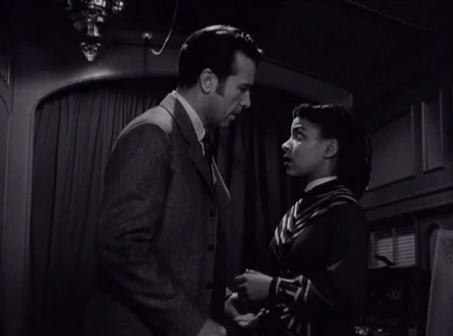
Ruby Dee has a meager but crucial part in The Tall Target that I deeply wish could have been more substantial. In fact, in an early version, the established star Lena Horne was supposed to play the part of the slave girl Rachel.

Though the movie doesn’t have too much time to tackle the issues at hand, with its limited runtime it does attempt some discussion in terms of African-American freedoms and the southern relationship to such an ideal as asserted in the 13th amendment. The dichotomy I’ve always heard repeated is that “the North loved the race but hated the individual. Southerners hated the race, but love the individual.” It’s a vexing sentiment that we somehow can see playing out here.

Ginny Beaufort (Paula Raymond) a proper southern belle notes that she grew up so close to Rachel treating her like a sister. So close in fact that she never even thought about giving the young woman her freedom. Meanwhile, her younger brother Lance is involved in more than he is letting on. The mystery is not in his objective — he’s made his sentiments fairly clear — he despises Lincoln. Rather what matters is who his compatriots are and how they plan to go after the future president.

For me, the illusion was broken in the final moments because up until that time the picture has kept its eponymous hero masked. He is the Tall Target and nothing else. When we see him somehow the mythos around him is broken and he becomes another actor more than the idea of the man we know as our 16th president.

Regardless, Anthony Mann’s effort, while not well received in its day, is another picture packed with exuberance. It gives us grit and intrigue aboard a train and like the best thrillers, it uses every restriction to keep the tension palpable while throwing around enough diversions to keep us in our seats.

3.5/5 Stars

The Furies (1950)

the furies 1.png

Frenzied opening strings from a score by Franz Waxman assist in introducing a film that positions itself as another textured portrait of the West boasting a pair of grandiose performances from Walter Huston and Barbara Stanwyck. This particular ride down the well-trodden paths takes place in New Mexico where cattle barons ruled the land like feudal lords. At its core is a warring clan and this is their tale of belligerent family drama that sprawls across the plains with a vengeance.

In fact, T.C. Jeffers (Walter Huston) is a man ruling his acreage known as “The Furies” with an equally-suited ferocity. He’s a larger-than-life figure who knows how to throw around his weight; the territory is scattered with his I.O.U.s christened T.C.s.

But his daughter Vance (Stanwyck) is no less imposing, knowing precisely what she wants — his empire — and chasing after it with the full intention of sinking her claws into it someday. When she finds the right man of course. We can liken them to Rockefellers of the West, ruthless while also being fiercely loyal and even generous to their friends. But they are not squeamish about going after their own.

The ensuing melodrama is laced with arsenic braced by Anthony Mann’s usual choices that ratchet the tension. While the scale has grown, his aptitude for projecting a certain raw volatility on the western frontier is no less apparent.

When rugged Rip Darrow (Wendell Corey) ambles into the Jeffers’ home during a lively gathering, Vance immediately tries to win him. It starts with a dance and goes from there.  Far more than a mere pretty face, Wendell Corey holds a grudge that really leaves an impression. He has long felt slighted by Jeffers for ending up with the land he long thought was his own and he gladly gets back at the man through his daughter. Except Vance feels betrayed when Rip takes $50,000 in bribe money never to see her again. That’s the termination of their relationship for good.

But it turns out that T.C. also seeks out companionship of his own and his chosen mate, Flo Burnett (Judith Anderson) proves to be a golddigger who hardly hides her intentions. She receives only Vance’s ire and Ms. Jeffords is not about to let this woman finagle her way into the family business even resorting to violence if necessary.

It’s yet another riff in this power struggle that reverberates again and again. Because this is an unrestrained showcase of opportunistic human beings who glory in their own avarice and pursuit of wealth. People pushing others around and undermining them with little regard for their well-being.

It ends up reaching its absolute zenith with a bloody shootout to push the Hererra Family led by brother Juan (Gilbert Roland) off the Furies once and for all.The skirmish results with one man at the end of a rope and Vance never about to let her father forget what he has done to one of her closest childhood friends.

But it doesn’t stop there because it never can. Not with people such as this. Daughter goes out across the frontier on a vendetta that will pay heavy dividends. She even reconnects with the other man she never wanted to see again. Together they scheme T.C.’s ultimate downfall but as he gets on in years the old warhorse is faltering a bit. His glory days are setting so maybe it’s for the best. One could say that T.C. got his comeuppance but by all accounts, he died a legend. The same cannot be said for many of his adversaries.

I can’t help but juxtapose Devil’s Doorway and The Furies. An interesting reference point is that Robert Taylor and Barbara Stanwyck were still husband and wife at the time but in both pictures, they try mightily to tame the West and hold onto what they believe is rightfully theirs. They have varying degrees of success.

The film also exhibits a racial element much like Devil’s Doorway because though it is rarely talked about, much of the mythology of the West is tied up in the white pioneer’s story. The marginalized folks like Native Americans, Hispanics, and certainly Asians are pushed to the edges of the frame. This film showcases the Herrera family.

Further still, there are an array of strikingly powerful women who exert their control in different ways. Though Beulah Bondi has a relatively small part you quickly realize that women such as her are important figures. Because they carry such crucial sway in the business of their husbands as the voices whispering advice into their ears.

Meanwhile, Judith Anderson while a bit of a tramp nevertheless is forthright and transparent about her intentions. She’s not a complete pushover and that makes a slight tussle with Stanwyck entirely credible.

Obviously, Barbara Stanwyck is phenomenal — one of the few performers who could have pulled off this role much like the matriarch in Sam Fuller’s Forty Guns (1957). It needs someone who is that assured and strong, who carries an unmistakable presence anchored by undeniable beauty. She was blessed with both.

Walter Huston would pass away the same year in 1950 but The Furies compiled his innumerable talents in one last monumental showing that’s a worthy swan song in a veteran career. What a way to go as T.C. Jeffords.

4/5 Stars


The Devil’s Doorway (1950)

devil's doorway 1.png

Right here we see the precise genesis of Anthony Mann as a director of westerns. To consider the string of modest classics that followed is nearly staggering. But he was well-suited for the transition taking his acquired skills over the years and translating them easily to the West.

The Devil’s Doorway is shot like his most gripping noirs thanks in part to John Alton’s continued partnership. Thunder sounding off in the background, low lights, and even lower angles when working in close-ups. Visually he certainly doesn’t pull any punches.

At first, I wasn’t sure if I would care for the picture since I knew next to nothing about it. However, in the first few minutes of expositional action, we learn something that sets up a striking dissonance not only within our character’s identity but in the West itself.

Lance Poole (Robert Taylor) comes back from the Civil War as a man who proved himself on many a battlefield from Antitiem to Gettysburg achieving the Congressional Medal of Honor for his heroics. Strikingly, for someone returning from such a divisive war, Poole has a fairly positive outlook. Except he’s rudely awakened when he comes home and finds that a different type of war is still raging.

This is the time to share the film’s major point and one that is crucial to getting into this narrative from screenwriter Guy Trosper. Poole is a Native American — a Shoshone by birth — but when he fought in the army no one judged him by the color of his skin. He shared food and quarters and fought alongside his fellow Americans.

And yet when he gets back to the land he calls his own, he finds that men have hardly changed even if the times have. White folk look at “Indians” with disdain and if not disdain then probably fear. There’s no sense of wanting to get to know them. Sure, there are a few who remain true to Poole from the old days like Zeke (Edgar Buchanan) and yet even they crumble under peer pressure. That means no drinks served to Indians in the saloon and certainly no owning property.

The Homestead Act is a grand proposition made for dreamers, rallying men to head out to the vast plains out west to stake claim to the territory and settle down. No such provision exists for the ones who have lived on the land all their lives.Under the law Poole’s not classified as an American citizen and what is he, you ask? Well, that’s very much what the picture is trying to address.

Even as desperate men surge toward Poole’s acreage of top land looking to move in, other Shoshone from a reservation, led by their chief (Chief John Big Tree) seek asylum because their current existence is a far cry from their former life of prosperity.

Poole knowing that the way of the white man worked for him during the war tries to seek out honest means of reclaiming his land. He forgoes the town’s crooked lawyer Verne Coolan (Louis Calhern) and calls upon Orrie Master (Paula Raymond); she’s a woman, not a man, which in itself is a statement.

Though reluctant, she takes his case because they need each other. She plays by the book, holding to the assertion that if something’s the law, we have to abide by it. Her faith, her religion of sorts, is the law and she treats it as sacred. But as those roads seem to lead nowhere for a man like Poole just because of the color of his skin, she tries to make him seek compromise — some amount of mutual understanding.

But when you have a bigot like Coolan doing everything in his power to push Lance off his property, such an agreement seems out of the question. Such a diabolical fellow is intent on inciting opposition and manipulating folks so that peace and compromise are no longer viable options.

People such as this are far too prevalent in this world and their philosophies poison the world for everyone. There is no understanding. There is no empathy and Lance is not about to wait around for it. He’s going to defend what he deems to be rightfully his.

Ms. Masters in near desperation sends out a distress signal to Fort Laramie calling on the Cavalry. It is her last hope for any type of peaceable resolution — even if it only stops the bleeding which has already begun between the natives and the homesteaders. We too look on powerless to stop the bloodshed because we are only an audience interfacing with a film. The question becomes what will we do with our reality if we see a parallel issue?  If and when former Union Officer Poole perishes there will be no one to play him “Taps” now will there?

Such a downbeat ending and harsh portrait was not something Hollywood was ready for and it seems that generally, Devil’s Doorway gets a bit buried. I think it’s about time that we all took our medicine and while not a perfect film it might cause one to perceive the Wild West of Hollywood lore with a very different heart.

To say it’s completely undermined by its casting is somewhat missing the point because its intentions are all but honorable and the picture lays in hard to issues that are not simply western issues but are quite easily transposed to post-war WWII, 1950s pre-civil rights America and obviously the present as well.

In fact, it hardly feels like jumping the gun to call Devil’s Doorway cutting-edge because like Broken Arrow (1950) of the same year, it actually concerned itself with the plight of Native Americans. But whereas the other picture is somewhat forgettable now, there’s still an undeniable bite to Mann’s effort. Even the black and white imagery aids in the tone (as well as practically masking a bit of Taylor’s makeup).

Here is a western that stars an “Indian” and an independent working woman who are not even romantically attached to each other. Beyond that, it straddles this line of muddied morality that hardly chooses sides but settles in the gray area that leads us to make some heady considerations.

Far be it from me to strip away visions of glorious gunfights and all-conquering heroes. But if you watch this story unfold — a grim statement of tenacity from Anthony Mann — those myths will be trampled on. You would do well to watch your step and open up your heart just a little bit, hopefully, more than when you first entered in the corral.

4/5 Stars

First Reformed (2017)

firstreformed1.png

“You’re always in the Garden.  Even Jesus wasn’t always in the Garden, on his knees, sweating blood. He was on the Mount. He was in the marketplace. He was in the temple. But you, you’re always in the Garden.” 

Paul Schrader and Martin Scorsese unknowingly formed a legendary partnership in making Taxi Driver (1976) that has left an indelible mark on cinema. Despite their diverging backgrounds, it seemed like they were very much kindred spirits. At least, they understood each other.

Scorsese of course, grew up in the Catholic Church even considering becoming a priest. Schrader likewise, had a deeply religious upbringing rooted in reformed theology even attending Calvin College. Aside from both being cinephiles, each man has battled through his share of demons and yet they have come out on the other side no doubt wiser.

Thus, with the release of Scorsese’s deeply spiritual passion project Silence (2016) a couple years ago, it seems fitting Schrader followed up with First Reformed soon after. I’m not sure if it’s mere coincidence or not but by this time in their lives, with space for retrospection, they have come to a crossroads to make daring, personal pictures about religious faith.

The opening shot is instantly recognizable. We have the stark symmetry of a church steeple. The religious space lacks the same type of iconography as the Catholic Church because the Calvinists came from a  tradition foregoing any amount of pomp & circumstance for a stripped-down aesthetic. All the focus was on the cultivation of the spiritual life.

There still is history, as this particular church is just about to celebrate its 250th anniversary and it was once a stop on the Underground Railroad years before. The resident reverend’s tours include touting the Dutch Colonial architecture and showing wide-eyed kids the trap doors escaped slaves used to hide in.

Now it’s ironically also a spiritual museum-piece — a creaky religious relic — attended by a few stray parishioners. The real center of religious activities is at Abundant Life a well-meaning but somewhat sanitized megachurch set up across the road. Perfectly reflected by their cafeteria wall emblazoned with the words from Acts 2.

The story actually begins with an experiment of sorts. Reverend Ernst Toller (Ethan Hawke) will keep a journal for an entire year in a notebook and then he will destroy it. There is an obvious finality to this. He’s set himself a hard timeline.

Though he mentions word documents and digital files, he might as well come out of a Bresson picture. His possessions are few and far between. A well-worn Bible sits on his bedside table accompanied by the works of Thomas Merton and G.K. Chesterton. His landscape and surroundings are just as stark and humble. Interiors are kept equally simple and straightforward.

firstreformed3.png

The unadorned yet meticulous composition use geography whether structures or a bit of symmetry to set up scenes. Inside the church with the lines of pews that might be plucked directly from Winter Light (1963). Then, along a row of houses in a neighborhood as a car pulls up to a house.

One house he pays a call on belongs to Mary (Amanda Seyfried), a young pregnant woman, who grew up in the church and is now worried about her husband Michael’s mental stability as of late. She worries it will affect their future child. The reverend might be able to help.

Upon their first dialogue together, it becomes obvious he is not a learned man. He had a stint in jail for his environmental activism in Canada and currently holds down a job at the local Home Depot.

But he gives a cogent account of why he does not want to bring a child into the world. By 2050 all scientific analysis seems to suggest dire straits are ahead if we do not make radical changes on an international level. Because climate, water levels, and everything else will not leave man unimpeded.

His question is simple. How do you sanction bringing a girl into the world who is full of hope and naivete? Then, she grows up and as a woman, she looks you square in the eyes and says, “You knew it all along, didn’t you?” And yet you brought her into this world of death. Most of what the reverend does is listen to his grief. The only response possible is that the blackness is not a new phenomenon. Man, woman, and child are born to trouble. It seems small comfort.

firstreformed2.png

As the themes begin to interweave there are continuous nods to Ingmar Bergman’s Winter Light (1963) from the snow motif to a deeply troubled husband and even a female associate who takes a deep concern in the well-being of our protagonist. You can sense Schrader acknowledging his deep abiding affections for Robert Bresson — an obvious reference point being Diary of a Country Priest (1951) — with a man of faith suffering from a mysterious ailment. It only serves to exasperate his human relationships and give a physical manifestation to his existential crisis.

In maintaining the transcendental spirituality of the film, Tarkovsky levitations and Dreyer-like “resurrections” are also evoked and the list goes on and on. In fact, it amazes me how obvious and plentiful the allusions are. Schrader barely tries to hide his affinities for certain pictures. They are most assuredly there being represented and it’s generally satisfying.

But it is a film that is also born out of the mind who brought us Taxi Driver and the ties are closer than we might expect. Because it becomes more akin to the desolate alienation of Travis Bickle as the story plods on. After experiencing a tragic death and witnessing the ways the modern world functions, Toller seems to see the need for a martyr in an unjust world. He becomes increasingly alienated.

His life involves helping out with the homeless food line, sitting in on the youth small group, and of course, his tours and Sunday duties. But it’s the old conundrum. He feels confined to the walls of his church. It doesn’t seem like he’s necessary for anything aside from spiritual comfort. He has no true impact on people lives and he himself is struggling to keep in communication with God. Solitary prayer seems empty. Hence a nightly journal.

Something happens when he gets in a spat with a local big whig over negative publicity from a funeral for Michael Masana. It was held at a toxic waste dump with a choir singing an environmentally conscious Neil Young tune. Toller gets lambasted for his “political behavior,” though he was admittedly only upholding the man’s wishes. And yet he is beginning to question how people who proclaim to follow God cannot take a greater stake in preserving his creation.

In documenting Martin Luther King Jr.’s efforts, Ava DuVernay’s Selma (2015) was a call-to-action in the realm of social justice. For all those people who claim or at least strive to be good, morally upright people, it is clear this is a universal fight. Likewise, First Reformed is a call or at least a meditation on environmental justice because humans are meant to be stewards. It is not completely about extremism (though Toller begins to inch that way) but in some ways, we are meant to live radical lives. Full of radical love and a radical conception of justice for the earth and other human beings.

But one could say this is not the true punchline. For that we must revert back to some of the deep-set themes of Schrader’s career, returning once again to his first collaboration back with Martin Scorsese back in 1976.

Because First Reformed has one of the most abrupt endings in recent memory. It catches us off guard on numerous fronts. We must start with the ambiguity which is nothing new. Travis Bickle entered the pantheon of cinema characters partially due to the enigma that clouds his fate in Taxi Driver.

Most people who have ever been ambushed by the film will recall the ending. Travis goes on his crusade to clean up the filth and it’s a violent rampage in the eyes of the world but for him, it’s an act of triumphant heroism.

In the final moments, he’s back in his cab again — his personal cathedral — driving the streets and there’s his untouchable girl, Cybil Sheppard, who appears in the back seat. He sees her through his rearview window and rides off. It seems almost impossible to read it in the literal sense. How could this be? Is this his own personal delusion? Could this actually be real? I know my own inclinations but I don’t know what to believe.

First Reformed is much the same. Here we have the Reverend about to take his poison — looking to end his life — in the face of such a dreadful world. Then a door opens and there stands the one person who might save him, Mary, appearing in the doorway like an angel.

They embrace and then beginning kissing and we spiral around and around them in one of the most violently uninhibited camera setups in the film. We have broken out of the harsh asceticism of the entire movie thus far.

Is it about this salvation coming through the physical union between two people? This could be the Ordet-like resurrection or maybe like Taxi Driver it’s all part of the ultimate delusion. The bottom line is we don’t know and Schrader doesn’t tip us. Much like Silence, what’s paramount is what we fall back on in response.

Can we read this as a story of despair or hope? The words of Toller echo through my mind, “Wisdom is holding two contradictory truths in our minds simultaneously.” This is First Reformed at its finest, ever oscillating between the two defining poles of any life.

4/5 Stars


“There is not a square inch in the whole domain of our human existence over which Christ, who is Sovereign over all, does not cry, Mine!” – Dutch Prime Minister and Theologian Abraham Kuyper

Unfaithfully Yours (1948)

unfaithfully yours 1.png

Though Preston Sturges would never eclipse the heights of the early 40s again and his stellar run was slowly spiraling down, we do have Unfaithfully Yours and for my money, that’s recompense enough.

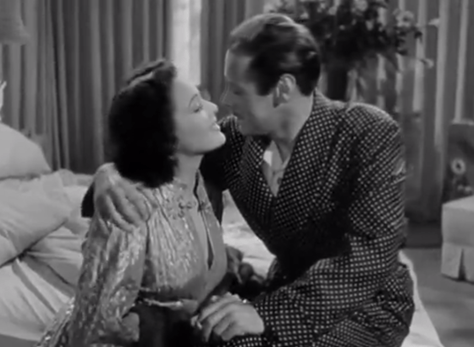
It documents the life of a prestigious conductor, Sir Alfred De Carter (Rex Harrison), happily married to a gorgeous woman (a stunning Linda Darnell) with ample help from a staff including an efficient personal secretary (Kurt Kreuger) and a crotchety Russian played by Lionel Stander. The entourage includes his wife’s wisecracking little sister (Barbara Lawrence) and the sister’s husband, an insufferable bore of the bourgeoisie named August (“He’s got $100 million don’t also be expecting Mickey Mouse”).

The whole issue arises when said brother-in-law, played by Rudy Vallee, takes Alfred’s passing entreaty quite literally to “watch over his wife” while he’s away. As August was also away paying a visit to mother, he has a private detective check in on his sister-in-law. The P.I. collected a comprehensive dossier on her activities while he was gone, which Sir Alfred promptly rips up.  It doesn’t help that the hotel house detective (Al Bridge) is very thorough in his job, driving the conductor to burn the documents decisively, followed by a valiant effort to put out the subsequent conflagration in his dressing room.

However, all his attempts are to no avail and the conductor starts getting ideas; the rumors that were in the back of his mind now start moving to the front, making him irritable.

What other film, featuring a tailor just trying to eat his lunch in peace, winds up leaving an impression because the man is given enough to say? It’s quintessential Sturges and he doesn’t disappoint many of his faithful players either. Each gets a spot of their own. The private detective (Edgar Kennedy) gets a contentious visit from De Carney and turns out to be a patron of the arts. He’s a keen follower of De Carney’s oeuvre even. Sturges gives him the perfect summation of his opinions, “For me, there’s no one who handles Handel like you handle Handel.”

There are also a few choice Sturges lines that I couldn’t help but recall being recycled from other pictures such as being “left to hang on a meat hook” and the age-old favorite “nuttier than a fruitcake.”

As the director slices through the material, De Carney thrusts and waves his way through Rossini, Wagner, and Tchaikovsky. He’s so attuned to his craft, in fact, that he daydreams through each, the music setting the perfect melody to each of his mental confrontations with his wife.

unfaithfully yours 2.png

The first arrangement of events is calculated yet diabolical, played to a piece booming with sweeping, all-encompassing, passionate rage. Using a voice recorder, he stages the perfect murder to entrap the other man. He ends up cackling in the courtroom with relish as he watches Tony get his sentence. It’s all too easy. Hitchcock might have been proud.

His middle piece captures the pure melancholy of the entire scenario. Both maudlin and chivalrous, as he decides the greatest act of love he can perform is to let her go to her true love while writing her a check that she might never have to work her pretty hands ever again. The final coda picks up the tempo again in a ragingly melodramatic fashion that culminates in the proposition of Russian roulette between a gentleman and his rival.

What actually happens is like so: It entails an inexplicable trashing of his apartment after dipping out of his finest hour prematurely. Lamps and wicker chairs are systematically demolished, not to mention the knocking of the telephone off the line and unwittingly pranking the operator again and again. Glass shatters, pratfalls, miscues, clunking about like a witless neanderthal. It is all present.

There is a Georges Rouault painting up on a wall that I distinctly remember from an Art History textbook I once read. So, obviously, this makes this picture the height of culture and it might as well be. Juxtapose that with Rex Harrison, always so refined and erudite, seen stomping about and making a shambles of his apartment and you have one of the film’s high points. And the picture has much to offer us even amid its bleak and admittedly dark deviations.

What’s striking is not simply that this is a physical comedy (typical Sturges) but that it wholly relies on Rex Harrison’s abilities and is nearly a wordless sequence. For a man who was so renowned for his pen, Mr. Sturges shows an apt restraint. This long extended scene says in visual terms that the very way we envision things never hold a candle to actual reality, where things get complicated and muddled by this or that. Nothing is left where we remember it or sudden onslaughts of sneezing come out of nowhere.

Recording machines, that despite being “so simple they operate themselves,” never seem to behave properly, foiling us at every possible interval. In fact, each of his nefarious ploys that he dreams up get thwarted.

unfaithfully yours 3.png

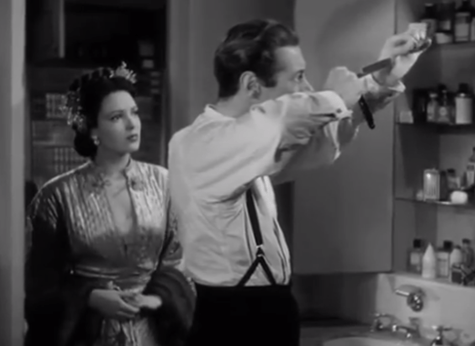
His wife comes home and they have a normal, healthy, human misunderstanding. Husbands get accidentally cut by razors, spill ink pots all over the desk, and wives innocently confuse the marginally different games of Russian Roulette and Russian Bank, worrying about the moods of said husbands.

The only flaw in Unfaithfully Yours, if we can call it that, is the fact that the husband has no open line of communication with his wife. Of course, not having it allows the film to cycle through each of its subsequent movements, thanks to our protagonist’s mercurial nature.

What I find most troubling about it is how he jumps too quickly to accusatory behavior in taking the higher moral ground. His better half is given the lower position as the doting wife, though her sincerity is never in question like his. I suppose it’s precisely why we must see Harrison acting like such a numbskull lunatic; we have a counterweight.

It’s true that the picture could have featured the pairings of Ronald Colman and Francis Ramden then James Mason and Gene Tierney at different intervals. Rex Harrison was brought on with Carole Landis to play his wife, only to have the actress replaced due to difficulties between her and Harrison. Landis is remembered today namely for her romantic ties to Harrison, her figure, and a terribly unfortunate, premature death.

It seems nearly impossible to separate the two as the picture’s release date was pushed back in part to the actresses death and her close romantic ties to Harrison (married to Lilli Palmer at the time). He was the last person to see her alive as well as one of the first people who discovered her body. While the parallels to this film aren’t altogether obvious, there’s nevertheless still some controversy swirling around both.

What we are left with is that Unfaithfully Yours is funny and then sad and then sadly funny again. We can’t laugh but we must just as life must be full of laughter. For it is one of the grandest antidotes for poison. The acerbic poison that crops up in people due to jealousy and distrust. The picture might be truer to life than we would care to admit. I’d generally be interested in hearing Rex Harrison’s thoughts. I guess we’ll never know. The viewing public in 1940s America certainly wasn’t ready for such a perversely pitch-black picture. It was probably too far ahead of its time. Even today it still maintains that sting of biting wit.

4/5 Stars

Hail The Conquering Hero (1944)

hail the conquering hero 1.png

I have long sought out this picture, and all I can say is all hail the conquering hero! It’s everything that could have been hoped for in a Preston Sturges wartime comedy. But in order for the laughs to come along with a great deal more, there must be a setup — a watering hole for our main players to familiarize themselves.

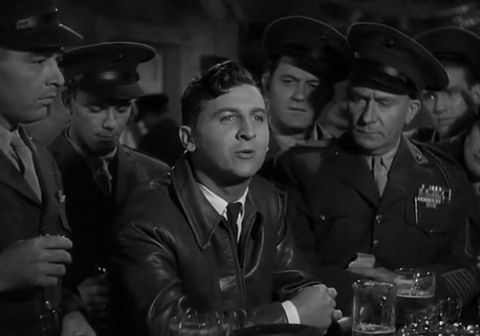
Sure enough, we are introduced to a fairly somber nightclub scene or maybe it’s simply the face of the one man the camera chooses to focus on, sitting dejectedly at the bar. There slumps Eddie Bracken, slightly pudgy and round-faced. By no means classically handsome but he and Preston Sturges had quite a thing going for a couple years.

He got sent home from the Marines for chronic hayfever. I’m extremely empathetic to his condition, as I’m sure innumerable others are as well. Anyway, he’s too embarrassed to go home, and it’s been a year now and he’s still not returned. However, he has nothing except the highest regard for the Marines, as his father gave his life serving his country. In fact, it was the very day our boy was born.

He pays it forward to a group of Marines on leave with no dough, thanks to the gambling habits of one of their pack. The act of charity isn’t lost on them and they get acquainted. Soon they find out the name of their benefactor. It has the be the most patriotic names ever invented: Woodrow Lafayette Pershing Truesmith (sans the Truesmith).

They are regaled with his story and stunned by his encyclopedic knowledge of the exploits of the Marines out on the battlefields. Their leader, Sergeant (William Demarest), even finds out they have a lot more in common as he knew the elder Truesmith — Winky Dinky for short — before he perished.

The only place for the film to go from here is back to Woodrow’s roots and so without his consent, his mother gets called up and it’s announced that he’s getting sent home. Woodrow’s against it from the beginning but his new pals say there’s nothing to it. He’ll wear a uniform for a day, give his mother a hug, and take off the uniform soon after, completely forgotten. Of course, as they ride the train into town, they have no idea what’s been stirred up in preparation.

A homecoming like you’ve never witnessed has been hurriedly assembled by the local committee chairman (the frantically hilarious Franklin Pangborn) and it’s the true essence of cacophony with unrehearsed dueling brass bands; the mayor and any number of folks milling about in expectant anticipation. The show is just beginning to warm up now.

What many will find astounding is just how perfectly Hail the Conquering Hero has been constructed by Sturges, at least in the way it skirts its topics with simultaneous delicacy and verve. Here is a film striking an impeccable course between that very same comedy and then admiration for the armed forces because no one can forget WWII was still blasting away across the world.

hail the conquering hero 2.png

Likewise, the church service far from belittling the faith is a lingering visual gag as we watch the dueling reactions of the two sides of the pews. First through the hymns and then a very sincere homily from the preacher culminating in yet another rousing display of goodwill. By now Woodrow has little hope to derail any of the fanfare with the erection of a commemorative statue christened “Like Father, Like Son” soon in the works. All his newfound Marine buddies are good for is stoking the fires and applauding the sentiment.

The next great sequence is cued by the music and Mother answers the door and mentions that the Judge (Jimmy Conlin) and some other civic leaders want to see Woodrow. Immediately his mind leaps to the worst possible scenario. The game must be up and all his Marine buddies inconspicuously grab household items in case of a tustle that might take place in the drawing room. Of course, their intentions are nothing of the sort. Far from it. The lead up makes the outcome into yet another outrageous reveal.

Just around this juncture, it becomes increasingly apparent that all the characters appear to move in packs and Sturges crams the frame gladly with bodies and faces and more appendages. Woodrow does his best to avoid the spotlight, flubbing his speech to the masses, and trying to downplay the bid for mayor thrust upon him only to be thwarted at every turn by a cheering crowd of well-wishers. One man even proclaims his was the greatest speech since William Jennings Bryan’s “Crown of Thorns!” Already we have the swellest giggle-fit inducer I’ve encountered in some time.

hail the conquering hero 3.png

I wracked my brain only to realize I’d never seen Ella Raines in a comedy before and for much of this picture she’s in the periphery, her comely smiling features on the screen with a whole host of others. But there are a few moments that, far from playing merely humorously, prove deeply moving as she is split between the man she is betrothed to marry and the one she truly loves.

The family she’s caught up in includes a quibbling father and son. The incumbent mayor (Raymond Walburn), who ponificates incessantly, attempts to dictate his speech in his latest bid for reelection only to get annoyed by his dim-witted boy (Bill Edwards) who nevertheless corrects his grammatical blunders. She’d do well to get out of there. Nevertheless, they are a bounty for humorous dialogue.

The stakes are set for a reversal of fortune with a number of parties having a chance to oust our hero. One man who’s buddy-buddy with the Mayor, the cool and collected Jake (Al Bridge) is mighty curious about Woodrow’s service record and he sends a wire to the Marine Base in San Diego. He gets the incriminating news shortly.

But ultimately it comes down to Woodrow himself and Sturges puts the perfect words in his mouth that Eddie Bracken then utters with an assured conviction. Riffing off the Biblical epithet he notes, “My cup runneth over with gall” and proceeds to pour out with veracious intent all the lies and masquerades he’s been too scared to admit to his own town. His guts are laid out right in front of him. Yes, his mother cries. The townspeople look on somberly and his Marine buddies can do nothing to dispel any of it. Even the words of the Mayor and his pal mean nothing now.

With such a showing you would think it was all over for Woodrow and he tells his mama that he’s going to leave again. He cannot stay. Not like this at least. But his girl comes back to him because she at least loves him unconditionally.

hail the conquering hero 4.png

At the train station the parlor games look like they might commence again but this time the whole town is involved, a lynching all but imminent. The Marines this time wrap up their belts inconspicuously to prepare for combat once more. Of course, the mob is there for a very different reason altogether.

The film has the foresight to see what so many of its contemporary war movies were, only made plainly obvious with the luxury hindsight: Light-hearted and good-intentioned yet still mawkish propaganda pieces. So Sturges took up his pen and tackled such hero worship and small-time jingoism, and yet settles on a resolution proving to be as venerating as it is satisfying.

Hail The Conquering Hero is a miracle assemblage of poignancy and humor; I don’t know how it comes away still intact and with my heartfelt laughter and deepest respect no less. It’s not an easy road to traverse by any means. Only a few have managed it. Chaplain in The Great Dictator (1940) distinctly comes to mind and Preston Sturges here.

4.5/5 Stars

Christmas in July (1940)

christmas in july 1.png

“If you can’t sleep at night, it isn’t the coffee – it’s the bunk” – Maxford Coffee House Slogan

Christmas in July is one of Preston Sturgeses earliest efforts where he both scripted and directed the material. He was fed up with how others had handled his handiwork. Obviously they must not have directed it in the zany scattershot way they should have. He would all but rectify that oversight in the early 1940s with his string of successes.

We are privy to a rooftop romance between Jimmy MacDonald (Dick Powell) and his best gal Betty Casey (Ellen Drew) as they take up a light squabble over modern living and radio sweepstakes. The man is intent on winning the grand prize of $25,000 for the Maxford House Slogan Competition. He hangs attentively around the radio to get the verdict. He, his girlfriend, and millions of other Americans.

But a snafu arises when the jury is hung in their decision-making process by an obdurate Mr. Bildocker (William Demarest). The radio announcer has no choice but postpone the annoucment. Not only does it annoy the public by leaving them hanging on a meat hook, it leaves space for a practical joke to go horribly awry.

You see, Jimmy is adamant that his slogan will be the kicker and he’s not shy about telling everyone about it. First, his girlfriend, then his mother, and finally any coworker who will listen. Three wiseguys in the office overhear his spouting and pull the gag to end all gags. All it takes are a few slips of paper, some paste, and an unused telegram slip. It’s a pretty horrible joke. You can probably envision it already.

In fact, I could just see it unfolding like the emperor’s new clothes and yet it’s more good-natured and innocent. He sees the note, reads it, and proceeds to stand on top of his desk to share his good fortune and tell his colleagues to gather around. It’s a sequence full of canned laughter as the floor manager comes by to see what the ruckus is about.

Jimmy and Betty are glowing and positively floating down the corridors together. They must be dreaming. He quite innocently wanders into the Maxford offices inquiring about his winnings and walks out again as nice as you please with a check for $25, 000. Next, comes the department store jewelry case and every other department they have.

Seeing the astonishing check in his possession, the store all of a sudden gets very generous and soon he’s being given everything on credit. Buying new fangled whizzbang contraptions like the all-in-one Davenola. Diamond rings and fur coats for his girl follow, and gifts for everyone else in his family and the adjoining neighbors. The street in his old neighborhood is pure bedlam with the passing out of toys to all the kiddies and free caraousel rides and confections. They’ve never had it so good. There has never been such a respite before.

christmas in july 2.png

As an audience we are in on quite a big secret. We know the bubble must burst some time. Our greatest fear is that it will completely devastate MacDonald. He’s the kind of man who requires the approbation of others to believe that his ideas are any good and that can be dangerous.

For all the madness, there is a very sincere consideration of the American Dream in this picture, not to mention what people deem to be truly important in their lives. His Manager, far from being a mere boob, has some suprisingly sagacious knowledge to dispel:

“Mr. MacDonald. I’m not a failure. I’m a success. You see, ambition is all right if it works. But no system could be right where only half of 1% were successes and all the rest were failures – that wouldn’t be right. I’m not a failure. I’m a success. And so are you, if you earn your own living and pay your bills and look the world in the eye. I hope you win your $25,000, Mr. MacDonald. But if you shouldn’t happen to, don’t worry about it. Now get the heck back to your desk and try to improve your arithmetic.”

Thankfully, the picture is loaded end to end with character parts. It’s positively swimming in them. Though he never worked with Dick Powell and Ellen Drew again, who coincidentally have a fine genial chemistry, many of the smaller bit players became mainstays of Sturgeses stock company. Aside from William Demarest (who gets the final comic punchline as per usual), you will see many other familiar faces if you’re acquainted with the director’s canon. In other words, Sullivan’s Travels (1941) Et Al.

There’s this innate sense that he’s stuffed this particular script with any number of inside jokes and he mastered the art of humorous character naming, only adding to this swirling cauldron of mayhem born out of one simple gimmick.

Hanging his hat on a slogan like, “If you can’t sleep at night, it isn’t the coffee – it’s the bunk” is seemingly a foolhardy task and yet he all but pulls it off. I must confess that I couldn’t get my head around the statement for a while because it seems that “bunk” used in its informal and archaic etymology as “nonsense” isn’t as common today But it reflects Sturges perfectly.

If there is a modern heir apparent to Preston Sturges I am still in the dark. The closest might be the Coen Brothers and yet their work has never undone me in the same ways. Maybe I’m looking in the wrong places. You also had a contemporary in Frank Capra who was well-versed in populous fare but though he had close collaborators, he rarely wrote his material or had the same unorthodox pizazz of Sturges.

Billy Wilder proved capable of much the same as Sturges, both as writer and director, but even he worked often with writing partners. His work was injected with a cynicism even foreign to Sturges in all of his idiosyncratic, zinging panache. Each is worthy of an examination due in part to their differences. However, Preston Sturges  was really one of the first high profile screenwriters, preceding so many modern success stories. He gave the formerly uninspired and restricted post a newfound respect at a time when that was all but unheard of.

One part of me speculates whether his humor is dated and another part asks why we don’t have films quite like this anymore? Part of the answer might be because of television. The kind of hijinks and episodes that Sturges seemed to showcase often got translated into I Love Lucy episodes and numerous other sitcom tropes that would gain traction over the years.

Still, there’s little doubt that something deeply satisfying is afoot — a film that zips along at an hour and seven minutes yet leaves us feeling like a whole boatload has happened in that same amount of time. Because it’s true. There are dour notes. Moments of wistfulness even, but paired with all that is frenetic and wonkers, you find Preston Sturges coming out on the other side with a comedic trifle that speaks to a great many things about American life, however superficially. Because remember, the punchlines are just as important as the lessons.

3.5/5 Stars

Hearts Beat Loud (2018)

hearts beat loud 1.png

“When life hands you conundrums you turn it into art” – Nick Offerman as Frank Fisher

The opening introduction of our character is nothing short of fantastic. He lights up a cigarette absent-mindedly, headphones plugged in to Tweedy only for his reverie to be broken by a patron telling him he can’t smoke inside. He responds bluntly, “I’ll put it out if you buy something.”

We know him instantly to be a man who doesn’t play popularity contests even when it would benefit him and his record shop. This is what the following piece of superfluous dialogue is implying as this offended customer says he just bought an album on Amazon instead.

Without hardly knowing anything about him, somehow we like this man behind the counter and simultaneously feel sorry for him. Surely, he can see the writing on the wall. The record shop, the trendy bastion of a bygone era, even in a neighborhood like Red Hook in Brooklyn, is probably on the way out. It is an endangered species and we as the populous have killed it.

This is not High Fidelity (2000). The record shop is no longer a place for buddy comedy with your ragtag band of musical connoisseurs quibbling over personal tastes and nonexistent romance. The niche begins to feel smaller and smaller. It has become even more so a thing of the past. I recently watched the documentary on the rapid decline of Tower Records, fittingly entitled All Things Must Pass. There is a certain wistfulness in acknowledging this irrefutable reality.

Like most indies of this day and age, Heart Beats Loud uses the same formula with quirky supporting characters who have their charms. The mother is a ditsy kleptomaniac who once had a career as a songstress. It feels like a blink and you miss it turn for Blythe Danner.

There’s Toni Collette, the local landlord who rents Frank his space. They have a relationship that’s hard to pinpoint. Their kids are grown. They’re friends and they can talk to one another. Still, there’s something unspoken between them; it supplies some unnecessary romantic tension.

Surprise, suprise, there’s Ted Danson who (wink, wink) runs the local bar and plays the ever-present available listening ear for our hero to commiserate with. We all need that friend.  Frank’s daughter Sam has such a confidante too even as she tries to figure out her life and love in the context of adolescence. Fortuitously, while I like these folks, they hold nothing compared to the people at the center. Seeing as we spend the most time with the two Fishers it’s probably for the best.

The age-old inversion is also present. The adult seems to be acting out like a child even as his kid makes up the difference by acting mature beyond her years. In one particularly indicative scene, Frank bugs his daughter in her attempts to study so they can have a father-daughter jam sesh together. Because this is the summer before she will head across the country to UCLA. They are on the cusp of a new period of life. He hasn’t accepted it yet.

The story beats are nothing strange or sensational just as the music is catchy but not altogether supernal pop. However, the familiarity is actually quite nice and because we like these people and the places feel warm and welcoming, we want to spend time there. There need not be more.

Together their jam sessions bleed into the synthesis of songs from the heart. It’s how they bond and find a way to communicate when there is no other available wavelength open.  Movies like these allow those of us who adore music and cannot play or sing a lick, live vicariously through some else’s experience. It’s the best way I can describe it. The last film to carry me away on the sound waves with this much relish was Sing Street (2016).

It won’t win any awards and it will be dismissed by so many more and yet there will be a niche market for it — just like vinyl itself. I am thankful we still have actors like Nick Offerman, willing to make unassuming, passionate projects like this one.

In the end, a seemingly inconsequential decision winds up stirring up some notice as the song they cut together actually has some mild success under their moniker We Are Not a Band. There’s the giddy delight registering on Frank’s face upon hearing the song he made in his living room with his daughter playing in a local coffee shop. He’s as proud and as flabbergasted as can be even though no one else seems to understand his elation.

This is purely That Thing You Do! or The Commitments grade musicianship. It’s good but not virtuoso or magnified enough to get a large following. Nevertheless, it’s tantalizing. What could have been? Because even as the shop is having its final day and Sam gets ready to head out west, they get another opportunity.

hearts beat loud 2.png

Someone is interested to monetize their band and tour it into something with legs. There is a moment where Frank genuinely wants this until he realizes it’s indicative of another issue. He needs a catharsis — a healthy, meaningful way to say goodbye to not only his shop but his daughter — and he gets it.

What more fitting way than a Last Waltz in the record store, except they’ve never even performed before. Still, they do it for the first and last time (maybe) and give it all they have for an audience of record hunters. The accolades and circulation were never important anyway.

They are in the pantheon surrounded by a hall of heroes. Some forgotten. Some not. I see Peter Frampton. Marvin Gaye. Lana Del Ray. The Beach Boys. Aretha. Bob Marley. Tom Waits. They’re all smiling down on these two people who love music. The personified joy is what it’s all about.

The message is succinct and we’ve heard it so many times before. Hearing it in the context of these people’s lives somehow gives it renewed resonance. Because it’s the message they need to hear and who knows, maybe some of us do as well.

Contentment is key. All change is not bad just as things of the past should not necessarily be ditched entirely for the new. Somewhere in between them all, between the record albums and the Spotify playlists, we should be able to find a happy medium. At the end of the day, the point of the music doesn’t change. It’s meant to bring us together.

3.5/5 Stars