Miracle Woman (1931)

miracle woman 1.png

“Beware of False Prophets which come to you in sheep’s clothing” – Mat. 8:15

The Miracle Woman is offered as a rebuke to anyone who, under the cloak of Religion, seeks to sell for gold, God’s choicest gift to Humanity —- FAITH. 

There are title cards that open up Miracle Woman to make it crystal clear what its intentions are. Though pointed, they hardly seem necessary given the motion picture we are about to witness. The images speak for themselves.

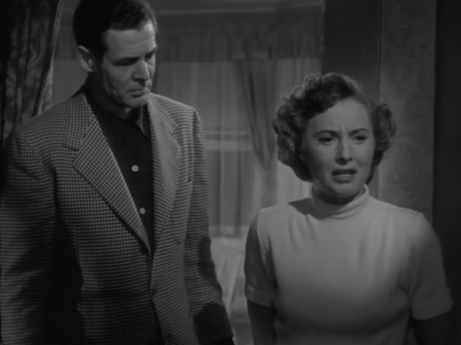
Inside an old-fashioned church building, we hear the opening throes of “Holy, Holy, Holy.” Most every contemporary audience knew that standard hymn well — cherishing its heavenly imagery. But when Barbara Stanwyck steps into the pulpit to pass along her father’s final words as pastor she breaks into the reverie and brings the house down. If there’s ever been a stirring depiction of righteous indignance she is most certainly it.

Like Jesus clearing out the temple of all those peddling their goods, Stanwyck empties out the entire building condemning the pews of hypocrites and lukewarm believers who sit before her. They willfully tossed her father aside for a younger man once they had no use to him. He died of a broken heart and Florence feels affronted.

A few voices chime in on her behalf but she’s all but left to wallow in her sorrows alone. One man stays behind and he’s important for this story. Bob Hornsby (Sam Hardy) was just passing through town and stopped by the church but was impressed by Fallon’s knowledge of scripture and charisma up in the pulpit. With his streetwise business acumen and her stage presence, he thinks they can really make something for themselves.

They soon resurrect a “Temple of Happiness” from a converted barn and it has the words Florence Fallon, Evangelist, and FAITH boldly emblazoned on its front for all to see. The main thing that has changed in 85 years is that the Christian faith has become less widely practiced compared to back then. But this narrative puts a voice to issues that have long plagued the organization of the church in the United States.

Namely, people make a near sideshow attraction out of the whole thing with brass bands and showmanship while simultaneously promoting selfish gain over any kind of advancement of the pronounced commandment to “love God and love thy neighbor.” I am grieved to say those root issues look very much the same all these years later.

We watch as Florence is slowly persuaded into getting back at the fickle people who sold her father out and she’s very good at it, even sincere, while Hornsby runs everything else from hauling in donations to dreaming up the next gimmick.

miracle woman 2.png

However, whether she meant to or not, Florence’s voice on the radio convinces a blind man (David Manners) to not give up on his life though he is struggling mightily. For that he is grateful but it becomes even more personal when he gets up on stage with her and then after that meets her face to face. There’s something inside of him that’s so genuine and attractive to a woman who is used to working with shifty characters.

The boy shows her a good time with some parlor tricks including a music box, cards, and his roommate a very forthright dummy named Al. In many ways, it’s this wooden doll who speaks for him from the depths of his heart. The things he doesn’t know how to say outright start spewing out of the little man.

While Florence finds herself falling for John, her partner who was so warm and genial that first day they met has started to get more demonstrative — even aggressive. Because Florence means a lot to him, not only as a companion but also his current livelihood. She’s fighting against him but it looks like he’s got her where he wants. She will have one final swan song and then has no choice but to go off with Bob, never to return.

However, John looks to manufacture his own miracle for her but unlike her other man, it’s not to sell tickets or pull the wool over the eyes of the public. It’s purely an act of love. He takes it a step further by fearlessly saving her life in the face of a hellish conflagration.

Capra never struck me as a terribly religious person but there’s no doubt he believed in humanity and he had faith in their capacity for good and their ability to love others. I think that perhaps this is the core of the whole “Capracorn” slogan. Because Capra as a director ultimately dwells on what he perceives to be the inherent good in people. That is not to say the conniving, corrupted, licentious side isn’t given any screen time. No place is that more clear than in Miracle Woman.

And yet the final image is of Barbara Stanwyck parading with a Salvation Army band singing “Glory, Glory, Hallelujah.” True, she gave up a lucrative career worth more money than she could imagine but she gained something worth exponentially more — her soul. She has learned how to love again and how to trust a man who in turn loves her deeply. That’s enough of a miracle.

One does have to question where her belief in God stands or if she deems the romantic love of her life to be enough. Regardless Stanwyck gives a stirring ever-impassioned performance that put her on track for continued success. She was a wellspring of talent even at this early juncture in her career.

4/5 Stars

“What God? Who’s God? Yours? This isn’t a House of God. This is a meeting place for hypocrites!”

Night Nurse (1931)

night nurse 1.png

We’re introduced to the day-to-day in a hospital ward with mothers giving birth, delinquents under police custody, and bootleggers coming in on the lamb with mysterious ailments. Barbara Stanwyck arrives in the office inquiring about a position as a nurse and she is flatly rejected for her references and lack of a full high school education.

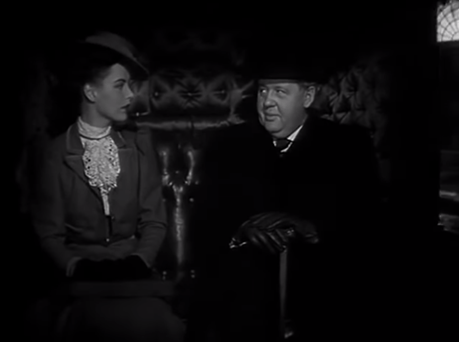
Reluctantly she exits only to make a connection in the revolving door with a white-haired genial doctor (Charles Winninger) who pulls some strings and lands her a spot as a trainee. Her roommate and guide to this new existence is the lively Maloney (Joan Blondell). The male interns send her a warm welcome too. Namely a skeleton in her bed which gets her in particular trouble during a late night bed check from the head nurse who rules the nurses quarters with an iron fist.

This is all only a setup of the films main concerns which have roots in sordid drama and soap opera-like thrills. The melodrama comes into full view as we are introduced to none other than a mustache-less macho Clark Gable who upon being asked who he is, replies “Nick the Chauffeur” only to be captured in closeup while eliciting a gasp from a night nurse.

It’s textbook stuff and then he proceeds to wallop her as she tries to use the telephone. But a smidgen of context is in order. Lora starts her first shift as a night nurse looking after two darling little girls. But from what she can tell they are systematically being starved and their perpetually tipsy mother, Mrs. Ritchie, seems to have very little input. Meanwhile, the doctor who took over the case when Dr. Bell was deposed is shady at best. All the while, Nick leers and strong arms his way around, making sure that Lora doesn’t do anything against the doctor’s orders. Conveniently that means no nourishment.

But “Little Miss Iodine” doesn’t go down without a fight. With the girls slowly wasting away upstairs and needless extravagant parties being held continually downstairs with booze freely flowing, Lora lays down the law. She smacks the girls’ mother around a little for her parental negligence. Also, it turns out that Lora’s new boyfriend comes in handy when he’s not bootlegging. They make a swell couple.

On the whole, this picture of emaciation is slightly disjointed and hyperbolic in its own right. There’s also probably too liberal an amount of undressing on camera. Because it’s only purpose is to be provocative.

I’m not quite sure if I ever figured out the mechanics of it all but there is an undeniable fury to it and William Wellman directs it as such through every beat from comedy to romance to mystery thriller. So with stalwart performances by Stanwyck and a no-good Clark Gable on the rise, matched by a certain enigmatic potency, there is enough meat here to make it a mildly diverting Pre-Code effort.

3/5 Stars

The Virginian (1929)

220px-Poster_-_Virginian,_The_(1929)_01.jpgThough the image quality of the print I saw hardly stands the test of time, there’s something almost modern about The Virginian’s characterizations or at least what it deems interesting to show.

There’s actually a layering of tones and a fluctuation in the moral dilemma at its core that feel a great deal more nuanced than a cut-and-dry shoot ’em up western beholden to the stereotypes that the genre was founded on.

In Victor Fleming’s hands, The Virginian was not only a western but an early talkie extending the possibilities of the medium. It’s true that at this point there was a lot of pioneering still to do in film as there had been in the West.

One aspect this picture took advantage of in particular was exterior shooting which gives the West an almost palpable nature because we see the dust swirling up from the feet of the cattle, we hear the constant chorus of animal sounds, and the expanse of the prairie is daunting but also starkly majestic.

Beyond genre conventions, it’s indubitably a seminal picture since we get the overwhelming sense that we are seeing a persona coming into his own — the crystallized image of stalwart Americana — Gary Cooper. Although he was a minor star and this was not only his first starring role in a western but also his first talkie, soon enough he would be one of the most beloved actors of his day.

True, he also made many pictures outside the genre of considerable repute in their own right, and yet there’s no underselling how important the western was in further instilling Cooper’s legacy for generations of faithful fans. His eponymous character in The Virginian is an early marker of the mythology of western masculinity that would stretch all the way to High Noon (1952) and Man of the West (1958). In fact, at times this picture, featuring an imminent showdown, looks eerily similar to its future brethren from two decades later.

His cattle foreman character is a man’s man. He’s a plain-speaking, straight-talking man of few words (Yes ma’am, No ma’am), who nevertheless cares deeply about honor and personal integrity. Yet he still gives off the homely qualities of a man of the West. And it’s true that much of this film adaptation of Owen Wister’s novel and subsequent play is concerned with the butting of heads that comes with the clashing cultures between West and East.

On one side you have the Virginian and the rest of the townsfolk and on the other is the new schoolmarm, Molly Stark Wood (Mary Brian), who causes quite a stir among the men in town and is a welcomed bit of civility to everyone else.

There is a sense that she can help tame this uncivilized world that lacks manners, education, and law and order. The themes would crop again and again most notably in Ford’s own moody rumination The Man Who Shot Liberty Valance (1962). But here there’s an oddly good-natured comedy streak. It’s not all horse opera.

The Virginian and his old pal Steve have a fine time switching the babies about to be christened by the parson which causes quite the hubbub. But the two men also jockey for the new gal’s affection in all matter of things. Looking to carry her bags or get a dance with her at the community gathering.

The Virginian and Molly even conduct a discourse on Romeo and Juliet which proves to be an enlightening distillation of their two differing perspectives. All of this is fine and dandy. Even the swapping of infants like a pair of regular cow rustlers feels innocent enough. But there’s another side of this world as well.

The main antagonist named Trampas (Walter Huston) wears black and yet he’s more of a cunning thief than an ornery devil, all guns a blazing. He’s more apt to shoot a man in the back when he’s not looking like a coward than actually face him man to man.

He also happens to be a cattle rustler himself and he’s pulled Steve in with him because it’s a pretty easy business. Lots of reward for little risk. Except if and when you get caught there are no two ways about it. The law of the land says you’ll be strung up even if you’re a friend.

And so The Virginian doesn’t shy away from the harsher realities of this lifestyle whether it be hangings or the prevalence of gun duels. It’s a part of the life but also so at odds with what is considered respectable in other parts of the world. Thus, not only the schoolmarm, but the audience, and really everyone else involved must grapple with what is right and what is wrong and how we reconcile those perceived differences.

4/5 Stars

“When you call me that, smile!” – The Virginian

Impact (1949)

Impact_1949_poster.jpg“In this world, you turn the other cheek and get hit by a lug wrench.”

Impact is literally bookended by a dictionary that is opened and then closed with a concise description of the titular phrase to frame our narrative. It couldn’t be more uninspired but the word “impact” gives us some reason to hope the movie within those covers will offer some thrills.  We must brace ourselves.

The story follows Walter Williams (Brian Donlevy) the world’s most perfect industrialist and husband. He can overturn deadlocked board meetings with his stunning entrances and continually rains down affection on his wife looking forward to a weekend away in Tahoe together.

Of course, his wife (Helen Walker) has other ideas. She plays the docile and lovey-dovey wife but really she’s up to something. We see it all too quickly. Mrs. Williams is looking to get rid of her husband with the help of her boyfriend and her hubby isn’t any the wiser. He’s a sitting duck.

The script penned by Jay Dratler relies on the fact that though he gets left for dead at the side of the road, it’s a botched attempt and while disoriented, Mr. Williams is still alive.

The film is mostly encumbered by its length as it starts to sag in the middle so that even Ella Raines’ entry about halfway through the picture isn’t enough to salvage the wreckage. She shows up in all places as a mechanic in a small Idaho town and business hasn’t been good lately.

Once again Mr. fix-it Walter Williams is there to save the day. Conveniently, he keeps his past a secret. He’s happy with this simple life away from the drama that’s happening back home. Here he can go to church on Sundays and have lazy strolls out in nature. One frenzied sequence involves the volunteer fire department stirring into action which Walter readily joins.

Back home a Lt. Quincy (Charles Coburn) is making a routine going over of the case and Mrs. Williams is making arrangements of her own unaware of the unfortunate turns her plans took.

The film would have done well to have a leaner line of action because it comes out of the mayhem feeling like 2 or 3 separate movies. There are the delightful noir bits of an unfaithful wife trying to work with her lover to end her husband a la The Postman Always Rings Twice (1946). Then, there’s an ensuing court case where Williams finds the murder rap turned on him. Again, not unlike the high stakes scenario in the former film.

But in the middle, bisecting the picture in half is a warm slice of Middle America by way of Idaho with its palpable geniality acting as an oasis. It could have used with some shaving down. Otherwise, we have some great location footage of San Francisco and the Sausalito area circa 1949. The performances are fine though neither Donlevy or Raines particularly pop.

Anna May Wong essentially plays the movie from the sidelines as a maid until she’s absolutely necessary to save the story; it’s a major pity she was not utilized better. Helen Walker, however, gives a deliciously malicious performance as the wife who never denies loving another man and yet looks to get out of her fix to save her pretty little neck. It’s individuals such as herself that make film-noir a veritable breeding ground for truly degenerate reflections of humankind. However, Impact could have been so much more potent.

3/5 Stars

The Web (1947)

The Web 1.png

An effort like The Web is precisely why many people would “die” for film-noir. Unless I am simply speaking for myself. But I don’t think so. Personally, I perked up upon reading the name William Bowers in the opening credits as one of the architects of the script because it’s quite easy to imagine some of the film’s choicest flirtatious patter being penned by him. He and his accomplices give our stars something to talk about in what otherwise might seem like idle moments. In fact, if it weren’t for its ultimately sinister outcomes, The Web carries a certain lightness of being through much of its run.

That brings us to our stars who are a fine teaming of talent for a B-grade picture. In fact, they are probably about as good as you could get considering. We have Edmond O’Brien, a personal favorite as a noir hero (The Killers, White Heat, D.O.A, etc.) and then Ella Raines, another often unsung but no less important noir heroine (Phantom Lady) of the 1940s.

Vincent Price is impeccable playing his at times beguiling businessman with that usual mixture of charm and slithering cunning. Between his lankiness and those distinct imperious eyes of his, he’s rarely been better. Our last prominent figure is the coolly perceptive William Bendix who despite his persona, knows far more than he lets on, as a generally competent member of the police force.

One morning a cocksure young lawyer named Bob Regan (O’Brien) goes barging into the offices of Mr. Andrew Colby on the pretense that his client, a man named Emilio Canepa who had his fruit cart upturned by negligent driving and he’s calling for $68.72 in damages. The businessman amusedly agrees to it, after all, it’s only a small trifle. But along the way, Regan tries to pick up the man’s loyal secretary Noel (Raines) as well as unwitingly piquing Colby’s interest. He could use someone with guts.

It’s such a dandy and a rather outrageous sequence that we almost forget the actual opening shot showing an elderly fellow being released from prison after a five-year stint. The only person there to greet him is his daughter. We gather he has a bone to pick and that is important for all that is inevitable in the near future.

For now, it’s all Edmond O’Brien. He notes that they have a snug little setup going on within Colby’s closest inner circle. They seem real buddy-buddy in all facets of their affairs. However, straight away Regan joins the operation when $5,000 is waved in front of him to act as a bit of an unofficial bodyguard and it comes with a gun permit he’s able to finagle out of his old friend at the Police precinct.

Of course, he doesn’t realize that just the following day he will be unloading the pistol on someone and killing a man no less — the same man who was just released for prison with the charge of embezzlement. But it was all done with clear intention as bitter Mr. Kroner was going to kill Mr. Colby so in that regard Regan has little to worry about.  And yet he can’t help but start to get ideas because between the police and nighttime visitors he’s given a lot to chew on.

the web 2.png

The film’s script has its share of veiled double talk both sensual and then increasingly threatening as it pertains to the curious events at hand. Because what reveals itself is a deliciously twisted reality that calls for the reevaluation of what we know to be true and who we trust as an audience.  The rational and yes, even the believable might very well fly out of the window but what a noir like this gives us is something arguably more satisfying in terms of impending doom.

Where something like a net — a web of destruction — begins to descend upon and close in around our heroes. It’s been cleverly orchestrated with the clearest of intent clearing up all the loose ends and framing them handily.

The police nab them easily in this case, involving multiple murders, a whole lot of money, and two tickets to Mexico. The question is who will gain from such a resolution and since that question is quite simple to answer, the better one yet is how might they possibly catch the culprit?

I’m not too proud to admit thoroughly enjoying The Web because it embodies everything that the dark genre is promoted as being and you leave the picture satiated after being caught up in something supremely sinister. It was never high art nor did it claim to be but that’s all part of the immense allure. O’Brien, Raines, Price, and Bendix might as well all be character archetypes. The parts they play do the picture a distinct service.

3.5/5 Stars

The Suspect (1944)

the suspect 1944.png

It is very much a male-oriented film in subject matter and frame of reference with Charles Laughton commanding center stage. He is the very figure that we are meant to empathize with as an audience. But it’s precisely those qualities, along with the presence of director Robert Siodmak, that make it remarkably straightforward to read The Suspect as film noir even given its Edwardian setting.

Veiled in the murky London fog are the mundane strains of noir popping up within the home and the shrouds do well to imprint the British streets with a certain darkness in tone and shading.

In fact, it would be similarly done in other pictures such as The Lodger (1944) and Gaslight (1944) but this one, in particular, can be tied back to the genre’s unhinged male paranoia. Because the dark predilections of noir have often been tied to an overwhelming form of matrimonial suffocation. Not only wives nagging but also the embodiment of the femme fatale to reflect men’s fears returning from WWII to find a new movement of independent women.

The Suspect fits seamlessly into the former category. Is it right to read all of this into the movie in hindsight? I will allow others to enact final judgment but for my own purposes, I will choose to see it in this light. Though it lacks a true femme fatale, it is loaded with blackmail and the threat of scandal that leads to an underlying sense of utter despair.

But it’s necessary to backtrack and explain how events come into being. Charles Laughton is an honest gentleman who works as a bookkeeper only to go home to the ball and chain.

We get a taste of his insufferable wife (Rosalind Ivan) amid turbulent interactions with their grown son (Dean Harens) who vows to leave their home for good because he can’t stand his mother. It feels as if she’s been cast as the devils incarnate and she might as well be next to Laughton’s portly angelic character. There’s a glassy-eyed sincerity to him that plays softly to our ears thanks to an at times rasping delivery. A quiet charm exudes from him all the time. Everyone but his wife seems capable of seeing it.

One such person is Mary Gray (Ella Raines), a woman with the most stunning of wardrobes, both prim and proper and certainly capable of employment. Except she’s had an awful go of it trying to find a job and kindly Mr. Marshall can’t be of much help in that regard. However, what he can offer is a bit of innocent companionship because he imagines that they are both a bit lonely — which of course is very much the case.

At this point, he’s finally found a little enjoyment and there’s nothing more than a desire to have someone to relate with. Still, Mr. Marshall deems it most prudent to break off his friendship with Ms. Gray because after asking his wife for a separation, he is alerted that there is nothing doing. Worst yet, the cackling witch makes his life even more horrible; because that’s precisely what she has been created to do.

The next major event is all too expected, so expected in fact that the film doesn’t even bother showing it. The death or murder or accident is left off of the celluloid though certain outcomes are heavily implied. It’s partially jarring as we hardly have time to track with this jump in the sequence of events.

Again, there are happier times ahead as now Philip has married the lovely girl and they are blissfully content together as companions. But another villain is invented (or rather has been waiting in the wings). A lecherous next door neighbor who’s an incorrigible wife beater adhering to a “hurt or be hurt philosophy.” He is willing to falsely testify that he heard Mr. Marshall arguing with his wife the night before her “murder.”

Something must be done about it. This time the desperate Philip takes the firmest course of action he can muster to stop this affront. And suddenly events turn slightly intriguing becoming Rope (1948) for a man that we hold some empathy for and that’s where any amount of tension is born.

In fact, the duality in the marriages is one of the most fascinating motifs. Because you could easily see in an alternative turn of events some sort of killing off of respective spouses for an agreeable partnership to be forged. And that’s very well what this picture might have been if not for the presence of Ella Raines. She’s very much vital to the outcome without ever trying to be. Since it’s true that she has no motive, what she offers is seemingly so amiable and a very legitimate reason to murder in one man’s eyes.

To Laughton’s credit, whatever he was supposed to have done, he never ceases to have a conscience nor a capacity to love. Thus, it makes the police investigation surrounding him one that is imbued with meaning. We care what happens to him and to Mary as well. While we aren’t given much of anything, the final notes hint at something not completely inhumane. That’s all I can give you.

3.5/5 Stars


Odds Against Tomorrow (1959)

odds against tomorrow 2.png

The unofficial timeline for classic film noir is approximately given as 1941-1958 but of course, there are notable outliers including Stranger on The 3rd Floor (1940) at the front end and this film, Odds Against Tomorrow, bringing up the rear. Pictures with what can easily be categorized as noir sensibilities whether visually, psychologically, or otherwise certainly were released outside of these arbitrary parameters. However, that’s part of the fun because this “genre” is so fluid and malleable; there’s no technical cutoff or subjective standards.

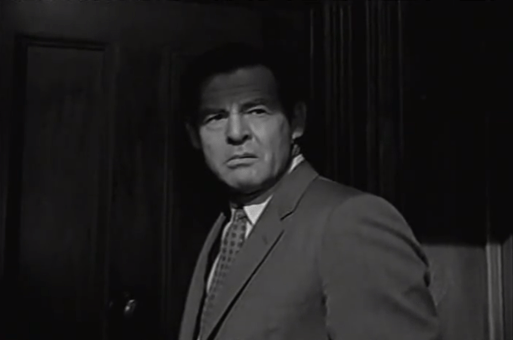
Director Robert Wise is generally remembered for his later works like West Side Story (1961) and The Sound of Music (1965) but every man has a Hollywood origin story. He cut his teeth editing Citizen Kane (1941) no less and began making gritty crime dramas in the late 40s. Two of the most commendable would be Born to Kill (1947) and The Set-Up (1949), the latter featuring Robert Ryan, now a crucial player again a decade later in the last of Wise’s outings in the same noir world.

We get our first glimpse of Earl Slater (Robert Ryan) walking on West Side Street in New York City and those shots assist in establishing the locale that we will be making our home in. Slater is on his way to a business arrangement with David Burke (Ed Begley).

They both have their reasons for joining forces. Burke was formerly a policeman who spent years faithfully serving on the force but when he wouldn’t get involved in a criminal investigation it all but sunk his career. Earl’s a less desirable character with a messy past as an ex-con and none too hidden racist tendencies.

He was the bigot with antisemitism in Crossfire (1947) so it’s a cinch that Ryan could play the narrow-minded white man in this picture too. We get an inclination when he playfully picks up the little African-American girl on his way to a meeting but it comes into full relief once he and the third member of their party, Ingram, are actually in a room together.

What makes the characterization so fascinating is though it’s so easy to envision Ryan in such roles because he plays each with such convincing enmity, he was a real-life crusader for Civil Rights and numerous other progressive causes. This is by no means his actual stance; far from it. Yet he makes us believe.

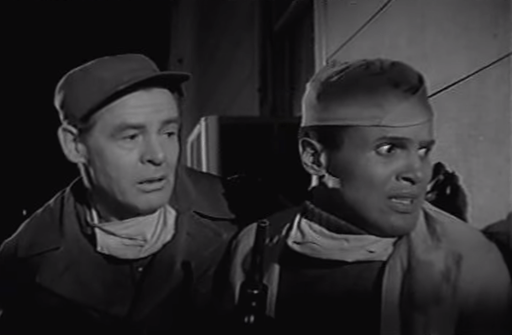
Though predominantly remembered as a singing star and for his presence in musicals, this was a self-selected part for Harry Belafonte (through his HarBel production company) that substantiates itself as arguably the most rewarding part of his career. He is Johnny Ingram a nightclub crooner who also plays a mean xylophone. But his greatest vice is that he’s a compulsive and extremely unsuccessful gambler — a bankroll of over $7,000 he’s supposed to dish out to a local mobster is residual proof.

Ed Begley, in a particularly charming role, acts as the calming force assuaging egos and keeping his team from completely tearing each other apart. Because he appreciates their talents and keeps them focused most of all on the payday that awaits them, $50,000 they could all use desperately.

Obviously, Ingram has his debts but also a daughter and an estranged wife to look after. Slater is rather unhappily married to a woman (Shelley Winters) who is supporting him for now. But he’s also fairly amicable with his neighbor down the hall (Gloria Grahame).

odds against tomorrow 1.png

Although the bigotry angle is no doubt important it’s not necessarily the focal point of the picture. Foremost of all, Odds Against Tomorrow is a showcase of style and atmospherics. There’s a seedy urban realism that aids in fashioning a tale of claustrophobic impending doom merely supplemented by the racial undertones. Wise achieves a certain look widely due to his on-location shoot but also infrared film stock which gives a very specific monochromatic quality to the exterior shots. Backed by jazzy scoring courtesy of John Lewis and we have a complete package standing toe to toe with Wise’s grittiest efforts.

Whereas most heist pictures take the route of letting the job occur and slowly unravel with mishaps that lead to extended agitation, this picture takes a slightly different approach. We get a line on the characters — their significant others and their problems — so their decisions make more sense. We know why they feel compelled to go through with what looks like “easy money.” However, the actual undertaking torques the picture’s ending into a fever pitch.

Because the title, of course, refers to gambling and the outcomes prove to be pretty bleak. Though the racial element began in the periphery it can’t help but reveal its ugliness in the film’s fatalistic finale. I won’t say the story comes off perfectly but if one is willing to feel it out and become immersed in the atmosphere, it generally succeeds by reveling in its environment.

3.5/5 Stars

House of Bamboo (1955)

house of bamboo 1.png

Leave it to Sam Fuller to make a film such as this — the first Hollywood film to be shot fully on location in Japan. His admiration for Japanese culture is not unheralded, specifically making something of a point to portray Japanese-Americans in pictures such as The Steel Helmet (1951) and The Crimson Kimono (1959).

And yet his style and sense of gritty bravado do at times feel out of place here as do the Hakujin military men milling about on Japanese soil. But even if his cultural awareness is not impeccable, I can’t help but feel that out of anyone who might have directed this movie, I’m somehow glad it was Fuller.  It is far more than its title might suggest.

Shot in CinemaScope with DeLuxe Color, its sumptuous widescreen photography is put on display even in the opening shot as we are given a gloriously panoramic exterior of Mt. Fuji with a train loaded with military arms. It’s subsequently hijacked by marauders who escape unimpeded. With typical Fuller ferocity, we have our inroad to the film’s main conflict with a couple of men murdered. Soon after, a dying soldier implicated in the raid on his deathbed worries for his Japanese wife.

The dialogue is a bit terse and stodgy with the typical melodramatic setups which nevertheless condense action and exposition into bite-sized chunks as the police begin a joint investigation conducted by Inspector Kitz (Sessue Hayakawa) and Captain Hanson (Brad Dexter).

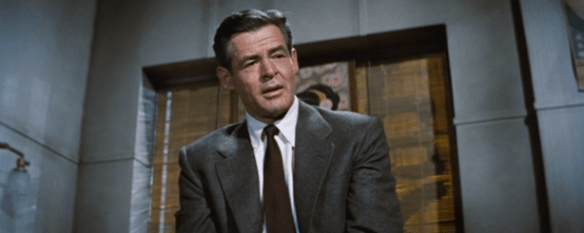
Weeks later the dead man’s old war chum, Eddie Kenner (Robert Stack) comes to Japan on the proposition of some employment. With his friend dead he starts throwing his weight around to get answers. Kenner goes to a rooftop interrupting a traditional performance, having an exchange that’s the epitome of ignorant American pig-headedness.

There’s no attempt whatsoever to learn the Japanese language or culture. He expects them to rise to his terms and play by his rules because he lives life thinking that “America is A Number 1.” He blunders around stubbornly repeating “Mariko Nagoya” and then goes into subsequent establishes looking for the boss of each joint to rough them up. Of course, he’s more nuanced than he lets on but in these scenes, it’s as if Fuller has developed an amalgam of the stereotypical lug-head G.I.

house of bamboo 3.png

All such roads lead to a big man named Sandy Dawson (Robert Ryan) who uses a pachinko racket to front much more lucrative and clandestine activities that soon prove of some interest to Eddie. With his buddy gone this is his chance at something good and he’s a perfect candidate with a military record spattered with various misdemeanors.

The picture feels like much less of a police procedural and more of Kenner’s story as his relationship with Mariko (Shirley Yamaguchi) evolves and he must navigate the cutthroat tension that runs through such a high stakes operation like Dawson’s. Of course, it’s nerve-wracking for Kenner for another reason as well.

Our finale finds us at a rooftop kiddie amusement park that has Fuller’s usual flare for taking the utterly pedestrian and imbuing it with certain peril as Ryan frantically fights for survival on a revolving carnival ride. I’d expect nothing less from the writer-director.

A brightly textured post-war Japan is captured in full here. Though no overt commentary is made, it’s right there in front of us to draw our own conclusions. At times, the frames are vibrant with a world that looks to be thriving thanks to Yankee know-how and western influence. Truthfully, Fuller’s picture doesn’t show much of what the war’s aftermath may have done. We must infer that for ourselves. Because House of Bamboo is where the lush DeLuxe tones and the specters of film noir must meet.

As I gather, there is a certain mentality, a term that can be used that explains why this depiction is not so much a lie or a double standard but a definite reflection of the Japanese people.”Shō ga nai” (しょうがない) roughly means that something cannot be helped or whatever will be will be as the French would say. And so far from holding grudges, they were a people who looked at the war years under extenuating circumstances. Thus, afterward, though some might have harbored ill-feelings, there’s this sense that the U.S. could quickly become allies with Japan. That’s partially how it happened.

So when we see The Tokyo Police Department and The U.S. Military police working in perfect tandem and even the fact that this film production pays its respects to the local powers that be, it speaks to this same mutual symbiosis.

However, that certain amount of camaraderie doesn’t mean that there aren’t still major incongruities and differences. The choice to not use subtitles on the interludes spoken in Japanese is refreshing. Because like Crimson Kimono (1959) a few years later, it’s easy to presume that the picture might be promoting stereotypes and a certain point of view.

house of bamboo 2.png

It’s true that Shirley Yamaguchi takes on a fairly stereotypical and unquestionably subservient role. Girls are flippantly referred to as commodities; the synecdoche of choice is “Kimonos.” I cannot deny that. And men such as Sandy and Eddie think they can stiff arm their way around the culture, straightening rough edges by handing out cigars as recompense. This doesn’t belay the fact that they are still fish-out-of-water. Not everything can immediately be made American nor should it.

Certainly it’s an imperfect picture and problematic for potentially perpetuating some common representations. However, whether or not he meant to, I think Fuller has provided us with a valuable portrait. It’s far from being as progressive as The Crimson Kimono but scouring it you see the inherent flaws with America trying to have their hands in rehabilitating Japan. At its core is something honorable but that doesn’t mean it comes off perfectly.

Sure, Japan has had its share of homegrown crime and problems born from within. But if you look at this picture everyone who is corrupt is a foreigner. It’s a dirty strain of capitalism where Sandy and his boys have muscled their way in, to the detriment of many of the Japanese.

Formally a casualty of pan and scan television techniques, this is no longer the case with House of Bamboo which has been restored to its full glory thank goodness. You can now catch Deforest Kelley for a few moments and relish a hard-nosed performance from Robert Stack opposite an unprecedented charismatic showcase for Robert Ryan.

If anything, as Eddie begins to genuinely fall for Mariko, there are affectionate touches that show that whether or not his initial behavior was a put on, he’s gradually revealing another side of himself. It means showing an interest in someone else’s culture. Doing the small things like using chopsticks to eat your meal or asking your girl how to say “Good night” in Japanese. For the record, it’s Oyasumi nasai (おやすみなさい).

More than anything else’s it’s a reminder that ignorance and entitlement can be rewritten and reformed when we genuinely care about other people. It stretches across cultural boundaries that we might come to understand others more personally. We need that kind of mutual understanding now more than ever.

4/5 Stars

Clash By Night (1952)

clash by night 2.png

Clash By Night comes from a stage play by Clifford Odetts and, in one sense, it’s extremely evident. However, being blessed by a still capable director in Fritz Lang and bolstered by quality talent does wonders for this squallish RKO drama. The portentous symbolism of Lang is on full display from crashing waves to billowing clouds in the skies up above.

We spy circling seagulls and seals perking up, creatures obviously hungry for something — in this case the fish being harvested on the trawler right nearby. Here we have our environment, a cannery that sustains an entire community with work. One of the seamen is Jerry (Paul Douglas) a teddy bear of a man who works on a fishing boat as his father did before him. He now supports his senile father along with his idle good-for-nothing uncle.

When Mae Doyle (Barbara Stanwyck) comes back to her family home after being away well nigh a decade, the summation of her activities is terse, “Big dreams, small results.” She’s very dismissive and aloof in every interaction; she’s not about to give herself to anyone or fall in love. But when the good-natured Jerry comes to call on her she actually accepts. Maybe she can learn to like a nice guy and have a home and a family. They try on all accounts and get married. Every attempt is made to convince herself that this is what a normal woman is supposed to aspire to.

However, Jerry’s buddy, the local projectionist at the movie theater, the outgoing, slightly patronizing stiff Earl (Robert Ryan) offers an inkling of something else. He has raw even carnal energy and a cynic’s outlook on love. Mae despises his personality type probably because it’s too close to home — too akin to how she sees the world. But his raffishness can easily get contorted into something volcanic, flaming with an attraction that draws in a wife desiring something more.

What’s staged thenceforward is a showing that hits the throttle on several occasions to heated extremes. It’s the utter epitome of ’50s hothouse drama that can feel overwrought and stagy; the emotions at times become heightened to an unbelievable degree. Sweat and manic attacks of rage that lead to blows ensue. Not to mention countless mentions of the rise in temperature.

Even the early dialogue at times feels too cute, manufactured to be read off and yet to their credit the stars come with fury at times heartless and tender and full of self-loathing. Stanwyck is a mess of tortured dissonance subjecting herself to emotional whiplash, never truly contented. However, feeling completely sorry for her proves difficult.

Though Marilyn Monroe received her first prominent billing, she comes off as more of a side note than an integral part of the picture at least in front of the camera. There’s little doubt she was causing her usual media frenzy behind the camera and headaches for her director due to her often temperamental ways. Those would hardly change but superstardom would only continue to descend upon her.

Always the consummate professional, Stanwyck was in the middle of divorce proceedings with Robert Taylor and as art often mirrors life you get the impression that just possibly she might be channeling some of that emotion into her performance. If she is, it’s nearly impossible to tell as she carries herself with the same self-assured composure in every scene, touching every note, regardless, with her accustomary ease.

Even for a black and white piece filmed by Nicolas Musuraca, Clash By Night is not necessarily a typical Lang exhibition in expressionistic, noirish tones but the expression comes boiling up from within his actors. That is enough. The picture could have done well to smolder until the end. Instead, it chooses a more forgiving road. Jerry relents saying, “You gotta trust somebody. There ain’t no other way.” He’s taking a beating and yet his heart is still large. There’s no word on whether it will be torn out again.

3.5/5 Stars

The Narrow Margin (1952)

the narrow margin 1

The Narrow Margin is comprised of tight and lean drama where every bit of film is used judiciously. This should rightfully earn it respect as one of the preeminent shoestring budget films of all time within any genre.

Because it’s easy to admire films that do a fine job with a plethora of resources and financial capital but what about those pictures working with very little? It seems like concocting something special with limited resources should be considered even more impressive. If you follow this logic, The Narrow Margin is an unrivaled success — a micro-budget masterpiece — that does a great deal to separate itself from the pack of lesser B-grade crime pictures.

Richard Fleischer gets lost among the big-named directors tagged to the big-named productions but when it came to small pictures he made some pretty decent ones and The Narrow Margin just might be one of the finest B pictures, period. But I think I already said that. Still, it’s worth saying twice.

If we had anything close to a star it would be Charles McGraw as a cop named Brown who has been assigned a case along with his veteran partner (Don Beddoe), an assignement neither one of them particularly relishes. They’ve been burdened with the task of protecting the widow (Marie Windsor) of a notorious gangster who has agreed to be the key witness before a grand jury.

It’s an extremely dangerous proposition as there’s a whole network of syndicate members who don’t want their names to get out. They’re ready to stop this mystery dame at any cost and by any means necessary.

The opening lines of dialogue come off as idle patter but they set up the entire scenario as the two policemen get ready to pick up the woman who will cause immense complication in their professional lives.

It’s a simple question really: What kind of woman would marry a gangster? Meanwhile, there’s a tension in the air and conflict pervading the film. Every waking minute is blessed with an air of constant confusion. Identities of everyone are all but in question. We don’t quite know what’s going on. We’re in the same place as the cops and that’s the key.

What follows is an astonishingly intense and immersive storyline that has no right to be either of those things. Still, it’s an undeniable fact. Faceless criminals in fur-lined coats lurk in the shadows ready to fill men full of lead. Tails loiter ominously at train stations for their mark. Men snoop around train cars trying to find out secrets. Lives are constantly in jeopardy. There’s not a moments peace for the chronically paranoid cops or the audience.

The majority of the picture takes place aboard a train bound for Los Angeles with the danger being crammed into a limited space with good guys and bad guys constantly trying to evade and outwit each other. They all vie for the upper hand in this continuously see-sawing game of cat and mouse. Because in simple terms that’s what it is. A cinematic game of cat and mouse.

But The Narrow Margin proves to be a fine train noir for the contours it develops to help strengthen this basic premise. It’s a rumbling ride complete with a fat man to stop up all the passageways, acerbic dames, and suspicious young boys wary of train robbers. It has character beyond a rudimentary crime film and that’s immeasurably difficult to convey in 73 minutes of celluloid. But Earl Felton’s script manages this near impossible feat.

For other films, the limited space would cause the action to become stagnant even tepid whereas, in this picture, those precise elements are turned on their heads as a true advantage. Though the film is starkly different, the original Alien (1979) similarly used consolidated space to hike the tension to uncomfortable heights. You get the same sense here.

But the great films also aren’t completely straightforward. Their rhythms might look familiar but they play against our preconceived expectations, thus allowing us to enjoy their bits of intrigue and the added payoffs they’re able to deliver. However, whether are not you’re able to predict everything that gets thrown at you is beside the point because the true satisfaction comes in the overall rush of the experience. This one is a gem, a diamond pulverized under filth and grime only to come out scintillating. Enjoy it for what it is.

4.5/5 Stars