The Maltese Falcon (1941) – Film-Noir

4ef67-falconmThis archetypal film-noir directed by John Huston, stars Humphrey Bogart as the detective Sam Spade. After an initial conversation with a mysterious woman, that same night two men end up dead. As Spade tries to understand what is going on, it puts him in contact with a paranoid little man and another man who is trailing him. All of them have something to do with a black bird and the situation gets more complicated when Spade meets the fat man. Rather surprisingly Spade ends up with the falcon but of course there has to be a twist. Soon enough the truth comes out of Brigid O’Shaughnessy and Spade coldly does his work. This film has great characters played by Mary Astor, Peter Lorre, Sidney Greenstreet, Ward Bond, and Elisha Cook Jr. The directing is good as well as the cinematography. This is the film that finally made Bogart a star and he would never look back.

5/5 Stars

Bonnie and Clyde (1967)

b1a0c-bonnie_and_clydeStarring Warren Beatty and Faye Dunaway, with director Arthur Penn, the film chronicles the crime life of a group of notorious gangsters during the 1930s. Clyde Barrow (Beatty), a small time thief meets the beautiful young girl Bonnie Parker (Dunaway) and together they begin robbing banks. Soon they enlist the help of a dim-witted mechanic C.W., and then Clyde’s brother joins the fray bringing along his wife. They have a string of successes and they become infamous nationwide. Soon they begin to bicker among themselves and the police start to buckle down. In a shootout Buck is shot dead and Bonnie, Clyde, and C.W. just barely escape. However, their actions eventually do catch up with them and thus ends the story of these two figures depicted as anti-heroes. This film is significant because it was influenced by the French New Wave but it in turn ushered in a new era of American film . It has a unique combination of comedy, romance, violence, and of course banjo music.

5/5 Stars

North by Northwest (1959) – Alfred Hitchcock

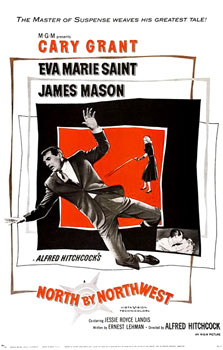
ed5e6-northbynorthwest1As the last collaboration between Cary Grant and Alfred Hitchcock, they came together to make the ultimate thriller in North by Northwest. Grant plays a common business man named Roger Thorndike who is framed as a killer in a very public place. All of the sudden he has become a fugitive on the run for a crime he never even committed. Along the way he meets a government agent (Eve Marie Sainte) while dodging the authorities. Trying to clear his name, Grant finds himself fleeing the actual killers. His adventures include a run-in with a crop dusting plane and eventually find him hanging for dear life.  However, he comes out on top in the end and he slowly falls in love too (of course). From the beginning when you see the opening credits and hear the score, you gear up for adventure and that is exactly what you get. It follows the wonderful tradition of Hitchcock films and it does not fail to entertain. Besides great locations, a memorable score, and interesting camera work, the story is wonderful.

5/5 Stars


The Philadelphia Story (1940)

Headlined by Katharine Hepburn, Cary Grant, and Jimmy Stewart, The Philadelphia Story  tells a comical tale of a divorced socialite who is about to be remarried. Tracy Lord is an arrogant socialite who divorced her equally fiery husband C.K. Dexter Haven. Now it is the day before her wedding to another man. However, Haven returns and brings a long two magazine reporters to get a scoop they were forced into. After a lavish party and many drinks the reporter (Stewart) and Tracy Lord find themselves spending an inebriated night talking and swimming. Haven manipulates the situation and the future husband Kittridge, who catches the tail end, believes something bad is happening. The next morning the wedding is in jeopardy and Hepburn and Stewart are oblivious. Although nothing happened, Lord agrees to terminate the wedding and Mike (Stewart) tries to save her embarrassment by proposing marriage. However, she realizes it is not meant to be and goes to Haven while Mike returns to the camera woman who loves him. It all ends well but the joke is still on them in the end. This romantic comedy has a lot of star power and it is actually pretty good.

4.5/5 Stars

Review: Casablanca (1942)

It was over 70 years ago that Casablanca hit the silver screen for the first time. All the main players are dead and gone now. The Golden Age of Hollywood, where pictures were being churned out with factory-like efficiency, has given way to a modern era of blockbusters. To borrow a quote from the movie, it doesn’t seem that one little film would “amount to a hill of beans” in our present world. Still, somehow Casablanca is beloved to this day, despite the numerous other films that have undoubtedly entered the black hole of film oblivion. It seemingly will not die and for good reason.

Considered one of the greatest films of all time, this well-loved classic deserves to be here. It is the hallmark of Humphrey Bogart and Ingrid Bergman’s careers. It also has one of the greatest scripts of all time, and it has achieved legendary status over the years. Many consider it purely the best film ever made and in all honesty, I would never try to refute that.

The film opens quickly and we are immersed in a world that is at the height of the Nazi terror, and many people are fleeing Europe by way of Casablanca. It is a treacherous place full of pickpockets, corrupt authorities, refugees, and naive tourists as well. Two German couriers have been murdered and some invaluable letters of transit have been stolen. That’s when we are first introduced to Rick’s Café Americain and its cynical proprietor Rick Blaine (Bogart).

A shady fellow named Ugarte (Peter Lorre) comes to Rick with the letters and asks Blaine to keep them for him. However, later that night Ugarte is taken into custody, and things begin to get even more complicated. Wanted resistance leader Victor Laszlo (Paul Henreid) is now in Casablanca, however, a Major Strasser has arrived from Germany to take him in. To top it off, Laszlo’s wife Ilsa (Bergman) was Blaine’s old flame in Paris and, needless to say, it didn’t end well.

Laszlo desperately needs the letters of transit to escape, and he inquires about them. Soon he is led to Blaine, but as Rick often admits he sticks his neck out for nobody. Knowing all too well that he is in danger, Laszlo still shows his defiance against his enemies by leading the people in a round of “La Marseillaise” and as a result, Rick’s is shut down.

All the memories of Paris begin flooding back, and then Ilsa confronts Rick in order to get the letters. This is possibly the most critical point in the film because this tense altercation ultimately renews the relationship between Rick and Ilsa. Rick asks her to trust him, and he begins to take things into his own hands. The results of his actions created one of the great romantic and cinematic moments in the history of film. The whole film leading up to this point hints at it, but Rick truly is a sentimentalist at heart. He can live with the notion that they will always have Paris and that leads him to commit a selfless act of love.

This film holds such a tremendous presence in movie history, and upon seeing the movie it makes complete sense what all the hype is about. What more could you want than Bogey, Bergman, Casablanca, and some of the greatest quotes ever uttered? Do not forget the corrupt, but nevertheless lovable French Captain Louis (Claude Rains), who delivers some terribly witty lines. Honestly, he may be my favorite character in the whole film, and that’s saying a lot!  Then, of course, there is the immortal tune of “As Time Goes By,” sung by Dooley Wilson which will forever be ingrained in film lore.

However, you also gain an appreciation for the other interesting characters of Casablanca, some comical, some sympathetic, and others despicable. We have a rogue gallery of everybody under the sun from Peter Lorre, Sidney Greenstreet, German soldiers, various guests, and all the staff at Rick’s Place. This movie has conflict and the uncertainty of war in practically every scene because at the time World War II was in full force. There are a broken romance and a forlorn hero who shows his courage in the end. As an audience, we come to realize the transformation of Rick into a truly great man. Ilsa on her part has the most radiant face I have ever seen.

It is wonderful that Casablanca succeeds as entertainment despite the fact that it is not modern. In fact, part of its charm is the black-and-white cinematography that helps make Rick’s Café so atmospheric. It effectively makes each interior shot moodi34 and every romantic scene even more striking. I am very doubtful that they would ever be able to pull this film off in color. It just wouldn’t work.

You do not need explosions and violence either, only great characters and a story with both drama and humor to reel the audience in. Up until the final moments of the movie you are captivated the entire time. Then, fittingly, you are left with the two men walking off into the night with the words, “Louis, I think this is the beginning of a beautiful friendship.”

In fact, with this film, my thoughts always go back to the script. Lines like “Here’s looking at you kid,” “We’ll always have Paris,” and “Round up the usual suspects” are so rampant that you cannot possibly remember them all, and I doubt there will ever be another film that is so immersed in American cultural lexicon. Still, many of my favorite lines in the film are those that get overshadowed by the more famous ones. That is the sign of an amazing film that never grows old. Even those who have not seen this classic film like to think they have, because the influence of Casablanca reaches everywhere. I guess I’m rather an idealist myself, so I would like to think that even if 70 more years pass, we’ll always have Casablanca.

Bringing Up Baby (1938)

In this mile-a-minute screwball comedy directed by Howard Hawks, Cary Grant is forced to deal with Katharine Hepburn’s ditsy socialite character. A Paleontologist (Grant) has been trying to assemble a dinosaur but he is missing a bone. On top of that Huxley is about to enter into an unhappy marriage and he also must impress a museum donor. The next day he meets a socialite (Hepburn) by accident and through a mix up he finds himself being taken to her home in order to help take care of a tame leopard named Baby. In the following chaos a dog buries the bone needed for the dinosaur, visitors come, Baby runs away, a wild leopard is on the loose, and the free-spirited girl finds herself falling for “Mr. Bone.” To complicate matters, the pair wind up in jail trying to explain their story to a quirky constable. In the end everything works out and despite the craziness, Huxley realizes he cannot live without this girl. This may not be  my favorite screwball comedy, but I would say it definitely is the zaniest and that stands for something.

4/5 Stars

Sunrise: A Song of Two Humans (1927)

Directed by F.W. Murnau, this silent film follows the lives of a man and his wife. A woman from the city meets the man and suggests that he drown his wife and sell his farm so they can be together. Then, the man takes his innocent wife out on the lake with evil intentions. He is about to go through with it, but ultimately cannot. The wife flees and they take a trolley to the city. The man asks for her forgiveness, and they walk through the city finally reconciled.

Over the day they get their picture taken, go in a barber shop, and have fun at an amusement park. They travel back home by boat and then a massive storm hits. The man searches for his wife to no avail, and then he encounters the exuberant city woman. In his anger, he begins to choke her, but his wife is still alive! He rushes to her bedside and they kiss. This film is wonderfully complex and artistic for a film without any talking. Unlike Chaplin or Keaton this is a great dramatic silent film that does not utilize slapstick comedy, and yet it still finds ways to be funny.

I had forgotten just how funny this film is in parts, and it nicely complements the very memorable love story. Visually this film is extraordinary with its multitude of landscape and city scenes that often overlap and are superimposed on one another. In this aspect, it reminds me of the experimental visuals of Keaton’s Sherlock Jr.

However, this film is very atmospheric and more emotion-filled than the other film. Furthermore, despite the lack of real dialogue, it is almost a misnomer to call this movie “silent.” It most certainly features sound, which often dominates certain sequences and also adds a great deal of feeling to the romance and cityscape. Sometimes it is the chime of bells, the honking of horns, intense background music, or just lively street chatter.

Despite the general story of redemptive love that dominates Sunrise, there are also some charming asides during the visit to the city. Each and every stop has a surprise, whether it is a suitor in the barbershop, the couple posing for the camera, the slipping of a strap on a lady’s dress, or a drunken pig on the loose at the carnival. Ultimately, the film reverts back to this song of two humans, and the temptation of the city and that type of woman loses its luster in comparison to nature’s sunrise and the innocent wife. It is a wonderful allegory and Murnau skillfully develops the cinematic space in unconventional and interesting ways.

5/5 Stars

Vertigo (1958) – Alfred Hitchcock

acaeb-vertigomovie*May Contain Spoilers!

Vertigo is an intriguing Hitchcock thriller, set in San Francisco, that has you cheering for Jimmy Stewart as he falls in love and struggles with his fear of heights. Right away you are met with the haunting opening credits and the dramatic opening sequence where Scottie (Stewart) acquires his vertigo. From then on Scottie must cope with his dizzying condition however, he has no time to remedy it since he suddenly finds himself tailing a beautiful woman for a friend. Much of the rest of the film seems surreal with minimal dialogue and interesting cinematography, leading up to the death of Madaleine (Kim Novak). Then the film switches gears and is mostly about the impact on Scottie who had become infatuated with Madaleine. Often he appears to be in a trance and he becomes obsessive after meeting Judy who looks strikingly like Elster’s dead wife. Scottie becomes controlling, trying to make Judy into the image of the woman he loved. She just wants him to love her for who she is but that cannot be. Fittingly, the film ends the way it began with drama and tragedy. This certainly is a fascinating view of human psychology and complex emotions. In order to appreciate this film it is almost necessary to watch it at least twice, once to understand the plot and then another time to spot the little details. Of all of Hitchcock’s work, I would say I still enjoy Rear Window or North by Northwest better but this film at least deserves a viewing or two.

5/5 Stars

Psycho (1960) – Alfred Hitchcock

Alfred Hitchcock is much appreciated now but this film especially stands out in American culture because it was a first rate horror film when that was an anomaly. It has a chilling score, a notorious villain, and a sequence that is one of the most famous in film history.

*May Contain Spoilers

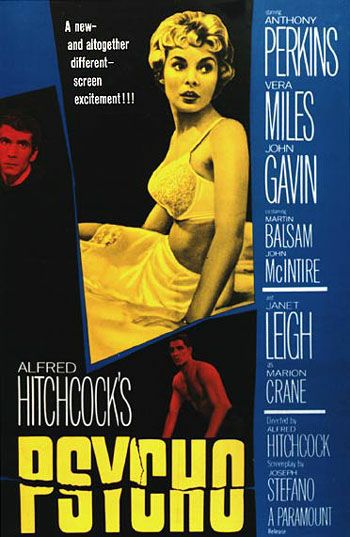
Directed by Hitchcock and starring Janet Leigh, Anthony Perkins, and Vera Miles, this film is intense from the opening sequence. Marion Crane seems to be your average love-struck woman stuck in her job. However everything quickly changes for her after she runs off with $40,000 that had been entrusted to her. Before she can get it to her boyfriend she must stop for the night at the Bates Motel. She rents a room and meets the timid, unassuming proprietor Norman. Soon it becomes obvious that he likes her but his domineering mother does not approve. Then later when Marion is taking a shower she is brutally murdered. Soon the situation becomes even more confused when a private investigator winds up missing. Marion’s sister and boyfriend resolve to go to the motel themselves. Little do they know the shocking events that await them. Undoubtedly Hitchcock’s most famous film, Psycho shakes the nerves and excites. Furthermore, it solidified Norman Bates as one of the most notorious villains of all time .

5/5 Stars

Lawrence of Arabia (1962)


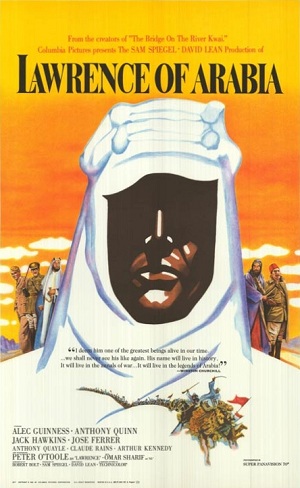
A film of truly epic proportions, in length, scenery, and brilliance, Lawrence of Arabia is essential cinema. Peter O’Toole delivers a stellar performance as T.E. Lawrence, a British soldier during World War I. The movie begins with his death from a motorcycle crash, which gives an early glimpse of the character.

Then, a flashback goes to his time in Arabia where his task was to unite the Arab tribes, and lead them in rebellion against the enemy so the British might win. Against the better judgment of his commanding officer, a Mr. Dryden of the Arab Bureau suggests Lawrence be sent to assess the possibility of an Arab revolt against the Turks. Lawrence heads with his guide to pay a visit to Prince Faisal. However, his guide is shot by another man and Lawrence resolves to make the journey alone. Their paths cross again in the camp of Faisal. There Lawrence interests the Prince because his ideas are far different from his commanding officer.

Showcasing his audaciousness Lawrence suggests a bold attack on Acaba which would allow the British to bring in supplies. He leads a group of men across the brutal desert knowing that this will be less expected. Sheriff Ali (Omar Sharif) doubts it will work and disapproves that Lawrence takes two young outcasts as his servants. It is later during the journey that Lawrence truly wins over the other men, including Ali, because he is relentless, even going back for a lost straggler. With some luck, Lawrence is able to gain the help of Auda Abu Tayi, but it is not without tension. Ultimately, his forces are able to take out the Turks, and Lawrence heads back to Cairo to relay his progress. However, on the way back he must struggle with the loss of a servant and the guilt of executing a man.

Lawrence is sent back to Arabia and there he leads his forces in guerrilla operations against the Turkish railroads. His exploits are documented by an American newsman, and by this point, he has become a mythical hero among his followers. However, after going to scout a town the seemingly invincible Lawrence is ultimately flogged and tortured, leaving him a broken shell of a man. He insists on leaving Arabia but his new commander, General Allenby orders him back for one final push towards Damascus.

This final mission sees a change in Lawrence, who has hired killers and missionaries to help him in his siege. Against the better judgment of Sherif Ali, Lawrence leads a massacre of Turks as they move onward. He takes Damascus, but his fragmented counsel of Arabs are unable to unite, and the city is given back to the English. Major Lawrence is promoted once more to Colonel, and then gets shipped home because his services are no longer necessary.

This is one of those films you want to see on the big screen because the scenery and cinematography is just that impressive by itself. David Lean had a skill at making epics, and this is perhaps his masterpiece. The desert is often stark and desolate, and yet striking in the same instance. The expanse of space that is viewed in a single shot is often mind-blowing. A human being on the horizon is hardly a speck, and the ever-present camels are hardly any more substantial. To complement these grand images is an equally magnificent score by Maurice Jarre, complete with overture and all. The cast must be mentioned too with such supporting stars as Omar Sharif, Anthony Quinn, Alec Guinness, Claude Rains, Jack Hawkins, and Anthony Quayle.

Then, of course, there is the man who played Lawrence. As portrayed so wonderfully by Peter O’Toole, Lawrence is an intelligent and, at times, arrogant man, who can be odd, distant, audacious, and also unscrupulous. That being said, he was an extraordinary man who was a mover and a leader of men. A very unique, at times controversial, and long unheralded man, who contributed to the war effort in a far different way.  In many ways, he was an adopted brother to the Arabs, and their country was also his. He was “Lawrence of Arabia.”

5/5 Stars