
“You’re in a fine mess! You got to get a divorce from a man you’re not even married to!”
It was only a recent revelation that Claudette Colbert at times feels far too sophisticated to be playing beautiful hitchhikers or penniless taxi passengers as she does in It Happened One Night (1934) and this film, Midnight. Though it’s easy enough to explain away.
The screwball comedy has always thrived on incongruities as much as it did on the class divides between the rich and the poor. Where the extravagance is almost laughable in its boorish decadence and the little men still have lives seemingly worth living because they are free from societal pressures. After all, making just enough money to scrape by is nothing short of paradise.
In this way, Claudette Colbert was the perfect person to tiptoe this line because she could be cosmopolitan and was glamorous with all those other snooty folks. But she’s also a comedienne like the normal folks, seeing the humor and working it for the laughs just as much as she’s willing to do things that seem normal. A walking enigma she might be but she also makes Midnight a sublime comic fairy tale as our uproarious modern-day Cinderella.
One of her cohorts and romantic partners is Don Ameche, the Parisian cab driver Tibor Czerny who begrudgingly opens up his livelihood on wheels for her as a random act of kindness. As we mentioned before the smartly dressed Eve Peabody has no penny to her name or a franc for that matter.
But what she does have is audacity and it buys her a ticket into a lavish gathering as one Madame Czerny put on by some rich somebody or other. It doesn’t much matter since it’s all only a pretense anyway. Billy Wilder and Charles Brackett’s script unwittingly created the original party crasher plot.
Eve finds herself at a snobby patronage of the arts where the impassioned man at the piano plays either Chopin’s 12th Prelude or his 11th Etude. Again, it doesn’t much matter but it’s hilarious all the same.
What happens subsequently subverts expectations nicely. Instead of getting tossed out of the proceedings she winds up the fourth in a bridge game of rebels warring against tepid entertainment.
There’s the debonair Jacques Picot (Francis Lederer), Marcel (Rex O’Malley) the man who nearly gave Eve a fright by fetching her, and Helene Flammarion (Marry Astor) a married socialite who is more than a little buddy-buddy with the dashing Monsieur Picot.
The charade becomes increasingly awkward the longer it keeps going and going and going. Every Cinderella has her midnight. The real joke comes when the fanciful game finally ends only to be replaced with a new reality as a true to life Baroness. She has no idea how it happened and that’s where our last important party comes in — her fairy godmother so to speak.
Mr. Georges Flammard (John Barrymore) witnessed Eve putting on a nervous floorshow and was intrigued. Now he watches her masquerade continue and he sees how they can help each other out. It has nothing to do with a desire to fool around. On the contrary, in an attempt to undermine his wife’s philandering he wants to bankroll Eve’s little white lie a while longer until she can win Jacques over and pull him away from Mrs. Flammard. It works quite well too.
Meanwhile, the entire cabbie population of France looks for the mysterious girl at Tibor’s behest. It proves to be equivalent to any missing persons agency in town and it comes with made to order traffic jams to boot.
Midnight turns into a magnificent floorshow as all parties collide in an immaculate perfectly timed collision. Eve and Mr. Flammard’s joint ruse looks like it might soon be ousted by Marcel and Mrs. Flammard who are intent on finding the truth about this curious baroness. But the whole fantasy is saved by a dazzling entrance by one well-tailored gentleman, Baron Czerny.
Now a new round of sparring back and forth begins. It’s full of glorious escapades, riotous telephone conversations with fictitious daughters, and Eve and Tibor trying to one-up each other with tall tale after tall tale. One thing Eve has going for her is Mr. Flammard still in her corner working his magic and John Barrymore puts on a fine showing in the film’s latter moments — his devilish eyes still gleaming as bright as ever.
Monty Wooley is introduced into the plotline in the ultimate piece of pitch-perfect casting as an opinionated but easily swayed judge. Thanks be to Classic Hollywood where pompous Americans can preside over a Parisian divorce court. But what matters is the right people get together. So screwball and fairy tales can still coexist. Wilder would prove it once more with Balls of Fire.
John Barrymore has always struck me as the tortured talent of the silver screen. One could contend that he was the most prominent member of the Barrymore dynasty except whereas his siblings Lionel and Ethel aged gracefully he burned out. Midnight came a little too soon for him.
It’s been a longheld fact that Billy Wilder and his writing partner Charles Bracket gifted two quality scripts that were ultimately directed by Mitchell Leisen. The integrity of the work was compromised to the point that Billy Wilder vowed to become a director himself so no one could mess with his material and when the material being messed with was Midnight and Hold Back the Dawn (1941) it begs the question how would the same magnificent films have ended up in Wilder’s hands?
Nevertheless, the actors are a fine gathering of talent while the script does wonders with the typical Wilder-Brackett combination that squeezes innumerable wit out of its wonky plotline. Billy Wilder must always get the last word in and his scripts always do. This one is no exception.
4/5 Stars
 While a less heralded picture, this Billy Wilder film is a minor classic built around a contrived comedic situation. Dean Martin opens playing a parodied version of himself as Dino the boozing, womanizing, but altogether good-natured playboy who makes a short pit stop in the gas station of the small town of Climax, Nevada following his latest Las Vegas circuit.
 “You can fool all of the people some of the time, you can even fool some of the people all the time, but you can’t fool all the people all the time.” ~ Inscription in the Fortune Cookie
 “On Sunday, August 13th, 1961, the eyes of America were on the nation’s capital, where Roger Maris was hitting home runs #44 and 45 against the Senators. On that same day, without any warning, the East German Communists sealed off the border between East and West Berlin. I only mention this to show the kind of people we’re dealing with—Real Shifty.” ~ James Cagney as C.R. MacNamara
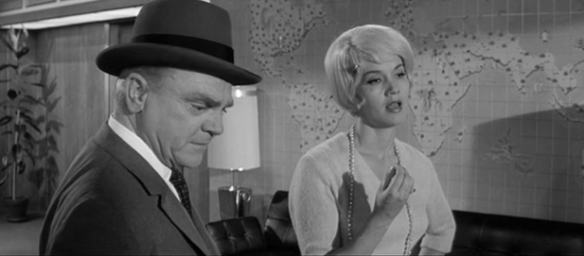 When he’s not getting English lessons or doing dictation with his shapely secretary (Liselotte Pulver), Mac is trying to swing a deal to start selling his billion-dollar beverage in the Soviet sector. He’s met by three bumbling boobs led by the portly Peripetchikoff (Leon Askin), who feel like heirs apparent to Ninotchka’s Russian trio.
 The monetized mayhem is complete with car chases, Soviet torture involving “Its Bitsy Teenie Weenie Polka Dot Bikini,” and a scramble to turn the belligerent Otto Piffl into a respectable capitalist. It’s a brilliant escapade blending social commentary and narrative hiccups as only Wilder could.

 Sabrina, Sabrina where have you been all my life? ~ William Holden as David Larabee
 es has what he had initially set out to get, but the story cannot be over. When he hears of a deadly car accident, he rushes across the border without heed of the law so that he can be with the love of his life. It’s a gushy conclusion that looks like it might end badly. After all, Iscoveu broke some major laws, but Hammock gives him some grace showing he’s a softy at heart. Even Anita gets what she’s always wanted.
 4 Star Films