I Confess (1953): What Would Hitch Do?

I_confess_poster

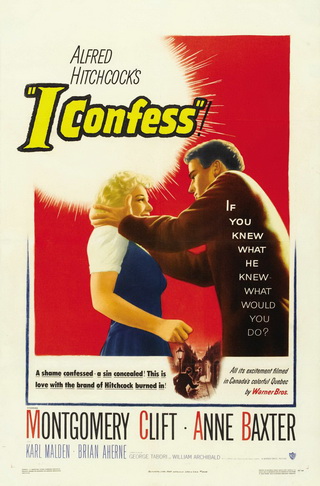
Religion doesn’t always play a prominent role in the films of Alfred Hitchock — he could possibly be considered a lapsed Catholic — but I Confess is his most overt exploration of moral and religious convictions. Although one could make the argument that he’s most interested in the mechanisms created by the moral conundrum since his priest becomes another innocent man accused. Nonetheless, the story speaks for itself.

It opens in quintessential Hitchock fashion as signage seems to indicate a route and then moments later a murder is announced with a body sprawled out on the floor. A man walks down the street briskly in the cosset of a priest. If nothing else, it suggests a man of the cloth might soon be implicated.

Father Michael Logan (Montgomery Clift), who will soon become of primary importance, is in the church when he is met by Otto Keller (O.E. Hasse), who works in the local parish with his wife. The Father has always been good to him, his friend even, and now he has a confession.

The confessional becomes such a powerful dramatic element: It’s been used to stirring effect in everything from Leon Morin, Priest to the more recent Calvary. In I Confess it conveniently sets up Hitchcock’s core dilemma. The flustered European immigrant confesses to the murder of a man named Vilette. Priests, of course, take a vow of confidentiality. Thus, the picture is not entirely a mystery. This is laid in the audience’s lap before we know what exactly to do with it.

Everything must become far more complicated. It involves the Father’s past relationship with the now married Ruth Grandfort (Anne Baxter). That was many years ago, although Logan remains above reproach.

Still, the police inspector (Karl Malden) needles him and cannot understand why he will not be more compliant. After all, he was supposed to meet Vilette the morning after his death, and he was seen with the young woman on the street corner, the day after. It’s true enough, but he will not divulge more regardless of how it looks.

Flashbacks clog up the story’s midriff even as it becomes imperative to inform the narrative. Because before he ever took his vows, they were in love. He went off to war and she was left despondent, receiving small comfort from her employer and future husband: Pierre.

Not all the performances feel altogether pristine or polished but as with the environment, this is a bit of added authentic charm. The more readily-remembered Hollywood actors feel mostly like dressing compared to Father Logan — Malden’s obdurateness might be the exception. Still, this is not altogether problematic and while the picture’s not exactly taut, it does feel psychologically distressing. Clift is made to suffer in silence.

We often forget, with the lustrous Technicolor glories of the Paramount years and pictures from Rear Window to Marnie, that Hitchcock was comfortable with smaller scale and black & white. Quebec is a very unique locale, but it effectively serves his plot and the evocation of provincial character quite well.

Although Hitchcock was never one to see eye to eye with so-called “Method actors,” I think of Clift and Paul Newman in particular, there’s no argument that he allows Monty to shine even sets him up for a nuanced but ultimately towering performance. There’s a quiet magnitude imbued by his stoicism in front of the camera.

He literally becomes a Christ figure and it’s no mere coincidence that Hitchcock shoots looking down past a sculpture of a man carrying the cross as Logan himself walks below on the street. Or for that matter, how often do you see a crucifix so prominently featured in a courtroom? It’s because this courtroom drama has a priest on the stand. The whole movie is playing out through what he will and will not do. His convictions dictate what will happen.

It’s the district attorney (Brian Aherne) who has the undesirable job of getting a conviction by doing his job to the best of his abilities. This means cross-examining a mutual friend (Baxter) as well as the man of the cloth. Is he in a sense, Pontius Pilate? Because even if Father Logan comes out of the trial alive, the media attention and the aspersions on his character can never be undone. He will be faced with public ignominy.

He’s also made to walk the gauntlet so many times; Hitchcock blesses Clift with some phenomenal close-ups and allows the camera to take on his protagonist’s point of view multiple times. He’s not the only one, but one can hardly forget the very final scene in the Chateau Frontenac Hotel: The Father goes in to confront the man who was going to let him take the rap for a murder he did not commit.

The man has a gun. He’s holding himself up and by now he’s desperate already, having killed at least one other person. The room couldn’t seem larger and still, with a kind of peerless conviction, Clift’s hero makes the long walk prepared to sacrifice himself yet again.

Ultimately, he is vindicated; there is a sense of justice, but what a terrifying portrait it is. For those without major religious convictions, it might feel absurd. I must admit it seems almost inconceivable a priest cannot alert the police about a murderer. Surely, even the Bible talks about there being a season for everything, and a time for every purpose under Heaven. Still, Hitchcock even made a point in an interview:

“We Catholics know that a priest cannot disclose the secret of the confessional, but the Protestants, the atheists, and the agnostics all say, ‘Ridiculous! No man would remain silent and sacrifice his life for such a thing.”

It should be noted, in a Hitchcock film, it usually seems like a time to kill and a time for hate because what better way to explore our moral makeup and the forums of human justice? In the end, Father Logan holds fast and is exculpated. If not only by earthly powers, then higher powers too. I’m still left to wonder what Hitchcock would have said in the confessional if he was faced with it.

You can tell a lot about a man from his fears as well as his vices. What stands out about the picture is how it never feels undermined by jokes. It feels as sincere as the man at its core. For some, it might be a turnoff. For others, it will make you appreciate the director even more. He willingly enters into the realm of the pious, albeit through the lens of murder.

3.5/5 Stars
The Locket (1946): Laraine Day and Splintering Psychology

the locket 1.png

“Have you ever done this before?” – Robert Mitchum as Norman Clyde

“No. I’ve never stolen anything in my life.” – Laraine Day as Nancy

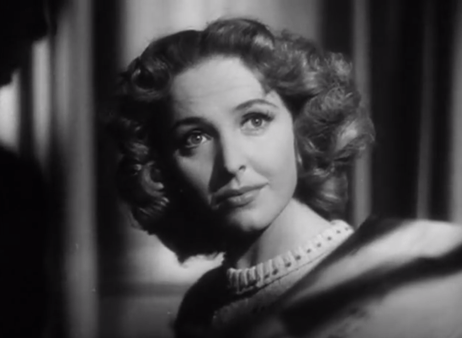
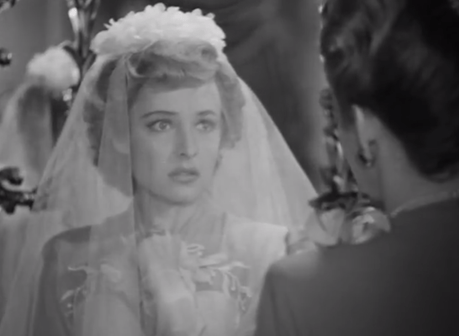
We’re met by a wedding with all the trimmings. It’s a well-to-do affair and Laraine Day looks quite dazzling. Her groom (Gene Raymond) is high on his good fortune in finding such a spectacular bride, introducing her to the aunts and uncles. Taken at face value, it’s a suitable development for a drawing-room comedy.

However, the perceptive viewer will note the presence of two very telling names in the opening credits. They are director John Brahm (The Lodger & Hangover Square) along with Nicholas Musuraca, who helped define the shadowy compositions of RKO Studios all throughout the 40s.

If anything, it suggests that what we’ve seen up to this point is mere pretense, an ebullient calm before the storm, until the past comes crashing through to wreak havoc. Sure enough, a grim, well-spoken psychiatrist (Brian Aherne) walks into the man’s study for a quick word. He’s comes bearing some doom to drop on the deliriously happy groom’s lap.

It lends the injection of noir sentiment we’ve been waiting for with bated breath supplying a flashback to go with it. Dr. Harry Blair recounts how, in his distant more jovial past, he wound up crashing bicycles with Nancy (Day). From then on, they were all but destined to be lovers.

It’s in these interludes where it becomes apparent Nancy is not altogether unlike Laura (Gene Tierney’s character) not because of her mental state so much as this perfectly bewitching aura she is allowed to cast over the frames of the film. Although this makes it sound too manicured; still, it’s true between the scoring, photography, and Day’s own vibrant, fully alluring performance, it’s difficult not to be swayed by the captivating energy.

The cute buoyancy carrying the opening replicates itself in this prelude as Nancy and the good doctor plan a deliriously happy future together. And yet screenwriter Sheridan Gibney brazenly interrupts the gaiety again. This time it is none other than Robert Mitchum interrupting the matrimonial euphoria with his own futile warning — yet another couched deja vu moment to follow the others.

As a matter of fact, in a spectacular move, The Locket utilizes no less than three couched flashbacks involving the three men, layered on top of one another, and each making the same mistakes as the man before them, caught in a deadly cycle…I wouldn’t recommend it to budding screenwriters, but here the commitment’s rather impressive.

This is one of the first great Mitchum performances establishing his world-wearied embodiment of the noir hero — smoking a cigarette, coat upturned in the falling snow — and he’s only one of the supporting figureheads.

the locket 3

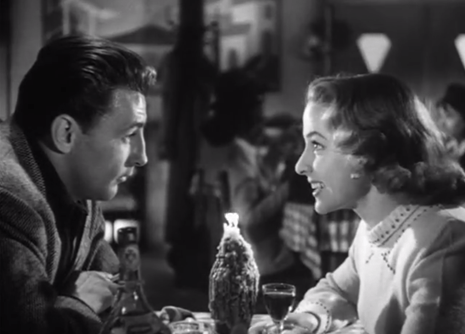
Norman Clyde (Mitchum) is a fairly successful artist, not a sterling success but talented and proud; he’s not about to take flak from anyone. After he gets off on the wrong foot with a woman in his studio, he starts obsessing over the girl. He can’t get her out of his head and wouldn’t you know, she’s holed up in the same Italian restaurant he always frequents. They make amends, of course, and their resulting relationship looks eerily similar to the glimpses we’ve already been granted. Nancy’s deliriously happy with her man of choice. There are no visible blemishes in sight.

However, the fragments and wisps of story keep on fading into one another. It’s so exquisitely rendered by the camera, in particular, when Mitchum and Day go into the recesses of their own personal recollections.

The striking similarities with Laura or even Woman in the Window become even more obvious due to the art angle — the enchanting portrait of a woman — because it does create this meta sense of the woman in the art both painted and photographed on celluloid. It allows her this sense of being out of body — almost otherworldly to the viewer — existing in this illusory state we must come to terms with. In one sense, it’s hard to shake the image of her. Nancy is no different.

One turning point is at a fancy dinner party. Shots ring out and Clyde sees Nancy exit a room frantically. A maid comes, and they hide down the hallway slinking away. Musuruca captures the instantaneous decisions with a fluid ease. We don’t realize it at the time, but it’s a crucial moment teasing out a bit more about Nancy — about her past secrets — and who she is as a person.

My only qualm is with Mitchum’s exit. It serves the story best, otherwise, he would continue to steal the show, but it certainly does not gel with his soon-to-be cultivated image. Alas, it is what it is.

Next, remember the doctor also had his chance with Nancy. They go off to England to stay at a stately manor to get away from the intensity of the Blitz. However, the accusations he’s heard about his wife start to burrow into his mind, so much so he can’t get rid of them.

Surely the rumors can’t be true! Because Nancy is so warm and genial, hardly begrudging or showing malice toward any of her past suitors. In fact, she downplays every interaction she’s ever had with any of them. As if they were nothing. As if the man she’s with right now is the only man she’s ever loved.

the locket 5

The extraordinary nature of Day’s character is how she is not a femme fatale — at least not in the traditional sense. They’re always two-timing and deceitful. With Nancy, at face value, you get none of that, and yet it’s not to say she’s not without her flaws. In a strange way, there are two sides to her as well.

She calls others out for being guarded, cynical, and suspicious, and yet she can often be found doubting everyone else’s motives even as she’s retroactively smoothing over her own. There’s the convenient compartmentalization of all the prior relationships into their individual spaces and the projecting of her issues onto others. It hints at something. Still, there must be a tipping point.

Then, we’re whipped back to the present. The wedding march in all its pomp becomes offset and infiltrated by the tinkling of a music box, like the memories slowly overtaking Nancy’s psyche. These latter moments turn into some of the most evocative sequences of montage in recent memory with all the weight of memory, trauma, and guilt flooding Nancy in the form of all the people she knew. There is no space to keep them apart and so they crush her under the weight, her mind totally fractured as she tumbles to the floor.

In a fit of irony, I couldn’t help but continually be reminded of the contemporary Frank Sinatra tune, “Nancy (With the Laughing Face).” It’s a startling juxtaposition with what we’ve just witnessed, a swelling, unnerving, engrossing exhibition in splintering psychology.

Laraine Day gives an absolutely unforgettable performance — easily the best of her career — and Brahm continues his run of moody melodramas with suffocating environs. The Locket doesn’t hold an instant appeal from the outside looking in, but once you get inside, it’s a bedeviling little gem of a film — as tantalizing as the trinkets so enrapturing to Nancy. There’s one major difference: we can enjoy this one without debilitating consequences.

4/5 Stars