
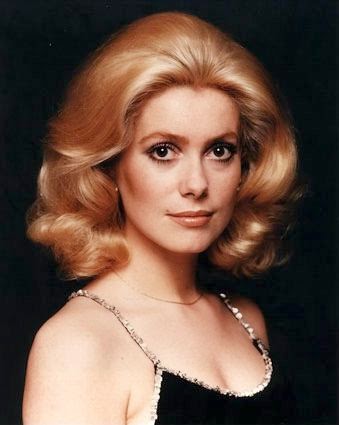
 It is hard to remember a time when I was so devastatingly sad due to a film, and it does not leave a deep hurt but a more wistful despondency that is far more real. However, that’s enough misery for the time being. Directed by Jacques Demy and starring an exquisitely young Catherine Deneuve, this cinematic opera is a moving musical piece that looks to be conventional and turns out to be quite the opposite.
The story begins in November of 1957 with a young mechanic named Guy (Nino Castelnuovo) who is deeply in love with the beautiful 16-year-old Genevieve (Deneuve). Guy cares a great deal for his godmother Elise who has a caregiver to look after her. Genevieve helps out her mother in running a small umbrellas shop in Cherbourg which allows them to scrape by. They must sell some family heirlooms to a kindly jeweler who is smitten with Genevieve. However, Genevieve and Guy have plans of marriage until Guy learns suddenly that he has been drafted for the war in Algeria. They spend their last hours together, and she vows to wait for his return.
 In the following months, it becomes evident that Genevieve is pregnant, but her mother tells her that Guy has probably forgotten her already. The jeweler, Roland Cassard (Marc Michel), professes his love for Genevieve and agrees to adopt her unborn child. Thus, partially on the urging of her mother Genevieve accepts his proposal and they are soon married leaving Cherbourg for good.
Finally, Guy returns from the war and things have changed. He now has a limp and is fed up with his old work at the garage. Furthermore, the Umbrellas shop is sold and Genevieve is wed and gone. Adding insult to injury his godmother soon passes away. With no one else to turn to, he looks to the caretaker Madeleine, and he realizes her love for him. They get married and he turns his life around with her help.
The years pass, and now during Christmas of 1963, a car pulls into Guy’s new gas station. After many years, the two former lovers come face to face once more. Now they have marriages and children, and their interactions are painfully aloof. They have moved on with their lives and they have moved on from their passionate romance.
 True, their lives have become sensible, but in this opera that Demy has constructed, this conclusion is sad and bittersweet. And yet if this were the only painful moment that would be one thing, but there are so many that touch the heart and move the viewer. When Guy goes off to the army and takes off on the train we can feel the great weight of anguish. More often than not, you can read the sadness on the face of these characters which complement the beautiful ballads they utter. In other words, it’s one thing to recount the plot and quite another to watch the events unfold.
I have to say that I had never seen a film that played out entirely through song, and even in the opening sequence, Demy consciously melds the diverse forms of film and opera. Umbrellas has the vibrancy and color of movies and takes the dramatic story line and songs of opera, to create a unique piece of musical artistry complete with acts and all. Its colors are bright and vibrant–utterly distinct in their composition. Everything from the bikes to the umbrellas and even back alleyways are beautiful. Although there are many magnificent melodies, rather surprisingly there is not one specific song that stands out (Well, maybe the theme), but instead, it plays rather like one continuous song with different sections and overtures that complement while not overshadowing each other.
 Demy’s earlier film Lola also gives an interesting insight into the character of Roland Cassard who once again becomes acquainted with a mother and her daughter in a shop. This time around he has accomplished his dream of traveling the world as a diamond merchant, however, Lola is still heavy on his heart. Another thing that is remarkable about the film is the weather which in many ways plays as another character. The varying degrees of rain and snow dictate the mood and shift with the changing seasons. There’s no doubt that Jacques Demy and his collaborator Michel Legrand created something special here that elevates the musical to a heartfelt tragedy of romance. That’s something many men would not be brave enough to do.
4.5/5 Stars
 4 Star Films