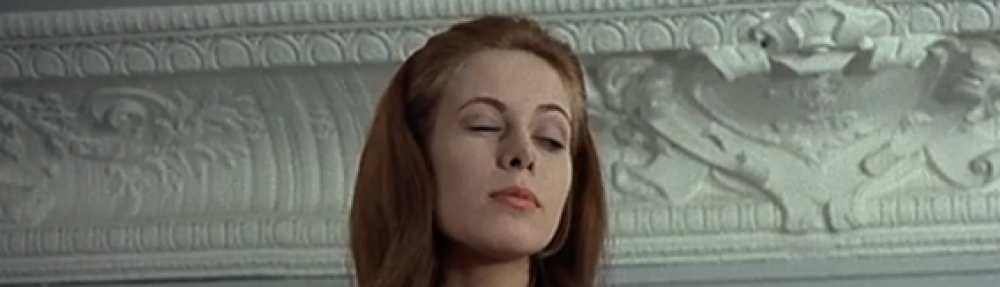
Metropolis (1927)

MetropolisposterFritz Lang’s archetypal sci-fi epic is steeped in politics, religion, and humanity, but above all, it is a true cinematic experience. It is visually arresting, and it still causes us to marvel with set-pieces that remain extraordinary. How did Fritz Lang piece together such a gargantuan accomplishment? Maybe even equally extraordinary, how was I able to see almost a complete cut of this film, which was at different times thought to be lost, incomplete, and ruined?

Metropolis really feels like one of the earliest blockbusters, although I would have to further substantiate that. Still, it’s basic story is generally captivating following a young man named Freder from the upper echelon of society with a father who runs things. This young man is really in the perfect position to succeed, the way society is set up. He even goes to the preeminent school where all the boys are dressed in white. Little does he know in the lower depths the beleaguered, grungy, weary masses in black are slowly killing themselves with work. The machine that drives this society is never satisfied, always desiring to be fed more and more and more.

When the boy finally sees the reality of the infrastructure his paradise is built upon, he cries out in horror. This is not the way things are supposed to be. He eventually switches places with one of these workers and attends a meeting deep in the catacombs (an allusion to the early Christians), where the pure goddess Maria lifts the spirits of her fellow man. But of course, the evil inventor Rotwang is enlisted by Freder’s father Joh Frederson. Their own relationship is marred by conflict over a woman they both loved. Freder’s dead mother. And so the scientist looks to resurrect his long lost love, and he needs Maria to develop his plan. He kidnaps her and from her likeness creates a double, who goes out to wreak havoc on all of Metropolis. The apocalyptic words of the Book of Revelation ring true as the whore of Babylon deceives the masses and leads them to destruction.

But Freder is the Mediator, he is the Savior of his people, and he is necessary to bring peace and tranquility to a world that has descended into such brokenness. So Metropolis is certainly a film full of symbolic touches, religious connotations, and political commentary, but all of this is developed by Fritz Lang through an archetypal hero’s narrative.

Hollywood has become an industry seemingly so obsessed with story, screenplays, plots. Certainly, a film like Metropolis is at least adequate in that area alone, but what really sets a film such as this apart is its cinematic scope. The sheer vast expanses it fills. The scope it creates through its plethora of extras and encompassing sets is hard to downplay. How to describe scenes where water is literally breaking down walls and covering masses of fleeing children? Or smokestacks spewing out refuse while trains, planes, and automobiles pass by in every direction. People scattering this way and that, following the false Maria in a chaotic frenzy. It reminds us what the motion picture, the moving picture, is all about. The images that are brought before us lead to a suspension of disbelief because more importantly they are incredibly affecting. At the atypical 20 frames per second, they are images full of tension, full of energy, and full of life.

Metropolis-new-tower-of-babelIn a sense, with Metropolis, we can easily see a precursor to Chaplin’s Modern Times a decade later. There is a general apprehension of the machine and the impact of a true industrial revolution. There is a fear that there are more positives than negatives. That machines will take over and man will become outdated. Perhaps someday our creation will destroy us. By today’s standards, such notions seem archaic, but are they? We still live in a society ever more obsessed with advancement, technology, and all the things that come with that. However outdated some of Metropolis might feel, and there are numerous such moments, at its core is the final resolution that between the body and the mind there must be a heart to regulate. We are not simply animals with bodies or rational machines with minds, but the beauty of humanity is that we have a heart, pulsing with life and vitality. That is something to be grateful for and never lose sight of.

5/5 Stars

Sherlock Jr. (1924)

sherlockjr1When I was just learning about silent comedy I would have said that it started and ended with Charlie Chaplin no questions asked. And it’s true that he most certainly is a starting point, but if you want to get even a small understanding of comedy you have to look at Buster Keaton (as well as Harold Lloyd). I’m not claiming a great deal of knowledge about silent films (I still have much to see and learn), but Keaton astounded me with his prolific output during the 1920s and his physical prowess. I did not appreciate The General (1926) that much the first time around, however, by the time I got to Our Hospitality (1923), Seven Chances (1925), Steamboat Bill Jr. (1928), The Cameraman (1928), The Navigator (1924), and of course this film, I completely changed my initial evaluation.

Since Sherlock Jr. is shorter than most of his other features it’s almost like Keaton cut out all the dross and what we are left with are sequences of cinematic gold. In this story about a projectionist obsessed with being a detective, there is surprising depth and inventiveness that is still magical today. The plot really is a film within a film, starting with Sherlock Jr. trying to win over the affections of his love (Kathryn McGuire) with a box of chocolates. But his rival (Ward Crane) does the same by more shady means and pins his dastardly deed on Jr. Now our hero is banished from the house and resigns himself to his projection room where he enters into a dream-filled sleep. It mirrors the film that is playing on the screen as he enters this world as a detective and fills it with all his real-life acquaintances. The fact that the girl comes back to him at the end feels rather superfluous because we automatically assume that is the case. It’s how Keaton gets there that’s ingenious

sherlockjr2It easy to marvel at some of the visuals as Buster Keaton literally leaves his body and walks onto the screen, shifting between an array of backdrops in a thoroughly entertaining sequence. He’s pulling crazy stunts without CGI mind you, and many of them put his life and welfare on the line. He tries his hand at pool with impressive skill and pulls off some amazing parlor tricks including a disappearing act that not only stumps the thugs pursuing him but the audience as well.

Even after reading a full breakdown of how he was able to literally vanish into thin air I’m still utterly baffled. Every time it causes me do a double take. Then, of course, there’s his wild ride on the handlebars of the motorcycle, which has some beautifully comic stunt work. It’s stuff you certainly would not want to try at home and it would be unthinkable today, but that was the brilliance of “The Great Stone Face.” He was literally willing to put his life on the line, and whereas Chaplin was adept at pulling at our heartstrings, the often emotionless Keaton does not try that. He wins us over with his resilience. In him, I find a figure of a very relatable temperament although he was more of a daredevil than I could hope (or want) to be. That just makes me respect and marvel at what he can do. If you want to see slapstick and sight gags at their zenith then take a look at Buster Keaton. Sherlock Jr. is always a good starting point.

5/5 Stars

Review: Sullivan’s Travels (1941)

Veronica_Lake_and_Joel_McCrea_in_Sullivan's_TravelsIf Preston Sturges was a comic wordsmith then Sullivan’s Travels was his magnum opus. It has so many pieces worth talking about, despite it only running a meager 90 minutes. It is the kind of comedy that director John L. Sullivan (Joel McCrea) would want to make, and it’s a message movie against message movies. It’s a film about filmmaking (including mentions of Capra and Lubitsch). There’s even a scene where an ecstatic actress goes racing around the studio lot, completely disregarding the period piece she is acting in. The script has the undeniable frenetic poetry of Sturges and even takes time to wax philosophical at times. Sullivan opens the film with some very grandiose vision of what film can mean for the everyday filmgoer (I want this picture to be a commentary on modern conditions. Stark realism. The problems that confront the average man!).

Sturges’ film is scatterbrained and insane in its pacing at times. Take the opening speeding sequence as a newly bedraggled Sullivan tries to shake his caravan so he can really get a feel for the common man’s plight. It almost gives you a heart attack as they blitz down the road, people and everything imaginable flying every which way. It’s faster than most modern action sequences could achieve.

However, although Sturges is undoubtedly known for the strength of his scripts, it’s important to note that Sullivan’s Travels has some wonderful visual sequences. Many of them lack his typical lightning dialogue and instead rely on music and images to develop scenes. Sometimes it’s the plight of the homeless on the road as Sullivan and his companion make their way across country. I would have never thought of this comparison before, but sometimes his heroes elicit the same type of empathy that would be given to Charlie Chaplin or the Gamine (Paulette Goddard) in Modern Times. In that same way, this film so beautifully fluctuates between comedy and heartfelt drama.

Another beautiful thing about Sullivan’s Travels is the cast. Our star is Joel McCrea, who is sometimes known as the poor man’s Gary Cooper, but that is rather unfair because he’s a compelling actor in his own right. Just look at this film to prove his case. Also, he and Veronica Lake (Ms. Peekaboo Haircut herself) have a fun relationship going from the beginning when they first meet in a diner. You might say the shoe’s on the other foot since she thinks she’s doing a good deed for this down on his luck nobody. She has no idea that her “big boy” is actually a big shot movie director. However, it makes no difference, because in some ways she feels responsible for him, and so she takes part in his noble experiment even afterward. That’s where we build respect for them, and she, in turn, falls for him. It’s what we want as an audience. And we finally get it when Sullivan beats his death and a chain gain to return to civilization. His nagging wife has married some other boob, so Sullivan gets his girl.

Sometimes I feel like a broken record, but it definitely seems like they don’t make character actors like they used to. It helps that Sturges has a stock company of sorts and the studio system probably helped in propagating certain actors. However, there’s no doubt that players like William Demarest and Porter Hall are so memorable. Their voices. Their look. There’s no escaping them and there are numerous other faces that you get deja vu with. We’ve seen them before somewhere and just cannot place it.

Within this whole story of comedy, romance, and a heroes journey, there is, of course, a moral. However, I don’t mind Sturges and his simple didacticism. Because he ditches high rhetoric or sickening idealism for a simple conclusion (There’s a lot to be said for making people laugh). A Pluto cartoon short that brings a few giggles can be just as impactful in this world of ours compared to the next big Oscar drama. That’s what Sullivan’s Travels led to. A change in perspective through a hilarious itinerary.

5/5 Stars

Review: Playtime (1967)

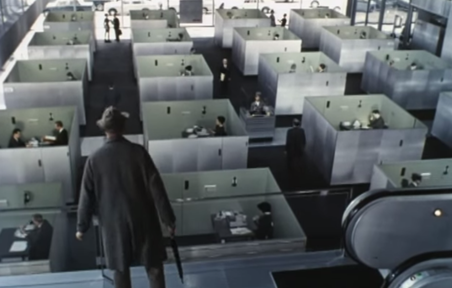
playtime1Playtime is a film that really can be broken into a number of set pieces elaborately constructed by director Jacques Tati. The vignettes begin, surprisingly enough, in an airport terminal, and a group of excited Americans are getting ready for a Parisian vacation. Mr. Hulot (Tati himself) is waiting to have a meeting in a glass office building, however, he soon gets lost in a maze of cubicles, playing cat and mouse with his contact.

Quite by accident, he wanders into an international trade exhibition and the tourists just happen to be there too. While there they are introduced to the latest gizmos, gadgets, and inventions to move society forward. They include silently slamming doors and retractable glasses. In typical Tati fashion, he gives us a glimpse of the old world from Mon Oncle. All that is left is one meager flower stand and a brief reflection of the Eiffel Tower.

Bumping into an old war buddy, M. Hulot is invited over and thus begins a long sequence in an apartment building. What makes it unusual is that the audience is left out on the street, but we can see multiple interiors through the glass. Thus, the conversation becomes unimportant, and the charades inside paired with the street noise is all we notice.

One of the most substantial sequences takes place in a place called The Golden Corkscrew. It is a packed house and the nightclub barely seems prepared for such an evening. Tiles are loose, food runs out, a band member comes late, the chairs leave marks on the backs of patrons, and much much more. Hulot stumbles in and comes in contact with several previous acquaintances. He also makes a few new friends including a boisterous American and a friendly female tourist.

After the crazy night, the morning comes and Hulot says goodbye to his new American friend but not before leaving her with a parting gift to remember her memorable time in Paris. It may not be the Paris of old, but it is still a cheery place made by its people who still remain the same even when the times change.

Jacques Tati’s Playtime took numerous years to complete and it was the most expensive French production at the time. It makes sense though because it truly is a magnificent piece of cinema. It is full of beautifully choreographed sequences and elaborate sets. Mr. Hulot often finds himself wandering through this labyrinth of modern Parisian humanity. Tati teases us, however, filling his world with Hulot doppelgangers.

Even when the gangly protagonist is on screen, he often pops off and on for minutes on end. He is no longer the primary focus of the film. Tati also takes great interest in the sterile modern society of glass, steel, and technology. The screen is filled with a wide array of individuals, which makes it fascinating to simply people watch. Furthermore, Tati almost refuses to use closeups, thus allowing the camera to capture more.

Playtime is slightly slower, to begin with than I remember, but it has wonderfully subdued humor paired with social commentary. Tati’s film may not have a lot of decipherable dialogue, but there sure is a great deal of noise. His sound effects seem to rival The Three Stooges in comical impact, often filling the void usually devoted to talking. It is moments like these where you see similarities to the old silent comics like Chaplin and Keaton.

Playtime is all about the minutiae and these moments are probably exhibited best at the nightclub. So much happens and much of it goes unnoticed, but oftentimes when you pick up on something the payoff is great because you slowly begin to notice more and more. Tati does not have to announce it, but he puts it there to be seen. For instance, there is the fish that is never served but is constantly being seasoned. Then, the doorman who opens the door without any glass. Finally, there is the waiter who gets all the ripped, torn and otherwise ruined articles of clothing. Together all these moments create some immensely funny sequences.

Another thing about Tati’s film. There is really no conflict. He is addressing the changing times, but at its heart, Playtime is just that. Light-hearted recreation.

5/5 Stars

Seven Chances (1925)

seven chances 1We’ve seen a derivative of this story many times before, but thanks to Buster Keaton, Seven Chances has a lot of marvelous comedic moments created by his wonderful physical ability.

The story goes something like this: Boy meets girl and he loves her but never makes his move. Now he has the chance at $7 million if he gets married before his 27th birthday. But that’s today so all he has to do is marry his sweetheart Mary. It sounds so easy until he complicates the whole situation with muddled words and misunderstandings.

Now he only has a matter of time to find another bride. His law partner puts down a line of candidates, and he strikes out each time earning a face full of laughs in reply. Even the secretary and coat attendant turn him down his pitiful plea.

He drives off desperate for a bride and his buddies put an ad in the paper sure to grab him a wife. Jimmy waits patiently at the church, but there’s a problem. Hundreds of women show up and soon turn into a mob bent on clobbering him for making fools of them.

Then and there begins one of the grandest, most epic, and extraordinary chase scenes of all time. Forget Bullitt or The French Connection, this is the seminal chase scene. It’s mind boggling to think how many extras they used and all dressed in drag no less. It is difficult not to marvel at Keaton’s physical prowess because that is where he tops Chaplin. He’s fantastic at scampering about, sliding around, and making pitfalls in general, given the right environment. Soon the world becomes his playground with coattails flying and droves of angry women hot on his heels.

He hitches a ride on the spare tire of a car, dangles from a crane, does frantic Australian crawl across a pond, rides a falling tree, and of course, dodges an avalanche of fake-looking boulders. All I can say is Keaton could have been a professional dodgeball player, but we can be thankful he stayed with film. He was pretty decent at comedy too.

Needless to say, Jimmy gets back in the nick of time, or did he? Of course, he did! It seems like he’s the only one who cannot plant a kiss on the bride. At least he has one now, and Mary is far more important than the money. That’s all that really matters.

Chaplin was great because his Tramp had so much expression. The Great Stone Face was great for the exact opposite reason. He lacked it. His nervous fidgeting or obvious dismay in all situations heightens the comedy making the laughs even more hilarious.

His two buddies are a comical pair in their own right with their differing heights and good-natured blunders. They get caught up in Jimmy’s unfortunate predicament and get knocked about a bit as well.

Keaton may have had greater films, but in his golden age during the 1920s, he could hardly do any wrong. Seven Chance has one of the greatest sustained comedy sequences of any of his films and it certainly does showcase his skills. He gave Chaplin a run for his money, literally.

4.5/5 Stars

Review: City Lights (1931)

 86b16-charliechaplincitylights2A comedy romance in pantomime. That’s just exactly what City Lights is, because, despite the fact that talkies had been around for approximately 4 years, Chaplin was hesitant to transition his Tramp over to sound. In many ways, I can understand why since the universality of his character would be gone and Chaplin’s own voice would give a very different feel to the little man. With his great popularity and artistic control, Chaplin made this film and Modern Times without dialogue. All he used were synchronized sounds and musical scores. As audiences can attest to, it worked out just fine for him.

This film opens with the Tramp in all his glory sleeping on a statue during its public unveiling. He is rudely awakened and shooed off on his way. He drifts down the boulevards finally meeting a lowly flower girl, showing her kindness before moving on. Although I am partial to Paulette Goddard, Virginia Cherrill plays the blind girl believably and she is a wonderful love interest for Chaplin’s character.

His next acquaintance is a drunken millionaire (Harry Myers) bent on committing suicide. His attempt is unsuccessful partially in thanks to the Tramp. He even gives the man a few positive words as is his custom (Tomorrow the birds will sing, be brave, face life!).

And there you have it. Chaplin introduced his audience to the two people who would be closest to the little man. The two new chums head to a high society hang out where they nearly get in a fight over everything from a bottle of seltzer to a chair, and even the floor show.

The Tramp goes back to the girl, and as another act of kindness he purchases her whole basket of flowers for $10 and continues to masquerade as a high society swinger. As the next title card reads, the sober dawn awakens a different man. Thus, The Tramp is initially rejected by his friend from before, but the drunken millionaire gets reincarnated once again and they begin a wild rager. The next morning the cycle begins again with the Tramp being thrown out.

The Little Man has taken it upon himself to be somewhat of a guardian angel for the blind girl who has become his love. Money is needed if she wants to have a home, and despite getting fired from his job, he resolves to get the funds the next best way. In a boxing match. This is where my favorite sequence, which plays out in the ring, comes to fruition.

The Tramp is seemingly outgunned, but that does not stop him from duking it out. He uses the referee, hugs, and anything else at his disposal to try and not get clobbered. The scene had to be choreographed extensively because at moments it looks just like a dance perfectly synchronized between the three characters. The so-called dance becomes even more uproarious when he begins to tackle his opponent and then unknowingly takes out the ref next. The fight seems even with each man falling down repetitiously as the ref tries to say the count. Unfortunately, the little man cannot hold out and he loses the pot.

One final time he runs into his millionaire friend just back from Europe, and he gets the much-needed money for his girl. Matters are complicated by burglars and a misunderstanding with the police. All works out in the end and the flower girl has her home and enough over to get a surgery to allow her to regain her sight.

Chaplin’s character pays the cost though, winding up in jail because of the “stolen” funds. When he gets on the outside he is more destitute than ever, but the girl’s business is now flourishing.

He runs into her and eyes her happily. Little does she know who this man is. This is not the debonair gentlemen she was expecting. She laughingly proclaims, “I’ve made a conquest.”

Only when she touches his hand by chance, reverting back to her old self, does she comprehend who this really is. This is her savior, the one person who radically changed her entire life. He is dressed in tatters and barely has a penny to his name. But he did have kindness and compassion for her.

A lot has been said about the final moments of the film where she has her “aha” moment, and he responds accordingly. What strikes me is how Chaplin so effectively reveals the nervous charm of his character. His fingers are constantly near his mouth, flower in hand. He states the obvious (You can see now). Then, the film closes with his face lit up with another nervous smile, fingers still in mouth.

It is hard to say where the story goes from this point. That’s not the important part here, though. The important part is that in both of The Tramp’s relationships his two friends cannot see who he truly is. The girl is physically blind and the millionaire is blinded by his stupor. They easily accept him in certain circumstances and yet they truly do not know him.

He, on the other hand, seems to accept them no matter the person they are at that moment. He is faithful and compassionate to them in all circumstances. It seems that perhaps the Tramp truly knows them because he is not blinded like they are. Again, I marvel about how so much can be pondered thanks to the actions of an unassuming vagabond. He is a remarkable little man with a very big heart.

5/5 Stars

Review: Modern Times (1936)

6b168-chaplin_-_modern_timesModern Times: A story of industry, individual enterprise, humanity crusading in the pursuit of happiness

With those words, Charlie Chaplin’s Modern Times opens with the final installment of The Little Tramp. Clocking in at a little under 90 minutes, Chaplin is still able to do so much, because he does not waste a single segment of film. This is one of the most wonderful pieces of social commentary that Chaplin was able to dream up to reflect the life and times of his audience — to reflect these modern times.

As was his style with The Great Dictator as well, he pokes fun and critiques his targets all under the guise of comedy. He sets the stage at the industrial factory that the Tramp works in. In a precursor to the famed I Love Lucy conveyor belt episode, it is the Tramp who must fight against the constant stream of nuts and bolts. Breaks and lunch become a thing of the past, and the little man suffers a nervous breakdown that leads to mayhem involving a wild ride through the cogs of the machinery as well as some oily madness.

Right off the bat, Chaplin poked fun at this mechanized system that is overseen by a Big Brother-type figure who spends his idle moments at his desk working on puzzles and reading Tarzan serials.

After the Tramp is forced to leave his job following the series of mishaps, he is confronted by numerous issues that Chaplin gleefully exploits. These include communism, the police force, prison, and even drugs (smuggled nose-powder).

Through the Tramp character, Chaplin comments that with the state of the nation during the Depression it was better to be in jail than out in the world. At least you got a bed and food. It was better than unemployment or starving to death with the police constantly on your backs ready to quell any riots.

These sorts of issues are explored through the character of the Gamin (Paulette Goddard). She becomes the Tramp’s love interest for the rest of the film, but the circumstances of their meeting are important. She was attempting to steal a loaf a bread from a bakery truck. It was not out of malice but desperation to feed her family.

The antics are often funny throughout these sequences, but the reality is, she and her sisters lose their father, and they are already motherless. The future is bleak and there is no help to be found with the Depression at its peak.

Here is where possibly my favorite part of the film begins. The two vagrants imagine themselves living in a middle-class household with fruit they can pick from outside their window and a cow that comes up to their door to be milked. They have a fully furnished home with furniture, ottomans, drapes and a fully stocked kitchen. This is their American Dream and that is where their hope lies. One could say that this was the consumerism culture of the post-war 1950s in a nutshell.

Next, the Tramp becomes a night watchman in a department store and for the evening he and the Gamin have the place all to themselves: To roller skate, eat, and use the beds and furs as they please. It is a moment of relaxing diversion from their normally grungy, monotonous lives.

Finally, they find a home as well. It is a real fixer-upper, but it’s home and that’s all that matters. They have each other, and they seem happy enough making do. The Tramp goes back to his 9 to 5 at the factory only to get kicked out once more. The pair of them land work at a local restaurant only to have juvenile officers come after the fugitive Gamin after an uproarious floor show from the Tramp.

Thus, they are once more on the road again. But that never stopped them before, and with his inexhaustible spirit the little man cheers on his love, “Buck up, never say die. We’ll get along!”

They walk off down the highway with new resolve but more importantly they have each other. If they ever do find that elusive lifestyle I am not sure it would be all that it is cracked up to be. The life of a Depression Era vagabond was no picnic, but I think the gift of the Tramp is he is able to make the best of all circumstances. He may look to a better lifestyle in the future with hope, but he does not need it to bring him happiness. Because the reality is, it never could completely satiate. I tip my hat to you for once little man, because for someone so humble you teach us a great deal about ourselves.

Chaplin did it again bringing us a near silent picture in the age of talkies. Although I admit it might seem awkward at times, this film uses sound and the score wonderfully to accentuate the images onscreen. Chaplin did not need the needless babble of dialogue unless it was for comic effect. After all, he and Paulette Goddard had enough chemistry beforehand, they didn’t need words.

5/5 Stars

Charlie Chaplin’s Little Tramp Who Could: Looking Back after a Century

Before the man with the mustache was Ron Burgundy and even before the Tramp was associated with a dog in a Disney flick, there was another. It has been a century since Charlie Chaplin first developed his Tramp character who is arguably one of the most well-known cultural icons of all time. His persona will forever be identified with that hat, that cane, and of course that mustache.

Charles “Charlie” Chaplin developed his most famous incarnation over a period of years as he worked in The Keystone Film Co. as a stock character. Movies were still a very new fad and Hollywood was the home of the infant movie scene.
 
 In his earliest appearances the Tramp was a comical drunk and a troublemaker. However, it would take just a number of years to transform him into a sympathetic bumbler who lit up the silver screen and filled movie halls with uproarious laughter. Chaplin ingeniously developed his character in such a way to elicit a wonderful balance of humor and empathy from audiences.

Many things have become obsolete over the past 100 years. Take Woodrow Wilson, The Model T, and World War I to name a few of the high points. How is it then that the Tramp has seemingly continuously remained in our collective cultural consciousness? I’m not just saying people are still sitting back in theaters to see his antics either. His image pops up everywhere mundane; you can even buy posters of him at Ikea!
 
Obviously in the film community Chaplin’s Tramp is still highly regarded as well. His films regularly place high on polls by the prestigious Sight & Sound Magazine as well as the American Film Institute. However, perhaps even more important than those accolades is the impact that the Tramp has had on our culture, and I do not just mean America but the entire world.
 
Maybe not everyone is an acclaimed film critic who has seen everything Chaplin (I certainly have not); however I think most people, no matter what their background, can relate to The Tramp in one way or another. His seemingly harmless vagabond image makes us laugh, smile, and perhaps even feel better about ourselves. We say to ourselves, “Wow, if things were this bad in the 1920s or 30s, I really do not have much to complain about.” Now that might be somewhat of an oversimplification of that time, but I think that is part of the reason he’s still fresh today.
 
The Tramp is the epitome of those old silent movies, with melodrama, romance, slapstick, and oh yeah, no talking. Ironically, it might be this last point that is the key to Chaplin’s success with the Tramp. No talking means no language barrier; culturally, socially, or even with the passing of the years, even 100 years. 
 
Back then when times were good and bad he was the world’s every man and although times have changed, he still has remained the same every man that each one of us are able to relate to. In this respect he is a mustached, shuffling paradox, because he reflects a bygone era and yet he still relates to us in our modern world. Amazingly, it seems that this little, funny looking man still has the extraordinary power to make us laugh, sympathize, and see ourselves through his humanity; even the most cynical of us.
 
I would challenge you; nay implore you to try a Chaplin film just once. Before you get too indignant or nervous let me say one thing. Start out with some of his later works like Modern Times or The Great Dictator, which has talking, and work your way back if you like it. Or start out with a short film and work your way up, that’s good too.

Either way I think you might just find yourself captivated by this little man. Perhaps he isn’t the simplistic silent star that you assumed him to be after all. Then again maybe you’re not feeling it the first time through. That’s alright because I would wager a guess that he might just be around in another century if you want to give it another go then, but don’t hold me to that.

My musings were inspired by this article:


http://www.latimes.com/entertainment/movies/moviesnow/la-et-mn-charlie-chaplin-tramp-classic-hollywood-20140126,0,4224217.story#axzz2tEoS53ac 

Hail Hynkel: Chaplin’s Ingenious Critique of Hitler (2013)

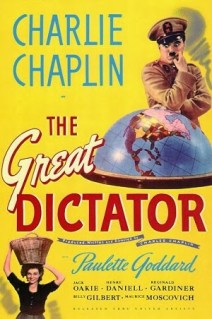
Charlie Chaplin was not just a movie star, he was an American icon and his fame did not simply end in the States but reached all over the globe. Furthermore, his name is synonymous with the Little Tramp who is still widely known to this day. True, Chaplin had rough patches, through numerous marriages and some unpopularity later in life, but in the early half of the 20th century, he was king. The Great Dictator not only showcased his artistry but also lambasted Hitler’s Nazi regime through the usage of outrageous humor. He used his adept skill at balancing comedy and pathos to win critical acclaim, but it also generated some controversy. Moreover, The Great Dictator is an important cultural artifact that is a reminder of a tense moment in world history.

Charlie Chaplin was a perfectionist in all areas of his films and he was not any different when it came to The Great Dictator. He produced, directed, and of course, acted in the film. He played the sympathetic figure of the Jewish barber and then he delivered a grossly different performance as Adenoid Hynkel, an obvious caricature of Adolf Hitler. In fact, the first scene with Hynkel is utterly fascinating because it is so very different than anything Chaplin ever attempted before. It is a far fling from his archetypal everyman, and yet he proves his brilliant acting ability. In this introductory sequence, the Phooey is about to give a speech to his many supporters. As far as staging and cinematography go the scene is quite minimalistic. Some high-level officials sit behind their leader with a few microphones in the foreground. Cuts go almost unnoticed, the position of each shot barely changes, and the camera hardly strays from the face of the Great Dictator. The obvious focus of it all is meant to be Chaplin’s mustached masquerade. His goal is to closely emulate Hitler but then exaggerate and ridicule the Nazi leader in the same instance. During the entire sequence, the Dictator violently gesticulates and orates while an understated translator deciphers the Germanic sounding gibberish. One moment Hynkel will be thrusting his fist up in the air in a triumph of the Tomanian will. The next he condemns democracy, liberty, and freedom of speech before spouting off more propaganda about Tomania’s formidable military. His mood swings are intense and he has sudden emotional lapses especially when he recalls his former struggles with his comrades Herring and Garbage (parodies of Herman Goring and Joseph Goebbels). All the while Chaplin mixes familiar words such as Wiener schnitzel, sauerkraut, Bismarck, and blitzkrieg with, coughs, sputters, and grunts to create a sort of “Gibberman.” That along with the gestures, body language, and mustache creates an extraordinary caricature of Hitler. Chaplin is so adept when it comes to minutiae like bouncing up and down on his feet, crossing his arms, or even wiping his tears on his tie. At times these movements can easily be overlooked because they appear so natural and these small details can get overshadowed by the outrageous dialogue and gestures. Chaplin’s film ultimately succeeds thanks to the laurels of his acting ability which allows him to so aptly impersonate Hitler in an irreverent way.
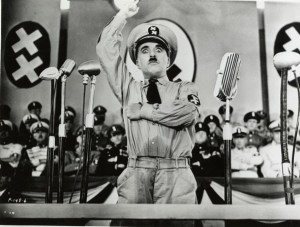
1418d-the-great-dictatorOn the surface The Great Dictator certainly is a comedy, however, perhaps even more so, it is an indictment and mockery of the corrupt tyrant who was Adolf Hitler. As is the hope with all satire, Chaplin undoubtedly wanted the American public and the whole world to know how absurd and dangerous this man was. Possibly the most alarming moment in the opening speech follows the patriotic description of the Aryan which is then harshly juxtaposed with the Jews. The Aryan was the Tomanian (or German) ideal of strong men, blonde-haired, blue-eyed women, and youth who would ultimately be “soldiers for Hynkel.” However, with the mention of Jews, Hynkel positively grinds his teeth at the word. Up to this point, Chaplin’s performance is utterly farcical, but in this one instant he makes us shiver. It is important to note that this is one of the only times the camera comes in for a close-up. Since this hardly ever happens in the sequence it is surprisingly uncomfortable. Despite, the fact that the translator matter-of-factly comments that Hynkel “Just referred to the Jewish people,” Chaplin’s actions as Hynkel say otherwise. He did not just refer to them; he positively strangles them with his diction and bends them to his will, much like the nearby microphones. Thus, when Hynkel goes on another tirade and the translator says that “for the rest of the world he has nothing but peace in his heart,” you completely distrust him and Chaplin uses these discrepancies for comic effect. However, they also act as a commentary on the persona of Hitler and these inconsistencies ultimately suggest that, he too, is not to be trusted. With his directing and acting, Chaplin implies numerous other things of Hitler as well. Hynkel is power hungry, unstable, tyrannical, and dangerous to the rest of the world. The same could be said of Hitler. However, despite his oddities, Hynkel is a commanding orator who knows how to win the people over in order to control their ideology. Yet again, the same applies to Hitler. As a staunch American and believer of democracy, Chaplin attempts to bring attention to these dangers and he only hopes his audience will be attentive. His purpose was not just to make a critically acclaimed piece of art. Behind Chaplin’s art, there was an earnest purpose that transcends simple comedy.
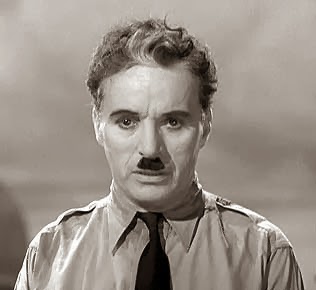
In essence, Chaplin told two stories with The Great Dictator and this allowed his film to have a greater impact. The scene I scrutinized put a great deal of emphasis on the title character, Adenoid Hynkel. Chaplin could have simply told the satirical story of Hynkel in a way that derided such works as Mein Kampf or The Triumph of the Will. I think he did this well, but it is important to realize he did not stop there with his critique. He also represented the plight of the Jewish barber who signified not only the struggles of the Jews but of many people during the Nazi terror. Chaplin develops a great deal of sympathy for this innocent barber, and it causes the audience to be moved. As a result, there is a desire for him to succeed and though there are times when we might laugh, it is almost always with him and not at him. In one last emotional set piece Chaplin has the masquerading barber speak in the place of the dictator. He pleads with humanity to fight for peace, as ardently as Adenoid Hynkel had condemned the Jews and lauded his own army earlier. Like Chaplin and Hitler, these two cinematic figures share a few similarities, and Chaplin utilizes these features to great effect. Because Hynkel is so outrageously crazy, it amplifies the degree in which we empathize with the barber and he strikes us as all the more guiltless, while the dictator grows even more vindictive in comparison.

Chaplin began his production of The Great Dictator in a tense moment in history and his film is important when we consider that era. After 1933, Hitler was on the rise and the threat of the Nazis was becoming increasingly imminent. But in Europe, and even more so in the United States, people did not realize just how dangerous he was. Chaplin was an artistically gifted man, but also a political man who was aghast at Hitler. He knew the idealized leader portrayed in Triumph of the Will could be used as deadly propaganda to influence the masses. Furthermore, he must have also known that he had often been labeled as a Jew himself because he portrayed characters contrary to the Aryan ideal. Unlike other members of Hollywood, Chaplin did not shrink back because he was afraid of the repercussions in Germany. In fact, during this early war period, he created one of only a few films which actually tackled the issue of Hitler and the Nazis. A couple other titles would be Confessions of a Nazi Spy (1939) by Warner Bros. and then To Be or Not to Be (1942) by Ernst Lubitsch. The Great Dictator was not the first of these films to be released. However, out of these titles, The Great Dictator was probably the most celebrated and perhaps the most blatantly anti-Hitler. The American public loved the film for its comedy, which was in line with many of Chaplin’s former classics. However, Chaplin did not try and hide anything behind the film. This is not a veiled parody of Hitler; it is extremely obvious. Looking at the political climate in which he was making this movie, it is an amazing piece of cinema. In some respects it is surprising it was so well received and yet I suppose it is a testament to Chaplin and the clout that he still carried up to this point in time. You could say that Charlie Chaplin willfully took on Adolf Hitler with the film, and in many ways, Chaplin was the victor. That is quite an extraordinary achievement. Of course, with all the prestige that goes with this film, there will always be controversy. The fact is, it covers a very sensitive topic, and the use of humor can often be frowned upon as insensitive in such circumstances. Chaplin said himself that if he had “known about the actual horrors of the German concentration camps, [he] could not have made The Great Dictator.” However, it is fair to say he did not know and also this film is certainly not making light of the plight of the Jews. On the contrary, it empathizes with them so that audiences will be on their side. Thus, this film seems to be made of more good than bad and I think it is safe to say that Chaplin can be commended for the work he did.

Charlie Chaplin began humbly, then started a career in the infant film industry, and never looked back. As iconic as Charlie Chaplin is, it is difficult to refute the fact that he was a tremendously skilled performer and filmmaker who knew his craft well. The Great Dictator worked so wonderfully on multiple levels as a comedic flick and a biting satire of one of the world’s most notorious villains. Specifically, in the opening scene with Adenoid Hynkel, Chaplin creates an uproarious caricature of Hitler that is realistic enough and yet so scatterbrained to work within the context of the film. Then, Hynkel is effectively juxtaposed with the little Jewish barber who radiates naiveté. Chaplin was bold to say the least. He retired his most famous character, he made his first sound film, he played two roles, and of course, he made fun of Hitler. I suppose we would expect nothing less from one of the greatest film stars of all time. However, Charlie Chaplin not only gave us a comedic assault on Hitler, it was an indictment of anti-Semitism, a rallying call for democracy, and an urgent and universal plea for action.