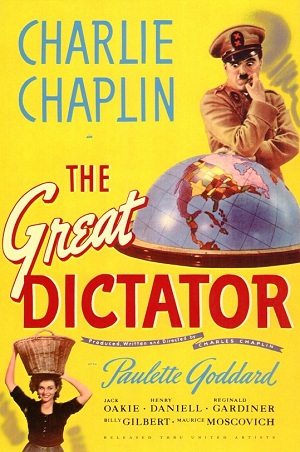
The Great Dictator (1940)

ac211-the_great_dictatorStarring Charlie Chaplin with Paulette Goddard, this satire blatantly critiques Hitler and the Nazis. The film opens during WWI where a little solider (Chaplin) saves an important military man. However, as a result he lands in a hospital with amnesia. All the while the power hungry dictator of Tomania, Adenoid Hynkel (also Chaplin) is on the rise. The man with amnesia returns to his barber shop in the Jewish ghetto and there he catches the eye of a beautiful girl Hannah. However, as Jews they are not safe, and even when things start improving, quickly Hynkel puts down his iron fist. The barber and another dissident are imprisoned, Hannah is in trouble, and Hynkel is ironing out his differences with Benzino Napaloni. However, after a gutsy escape, the barber poses as Hynkel and makes an impassioned plea to the people.

I see this film as a drama full of pathos. It is important to realize that is is not trying to make light of the situation but it is in fact condemning what Hitler was doing at the time. I think that is part of the brilliance and universality of Chaplin’s films. He could balance drama and comedy so aptly, making it possible for him to tackle this controversial topic head on. Furthermore, even though this was his first true talkie he still kept one foot in the silent age in his portrayal of the barber (very similar to the Tramp), and yet he also acknowledged the very present danger of Hitler. This film has some wonderful moments, but I think the two that really stick out are the opening speech by Hynkel which blatantly derides Hitler’s mannerisms and rhetoric. Then, in a complete 360, Chaplin gives his powerful speech aimed to rally mankind. Overall, it is a stellar duel performance from Chaplin and Goddard is as radiant as ever. That mustache certainly did not hurt the film either!

5/5 Stars

The General (1926)

This silent film starring the great Buster Keaton, tells a simple story with comical results. Keaton is Johnnie Gray, a Southern engineer who loves his locomotive and his girl. As it turns out Union spies steal his train, The General, and they also take his love captive. Now Johnnie must track them down and save his fair southern belle. After many a comedic antic, Keaton finds himself behind enemy lines and he is now on the run. However, he does eventually get the girl and then warns the Confederates that the Union forces are coming. Because of his great bravery, he is rewarded with the rank of Lieutenant even though he was not enlisted. Although this film might seem slow to the modern audience, if put in context the, the bouncy score, the slapstick comedy, and Keaton can all be enjoyable. “The Great Stone Face” was one of the few who gave Chaplin a run for his money.

4/5 Stars

Keaton and Lloyd

I have been well acquainted with the films of Charlie Chaplin which always seem to couple romance and comedy so nicely with the character of the Tramp.

However, I had seen very little of Buster Keaton and I had only heard of the name Harold Lloyd. Recently I have finally had the pleasure of taking in more of their work and I must say I have a new appreciation for them. With their respective films it is understandable how they were able to give Chaplin a run for his money. Keaton always appears as a solemn figure whether he is a Confederate soldier, a detective, and so on. He does not try and win our sympathy or affection but he is always determined to take on whatever his world throws at him. His various hilarious and often life-threatening antics cause us to cheer for his characters and in turn we also grow to respect Keaton for his talent as an actor and a director. (Recently I have been able to see Sherlock Jr., Steamboat Bill Jr., and Our Hospitality).

Then, there is Harold Lloyd, the number three man of the silent era comedians. Lloyd had his own persona that he developed to perfection. He was the nerdish fellow who always wore the same pair of glasses and the same hat. He makes us laugh because of his naivete and various antics including scaling a building only to dangle from a clock (Lloyd actually only had eight fingers to accomplish this feat because of an accident). This  causes us to empathize with him much like we would with Chaplin, but their styles could never be confused with each other. (I was able to watch Safety Last! and The Freshman).

That is the beauty of these three men because each one created his own legend and so each one is an icon in his own right. People might fight over who is the best of the group, but really there is no comparison since they all went in different directions. Although these films may be an acquired taste, I hope to be able to watch more in the future sometime!


City Lights (1931)

In this Charlie Chaplin film we follow the Tramp as he romances a blind flower girl and is befriended by a crazy millionaire. In line with all the great Chaplin silent films, this one has many comedic moments but also sentimentality. In one scene the Tramp might find himself dragged along with the millionaire or fighting in a boxing match. However, the next sequence he might be sharing a very nice moment with the girl who only knows him by his voice and kind deeds. Fittingly, in the final moments of the film, the flower girl who can now see is reunited with the humble tramp who showed her so much kindness. Overall this was a very good film and it seemed to have a wonderful balance of humor and romance. It proves that sound is not always needed if you are a good storyteller.

5/5 Stars

Other Chaplin films I may watch in the future include The Kid (1921), The Circus (1928), and The Great Dictator (1941)

The Gold Rush (1925)

3c3f8-the_gold_rushIn this Charlie Chaplin flick we follow the little man or the Tramp as he prospects for gold in the Yukon. All alone and cold he stumbles upon a cabin where a corrupt man lives. However, the weather wreaks havoc and the Tramp finds himself eventually left with a fellow prospector. After a time the two friends split up. In the city the little man finds love while his former partner meets up with trouble on the road. Eventually they  do reunite, strike it rich, and become millionaires. Along the way there are many characteristic Charlie Chaplin antics. It is extraordinary, because for a film that is not a “talkie,” The Gold Rush is surprisingly complex with humor, drama, and romance. If you take into consideration the era of this film, it is very good.

4.5/5 Stars

Charlie Chaplin will be continued in the next review…

Modern Times (1936)

Arguably the first great superstar of film, Charlie Chaplin was the man known simply as the Tramp in his silent movies. For this reason Modern Times seems like the perfect bridge between the early silent era and the age of talkies starting in the late 1920s. Chaplin had many successes earlier including The Gold Rush (1926) and City Lights (1931). However people wanted to hear talking and soon enough everyone would have to make the transition or else die out. Because of Chaplin’s popularity he was able to make one last great silent picture. From that point on however it got a lot louder in theaters.

In this film the iconic Tramp character finds himself up against modern technology and the Great Depression. The whole movie seems to be critiquing factories, the police, the economy, and even modern film by using little actual dialogue. With that being said, this is a great film which exhibits everything that made Chaplin famous. He still has that walk, that mustache, and new hilarious antics to accompany everything else. Yet again there is a love story, between a tramp and a beautiful homeless girl played by Paulette Goddard (Only in the movies). Despite all the hardships they face this resilient pair amazingly still have hope. Fittingly, in the end the two lovebirds walk off into the background, seeming to bring the end of the Chaplin era, but also leaving us with a feeling of hope for the future.

5/5 Stars