Review: East of Eden (1955)

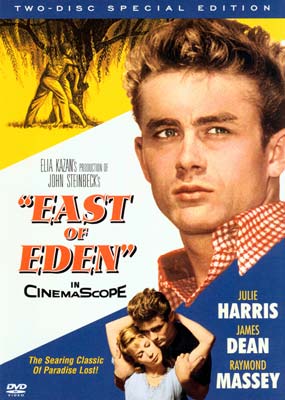
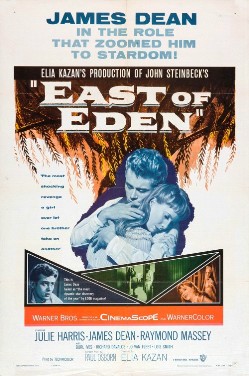
east_of_eden_posterEast of Eden. It was John Steinbeck’s epic work. Showcasing a familial narrative sprawled across his familiar locales of Salinas and Monterey over the turn of the century. But as a film, it rather unwittingly became James Dean’s. He wasn’t even a star yet. He had been on the stage and in a few small roles on television. His performance as Cal Trask was his first film role and the only one that ever got released during his lifetime. As his following two films, both premiered after his untimely death (curiously not all that far away from this film’s setting).

Director Elia Kazan utilized Technicolor and the harrowing perspective of Cinemascope to paint East of Eden with vibrant colors and rather unnerving angles. It’s also true that Kazan, known for evoking intense performances from actors bread on the Method,  was more inspired than perhaps even he realized when he cast Dean. The actor’s body movements. His moody histrionics. His angst emanating from those piercing eyes of his. Even his terminal sadness channeled from his own real-life desire for his father’s love. It’s all within the role of Cal Trask and takes away any doubt about who the focal point of this film is.

And for some, this might be a rather glaring problem with the film. Kazan’s adaptation of the latter half of Steinbeck’s novel focuses on the Cain and Abel dynamic between brothers Cal and Aron as they vie for the affection of their father Adam. For the film to work, each of these characters should be on equal footing. And it’s true that the film is a pendulum of emotional turmoil. It’s positively charged with virulent intensity. First, it’s Cal who is angry and isolated as he tries to discover the whereabouts of the mother he never knew. Meanwhile, his brother Aron (Richard Davalos) is happily in love with his girl and readily defends his brother against any criticism.

But as Cal tries with all his might to win the affection of his father by any means possible, things begin to change. No, his father never exhibits the type of pleasure in him that he so desires, but in his struggles, Cal becomes closer with his brother’s girl — gaining her sympathy.

As time passes, the U.S. is teetering on the brink of the Great War and still, Cal cannot earn his father’s love and his brother becomes more and more jealous. As Cal comes into his own, showing a certain amount of industry and thoughtfulness, it seems Aron becomes more withdrawn and cold. And still, Adam loves his “good son” the best.

James Dean’s performance is spectacularly engaging. I would argue it’s not a morbid sense of curiosity that draws us to him as a tragic hero. But he truly had a special ability to control entire scenes with a glance or some slight movement. Like a Brando or a Clift, he had a certain ability to tap into something that classical actors couldn’t quite touch. Whether it was realism or not is slightly beside the point because they live in characters who are charged with real emotions. It makes Dean’s role as Cal Trask almost palpable. You can feel all that is going on inside of him.

It’s the fact that Dean is so memorable, that brings to light just how much some of the other roles pale in comparison. Davalos does a fine job in his first film, but he cannot balance the scales weighed down by Dean. Raymond Massey on his part is a fairly flat actor not given to anything altogether interesting. It is Dean who elevates Massey’s role in a sense (even though Massey despised the younger actor). Furthermore, Julie Harris is a reputable performer with great heart but she somehow seems miscast (perhaps she’s too old for her role). And Jo Van Fleet gets into the film with a few integral scenes but even she does not have enough time to neutralize Dean.

Perhaps it’s because of the now iconic screen tests of Dean and Paul Newman working off each other, but part of me wonders if Newman in the role of Aron could have done anything to counterbalance Dean. Part of me rejects this hypothesis because Newman never had the same type of melancholy or intensity that Dean was able to muster. He was the likable one. Still, it’s an interesting supposition that in no way takes away from the phenomenal way James Dean burst onto the scene in 1955. He was an explosive supernova of talent — unfortunately for us, he was snuffed out far too quickly.

4/5 Stars
Review: On The Waterfront (1954)

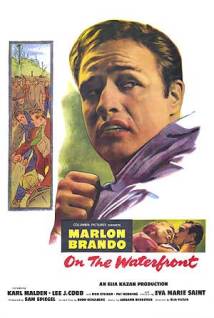
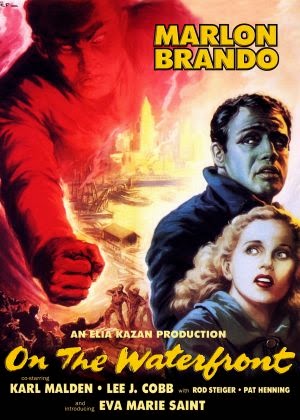
8542a-on_the_waterfront_poster“They always said I was a bum, well I ain’t a bum Edie.” That is what washed up prizefighter Terry Malloy (Marlon Brando) must try and prove to himself and others for the entirety of this crime-drama. On the Waterfront is ultimately his story of conscience and redemption that we watch unfold. It’s not pretty, but you’ll soon see for yourself.

Living on the waterfront is a tough existence. The mob decides who works and who won’t. Longshoremen are expected to be D & D (Deaf and Dumb) or else they have something coming. That’s how big shot Johnny Friendly (Lee J. Cobb) and his boys can run the entire area. They utilize fear and money to keep the working masses at bay. No matter what police or the crime commission might try to do, they have no hold on the waterfront. It’s a jungle out there and if you want to survive you look out for number one, don’t ask questions, and live another day.That is Terry Malloy’s philosophy and it suits him just fine. His brother Charley is Friendly’sright-handd man and he’s made a good life for himself thanks to his brains. Terry is more brawn than brain, and he does what his brother says. One night he blows the horn on a young man named Joey because he called out Johnny Friendly. That same evening Joey is knocked off, literally. Terry tries to justify it. He only thought they were going to “lean on him” a bit. With that incident begins Terry’s inner battle.

The moral compass of the film is supplied by two people. Edie Doyle (Eva Marie Saint) returns to her town from school with her beloved brother Joey now dead. She cannot understand why no one else will speak out about it or do anything to carry his cause. It is ultimately Father Barry (Karl Malden) who does just that realizing that his parish is the waterfront. He must fight against the injustice of the mob and hope others will join him. It’s a tall order. At the first meeting he holds in the church, a window gets busted, and thugs wait outside for people to beat up on. Terry was sent by Johnny to check it out and it is there that he meets Edie. He is immediately taken by her, and she warms to him. She sees him differently than the others without knowing what role he had in her brother’s death. The Father and Edie encourage Terry to testify at the crime commission after another man is killed in an “accident.”

Friendly can’t have a canary and its Charley’s job to straighten out his brother. That’s when they take their fateful car ride. Terry spill his guts (I coulda had class. I coulda been a contender. I coulda been somebody, instead of a bum, which is what I am, let’s face it. It was you, Charley.) and Charley responds the only way he knows how. He saves his little brother who he has always looked out for and pays the price.

Now Terry has his reason to testify and soon enough he goes before the crime commission to call out John Friendly. He has broken the waterfront code and gone canary. All respect for him is gone and Friendly wants his hide, but Edie is overjoyed in him. Finally, Terry has left the shackles on the waterfront and freed his conscience. He confronts the big man himself and is beaten to a pulp. But as Father Barry says he may have lost the battle, but he won the war.

Before getting to Brando, I must acknowledge the other players for their stellar performances. Eva Marie Saint is just that, a saint, and she gives a heartfelt performance as Edie. It is her love and care that leads Terry to turn himself around because she sees a little piece of humanity left in him. Karl Malden has perhaps one of his finest roles as the Father who represents a man of the faith remarkably. He is no joke, and he does not cave to hypocrisy. His waterfront sermon is one of the most powerful moments:

“You want to know what’s wrong with our waterfront? It’s the love of a lousy buck. It’s making the love of the lousy buck – the cushy job – more important than the love of man! It’s forgettin’ that every fellow down here is your brother in Christ!”

However, Rod Steiger’s poignant scene with Brando in the car is similarly extraordinary, because he realizes where he has failed. He does not need the words. He just stays silent, and we see it on his face. He is the one who pays for the mistakes, though, and he is far from a bum. Then, of course, there is Marlon Brando himself. He is often hailed one of the greatest actors of all time, but he usually played corrupt undesirables or rebels. Terry Malloy is perhaps his best role, and he is the good guy for once. He must struggle to do what is right by him, and he must struggle to prove himself to others. Brando plays him with some much genuineness, heart, and vulnerability at times. He is far more than the brusque meat head we take him for initially.

Elia Kazan was a champion of hard- edged dramas especially in the 1950s and he never succeeded more so than with this film. The black and white cinematography with perpetual fog drifting in fits the dire mood nicely and Leonard Bernstein’s score further compliments the drama. This is a fine example of Classic Hollywood cinema which was praised back then and lauded now. Our fake blood may have gotten better, but otherwise, it’s hard to top this film.

5/5 Stars

East of Eden (1954)

In his first great film role, James Dean plays a rebellious son named Cal Trask who lives with his father and brother Aron in Salinas. Directed by Elia Kazan from the Steinbeck novel, the movie chronicles Cal’s struggles in the shadow of his favored brother Aron. Despite good intentions at first, Cal is constantly rejected the praise that his brother garners. Thus embittered, he lashes out at his brother, falls for Aron’s girl, and turns their father’s world upside down. With his performance Dean brings alive the character who is himself an allegory for Cain. Julie Harris, Raymond Massey, and Jo Van Fleet all deliver good performances that play off Cal. Overall this is a classic adaption of a classic author. 

 4/5 Stars

A Streetcar Named Desire (1951)

The film adaption of the Tennessee Williams’ play, A Street Car Named Desire was directed by Elia Kazan and stars Marlon Brando as the rough Polish husband of Stella Kowalski. Vivien Leigh plays the role of Stella’s airy and superficial sister Blanche. The film opens in the French Quarter of New Orleans where the Southern Belle Blanche DuBois comes to live with Stella and Stanley. Over time we learn of her past full of forbidden love and other problems. Stanley is a brutish, dominating man and the arrival of Blanche upsets his relationship with his wife. A friend of Stanley’s, Mitch (Karl Malden) is drawn to Blanche but the conflict between her and Stanley make the relationship impossible. Now Stanley knows of her past and confronts Blanche about it. His cruelty and violence lead to her final breakdown. Ultimately, Mitch is angered, Stella is grief-stricken, and Stanley shows his dependence on Stella. This film is full of drama and at times you dislike both Stanley and Blanche. Mitch is one of the characters you actually feel for.

4/5 Stars

On the Waterfront (1954)

In his first great crime film Marlon Brando teamed with Elia Kazan and played a very different sort of character. It tells a moving story of a man who chooses to change in very difficult circumstances and to do what is ultimately right. This film has great characters and memorable dialogue that show the complexity of the human race. It proved that Brando could play a true hero and not only a villain.

*May Contain Spoilers
In this film starring a wonderful cast including Brando, Rod Steiger, Karl Malden, Lee J. Cobb, and Eva Marie Sainte, a washed up prizefighter redeems himself. The waterfront is a tough area controlled by a gang led by Cobb. Brando’s Terry Malloy gives them information about a young man, because his brother (Steiger) is second in command. Only afterwards does he find out they knocked the man off and now Malloy must deal with his conscience. He slowly falls for the dead boy’s sister and must tell her the truth. With the help of Sainte and a Father played by Malden, Malloy testifies to put away Cobb for good. However his brother Steiger pays the ultimate price after one of the most poignant scenes in movie history. Kazan behind the camera does a good job at allowing his actors to flourish. This film is definitely a great one telling a classic story of redemption.

5/5 Stars