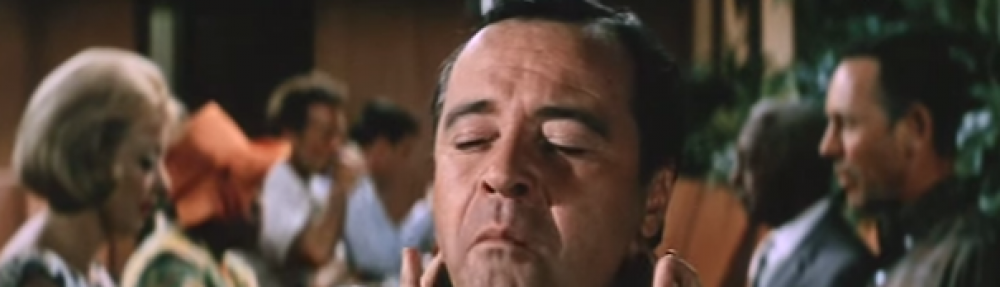
Lola (1961)

Lola1961As the debut of Jacques Demy, Lola has some qualities that, for lack of a better term, are very un-Demy. First off, he was a member of the French New Wave period of filmmakers and yet he resigned himself to making mostly musicals, taking inspiration from Hollywood and setting them in his own unique world. He was not concerned with the experimenting or political undertones of many of his peers. However, this is probably the most typical looking of his work and thus a jumping off point for the rest of his career.

Not quite as elegant in camera movements as Max Ophul’s work which received a nod, Lola still has a pleasing sleek visual style representative of the French New Wave. Its silky smooth, black and white cinematography courtesy of Raoul Coutard (Breathless), however, makes the film look more like something from Godard.

Lola is what Demy himself coined “a musical without music,” I suppose because it lacks the signature singing of his later films, but keeps the music and some of the other elements. Demy’s film also has a sense of cinematic realism with characters crossing paths with one another in various coincidental moments. It may be highly unbelievable in its plotting and yet it works within the Demy world of romance and fatalism which he would often revisit later on.

lola3This film follows a cabaret singer named Lola (Anouk Aimee) in a small seaside village called Nantes. She has a young son and a lover who she has long waited for. In the meantime, childhood friend Roland Cassard (Marc Michel) trudges on with his life without much drive. He is a befriended by a lady and her daughter Cecile at the local bookstore where they strike up a quick friendship. Then, by chance Cassard runs into to Lola, or Cecile as he used to know her when they were children. It’s been many years and although she has been getting together with an American sailor (Alan Scott) named Frankie, she is excited to go out for an evening with Roland. However, in another interesting meeting young Cecile runs into Frankie while buying a comic book and they have some fun together.
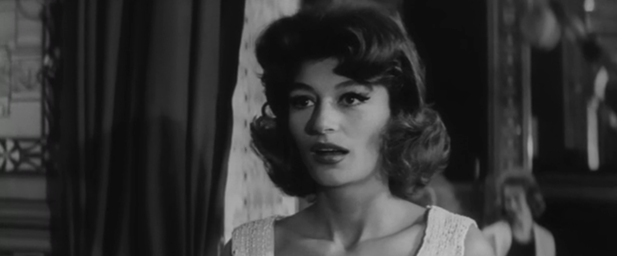
lola6In the end, Lola tells Roland that she will never truly love him and they must remain friends. It’s a bitter time for Roland as he decides to leave like he was originally planning. Finally, Michel returns and Lola is reunited with her love. It’s another bittersweet tale of love from the mind of Jacques Demy. Whimsical, poignant, and wistful too. That’s not the last we will see of Roland, though his luck doesn’t get much better (Umbrellas of Cherbourg), and  Lola returns too (Model Shop). Now only to go back and watch The Blue Angel (1930) from von Sternberg and Lola (1981) by Fassbinder which both bookend this work by Demy also chronicling a cabaret singer. There’s a lot of history here still to be seen and Jacques Demy is a worthy addition to the lineage even if this is not his best film.

4/5 Stars
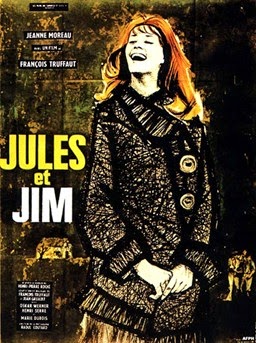
Jules et Jim (1962)

Jules et Jim (1962)Directed by Francois Truffaut, this film begins before WWI with two friends, the timid Austrian writer Jules and the more outgoing Frenchman Jim. Both men become enchanted by a statue that a friend had seen and soon Jules meets the free spirited Catherine after being with several women before her. Although he begins a relationship with Catherine, she soon casts her spell on both of them causing them to have a very close relationship. 
Just before the Great War begins Jules and Catherine are married but when the fighting starts the two men are on opposite sides. Fortunately, they both come out of the war and Jim comes to stay with his friends in their mountain home. Now they have a daughter but their marriage is difficult because Catherine has had several affairs. She begins to flirt with Jim and Jules gives his blessing hoping Catherine will still be present in his life. 
Catherine and Jim end up separating however when they struggle to have a child. Later, they reconnect in Paris but Jim resolves to marry another girl much to Catherine’s jealousy. They meet one last time and Catherine goes on a drive with Jim that ends fatally. Jules is left to grieve for his best friend and his true love.
It is interesting how Catherine is really the main character here despite the title suggesting otherwise. Jeanne Moreau does not seem like your typical beauty either and yet Truffaut makes her character truly special. If you want to become acquainted with Truffaut and the style of French New Wave this one of the films you need to go to. The 400 Blows first, Jules and Jim soon after. 
4/5 Stars

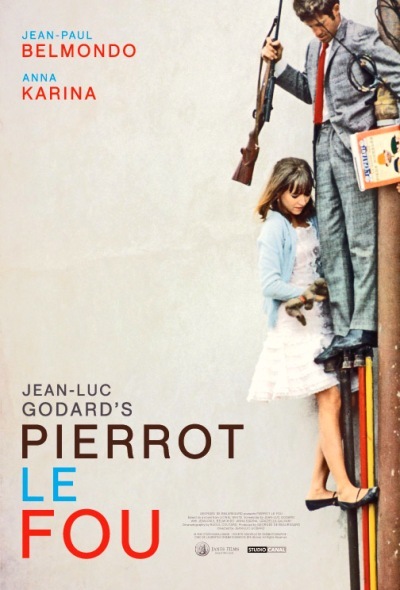
Pierrot Le Fou (1965)

Directed by Jean-Luc Godard and starring Jean Paul Belmondo and Anna Karina, this film is chock full of poetic musings, literary allusions, pop culture images, and so on. Belmondo is a Frenchman who is unhappy with his life and marriage. When a young woman he is already acquainted with comes to watch his child, they eventually elope together. Ferdinand goes with Marianne to her apartment only to find a corpse and they must flee the scene from two gangsters. Now on the run, the two lovebirds are intent on living life and making their own Hollywood inspired movie that they can both star in. Their aspirations lead them to live a wild life on the move, but finally they settle down for a awhile in the French Riviera. Ferdinand is content with a quiet life of philosophizing but Marianne is discontent with this life right out of a Robert Louis Stevenson novel. They finally move on and stop at a night club where they face one of their pursuers. After some mishaps Ferdinand and his girl get separated. Finally they are reunited only to have Marianne turn on “Pierrot” for her real boyfriend. The final moments are filled with gunfire, a suitcase full of money, blue paint, and dynamite. You could say that everything blew up in Ferdinand’s face, and you would be quite correct.

4/5 Stars

Vivre Sa Vie (1962)

ef6de-vivresavieposterDirected by Jean-Luc Godard and starring Anna Karina, this French film shot like a documentary begins up close and personal in the life of a 22 year old woman named Nana. In 12 separate scenes we slowly are given a view into her life. She goes from leaving her husband, trying to get into the movies, and then finally begins prostituting herself for easy money. All the while this beautiful young lady struggles with men. Here interactions sometimes leave her somber and other times light-hearted. Through it all she tries to live her life the way she sees fit. She might be playing pinball, working in a record shop, viewing a movie, or attempting to pick someone up. She is so alluring in a quiet sort of way and as observers we begin to feel pity for her more than anything. In the end tragedy strikes and all of a sudden it is no longer her life to live. This film had moments where it became talkie however the narrative divided into 12 sequences and the constantly swiveling camera were major attributes. Furthermore, this film appears as if it will be an in depth character study and yet by the time it abruptly ends we hardly know much of anything about Nana besides what is on the outside. In real life Anna Karina would be Godard’s wife for a time and he used her in many of his works.

4.5/5 Stars

Breathless (1960)

5cad1-c380_bout_de_souffle_movie_posterThe debut of Jean-Luc Godard and starring Jean-Paul Belmondo with Jean Seberg, this film was influential in helping to jump start the French New Wave. The story begins with a small-time thief named Michel stealing a car and then killing a policeman  Quickly, he becomes a fugitive in need of money. This brings him in contact with an American journalism student he had met before. They spend time together with Michel professing his love and Patricia still feeling unsure whether or not she truly loves him back. In a final act of reassurance Patricia betrays Michel and he is chased down by the authorities. He is a far cry from the American movie stars and crime films he idolizes. With its jazzy score, bilingual dialogue, jump cuts, and Parisian scenery, this film is chic and cool. It paid homage to Hollywood but it also paved the way for a new era of films starting in the 60s. The film is perhaps not as impressive to today’s audiences but it certainly has a look that you have to appreciate. Godard was ahead of his time because he went against all conventions that had been set up for cinema and he thereby revolutionized the film world.

4.5/5 Stars

Hiroshima Mon Amour (1959)

72bd9-hiroshima_mon_amour_1959This film is not only a seemingly early form of the French New Wave, it also has many qualities of a documentary, and it is certainly an international film. The film opens with a one night stand between a French actress and a Japanese architect who rendezvous one night in Hiroshima. In the short time they spend together, she reflects on her memories of the city that was not too long ago devastated by the atomic bomb. He often rejects her recollections but nevertheless, he cannot bear for her to leave and he continues to pursue her. Eventually in the course of their time together she relates her days back in the town of Nevers in France. During the occupation, she had a beau who was German and was eventually killed. The events and aftermath haunted her even many years later. They spend some of their time together walking the streets of Hiroshima and with their time running out they vow to remember each other by Hiroshima and Nevers respectively because their real names are never mentioned. This film begins very much like a documentary on Hiroshima but very quickly it turns into a character study focusing on ideas of love, memory, and personal identity. This film is more about art and expression and it uses quick flashbacks to replicate the past with voice-overs bringing the audience back to the present. That being said it should be treated as such because it truly is a masterpiece from Alain Resnais.

4.5/5 Stars

Bonnie and Clyde (1967)

b1a0c-bonnie_and_clydeStarring Warren Beatty and Faye Dunaway, with director Arthur Penn, the film chronicles the crime life of a group of notorious gangsters during the 1930s. Clyde Barrow (Beatty), a small time thief meets the beautiful young girl Bonnie Parker (Dunaway) and together they begin robbing banks. Soon they enlist the help of a dim-witted mechanic C.W., and then Clyde’s brother joins the fray bringing along his wife. They have a string of successes and they become infamous nationwide. Soon they begin to bicker among themselves and the police start to buckle down. In a shootout Buck is shot dead and Bonnie, Clyde, and C.W. just barely escape. However, their actions eventually do catch up with them and thus ends the story of these two figures depicted as anti-heroes. This film is significant because it was influenced by the French New Wave but it in turn ushered in a new era of American film . It has a unique combination of comedy, romance, violence, and of course banjo music.

5/5 Stars