The Earrings of Madame De… (1953)

MadamedeposterThe Earrings of Madame De…, in essence, feels like the perfect incarnation of an Ophuls’ film. In fact, sometimes I forget that Ophuls is actually German because his films are full of French sentiment. I mean that not because of their cast, although we do have Charles Boyer and Danielle Darieux, but more so due to the fact that his films are about elegant, melodramatic romances that fit the decadence of Parisian high society. For instance, in Madame De… Danielle Darrieux is positively swimming in luxury, whether it means dresses, furnishings, or especially jewelry. Materially her husband Andre (Boyer), a French general, has lavished all the worldly possessions upon her. Except that’s not what she wants. At least that’s not what will make her happy. She may be obsessed with the material, but even the material which she so desires is ultimately poisoned over time. Over time Andre cannot even win her over with trinkets and gifts. She cares little for the eponymous earrings until they come from her true love Baron Donati (Vittorio De Sica).

These are the same earrings that she sold to pay off a debt. The same earrings that Andre reacquired from the jeweler and then made the rounds once more. Ophuls said himself that he was drawn to this narrative because “there is always the same axis around which the action continually turns like a carousel. A tiny, scarcely visible axis: a pair of earrings.” And really it is a fascinating plot device that ties the entire narrative together, while also seeming to reflect the utter frivolity and triviality of it all. How can these earrings hold so much weight to one person? And yet that’s only the face value, because, to begin with, they are only an object to be coveted and maybe cherished. Over time they become a token, a symbol of true love and Louise gives them away to the parish because she no longer needs them. She has some notion now of what true love actually feels like.

For the majority of the film, Andre is forever civil with her. He knows that she does not really love him, and he even has time for a mistress on the side. He handles her opportune fainting spells and little charades with grace and at times amusement. But when he gets a hint at Donati’s relationship with his wife, he does what any honorable gentlemen would do. He’s indignant of his rival and builds a huge feud out of nothing. What follows is a duel and the rest is history.

Madame De… probably does not get as much acknowledgment as it should, because Ophuls was a champion of so-called “Women Pictures,” which actually take on the point of view of women, in an industry that’s so male-dominant even to this day. Thus, Madame De… is a little different in perspective, and it tries to hide all of its tragedy behind superficiality. It makes for an interesting lesson in romance and the female psyche. Yet again the director shows his immense affinity for staircases turning them into the personal playground for his camera. He loves to twirl, pirouette, and glide just as much as Louise and Donati do as they dance the night away at the ball. De Sica is a champion director in his own right, but it was especially fun to see him in front of the camera and he seemed an apt player opposite his costars. The worthy equal of Boyer and a suave love interest on top of that. There’s nothing more romantic than Danielle Darreux dreamily repeating to him, “I don’t love you, I don’t love you, I don’t love you.” The sad irony is that those words ring true with her actual husband as reflected by a pair of earrings.

4.5/5 Stars
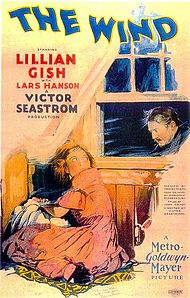
The Wind (1928)

190px-The_Wind_(1928)The makers of The Wind took their content seriously. Filming commenced near Bakersfield in the Mojave Desert where temperatures fluctuated around 100 degrees. Eight airplanes where used to churn up enough force for the effect of swirling sand and much of the crew was forced to wear protective clothing while facing the elements. It sounds like a hardly pleasant experience and yet Swedish director Victor Sjostrom’s project with silent film goddess Lillian Gish proves transcendent to this day.

An early inter-title explains the film’s story of a “woman who came into the domain of wind,” and essentially that sets up this archetypal woman vs. nature story. Gish is our heroine Letty, who has come all the way from Virginia to live with her cousin. Why she would want to live in such nasty conditions is not clear, but she must have had good reasons. Every sequence you are reminded of this film’s title, because hats, hair, scarfs, are always blowing in the wind, no exceptions. Tranquility does not have a place in this film. Vast expanses of desolate terrain reign supreme and the men match the land. The first acquaintance Letty makes on her way out is the forward cattle buyer Wirt Roddy. He warns her of the treacherous country she is about to enter, but she is, after all, Lillian Gish. Nothing will stop her.

When she finally arrives at the ranch of her cousin Beverly, he is delighted to see her, but his callous wife and bratty kids are not so warm with their welcome. Letty also catches the eyes of two ranchers: The rugged Lige Hightower and the aging Sourdough. Both have a hankering to ask for her hand in marriage, and the dance in town seems like the perfect place for popping the question.

But a giant cyclone strikes leaving destruction in its wake, and the general public seeks shelter below ground as the men try and brace for impact. In the mayhem, Roddy declares his intentions and now there are three suitors vying for Letty’s affections. It’s good fun for Letty until the jealous Cora forces her out of the house. She doesn’t want Ms. Sly Boots wrecking her home as she surmises.

Letty needs someone to turn to and her first choice is Roddy, but he always was a grinning conniver, and he finally confesses he’s already married. That won’t do and she reluctantly chooses Lige. Although, since he is so rough around the edges, she doesn’t know how to relate to him. She certainly doesn’t love him, and he catches on pretty quickly when trying to kiss his new bride. Despite, a violent side, Lige proves he does have a grain of decency buried in the sand somewhere. He resolves to get enough money to send Letty back to where she came from and, he soon loses his scruffy beard.

Lige goes out in the elements out of necessity in taking part in a roundup. His wife initially pleads with him to take her along, but the conditions are too adverse and she is left behind, all alone between four flimsy walls which are supposed to defend her from the forces that be. A deadly Northern is coming, personified by a prancing stallion, but that’s not all. Roddy sneaks back to Letty intent on taking her away with him, and between the never-ending onslaught of wind and sand, along with her former suitor, Letty is beside herself. It’s a frantic struggle against the wild forces of nature, not to mention a craven man. However, being the heroine that she is, Lillian Gish find her gun and does what she has to do. As they say, absence makes the heart grow fonder, and thus when a jaded Lige gets home, he is surprised to be met by Letty with open arms. They share the original Titanic embrace, with the wind billowing around them, eyes closed, enjoying this moment of pure adrenaline. Even for the 1920s, Gish is a universal beauty, and there’s a pristine magnetism to her. I would never wish any type of harm or misfortune upon her. She has such a sincere face. Or maybe it’s a fragile frame backed up by courageous nature. Her struggles remind me somewhat of The Gold Rush or Steamboat Bill Jr. because in each of these films a character we truly care about is pitted against nature’s wind. These films have different effects, but each is powerful in its own right.

4.5/5 Stars

The Crowd (1928)

220px-Crowd-1928-PosterThe Crowd is a true piece of urban Americana, setting the standard when it comes to your average everyday American. King Vidor’s film lacks big-name star power and plays on a universal story similar to Murnau’s Sunrise. Our protagonist is Johnny Sims, who was fittingly born on the 4th of July. He’s the quintessential stand-in for anyone who has ever pursued the American Dream. He faces the death of his father at an early age and grows up getting lost in the masses of New York. With wall to wall skyscrapers towering above and a hopping city life, it’s easy to disappear.

This film is not Metropolis, but it is about a metropolis with the same behemoth sets swimming over the top with extras. In fact, at his job, Johnny looks like the original C.C. Baxter from The Apartment. He’s a cog in the giant mass of humanity, a little stop in the ever-churning conveyor belt.  Like Baxter, Sims becomes smitten with Mary, a lovely girl he meets on a double date with his joking colleague Bert. A lively night at a carnival and going through the tunnel of love cements their relationship. Soon they are married and heading off to the perfect honeymoon destination: Niagara Falls. This is where the love story is at its peak, riding on a wave of euphoria since these two are loved and in love. They feel indestructible, and there’s no one in the world that they would rather be with.

But as per usual, life happens to get in the way of love. Johnny isn’t too fond of Mary’s brothers and her mother, and the feelings are mutual. They just don’t see eye to eye, and they are skeptical of his prospects as a breadwinner. Matters are made worse during a tiff where Mary threatens to leave, and Sims does little to object. Their house is slowly falling apart, although they keep it together momentarily since she announces her pregnancy. That is the thin thread that binds them together.

Following their baby boy, comes a little girl, and finally, the raise that Johnny has been hoping for, but it’s not much. Things continue to be difficult as Johnny still waits for his ship to come in. His wife is annoyed with him and the meager prospects ahead. We are reminded that it’s not the big things but often the little ones that cause the most damage. Like little biting remarks that cut to the quick. And yet somehow, Johnny and Mary hang onto their romance.

In one scene she gazes down from the windowsill at him on the street below and they make up after a row. It’s rather reminiscent of Romeo and Juliet, reflecting that they still care about each other. But matters are not helped by the fact that Johnny seems pretty useless. On a beach holiday Mary struggles to get everything right, and despite her best efforts, it all turns out wrong.

Only a few years before Johnny laughed out loud at a man forced to humiliate himself carrying signs masquerading as a clown. How embarrassing! And yet a desperate Johnny winds up with a similar lot. It doesn’t help that personal tragedy strikes his family where they are most vulnerable. In its day it was actually considered obscene (for featuring a toilet), and it was far from a success due to a downbeat ending. This is a Pre-Depression world, and yet life is still far from easy.  And that allows The Crowd to stand the test of time fairly resiliently because it’s still possible to relate with its patriotism, its tragedy, and its resolute optimism.

4.5/5 Stars

Ali: Fear Eats the Soul (1974)

alifear4Werner Rainer Fassbinder is one of those artists known for his tumultuous personal and political life, and yet with all the dialogue swirling around his backstory and untimely death, there is no doubt that he sent a charge through the film community that is still being acknowledged today. The New German Cinema of the 1970s breathed new life into an industry and created a massive impact. Part of the fact is that Fassbinder’s work hearkens back to his forefathers while constructing a space within the medium that was all his own. That’s what the great filmmakers do. They take what has already been done, grab hold of some inspiration, and run with it into some new uncharted territory.

In the case of Ali: Fear Eats the Soul, he takes the work of 1950s melodrama master Douglas Sirk and transposes it to his contemporary Germany. His particular inspiration is All That Heaven Allows, which revolves around the shocking romance between a respectable woman and her younger suitor. That in itself makes for a juicy piece of drama, but Fassbinder expands on that by adding a racial component. Always fascinated by topics of race, Fassbinder looks at an elderly German lady (Brigitte Mire), who begins to form a bond with a much younger Moroccan laborer named Ali (El Hedi ben Salem).

alifear3What begins as a small gesture, soon enough actually develops into something more, because once they sit down to coffee, they realize they actually appreciate each other’s company. Although I don’t understand German, the subtitles make it clear that Ali’s German is rather rudimentary, and yet that matters little to Emmi. She just enjoys having someone to talk to.

Emmi works as a maid and her husband is deceased and her children are grown up. She’s lonely. Ali has a group of friends from his homeland, but he feels like he’s treated less than human in Germany. Emmi’s different than your average German, but then again, her first husband was a Pole during the Nazi regime, so she’s no stranger to going against the grain. To her, it’s not a big deal. It’s just gets blown up by family and the tenants around her. Her nosy neighbors are quick to gossip and they all have a heavy case of discrimination. In fact, the unlikely couple is surrounded by narrow-minds sitting atop old bodies. A prime example is the local grocer, who ignores Ali, before changing his tune since he wants Emmi’s business.  But even Emmi’s children are not pleased. You can understand being surprised and a bit dismayed, but once a television set is kicked in, there’s automatically more to it. It’s not simply anger in it being such a rash decision, but the fact that Ali is a foreigner (and much younger). And yet all these separate issues are so closely intertwined it becomes an interesting situation. More often than not it’s the pervading bigotry that is the most noticeable.

alifear5Although the issue of age plays a role too, because at times Emmi looks out of place with Ali’s friends, and the same goes for Ali among her friends. It even leads him to a one night stand with the sultry bar owner (Barbara Valentin).  But Emmi is a very forgiving soul and in her, Ali finds grace. I’m not sure if I concur with all the conclusions that Fassbinder draws, but I can respect his stands on race. In fact, when Ali alludes to the catastrophe in Munich during the Olympics in ’72, such a current events make this prejudice toward Arabs all too real. It was a real pertinent issue and it still is to this day.

As for Fassbinder, he certainly knows how to work around his sets. The composition of his scenes is simple, but vibrant in mise-en-scene. He certainly has a touch of Sirk, being a little less luxurious, but still as bright. The closest modern example I think of is Wes Anderson as far as utilizing interesting color schemes and symmetry to frame shots. Also, there are quite a few times where Fassbinder maintains a shot for seconds on end. In such moments, it feels like we’re looking at a painting in a Fassbinder gallery. And it is exactly that. Art with an emotional depth from one of the foremost German masters.

4.5/5 Stars

The Exterminating Angel (1962)

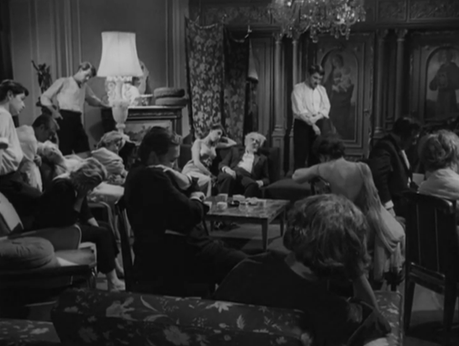
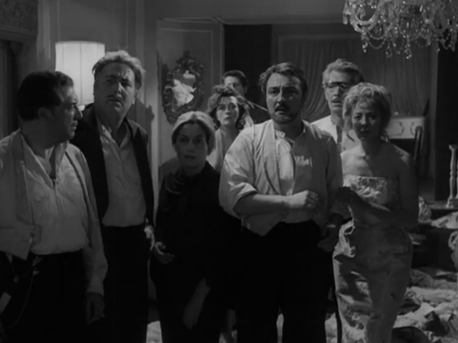
exterminating1In a sense, I’m scared to be confronted with Bunuel’s films more often than not, because even to this day they are surprisingly subversive. But with The Exterminating Angel, there is a different sort of apprehension to be faced altogether. It is a fascinating film because it shows the descent of humanistic man into the depths of his primordial nature. However, it builds off the cruelest and most interesting practical joke ever conceived. It’s played on a group of people within the confines of the frame and the audience watching in equal measures.

Of all places, it starts at a dinner party where good etiquette, manners, the upper class, and culture all collide. Luis Bunuel seems to have a preoccupation in placing his subjects around a table because really there is nothing more human than sharing a meal together. Although, he finds ways to make it interesting and in this case wickedly absurd. The table becomes an arena for gossip, loaded barbs, harbored feelings, and ruffled feathers.

It’s quick to enter an almost surreal state as all the guests are unable to leave the confines of the room. We take things for granted so easily, but in their world leaving the room is not a given, even if it seems so straightforward to us. Some force is keeping them where they are, although we never see it or hear any mention of it. Our only inference is that there is some outside force holding them there. They are literally haunted by specters with a shroud hanging over them — an Angel of Death if you will.

exterminating2This prolonged period of isolation lends itself to the degradation of all pretenses. The animalistic tendencies replace all shreds of decency. All the dirty little secrets that lurk under the surface then begin to rear their ugly heads. Honestly, it’s hard to keep them at bay in such close proximity, for prolonged periods of time, because people see the real you. It becomes hard to hold your tongue, to keep those biting words from slipping out, especially when fatigue and hunger sets in. As many of the men and women begin to falter, the good doctor represents all things rational and seemingly honorable. But when he is cast aside it reflects an end of human dignity. These individuals who were once so high, have fallen such great heights. Lambs get taken to slaughter and pipes are busted just for even the smallest taste of water.

It strikes me that this film is literally a picture of hell. No, it’s not the fire and brimstone picture we are accustomed to, but instead, it is a hell created by the individuals themselves, feeding off their own evil and pride, and accentuated by their prolonged purposelessness. Just think, it takes a woman named Leticia (Silvia Pinal), to break all her companions out of this cycle they have become stuck in. She realizes the utterly pointless loop they are caught in and breaks them out of it with a few powerful pieces of induction. Also, could there be some symbolism in her nickname “Valkyrie” (The chooser of the living and the slain)? I think so.

exterminating3They leave the room just as easily as they entered it. It happens so unremarkably in fact that some might feel duped, and I would not blame them. Why did we watch this group of socialites remain in a room for an hour and a half if they could have gotten out this easily? But if you ask this question you miss out on the whole mind-bending aspect of Bunuel’s main conceit. We cannot fully understand; we can only marvel at the fact that something that we take for granted like leaving a room, doesn’t work so simply. Do I understand it, certainly not, but it makes for an amazingly powerful and frightening study of human nature. This is also a film that does not let off. In fact, although we finish one cycle, it looks like another one is about to begin with a few clergy trapped for another inexplicable reason in their cathedral with many parishioners. Outside a riot forms as another herd of lambs makes its way to the chapel. It’s as depressing as it is funny in some unnerving sort of way. Not only has Bunuel played a joke on his characters, but his audience as well. This time I didn’t mind all that much.

4.5/5 Stars

Winter Light (1963)

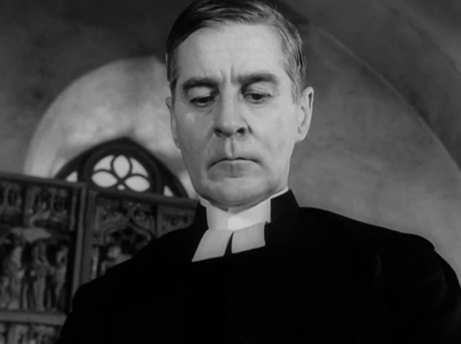
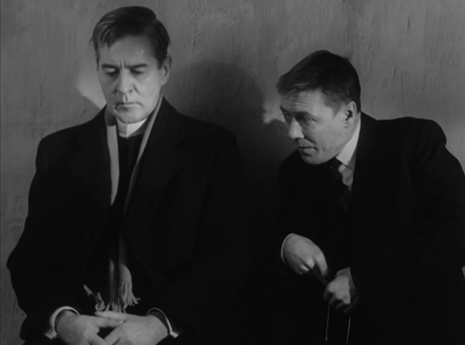
winterlight1In the second leg of Ingmar Bergman’s Faith Trilogy, he gets right to the core of all matters of faith. He takes an up close and personal look at a man of the cloth named Tomas (Gunnar Bjorstrand), who shepherds a small congregation in a rural Swedish town. Such is the life of a clergyman, as with any life, where there are rough patches and emotional highs that rejuvenate you, but mostly rough patches. In fact, he is going through such a spell when the film begins. We survey his humble little chapel, and there are only a few scattered members of the community present. Half seem disinterested and Tomas himself speaks words of spiritual truth and yet it seems like he is only going through the motions. Does he actually believe these benedictions and words that he is proclaiming? I’m not sure he even knows for sure.

He’s been withstanding a winter period of his life personified by the icy weather engulfing his humble city on a hill. It reflects his own heart and mind which are going through a season of extraordinary indifference. On top of that, he’s fighting a bad case of the flu, and he is discontent in God’s silence. Where is God? Why is He not more present in his life?  Why does he not more clearly reveal himself? Is there any power left in prayer? They are honest questions from a man struggling with faith, and it’s the epitome of an existential crisis. Bergman seems to be churning up all the thoughts creeping up in his own mind, and it’s very human — extremely honest.

Tomas has little in the realm of advice or comfort to offer his parishioners. For instance, when the depressed fishermen Jonas (Max Von Sydow) comes to the pastor after contemplating suicide, given the state of the world in the nuclear age, Tomas has little to say, because in order to encourage others you have to be encouraged. There’s nothing that can be done if the well you’re running on goes dry. You cannot sustain yourself that way. About all he is able to offer are a few downward glances because there’s no conviction left in him.

winterlight2On a personal note, Tomas lost his beloved wife and now he deflects the affections of local teacher Marta, who herself does not believe in God, but still, she loves Tomas dearly. In a deeply heartfelt letter, she confesses her true feelings for him, and he responds with very little acknowledgment. He cannot bear the townsfolk talking about them, and he still misses his wife dearly. It doesn’t help when he gets tragic news about Jonas.

Winter Light never reaches a clear conclusion, because life is hardly ever like that. In fact, there is an underlying irony that becomes apparent in this story. After Tomas lashes out against Marta and tells her to let him be, it becomes all too clear that Marta, though she does not believe in God, is in a sense, living a better life. They are both lost in the throes of winter still, but she at least has the capacity for love and vulnerability. Tomas’s apathy seems to be a far greater plight since he feels trapped in a labyrinth of idiotic trivialities, as he puts it.

winterlight4The sexton Algot brings up an interesting point about the suffering of Christ. His physical suffering must have been immense, but how much greater must he have suffered when everyone deserted him. The disciples didn’t understand a thing he said, Peter denied him, everyone else deserted him, and he was even forsaken by God. It suggests the importance of our interactions with one another. In the days of our lives, it becomes so easy to continue constantly in the endless cycle of life. Never getting outside of it and relating to our fellow man. Falling into apathy and indifference, which is especially easy when tough times hit.

Bergman does it again, delivering a film full of philosophical depth and questions that force the viewer to ruminate over their own condition, whatever their background or beliefs might be. Sven Nykvist’s photography is beautifully austere once more, and it adds a certain visual depth to the director’s trilogy. It’s stark, pure, and piercing with gorgeous shades of black and white.

4.5/5 Stars

Man With a Movie Camera (1929)

Man_with_a_movie_cameraWatching a film like Man with a Movie Camera makes me disappointed that there are not more films like it, because what it does, along with the most historically significant films of our times, is transport us to a different time and place we can never fully know or comprehend. Dziga Vertov does that with Soviet Russia circa the 1920s, and it’s pretty amazing. It doesn’t have some grandiose agenda but acknowledges flat out that it is simply an experiment. What it does so well is stripping film down to its most basic components. Consecutive moving images. The images that end up within and outside the frame.

There’s an inherent difficulty placing Man with a Movie Camera up against other films because it functions so differently. It has such vast importance on an experimental and inventiveness spectrum. It’s not a narrative that will grab hold of your interest and it’s not even made in the typical documentary form that we are used to. However, if you quiet yourself for a few moments, it really does have a fascinating quality. If we just sit back and watch, we can marvel at the little things as if we were just sitting on a bench and perhaps watching the world going by.

We see the streets of Russia in cities like Kiev and Moscow. The birds, the people, and even the movie theaters, all comprising day to day life. It actually feels rather like the German silent People on Sunday (1930), and it is crazy to think how mundane this communist society feels. Then, there are other moments that are quite invigorating or at least they get the blood pumping. Cars, trains, machinery, water, in constant fluid motion and it’s a spectacularly relentless rush.  Vertov even does some photography of athletes and sports which feels very much like a precursor to Leni Riefenstahl’s work in Olympia (1938).

There are other times where Vertov is literally playing with the medium. Playing with the film images, still images, and seemingly anything else he can think of. But he warned us beforehand so it’s quite alright. There’s double exposure, aerial shots, split screen, slow-motion, stop-motion, and probably so many other techniques and tricks that we easily take for granted.

Also, we hardly think about the pace of these images, because they feel so normal. But that in itself should cause us to stop and back up for a moment. Man With the Movie Camera has an average shot length that was unheard of at the time. Instead of over 10 seconds, it was going about 2 seconds. That’s about what you get with your average blockbuster now, but when Vertov did it, people thought it was abrasive for its sheer speed. It was different than anything they had ever been subjected to before and yet it would appear that over 80 years later we are most certainly indebted to this cinematic experiment. It’s one for the ages because even if you’re not fully captivated, it’s hard to downplay how influential this work was. It revolutionized and totally rearranged how people perceived film.

4.5/5 Stars

The Conformist (1970)

conformist3 I had never seen anything from Bernardo Bertolucci, but a few of his other films that came to mind were Last Tango in Paris and 1900. I was expecting some mix of The Godfather and Le Samourai set in Italy during the 1930s. In all honesty, those were the meager reference point I was going into this film with. In some respects, it felt like my first time with The Leopard or The Battle of Algiers, because I thoroughly enjoyed the films, but the history and backstory really eluded me. Not knowing the ins and outs, what was fictitious or what was reality, I was forced to strip it down. So even if I could not track with everything, I could appreciate it as a piece of cinema trying to paint a picture of a certain time and place.

That’s what Bernardo Bertolucci and his cinematographer Vittorio Storaro do so well, and it turns The Conformist into a visual delight. It can stand on that merit alone, depicting gray facades that are only an outer shell for beautifully stylish interiors, flooded with light and infused with colors and textures. The drawing rooms are luxurious and Paris and Rome become the perfect backdrop for a world that vacillates between the bleak and the decadent. It’s the clean modernization of this fascist society intermingled with the ways of old. Storaro on his part, even makes leaves compelling and a man walking down the street becomes fascinating with dutch angles and contorted perspectives. That’s just the visual side of this film.

conformist1The Conformist, at its core, is a character study of one man, Marcello Clerici (Jean-Louis Trintignant), who is trying to find normalcy in a 1930s Italian world that is dictated by fascism. He’s a member of the secret police, who is assigned to knock off a political dissident seeking asylum in France. The target turns out to be one of his former professors so that in itself begins a personal conflict. There is a constant clashing of the state and duty with family and kinship. But within this main objective which drives the entire story and eventually takes Marcello from Rome to Paris, there is also a lot of personal baggage to be parsed through.

Although Marcello is pursuing the professor with his comrade Manganiello, a barrage of flashbacks cast some light on the rest of his life. It develops the framework for this man, what he does, and why he does it. His mother lives in their crumbling family mansion contenting herself with the companionship of her Japanese chauffeur “Tree.” Marcello’s father is locked away in an asylum. That is his family of origin and even going back to his childhood, he was traumatized and sexually abused. Now, in the present, he tries to conduct a normal lifestyle with his fiancee Giulia (Stefania Sandrelli), but when he goes to confession on her prompting, we realize how hardened he has become. His family does not seem all that important to him and religion is little more than a social structure.

conformist5And when he finally travels to Paris with Giulia, to meet with his old professor and complete his objective, that task gets complicated when he sees Anna (Dominique Sanda). Whether they know each other from before or not is ambiguous, but what’s not ambiguous are his advances towards her. It’s another weird, twisted dynamic because she knows that he is a fascist, and Marcello knows he will soon enough have to kill her husband. His wife and Quadri’s wife get along quite well. There is no animosity there, just like there seems to be no visible animosity between Marcello and his former teacher.

Murder should not enter this equation just as adultery doesn’t seem logical. Marcello even has his doubts, but again relationships, love, and family all take a back seat to the cause, just as he takes a back seat and lets everything run their course. But he cannot maintain his perfect veneer forever. There has to be a breaking point somewhere and so there is. With the fall of Mussolini, no one wants a conformist and Marcello is stuck in this gray area.

In The Godfather, since they are in America, at least they have some corrupted notion of family and religious faith. They accept capitalism although they work outside of it at times. But in The Conformist, although Marcello likes the idea of family, he really does not desire it. He falls for another woman in lieu of his wife, and yet that woman is of little concern to him when it comes to the agenda of the state. He looks for normalcy and maybe he gets it in a sense, but underneath it lies so much pain, dirt, and corruption. Just look at Marcello. He’s a repressed, misogynistic, faithless, fascist conformist. We expect him to be like Le Samourai, and he can’t even pull a trigger with confidence. He’s a pitiful, messed-up man who has been riddled with fascism. It didn’t kill him, but it might as well have.

4.5/5 Stars

Metropolis (1927)

MetropolisposterFritz Lang’s archetypal sci-fi epic is steeped in politics, religion, and humanity, but above all, it is a true cinematic experience. It is visually arresting, and it still causes us to marvel with set-pieces that remain extraordinary. How did Fritz Lang piece together such a gargantuan accomplishment? Maybe even equally extraordinary, how was I able to see almost a complete cut of this film, which was at different times thought to be lost, incomplete, and ruined?

Metropolis really feels like one of the earliest blockbusters, although I would have to further substantiate that. Still, it’s basic story is generally captivating following a young man named Freder from the upper echelon of society with a father who runs things. This young man is really in the perfect position to succeed, the way society is set up. He even goes to the preeminent school where all the boys are dressed in white. Little does he know in the lower depths the beleaguered, grungy, weary masses in black are slowly killing themselves with work. The machine that drives this society is never satisfied, always desiring to be fed more and more and more.

When the boy finally sees the reality of the infrastructure his paradise is built upon, he cries out in horror. This is not the way things are supposed to be. He eventually switches places with one of these workers and attends a meeting deep in the catacombs (an allusion to the early Christians), where the pure goddess Maria lifts the spirits of her fellow man. But of course, the evil inventor Rotwang is enlisted by Freder’s father Joh Frederson. Their own relationship is marred by conflict over a woman they both loved. Freder’s dead mother. And so the scientist looks to resurrect his long lost love, and he needs Maria to develop his plan. He kidnaps her and from her likeness creates a double, who goes out to wreak havoc on all of Metropolis. The apocalyptic words of the Book of Revelation ring true as the whore of Babylon deceives the masses and leads them to destruction.

But Freder is the Mediator, he is the Savior of his people, and he is necessary to bring peace and tranquility to a world that has descended into such brokenness. So Metropolis is certainly a film full of symbolic touches, religious connotations, and political commentary, but all of this is developed by Fritz Lang through an archetypal hero’s narrative.

Hollywood has become an industry seemingly so obsessed with story, screenplays, plots. Certainly, a film like Metropolis is at least adequate in that area alone, but what really sets a film such as this apart is its cinematic scope. The sheer vast expanses it fills. The scope it creates through its plethora of extras and encompassing sets is hard to downplay. How to describe scenes where water is literally breaking down walls and covering masses of fleeing children? Or smokestacks spewing out refuse while trains, planes, and automobiles pass by in every direction. People scattering this way and that, following the false Maria in a chaotic frenzy. It reminds us what the motion picture, the moving picture, is all about. The images that are brought before us lead to a suspension of disbelief because more importantly they are incredibly affecting. At the atypical 20 frames per second, they are images full of tension, full of energy, and full of life.

Metropolis-new-tower-of-babelIn a sense, with Metropolis, we can easily see a precursor to Chaplin’s Modern Times a decade later. There is a general apprehension of the machine and the impact of a true industrial revolution. There is a fear that there are more positives than negatives. That machines will take over and man will become outdated. Perhaps someday our creation will destroy us. By today’s standards, such notions seem archaic, but are they? We still live in a society ever more obsessed with advancement, technology, and all the things that come with that. However outdated some of Metropolis might feel, and there are numerous such moments, at its core is the final resolution that between the body and the mind there must be a heart to regulate. We are not simply animals with bodies or rational machines with minds, but the beauty of humanity is that we have a heart, pulsing with life and vitality. That is something to be grateful for and never lose sight of.

5/5 Stars

Two Days, One Night (2014)

Deux_jours,_une_nuit_posterIf people watch Two Days, One Night, they’ll probably recognize one face and you’ll hear something similar to the following: “That’s the girl from Inception and the Dark Knight Rises right?” The more observant viewer might say something like: “Isn’t that Marion Cotillard?” And they would be right on either of these accounts and yet the Dardenne Brothers (who the average viewer, unfortunately, might not know), take Ms. Cotillard and place her in a completely different type of role altogether. They take an A-List Hollywood star and drop her in the every day, lower class world that the brothers themselves came out of. In fact, the story and most of their stories are set in Seraing, a French-speaking area of Belgium that is known for industry.

They have an immense fascination in simple people just trying to make ends meet. Most of their stories have mundane narratives like The Kid with a Bike (2011), and Two Days, One Night is little different in that respect. It’s so basic in conception and yet in this banal and rough-edged world, the Dardennes find immense beauty.

Our chief subject is Sandra, a young woman who is married has two kids and has just battled her way back from depression. Undoubtedly it was a tough road, but she is obviously resilient and ready to get back to work. After all her family needs the money because her husband only works at a restaurant. But her whole reality is changed in a matter of minutes when she learns she will be laid off. Her company can either keep her on or give all their other employees bonuses. The majority took the bonus over Sandra. Her work friend Juliette buys her another ballot for the following Monday, so Sandra has a few days to try and plead her case. But she’s done fighting. She’s tired and defeated before she begins. It’s her husband Manu who urges her forward and reluctantly Sandra follows through.

This is the core of the film as Sandra goes from home to home, ringing doorbells, and talking with the people hidden away in their homes. They are no longer her faceless colleagues, but soon they become living, breathing people. Just like Sandra, they have a personal stake in this decision. Maybe it’s to pay for a daughter’s schooling, remodeling a home, or trying to stay afloat as a single parent. There are those who are simply fearful of being laid off and those who hope that Sandra will succeed while admitting they’ll vote for the bonus. They all seem like generally legitimate responses, and Sandra knows that just as we do, but she tries anyway, at least to talk with them–get them to see her side. Because this decision has major repercussions, and it’s not just occurring in a vacuum.

Things are teetering dangerously on the edge of equilibrium for everyone involved because everyone seems to be between a rock and a hard place. And there’s no difference between Marion Cotillard and all these other unknown actors. They’re all bracing themselves for sinking in the same boat.

In a way I found myself comparing this film to the courtroom drama 12 Angry Men because in a similar manner Sandra must go about trying to convince her colleagues to change their minds, and talk them out of their convictions. It’s a difficult task, and this film speaks to the logic and rationale that dictate human decisions. There are individuals all across the board from those who only are looking out for themselves. Is it too hypocritical to call them selfish? It’s hard to know. There are those who want to good, but just cannot, and finally those who stand by Sandra, because they feel it is the right thing to do. The most painful of these interactions occur with those colleagues, who are so conflicted inside. You can see the situation at hand tearing them apart.

Other directors would be terrified of such a film, looking to fill slow moments with some kind of heightened state of action. The Dardennes are content with having their actors rock out to Them’s “Gloria” after a long day. And true, there are many moments of tension and even conflict, but most of this film is about people talking, mirroring the rhythms of real life. The camera is constantly by Sandra’s side, peering at her face, and staying on her hip. Her face has to carry some scenes at times, and it does so wonderfully. Really, this is a film that displays her resilience, grit, and determination to push forward. It had the potential to be either feel-good drama or a tragic story, but it finds a beautiful middle ground. Sandra comes out an undisputed winner, just not in the way that she expected.

4.5/5 Stars