High Sierra (1941)

high-sierra-1They Drive by Night is a surprisingly engrossing picture and I only mention it for its obvious relation to High Sierra. It came out a year earlier, helmed by Raoul Walsh starring George Raft, Ann Sheridan, Ida Lupino and, of course, Humphrey Bogart. The important fact is that if Walsh had gotten his way, he would have cast Raft again as Hollywood’s perennial tough-guy leading man.

But Bogart saw what this film, based on the work of W.R. Burnett, could do for him and he talked Raft out of the part while lobbying Walsh for the role. Reluctantly the director agreed and as it turned out it was the perfect vehicle for Bogart’s big break as he had foreseen.

High Sierra functions as a crossroads of sorts between America’s standard genres. There’s no question that Roy Earle is a gangster in the former sense of the word. And even as an actor Bogart was used to playing second fiddle to the likes of the Cagneys, Rafts, and Robinsons. But if there was ever a poster boy for the emerging film-noir movement Bogart is the shining example carrying that tough as nails persona from gangster films but also functioning as a fatalistic antihero in the same sense. We see it with Spade, Marlowe, and all the rest. Also, as an early heist drama, High Sierra ushers in a trend that would be explored further in films like The Asphalt Jungle, Kansas City Confidential, and The Killing (notably all gritty cogs in the film-noir canon).

To understand what Bogart saw in this picture and to comprehend what a lynchpin it was, it’s necessary to delve into the story itself penned by Burnett and Bogart’s long time future collaborator John Huston.

Veteran gangster Roy Earle (Bogart) has just earned a government pardon with a little help from a powerful friend. It’s this aged gangster from the old days Big Mac who pays his loyal henchman a favor so he can run point on a new bank job. Big Mac is on his deathbed and the changing of the guards seems all too imminent, still, Earle is beholden to him. He’s a loyal son of a gun and tough as all get out. He’s not about to trust a copper and just about scoffs at the men who are supposed to help in pulling off the job.
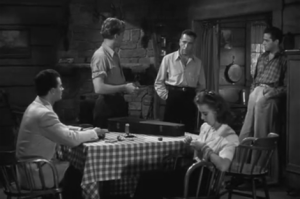
high-sierra-3He’s not about to lose his nerves or take his eyes off the objective but the two young bucks he’s thrown in with (Alan Curtis and Arthur Kennedy) carry the tough guy bravado well but there hardly as experienced as him. He’s not too happy about the girl (Ida Lupino) they have hanging around either because she’s an obvious liability. In his experience, women squawk too much. The man on the inside (Cornel Wilde) is even worse, a spineless hotel clerk with even less nerve.

Earle’s philosophy is nothing out of the ordinary. It’s what we expect from a gangster picture. However, there are several elements to suggest that we are on the brink of a new movement to reflect the changing American zeitgeist. High Sierra is actually composed of a great deal of on location shooting throughout the Lone Pine area that adds a layer of credence to this entire tale but also a certain visual tranquility. And although it’s difficult to know precisely how much involvement Huston had on the script, there’s no doubt that his impact on noir was crucial with The Maltese Falcon released the same year.

But the bottom line is Bogart’s character has another side. With the gears of the heist in motion, he wryly notes, “Of all the 14 karat saps, I start out this caper with a girl and a dog.” And it’s true he has a certain soft spot for Marie Garson, and the yippy dog Pard (Bogart’s own pet Zero) but that’s not the extent of his character. In the stories most striking B plot, he befriends a trio of poor country folk led by their patriarch the always amiable Henry Travers and important to Roy because of their pretty granddaughter (Joan Leslie) who also happens to be a cripple.
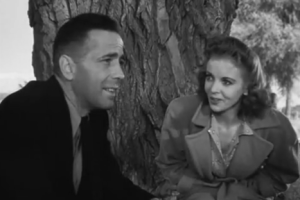
high-sierra-2In an unassuming act of charity, Roy has a doctor friend take a look at Velma and ultimately pays for the surgery that heals her ailment completely. Still, if the story ended there it would be a happy ending but with the heist in the works, Roy is not so lucky. He pulls off the job and makes his getaway but with most any cinematic criminal activity in Hollywood’s Golden Age there must be repercussions. After all, that’s what keeps things interesting and it’s true that Roy and Marie are able to lay low for a time but soon the word is out and the gangster is a wanted man.

Walsh orchestrates the tense finale stirringly in a way that still has the power to excite with editing, score, and camera all flowing seamlessly for the most crackerjack of endings. It’s true that big shots are brought low and the irony was that it was hardly a woman or a dog that caused his downfall. It was himself. In those faltering moments, Bogart won his audience over as a leading man and would never lose them again. Certainly, we have the rather unfair added benefit of hindsight, but High Sierra stands as a monumental picture.

4/5 Stars


Baby Driver (2017)

Baby_Driver_poster.jpgEdgar Wright has a reverence for movies, he knows his movies, and when he makes his own movies there’s always an inherent understanding of the cinematic landscape–taking what’s already been done and proceeding to add his own affectionate spin on it.

There are aspects of his filmography from Shaun of the Dead (2004), to Hot Fuzz (2007), and Scott Pilgrim (2010) that are familiar but you can never accuse him of being derivative because he seems fairly incapable of that mode of filmmaking. Coming from such a tradition of off-kilter modern classics, it’s no surprise that Baby Driver is far from your typical heist film though it boasts both cars and crime in equal measures.

Part of what sets it apart is a soundtrack, something that has been put back in vogue recently by films such as Guardians of the Galaxy. It reflects how popular music can replace a score by tying itself so closely to the plot and the most important elements of its characters so much so that it becomes vital even to the narrative arc.

In this case, it involves Baby (Ansel Elgort) a young getaway driver plagued by the memory of a life-shattering car crash, one of the many traumas being tinnitus, a ringing in the ears that he helps to alleviate by constantly blocking it out with music. Thus, he can be found with a ubiquitous pair of earbuds tucked into his auditory canals ready with an iPod Classic full of tunes for every occasion (He even has a pink one with sparkles).

Of course, his driving songs prove to be the most important and he uses music to keep himself in the zone when he’s making the getaway. What helps him concentrate proves to be an equally thrilling experience for the audience, immersing us in the action in the most utterly electrifying and crowd-pleasing way possible. Cars swerving this way and that down the busy urban jungle of Atlanta with retro tunes blasting in surround sound. If that doesn’t epitomize a summer blockbuster than little does.

Criminal types including a psycho killer named Bats (Jamie Foxx) and an armed and dangerous couple Buddy & Darling (Jon Hamm and Eliza Gonzalez respectively) are only a few of the colorful figures Baby falls into company with. Doc (Kevin Spacey) is their contact who runs all their operations with a plethora of inside contacts and a dry no-nonsense precision. He trusts Baby because he’s never steered him wrong. But it does beg the question how did this young man get himself into this life?

Because when he’s off “work” he spends time caring for his deaf foster father (CJ Jones), mixes audio cassette tapes out of his bedroom and frequents the local cafe that his mother used to work at. There’s also a waitress (Lily James) in said diner who intrigues him and brings him out of his shell with genial vivacity.  They share music as much as they share aspirations and mundane conversations.

But the danger is that the soundtrack becomes a gimmick and it’s true that Wright does a couple of no-nos including having his characters meet and subsequently fall in love over music, namely Carla Thomas’s 1966 hit “BABY” and Beck’s “Debora.” That’s an unforgivable cliche and yet we still want it and in his very best sequences he builds around the cadence and rhythms of the complementary songs that fit immaculately with the editing too. Whether a jaunt to grab coffee, the mundane creation of a peanut butter sandwich or a car chase, each becomes like a musical dance that’s surprisingly fresh.

If the genres of musicals and chase films ever had a point of intersection it would be Baby Driver. These opening moments have the energy of a Gene Kelly musical or even this past year’s La La Land pulsing through them. But it’s equally indebted to the heritage of The Driver (1978), Drive (2011), and of course the king of the heap, Bullitt (1968). The bottom line is that there is a care to deliver the goods as expected and have fun while doing it. There’s something refreshing about practical stunts that don’t utilize CGI and nevertheless manage to feel all the more exhilarating and real. There’s no question that this is an action film. But an action film set to the beat of the music.

Unfortunately, after setting such a fascinating groundwork for a film and delivering on a concept that seems admittedly absurd at times, it does feel that Baby Driver descends into utter chaos–action film hell if we want to coin a term–full of profane violence. No longer does it fully utilize the concept that it was built around or the engaging methods it initially used to draw the audience into yet another colorful creation of genre fiend Edgar Wright.

It’s as if the final act of the film doesn’t quite know where to go. The characters start to deviate from the axes that they have been moving on thus far. Not unsurprisingly Buddy is bent on getting revenge on Baby but Baby also shows a darker side without much provocation and Doc suddenly becomes a romantic sticking his neck out for the young lovebirds. There’s a certain amount of confusion on what direction to go next.

However, you could easily make the case that these developments are simply mirroring reality for a getaway driver, especially one as young as Baby. This is partially a tale of maturation. Losing innocence and trying to find it again without completely blocking out the world around you. In the end, the film settles down just enough into a conclusion that fits the parameters set up in the beginning. It’s lifted from the bloody wreckage and actually slows down long enough to ground itself in its characters once more as stylish and satisfying as ever.

4/5 Stars

Kansas City Confidential (1952)

KCConfidential.jpgSaying that Phil Karlson has a penchant for gritty crime dramas is a gross understatement. And yet here again is one of those real tough-guy numbers he was known for, where all you have to do is follow the trail of cigarette smoke and every punch is palpable–coming right off the screen and practically walloping you across the face.

Like all heist films, there must be a point of inception, however, Kansas City Confidential finds its story after the crime has been committed and the perpetrators have split up without a hitch. The man who takes the heat, their fall guy and the unsuspecting stooge is Joe Rolfe (John Payne who is adept at playing such roles) a nobody truck driver and a convict once upon a time.

It seems like the perfect crime as the three hired hands all wore masks and had no connection to each other, except for the stocky and demonstrative Mr. Big, the mastermind behind the whole operation and the one calling the shots. He sends each man off with enough money to tide themselves over until he contacts them to reconvene for their big payoff. Whether or not he will actually cough up the 300,000 clams he owes each of them is quite another story.

Still, each man heads his own way and Joe is getting grilled by the cops day after day in the hopes that he will crack. Finally, he is released, but with no prospects and no job, he sits in a bar stewing in his anger. The story takes it’s next big turn when he follows a lead down to Mexico to tail one of the hoods in on the job Peter Harris (Jack Elam). And although Joe is going in blind, he soon catches wind of the impending rendezvous in Barados and decides he’ll just show up as well, to get to the bottom of the entire mess.

It’s there where he first crosses paths with two other leering hoods, the beady-eyed Tony Romano (Lee Van Cleef) and the silently brooding Boyd Kane (Neville Brand). However, while keeping tabs on these cronies, he keeps company with a budding lawyer Helen Foster (Coleen Gray), who has come to call upon her protective father, the former policeman Tim Foster. If this set up isn’t plain enough already, it certainly becomes increasingly interesting as the gears continue to turn towards the story’s inevitable climax.

Most certainly Kansas City Confidential boasts jarring close-ups, low budget facades and perpetually sweaty faces that accentuate its unsentimental noirish qualities. However, Coleen Gray acts as a more enlightened noir heroine, who does not grovel for her man or weep incessantly at the thought of danger. Instead, she’s training to be a lawyer, and rational but still unequivocally kind. Despite not having a proper meet cute, the chemistry between Gray and Payne still works surprisingly well.

What makes the film inherently more interesting is how the crime is embroiled with family issues. Because, as an audience, we know Mr. Big’s identity: a corrupted cop who got a bum steer and now is going to reap the benefits of setting up some real losers. Still, that doesn’t excuse what he did and Joe got dealt a similarly sorry hand. The fact that Foster’s daughter is involved sheds him in a more humane light and in the same instance makes Joe a more likable figure. In many ways, she brings out the best qualities of both these characters. It’s the darker recesses that lurk behind their characters. Those are made more evident by the likes of Lee Van Cleef, Jack Elam and Neville Brand, a real rogues gallery of baddies if there ever was one.

4/5 Stars

How to Steal a Million (1965)

220px-HowtostealamillionHonestly, the main attraction of this film is its leads in Audrey Hepburn and Peter O’Toole as well as its director, the great William Wyler. Otherwise, this film is a fluffy, silly caper comedy with a touch of drama. It falls somewhere in between a rom-com and an art heist film where everyone in Paris speaks English. Go figure.

Nicole Bonnet’s (Hepburn) father Charles is a master forger of all types of art which he supplements his own vast collection with. Many of his pieces have been sold for a pretty penny at auction, and he has yet to be found out.

He loans out a family heirloom, Cellini’s Venus, to a local Parisian museum for a large exhibition. Meanwhile, Nicole catches someone in the act of burglary and it ends up being a handsome young gentleman (Peter O’Toole).  She is given a fright but ultimately is taken by the man who hardly seems the thieving type. She lets him go without calling the police even giving him a ride home.

Eventually, they cross paths again and she recruits him to help her steal Cellini’s Venus from the museum. She doesn’t tell him why, but she has her reasons and he willingly obliges. It’s all good fun after all.

The caper scenes are no more harrowing than the rest of the film. In fact, it gives the perfect setting for more comedy as the two burglars get locked in a broom closet together after closing time, while also repeatedly setting off the alarm. But it’s all part of the man’s plan, because, after all, he’s a professional. And their plan works. They get away with the statue and the following day the news spreads like wildfire.

In the end, Nicole finds out that Simon Dermott is actually a private eye specializing in art and criminology. He’s no thief and so this was his first heist too. She thinks she’s in for it now, but they’re too in love for that to matter. He explains himself to Mr. Bonnet who reluctantly agrees to end his forgery career on top.

The two lovebirds drive off madcap down the streets of Paris with a beautiful life ahead of them. There’s not much else to say except Hepburn and O’Toole are fun together, while the score of a young John Williams has a recognizable bounciness. Hugh Griffin seems slightly miscast to be Hepburn’s father, and the film is far from pulse-pounding, but these small facts do not negate from its overall charm.

3.5/5 Stars

Review: The Killing (1956)

e4855-thekilling1Stanley Kubrick is one of the most acclaimed directors of all time, and The Killing is his first great film. The main focus of the action takes place at a racetrack, but a great deal of the story occurs in other places before and after the job is pulled.  Recently released Johnny (Sterling Hayden) is the mastermind behind an intricately planned job. It’s a whole complex jigsaw puzzle involving a few “Average Joes” and a couple professionals. When you put it together it all adds up to the perfect heist.

Marvin is a friend of Johnny’s and a fatherly figure who is backing the deal. George (Elisha Cook Jr.) is the paranoid window teller banking on the job so he can hold onto his shallow wife. Randy is the policeman who is set to pick up the plunder. Then, Mike is the bartender who is supposed to help with the distraction. Johnny lines up the brawn, Maurice, to start a fight at the race track with Mike. He gets a sharpshooter named Nikki to bump off a horse and it’s all set. All their plans revolve around the Seventh Race, and they have it planned out to the minute. The beauty of The Killing is that it all but works like clockwork. The horse is shot, the brawl does its job, the vault is cleaned out, and the money gets picked up. Only a few small problems crop up.

After the job is done is another matter, as the perfect timetable begins to break down. In a matter of seconds, things blow up thanks to George’s backstabbing wife (Marie Windsor). Soon the carnage is strewn all over the floor. Johnny holds onto the money as previously decided since things go awry, and he makes the getaway. His girl (Colleen Gray) is waiting at the airport and it looks to be smooth sailing from here on out.

Thanks to a yippy dog and a precarious perch, the money-laden suitcase takes a tumble and the contents fly off. All too soon it’s raining money, and there’s nothing Johnny can do about it. He leaves the terminal with Fay, but with no taxi to be had, he gets nabbed and there is no chance to escape. After everything lining up so perfectly for him, in a cruel turn everything that could go wrong did. He was not going to be so lucky.

The title of this film always struck me as ambiguous, whether it meant the amount of money being taken or the deaths that take place I’m not sure. However, I do know that The Killing is tautly constructed. The non-linear and sometimes overlapping narrative is held together by the narrator. He seems fit for a newsreel, but he complements the straightforward procedure of the film with timestamps included.

Because of the lead performance of Sterling Hayden and the main plot element of a heist, this film can sometimes be confused with John Huston’s The Asphalt Jungle (1950). However, I enjoy this storyline more because the heist is not the issue. It is the aftermath and all the subsequent problems occurring so rapidly.

It is a wonderful unraveling thriller and although we do not see Johnny arrested, he might as well be because there are two men with pistols drawn walking right towards him. The Killing was not a big payoff for Hayden’s character, but it certainly is for the audience.

4.5/5 Stars


Le Cercle Rouge (1970)

LecerclerougeDirected by Jean-Pierre Melville and starring a cast including Alain Delon and Yves Montand, this crime film hearkens back to heist films such as The Asphalt Jungle, back in the 1950s.

In a cold open, two storylines are introduced. One man, Vogel, is in custody and is handcuffed to a policeman as they board a train. At the same time, a man named Corey is let out of prison, on good behavior, and he is tipped off on a possible heist job. In both cases, we have little background information to go on. Then, Corey pops in unexpectedly on an old mob boss and forcibly “borrows” some money from the man, who has also stolen his girl. He buys a new car and throws off a couple of thugs who were sent after him. As the morning dawns, the captive on the train makes a daring escape and flees into the nearby forest. Soon roadblocks are set and the manhunt begins. He desperately gets into an open car trunk to hide, ironically it is the same car of the man, who was recently released.

However, he was noticed and Corey tells him to get out of his hiding place.  Vogel is tense but his cool and collected acquaintance helps him sneak through a checkpoint noting that Paris is his best chance of escape. Corey is chased down once again by Rico’s henchmen, but Vogel sneaks out and comes to his aid. They head to Paris and find a sharpshooter to case the jewelry store and help them with their plan. The police detective is still searching for his quarry, and he tries to enlist the help of a crooked club owner. Meanwhile, the plans are made, and the heist is pulled off with great precision and efficiency. They get away with the jewels smoothly enough. However, the marksman settles to take no part of the plunder, and their initial buyer falls through. Relatively quickly there is a new person interested, so Corey takes the goods to him. Only too late Vogel comes to warn him, and just like that, they must flee the premises with police all around.

Much like Le Samourai, this film gives off an extremely cool vibe, and it makes it all the more enjoyable to watch. Alain Delon is such a smooth operator, and whether it is the way he dresses, talks, smokes, or pulls off the heist, it cannot be easily dismissed. However, the other main players give serious and nuanced performances of their own, which cannot be overlooked. Melville makes all of his scenes so interesting, through the setup and the fashion in which his characters go through the world of the film. His characters act in the mode of behavior that they believe is correct and most are rather taciturn and guarded. I cannot decide if I like Le Samourai or Le Cercle Rouge better, but it must be said they are in a special class of crime films.

4.5/5 Stars

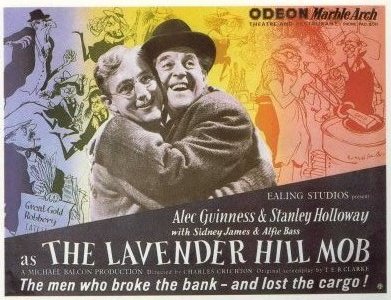
The Lavender Hill Mob (1951)

1dadb-the_lavender_hill_mobStarring Alec Guinness and David Holloway this Ealing Studios comedy-heist film begins with an older man recounting how he got away with a large amount of gold bullion. His job had been to ride with gold shipments while they were transported. However, soon he met a quirky fellow partial to art and together they devised a plan to get the gold. They enlisted the help of two small-time criminals. The day of the caper was far from smooth and they must improvise. With luck they get away and the two instigators take their prize to Paris. There they have disastrous results and arrive back in England eventually to even more craziness. This film had endearing characters and its share of comical moments. If you pay attention you can see a young Audrey Hepburn for a blink of an eye near the beginning too!

4.5/5 Stars

The Asphalt Jungle (1950) – Film-Noir


* May contain spoilers
Directed by John Huston and starring an ensemble cast headed by Sam Jaffe and Sterling Hayden, this was the first great noir heist film. Jaffe has just recently been released from prison and he has contrived an intricate jewel robbery. He teams with a multi-talented safe cracker, a small time thug with dreams of owning a farm, and an invalid driver. The whole operation is to be backed by an attorney who is in a difficult situation. Initially the procedure begins well enough but soon things go haywire with alarms, misfired guns, and then police. Now Jaffe is wanted again, Hayden is slowly dying, a bookie loses his nerve, and the attorney tries to pull a fast one. The perfect conception turns out to be far from it in the end. This film reminded me strikingly of The Killing which I saw earlier. Both are heist films starring Hayden and they end disastrously. For her part Marilyn Monroe steals the screen in her first prominent role which was a foretaste of what was to come.

4/5 Stars

The Killing (1956) – Film-Noir

1eadc-thekillingposterkubrickDirected by Stanley Kubrick and starring Sterling Hayden, the film follows a group of crooks and everyday race track workers who carry out an intricate robbery. In the planning stages they have everything figured out completely with one small disturbance. When the day arrives, the plan begins as expected. Each man takes his place in order to do his part. Perfectly coordinated with a disruption in the race and a planned riot. Hayden grabs all the money he can and drops it to an accomplice with hardly a snag. While waiting to split the heist there is finally a wrench in the plans that turns fatal. Hayden catches wind of it and splits as was decided beforehand. With his money and his girl he gets ready to leave the trouble behind him. In a final cruel twist of fate his plan is accidentally uncovered. The shock takes all the fight out of him. This film is wonderfully constructed with its different point of views all hinging on race #7 and the subsequent “killing.”

4.5/5 Stars