
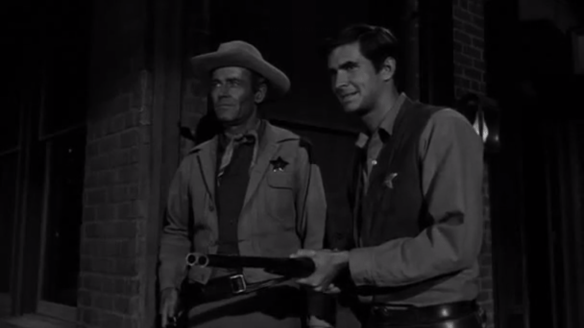
“You can master a gun if you have the knack. Harder to learn men.” ~ Henry Fonda as Morgan Hickman
A veteran bounty hunter rides into town with a corpse slung over the rear of his horse and gets the whole town gawking. They don’t quite fancy this entrance because they’re about law and order in these parts. Paid guns have no place in the western utopia that they have envisioned.
Obviously, no one in town wants to house such a reprobate and he has no place to bed down his horse at the livery stable either. Finally, he finds room and board with the only folks who have enough congeniality to welcome in a man like him. Because in one sense they are ostracized too, living on the outskirts of town as local pariahs. The single mother Nona (Betsy Palmer) gets by doing needlework in the evenings and trying to keep her son out of mischief. He’s half-Indian. Hence the reason no one wants anything to do with them.
But in this man who seems little more than a hardened killer, they find someone genuine and compassionate when you get to know him. Though initially surprised by the boy’s paternity his kindness doesn’t slacken admitting only that many others grow up hating Indians. They are preached as much by their parents and take it to heart so they can’t hardly change their ways. It’s unfortunate.
I’m not sure if I dare use the term “revisionist western” lest viewers get the wrong idea but seeing of all people gun shy Anthony Perkins as sheriff over a town you realize that something is gravely different with the film’s character types — at least this crucial one. His skittish nature is perfectly-suited along with his boyish looks because, as he soon learns, being a sheriff is not only about what you do but how you look doing it. Being smart, working your mind, and projecting a certain image.
At first, Ben Owens (Perkins) is like everyone else. He sees Hickman only at face value. But soon he gathers there is much to glean from this veteran who is handy with a gun and holds a wealth of knowledge. Most impressively he’s lived long enough to talk about it and that means he must be a pretty smart fellow. He’s become well-versed in human nature.
He looks at Owens, a young gun beholden to the duty thrust upon him, and he sees a dead man walking. He’s not going to last long. Hickman knows it. Ben’s girl (Mary Webster) knows it. Perhaps deep down Ben knows it too.
Finally, he asks the bounty hunter to be his mentor and reluctantly Morg agrees to it because his pupil still has his training wheels on as it were. He’s not ready to stand down the town or confront a hulking heavy like the local bad boy named Bogardus (Neville Brand).
One of the film’s finest creations is the local Doctor Joseph McCord (John McIntyre) who not only pulled strings to get Mrs. Mayfield work but he is keen to play matchmaker with two of the fast-growing babies he brought into the world. Indeed he is well-liked by all on every side.
Mann pulls another stunt, not unlike the one in The Far Country (1954) with the Doc making a grand entry with his horse into town to much fanfare on his birthday. It’s one of the film’s most indelible sequences.
A pair of half-breed brothers are also on the lamb and wanted for a couple of crimes. Bogardus gathers a mob of his own to go after them. But begrudgingly following the advice of Morg who has remained hands-off, the Sheriff decides to track them alone.
Morg lingers behind and ultimately ends up being the one who smokes them out without any bloodshed. He delivers the McGaffey Brothers (including Lee Van Cleef) over to the Sheriff so that justice can be implemented first in the jailhouse then in the courtroom.
But that is just the beginning. The final act takes on an uncanny turn toward a High Noon-like allegory. One man faced with a major opposition and yet resisting to back down. But whether or not that motif is McCarthyism incarnate or not, Mann’s handling of the sequence is arresting.
He sets up the action in such a way that we are standing behind Perkins peeking past his solitary frame. He’s unimposing and spindly standing there on the jail steps with his shotgun but he is a better man than me. The question he must grapple with is where the line between a good man and a dead one exists. Sheriffing is a nervewracking business and most men die young in such an occupation. Mann makes us comprehend exactly why that is.
And yet, in the end, it’s all for naught as the picture collapses too easily lacking that typical hard-edged savagery of Mann’s other pictures with James Stewart. While Dudley Nichol’s high-minded script might be quality stuff for a minor picture, it’s not necessarily the script best-suited for Mann.
He was never one for moralizing. In fact, his best films about isolation or outsiders never seemed to make a point of a racial divide or any other societal issues. It felt like they were very much implicit in the story at hand. They never were didactic instead choosing to viscerally speak to us delivering any themes through mere osmosis.
By no means does that downplay the fine chemistry between Henry Fonda or Anthony Perkins both seemingly impeccably cast. However, The Tin Star is a picture that could have been even more resonant.
3.5/5 Stars
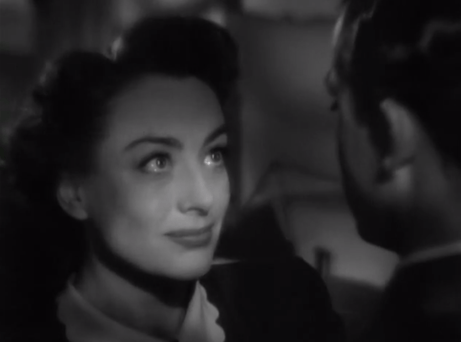
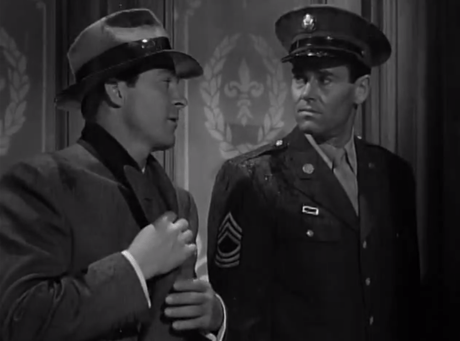
 This is an Otto Preminger film about politics. That should send off fireworks because such a divisive topic is only going to get more controversial with a man such as Preminger at the helm — a man known for his various run-ins with the Production Code. All that can be said is that he didn’t disappoint this time either.
 “You have the darndest way of bouncing a fellow down and bumping him up again” ~ Henry Fonda as Charles Pike
 In fact, we have a brilliant introduction to her as she narrates the scene unfolding in front of her with the aid of her compact mirror. She trips up the bumbling bachelor and their introduction is the first exclamation point in a bumpy relationship. She’s ready to play him and marry rich and famous, because he’s a pretty naive fellow, and stiff around the ladies. Fonda’s nervous charm proves the perfect recipe for success as he is constantly being overwhelmed by Stanwyck’s frenetic barrage. His defenses are down and he hasn’t the foggiest what has hit him. Either he was really that uncomfortable or otherwise, he does a superb job of faking it since there’s never another moment where he’s not being fondled or manipulated.
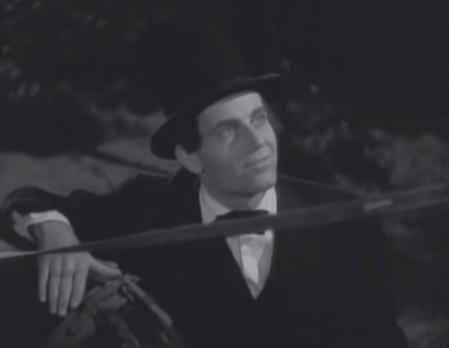
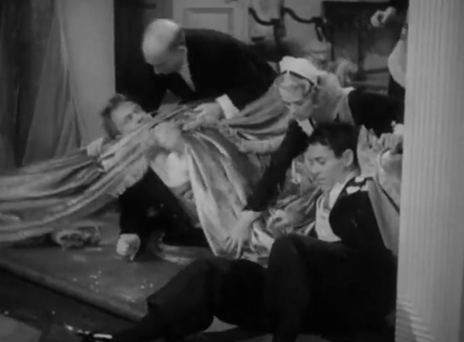 The story could end there, but Sturges has set his story up perfectly for a killer second act. Jean plans a perfectly sneaky revenge plan to get back at “Hopsy” by posing as the British niece of another con man (Eric Blore). He uses his own wily charm and influence to get them an invitation to the Pike household for dinner. There we see several other great character actors in action including Horace Pike (Eugene Pallette), and the perennial sourpuss Muggsy (William Demarest). Jean shows up now as the Lady Eve and successfully convinces her “Hopsy” that she is a completely different individual. The film works wonderfully on this axle of ludicrousness because young Pike is completely befuddled and awestruck again. He goes thudding, clanking, and crashing all evening long, a true victim of love. Pike thought he lost one girl for good and here’s another even better prospect. A whirlwind romance follows and everything is falling into place beautifully. There’s a frantic montage in preparation for the big day and then it happens. They get hitched. Afterwards, it’s all done and the two lovebirds are on a train barreling down the tracks interspersed with the long laundry list of all Eve’s beaus from Angus, to Herman, and Cecil and so on. It’s Charles’ worst nightmare, and he hopes to get out of it as quickly as possible.
 What makes Sturges’ film so wonderful is all the parts making up the whole. His script is perfectly contrived mayhem. He sprinkles it with his typical slapstick, his loudmouthed stock company lends an added layer, and his typically lightning-quick repartee is brought to life by his leads. Stanwyck was the quintessential leading lady of the 1940s and in 1941 she was in fine form (Balls of Fire and Meet John Doe). She can dance so effortlessly between dynamic comedy to heartfelt drama that is positively palpable. She overshadows Fonda in a sense, but they still work together, because he is her perfect foil, the precise innocent fool to fall into her web of feminine wiles. She can muss up his hair, manhandle him, and completely manipulate his feelings. Yet we still like both of them in spite of it. They are a hilarious match, and there’s space for some passionate canoodling as well. It’s probably one of the most perfectly wonderful, utterly dysfunctional relationships we could ever hope to see put on screen. By continually whipping out punch line after punch line to the very last quip, Sturges makes this comedy look positively effortless.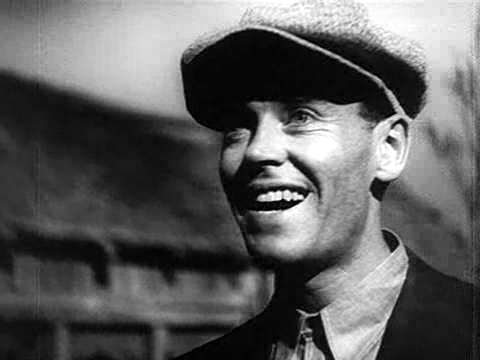




 4 Star Films