
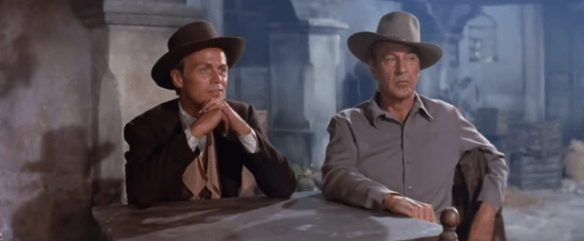
It does feel like one of the grand old westerns we left behind in more recent years. It’s a big picture in the horizontal majesty of widescreen, Glorious Technicolor, backed by the only score Bernard Hermann would ever arrange for the West. There’s little doubt we are in for a spectacle of the highest order.
Maybe Richard Widmark doesn’t look as good in color as the shrouds of noir, but he can act. Here he’s a poker player who fancies himself a poet on the side. As he gets off at an isolated Mexican outpost, he’s yakking away to the typically taciturn Gary Cooper. The taller fellow plods by his side quietly amused by everything coming out of Widmark’s mouth.
They are joined by a third man (Cameron Mitchell) biding their time en route to the goldfields of California by listening to the floor show (Rita Moreno) at the local cantina. I do relish films that take place in multiple languages; perhaps it humbles me. Because as I’m no longer living near a Latino community and I haven’t studied in a long time, my Spanish is rusty, so I can only pick up bits and pieces. I am at the mercy of others.
But it also means Gary Cooper can pay a major service to the audience. He translates for us and with that comes an added depth to his character. He’s knowledgeable and must have been around. How does he know the language? We don’t know right off so it teases us to stick around in order to find out.
It’s quite relaxing until Susan Hayward bursts in on the men, effectively dropping the whole reason for the picture right in their laps. An adventure is afoot, and they take it up with few reservations. It doesn’t seem to cross their minds to question any of it; the compensation waved in front of them is high enough. Maybe they maintain their own private reasons. Soon they’re journeying through a mountain pass in order to help save the woman’s stranded husband (Hugh Marlowe).
A perfect moment on the road — making sure we’re aware of the stakes — features a dislodged frying pan clattering down below, ricocheting off the rock faces, and echoing through the canyon as it makes its descent.
As things progress, it becomes apparent the fine line between brooding and dull is a difficult one. It certainly is, more often than not, a slow burn with Widmark waxing philosophical and Cooper projecting an air of constant clear-sightedness about the world. He never loses his head. The rest of the time we’re waiting for something.
The confrontation between Hooker (Cooper) and the hothead Daly (Mitchell) is a particular sequence to relish as the young gun not once, but twice, is sent somersaulting on his back — his butt nearly putting out the fire and getting singed as a result. By the end of his drubbing, he’s practically rolling in it, and he’s been made to look terribly foolish.
But like Way of The Gaucho, the on-location shooting is what the movie can boast about the most. The action is middling and dull at best, because it’s a long haul to get a payoff. We are waiting for things to come to a head and while Indians are said to be brewing up in the hills, they only show themselves briefly.
Oddly, Susan Hayward is thanklessly cast as the villain-turned-hero. Maybe it has to do with the time the picture came out since she hardly gets the delicious part of a femme fatale. More often than not, she feels like a scapegoat, that is until everyone realizes how faithful she is. It’s too little too late.
By the end of the story, the emotions lack resonance, because they haven’t built up into anything truly believable with continuity we can easily trace. It does feel a bit like running through the paces just to get to the marks, and it’s difficult to say given the talent on hand. They are a fine host of actors.
It’s possible to cast a bit of the blame on Frank Fenton’s script, which has fun with some dialogue — getting a bit profound about male avarice and passion — while supplying the actual plot little meat.
Gary Cooper and Richard Widmark too were always men of action, but there’s not enough here for them to accomplish. By the time they have chances to do what is purportedly brave and heroic, the deep recesses of meaning looking to be excavated are hollow — even strangely so, because we truly want there to be more, and there isn’t.
3/5 Stars
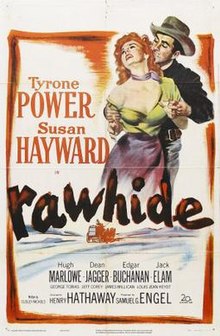 Though it’s easy for this film to be overshadowed by Clint Eastwood’s Rowdy Yates, in retrospect, Rawhide is a spare outpost western nevertheless loaded with tension and talent. It is set against the backdrop of a network of stagecoaches transporting mail across the continental United States.
 Rainbows, the soft misting of waterfalls, and honeymooning couples going through the tunnel of love. It hardly feels threatening at all, but that’s what makes film-noir so delicious. As the film style most reflective of the human condition, it proves that the dark proclivities and jealousies of the human heart can crop of anywhere–even a gorgeous tourist trap like Niagara Falls.
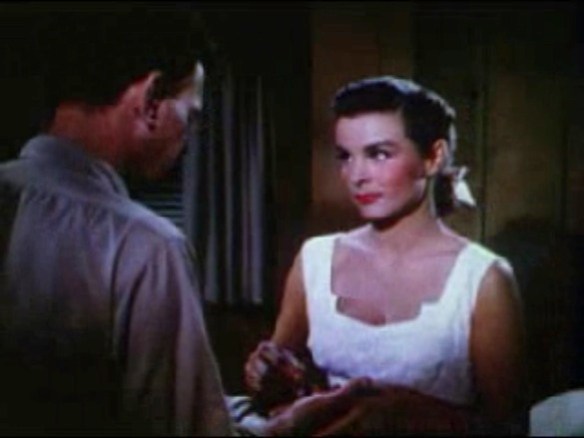 Without a question, Jean Peters becomes our favorite character as Polly, and it was an eye-opening for me personally to see her in a role so vastly different than Pickup on South Street. I had pigeon-holed her, rather erroneously as such a character, but Niagara shows a more tempered side to her persona that felt more representative of her as an actress. Max Showalter plays her husband, the genial and oblivious Ray Cutler, who takes his lovely wife on a long overdue honeymoon, only to have it totally ravaged thanks to the Loomises.
 My father has always maintained that two of his favorite films are The Magnificent Seven and True Grit. The first one makes sense with its stellar cast, resplendent score, and some top rate gunslinging. The second film, well, it makes sense too, but for completely different reasons.
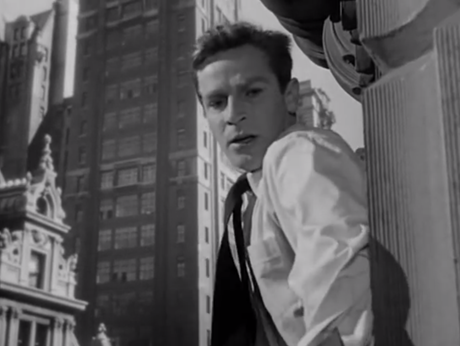

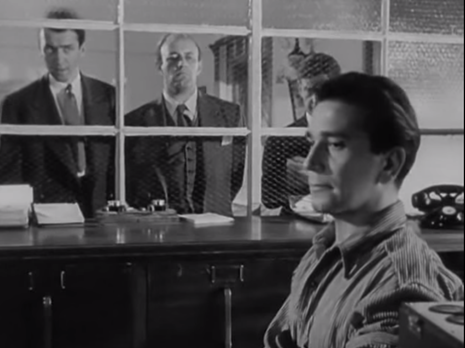


 ay finally comes when Nick gets out and he has Nettie waiting for him with his two girls. They are a beautiful happy family and Bianco has remade his life possibly better than it ever was before. However, he’s still beholden to the D.A. and they want him to get dirt on Tommy Udo. They don’t know what they’re asking, but still, Nick goes through it reassured that depending on what he can get, Udo will be put away for good. But of course, the slimeball beats the rap and Nick’s now a sitting duck. He sends his family away and waits for a confrontation with Udo.
 4 Star Films