Persona (1966)

f15de-persona1“Persona: The image or personality that a person presents to other people” ~ Merriam-Webster Dictionary 

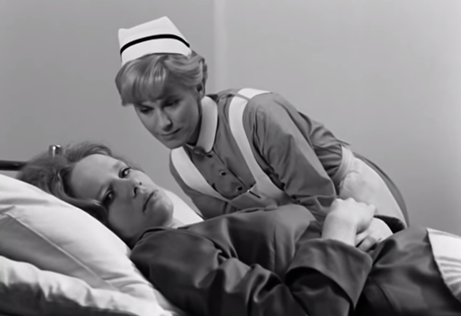
Ingmar Bergman’s Persona got me thinking. About what I’m not quite sure, but it did leave me confused and utterly perplexed which I suppose is a good thing. Since I am a fan of comparisons, I will go out on a limb and say I felt like I was watching the cross between L’Avventura and Repulsion. Persona is certainly befuddling psychologically and it has the crispest, most pristine black and white cinematography I have seen in a long time, courtesy of Sven Nykvist. 

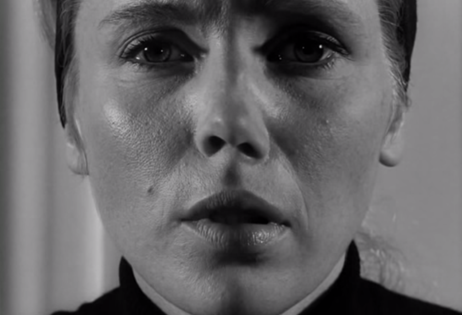
The opening sequences in the hospital are noticeably minimalist with an accentuated sterile environment. The close-ups feel reminiscent of The Passion of Joan of Arc and the highly dramatic and unnerving score  sends twinges down our spine. To top it off, the takes can be excruciatingly long, focusing on an inert face or a solemn figure crouching in a doorway. Silence is just as prevalent as dialogue.

At its core, Bergman’s film is an examination of individual characters in space. Alma (Bibbi Andersson) is the young sprightly nurse who is called in to take care of catatonic actress Elisabet Vogler (Liv Ullmann). Their interactions quickly move from the plain hospital room to the seaside cottage loaned out to Mrs. Vogler for her recovery.

What begins as attendant watching over patient soon evolves into a vulnerable woman finding a silent foil to confide in. The Persona is changing. 

All of a sudden roles are reversed and when Alma discovers a letter Elisabet sent away to the administrator, things are never the same. She feels betrayed learning that the actress has been analyzing her in silence. All that’s left is bitterness and anger towards her mute companion. No words come out of her mouth. Only blank stairs and more silence. She remains strangely calm in juxtaposition with the agitated Alma who becomes more and more tormented. But it is at this point we have lost much of our grip on reality. The lines, as well as the images, are often blurred and warped.

Persona takes on some brazenly edgy topics with frankness that is often abrasive. A repeated monologue by Alma follows the discovery of a recovered photo of Elisabet’s little boy. In the sequence, Alma speaks the words on Vogler’s mind and we are forced to labor painfully over her words yet another time. In many ways, Alma becomes the stand in or understudy for the actress and the role is far from elegant.

By the time the film came to its conclusion I hardly knew what to think. It elicited powerful feelings and reactions of aching and apprehension. If nothing else Bergman certainly makes you think and his Persona is unquestionably a striking piece of cinematic art. He has the skill of riddling our minds like a Bunuel or even Godard. It’s powerful if not completely satisfying because we can never hope to fully understand it.  

4.5/5 Stars

Three Colors: Blue (1993)

b0ad4-threecolorsblue“Now I only have one thing left to do: Nothing. I don’t want any belongings, any memories. No friends, no love. Those are all traps.”

I once thought that Before Sunrise was the type of movie that I would want to make. Three Colors: Blue is another concept that I have often envisioned without even knowing it. In fact, I had seen The Descendants, a film with a somewhat similar story arc told from a different perspective. Except whereas Clooney’s film is full of blatant drama and intense familial moments in Hawaii, Blue is far more nuanced.

The Descendants might be a more gripping drama, but Blue has the sort of complex depiction that seems to more closely mirror reality. The grieving process involves isolation, solemness, and at times few words. The easiest way to grieve is not to feel, not to fully embrace the pain. Sometimes that is the simplest if not the healthiest way to deal with it for Julie. It’s a real world approach to the scenario, and it’s no less painful to watch — perhaps even more so.

Julie’s husband Patrice de Courcy was a famous composer who was commissioned to arrange a grand piece to be performed at concerts for the Unification of Europe. It is a great honor and we quickly learn that Patrice is quite a big deal. However, after a car accident, Patrice and his 5-year-old daughter perish in the crash and only Julie gets away alive. It is a stark, unsentimental picture, and it succeeds in changing Julie’s life forever.

After being released from the hospital she soon sells all her possessions and moves out of her family apartment to take up residence somewhere far removed from any acquaintances, including a man named Olivier who is in love with her. She has a new home and begins to sever ties to her old life. The unfinished work of her husband (and her) is trashed and that’s the end of that. In her new Parisian home, she has a rodent problem and becomes the hesitant confidant of a local exotic dancer. Furthermore, she rejects the necklace that a young man pulled out of the wreckage. Her times of solitude are spent swimming laps alone in the local pool, submerged and half-covered in shadow. Grandiose symphonies reverberate through her mind haunting her. In such moments, Kieslowski will often black out the screen in the middle of the scene, effectively interrupting the action for a few seconds before bringing us back.

Words are few and far between for Julie and when she does speak it is often brief and reserved. We are, therefore, forced to observe her without the aid of dialogue. She is certainly detached but there is a provocative side to her. Something is mystifying about her soft features, dark eyes, and short hair. She is a wonderful woman of mystery and beauty because the reality of it is, we do not know a whole lot about her. We must discover more bit by bit and she does not readily disclose information.

It is when pictures of her life literally flash before her eyes on a TV screen that the story takes its next turn. Julie learns soon enough that her husband had a mistress that he was with for a few years. In the hands of Hollywood, this would be high drama. In the hands of Kieslowski, it is far from it. Julie is still the same aloof individual she always was and even a confrontation with the mistress does not change that. She is civil and generous through it all.

Finally, she returns to her husband’s composition which she learns Olivier has started to rewrite. They agree that he will make his own work and Julie must accept it for what it is. Faces from the film float across the screen and a still solemn Julie lets out a few silent tears. The anti-tragedy is complete, a subdued, intriguing piece of cinema. Not for those with short attention spans but, I am interested to see Red and White. Kieslowski intrigues me with his thought provoking films somehow reminiscent of the likes of Bergman or Bunuel.

4.5/5 Stars

Annie Hall (1977)

annie hall 4 alvy“I would never want to belong to any club that would have someone like me for a member. That’s the key joke of my adult life, in terms of my relationships with women.”

So begins Annie Hall a film that Woody Allen, also known as Alvy Singer, begins with an opening monologue borrowing a quip from Groucho Marx. It acts as a lead into his life story, romantic and otherwise.

He had a childhood characterized as being morose, depressed, and so on, because as he noted early on “the universe is expanding.” He grew up living under a roller coaster and having fun with the local bumper cars. He grew up to be a comic with the same despondent outlook on life. In one memorable long shot of a sidewalk, we listen to Alvy talking to his friend about people making jokes about him being a Jew and his assertions seem uncalled for.

Alvy Singer and Marshall McLuhan

When Alvy was dating Annie, they went to Ingmar Bergman films and The Sorrow and the Pity was a personal favorite of Alvy. A favorite film with a perfect title and subject for the pessimistic fellow. However, what really vexes him are puffed up know-it-alls who pontificate on and on like they are God’s gift to the universe. It seems necessary at this point to break the fourth wall.

As Alvy recalls his early childhood and first relationship which began at an Adlai Stevenson rally, it is rather funny that he remains unchanged the whole time. Physically Woody Allen is playing Alvy as a young man and an old man without any change.

Then there is the fiasco with the lobsters and the memories of his first meeting with Annie over tennis. That was when he met the girl who came out of the Norman Rockwell painting. Seemingly the antithesis of Alvy himself.

Their relationship is examined with all its quirks from a trivial conversation about art, with underlying subtitles that reflect their real thoughts, to Annie’s stint as a nightclub singer. They have a comical time people watching, and Alvy recalls his second wife and the one who was a Rolling Stone reporter. His relationship with Annie also has its share of arguments, over spiders at 3 in the morning and adult education. Through it all Alvy still views Annie as a cartoon version of the Wicked Queen from “Snow White,” who he secretly loves.
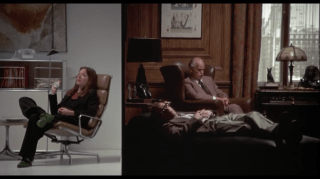
It is during a famous split screen sequence (actually a split room) where the stark differences, not only between the pair, but the genders are pointed out. Things are changing. They take a trip out to sunny California and Alvy cannot help but hate it compared to pleasantly gray New York. They have laugh tracks, wheat germ killers, and trash which is subsequently made into T.V. shows. Annie loves it all.

The inevitable comes and Annie breaks up only to have Alvy soon revisit California to propose marriage. Needless to say, it does not happen. He returns to New York and makes his first play about their last conversation verbatim, with one small revision. Alvy sees Annie one last time when she returns to New York, and they share some laughs while highlights role across the screen.

Allen’s stand-in Alvy sums it all up with one final joke about a guy who has a brother who thinks he a chicken, but he fails to do anything about it because he needs the eggs. That’s how he feels about relationships. “They’re totally irrational, and crazy, and absurd,” but you keep on because you need the eggs. Another philosophical gem from Alvy Singer.

The irony of Annie Hall is that many a person has gone on to pontificate on and on about it, but if we actually pulled an Alvy Singer and dragged Woody Allen from out behind a movie poster, I’m sure he could set us straight. Annie Hall is chock full of humor, a far from typical type of romance, and people trying to find their way in life. Take away discussion about psychoanalysis, modernism, antisemitism, and what you are left with are people just talking. Some of what they say is about such philosophical topics, but sometimes it’s not. It’s about memories, simple observations of life, and the little things that happen along the way.

There are clashing worldviews that come up against each other like New York and California (brought to us by the cinematography of Gordon Willis). There are different sorts of people like Alvy Singer and Annie Hall. Yet we still go through relationships “because we need the eggs” so to speak. We are searching for that type of intimacy and closeness, and very often we keep looking and looking. It is painful, seemingly necessary, and all the same, it can feel pointless. It’s part of being human I suppose.

Annie Hall works for me because of the quirks that give a fresh face to the typical romantic comedy and it will be the measuring stick for other such films that are being released for years to come. I am not usually a major fan of Woody Allen films, but this one is his undisputed masterpiece. It exemplifies his general philosophy and approach to comedy. Not to mention his typical players in Diane Keaton and Tony Roberts.

4.5/5 Stars
The Virgin Spring (1960)

19cfc-jungfrukc3a4llanDirected by Ingmar Bergman and adapted from a Swedish ballad, this film revolves around a Christian Medieval family. Their only child is a beautiful, care free girl who they cherish. They sned her off to church with a maid servant. Along the way the two of them must pass through the forest. The girl leaves her servant behind to rest and then she goes on, meeting some herdsman on her way. She shows them hospitality by sharing her food, but the two men brutally rape and kill her. Ironically, that night they seek shelter with the girl’s family unknowingly. By accident the parents discover what became of their daughter and they must then decide what action to take. Bergman’s films certainly bring up questions about morals, religious faith, and evil. None of the characters were perfect but instead human, because they all make mistakes and must ask for God’s forgiveness

4/5 Stars

The Seventh Seal (1957)

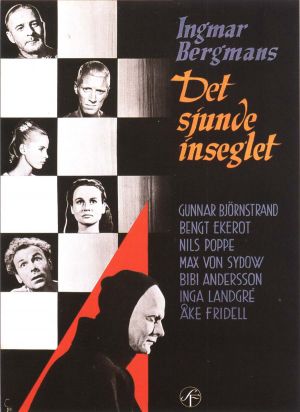
Starring Max Von Sydow and directed by Ingmar Bergman, this Swedish film revolves around a knight who returns from the Crusades with his squire. He begins a chess match with Death which parallels his travels across a land infested with the Black Death. Along the way he is joined by a pair of married actors and a blacksmith. However, he is tired and disillusioned with his life. To make matters worse he witnesses some terrible things and finally loses his game against Death. He returns to his wife with some of his friends and they face their fate when the time comes. This film was an interesting blending of a Medieval setting and modern disillusionment. Besides being very metaphorical, the cinematography is stark, while the title alludes to the events in the biblical book of Revelation.

5/5 Stars