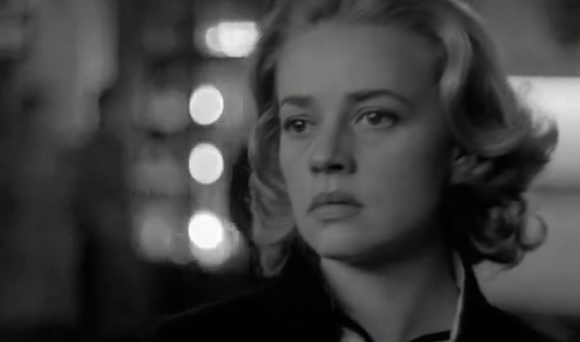
Elevator to the Gallows (1958)

elevatorto3“This affair like a Racine tragedy will be over in 24 hours”

Elevator to the Gallows was the debut of Louis Malle, a man who found success in both his native France and the United States. In truth, it’s an easy bit of delectable icy noir to enjoy, because it goes down quite effortlessly. From the cold open this film remains ridiculously cool, boasting a score from jazz visionary Miles Davis that dances and sways in sensual rhythm with the images onscreen. Recently I’ve gone through somewhat of a minor Jazz epiphany and Davis was a major instigator of that.

For all intent and purposes, this is the film that made Jeanne Moreau into an icon to be noticed. She’s not the same type of beauty as Brigitte Bardot or Catherine Deneuve, but this film shed some light on why she stands out among the best of France’s leading ladies. Really she’s the only character who we get inside the head of — we hear her thoughts as they drift in and out of her mind. Also, out of everyone, Malle allows his camera to dwell the longest on the face of Moreau with few distractions. We see her wander the streets listlessly, checking her complexion in windows, and somberly gliding upstream as cars speed past on all sides. It’s as if she’s constantly living in a dreamy alternate reality that is only broken when she must actually interact with the humans that inhabit the space that exists around her. But how did she get here?
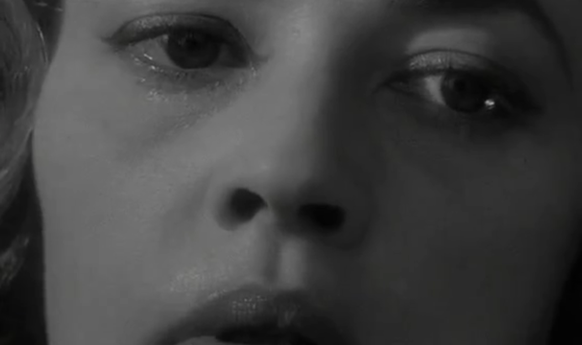
elevatorto4Back to that cold open. Florence is communicating with her lover Julien, as they put their plan into action. It all happens so fast as the credits flash on the screen, but soon enough we gather that he plans to kill her husband, so the two of them can finally be together. So, in other words, it feels like some kind of love triangle with Florence Carala. As a former paratrooper deployed in Indo-China and then Algeria, Julien is more than capable of carrying out the task. It requires scaling a building on a rope, taking the shot to finish off the condescending war profiteer Mr. Carala, framing it as a suicide, and then making a getaway without anyone being wise.

All the pieces fall together, but Julien forgot one thing. The rope is still hanging there! He rushes up to fix his mistake, but on the way down another employee unwittingly shuts down the lift, and now Julien is stuck in the elevator with no easy way to get out of his jam. He is sure to be caught. It’s a tense spot he’s in, but really that’s not where the heart of the story lies because Julien remains where he is for much of the film.
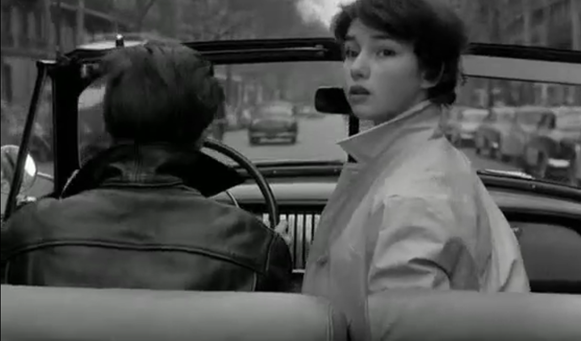
elevatortoThe other arc feels closely tied to The French New Wave Movement as an angsty young man decides to take Julien’s sweet ride for a spin and his reluctant girlfriend takes part in their little escapade. Their final destination is a hotel where they decide to register as Mr. and Mrs. Julien Taverner because it’s bound to be a good bit of fun. They even get chummy with a pair of German tourists and the champagne flows freely.

Meanwhile,elevatorto1 an anxious Mrs. Carala begins to listlessly comb the streets trying to gather what happened to her lover. Where did he go? Julien
still sits in the elevator trying to rig a way out as the cigarette stubs pile around him. The good times of young lovers Louis and Veronique soon turn sour when the boy loses his temper and with that, all rationality goes out the window. As Godard once quipped all you need for a film is a girl and a gun, and in this case, it rings true.

Now Julien is wanted for a murder he did not commit and is still the unknown perpetrator of yet another murder that has yet to be uncovered. When he finally breaks out of his prison the following morning, he inadvertently walks into a big heap of trouble. But it is Louis and Florence, who end up back at the scene of the crime where a dark room becomes their downfall.

4.5/5 Stars
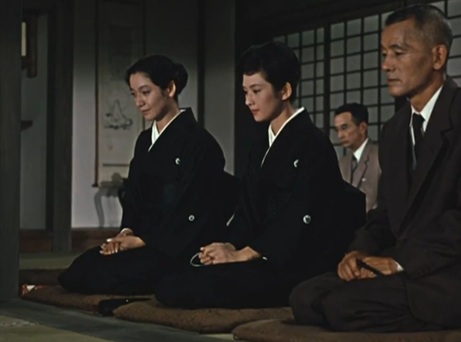
Late Autumn (1960)

lateautumn1Yasujiro Ozu has the esteem of being christened “The Most Japanese Filmmaker.” It’s certainly a high honor, but at first, it can feel rather counter-intuitive because after all, such a great master of cinema cannot be considered average or a composite in the scheme of Japanese film history. And I don’t think that is what this title is trying to get at. The fact is that Ozu, over time, really experimented with the conventions written by classical western filmmakers and he built his own unique aesthetic that is quite evident later in his career. That being said, his film’s are very Japanese in the way they interact with and dissect the culture that he comes out of, and I think that is paramount to understanding and ultimately appreciating his work.

It’s no different with Late Autumn, Ozu’s penultimate film, a social-familial drama that shares a great deal of similarity to some of his earlier work. The fact is, he’s constantly returning to these ideas of marriage, family, generational differences, and the underlying etiquette that is so prevalent in Japan and Asian cultures in general. But of course, much of what he examines is universal and that’s what allows his films to remain timeless.

With Late Autumn, in particular, it’s easy to marvel at how the director frames his space because he seems to have tremendous spatial recognition. He’s confident in his aesthetics which he highlights with colors and axis lines, which are then further embellished with human subjects. Not many directors are brazen enough to show us an empty room, a hallway, or the mundane facade of a building, but Ozu is so self-assured in his composition. They are too long and occur too often to be establishing shots. He wants to continually convey to us the space that his characters inhabit and he’s meticulous. Everything is placed with pinpoint precision just the way he wants. And it shows.

On a basic level, Late Autumn can meld nicely with many of the director’s other works also based around the seasons. In this color installment, three adult men gather for the funeral of one of their mutual childhood friends. It’s a sad occasion as they wistfully remember the good old days when they were young and in love. But as a service to their deceased friend, they agree to find a husband for his sweet sunshine-faced daughter Ayako (Yoko Tsukasa). However, they also worry for his widower Akiko (Setsuko Hara), who is equally beautiful, since the years have been very good to her. What follows is the typical fumbling attempts at matchmaking, trading manners, and so on. When Mr. Mamiya inquires if he should ask for a young man’s picture and resume, we assume it’s a joke, but he’s quite serious.

What makes Autumn different than earlier classics like Late Spring or even Tokyo Story, is that it shows the next generation of young people.  The kids embrace the rockability of Elvis while reading Mickey Mouse cartoons. The young adults are folks who have grown up in the specter of WWII. They want to leave behind the world of useless honor and restraint.They speak their minds and show their discontent.

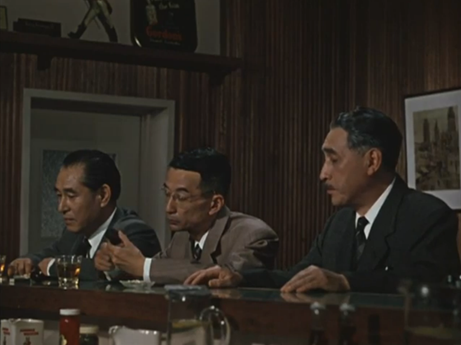
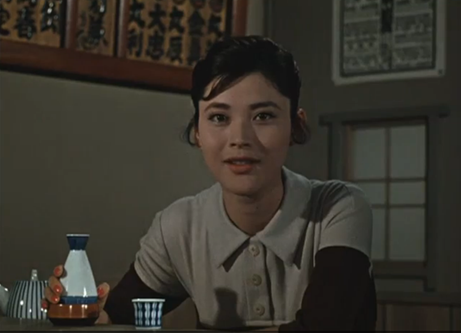
lateautumn2I enjoy the light touches of humor injected into this film because the three chums sit around the bar making observations with a bouncy score that seems more at home in a Tati comedy. Sometimes they’re genuinely trying to be funny, but more often it’s hilarious because they’re actually so dysfunctional. They take on this task of watching over their friend’s family with all seriousness, but they get sidetracked by their own desires and personal concerns. They stir up rumors, make waves, and ultimately cause a lot of trouble. Everything gets muddled and it’s the blunt and frank assertions of young Yuriko (Mariko Okada) that points out their failures. She sees how they have made a mess of things and calls them out for it. Perhaps it feels abrasive, but I think they like her for it and the audience does as well. She’s a reflection of this new generation that’s not looking to mince words or hide behind social etiquette. They’re fed up with that type of lifestyle. In fact, Yuriko is the one who says marriage is the worst. The ideal would be if love and marriage always went together, but they don’t.

lateautumn3Thus, although the relationship between Ayako and her mother takes center stage as the film progresses, Yuriko is extremely pivotal. It’s the lives of the first two women that are affected by the unintentional bungling of these men, but it is Yuriko, who signifies change for the better. In many ways, this story feels very similar to Late Spring in particular, but the interest is not so much in original ideas as it is in re-imagining ideas. It’s a film for the 1960s where men are slowly losing their vice-like grip and societal norms are changing as women move to the forefront. But what remains are the suggestion that it’s alright to push back against societal pressures, and interpersonal relationships are delicate flowers that must be cultivated with care. So easily they can be trampled and destroyed. It takes a certain type of person to acknowledge their own faults while persistently loving those around them.

This is the utmost compliment, but in many ways, Setsuko Hara reminds me a great deal of my own grandmother, a woman who radiated a genuine kindness that was apparent to everyone who walked through life alongside her. Bless their souls. Both of them.

4.5/5 Stars

Claire’s Knee (1970)

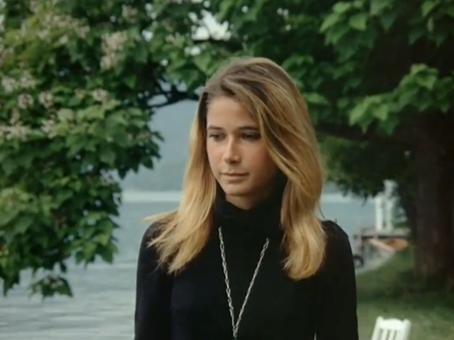
claireskneeClaire’s Knee is a film made for color. Eric Rohmer’s other films up to this point had almost exclusively been black and white, but it’s as if he knew that his newest oeuvre deserved different treatment. It’s vast countrysides and glistening lakes abundant with flowers and fruits fill up our senses. We get to watch and see and experience the beauties of this oasis. And there is no music because the songs of the birds suffice.

Jerome (Jean-Claude Brialy) is a reserved but genial diplomat, who also pulls off his beard quite well. He’s taking a peaceful holiday at Lake Annecy as he prepares himself for marriage with his longtime sweetheart. Quite by chance, he bumps into an old friend named Aurora during a jaunt in his speedboat. Through her, he meets her landlady Madame Walter, the lady’s daughter Laura, and finally Claire, Laura’s older half-sister. It’s an increasingly interesting chain of acquaintances.

The course of the film follows the progression of the summer days signified by white inter-titles expressing the date and time. During these days Jerome, in a sense, willingly becomes Aurora’s “Guinea pig” for her next novel as they discuss love, life, relationships, desire, and the like. Early on, Aurora notices that young Laura has taken some liking in Jerome, and he good-naturedly pursues the relationship, to see what happens.

clairesknee2She’s a young girl who has some big ideas. Laura admits feelings for Jerome, but it’s seemingly only fleeting young love. She still has many years ahead of her, and yet her opinions on love and friendship are already forged. She’s willing to discuss them in depth with her much older counterpart. They take a hike through the mountains together, dance together on Bastille Day, but it’s not a romance. She moves on to a younger boy more fitting for her.

But that’s enough skirting around the uncomfortable. It’s the entrance of Claire that feels integral to the film, if not simply for the fact that the film’s title revolves around her. The fact is Claire is a beautiful girl, who intrigues and disturbs Jerome for the simple fact that her physical appearance is all he knows about her.

The moment he witnesses her picking fruit off a tree up above him, he cannot stop looking. He’s absolute powerless around her. She intimidates and casts a spell that mystifies him. The fact he wishes to touch her knee is hardly a thing to be taken all that seriously. By this point, we know that Jerome and Aurora are not all that serious. It’s almost as if they’re playing a game. And yet Jerome still earnestly wishes to touch Claire’s Knee.

In a moment of sincerity he even acknowledges he is drawn to thin delicate girls, but having a girl made to order would hardly be a recipe for true love. Because the fantasy could never equate to actual compatibility and joy for two individuals. The perfect moment does finally arrive, and it seems like Jerome can finally act out on his desire. He is caught in the rain with Claire and they must wait, taking refuge from the rain. He has news about her boyfriend that brings her to tears. In an instant, he caresses her knee, but soon enough all the desire is gone and it gives way to a good deed.

clairesknee3Thus, somehow Jerome maintains his good-natured personality despite his potentially disastrous relationships with the two girls. It’s as if he knows that inconsequential flings and fantasies can never measure up to true love. He heads off ready to marry his bride to be. We never get a feeling that this is some odd ploy to get a dramatic rise out of its audience. Rohmer’s moral tale is genuinely curious about love. In truth, it’s packed full of musings and revelations on the issue. It draws the conclusion that love means nothing without action.

To his credit, Brialy pulls off the role nearly flawlessly, because he could have so easily seemed like a perverted jerk, but somehow he still comes out of this film with his reputation intact. Perhaps it’s because Laura and Claire are such striking characters. Jerome somehow pales in comparison, despite his age. Although young, Laura seems beyond her years and then there’s Claire. A young woman so exquisitely beautiful in a natural, carefree sort of way. She is perfect to be the subject of this film.

4/5 Stars

The Hunt (2012)

The_Hunt_(2012_film)One lie. That’s all it takes to completely decimate one person’s life. Out of the mouth of babes can oft come gems, but also deadly slander that leads to public scandal and personal destruction. In a small Danish village that’s what happens to Lucas (Mads Mikkelson), a sympathetic kindergarten teacher, who generally cares for his kids, while he tries to maintain a relationship with his teenage son Marcus, who is the casualty of divorce. It’s not easy for Lucas either, but he finds solace in his work and the companionship of his coworker Nadja, who moves in with him. On top of that, he is well-liked in his community which includes his close friend Theo, who has a son and a little girl Klara — dearly fond of Lucas’s dog Fanny.

But in one instant Klara makes the life of her adult friend a living hell. In a moment of confusion, she makes a confession to her teacher. Both surprised and worried, the information sends all sorts of alarms off in Grethe’s head and Lucas is relieved of his position quickly. Next, Klara’s parents are brought in and soon the rest of the community is let in on the troubling news. The following contradictory statements brought forth by Klara are quickly dismissed. After all, she has been thoroughly traumatized by Lucas. He’s arrested but finally released because the testimonies of the children do not add up. Still, he’s now labeled as a sexual predator and ostracized by everyone. His former friends have turned against him, and he is no longer welcome in the local grocery store.

The only place he can turn is his friend Bruun, who does not abandon him, as well as his son Marcus. That does not do any good for faithful Fanny as the witch hunt continues.  The sequence of events has the Christmas holiday as its backdrop, and it seems like peace on earth and goodwill towards men need not apply to Lucas. In one potent moment, the solemn outcast wanders into Church for service, only to be forced to sit in a pew all alone. There gathered around him are all the people who have destroyed his life. All the people who professed to be his friends, and yet quickly turned on him.

His response is uncalled for perhaps, but certainly not unwarranted. Theo is deeply affected and it only takes listening to the listless whisperings of his little girl to know that Lucas is innocent. They make peace on Christmas day and things die down.

Time passes. Lucas is happy. He’s back with Nadja. Marcus is about to get his rite of passage as a hunter. Everyone’s friends again. But still, there’s something not quite right. In the final moments, the motif of a hunt takes on a deeper meaning. The drama has all but subsided and yet it still lingers. Lucas is still being hunted even if it’s only in his dreams.

After the Wedding gave me tremendous respect for Mads Mikkelson as an actor, and The Hunt only solidified that conviction. He is facially so recognizable and expressive. Not exactly a handsome face, but there is a raw beauty to it, and it is wonderful for expressing a broad spectrum of temperaments. It can be an evil mug or a sympathetic face revealing layers of anguish. In many ways, it’s a great enigma, so reserved and yet so emotive. Thomas Vinterberg’s bare-boned film rides on Mikkelson’s shoulders, and he is able to carry the weight brilliantly.

4/5 Stars

Day for Night (1973)

dayfornightposter10 years prior Jean-Luc Godard made his own film about movie-making entitled Contempt (1963). It too delved into what it looked like to make films, as well as the individuals behind the camera because their relationships undoubtedly affect what is revealed in front of it. His colleague Francois Truffaut came out with his own meta-film about film, but Godard was open with his criticism. In fact, their long friendship suffered because Godard accused his longtime collaborator of selling out and telling a lie.

However, if we look at Day for Night today, that feels a little harsh, because while Truffaut’s film is engrossing and different than his earlier New Wave work, he is, in general, a more accessible director on the whole than Godard. That should certainly not take away from what he gifted to his audience. What he does is color the lines between film and real life. Because, while one mirrors reality, it can never quite replicate it and things get messy when the two begin to get in the way of each other.

Immediately we are thrown into a street scene only to learn minutes later that it’s only a set; these commonplace people only extras filling up a cinematic space. It’s the perfect entry point into the meta nature of the film. Ferrand (Truffaut himself) is the director flooded with all your typical problems, setbacks, and deadlines. He must work around his stars, navigating the drama that comes about with so many personalities all gathered together. Severine is a has-been starlet with troubles remembering her lines. Alexandre is her love interest, a fading star in his own right who is aging gracefully. Alphonse (Jean-Pierre Leaud) is the young heartthrob, who secured a script girl position for his girlfriend, but their playful romance is not without bumps. All the while everyone waits with baited breath for the arrival of transcontinental star Julie Baker (Jacqueline Bisset), who has recently recovered from a nervous breakdown followed by a marriage to a distinguished doctor.

We are privy to series of takes, rushes, and all the decisions that are going on behind the scenes. It is in many ways far fuller and more in-depth than the picture Godard gives, but Truffaut maintains the same respect for his heroes. He goes so far as name dropping: Hitchcock, Hawks, Bresson, Godard himself, Bergman, Rossellini, Lubitsch, Bunuel, Jean Vigo, Jean Cocteau, not to mention an initial dedication to the Gish sisters. Even Citizen Kane and The Godfather, two of cinema’s landmark achievements, are both alluded to in passing.

But adding an exclamation point to everything is the drama of death, romantic affairs, and even a pregnancy, suggesting that life is a lot messier than a moving picture. All the strips of celluloid get tied together in a nice bow. They can be explained away by a plot point. They can be completely discarded on the cutting room floor. Or a double can be hired as an easy fix for any discrepancy. In this, there is a falseness that fails to perfectly align with reality. There is no perfect way to convey the truth, because everything, even a documentary, can never be complete subjective reality. A mirror image is only a reflection of what is real. That is part of what Truffaut is getting at and that is part of the irony of his row with Godard.

You only have to look at its title, because Day for Night points to the inherent artificiality of cinema, but Hollywood films especially.  So, far from telling a lie, Truffaut seems to riddle the film industry with all sort of holes, pointing out the difficulties that come with such a business. Life and film may meet and overlap, but they can never truly reconcile their differences because there is bound to be contention along the way that cannot be perfectly remedied by even the greatest director.

But far from condemning the art form, it’s important to realize Truffaut is pronouncing his undying affection for the medium. He was the one who famously asserted, “I have always preferred the reflection of life to life itself.” This man unquestionably loved movies and it shows.

4.5/5 Stars

After The Wedding (2006)

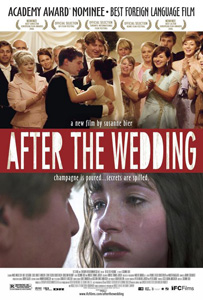
After_the_WeddingThere is a scene in After the Wedding where the new bride Anna gets up and announces that it’s not usually customary for a bride to give a toast, but something is bound to go wrong at some point, so she might as well get it over with. It’s like she’s unknowingly cushioning the blow. She does not know, and the audience certainly doesn’t know, the gravity of what she says next. There are two people in the room who do. Anna voices how much she loves her parents even though she realizes Jorgen is not her real father, she cherishes him all the same.

I try and not use the label “tearjerker” lightly, but with this Danish film from director Susanne Bier, I mean it wholeheartedly. It cuts so deeply because there’s a bitter-sweetness to it that lingers, and that only occurs when you’re actually invested in characters. We meet Jacob first (Mads Mikkelsen), a middle-aged man, who seems to have built a rewarding life teaching in India. But on a trip back to his homeland, to hopefully acquire some funding, he comes across a familial secret that impacts him greatly. It all happens because the friendly businessman Jorgen invites his new acquaintance to his daughter’s wedding the following night. We get the film’s main jolt during the wedding and the whole story is never the same afterward because it flips everyone’s life upside down.

The next big revelation comes out when loving wife Helene presses Jorgen about his heath. Anna has her own problems when she walks in on her new husband with another woman. These up the drama, but it’s important to make it clear that this story doesn’t rely on soppy drama to maintain the stakes. The peaks are powerful, but even in the valleys, it keeps our interest. Certainly the melodrama is deeply jarring, however, it only delivers such an impact, because the people involved are far from one-dimensional cardboard cutouts. This could have easily becomes some Danish attempt at a telenovela and yet it does not. Far from it, Jacob, Jorgen, Helene, and their daughter Anna are figures, who we can almost feel the contours of. They bring to mind glimpses of friends or family perhaps. Generally good folks, who have made mistakes along the road.

In his past, Jacob acknowledges a drinking problem and sleeping with other women. Now he runs an orphanage in India and he’s matured greatly. Helene admits to not knowing all the answers for the decisions she made as a young woman. She probably should have done things differently, but the bottom line is that she loves her daughter deeply and is completely devoted to her husband. Jorgen might be a mogul and a powerful man, but he also has a deep devotion to his family. Seeing him with his kids you know he is a good father because he loves and provides for them in all possible ways. He actually makes time for them and it shows.

Hellene voices the audiences concern that all this drama is too great of a coincidence, but overshadowing that detail is something very heartfelt that Jorgen says. When he knows he probably doesn’t have too much more life ahead of him, he voices the sentiment that time is so utterly important. Furthermore, every relationship, every acquaintance we make, is important to life. Without those, life is meaningless. That’s the core of this film. It’s people parsing through the mess and finding what’s important. That’s what keeps Jorgen and Hellene together. That’s what makes Anne cherish her parents so deeply. That’s what makes it so difficult for Jacob as he weighs whether to stay in Denmark or go back to India.

4/5 Stars

The Earrings of Madame De… (1953)

MadamedeposterThe Earrings of Madame De…, in essence, feels like the perfect incarnation of an Ophuls’ film. In fact, sometimes I forget that Ophuls is actually German because his films are full of French sentiment. I mean that not because of their cast, although we do have Charles Boyer and Danielle Darieux, but more so due to the fact that his films are about elegant, melodramatic romances that fit the decadence of Parisian high society. For instance, in Madame De… Danielle Darrieux is positively swimming in luxury, whether it means dresses, furnishings, or especially jewelry. Materially her husband Andre (Boyer), a French general, has lavished all the worldly possessions upon her. Except that’s not what she wants. At least that’s not what will make her happy. She may be obsessed with the material, but even the material which she so desires is ultimately poisoned over time. Over time Andre cannot even win her over with trinkets and gifts. She cares little for the eponymous earrings until they come from her true love Baron Donati (Vittorio De Sica).

These are the same earrings that she sold to pay off a debt. The same earrings that Andre reacquired from the jeweler and then made the rounds once more. Ophuls said himself that he was drawn to this narrative because “there is always the same axis around which the action continually turns like a carousel. A tiny, scarcely visible axis: a pair of earrings.” And really it is a fascinating plot device that ties the entire narrative together, while also seeming to reflect the utter frivolity and triviality of it all. How can these earrings hold so much weight to one person? And yet that’s only the face value, because, to begin with, they are only an object to be coveted and maybe cherished. Over time they become a token, a symbol of true love and Louise gives them away to the parish because she no longer needs them. She has some notion now of what true love actually feels like.

For the majority of the film, Andre is forever civil with her. He knows that she does not really love him, and he even has time for a mistress on the side. He handles her opportune fainting spells and little charades with grace and at times amusement. But when he gets a hint at Donati’s relationship with his wife, he does what any honorable gentlemen would do. He’s indignant of his rival and builds a huge feud out of nothing. What follows is a duel and the rest is history.

Madame De… probably does not get as much acknowledgment as it should, because Ophuls was a champion of so-called “Women Pictures,” which actually take on the point of view of women, in an industry that’s so male-dominant even to this day. Thus, Madame De… is a little different in perspective, and it tries to hide all of its tragedy behind superficiality. It makes for an interesting lesson in romance and the female psyche. Yet again the director shows his immense affinity for staircases turning them into the personal playground for his camera. He loves to twirl, pirouette, and glide just as much as Louise and Donati do as they dance the night away at the ball. De Sica is a champion director in his own right, but it was especially fun to see him in front of the camera and he seemed an apt player opposite his costars. The worthy equal of Boyer and a suave love interest on top of that. There’s nothing more romantic than Danielle Darreux dreamily repeating to him, “I don’t love you, I don’t love you, I don’t love you.” The sad irony is that those words ring true with her actual husband as reflected by a pair of earrings.

4.5/5 Stars

Three Colors: White (1994)

threecolorswhite1The Three Colors Trilogy is made up of the three colors of the French flag. Thus, the second installment, between Blue and Red is of course White. It is considered by some to be the weakest of the three films, but that is rather unfair because it is still wonderful in its own right.

The other films are pensive, thoughtful pieces of drama, but White is actually quite funny in a dismal sort of way. You see, Karol Karol (Zbigniew Zamachowski) is a Polish hairdresser, who is going through divorce proceedings because his beautiful French wife says she doesn’t love him anymore. He has to sit through the court hearing being delivered in a foreign tongue, and he has to go through public embarrassment in front of everyone. It’s a humiliating situation and the worst of it is that he still loves Dominique (Julie Delpy). He loses all his money, his credit is invalidated, and she takes about everything else. At least Karol has his giant suitcase, but that’s about it.

threecolorswhite2That’s where a fellow named Pole Mikolaj finds him slumped up against a wall in the subway station. He’s pitiful, but they strike up a conversation in their native language, and he agrees to help Karol stowaway to get back to Poland. There’s nothing left for him in France after all, so he hides in his suitcase and his new friend takes it through customs. It’s utterly ridiculous, but they play it straight. Then picture this. You’re stowing away inside a suitcase and then some thieves steal it to get the payoff inside. Imagine their surprise when they find not valuables, but a human being. And the jokes on them because that human has absolutely nothing to steal. All that’s left to do is give him a firm kick in the rear and leave him for dead. If it wasn’t so depressing, this would be absolutely hilarious, and it still is pretty funny.

Next Karol tries to make some quick money, because hairdressing may be in demand, but it’s not a great moneymaking proposition. He ends up being hired as a bodyguard, and he’s a very awkward sort to be packing a firearm. His next scheme is to double-cross his boss by buying up plots of land before his bosses can. They looked to sell if for profit to big corporations, but Karol beats them and they cannot touch him. They’ve no way to get the money from him, and all of the sudden, it seems like he’s doing very well.

threecolorswhite3The time has come for one last vengeful trick and the joke’s on Dominque this time. He still loves her, but Karol enlists the help of Mikolaj and a few others, to help him get back at his wife. It works better than he was expecting, in fact, maybe too well. Dominque still has feelings for him, but now he may never be able to see her again.

Krzysztof Kieslowski’s films usually have a sensuous and mysterious woman in the lead, whether it’s Irene Jacob or Juliette Binoche. Julie Delpy is a similar type of beauty, and yet she is less the focal point compared to Karol Karol. In a sense, you give up some of that enigmatic aura of the aloof goddess, but Karol is an extremely funny character, even visually. Thus, White is not quite like Blue or Red, but they are interconnected and it’s still thoroughly worthwhile. Different is often a strength, not a weakness, and in this case, it is a good thing.

4/5 Stars

Ali: Fear Eats the Soul (1974)

alifear4Werner Rainer Fassbinder is one of those artists known for his tumultuous personal and political life, and yet with all the dialogue swirling around his backstory and untimely death, there is no doubt that he sent a charge through the film community that is still being acknowledged today. The New German Cinema of the 1970s breathed new life into an industry and created a massive impact. Part of the fact is that Fassbinder’s work hearkens back to his forefathers while constructing a space within the medium that was all his own. That’s what the great filmmakers do. They take what has already been done, grab hold of some inspiration, and run with it into some new uncharted territory.

In the case of Ali: Fear Eats the Soul, he takes the work of 1950s melodrama master Douglas Sirk and transposes it to his contemporary Germany. His particular inspiration is All That Heaven Allows, which revolves around the shocking romance between a respectable woman and her younger suitor. That in itself makes for a juicy piece of drama, but Fassbinder expands on that by adding a racial component. Always fascinated by topics of race, Fassbinder looks at an elderly German lady (Brigitte Mire), who begins to form a bond with a much younger Moroccan laborer named Ali (El Hedi ben Salem).

alifear3What begins as a small gesture, soon enough actually develops into something more, because once they sit down to coffee, they realize they actually appreciate each other’s company. Although I don’t understand German, the subtitles make it clear that Ali’s German is rather rudimentary, and yet that matters little to Emmi. She just enjoys having someone to talk to.

Emmi works as a maid and her husband is deceased and her children are grown up. She’s lonely. Ali has a group of friends from his homeland, but he feels like he’s treated less than human in Germany. Emmi’s different than your average German, but then again, her first husband was a Pole during the Nazi regime, so she’s no stranger to going against the grain. To her, it’s not a big deal. It’s just gets blown up by family and the tenants around her. Her nosy neighbors are quick to gossip and they all have a heavy case of discrimination. In fact, the unlikely couple is surrounded by narrow-minds sitting atop old bodies. A prime example is the local grocer, who ignores Ali, before changing his tune since he wants Emmi’s business.  But even Emmi’s children are not pleased. You can understand being surprised and a bit dismayed, but once a television set is kicked in, there’s automatically more to it. It’s not simply anger in it being such a rash decision, but the fact that Ali is a foreigner (and much younger). And yet all these separate issues are so closely intertwined it becomes an interesting situation. More often than not it’s the pervading bigotry that is the most noticeable.

alifear5Although the issue of age plays a role too, because at times Emmi looks out of place with Ali’s friends, and the same goes for Ali among her friends. It even leads him to a one night stand with the sultry bar owner (Barbara Valentin).  But Emmi is a very forgiving soul and in her, Ali finds grace. I’m not sure if I concur with all the conclusions that Fassbinder draws, but I can respect his stands on race. In fact, when Ali alludes to the catastrophe in Munich during the Olympics in ’72, such a current events make this prejudice toward Arabs all too real. It was a real pertinent issue and it still is to this day.

As for Fassbinder, he certainly knows how to work around his sets. The composition of his scenes is simple, but vibrant in mise-en-scene. He certainly has a touch of Sirk, being a little less luxurious, but still as bright. The closest modern example I think of is Wes Anderson as far as utilizing interesting color schemes and symmetry to frame shots. Also, there are quite a few times where Fassbinder maintains a shot for seconds on end. In such moments, it feels like we’re looking at a painting in a Fassbinder gallery. And it is exactly that. Art with an emotional depth from one of the foremost German masters.

4.5/5 Stars

My Night at Maud’s (1969)

nightatmaud's1I love the forum that is created in international cinema where all things can be debated and discussed without fear of what the audience will say. Hollywood caters to the audience and that more often than not means that thrills are given greater weight than substance. Eric Rohmer worked at Cahiers du Cinema alongside French New Wave visionaries like Jean-Luc Godard and Francois Truffaut, but he joined the game a little later than his colleagues with a different style. Rohmer took his pseudonym from director Erich von Stroheim and British novelist Sax Rohmer. He was a highly educated man and that comes out in his films.

My Night at Maud’s comes from the perspective of a man, who we have a sneaking suspicion might be a lot like Rohmer.  Jean-Louis (Jean-Louis Trintignant) is a reserved, highly religious, intelligent man. He attends mass on Sunday, bumps into an old school chum on the street, and willfully enters a discussion on all sorts of philosophical topics.

Whereas Godard interest himself in the lowly gangsters, the streetwalkers, or the lovers on the run, Rohmer’s character are in a completely different stratosphere. They are a higher slice of society, and it shows in what they spend there time philosophizing about. In fact, there’s a lot of discussion stemming from Pascal’s wager on whether or not it is beneficial to believe in God. Although he can be a bit of a clown, Vidal is also a philosophy professor and ready and willing to delve into such topics. He holds hypotheses on the meaning of life, and he’s considered where hope comes from. These are intelligent beings and deep thinkers, and by transference, they lead us to think. They drop by on Vidal’s friend Maud (Francoise Fabian), who is a divorcee, irreligious, and most certainly a free thinker. She’s also beautiful, and she likens there little late night convo to the salons of old as they gather around her bed to raise their conjectures.

nightatmaud's4I feel like I have known people like Jean-Louis, and I cannot help but like them. He’s a fairly resilient Christian, but not a perfect example mind you, and yet he feels far from a hypocrite. With his new dialogue partners, he speaks of his past love affairs and how they can exist with his religious convictions. Maud rather matter-of-factly labels him a “shame-faced Christian” and a “shame-faced Don Juan,” because he’s not fully committed or acknowledging of either. And yet she generally likes him a lot. He likes her company too and so they can continue talking in a genial manner. She pokes fun and ribs but never attacks. And she openly brings up numerous different ideas about Christianity. There are things that feel very human, but not very Christian to her. Maud asks if Christians are judged by their deeds? She assumes there is a bookkeeping aspect of Christianity where good deeds are weighted versus sin. Several times the rather obscure term of Jansenism is thrown around a bit in reference to the theology of Dutchman Cornelius Jansen. It surely is difficult to keep up we these folks at times, but it’s well worth it.

Maud has her own preconceived notions about religion, while Jean-Louis has some delusions about romance. He thinks he’ll meet a pretty blonde Catholic gal and fall in love. It sounds utterly preposterous and yet then he meets Francoise (Marie-Christine Barrault) after his night at Maud’s. She’s the perfect embodiment of everything he’s ever dreamed of in a romantic partner. They seem like a good pair, although she is still in school, they are intellectual equals with similar personal convictions.

nightatmaud's5Sure enough, 5 years down the line they are married with a young son. Jean-Louis has not seen Maud for many years now, but quite by chance they bump into each other on the beach. Both pick up where they left off as if no time has passed because it’s so easy for them to converse. Francoise is noticeably uncomfortable around Maud, but nothing more is said about it. Jean-Louis moves on and plays contentedly with his family on the beach. Maud heads back up the hill as cordial as ever. This is an ending that is made powerful in its subtleties above all else because Jean-Louis and the audience realize something about Francoise. Yet there is no need to voice those conclusions because all that matters to him is that he is happy.  It toes a soft line between romance and drama, instead resorting to a beautiful exchange of ideas. Noticeably, in Rohmer’s film, there is no score so the dialogue is elevated to the level of music. It fills the void using deep, introspective and personal forms of verbal expression.

4/5 Stars