Blow-Up (1966)

40940-blowup_posterDepicting the time and place of Swinging London in the 1960s, this film is directed by Michelangelo Antonioni and it stars Peter Hemmings as the protagonist. He is a fashion photographer in a hopping city. He spends his day working with models with countless photo shoot after photo shoot. He is skilled at his job and as such he is temperamental and at times irritated by his fashionable but arduous occupation.

After one such string of photo shoots he goes off on an excursion to an antique shop and a park where two lovers have met. He sticks around and snaps pictures of them before he is chased off by the woman. The next day the attractive woman comes to him asking for the negatives and at first he refuses. After she has left he develops the negatives and blows them up only to find something very intriguing. He goes back to the park at night and finds something very perilous indeed. He returns to his flat and then he spots the woman at a club only to lose her during a concert.

Following the lively evening he returns once more to the park, this time to find something even more unusual. Despite all his efforts everything is still a complete mystery that he cannot hope to solve or understand. There seemed to be some superfluous scenes in this film but it was interesting to watch it unfold. The photographer has an intriguing lifestyle but he is not a very likable character. Following the blow up of the image everything begins to change and we begin to sympathize with him. When the film ends and the mystery is still unresolved, it forces him as well as the audience to simply accept it and move forward. This is an anti-mystery if there ever was one.

4.5/5 Stars

Wings of Desire (1988)

7ebbf-wingsofdesireposterDirected by Wim Wenders, this German film has almost a stream of consciousness feel. It opens over the skies of West Berlin where a couple angels watch over the humans as unseen and unheard guardians. They pay attention to the thoughts, desires, joys, and fears of a plethora of folks from all walks of life and act as unobserved comforters. These angels are immortals and although they are familiar with humanity they are not a part of it. 

Among others, the angel Cassiel observes an old man named Homer who dreams of a world of peace. Damiel on his part finds himself infatuated with an utterly lonely circus trapeze performer, and he also watches over the actor Peter Falk as he begins shooting his next film. Because of his newfound love, Damiel desires to feel what it is to be human. Aside from affection, he yearns to be able to do the little things that go along with being mortal like drinking a hot cup of coffee. Finally, determined Damiel does indeed shed his angel wings and immortality for a chance to be human. He knows what it is to breathe, to tell colors apart, and he finally does get his cup of coffee. 

Quite by chance, he has an encounter with Falk who tells Damiel a secret and encourages him in his new life. Cassiel, still an angel, tries to stop a suicidal youth from jumping, but he is unsuccessful and it hits him hard. 

In the final moments of the film, by fate, Damiel meets his girl at a concert, and they embrace as if they had known one another for an eternity and in a way they had. This film is beautifully photographed in a sepia tone that reflects the viewpoint of the angels. It is only the humans who see the world in all its glory, bursting with different colors. This film was quite fascinating, and it is the type of film I would want to make that really gets up close and personal with some many people without actually focusing on them. Furthermore, Peter Falk was a wonderful addition to this film, and he was a pleasure to watch because he gave off the impression that he was simply being himself. And I think he was.

Next on my list to see from Wim Wenders is Paris, Texas, but I would also like to explore more of the New German Cinema from the likes of Rainer Werner Fassbinder and Werner Herzog. 

4.5/5 Stars

Le Silence de la mer (1949)

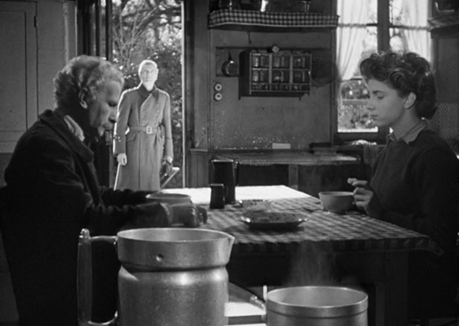
f9677-lesilence1Out of the many titans of French film, I found a personal favorite in Jean-Pierre Melville. Aside from changing his name in honor of the American author who wrote about the great white whale, Melville was also a member of the French Resistance during WWII. Thus, he seems to be the perfect man to helm a film based on a novel that was secretly published during the Nazi occupation. You would think that it would be brimming with political agenda and underhanded controversy.

Instead, Melville gifts us a nuanced and sympathetic film about a German Lieutenant who is quartered in the home of a French gentleman and his young niece. In many ways, much of the story plays out as an extended monologue rattled off by Werner von Ebrennac, and it becomes the perfect narrative device for an intimate character study. He is met by silence and passive aggression from his hosts, who hate his guts and the situation they have been placed in. He represents everything they despise, and his mere presence also reminds them of the shameful fact that France has fallen.

And yet he is far from the stereotype, and Melville never allows this German Lieutenant to succumb to our preconceptions. This has to be one of the most sympathetic depictions of a German soldier ever seen captured on film. It turns out that Ebrennac is a perfect gentleman, cultured in literature (Moliere, Rascine, Cervantes, Dante, Shakespeare, and Goethe), and a seasoned musician. His head is full of romantic ideals about the reviving of France as it is taken under the wing of its new conqueror.

His words are always met with a quiet contempt as uncle and niece continually sit reading and knitting. It never seems to change or stop. There is never a change in temperate or a word spoken. Just the words of Ebrennac every evening after he gets back and the voice-over of the older gentlemen constantly illuminates us about the unspoken workings of his mind.

Soon, however, the Lieutenant learns the reality of the war from Treblinka to the Nazi ideology pervading the psyche of all the German military. Friends have been brainwashed, and his view of the German war is completely dashed. There is nothing left to do but apply for a transfer and resign himself to the hell that has been created. Uncle and niece reluctantly bid farewell to a man who was the exception.

This was Jean-Pierre Melville’s first feature, but I really enjoyed it as simple as it is. He seems to understand the ambiguities of war. It often is difficult to decipher who is in the right or the wrong. Germany was the odious villain and France the obvious victim. However, in this domestic drama the tables are seemingly switched in stark contrast.

4/5 Stars

Persona (1966)

f15de-persona1“Persona: The image or personality that a person presents to other people” ~ Merriam-Webster Dictionary 

Ingmar Bergman’s Persona got me thinking. About what I’m not quite sure, but it did leave me confused and utterly perplexed which I suppose is a good thing. Since I am a fan of comparisons, I will go out on a limb and say I felt like I was watching the cross between L’Avventura and Repulsion. Persona is certainly befuddling psychologically and it has the crispest, most pristine black and white cinematography I have seen in a long time, courtesy of Sven Nykvist. 

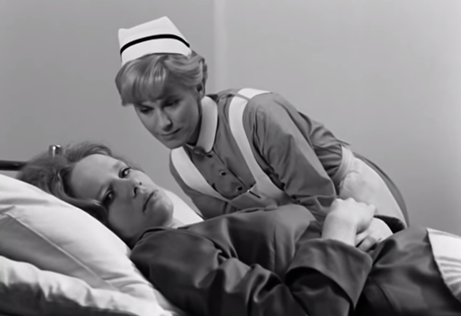
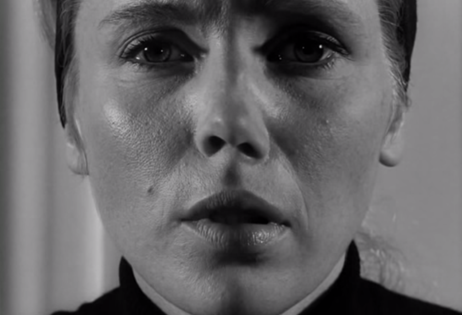
The opening sequences in the hospital are noticeably minimalist with an accentuated sterile environment. The close-ups feel reminiscent of The Passion of Joan of Arc and the highly dramatic and unnerving score  sends twinges down our spine. To top it off, the takes can be excruciatingly long, focusing on an inert face or a solemn figure crouching in a doorway. Silence is just as prevalent as dialogue.

At its core, Bergman’s film is an examination of individual characters in space. Alma (Bibbi Andersson) is the young sprightly nurse who is called in to take care of catatonic actress Elisabet Vogler (Liv Ullmann). Their interactions quickly move from the plain hospital room to the seaside cottage loaned out to Mrs. Vogler for her recovery.

What begins as attendant watching over patient soon evolves into a vulnerable woman finding a silent foil to confide in. The Persona is changing. 

All of a sudden roles are reversed and when Alma discovers a letter Elisabet sent away to the administrator, things are never the same. She feels betrayed learning that the actress has been analyzing her in silence. All that’s left is bitterness and anger towards her mute companion. No words come out of her mouth. Only blank stairs and more silence. She remains strangely calm in juxtaposition with the agitated Alma who becomes more and more tormented. But it is at this point we have lost much of our grip on reality. The lines, as well as the images, are often blurred and warped.

Persona takes on some brazenly edgy topics with frankness that is often abrasive. A repeated monologue by Alma follows the discovery of a recovered photo of Elisabet’s little boy. In the sequence, Alma speaks the words on Vogler’s mind and we are forced to labor painfully over her words yet another time. In many ways, Alma becomes the stand in or understudy for the actress and the role is far from elegant.

By the time the film came to its conclusion I hardly knew what to think. It elicited powerful feelings and reactions of aching and apprehension. If nothing else Bergman certainly makes you think and his Persona is unquestionably a striking piece of cinematic art. He has the skill of riddling our minds like a Bunuel or even Godard. It’s powerful if not completely satisfying because we can never hope to fully understand it.  

4.5/5 Stars

Wages of Fear (1953)

2c3da-salairedelapeurr350Directed by Henri-Georges Clouzot, this international thriller stars a cast headed by Yves Montand. The film opens in a hell-hole of a town in South America where many jobless drifters spend their days. The joke is that it is really easy to get there, you just can never get out again. 

A Frenchman named Mario (Montand) is one of these vagabonds who has little to do except make eyes at a pretty girl (Vera Clouzot), and sit around the local hangout. Then a massive fire breaks out at a nearby oil field of the corrupt, American Southern Oil Company (SOC). In order to stop the devastation, the solution is to use explosions triggered by nitroglycerin. But the journey to the fields is extremely dangerous so there is the brilliant idea of finding four eager vagrants to transport two trucks of nitro on this 300-mile suicide mission. In need of a break, most of the town jumps at the opportunity. However, only four men actually get this “privilege.” 
One is Mario, another his jovial roommate Luigi, and then the closed off and menacing Bimba. The fourth man who eventually joins this trio is Jo who is an older French fellow who befriended Mario. Then, Mario and Jo leave in one vehicle followed by Bimba and Luigi with the fun just beginning. They must navigate the treacherous roads full of not only bumps but barricades and giant boulders. All the while they are worn thin physically and psychologically. 

Soon the confident Jo turns into a sickly coward, but the other three must keep on going if they want their payoff. In the end, this mission turns out to be too much for some. Eventually, Mario gets ready to return to his girl with $4,000 in toe, a deliriously happy man.
First off, when it is said that this film is a “thriller,” we are not talking about a Hollywood thriller here, with overwhelming action followed by twist after turn. What makes the Wages of Fear so powerful is the sustained intensity because every moment that the nitroglycerin is in the picture you half expect something to go wrong. As such a thriller, I almost came to expect the ending because I really do not think it could have ended any other way. In many ways, it is not simply a critique of the American oil industry, but also the American film industry, and it confidently defies both.

4.5/5 Stars

Three Colors: Red (1994)

 3a286-threecolorsred3Kieslowski’s films are mostly character driven and yet he often uses high drama to create a far more complex lens to observe his subjects. In Blue, the inciting incident was a deadly car accident. It seems only fitting that he would end this story with the catastrophic sinking of a ferry. He takes the same bleak, no-nonsense approach with little fanfare that he used before. It’s his way.

In fact Three Colors: Red as a whole is another simplistic film in plot, and yet the irony is that the film is chock full of complexity because its major point of interest is interpersonal relationships (as suggested by the intertwining phone lines shown early on). There is nothing more tangled and intricate about humanity than our relationships.

As such, this final installment is in many ways a story about love, romance, and friendship, and yet Kieslowski does not find it necessary to preach to us. He is better and more thoughtful than that, laying out the story for us to ponder and mull over. This is the story or better yet the parable he created.

Valentine (Irene Jacob) is a young student and model who is constantly an innocent and sympathetic figure with a pair of doe eyes. She is often shown in profile which continually reveals her youthful and even sullen beauty. She is even the somber poster girl of a gum campaign plastered around town. There’s a boyfriend in her life who she desires the affection of, and then there’s a brother who is hooked on drugs. In other words, life is far from rosy and secure.

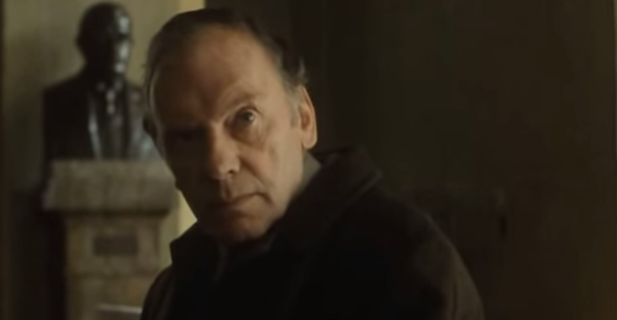
One day she accidentally runs over a dog that she takes to the owner (Jean-Louis Trintignant,) who seems surprisingly unconcerned by the event. She does the only thing she can do with a clear conscious which is taking the dog to the vet and then taking care of it herself. Soon after, Valentine finds herself walking the dog by the old man’s house once more and she discovers what he does all day. It turns out he is a retired judge, and he spends his solitary existence eavesdropping on the conversations of others (including Valentine’s neighbor Auguste).

Later, through the grapevine, she finds out that a retired judge had a suit filed against him, and she rushes to his house to assure him she had no part. He already knows because he was the one who turned himself in.

Over the next days, Valentine begins to empathize more and more with Mr. Kern’s existence. As a former judge, he was forced to make decisions far more difficult than most. In fact, why do people follow laws? Is it out of goodness or purely self-serving? Is morality all relative? What really is good and bad, because how would we act in the other man’s shoes? By this point, we see Kern’s struggle a little better.

Finally, Valentine invites her new found friend to her last fashion show before she heads to England for a few weeks. It’s a touching moment when he pays her a visit after the show, but it also reveals the pain in the old man’s past. It may be a lucky guess but all we know is that Valentine figures him out. It just shows that you cannot judge others by first impressions.

So as it goes, Auguste’s life practically mirrors that of a younger Kern, and thus, so many parallels become evident. Aside from the obvious, I only figured it out after the film was done, but they are both judges, struggle in love and the like. At the end of the film when Kern sees the news about the ferry with Valentine and Auguste aboard, the only thing we know for sure is that there were seven survivors (guess who!). In a somewhat subtle way, the trilogy is connected and Kieslowski ends his tale on a fitting note. It freezes and just like that the career of one man was done for good. A couple years later he would already be gone. But he went out on top and Three Colors cemented his legacy. I always loved the color red the best. Here’s yet another reason why.

4.5/5 Stars
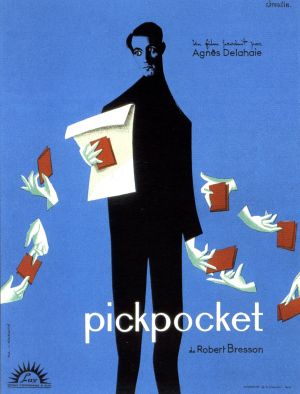
Pickpocket (1959)

6593f-pickpocketposterThis French film directed by Robert Bresson, begins with voice-over narration of a man recalling his past. Michel is a nondescript person who was down on his luck. Then, one day he ineptly tried his hand at pick pocketing and was caught. He got off and over time he sharpened his skills and teamed up with two other men. They successfully bring in a great deal and it becomes Michel’s livelihood. At the same time Michel’s mother is becoming ill and he meets a young neighbor named Jeanne. Michel’s best friend is falling for this girl while Michel himself is continually tempted to steal. This leads to a little trouble from a police inspector and yet he stays out of jail.

However, after further discussion with the chief and Jeanne, Michel leaves Paris. He returns later still impoverished, to find Jeanne with a child but unmarried. He resolves to support her and yet after trying to work, he reverts back to his past vice. This time his guard is down and he winds up in jail. Jeanne comes to visit him a great deal and through this devotion he realizes they both are in love with each other.

This film has simple but intriguing topic. Sometimes the pick pocketing scenes are shown almost as a choreographed dance which is done so fluidly. Overall Pickpocket has a striking resemblance to Doestoevsky’s Crime and Punishment but it reflects the wonderful simplicity of Robert Bresson’s realistic style. Is it just me or does Marika Green look like Natalie Portman in black and white. I certainly think so.

4.5/5 Stars

Three Colors: Blue (1993)

b0ad4-threecolorsblue“Now I only have one thing left to do: Nothing. I don’t want any belongings, any memories. No friends, no love. Those are all traps.”

I once thought that Before Sunrise was the type of movie that I would want to make. Three Colors: Blue is another concept that I have often envisioned without even knowing it. In fact, I had seen The Descendants, a film with a somewhat similar story arc told from a different perspective. Except whereas Clooney’s film is full of blatant drama and intense familial moments in Hawaii, Blue is far more nuanced.

The Descendants might be a more gripping drama, but Blue has the sort of complex depiction that seems to more closely mirror reality. The grieving process involves isolation, solemness, and at times few words. The easiest way to grieve is not to feel, not to fully embrace the pain. Sometimes that is the simplest if not the healthiest way to deal with it for Julie. It’s a real world approach to the scenario, and it’s no less painful to watch — perhaps even more so.

Julie’s husband Patrice de Courcy was a famous composer who was commissioned to arrange a grand piece to be performed at concerts for the Unification of Europe. It is a great honor and we quickly learn that Patrice is quite a big deal. However, after a car accident, Patrice and his 5-year-old daughter perish in the crash and only Julie gets away alive. It is a stark, unsentimental picture, and it succeeds in changing Julie’s life forever.

After being released from the hospital she soon sells all her possessions and moves out of her family apartment to take up residence somewhere far removed from any acquaintances, including a man named Olivier who is in love with her. She has a new home and begins to sever ties to her old life. The unfinished work of her husband (and her) is trashed and that’s the end of that. In her new Parisian home, she has a rodent problem and becomes the hesitant confidant of a local exotic dancer. Furthermore, she rejects the necklace that a young man pulled out of the wreckage. Her times of solitude are spent swimming laps alone in the local pool, submerged and half-covered in shadow. Grandiose symphonies reverberate through her mind haunting her. In such moments, Kieslowski will often black out the screen in the middle of the scene, effectively interrupting the action for a few seconds before bringing us back.

Words are few and far between for Julie and when she does speak it is often brief and reserved. We are, therefore, forced to observe her without the aid of dialogue. She is certainly detached but there is a provocative side to her. Something is mystifying about her soft features, dark eyes, and short hair. She is a wonderful woman of mystery and beauty because the reality of it is, we do not know a whole lot about her. We must discover more bit by bit and she does not readily disclose information.

It is when pictures of her life literally flash before her eyes on a TV screen that the story takes its next turn. Julie learns soon enough that her husband had a mistress that he was with for a few years. In the hands of Hollywood, this would be high drama. In the hands of Kieslowski, it is far from it. Julie is still the same aloof individual she always was and even a confrontation with the mistress does not change that. She is civil and generous through it all.

Finally, she returns to her husband’s composition which she learns Olivier has started to rewrite. They agree that he will make his own work and Julie must accept it for what it is. Faces from the film float across the screen and a still solemn Julie lets out a few silent tears. The anti-tragedy is complete, a subdued, intriguing piece of cinema. Not for those with short attention spans but, I am interested to see Red and White. Kieslowski intrigues me with his thought provoking films somehow reminiscent of the likes of Bergman or Bunuel.

4.5/5 Stars

The Kid with a Bike (2011)

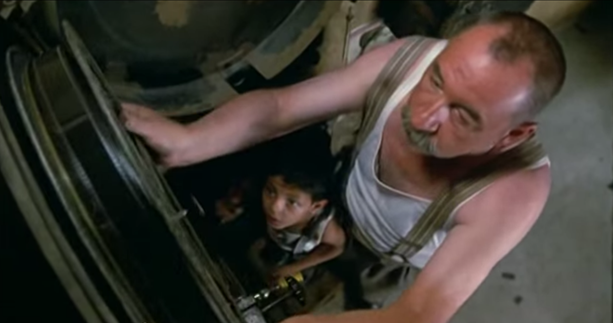
fe148-kidwithabikeTo say this is an affecting film would be an understatement, because if you want, to be honest, it is truly heart wrenching and painful to watch. From the beginning moments, this film brought to mind a modern-day hybrid of The 400 Blows with a bit of The Bicycle Thief mixed in. However, comparisons are always unfair, because this film will never be either of those and that is fine.

Cyril (Thomas Doret) is a young red-headed boy whose most prize possession is his bicycle. Now his mother is non-existent (either dead or gone) and his father might as well be. The boy lives at a foster home, but he is an unruly occupant who is prone to flee. The reason being is that Cyril clings to the hope that his father will come and get him or that his father will call him soon. It never happens.
On one such escape attempt, Cyril clings to a lady hairdresser (Cecile de France)  as his caretakers pry him away. Soon she comes to see him and brings his prized bike which had been stolen. Next, she graciously agrees to take him for the weekends after he asks her. However, he is far from a perfect child, often detached, prone to disobey, and can even be violent at times. Things get worse when Cyril goes with Samantha to talk to his father. It’s a happy moment for Cyril until his father reluctantly tells him to his face that he will not take him back. He had initially asked Samantha to do it showing his lack of a spine and self-respect. You cannot much blame Cyril, but he gets worse before he gets better. He spends time with a local thug who ingratiates himself to Cyril with bike repairs, Assassins Creed, and soda. The motive being he needs a new accomplice to take part in a small-time robbery. The worst part is Cyril does it after Samantha specifically tells him not to hang out with the guy.
Without getting into all the gory details Cyril runs into more problems, Samantha gives up her boyfriend, and there are more repercussions for his actions. However, unlike The 400 Blows, this film ends on perhaps a more positive, although altogether odd, note. We can only hope that Cyril and Samantha gel even more because they deserve to be happy, but that is a story for another film. Or maybe it is better not knowing.
I had yet to see anything from the Dardenne Brothers, but I can see why their type of film-making is so popular. It’s “European film” at its best with simple storylines, realistic and humble camerawork that is brought to life by complex characters. There is a lot of raw emotion and character traits that must be parsed through. Motives and actions must always be questioned since we cannot understand everything. We just know they happen. That is a beautiful thing I suppose because these characters are not often two dimensional and that is a service to the audience. These are the type of films people deserve to watch whether they know it or not. If all we see are summer blockbusters and Oscar contenders we would be missing out on a whole different niche of film entirely. Give it a chance and just maybe you’ll like it.
4.5/5 Stars

Cinema Paradiso (1988)

58390-cinemaparadisoTo the casual viewer, Cinema Paradiso can seem like a plodding film, but this pacing is almost necessary since it reflects the passing of the years for one individual. It has been 30 years since Toto left his hometown as a young man never to return. Now he gets a call from the mother he never talks to, with the message that Alfredo has passed away.

The memories become coming back from when he was a young boy in the post-war years. He had a knack for getting into trouble, falling asleep as an altar boy, and getting scolded by his mother. She was especially displeased with his obsession with the movies played at the local theater called Cinema Paradiso. It is there where Toto has his first encounters with the great legends of film, but also perhaps more importantly, the projectionist Alfredo. Initially, the middle-aged man finds the boy a nuisance but slowly a close bond forms between the two. Alfredo teaches little Toto the tricks of the trade and the movie hall flourishes with packed houses all the time. You see, it was the age when movies were a family affair, and the whole town showed up to be entertained. They were the perfect escape from disillusioned post-war years. However, there still is a local priest who censors all kissing in film because after all, that’s highly objectionable. Very racy indeed.

One such night a near fatal accident occurs when the projector overheats then burns the film setting the whole projection room ablaze. Toto barely pulls out Alfredo alive and he is permanently left without sight. From that day on his young prodigy takes over the job but never forgets his mentor and friend. The boy is soon turning into a man and it means young love and a stint in the army, and still Alfredo is around for him. He is always ready to give a bit of homespun wisdom from a movie or do a simple favor. However, finally on the advice of his old friend Toto left town and never returned in order to make something of his life. 

Now he finally returns to pay his respects and the old has passed away. Some familiar faces still inhabit the town but the Cinema Paradiso is about to be demolished and the end of an era has arrived. The days of cinema halls are waning as videos and the like grow bigger. As a gift to his friend Alfredo left Toto (now Salvatore Di Vita) one last reel of film containing a montage of big screen kisses. It is less a lesson in Italian and American classics and more of a lesson in life. Our relationships matter. More on that later. 

 Cinema Paradiso made me crave watching films with a big audience because that is something modern moviegoers often do not experience. Movies were initially meant for the masses (ie. Sullivan’s Travels) and they were meant to be enjoyed in community with one another. That’s part of their magic I suppose. 

This is also a highly sentimental, highly nostalgic look at film, but as I alluded to before, it is less about film and more about the people. I tried to recognize actors and films while I saw bits and pieces of old black and white footage, but then I realized it was arbitrary because the audience members are what really mattered. As Alfredo points out in one of his last chats with Toto, “Life isn’t like in the movies. Life…is much harder.” However, the reward of living life is great despite the risk involved, and so it is necessary to leave the movie theater, television, or your laptop behind at times. Life and the relationships that fill it are the most paramount of all and although nostalgia is wonderful there is something to be said for living in the present. That is some of what Cinema Paradiso teaches us and it is a message to take to heart.

4.5/5 Stars