
 “On Sunday, August 13th, 1961, the eyes of America were on the nation’s capital, where Roger Maris was hitting home runs #44 and 45 against the Senators. On that same day, without any warning, the East German Communists sealed off the border between East and West Berlin. I only mention this to show the kind of people we’re dealing with—Real Shifty.” ~ James Cagney as C.R. MacNamara
I love Billy Wilder. It’s as if he’s a lightning rod for all things controversial, biting, and politically charged, and he’s got a wicked wit. Thus, a cultural moment such as the Berlin Crisis must have been a juicy piece of material for him. Since it was, after all, his native land before the war, and he fills the frame with all the necessary touchstones. His collaborative script with I.A.L. Diamond carries a similar frenetic rapid firepower to Hawk’s His Girl Friday while maintaining a point of view relevant to that moment in time. The East Germans march in anti-American parades with signs plastered with the faces of Khrushchev and Castro. We pick out words like Little Rock, U2, Kennedy, and so.
This is really a film about Coca-Cola, capitalism, and Yankee ingenuity as it rubs up against the Soviet philosophy, where both sides end up getting poked at. It’s the arena of the Cold War played for comedic effect.
C.R. MacNamara (James Cagney) is an ambitious established Coca-Cola exec who is used to working all across the world with his wife (Arlene Francis) and children being towed along with them. He’s looking for the next big job to propel his career even higher and Berlin is his latest stop. Our first trip to his office offers a bit of the comedic corporate hierarchy of The Apartment.
There are the rather sardonic post-WWII sensibilities that the Germans are a new people, not to be implicated in the crimes — even going so far as to not acknowledge the name of an infamous Adolf. Although his heel-clicking righthand man Schlemmer furiously denies it, there’s a sense that he’s a closet Gestapo (a less crazed version of Dr. Strangelove). He cannot deny his conditioned urges after all.
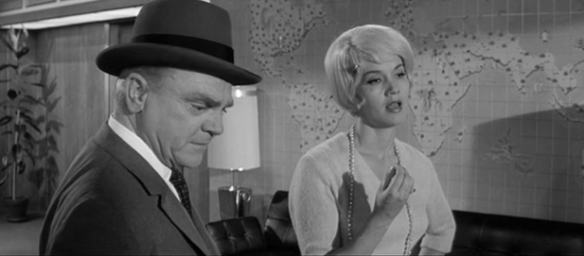 When he’s not getting English lessons or doing dictation with his shapely secretary (Liselotte Pulver), Mac is trying to swing a deal to start selling his billion-dollar beverage in the Soviet sector. He’s met by three bumbling boobs led by the portly Peripetchikoff (Leon Askin), who feel like heirs apparent to Ninotchka’s Russian trio.
Once again underlying their entrance are the political sentiments at the time. After offering Mac a cigar, they giggle that they traded the cigars for some lousy missiles (The future Cuban Missile Crisis springs to mind). There also intent on winning the Space Race.
If these were the mains concerns of Wilder’s narrative it would be at least historically fascinating, but he gives us more. One of Mac’s higher-ups Mr. Hazeltine, based in good old Atlanta Georgia dials him up on the telephone to inform him that his little angel Scarlet (Pamela Tiffin) is coming for a stay in Germany. It becomes Mac’s duty to watch over her and keep her out of trouble. At first, things seem to be going beautifully, until Scarlet disappears only to return with a boyfriend (Horst Bucholtz) from the eastern sector. A bamboozled Mac tries to figure out how to get rid of the Commie only to find out the two contrarian lovebirds are married and there just might be a child on the way!
To add to the ruckus, Mr. and Mrs. Hazeltine abruptly decide to come visit their baby to see how she’s getting on across the pond. Being the clever capitalist that he is, Mac hatches a plan to dump Scarlet’s Soviet beau and get her back to her parents. But it’s not that easy. It means dealing with his three Communist counterparts, giving them what they want, in the form of Fraulein Ingeborg, and getting Scarlet to her parents in good health.
 The monetized mayhem is complete with car chases, Soviet torture involving “Its Bitsy Teenie Weenie Polka Dot Bikini,” and a scramble to turn the belligerent Otto Piffl into a respectable capitalist. It’s a brilliant escapade blending social commentary and narrative hiccups as only Wilder could.
And, boy oh boy, can Jimmy Cagney deliver dialogue. He’s as dynamic as ever with every phrase and movement, snapping all the while with entrepreneurial abandon. Meanwhile, the score is constantly clapping, bouncing, tap tap tapping away in the background.
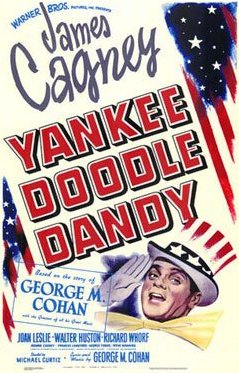
There are nods to Gunsmoke and Little Caesar all in the same scene. We get allusions to the Algerian situation, Freedom buses, Grace Kelly, Spartacus, Nat King Cole, Duke Snider, and columnist Ear Wilson — the only one I had to look up. There’s even a cuckoo clock that plays Yankee Doodle Dandy. If I’m not mistaken James Cagney was in a pretty decent film involving that song at one point in his career.
The film’s wicked wit is perfectly illustrated by the following bit:
“My father is an S.N.O.B.”
“A what?”
It’s a film that has a playful sensuality and potential rudeness that is all the while veiled behind 1960s sensibilities like Coca-Cola and baseball. Wilder was the master at subverting the norm and making us laugh the whole time. One, Two, Three is a blast from the past that is as refreshing as a sip of Coca-Cola, while also carrying a political charge.
“I wouldn’t touch the Russians with a ten foot Pole and I’m not interested in the Poles either!” ~ Mr. Hazeltine
4/5 Stars
 4 Star Films