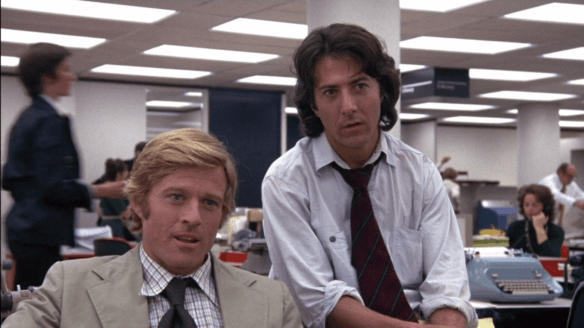
All the President’s Men (1976)

allthepresidentsmen1You couldn’t hope to come up with a better story than this. Pure movie fodder if there ever was and the most astounding thing is that it was essentially fact — spawned from a William Goldman script tirelessly culled from testimonials and the eponymous source material. All the President’s Men opens at the Watergate Hotel, where the most cataclysmic scandal of all time begins to split at the seams.

And Bob Woodward (Robert Redford) joined by Carl Bernstein (Dustin Hoffman) were right there ready to pursue the story when nobody else wanted to touch it. The Washington Post went out on a limb when no other paper would. Because if we look at the historical climate, such an event seemed absolutely ludicrous. Richard M. Nixon was the incumbent president. Detente had led to cooled tensions with the Soviets. And Democratic nominee George McGovern looked to be on a self-destructive path.

But the facts remained that these “burglars” had ties to the Republican Party and potentially the White House. It was tasked to Woodward and Bernstein to figure out how far up the trail led. And to their credit the old vets took stock in them — men made compelling by a trio of indelible character actors Martin Balsam, Jack Warden, and Jason Robards.

Woodward begins hitting the phones covering his notepad with shorthand and chicken scratch, a web of names and numbers. With every phone call, it feels like they’re stabbing in the dark, but the facts just don’t line up and their systematic gathering of leads churns up some interesting discoveries. Names like Howard Hunt, Charles Colson, Dardis, Kenneth H. Dahlberg all become pieces in this patchwork quilt of conspiracy. The credo of the film becoming the enigmatic Deep Throat’s advice to “Follow the money” and so they begin canvassing the streets encountering a lot of closed doors, in both the literal and metaphorical sense.
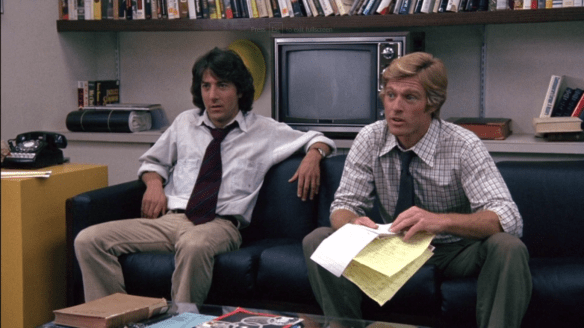
allthepresidentsmen3But it only takes a few breakthroughs to make the story stick. The first comes from a reticent bookkeeper (Jane Alexander) and like so many others she’s conflicted, but she’s finally willing to divulge a few valuable pieces of information. And as cryptic as everything is, Woodward and Bernstein use their investigative chops to pick up the pieces.

Treasurer Hugh Sloan (Stephen Collins) stepped down from his post in the committee to re-elect the president based on his conscience, and his disclosures help the pair connect hundreds of thousands of dollars to the second most powerful man in the nation, John Mitchell. That’s the kicker.

It’s hard to forget the political intrigue the first time you see the film. What I didn’t remember was just how open-ended the story feels even with the final epilogue transcribed on the typewriter. The resolution that we expect is not given to us and there’s something innately powerful in that choice.
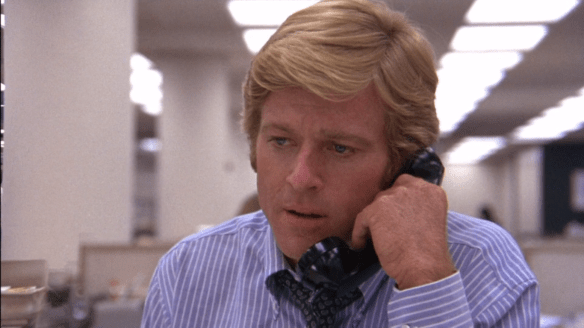
allthepresidentsmen4Gordon Willis’s work behind the camera adds a great amount of depth to crucial scenes most notably when Woodward enters his fateful phone conversation with Kenneth H. Dahlberg. All he’s doing is talking on the telephone, but in a shot rather like an inverse of his famed Godfather opening, Willis uses one long zoom shot — slow and methodical — to highlight the build-up of the sequence. It’s hardly noticeable, but it only helps to heighten the impact.

Furthermore, some dizzying aerial shots floating over the D.C. skyline are paired with Redford and Hoffman’s voice-over as they are canvassing the streets to convey the type of paranoia that we would expect from a Pakula film. Because, much like the Parallax View before it, All the President’s Men holds a wariness towards government, and rightfully so. However, there is a subtext to this story that can easily go unnoticed.

The name Charles Colson is thrown around several times as a special counselor to the president, and Colson like many of his compatriots served a prison sentence. That’s not altogether extraordinary. It’s the fact that Chuck Colson would become a true champion of prison reform in his subsequent years as a born-again Christian, who was completely transformed by his experience in incarceration. And he did something about it starting Prison Fellowship, now present in over 120 countries worldwide.

It reflects something about our nation. When the most corrupt and power-hungry from the highest echelons of society are brought low, there’s still hope for redemption. Yes, our country was forever scarred by the memory of Watergate, but one of the president’s men turned that dark blot into something worth rooting for. It’s exactly the type of ending we want.

4.5/5 Stars
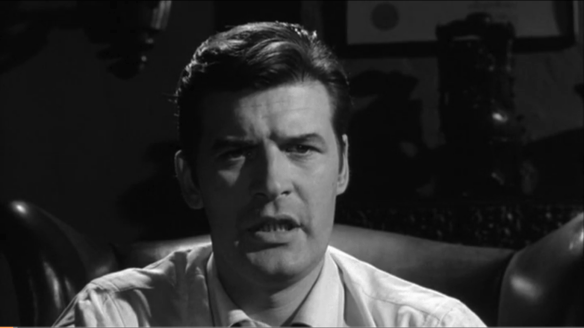
Shock Corridor (1963)

shockcorridor1“This long corridor is the magic highway to the Pulitzer Prize” – Johnny Barrett
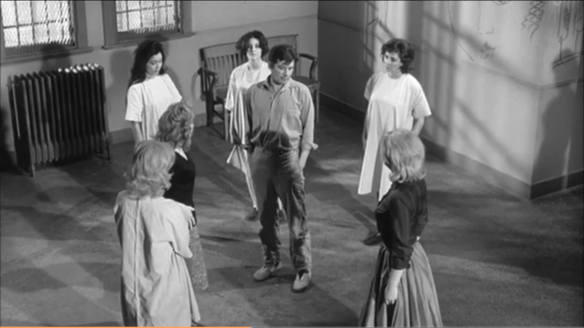
Being a jack of all trades, producer, director, screenwriter extraordinaire Sam Fuller also had a stint as a journalist. Therein lies his obvious stake in Shock Corridor, a film that looks frightening on paper, and is even more eye-opening in execution. True, this is not an altogether realistic film, but that’s what makes it such a stirring portrayal. It dives into the darkened recesses of a sanitarium showing us things we don’t want to believe. They probably weren’t all true, but there’s still that shred of doubt. We’ve seen enough One Flew of the Cuckoo’s Nest and read enough horror stories to know better. Fuller plays off that fear which intrigues us as much as it alarms.

Investigative journalist Johnny Barrett (Peter Breck) can see it now. If he infiltrates a mental institution he can dig up the truth on a murder case that occurred behind closed doors and was quickly hushed up. Such a piece of detective work could earn him the Pulitzer Prize easily, and the tantalizing prospect is too good to resist. His girlfriend played by Constance Towers pleads with him to back out, because she wants no part of the plan.

But he teams up with his editor Swannee and Psychiatrist Dr. Fong to cook up a backstory the people in charge will buy. Barrett gets coached in how to act and respond to every question. It’s a potential long shot, but just like that, they buy his sordid story of obsession with his sister thanks to a performance by Cathy. He’s in.

shockcorridor3Behind the pearly gates, there are brawls galore and noisy neighbors riddled with all sorts of neurosis, quirks, and ticks. There are the good cop and bad cop who help care for the patients and keep them at bay. Johnny even begins to have hallucinations of his girlfriend drifting through his dreams. He gets introduced to hydrotherapy, dance therapy, and even faces a traumatizing experience at the hands of women in the female ward.
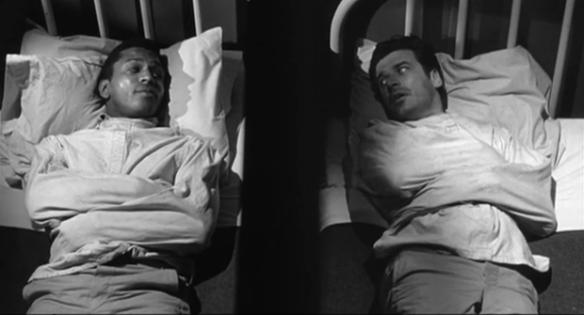
All the while, he is sniffing around for any information on the man named Sloan who was killed with a knife by a man in white pants. He makes his rounds questioning three different witnesses and amid their idiosyncrasies, they give him bits and pieces of fact. However, their own mental capabilities are clouded by traumatic war experiences, racist ramblings, and fear of impending nuclear war.

shockcorridor2The boisterous, tumultuous chaos of the ward does almost become maddening, even to the viewer. Johnny has a few angry outbursts of his own as the strain of the facility gets to him more and more every day. Electric shock therapy among the other treatments leaves him mixed-up, confused, and overtly paranoid. He’s hardly the man we met in that office so many days ago and even if he got the scoop he was looking for, at what cost? Shock Corridor has a thunderously disconcerting ending worthy of a Fuller production.
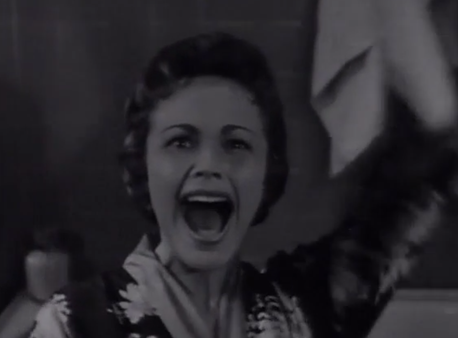
From casting Philip Ahn as a knowledgeable psychiatrist to the absurdity of an African-American obsessed with the KKK and Pro-White sentiment, Fuller once again does a lot on the racial front. He manages to represents Asians in a positive light and the character of Wilkes points to the still inherently twisted nature of southern white supremacists, even after the advent of such legislation as Brown v. Board.  Thus, once more he gives us a sensationalized story with a surprising amount of depth to it. No doubt he had a soft spot for journalism since that’s what he made his living off of at one time. But Shock Corridor implies that there is such a thing as crossing the line. It’s the utter extreme, but it’s cautionary nonetheless.

3.5/5 Stars

Spotlight (2015)

Spotlight_(film)_poster“They say it’s just physical abuse but it’s more than that, this was spiritual abuse.”
I wrote a piece tracing the obvious parallels between All the President’s Men and Spotlight, two films that I could easily see both shaking the very framework of American society through their very candid portrayal of journalism. When actually getting to see Spotlight the connections became even more prominent. Our narrative begins, not in Washington D.C., but in Boston Mass, 1976. It even goes so far as having a Ben Bradlee connection. Bradlee Sr. worked with Woodward and Bernstein while the Big Throat story was breaking. Of course, numerous years later Bradlee Jr., continuing the family profession, was working at the Boston Globe and becoming an integral part of what was going on there.

But enough with similarities, this film, written and directed by Tom McCarthy, deserves its own personal set of commentary. Spotlight is the investigative unit of the Globe and as such their work is not for the quick news flash, but grinding out long, detailed stories, although at times it takes a while to latch onto a juicy tidbit.

However, a new, rather stiff editor named Marty Baron points the team towards a story where a lawyer is accusing a local Cardinal about doing nothing after he found out a local priest was sexually abusing children. It’s a problematic scenario that deserves a little more time, but at this point, it’s an isolated event. It’s one man’s evil. One man doing nothing to remedy an outlier in the Catholic Church.

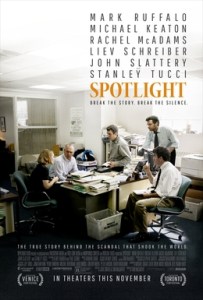
What follows is as troubling as it is imperative storytelling. The members behind the Spotlight team are not arrogant, self-righteous people, or figure pointers, only truth seekers. That’s their job, after all. The cast is well rounded and credible while no one figure steals the spotlight, literally. Michael Keaton is their leader “Robby” who has close ties with the community even going to high school across the street. Mark Ruffalo is the integral member Michael Rezendes who not only writes the story but has the important task of trying to needle a local attorney for information and documents that can blow the story wide open. Meanwhile, Sascha Pfeiffer (Rachael McAdams) carries out numerous interviews of her own in this multiple-pronged assault for the truth.

Their investigation looks to victim organizations, lawyers, priests, and a psychotherapy specialist. If it’s not obvious already, Spotlight makes it painfully clear that this is not a story of a few isolated incidents but an entire epidemic. This is the whole country — the whole world. It makes you positively squeamish and it’s perturbing in its brutal honesty. There’s no way for it to be sanitized and that’s indubitably frightening. We should be angry, we should be grieved, it should be abrasive to our senses.

It’s bringing to light an entire conspiracy of corruption. There are no paper trails, evidence is swept under the rug, and person upon person remain tight-lipped either due to guilt or shame. Humanity is drawn to darkness, but we want things to be brought to light. It’s the dissonance of what it is to be a person — the constant battle going on in our own human hearts. This isn’t meant to be about individual finger pointing, but an indictment of a system. An indictment of what we all are capable of. If it’s not being able to maintain the celibacy requirement, then it’s a pastor addicted to pornography, or a man sleeping with someone else’s wife. They’re different scenarios, but the people behind them are all similarly broken.

With the narrative of Spotlight cataclysmic events such as 9/11 shift focus, but they cannot fully distract from the bleeding that is still going on behind the scenes. There’s still a need to get to the root of the problem and they do. Mark Ruffalo’s character talks about having some deep down inclination that he will one day go back to the church and then came the day that all that came crashing down as they prepared to break the story. All his hopes went unrealized. It has to be an abysmal feeling. These are folks living in a secular world and a Church that falters so greatly is of little comfort. God is a distant deity, not a personal one, so it seems.

When the story hits the pavements you know that all hell is going to break loose, but what really happens is that all the pain, suffering, and shame has finally received the spotlight it deserves. The major realization is not that one person is the problem or even that another person is the problem. But the most frightening revelation Spotlight offers up is that we’re part of that problem. That’s tough news to swallow and this is a film that does it with immense credence and poise. Perhaps the toughest moments of the film come when the lights have died down and we see the staggering numbers of just how many cities were rocked by similar scandals. If you’re like me you see cities that are all too familiar. A film of this magnitude begs for some kind of response from its audience. It’s up to the viewer to decide what that will be — whether social, spiritual or something else entirely.

This is a potent film of the highest nature that lifts up journalism as a noble profession, while simultaneously rocking its audience with a real-life narrative of substantial magnitude. I’m not one prone to bloated statements, but this just might be the best picture of the year. Its impact has been duly noted.

4.5/5 Stars

Libeled Lady (1936)

Poster_-_Libeled_Lady_01Libeled Lady has screwball comedy written all over it and that’s perfectly alright with such a glorious cast. Myrna Loy and William Powell reunite once again (for one of their 13 pairings), but we also get Jean Harlow and Spencer Tracy. Amazing!

The set-up is easy and pretty self-explanatory. Warren Haggerty (Tracy) is the managing editor of the New York Evening Star, but while he is reluctantly getting ready to walk down the aisle, he gets the horrific news that the paper sent out a misinformed scoop by mistake. Now Haggerty is faced with a $5,000,000 libel suit from wealthy socialite Connie Allenbury (Loy), and it brings his weddings proceedings to a halt, much to the chagrin of his peeved fiancee (Harlow). This isn’t the first time that their big day has been postponed after all.

Stuck between a rock and a hard place, he goes to one of his former reporters, Bill Chandler (Powell), who really rubs Haggerty the wrong way, but he also happens to be a whiz when it comes to libel. He’s the only man who can get the paper out of the major jam so he leverages his position. Things go down like this. Chandler will ingratiate himself to Ms. Allenby and soon afterward Gladys Benton (Harlow) posing as his wife, will rush in on them. Presto! The suit will be dropped. Simple, right?

It’s the consequences that get even dicier. At first, Gladys absolutely despises being cooped up in a hotel with Chandler and she’s still fed up with Warren. But over time, the close quarters cause Chandler to grow on her. Meanwhile, Chandler tries to learn everything he can about angling, to charm Allenby’s father (Walter Connolly), who is a fishing aficionado.

From the start, his daughter has Chandler pinned as a fake (which of course he is), but by some act of heaven his act actually works and he wins them both over. Worse, Connie is falling for him and he’s reciprocating, but Haggerty is still waiting for the plan to be executed. Gladys is waiting impatiently for her “husband” who she seems to genuinely miss. It’s all a big mess to be sure.

The finale involves the four leads together for one final climactic barrage of pandemonium and spouse swapping. As you would expect everyone ends up with the right partner, but it was sheer craziness to get there. It had been a while since I had seen a screwball, and Libeled Lady is a striking reminder why the genre is so fun. It had me laughing pretty hard whether it was the utter absurdity of the fishing sequence or any of the other madcap moments. It boasts quite the cast too. It’s crazy to think that in only a year Jean Harlow would be gone, a short but vibrant career behind her.

4/5 Stars

While the City Sleeps (1956)

whilethecity1While the City Sleeps has a brilliant cold open followed by a pounding title sequence, courtesy of Fritz Lang, that brings to mind a bit of Diabolique and Psycho. The rest of the film turns into a case to find the wanted lipstick murderer (based on a real killer), but that only holds part of our attention.

When newspaper magnate Mr. Kyne dies suddenly, his begrudging son Walter (Vincent Price) takes over intent on shaking up the status quo and putting his mark on the company. He soon turns three men against each other as they desperately fight for the new position of executive director. The first is veteran newspaper editor John Day Griffith (played by the always memorable character actor Thomas Mitchell). The second candidate is chief of the wire service Mark Loving (George Sanders) who is Griffith’s main competitor. Finally, in the third spot is Harry Kritzer who happens to have a secret ace in the hole. Each of them is tasked with finding out the real scoop about the serial killer, and it turns into a real tooth and claw ordeal. Within the glass cubicles, everything can be seen, but not everything is heard and that’s where the secrets get disclosed.

On the outside looking in, so to speak, is star TV reporter Edward Mobley (Dana Andrew), who agrees to help his friend Griffith by doing a little digging around about the murderer. He gets some tips from a cop friend Lt. Kaufmann (Howard Duff), and Mobley tries to smoke the killer out on air. However, it leads to the potential endangerment of his fiancée Nancy, who also happens to be Loving’s secretary. Loving has his love directed towards a female reporter named Mildred Donner (Ida Lupino), who attempts to needle Mobley for info. At the same time, the killer is on the move once more, with Nancy being an obvious target. Mr. Kritzer’s own romantic entanglements get him in trouble because he is seeing Kyne’s beautiful but detached wife Dorothy (Rhonda Fleming). Mildred finds out about them and they have some talking to do. Mobley also has some making up to do with Nancy after she finds out Mildred came to see him. It’s a big mess.

whilethecity3Mobley juggles everything from his love life to the big scoop and they apprehend the killer, but things at Kyne’s don’t wind up exactly the way they expected. Mobley looks to move on from the paper with Nancy, but even he cannot get away that easily.

While the City Sleeps is an underrated tale from Lang that is positively stacked with big names. Its pacing can be deliberate at times, but it is just as much an indictment of journalism as it is a thriller. The office is a web of deception with so many interconnections between these work factions. Those you would normally expect to be scrupulous seem to give up their honor in the face of this new promotion. In a sense, Mobley seems to be outside of this fray and yet he cannot help but get involved in it. It doesn’t help that nothing turns out the way it’s supposed to. Everybody seems to gain something, but nobody really wins the game.

I must say it was great to see Dana Andrews in one of these leading roles again and although their roles were smaller, Ida Lupino and George Sanders still were a deliciously stuffy and corrupt pair. I was never really a fan of Vincent Price due to the roles he normally plays, but I was inclined to like Howard Duff (Lupino’s real-life husband) in his turn as the policemen. It goes without saying that Rhonda Fleming is positively beautiful, but she also cannot be trusted. I guess that applies to about every character in this film. It’s certainly a cynical world out there that Lang paints, where the killer might be caught, but corruption is never fully quelled.

4/5 Stars

The Parallax View (1974)

1c362-parallax_view_“Fella you don’t know what this story means”

The first shot and we know where we are. We’ve been here before. It’s Seattle. The occasion is a Fourth of July parade honoring Senator Charles Carol. Any viewer paying attention knows something fishy is afoot and in perhaps the most intense moment of the whole film the man is violently assassinated. A committee deliberates and comes to the conclusion that the perpetrator was acting alone. And so begins The Parallax View.

Second rate journalist Joseph Frady is known for getting into trouble or causing it most of the time. So when he is interested in rehashing the old story his long-suffering supervisor is skeptical (Hume Cronyn). It all starts because news reporter Lee Carter comes to Frady fearful for her life. It turns out that 6 of the people who were there during the assassination have all died one by one. It’s all very circumstantial and seemingly harmless enough. Soon Carter herself is dead due to barbiturates and alcohol. Frady heads first to the town of Salmon Tale (in search of the elusive Austin Tucker), where he runs into trouble with the local authorities and stumbles upon the Parallax Corporation. He gets his rendezvous with Tucker who is also fearful for his life. Minutes later Kabooom.

He continues winding up with more questions than answers as new bits and pieces crop up. It turns out Parallax is in the very lucrative business of recruiting assassins, so he goes off the grid to join them. His training includes a montage of images to condition him, and the audience is submitted to the process as well. Frady diverts a bomb threat thanks to a stack of napkins, but still another one bites the dust. He finally finds his way to a convention hall where a big to do is in the works for a senator. In a perfect bookend, another man is shot and after deliberating the committee concludes Joseph Frady acted alone. The biggest conspiracy in the country gets away with murder again and slinks back in the shadows.

Gordon Willis’s cinematography exhibits beautiful wide and long shots framing his subjects in their environments. Beatty is fit to play the somewhat rogue reporter but very few of the other characters are memorable. Perhaps that’s precisely the point. The film has extremely deliberate pacing (ie. Two men ride up an elevator one after another in no immediate hurry). However, the paranoia elevates as the film progresses, because we have little idea what is going on, we just know that something is going on. I am partial to The Manchurian Candidate, but here is a film that represents the 1970s, a decade still fraught with political unrest and a myriad of recent assassination attempts.

3.5/5 Stars

Review: Roman Holiday (1953)

Joe: Today’s gonna be a holiday.
Princess Ann: But you want to do a lot of silly things?
The answer is yes, yes we would!! That is the beauty of this film, which plays out as a lovely jaunt through Italy with two favorites in Audrey Hepburn and Gregory Peck. With Hepburn being practically unknown at this point in time, it made her a wonderful choice to play Princess Ann. She was someone without any prior identifying roles making her young princess seem plausible. William Wyler took a chance on an unknown and he certainly hit the jackpot.
Gregory Peck on his part was always a strong leading man and an All-American type, perfect to play Joe Bradley. However, he also exuded gentlemanliness,s so despite the fact that the princess spent the night in his apartment we know nothing went on.  He had no ulterior motives bringing her to his apartment and even when he arranges to get an article out of her we know that is not who he is.
The film itself consists of wonderfully connected vignettes incorporating the Roman culture and landscape. Princess Ann leaves behind the hospitality of Joe in order to explore a bit before she goes back to her real life. In order to get that major scoop, he tails her and finally invites himself to tag along, so beginning the real fun. Princess Ann gets her beautiful locks cut by a friendly barber and buys some gelato from a street vendor.
 
Soon she takes her first puff of a cigarette, takes in the glory of the Coliseum, rides a Vespa through the hectic streets of Rome, and winds up in police headquarters with some explaining to do.They finish up their afternoon on a more thoughtful note at a wall of wishes originating during World War II.
 
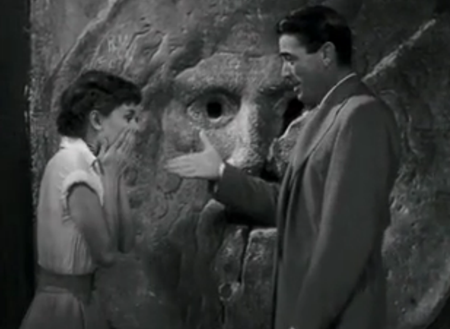
One of the best moments occurs at the mouth of truth, a great stone statue, which you are supposed to stick your hand in before it eats it up. In a moment of sheer fear Princess Ann or Audrey Hepburn, I’m not quite sure who looks on in horror as a screaming Bradley removes his arm and his hand is gone. Up comes the hand from the coat sleeves and the jokes on her. It has absolutely no bearing on the plot but it makes us love Peck and Hepburn even more.
 

To finish off the evening the two companions and Irving (Eddie Albert) cause a ruckus at a dance aboard a barge before swimming away to safety. There Ann finds love and a soaking wet kiss to go with it. But it is at that moment when the laughs stop and the romance begins that everything becomes all too clear. This wonderful day cannot last forever. There is a moment, after one final embrace, when they have to say goodbye for good.

This is not one of those “love at first sight” stories, but it is a different sort of fairy tale where two individuals share an enchanting day together and fall in love. Every Cinderella story must end and so does this one (Anna: At midnight I’ll turn into a pumpkin and drive away in my glass slipper). They must eventually come back down to reality with Princess Ann fulfilling his duties and Joe moving on with his career.
 
Joe’s major newsflash is not a thing anymore. The whole day means too much to him and being the buddy he is, good ol’ Irving understands that. Speaking of Irving, he deserves some discussion. Eddie Albert’s character is spilled on, stepped on, knocked over, tripped, and through it all remains the perfect buddy for Gregory Peck.  Even his little car is a riot, not to mention his inconspicuous tiny cigarette camera and his sly efforts at photography in every type of circumstance. Irving shares a great deal of double talk with Joe which somehow gets past the unsuspecting princess. However, by the end of the film, the princess is also a cohort in their memorable adventure with commemorative photos included! 
 
When Joe Bradley walks out of the grand palace he leaves content knowing that he shared something special. No one else needs to know (aside from Irving) about the fairy tale they shared and that is the beauty of it all. It is just their little secret, their Roman Holiday
 
5/5 Stars

Ace in the Hole (1951) – Film-Noir

Starring Kirk Douglas with director Billy Wilder, the film follows a hard-nosed and manipulative reporter who finds himself stuck in New Mexico without any money. He takes a small job and soon happens upon a cave where a man has gotten trapped. Soon he spins it as a great human interest story and people flock from far and wide to witness the event. The buried man’s unhappy wife capitalizes on the foot traffic and the local sheriff tries to get some free publicity for the upcoming election. Meanwhile Tatum tires to draw out the events so he can get a better story and his old job back. All the while the man gets weaker and weaker until he eventually dies. Just like that everything clears out and the big carnival is over. Tatum brought the demise of another man just to get a story and he ultimately fell himself losing the story and the job he had fought so fiercely to acquire. Although not Wilder’s most well-known film, this is certainly a biting critique of journalism and humanity in general.

4/5 Stars