Favorite Films of 2023

I was a bit behind on my movie-watching for 2023, but here is a list of a few movies I enjoyed from the past year. I’ve either linked to a previous review or included a short capsule. Enjoy!

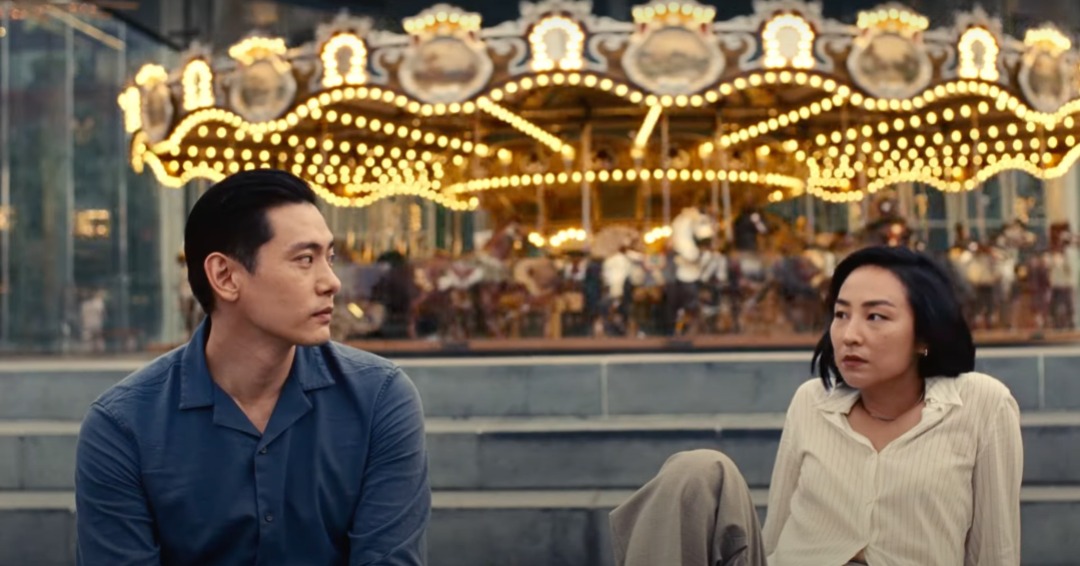
Past Lives

Writer-director Celine Song’s use of time is self-assured and brazen. She’s loose and elastic with it, bravely allowing her story to cut 24 years into the past before fast-forwarding 12 years and then 12 years again. But these jumps in time feel subtle and right with the perfectly applied sense of space and context. We never feel like we’re being rushed. The elliptical nature of a single cut is imbued with so much power. The movie is the epitome of contemplative cinema as it tells a fated love story.

Greta Lee is such a phenomenal conduit of this drama, and she takes every scene with a composure full of warmth and feeling. Teo Yoo has a forthright candor morphing from a boyish heartthrob to a man still grappling with unresolved feelings. John Magaro could easily be a whiny-voiced annoyance — the white evil of the movie — and yet it’s a credit to his humanity that we like him and even empathize with him (especially if we don’t speak Korean like this viewer).

As humans, we’re always looking to discern what our future will be. Religious people question God’s plan for their lives. And often we have the nagging thoughts of what-ifs and how things could have been. Perhaps I’m the only one who thinks like this. But Past Lives seems to suggest this is not the case.

Perfect Days 

It feels almost too convenient to evoke Jim Jarmusch’s Paterson from a few years back when considering this new film from Wim Wenders, but I can find no other alternative. They both focus on individuals who live contented analog lives with daily rhythms that feel almost radical in the face of the world around them. It doesn’t matter if it involves bus driving or in the case of Hirayama (Koji Yakusho), cleaning toilets in Japan under the watchful eye of the Tokyo Skytree.

Jarmusch, much like Wenders, has always felt like a sojourner with an insatiable curiosity, and both men seem to be continually expanding the cultural canvas of cinema through their travels and observations of a wide swath of humanity. Of course, Wenders started out first and has been doing sustained work for many years. It seems fitting that a film like this, while focusing on a very specific Japanese milieu, with the help of co-writer Takuma Takasaki, still boasts some of Wenders prevailing passions from photography to rock and roll music.

But what could feel like a mere gimmick gives rise to a man, thanks in part to Yakusho’s disarming performance, who has so much to offer the audience and others within the frames of the film. Because there’s something so quietly instructive about him. We can learn so much and appreciate so much more if we only observe the people and things around us. I found it charming, and it was a stirring reminder of why I love Japan (and the films of Wenders).
The Taste of Things

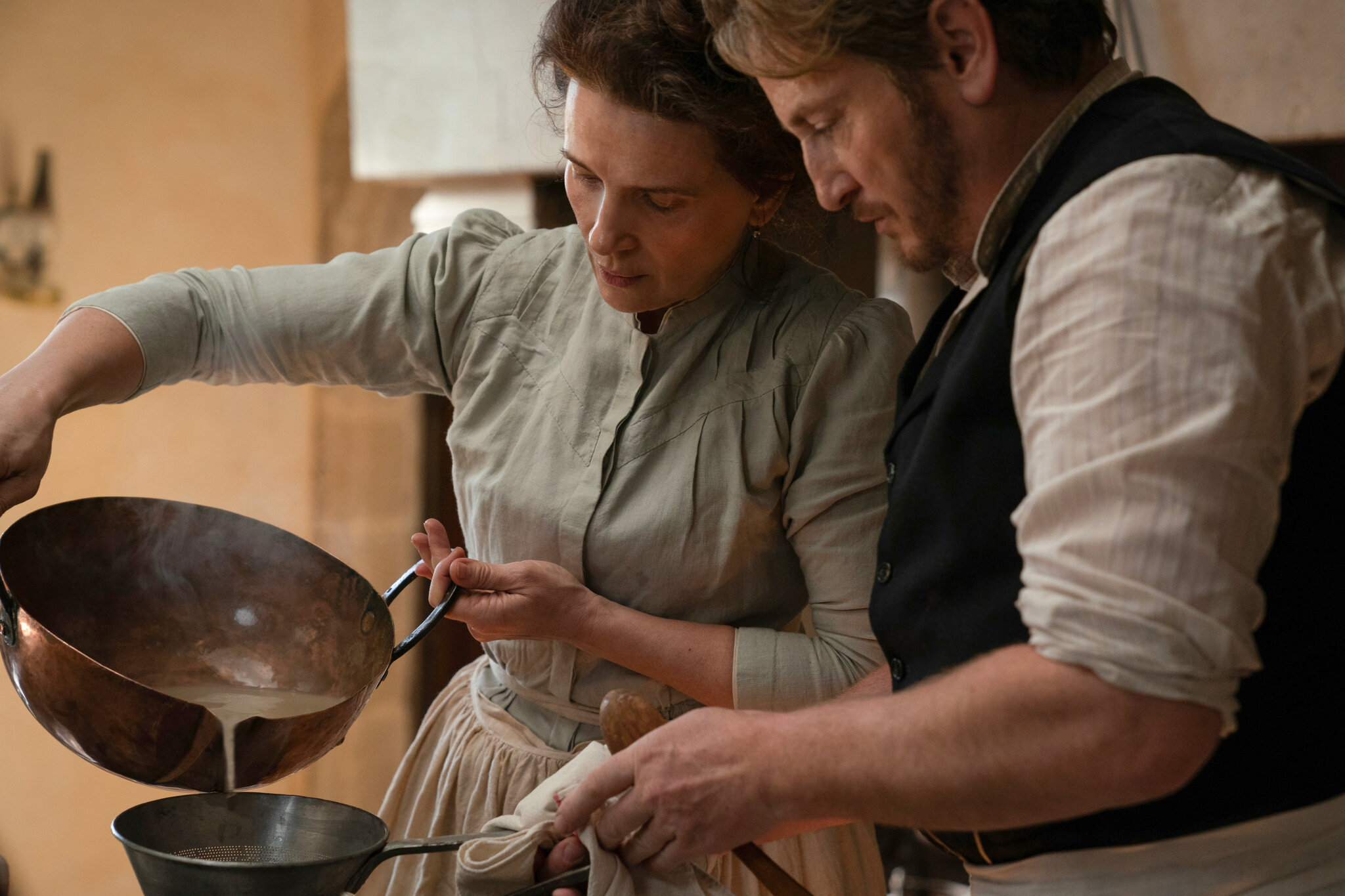
Babette’s Feast is a film that was a revelation to me from the very first time I watched it. I’m no gourmet and yet such sumptuous delights are hard to resist wrapped up in a Danish parable as it is. The Taste of Things is much the same – coming out of the same lineage – and the unbroken introduction to this tactile, delicious world of food in a 19th-century French kitchen is equally entrancing. There’s something so compelling and equally remarkable about these epicurean delights being created before our eyes. How something can have an extravagant simplicity to them requiring the utmost amount of tender loving care (and the freshest ingredients plucked straight from the garden).

While it’s not quite as thematically rich as its predecessor, it does rest on a love story brought to the screen by the incomparable Juliette Binoche and Benoît Magimel, a pair of performers with a real-life history albeit one in the past. Food is their undisputed love language. It buoys their romance in such a rapturous way paired with the delicious cavalcade of eateries and a vow to train up another generation of chefs who have the intuitive gifts and the innate passion for food that can be further cultivated. There’s something quiet, beautiful, and melancholy about Tran Anh Hung’s film that I greatly relished. 

Killers of the Flower Moon

There’s something more fundamental here. You see it in many of Scorsese’s movies from Goodfellas, Wolf of Wall Street, or any of his gangster pictures showing the traditional villains in an intimate if not entirely sympathetic light. He always seems to return to this because this was his childhood — he grew up in a neighborhood with these sorts. By the world’s standard are they corrupt? Yes, but they aren’t personified evil. They act as complicated characters full of charisma, humor, and whatever else.

It feels like this is his gift as a filmmaker. Because we don’t always like these people, but he was never interested in a black hat and white hat morality. Perhaps that’s why he did not make Killers a more traditional Western because this would not be true to the ethos he’s had since the very beginning.

Lily Gladstone is such a powerful emotive force in this movie because if Leo’s performance is so pitiful, she is his perfect scene partner by maintaining an equilibrium; there’s a regality to her that’s not easy to break and yet she’s not an unknowable stoic. She loves deeply and with Ernest and her family, we see both her affection and her deep sorrow when they are ripped away from her one by one. The movie requires her strength to hold it together and instill it with resonance. Scorsese never asks easy questions, and I believe that comes with honesty, and it’s part of the reason he’s still one of our premier filmmakers. He’s still curious and the questions he asks with his films are ones he’s still wrestling with now 80 years on. They’re universal.

Oppenheimer 

It’s easy to cast Oppenheimer as one of the most important figures of the 20th century since he was the “Father of the Atomic Bomb,” but he was also one of its greatest tragedies. There’s a scale and scope to this narrative woven right into the very fabric of history. A whole movie could be borne on Cillian Murphy’s face and it is. Between his vivid eyes, gaunt contour, the porkpie hat, and pipe, there’s something instantly iconic about him. He’s haunted and profound even before he says or does much of anything.

It’s also dizzying watching Christopher Nolan develop the rich world around Oppenheimer packed with substance — a real world of real people and events we get to experience firsthand. This immediacy is key and although I’ve read the book, I don’t think you’re required to keep it in your back pocket. Nolan has done the unthinkable by making a potentially stodgy historical piece into a gripping blockbuster. In the age of superhero movies, studios have mostly assumed historical genres are dead.

Likewise, by shaking up a prosaic biopic form, the director alights on something that’s narratively audacious even when it falters. That’s why he’s remained one of our most beloved filmmakers over the last decades. He makes big movies for thinking people, and if nothing else, I hope Oppenheimer acts as a clarion call for more thoughtful tentpoles in the industry. The audience seems to be more than rewarding his efforts.

The Boy and The Heron

I was thinking how grateful I am that filmmakers like Martin Scorsese and Hayao Miyazaki are still giving us their art. How lucky are we? The Boy and The Heron gleans some inspiration from the 1937 book How Do You Live? and also the annals of Japanese history and Ghibli Studio’s own lineage. Watching the film there are many echoes of Miyazaki’s favorite topics and also the influence of his mentor Issao Takahata.

For a Western audience, it has the tinges of Narnia where the war is an everyday tragic reality, and thus a world outside our own gives space for respite and marvelous things that can break in and heal our hurts so we might make peace with them. I was reminded of Petitte Mamam where the magical can somehow bring a parent and child closer together, even forge them by fire and trials of many kinds. 

All this fits for the simple reason that the film is very much a fairy tale. I couldn’t get away from this idea that Miyazaki’s film is so beautiful to look at, absolutely resplendent (he also has a penchant for the cutest creatures), and yet it has these pointed moments of ugliness even terror that feel like a necessity. The contrast is key to making the magical world feel in a sense real because we recognize both the good and evil from our own lives. It’s within this space where children can grow and thereby enter back into their lives ready to face the challenges ahead. It occurs to me that Scorsese, Miyazaki, and others like them maintain the curiosity and wonderment of youth. The years they’ve been on this earth belie their child-like spirit. It makes their movies still so accessible and universal to the masses, well worth our time and consideration. 

Afire

I appreciated Afire because, like many of the director’s earlier films, it’s deep in conversation with the vast annals of cinema. This one in particular feels like a paler, pudgier version of an Eric Rohmer movie. Something in the vein of La Collectionneuse, Pauline at the Beach, or even A Summer’s Tale. I felt vindicated hearing that Petzold was in fact consuming some Rohmer films during the pandemic, but that was only part of his inspiration. Unlike Hollywood, Germany doesn’t have a lineage of summer movies about the last day of school or hanging out at the beach with no adult supervision. The summer had vanished not only from their filmographies but from Germany as a whole. The nation rarely got this opportunity with the ascension of the Nazis and this historical backdrop gave rise to many of the specters which have haunted most of Petzold’s oeuvre.

If you wanted to make a case, Afire is actually Petzold’s most comedic film to date and his closest to romantic comedy thanks to its lead. I’m still trying to get my feelings in order, but Afire delivered like the director always seems to. It’s deeply observed and engaging with its perceptive vision of humanity and interpersonal relationships. But what makes it richer comes with how the writer-director takes a simple premise and simultaneously imbues it with all this intertextual meaning. His references are not always overt, but couched within his stories are the echoes of his nation’s films as well as literature and mythologies – many of his projects over the years have been adaptations of much older work. In our current age of cursory knowledge and vapid fads, he’s a refreshingly thoughtful filmmaker.

Godzilla Minus One

I found Godzilla Minus One feeling like this year’s Top Gun for what it teaches us about sequels. Obviously, Godzilla is an institution in Japan, but here we see a film that takes the very specific context of the original film amid the nuclear age — reminding us of the context of a post-war world — while building on the past in new ways. Top Gun: Maverick did much the same as its predecessor, and it was oddly such a human and intimate film in the same way that this giant monster movie with tinges of Jaws (and The Dark Knight Rises) feels even least nominally invested in interpersonal relationships beyond mere kaiju eye candy.

This new film is a spectacular bit of construction blending period drama with solid special effects, a quintessential demolition of Tokyo, and deep sea confrontation that brims with menace and personal stakes. Perhaps what’s most spectacular is how director and general mastermind Takashi Yamazaki was able to offer up a low-budget tentpole full of invention and a stirring message of hope. In a film full of devastation and general destruction, the narrative bends refreshingly toward a message promoting the sanctity of human life. This feels like a radical position for a genre that feels almost antithetical to this kind of sentiment. 

Godland

It’s the kind of taxing epic that is not for everyone. Positioned somewhere between Carl Theodor Dreyer and Werner Herzog, it’s both gloriously desolate with the raw beauty and power only nature can attain. It also brims with the kind of existential weight one feels when your attempt at Christian faith is found lacking and all your pride and human vigor are laid bare.

Our protagonist cuts a gaunt figure. He’s the most ascetic and joyless man of the cloth, but out of many striking images in the film, there is a sequence that feels emblematic of the trail he leaves in his wake. First, an interpreter who must be buried, and then his horse which is left for dead, followed by a final summative death. Seasons change and yet in our limited capacity we are so insignificant in comparison to God’s creation and his majesty and it is arrogance and folly to think otherwise. I am reminded of the verse: “What is man that you are mindful of him, and the son of man that you care for him? Yet you have made him a little lower than the heavenly beings and crowned him with glory and honor.”

This is a spectacular perspective, and it is something to be held with a loose rein of humility. Grace is something to be cherished because it changes your outlook and how you treat others. Meanwhile, colonialism is something we still feel the repercussions of here, and we see it here in the cultural and linguistic tension between Denmark and Iceland. Condescension has no place in the supposed Christian way of life; it’s ultimately a pernicious force. 

Across The Spider-Verse

As we watch the live-action Marvel comic book movies show what feels like signs of slightly waning dividends, it makes the animated iterations all the more intriguing. They exhibit a meshing of style and storytelling. It’s exquisite to look at, but they’re not simply empty animated images. The form fits the content and we get a sense of atmosphere, even emotion through the way they are distilled through the visual palette. There’s an invention and a sense of craft that takes into consideration the modern landscape while still staying true to the form of split panels or even the evolving painterly watercolor aesthetic of Gwen’s world. Somehow everything is all but typified by our hero fighting a Renaissance vulture with Jeff Koons balloon sculpture left as collateral damage. 

I still remember when they made Star Wars literature legends and they were no longer canonical. That was probably one of the first instances I began to understand the term. Now it’s pervasive across fan culture. Canon events form the building blocks of the spider-verse world, but they also say something about our search to make meaning out of circumstances. It may be entertainment but it could probably spawn a whole conversation about predestination, free will, reincarnation, and the afterlife in general.

Part of me wonders if the reason these concepts are so intriguing to us or even comforting is that we are longing for something more (or something else) — something beyond the life that we lead. Surely this can’t be all there is. Why else would the world continually clamor for sequels and ever-expanding universes? My only qualm about the movie is my problem with all these “metaverses.” We can never leave well enough alone. But then again, they never satiate us. 

Documentaries: Beyond Utopia, The Mission, The League, Still: A Michael J. Fox Story, Being Mary Tyler Moore

Honorable Mentions: Are You There God? It’s Me Margaret, Earth Mama, Suzume, Flora and Son, and Fallen Leaves

Summer Hours (2008)

A few years ago my mother helped sell my grandparents’ home, and it was a home they had resided in for well nigh 50 years. They were not affluent French folk with a fine arts collection; what they did have was a connection to that space.

And it wasn’t just my grandparents but my mother and her siblings, and then all the grandchildren and great-grandchildren, who had varying attachments. It’s a strange sensation when a space that has been an element of your life for many years, or in my case, as long as I can remember, is boarded up or renovated and the cycle of life continues there. It’s these kinds of ideas Oliver Assayas’ Summer Hours bring to the fore, and I’m sure many can easily relate.

The movie opens with the 75th birthday of the family’s matriarch (Edith Scob). It has remained her lifelong mission to the maintain the legacy of the famed artist, and her uncle, Paul Berthier. But she’s also pragmatic and realizes the reality, resigned to the facts. “A lot of things will be leaving with me. Memories, secrets, stories that interest no one anymore,” she says. The same might be said of the Corot paintings and a broken plaster that belonged to Degas. They are impressive relics but relics nonetheless.

They are an imperfect family — what one isn’t — but even if you compare this film to something like A Christmas Tale, the story is not so much borne out of dysfunction, but what the passing of generations and time means to us all. Things cannot mean the same or remain the same for all of us. We are bound to see them in a different light.

The seeds are sown early on: one son (Jérémie Renier ) is based abroad in China and a daughter (Juliette Binoche) lives in New York for work in the design industry. It’s quite a long trek for them to get back to France and see their mother. Only the eldest, Frederick (Charles Berling), lives nearby with his family. This doesn’t feel altogether unusual, in fact, many of the people I know in the fast pace world I live in, are not close to relatives. This is a luxury. Eventually, the presents are opened, small talk is had, kisses are shared, and the family must leave.

Once again, the mother is left alone. It’s not callous; it’s reality. I’ve noticed Assayas employs long fade-outs in his films. It could have several uses, but it also suggests the passage of time. Their mother Helene is gone quite abruptly, and they must contend with her affairs.

If you wanted to be crass, you could pattern the movie after Citizen Kane, instead focusing on a French lady who left behind a lot of artifacts for her family to quibble over. It’s all very tasteful and orderly but still, there’s something so unnatural about going through the possessions of the departed.

The one son who still lives in France has a romanticism about him, assuring his mother all her work will not be dissolved, and they will hold onto her country home for the grandchildren. He doesn’t want to believe what she’s already accepted. Sure enough, things begin to progress just as she foresaw. And although I didn’t want to believe it, I also realized I was blinded because life gets in the way.

It doesn’t really make sense to hold onto the place. It’s not practical and with most of the family out of the country anyway and the money needing to be split three ways, how do you do that without causing rancor to build up? No, it makes the most sense to sell, donate, and auction off as much as possible. And so they do just that.

They work through the arrangements and make sure their mother’s faithful housekeeper is well taken care of or at least as best as they can manage. It still feels like an unceremonious end.

Pretty soon beloved family heirlooms are in a museum where they can benefit more people. It’s history for them to appreciate. But it also feels austere and unenchanted. There’s a distance between it and the people who are meant to enjoy it. Now they are quite literally museum pieces.

I had a friend I met overseas. She was not French but she loved Nice dearly. It was the home of Auguste Renoir, one of the country’s most beloved painters. I bring it up only because she is from a different generation and somehow it feels like they have a greater appreciation for the natural arts. It’s not that they have a monopoly or that none of us care, but we’ve come of age in a different time of modern art, technology, and globalization.

Summer Hours made me grapple with these emerging realities all the more pervasive in an era well after the film’s release in 2008. The past can never quite hold the same sort of import for us because they are not our personal experience and never can be. My parents have memories I will never know or just as easily forget if they tell me. Grandparents lived in generations I will never fully comprehend nor appreciate.

But it’s not like we can sit around taking stock of everything they ever did. It’s not a game we can ever hope to win against the inevitable march of time or unexpected human tragedy. It would be totally futile and hopeless otherwise.

It’s what makes the organic moments we get, a stray memory or a long-hidden away anecdote, all the more special. And yet it seems we would do well to know their stories and their history as best as we can.

I’m still not sold on the importance of leading a lasting legacy. That’s perhaps something only affluent French people and film critics dither about. I’m not sure. But there is something to respecting history and where we’ve come from while still continuing to navigate our everyday lives. We must strike a balance.

In Summer Hours we see the dissolution of years of work right in front of us, not out of malevolence but due to life and necessity  — choosing the path of least resistance. It’s hard to admit, but these are the things we all strive for and so it’s hard to blame these characters for any of their actions. Even if it doesn’t seem entirely right, it’s also a part of life.

One of my primary qualms with the picture is how it seemed to pick up ancillary characters only to drop them. We meet Binoche’s boyfriend in one scene, Eloise’s nephew is a kindly cab driver, and we meet Frederic’s kids.

His daughter was a character I was skeptical of and yet she becomes one of the most crucial as a kind of bridge between generations. The mother’s home is about to be sold at the end of the summer, and so they have a short amount of time to enjoy it. Rather than being prudish about it, they let their kids hold a party. I was half wondering if they expected the kids to trash the place and turn it into a kind of funeral pyre. With all the youth flooding in it feels like the place is about to be met with desecration.

Instead, something else happens. They hold their party. The grounds are full of exuberant young teens and adolescents hanging out and having a good time. It’s somehow a recontextualization and a new life for the space. We almost forget all the old antiquities and works of art and now only see it with all this youthfulness dancing around and enjoying one another’s company.

The daughter sneaks off with her young beau no doubt like her grandmother before her, and we feel a certain amount of catharsis in a situation that is left relatively open-ended. We didn’t have a party in my grandparent’s backyard to send it out — I kind of wish we had — but I’d like to think that like Summer Hours a young family or some kids are enjoying that space like we did a couple of decades before.

4/5 Stars

Clouds of Sils Maria (2014)

Clouds_of_Sils_Maria_film_posterIt’s my prerogative to respect films that dare to leave me questioning their ambitions and their outcomes. Clouds of Sils Maria is such a film. At times it gets so caught up in its own meta-narrative perhaps too much so.

Still, this is a story about a middle-aged actress (Juliette Binoche) called upon to return to the script that made her famous but this time in the much more unglamorous role. Her stardom is such that she can pick and choose her work still but that doesn’t make growing older and life in general any easier. She must navigate press junkets, paparazzi, divorce proceedings, and on top of it all the death of a good friend — the man who helped make her famous.

The person keeping Maria sane through every bit of drama and every tiresome ordeal is her personal assistant Valentine (Kristen Stewart). She is also the one who cajoles her client to take the role. My gut further suggests that there are the inklings of All About Eve echoed in Olivier Assayas story between a mature actress and a rising star who is a prima donna scandal maker of the social media age (played by Chloe Grace Moretz).

But still that dynamic proves to be less fruitul and ultimately less interesting than the relationship that is examined between Maria and Valentine. It is their scenes together that are tirelessly engaging because their interactions run the gamut of emotions. How do you begin to define them?

The dividing line between this play that they are bouncing off each other and their actual lives at times feel perilously close as they jump in and out. Somehow in some unknowable way, it seems to reflect real truths about their relationship.

The meta moments are innumerable including those that suggest Binoche’s earlier film Rendez-vous, Chloe Grace Moretz forays into superhero blockbusters, even a passing coincidental remark Stewart makes about a film featuring werewolves. There’s a Harrison Ford film directed by Sydney Pollack (a lah Sabrina) maybe lightly poking fun at how Juliette Binoche and Julia Ormond could easily be confused.

But if nothing else these feel like only slight nods if not pastiche that do not necessarily aid the aspirations of the film. They mean very little. The far more fascinating suggestion is just how closely the characters of Maria and Valentine read to the figures in the script while they practice the lines in the mountains. But it’s not just that. It’s how their conversation organically reveals bits and pieces of their personal philosophies.

So to clarify it’s not reality intersecting with fiction but the fiction within the fiction that creates a greater depth that complicates matters. That’s what makes the film at times beautiful and perplexing. The fact that Valentine evaporates is tantamount to Michelangelo Antioni losing his main character in L’Avventura. Likewise, Valentine disappears into the clouds never to be seen again and that’s far more interesting than any amount of commentary that could have been crammed into the storyline about Stewart’s actual career.

And in truth, this has to be without question the greatest performance of Stewart’s career thus far because there’s something streetwise, nuanced, and clever about her. There’s a strange sense through her wardrobe and demeanor that this is part of Stewart that we are actually seeing, although I’m not sure how true that is. It feels the very essence of “un-acting” if we can coin that phrase.

Binoche, of course, has a lauded spot as one of the eminent stars of European cinema for very good reason with a career that has been held in regard for well nigh 30 years. Somehow she feels like oil and water mixed with the likes of Stewart and Moretz, products of Hollywood blockbusters, but that’s what makes this film an interesting marriage of backgrounds.

Far from being conflicting, the pairing of Binoche and Stewart is ripe with interesting qualities because their differences make the interactions pop. They can be so diametrically opposed. Their age, backgrounds, and at the very core how they view these central characters of Sigrid and Helena in the film within the film. Yet at the same time, they’re so closely tied together and interconnected — their relationship of a star with her personal assistant that proves to be even closer still to that between friends and confidantes.

When Stewart disappears from the story much of what was interesting vanished from the picture but then again because she vanished it made the picture’s denouement more interesting.

By the end, as an audience, it feels as if we have little stake in the trajectory of Maria’s career. It’s hard to care too much about her at this point because she’s been a star, she is a star and she probably still will be one unless her own temperamental nature gets in the way. It doesn’t leave us with the same empathy that comes with All About Eve because our heroine still has a career fully intact.

Clouds of Sils Maria’s immaculate classical music played over elegant tracking shots, matched by soft fade outs between sequences is pleasant if not a tad pretentious. But its ambitions thematically, by the time the curtain falls, feel noticeably more nuanced than its predecessor. It leaves us with something mystifying to ruminate over and that is nearly enough if not wholly satisfying.

4/5 Stars

Three Colors: Blue (1993)

b0ad4-threecolorsblue“Now I only have one thing left to do: Nothing. I don’t want any belongings, any memories. No friends, no love. Those are all traps.”

I once thought that Before Sunrise was the type of movie that I would want to make. Three Colors: Blue is another concept that I have often envisioned without even knowing it. In fact, I had seen The Descendants, a film with a somewhat similar story arc told from a different perspective. Except whereas Clooney’s film is full of blatant drama and intense familial moments in Hawaii, Blue is far more nuanced.

The Descendants might be a more gripping drama, but Blue has the sort of complex depiction that seems to more closely mirror reality. The grieving process involves isolation, solemness, and at times few words. The easiest way to grieve is not to feel, not to fully embrace the pain. Sometimes that is the simplest if not the healthiest way to deal with it for Julie. It’s a real world approach to the scenario, and it’s no less painful to watch — perhaps even more so.

Julie’s husband Patrice de Courcy was a famous composer who was commissioned to arrange a grand piece to be performed at concerts for the Unification of Europe. It is a great honor and we quickly learn that Patrice is quite a big deal. However, after a car accident, Patrice and his 5-year-old daughter perish in the crash and only Julie gets away alive. It is a stark, unsentimental picture, and it succeeds in changing Julie’s life forever.

After being released from the hospital she soon sells all her possessions and moves out of her family apartment to take up residence somewhere far removed from any acquaintances, including a man named Olivier who is in love with her. She has a new home and begins to sever ties to her old life. The unfinished work of her husband (and her) is trashed and that’s the end of that. In her new Parisian home, she has a rodent problem and becomes the hesitant confidant of a local exotic dancer. Furthermore, she rejects the necklace that a young man pulled out of the wreckage. Her times of solitude are spent swimming laps alone in the local pool, submerged and half-covered in shadow. Grandiose symphonies reverberate through her mind haunting her. In such moments, Kieslowski will often black out the screen in the middle of the scene, effectively interrupting the action for a few seconds before bringing us back.

Words are few and far between for Julie and when she does speak it is often brief and reserved. We are, therefore, forced to observe her without the aid of dialogue. She is certainly detached but there is a provocative side to her. Something is mystifying about her soft features, dark eyes, and short hair. She is a wonderful woman of mystery and beauty because the reality of it is, we do not know a whole lot about her. We must discover more bit by bit and she does not readily disclose information.

It is when pictures of her life literally flash before her eyes on a TV screen that the story takes its next turn. Julie learns soon enough that her husband had a mistress that he was with for a few years. In the hands of Hollywood, this would be high drama. In the hands of Kieslowski, it is far from it. Julie is still the same aloof individual she always was and even a confrontation with the mistress does not change that. She is civil and generous through it all.

Finally, she returns to her husband’s composition which she learns Olivier has started to rewrite. They agree that he will make his own work and Julie must accept it for what it is. Faces from the film float across the screen and a still solemn Julie lets out a few silent tears. The anti-tragedy is complete, a subdued, intriguing piece of cinema. Not for those with short attention spans but, I am interested to see Red and White. Kieslowski intrigues me with his thought provoking films somehow reminiscent of the likes of Bergman or Bunuel.

4.5/5 Stars