Vincente Minnelli’s Films (1946-1955)

Undercurrent (1946)

Undercurrent hardly holds a substantial place in any noir conversations partially because Vincente Minnelli’s reputation in part seems antithetical to the dark style born out of chiaroscuro and German Expressionism. His background was squarely in luscious art design and stage productions.

Likewise, the combo of Katharine Hepburn and the two Roberts: Taylor and Mitchum, is not one that quickly springs to mind. However, there are some merits to it simply for the sake of it being different; not dramatically, these types of psychological women’s pictures were very much en vogue during the ’40s.

It’s the pieces assembled that feel unique if somewhat ill-suited. Still, the curious hybrid of tones and talents certainly is a historical curio more than intriguing to the invested party.

I almost have trouble buying Hepburn as a reticent, uncomfortable outsider among the D.C. elite her new husband Alan (Taylor) knows, a woman holding drinks in hand just waiting for someone to talk to. But if I don’t completely believe it, she does earn my empathy.

Mitchum, the legendary mule of RKO was simultaneously earmarked for 3 or 4 pictures at the time, and so he doesn’t show up in Undercurrent until much later. Still, he has the benefit of casting a Rebecca-like influence over the picture.

After an hour of building him up, we finally get sight of Mitchum, and we know where this story is going. Because he’s a real human being and fairly innocuous to the eye. As the presence of Mitchum begins to exert itself on the picture, the marital bliss of newlyweds grows more and more harrowing by the minute. We have a picture in the same vein as Suspicion and House on Telegraph Hill.

Despite choosing the part, the constraints of the role don’t feel totally in line with Hepburn’s talents. She isn’t a shrinking violet or the kind of timorous beauty befitting Joan Fontaine or even Ingrid Bergman. Robert Taylor is mostly adequate in the vengeful husband part. He flip-flops efficiently between these stints of gracious charm — a perfect husband and lover — then, becomes clouded by these perverse streaks of jealousy and rage.

3/5 Stars
The Pirate (1948)

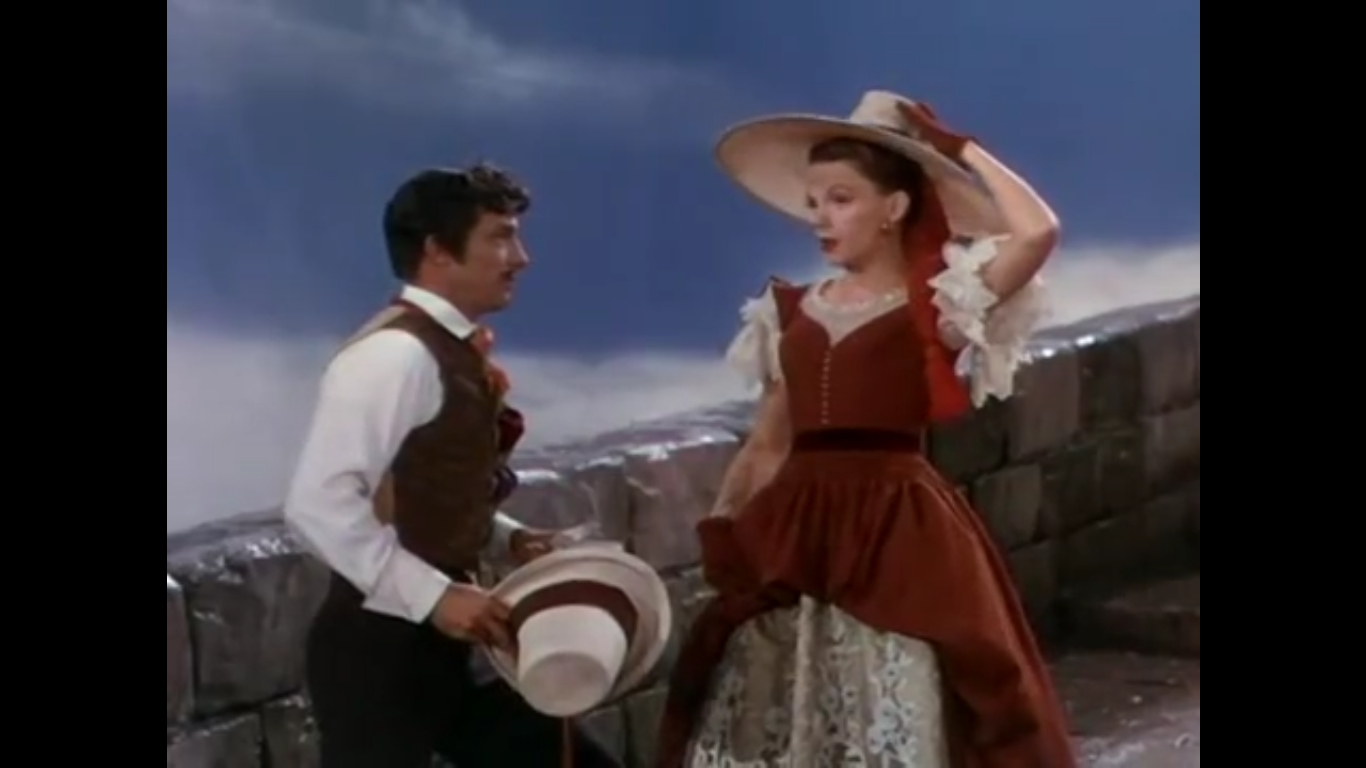
It’s plain that The Pirate is born out of the traditions of the 1940s Hollywood lineage like Blood and Sand or Black Swan, even Gene Kelly’s own Three Musketeers. However, between the bright evocative staging of Vicente Minnelli and the instant performance-driven rapport of Garland and Kelly, it works quite splendidly with what it has to offer.

Today it doesn’t hold much of a reputation, and I would stop short of saying it’s a minor masterpiece. What we do have is a picture banking on the charisma of its leads and a certain pictorial opulence supplied by its primary mastermind.

Kelly, taking all the niñas of the town by storm, is full of allure and his usual magnetism as he twirls, leaps, and bounds between all the pretty girls. It’s all about the patter between the stars as he plays the foxy street performer, and Garland is the put-upon maiden who is betrothed to another man. His vocation gives the director license to use these elements of theatricality and faux drama to tell the story.

What do I mean? It could be a story of tragic, unrequited love. It might just as well be a tale of marauding pirates, and yet somehow, between the song and dance, it becomes a kind of tongue-in-cheek comedy of two lovers perfectly suited for one another being thrown together.

There are moments where Garland and Kelly seem to be playing in a separate movie, or at least they are in on the joke with the rest of us, even as they mess with each other. Trashing his apartment feels like the highest form of romantic tension only for the drama to become slightly heady again: Kelly is set to be hung as the dreaded pirate Macoco. Is it a first to have a musical number performed under a hangman’s noose? I’m not sure.

Thankfully, he gets some stellar support. While I’ll be the first to admit “Be a Clown” feels like a less funny prototype for “Make em Laugh,” if you’ve never seen the Nicholas Brothers, it’s a small recompense to see them join Gene Kelly and get some commendation in the spotlight as his momentary equals. It feels like a flawed but heartfelt apex to a picture that could be described in much the same terms.

3/5 Stars
Madame Bovary (1949)

Madame Bovary is the kind of trenchant literary work the Production Codes would go to all costs to declaw. In one manner, it’s somewhat remedied by James Mason’s framing by providing a mostly blase narrative device to enter the story.

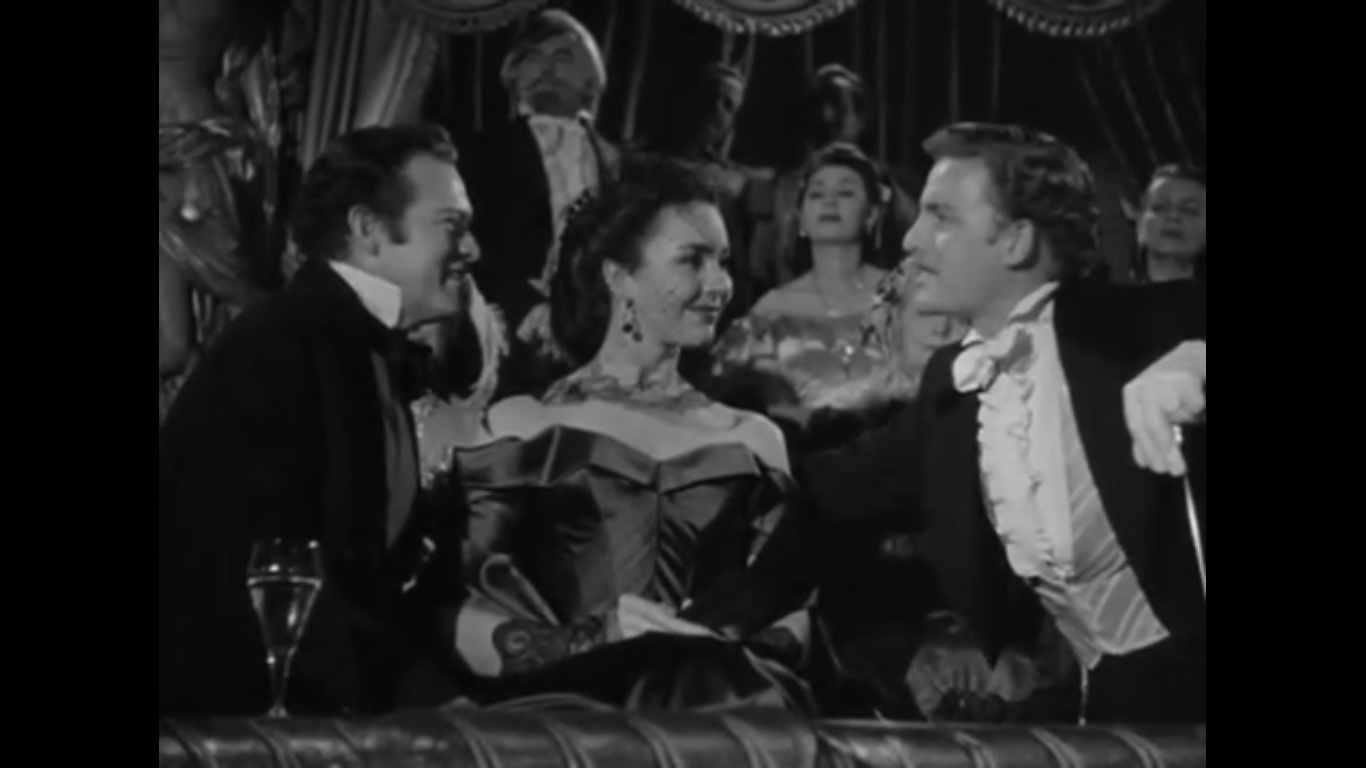
Even as something leaner in budgeted black & white (one could hardly confuse The Pirate with Madame Bovary), it’s still the same Minnelli. The ball sequence spelling the ascension of Emma (Jennifer Jones) as a society darling, while somewhat compact, exudes an impressive opulence.

The director makes sure to follow Jones’s incandescent form as she prances and waltzes her way across the dance floor with great distinction. Her gown alone is enough to make the upper classes stand up and take note. The dashing Louis Jourdan is certainly more than aware of her. It’s totally taken up by the kind of swirling euphoria also holding a place in the oeuvre of Marcel Ophuls — Letter from an Unknown Woman and Earrings of Madame Despring instantly to mind.

It becomes more and more of a gothic drama as things progress, overtaken by gales of wind, thunder, lightning, and an incessant downpour of rains to go with the equally tumultuous score of Miklos Roza.

However, more importantly, Emma becomes possessed by all of her own ambitions and preoccupations. She is emotionally distant from her husband (Van Heflin), absent from her child, and totally involved with other men. She entreats them to take her away from such a dreary life, constantly prone to these histrionic gestures of love and loss at the hands of her suitors and husband. They hardly know how to respond to her.

If the terminology was present at the time, she is cut out of the cloth of some kind of femme fatale, albeit born out of the annals of classic literature. Moreover, she is a woman who never seems to know what she truly wants. She sends out an array of mixed signals — living a life made up of so many contours and emotions — and never settling on anything honest.

It’s as if she’s fashioned a kind of fantasy life for herself woven out of her own personal whims though she remains self-destructive to the very last iota of her being. There’s something unnerving about her and Jones plays her as such; it’s easy to understand how society was scandalized by her because she does not live by societal norms. Mason’s concessions for her character aren’t enough to totally wipe out the harrowing impact of the performance.

3.5/5 Stars

The Cobweb (1955)

“What happens if you go into town to the movies? You start screaming or something? They’d think you’re a critic, that’s all.” – John Kerr as Steven

If it’s true you can make a screwball comedy like Easy Living (1937) about a fur coat falling from the sky, then it’s equally possible to make a portrait of psychological horror about drapes. The Cobweb busies itself with the vast array of interpersonal relationships taking place on the grounds of a psych ward. Richard Widmark does his best to aid his patients in their recoveries as he juggles familial and boardroom responsibilities. It’s no easy balancing act.

For a film that is mostly disregarded, it’s easy to clump it together with something like Executive Suite (also produced by John Houseman) with one of the most phenomenal assortments of players one could hope to cobble together during the golden era of Hollywood.

Lilian Gish is at her most ornery but lest we forget, she truly is the queen of the movies. Charles Boyer and Lauren Bacall are equally crucial touchstones of film history, playing two respective love interests as Widmark struggles to connect with his wife, Gloria Grahame. Even ’30s scream queen, Fay Wray, has a brief appearance in a picture that boasts Oscar Levant and then the up-and-coming talents of John Kerr and Susan Strasberg.

In one scene with all the various folks blocked throughout the room, it’s almost difficult to distinguish who’s a patient and who’s not, but if we are to appreciate this drama, it doesn’t half matter. Widmark falls for another woman. Grahame flaunts her charms and goes looking for love from Boyer, who is now mentally compromised. Gish is incensed about having her opinions disregarded. Some of them are petty and others are stricken with loneliness and actual psychoses.

The palette becomes such an evocative way to color the emotional undercurrent and elements of suburban life, not unlike some of Nicholas Ray‘s work or something like Strangers When We Meet. The visual world is beautiful; still, it lets loose an environment full of pain and inner turmoil. Although Minnelli handles his characters deftly, there’s no place for the film to go but toward a hysterical fever pitch.

3.5/5 Stars

Portrait of Jennie (1948)

portrait-of-jennie-3The strands of our lives are woven together and neither time nor the world can break them.
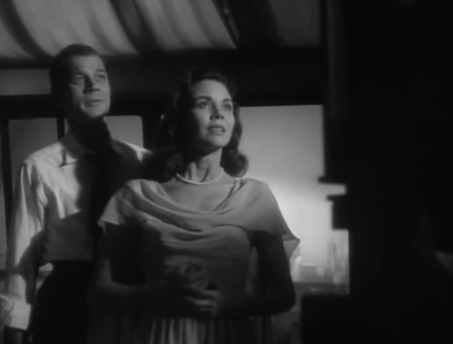
From the outset, you get a sense from the grand philosophical dialogue and imagery that we are being treated to a classical Hollywood precursor to Terence Malick’s Tree of Life. Quotes from Euripides and Keats flash over the screen. Profound questions are brought to the fore. What is time? What is space? What is life? What is death?

And it is somehow a spiritual film and not because of convents or biblical references. It’s a different type of spirituality — more elusive than a simple description. It’s summarized by the early supposition that each person must find their own faith. You must learn how to care deeply about something. And these initial suggestions give a hint to the film’s intention although the rest rolls out in more typical Hollywood fashion courtesy of David O. Selznick.

Eben Adams (Joseph Cotten) is one of those starving artists types who gets very little monetary value out of his creative vocation as a painter. Although initially brusque, he does receive some encouragement from a pair of veteran art dealers (Ethel Barrymore and Cecil Kellaway) and for the majority of the film, they remain buttresses to his career.

They see a spark of talent in this man — though not fully realized — there’s something there that can develop into something beautiful. Perhaps they see the landscapes like he does, where the images of the world are literally on canvass (Director William Dieterle denotes this phenomenon well).

portrait-of-jennie-2But it’s a chance encounter with a young girl named Jennie (Jennifer Jones) that gives Eben the type of inspiration that every artist dreams of because it’s precisely this spontaneous spark of joyous energy he needs to add something vibrant to his own life. In her constantly evolving role, Jennifer Jones exudes an effervescence, a certain radiance in body and spirit that lights up the screen in embodying this apparition of a girl.

She meets Adams first near a park bench, then doing whirly-birds on the ice rink. They continue to have these little moments together made up of chance encounters and pieces of fate. Although the film hardly gets to explore the idea, Portrait of Jennie plays with time for the sake of love. And it conveniently allows its two characters to meet each other at very different reference points in life. For him, it’s only a few days. For her she’s no longer a young girl, now blossoming into a mature young woman. And that is part of the tantalizing charm. Their chemistry flourishes. It becomes evident that much of romance is made up out of memories, these little fleeting moments of joy in being together.

It’s fantasy aspects make it a fine companion piece to the Ghost and Mrs. Muir as well. Light, passionate, moving, all those things. Yes, its conclusions on love are more than soppy, but a little soppiness does wonders in this cynical world we find ourselves in presently.

Out of context, it sounds ludicrous that Adams pilots a boat out into a New England gale for no reason except that it is the last place Jennie was seen. But interestingly enough, this conclusion hardly feels out of the ordinary since we intuitively know that Eben is going where he needs to, or at least where the film suggests he needs to go. And it’s not terrifying in all its technicolor glory because those apprehensive feelings easily give way to the raw majesty of it all — the pure awesomeness of the crashing waves — the churning forces of natures.

In these moments the film reaches its crescendo of love while also coming full circle to its opening prologue. But there’s something inside of me that feels unfulfilled with this ending. There’s a hollowness. Eben and Jennie had something together but what is it exactly, is difficult to comprehend completely. Eternal, no. Immortal, no. It’s only a moment. That is all.

portrait-of-jennie-1I find that despite his pedigree Joseph Cotten still comes off as an underrated actor and with each film I see him, I enjoy him immensely. Maybe for those very qualities. He’s not altogether handsome but he has a pleasant face. His voice isn’t the most formidable or debonair but it does have character. The supporting players lend some Irish flair to the cast and it’s striking that everyone from Ethel Barrymore to Lilian Gish glows with a certain hope. There is no obvious antagonistic force in this film. Eben Adams found his inspiration — the muse of a lifetime — and that passion is enough to lay the foundations of a film.
In some ways, I am discontent with the actual portrait of Jennie. The film acts as a better portrait of who she was as we continually get small swatches of her personality and glimpses into her character. In comparison, that painting seems little more than an austere shell. It lacks the same joyous vibrancy of the woman it was hoping to capture. That is to Jones’ own credit but to the detriment of the story. The painting lacks the same aura of the film.

3.5/5 Stars

The Wind (1928)

190px-The_Wind_(1928)The makers of The Wind took their content seriously. Filming commenced near Bakersfield in the Mojave Desert where temperatures fluctuated around 100 degrees. Eight airplanes where used to churn up enough force for the effect of swirling sand and much of the crew was forced to wear protective clothing while facing the elements. It sounds like a hardly pleasant experience and yet Swedish director Victor Sjostrom’s project with silent film goddess Lillian Gish proves transcendent to this day.

An early inter-title explains the film’s story of a “woman who came into the domain of wind,” and essentially that sets up this archetypal woman vs. nature story. Gish is our heroine Letty, who has come all the way from Virginia to live with her cousin. Why she would want to live in such nasty conditions is not clear, but she must have had good reasons. Every sequence you are reminded of this film’s title, because hats, hair, scarfs, are always blowing in the wind, no exceptions. Tranquility does not have a place in this film. Vast expanses of desolate terrain reign supreme and the men match the land. The first acquaintance Letty makes on her way out is the forward cattle buyer Wirt Roddy. He warns her of the treacherous country she is about to enter, but she is, after all, Lillian Gish. Nothing will stop her.

When she finally arrives at the ranch of her cousin Beverly, he is delighted to see her, but his callous wife and bratty kids are not so warm with their welcome. Letty also catches the eyes of two ranchers: The rugged Lige Hightower and the aging Sourdough. Both have a hankering to ask for her hand in marriage, and the dance in town seems like the perfect place for popping the question.

But a giant cyclone strikes leaving destruction in its wake, and the general public seeks shelter below ground as the men try and brace for impact. In the mayhem, Roddy declares his intentions and now there are three suitors vying for Letty’s affections. It’s good fun for Letty until the jealous Cora forces her out of the house. She doesn’t want Ms. Sly Boots wrecking her home as she surmises.

Letty needs someone to turn to and her first choice is Roddy, but he always was a grinning conniver, and he finally confesses he’s already married. That won’t do and she reluctantly chooses Lige. Although, since he is so rough around the edges, she doesn’t know how to relate to him. She certainly doesn’t love him, and he catches on pretty quickly when trying to kiss his new bride. Despite, a violent side, Lige proves he does have a grain of decency buried in the sand somewhere. He resolves to get enough money to send Letty back to where she came from and, he soon loses his scruffy beard.

Lige goes out in the elements out of necessity in taking part in a roundup. His wife initially pleads with him to take her along, but the conditions are too adverse and she is left behind, all alone between four flimsy walls which are supposed to defend her from the forces that be. A deadly Northern is coming, personified by a prancing stallion, but that’s not all. Roddy sneaks back to Letty intent on taking her away with him, and between the never-ending onslaught of wind and sand, along with her former suitor, Letty is beside herself. It’s a frantic struggle against the wild forces of nature, not to mention a craven man. However, being the heroine that she is, Lillian Gish find her gun and does what she has to do. As they say, absence makes the heart grow fonder, and thus when a jaded Lige gets home, he is surprised to be met by Letty with open arms. They share the original Titanic embrace, with the wind billowing around them, eyes closed, enjoying this moment of pure adrenaline. Even for the 1920s, Gish is a universal beauty, and there’s a pristine magnetism to her. I would never wish any type of harm or misfortune upon her. She has such a sincere face. Or maybe it’s a fragile frame backed up by courageous nature. Her struggles remind me somewhat of The Gold Rush or Steamboat Bill Jr. because in each of these films a character we truly care about is pitted against nature’s wind. These films have different effects, but each is powerful in its own right.

4.5/5 Stars

Broken Blossoms (1919)

brokenblossomsBroken Blossoms or The Yellow Man and the Girl. How do you deal with such a film coming from modern sensibilities of race and romance? It actually turned out to be easier than you would think, but not altogether straightforward. D.W. Griffith is no stranger to racial controversy in his films. because his archetypal Birth of Nation (1915) is known as much for its influence as it is for its depictions of African-Americans and the KKK.

For Broken Blossoms, he places the microscope on Asians and in this case a “Yellow Man” or “Chink” named Cheng. It’s not necessarily a good start, but it’s important to realize the lens and the times this film comes out of. Those terms are offensive and seemingly insensitive to us, but back in the teens, those terms were commonplace. Thus, if we put that aside for a second, it becomes important to look at actual depictions and objectives.

Cheng (Richard Barthelmess), who was indeed portrayed by a white actor, is characterized as a peaceful and kind individual looking to live in harmony with his fellow man. Bruising boxer and abusive father, Battling Burrows, is our obvious antagonist and the complete opposite of Cheng. It’s not simply a clash of race, but of temperaments, and kindness versus hate. The First Lady of Cinema Lillian Gish plays Burrow’s long-suffering daughter Lucy to perfection. I cannot remember the last time I had so much pity for a single character because with every close-up or piece of body language, Gish seems to suggest her horrible plight. She is so sweetly demure and yet so much tragedy is placed in her path.  As an audience, we cannot help but have compassion for her like Cheng. Her father constantly expects her to perform housekeeping duties and beats her whenever he pleases. In a sense, Cheng is her savior, but Burrows isn’t too happy about that.  The idea that there could be any type of love between his daughter and this “Chink” is out of the question.

brokenblossoms1I suppose in a sense this is a love story and we want both these characters to be happy. One inter-title says of Cheng: “The beauty that all Limehouse missed smote him in the heart.” It’s a beautiful line and suggests the wonderful connection that these two seem to have. Although the dream loses a little of its charm when Gish’s character calls her suitor “Chinky.” It was in this moment where I stopped feeling sorry for simply Gish, but also her character. She seems like a girl like Mayella from To Kill a Mockingbird, who is bred with racism and yet she becomes so lonely in the process. All the abuse leaves her empty and searching for something. In that case, her only outlet was wrongly-accused mockingbird, Tom Robinson. In this case, it’s Cheng, the only person who seems to see Lucy Burrows differently.

I cannot speak for others but I can forgive Broken Blossoms for some of it’s more unfortunate moments and I’m sure Birth of a Nation would require a lot more dialogue. There are certainly numerous outdated, rudimentary views here from Southern-bred director D.W. Griffith. But I think if we look at the bigger picture, this is a film that attempts to point out evil and bring to light a little beauty even if it comes from an Asian and a defenseless young girl. I not sure what to make of it. Can we call it a clear-cut interracial love story? Maybe, but perhaps that’s not the biggest issue. This is a film that tries to move its audiences by evoking emotion and deriving pity for its protagonists. It’s a far more intimate portrait than Griffith had done before. On that level, Broken Blossom succeeds.

4/5 Stars

Intolerance (1916)

800px-Intolerance_(film)His ambitious follow-up to The Birth of the Nation a year before, D.W. Griffith’s Intolerance boasts four narrative threads meant to intertwine in a story of grand design. Transcending time, eras, and cultures, this monumental undertaking grabs hold of some of the cataclysmic markers of world history. They include the fall of Babylon, the life, ministry, and crucifixion of Christ, along with the persecution of the Huguenots in France circa the 16th century.

The stories are stitched together and become only a few touchstones in a contemporary tale of a young man and woman battling against the bleak world around them. The Dear One must try and recover her child from the clutches of a society crippled by corruption, while her husband must battle against a criminal past that looks to ruin his life forever. Each setting has its lulls and crescendos that fluctuate between the mundane and the overtly bleak.

Although some of the religious undertones are somewhat simplistic they still have some resounding power in their successive notes. A Christ subjected to the crucifixion sent there by hypocritical Pharisees. A mother crying to God that she might recover her child because the corrupt and evil seem to be having their way with her. These are the low points of despair. But just as Babylon fell at the hand of Cyrus the Great, our hero The Boy escapes the business end of the hangman’s noose literally by a matter of seconds. It’s perhaps the most intense and ultimately gratifying moment in a film that runs the gamut emotionally.

The film’s four arcs are certainly not in equal parts or equal in impact, but nevertheless, they suggest the complex plotting that Griffith was attempting to experiment with and it’s still quite impressive even by today’s standards. He takes such a broad, universal theme like intolerance and gives it legs in the form of a story that crosses time and space, cultures and languages to really meet all people where they are at. I will stop short of calling it overlong, because Intolerance is one of the truly epic films out there, and while it’s possible to lose a bit of the film’s cohesion, it nevertheless is an impressive endeavor.

So perhaps it’s true that he made the film due to people’s criticism of The Birth of the Nation — though it seems rightly justified. Still, even to this day, the film stands as an emblem of something more and perhaps the best “sequel” to a film of such a dubious nature. It cannot cover up for the sins of the former film, but it can certainly overshadow them. History has looked kindly on Intolerance and if it is not more widely known than its predecessor than it certainly deserves to be.

You could argue that D.W. Griffith was the first person to really explore the language that is film, as a mode of artistic expression. Because, although it may have cleaned Griffith out and ended up an unfulfilled commercial flop, there is no doubt that this colossal silent left an indelible mark on the industry. Perhaps Hollywood took note and began to turn away from the single-minded vision of auteurs in favor of a regimented machine that churned out a commercial product. That ‘s the Classic Hollywood period for you. However, Griffith perhaps unwittingly created many of the rules and dimensions that Hollywood would take to heart and systematically put to work in its future works. Furthermore, a case can be made that Griffith also set the groundwork for European cinema that often gave birth to loftier, more artistically inspired works altogether. Thus, the influence of Griffith cannot be understated. He was vastly important to the medium of film as we now know it.

4.5/5 Stars

The Night of the Hunter (1955)

83767-nightofthehunterposterDirected by Charles Laugton and starring Robert Mitchum, Lillian Gish, with Shelley Winters, the film tells the story of a preacher who epitomizes a wolf in sheep’s clothing. While serving a short sentence in jail, this “preacher” (Mitchum) learns from another man who is to be hanged that he hid $10,000 near his home. Intent on finding it, the fanatical man slithers his way into the life of the man’s widow (Winters) hoping to find the money by using her kids. They are adamant to not tell where it is and they soon discover what kind of man he is. After he murders their mother, the two children flee down the river. There they are taken in by a hospitable Christian woman (Gish) who has other orphans. They grow to love and trust her as their own mother. However, the sly preacher is bent on taking them away along with the money. Gish realizes his evil and has none of it. In the final scenes it is proved that love always wins over hate. This movie is certainly chilling, and disconcerting but the latter half I found especially good. Laughton deserves credit and the acting was good as well.

4.5/5 Stars