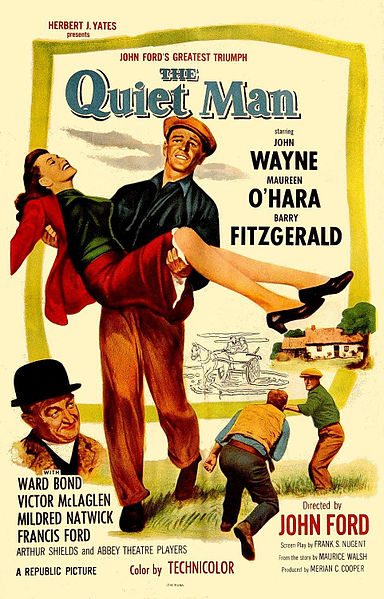
Review: Miracle on 34th Street (1947)

miracle on 34th street.png

From its opening motif of a man nitpicking the arrangement of reindeer in a shop window, Miracle on 34th Street skates away on a delightful journey that evokes both fanciful whimsy and a liberal amount of holiday sentimentality. However, it’s also one of the finest examples and greatest purveyors of holiday cheer ever and that’s in spite of an original theatrical release that Daryl Zanuck slated for the summer of 1947.

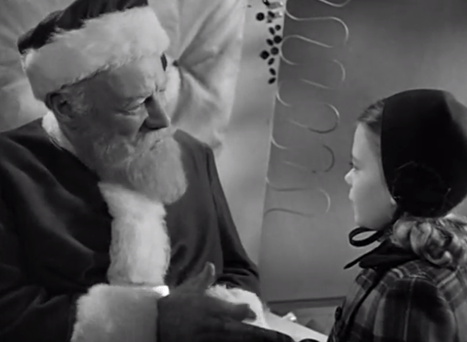
Still, all of this aside, the major heartbeat and the effervescence of the picture falls on the shoulders of that precocious gentleman Edmund Gwenn in the most iconic performance of his career. No matter your leanings, be it a sentimentalist or a pragmatic realist, at the very least, he makes you want to believe in Santa Claus. And what’s striking is how he embodies such a man.

Because we could get into a debate on whether he is the real thing or if he truly is delusional and thus, we would have to be alarmed by this entire ordeal. Yet the results speak for themselves as do the fruits of his labor which help to uplift an entire city.

It’s true that he lays down a trail of hints from the outset at the Macy’s Thanksgiving Day Parade about his origins. If you’re paying attention and know the score they are easy enough to notice. However, he’s never pompous in proclaiming his exploits.

What draws everyone to him is this genial charm that cannot be fabricated. It’s all him.  There is no shred of an egomaniac or a mentally disturbed person. In fact, he feels the complete antithesis of many of the adjectives we might toss out to describe the commercialized Christmas so prevalent today (and even back then).

Alfred, the young janitor, and a personal favorite expresses the sentiment aptly. “It’s all about, Make a buck. Make a buck. There are a lot of bad “isms” to choose from but arguably the worst is commercialism.”  And it’s Kris who helps to rail against that holiday status quo when he finds himself working as Macy’s floor Santa.  In fact, it almost feels like a necessity that all these things come to pass because not only are people forgetting about him but more importantly, they are forgetting the core tenets of the season.

There are several scenes in particular that put a heartbeat to a little bit of the magic that courses through this picture — a picture that director George Seaton dearly wanted to make as did John Payne. Because it exudes something so remarkable that has proved timeless in years since. Even Maureen O’Hara, though initially skeptical of returning to Hollywood from her oasis in Ireland, relented because she was taken by the story.
miracle on 34th 2.png

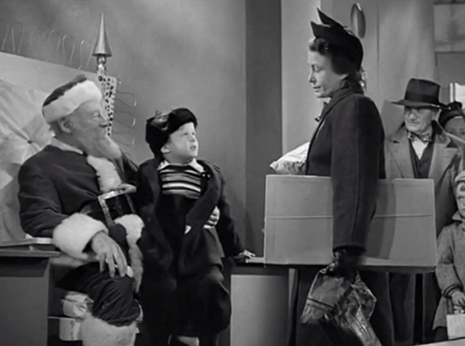
As someone always interested in the periphery, one of my favorite moments involves Thelma Ritter. It’s only a small sequence but she plays a harried mother who wants to go home and soak her feet after struggling to find her son a toy fire engine. The joy is watching Santa put the color back into her face when he incredulously evokes the spirit of giving. She’s flabbergasted by this unprecedented piece of goodwill. It’s the calling card of a true Santa.

Then there’s the little Dutch girl who pleads with her foster mother to see Santa. And it’s pure magic, again, because they form a connection when Santa breaks out into her mother tongue and they’re able to sing a Christmas song together. There’s so much underlying context made beautiful by the fact that we have to read deeper to extract the meaning. Surely viewers knew this girl was a casualty of WWII but beyond that, the fact that Santa is able to cross this perceived language divide is in itself a near miracle.

As someone who does not speak Dutch, I’m not privy to the precise conversation but it’s easy to empathize because here Santa Claus has made someone on the outside feel known and loved. It’s telling these precise events strike a chord with young Susan (Natalie Wood) also.

Certainly, it’s about time to fill in the story’s nucleus and of course, sandwiched in between this broader narrative, involving so many people, is a very personal one. It really is a case study and it’s noted as such by Kris Kringle and his devoted follower Fred (John Payne). They fight a two-front war to work on the most obdurate, rational minds in New York, Doris (O’Hara) and her pragmatic little girl Susan (Wood) who has been trained up by the best.

Ironically, Kris’s war on commercialism very much subverts the longheld spirit of capitalism as we watch the foremost toy companies, namely Macy’s and Gimbel’s pitted against each other looking to outdo one another in the realms of helpfulness and good cheer.  It’s simultaneously hilarious and downright uplifting.

But there must be more because goodness very rarely moves forward wholly unimpeded. The antagonist in this scenario is a curmudgeon, insignificant company psychologist named Sawyer (Porter Hall in a particularly testy role) whose own misgivings about holiday cheer cause him to suggest Kris be put in a mental institution. The case of the holiday season begins when Santa is put on trial.

There is a logical conclusion with a respected judge (the character journeyman Gene Lockhart) presiding but don’t expect it because this is a story about miracles and a film about intangibles and a jolly old man spinning his spellbinding magic for the good of mankind.

miracle on 34th 3.png

To the last knowing wink, it tests our faith in the man but even today it never seems like a picture to outright shirk reality. Instead, it’s more founded on cultivating all that is good and life-giving when you tone down the hard-edged pragmatics that leave no room for imagination or faith of any kind.

Because oftentimes, when those reservoirs are sucked completely dry, you are left with people who lack joy, contentment, charity, and goodwill for their fellow man. From such wastelands come the Mr. Sawyers. If you close yourself off completely to this season or this film, you might just feel yourself left a little empty inside.

More than anything else, Miracle on 34th Street is a story of childlike faith as this is much of what the season is supposed to be indicative of. The ultimate gifts of love, joy, and peace require an openness in order to receive them fully.

All there is left to do is to close with an excerpt of prose far more learned and impassioned than my own, penned to an inquisitive girl named Virginia. Because this film very well could be the proof behind the words:

Yes, Virginia, there is a Santa Claus. He exists as certainly as love and generosity and devotion exist, and you know that they abound and give to your life its highest beauty and joy. Alas! how dreary would be the world if there were no Santa Claus! It would be as dreary as if there were no Virginias. There would be no childlike faith then, no poetry, no romance to make tolerable this existence.

We should have no enjoyment, except in sense and sight. The external light with which childhood fills the world would be extinguished…Only faith, poetry, love, romance, can push aside that curtain and view and picture the supernal beauty and glory beyond. Is it all real? Ah, Virginia, in all this world there is nothing else real and abiding.

5/5 Stars
McLintock! (1963)

mclintock_4

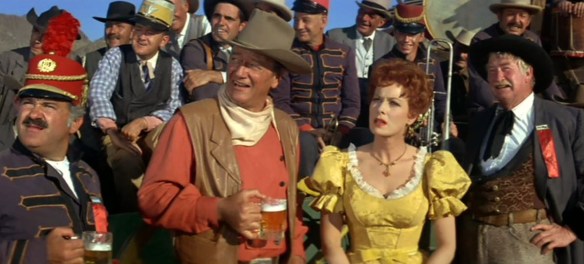
Apparently the name McLintock doesn’t come with the letter T. At least that’s the sense you get when the townsfolk send a salutation to the estimable cattle baron G.W. McLintock (John Wayne). Those who do pronounce that T are either out of towners, educated people, or probably the folks GW doesn’t like much. It’s true that the film is a western reworking of Taming of the Shrew so it’s very much a comedy. For all intent and purposes, it acts as a slapstick farce highlighted by a particularly raucous town-wide fist fight followed by a bungled hanging that just happens to commence right above a mudhole. The results speak for themselves.

But with the influence of its iconic star John Wayne, McLintock is also a fairly obvious commentary from one of Hollywood’s staunch conservatives. Still, the film never acts as a typical Western is supposed to.  In some ways, McLintock is a very modern representation of the West where you have the most amiable sheriff in the world, hardly anyone ever pulls out a gun, and numerous folks have college educations. Except in so many ways, this film can be critiqued for being outdated by today’s standards. There are “Indians,” belligerent Chinamen, and feisty women. GW has mutual respect and good relationships with many of these people but some of the usual sensibilities are still visible.

If the auteur theory can pertain to an actor than this film has Wayne’s handprints all over it. This isn’t a Ford film or a Hawks film or a Hathaway film starring John Wayne. This film is John Wayne’s, even more so than usual.

His son Michael helped produce, he enlisted the son of his old buddy Victor McLaigen to direct, his own son Patrick got a prominent position as a plucky young cattle hand, and so on. He fills the ranks with numerous veteran performers beginning with his greatest female costar Maureen O’Hara as his estranged wife who comes back to town threatening to divorce him and whisk his daughter away to the high society back east.

His trusty right hand Drago is played by Chill Wills while Strother Martin, Hank Worden, and even Edgar Buchannan take supporting turns. Perhaps the most unusual appearances are the presence of the radiant young Stefanie Powers as his daughter and yes, Jerry Van Dyke as a dorky college boy. A special guest spot was found for Yvonne De Carlo as a favor due to the fact that her husband had recently been injured on another film production.

But there’s also a pointed jab at Hubert Humphries in the form of the spineless, insensitive governor Cuthbert H. Humphrey, proving that even Wayne’s politics are channeled into the picture.

The final climax is played for laughs and it does provoke uneasy laughter, at least by today’s standards. It’s hard not to feel strange watching Maureen O’Hara running through town in her undergarments as G.W. pursues her and the town follows behind in hot pursuit. It’s full of pratfalls and slapstick moments that are indeed funny but at what cost?

For some reason, despite the light tone up to this point, it feels cringeworthy when Wayne knuckles down and gives his long-absent wife a shellacking right in front of everyone. Of course, by the end of the film they are together again and I wanted to be happy but this was not The Quiet Man (1952). It felt like Maureen O’Hara had conceded and lost. She returns to the cult of domesticity with her husband which isn’t inherently a bad thing but she hardly feels like a full partner in their complementary relationship.

By this point, although she had the upper hand the entire movie, digging in her spurs, she’s put in her place. In the end, she and GW get to live the life he wants. Because as he notes, “all the gold in the United States Treasury, all the harps in heaven, can’t equal what happens between a man and a woman with all that growing together.”

It’s true that using the word petulant to describe McLintock just doesn’t work. His daughter tries it and he laughs it off and I’m sure if any critic wrote as much Wayne would have done the same or cuffed him one maybe. There were invariably many people who didn’t much like John Wayne but it’s hard not to respect him–even in a comedy.

3.5/5 Stars

Review: Miracle of 34th Street (1947)

703c5-miracleon34thChristmas movies do not get much better than this. What a concept! Here’s a film about a man who really is Kris Kringle aka Santa Claus. He gets picked up by Macy’s department store to be their Santa Claus, and he winds up facing a hearing to decide whether he is legitimate or not. His pet project is to make an unsentimental little girl (Natalie Wood), and her practical mother (Maureen O’Hara) believe in him. He finds an ally in a young lawyer (John Payne) who believes in his holiday cheer and is also smitten with the girl’s mother.

Some people would undoubtedly say it’s a bunch a hogwash to make a movie about such a topic. Maybe it is only holiday tripe, but I find it is very hard to refute this “Miracle” of a Christmas classic. The characters portrayed are so spot on and heartfelt it is so easy to get pulled into their story. At the same time, it’s difficult not to like a film where department stores help each other, the hustle and bustle is toned down, and for once mankind has faith in each other for awhile.

As an audience, we gravitate towards Edmund Gwen because he represents the Santa we all wish to know. He is kind, thoughtful, generous, and above all a magical gift giver. Maureen O’Hara goes through a character progression that mirrors that of her daughter, except it is perhaps a little more poignant in her case due to her maturity. It would seemingly be easy to dislike her and yet thanks to O’Hara we cannot help but feel for her. She is also extremely beautiful, even in black and white. Although young, Wood proves to be a memorable little girl in this one, and she was just getting started. Payne is a good addition in his own right — a highly underrated actor.

The film is rounded out by a wonderful array of characters in the Macy’s store like magnate R.H. Macy (Harry Atrim), well-meaning Mr. Shellhammer (Philip Tonge) and friendly young janitor Alfred (Alvin Greeman). Shoppers such as the one and only Thelma Ritter in an early role, and civil servants like Judge Harper  (Gene Lockhart) round out New York’s population with generally decent people who we can relate to. The one exception is Dr. Sawyer (Porter Hall), the company psychologist, and greatest villain of the film, who is the antithesis of Kris and his Christmas spirit.

My hope is that this one never pales, never loses its cheer, and maintains its timelessness for many Christmases to come. Until the next Macy’s Thanksgiving parade comes along have yourself a merry little Christmas and remember all psychologists are not evil jerks looking to ruin the holidays!

5/5 Stars

The Best Films of Maureen O’Hara

MaureenO'Hara1. The Quiet Man
2. Miracle on 34th Street
3. How Green Was My Valley
4. The Huchback of Notre Dame
5. McLintock!
6. Rio Grande
7. Our Man in Havana
8. Sitting Pretty
9. This Land is Mine
10. The Long Gray Line
11. The Parent Trap

Rio Grande (1950)

f5e4d-riograndeThe last installment of John Ford’s Calvary Trilogy. Not the best of him or Wayne for that matter, but it is still a worthwhile film. First, there is the tension in the paring between Wayne and Maureen O’Harra as they quarrel about what to do about their young son who is a member of Wayne’s unit. There is a supporting cast including the likes of Victor McLaglen, Ben Johnson, Harey Carey Jr., and Calude Jarman Jr.

While watching it I was just thinking how Ford has so many great looking films in both color and black and white. This one uses the latter as well as a Monument Valley backdrop to perfection. It just looks so beautiful in every shot and Maureen O’Hara does not hurt the eyes either for that matter.

Soon after Ford would pair again with a few of his stars to make another little film. Anyone for The Quiet Man?

3.5/5 Stars

The Quiet Man (1952)

Starring John Wayne and Maureen O’Hara with director John Ford, the film follows an ex-American boxer as he returns to his roots in Ireland. Soon he is befriended by the proper yet kindly folk in the quaint town. Also, a beautiful red-haired girl catches his eye one day. Fireworks start between the American and the proud brother, so he will not condone the courtship or marriage of his sister. Finally, Wayne does gain his wife but she is unhappy without her dowry and she believes her husband is a coward since he will not fight for it. Little does she know the past he tried to escape, but once he gets it off his chest, he does fight. Through the exciting event both men grow fond of each other and the town gets a kick out of the entertainment. O’Hara and the rest of the cast including Barry Fitzgerlad are wonderful as the Irish folk, all playing off the Quiet Man.

5/5 Stars

How Green Was My Valley (1941)

Starring a cast including Roddy McDowell, Walter Pidgeon, Maureen O’Hara, and Donald Crisp, with director John Ford, the film is told from the eyes of a young boy (McDowell) from a Welsh mining family. Huw has five older brothers, an older sister, and two strong but goodhearted parents. As times get tougher, he sees one brother get married and two others leave for America. Huw faces his own struggles recuperating from an injury and surviving his schooling. Along the way he is aided by the kindly preacher (Pidgeon). However, soon he sees his family torn apart even more when his sister is unhappily married off, a brother is killed, and two others lose their jobs. Then, finally when his sister returns, the town folk start a scandal, and Mr. Morgan becomes trapped in the mine. It does end on a good not and the family stays resilient. This film is full of adversity but more importantly it has warmth and good people. The camera work is excellent and the Welsh singing is memorable.

4.5/5 Stars

Miracle on 34th Street (1947)

Starring Edmund Gwen, Maureen O’Hara, John Payne, and Natalie Wood, the film tells the heartwarming story of an old man who acts as Santa Claus for the Macy department store in New York. However, Kris who is a very warm person (Gwen), truly does believe he is Santa and he is constantly being kind to others. Despite his popularity, a sour psychologist claims Kris is crazy and the case goes to court to decide once and for all if he is Santa. Although the case seems bleak, Kris is enlightened by the fact that his test case family (O’Hara and Wood) finally believe in him. Through a series of extraordinary events his lawyer friend (Payne) is able to win the case right before Christmas. Pretty soon Kris seems to prove that he really is who he said he was. This is one of the great cheering Christmas classics of cinema.

5/5 Stars

Merry Christmas everyone!