Review: Network (1976)

network 1.png

“We’re not talking about eternal truth or absolute truth or ultimate truth! We’re talking about impermanent, transient, human truth! I don’t expect you people to be capable of truth! But, you’re at least capable of self-preservation! That’s good enough!” – Peter Finch as Howard Beale.

Throwing around the term auteur and you’ve already set yourself up for a grievous debate with some diehard cinephile. There are those ardent disciples as well as those who vehemently oppose what they deem a simplistic notion.

Because the main tenet is that the auteur or “author” who exacts his vision on a movie is namely the director. However, if there was ever a subject to cast in the role of “screenwriter as auteur,” Paddy Chayefsky just might be the perfect candidate. He came of age in the medium of television, an adamant humanist and purveyor of social realism. His most prominent work of those early years being the heart-warming classic Marty, which first starred Rod Steiger and then did great things for Ernest Borgnine in the film adaptation.

Network is conveyed by a veteran Chayefsky who has weathered the industry for a long spell now and looking at it presently, we observe his wry bit of commentary. Because the beast of a medium made him but he seems to derive some glee from confronting it head-on. He’s taken the systems in place and very conveniently added his own spin.

Along with the Big Three, CBS, NBC, ABC, he has created his own outlier, a dark horse, and the littlest giant UBS. The landscape is one familiar to anyone who lived through the 70s. Nixon got the can. There have been two recent attempts on President Ford’s life. It’s the wake of Watergate and Vietnam, with the throes of inflation and depression. America is looking for an escape valve for their dissatisfaction.

I’d like to think that the world of The Mary Tyler Moore Show has some semblance of truth to it with its camaraderie and the humanity of its comedy, but then we see Network and are provided another harsh alternative that bears the uneasy feeling of its own truth.

In this same world of civil unrest, television networks with their programming regimens and new shows are bloated with all sorts of agendas. You have the continually clashing horns between warring executives and self-serving angles in their neverending quest for higher ratings and a bigger share of the viewing public.

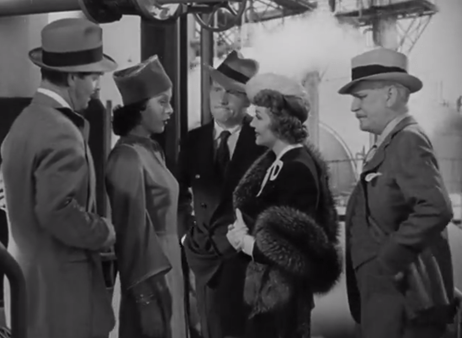
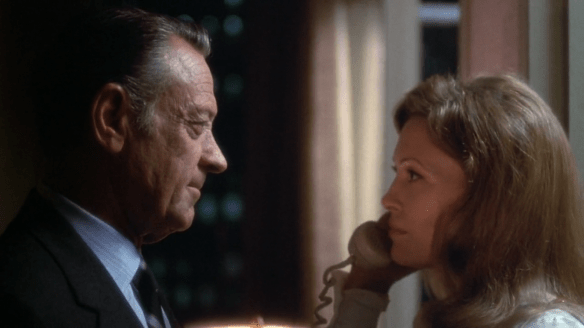
Max Schumacher (William Holden) is a remnant of television’s bygone era where men like Ed Murrow and Walter Cronkite were symbolic purveyors of truth in all facets of America. Maybe the nation was naive but at least they believed in something. Times have changed. Sensationalism and stories to stir up some form of controversy are of particular interest especially with Diana Christensen (Faye Dunaway) who aims to use such material to bolster the network’s abysmal ratings.

network 3.png

Meanwhile, abrasive big whig Frank Hackett (Robert Duvall) is tired of the news division’s lackluster performance, and he’s ready to instigate some new changes within the business conglomerate. Schumacher feels slighted as his former allies seem to crumble around him.

Now’s about a good time as any to introduce Howard Beale (Peter Finch). He’s one of Max’s best friends from the old days and due to plummeting ratings, he’s been given the axe. I never felt sorry for Howard Beale before because he’s so often lost in the shuffle of the movie. He’s used by not only the network but the film itself as a kind of diatribe. It seems like the man is all but forgotten.

Finch plays the role so pitifully at times and that becomes easily overshadowed by his attention-getting histrionics.  However, when he makes his initial announcement that he will take his life on air, in two weeks’ time, it’s very matter-of-fact. There’s little agenda to it. Here’s a man who’s lost his wife and now is losing his job after 11 years of service to the network. Soon he’ll have nothing.

The utter disinterest in his plight is what’s most striking when you look down the line of producers and behind-the-scenes employees who sit in the dark in front of the monitors chatting rather than actually paying attention to their anchor. Apathy seems to reign.

Simultaneously, Christensen is exploding with harebrained schemes of inspired lunacy that she seems all too serious about enacting, from a docudrama called The Mao Tse-Tung Hour to keeping Howard Beale on the airwaves. She’s the foremost proponent of angry shows to articulate the angst of the general public through counterculture and anti-establishment programming. That’s her agenda.

In this very way, Network is a film of bewildering disillusionment in the world full of crises and absent of reason and maybe even God. Howard is a voice to all those absurdities and when he calls B.S., he turns the heads of the entire country. It blows up but as any publicity is good publicity, Diana convinces her boss to keep the mad prophet on.

She positions Howard Beale as a prescient even messianic figure calling out the hypocrisies of the age. Her boss openly objects, “We’re talking about putting a manifestly irresponsible man on television,” which Dunaway promptly nods her head in response to. Maybe she’s a bit crazy in her own right.

Then, when the fad keeps on going and he’s now got people yelling out their windows or sending their grievances straight to the White House, Christensen is complaining that he’s too irascible, not apocalyptic enough, recommending some writers be brought on to pen some juicy jeremiads for him to spout off. In spite of the ludicrous nature of it all, the results speak. Soon Howard Beale’s antics have landed him 4th in the Nielsen ratings surpassed only by The Six Million Dollar Man, All in The Family, and Phyllis.

Hackett is deliriously happy about the success and becomes power-hungry. But as Beale’s sole friend still kicking, Schumacher can’t help but feel Howard’s being used, even as he himself gets involved with Diana (she harbored a girlish crush on him in college).
network 2.png

The film’s trajectory seems all but predestined. The fad of Howard Beale begins to wane and ratings go down with him. Max Schumacher’s job and then his marriage go down the tubes as well, all because of Diana. For her part, Diana is so completely consumed by her work that everything, even her personal life, works in scripts. However, the rendition of The Blue Angel that she’s unwittingly been playing with Max doesn’t end as she initially thought.

As a satire of the medium we know as television, Network certainly has few equals. Chayefsky spends a good spell of time orating off his soapbox as he does in many of his pictures. The ideas are there. The words are coming from voices and we’re taking them in, and they are spiced up with rhetoric and wit. If anything, one can marvel at his work even when it doesn’t take. It bears his mark.

The one thing about Network that is still harrowing today is the mere implications. Television was being considered an institution systematically destroying everything it touched through its manipulation and backstabbing industry practices. It only exasperates the situation by breeding a public that’s both vacuous and apathetic.

There is no call for human decency anymore. There are no true glory days. People are depressed, lonely, bitter, and helpless. If that all came to pass, theoretically, because of a box sitting in a family’s living room, 21 inches in size, that could be turned off, and had bad reception more often than not, what is the internet doing to us?

Now we’re in constant interface with our devices, warring for our attention and promising us comfort and convenience. Meanwhile, our ghost machines suck us dry. We’re shells of human beings. There are some figures in Network that I dislike, played most convincingly by Duvall and Ned Beatty. They seem opportunistic, crass, and merciless. But most everyone else of note I feel somewhat sorry for. The Max Schumachers, the Diana Christensens, and of course the Howard Beales. What did we do to deserve this madness?

4/5 Stars

The Americanization of Emily (1964)

americanization of emily 1.png

“Don’t show me how profitable it will be to fall in love with you, Charlie. Don’t Americanize me.” – Julie Andrews as Emily

Yes, Kubrick’s film is definitive. Though something inside of me wants to rale against convention and wave the flag for The Americanization of Emily instead, a movie that came out the same year as Dr. Strangelove (1964) and could probably use the acknowledgment. While not technically as renowned — Arthur Hiller is no Stanley Kubrick — this is probably the director’s best work and we do have a script by Paddy Chayefsky, the man famed for penning everything from Marty (1955) to Network (1976).

Our stars are to die for in James Garner and Julie Andrews while in its satirical bleakness, the movie predates the absurdity of Mike Nichol’s Catch-22 (1970) adaptation or Altman’s M*A*S*H (1970). At any rate, it deserves a place in the conversation among the seminal anti-war statements of the 20th century.

Though Chayefsky can get verbose with his quill, it’s all quite eloquent; between the stars and the dilemma they find themselves in, the resonance of The Americanization of Emily cannot be overstated. It starts with of all things a “Dog-Robber,” the pet name and vernacular shorthand used for personal assistants of military big wigs.

Garner always the conman, grifter, or otherwise likable trickster, is seamlessly fit to play Charlie Madison, a rapscallion who is also very good at his line of work. As right-hand man to Rear Admiral Jessup (Melvyn Douglas), Charlie is tasked with laying out the red carpet for his superior, charming and cajoling his way to get the best of the best. That means the finest food and the most charming female company that wartime Britain has to offer.

A couple of the assumed premises of the picture are troubling, starting with the prevalence of what can only be termed “tush slaps” of nearly every female attendant. Nearly everyone seems to enjoy the attention. The second is how the war takes a back seat as does the fact, despite Man being infallible and the reasons for war being muddied, Hitler was seemingly a power that necessitated some counteraction. For that matter, D-Day feels like it’s an open secret among every Tom, Dick, and Harry.

But this is all part of the groundwork which all comes into relief as we begin to visualize the story. Consequently, it doesn’t much feel like a bombed out or rationed Great Britain at any point in time. There’s little need for historical accuracy — the trail of a cynical war comedy with all its biting fury is what’s most importantly on display.

After getting off on the wrong foot, Charlie and his assigned chauffeur Emily (Andrew) joust a bit only to fall into each other’s arms. She brings him over to tea with mother and there he sees the shrine to all the deceased war heroes in their family (a lah Hail the Conquering Hero). Except Charlie sets the record straight on what he thinks of war and how other people go about it. Some might consider him callous but the way he sees it, being brutally honest, in such a case, is the most humane thing to do.

Mrs. Barnham has long been pressing on in life as if her son was still alive. However, Charlie brings the tea conversation to the cold hard facts. In his estimation, it’s the most profane thing in the world to enjoy war. Enjoyment in the same sense that he sees grieving as a sensual thing for a woman — when she can mourn her husband who gave his life so gallantly for his country. He doesn’t see anything noble about needlessly making heroes of our dead, venerating them, instead of allowing them to rest in peace.

When probed about his religious views, he retorts quite blatantly he’s “a practicing coward.” He learned it in Guadalcanal in the midst of buddies dropping all around him. “Wars are the only time a man can be gallant and redeemed. Wars are always fought for goodness, except virtue is so unnatural to us. God save us all from people doing the morally right thing.” These are little nuggets of wisdom he drops.

americanization of emily.png

The complete absurdity of it all comes into focus when his commanding officer cooks up a cockamamie plan to shoot a movie during the storming of Normandy to capture the first dead man on the beach — who will obviously be a sailor — proving to the world that the Navy is just as important as anyone else. They know he’s really flipped when Admiral Jessup dreams up the Tomb for the Unknown Sailor too.

Still, no one has the gumption to disobey so Charlie’s buddy Bus (James Coburn) looks to stall operations as long as possible and yet, in the end, they find themselves hurtling toward Normandy on an utterly pointless suicide mission. Except Bus gets bitten by the patriotic bug too and goes nutty for his duty with Charlie and his lackluster movie crew hoisted onto the LST like stray cargo. They’re going whether they like it or not.

The comedy is solidified for me in the D-Day sequences as Charlie finds himself dumped out in the ocean, flailing around in the cold, half-heartedly trying to hold onto a camera he doesn’t know how to use, probably already decommissioned by sea water. It’s utterly pointless. Here he is amid the chaos with his former friend goading him on only to wing him with a pistol in the process. Charlie’s left for dead but on the bright side, at least he’s positioned himself as the first casualty on the beaches of Normandy — a navy man, no less.

True to form, the images of him are soon plastered all over every magazine back home. He’s been christened a hero and every type of idolatry he would never care to give anyone else is lofted on him. It’s far from done, rolling over on itself one final time.

There must be continuous punchlines to underscore the sheer looniness of it all. Whereas a picture like The Spy Who Came in From the Cold (1965) is bleakly cynical, here James Garner is able to inject his grouchy strain of comedy into the part, aiding the story to its conclusion. But the final zinger goes to Julie Andrews as she is and always will be his equal in the film.

“Honestly, Charlie, your conversion to morality is really quite funny. All this time I’ve been terrified of becoming Americanized, and you, you silly ass, have turned into a bloody Englishman.”

So you see, it might have just as easily been called the Anglification of Charlie. There you have the irony at work again. Somehow it makes sense and it doesn’t at the same time. That’s war in a nutshell.

4/5 Stars

The Song of The Thin Man (1947)

the song of the thin man 1.png

The Song of The Thin Man is really and truly the swan song of the series and while I did enjoy most of the additions, there is a sense that it was time to end the franchise. The year is 1947. The war is over. Things have changed. It really has little to do with William Powell and Myrna Loy being older or past their prime, because they are still a joy to watch working in tandem and they’re hardly over the hill.

But in some respects, society didn’t need Nick and Nora anymore. They were more like a touch of nostalgia than an up-and-coming force because they were born out of the Depression years and though they grew and matured as characters well after that, it seemed like as good a time as any to let them be.

Their son, little Nick Charles Jr. (a young Dean Stockwell) is a precocious lad like his father.  His behavior is deserving a spanking though his father is averse to giving it out even on his wife’s behest. But this was never meant to be a family comedy. Even Asta was always a sidekick and not a focal point.

Most of the film is conceived on a luxury liner, the S.S. Fortune amid nightclub musicians and patrons who have come out for a charity benefit put on by the wealthy David Thayer. It’s the perfect locale for, you guessed it, murder.

The center point of it all is Tommy Drake, the band leader scrapped for cash and with plenty of bones to pick with any number of people. He wound up gunned down from behind. In introducing all the players, it’s safe to assume they’re potential suspects too. There’s songbird Fran Page (Gloria Grahame), the ship’s proprietor Phil Brant (Bruce Cowling), and the soused musician Buddy Hollis (Don Taylor). It’s Brant and his forbidden fiancee, Janet Thayer (Jayne Meadows), who come to the Charleses so that Phil’s name might be cleared.

Bess Flowers turns up in a fairly visible role given her usual penchant for bit parts in hundreds of high profile films. Leon Ames returns to The Thin Man universe in an unusual circumstance of the same actor taking on a different role. Helen Vinson who played his wife previously was not available for the picture and so the exquisite Patricia Morrison (currently 102 years young at the time of this viewing) filled the part instead. Even noir regular Marie Windsor shows up as a gangster’s moll although I’m not sure if she even utters a word.

Anyway, back to the business at hand, Nick and Nora Charles and the mystery. One of the best parts of the film is watching the Charleses be introduced to the jazz beatnik culture craze and their guide is none other than Clinker (Keenan Wynn) a real hip cat on the reed who happened to be aboard the liner when the murder occurred.

It should be noted that when rock n’ roll came Beethoven could be found rolling in his grave. Currently, his bust simply looks begrudgingly from his perch, given the state of affairs with the contemporary music scene.

Interestingly enough, there aren’t many police authorities running around to get in the way. It’s all Nick Charles joined by his wife and, in this case, Clinker who has connections to really help them understand the scene.

Although the setup and the characters are interesting enough, the film probably has the least satisfying finale of any of the Thin Man films. It winds up back on the ocean liner but it somehow doesn’t come off like its predecessors. Even the fact that the picture is a good 20 minutes shorter than the earlier films seems to suggest the beginning of the end. But on the bright side, for once Nick was able to retire for good — to his bedroom that is. It’s fitting, really. Mr. and Mrs. Charles gave us plenty of laughs. They deserve to rest in peace.

3.5/5 Stars

The Thin Man Goes Home (1945)

thin man goes home 3.png

Sometimes it’s necessary to go back to the basics. We’ve been introduced to the social elite of New York and San Francisco, invited along to giant family estates, and frequented the race track and wrestling rings. It only makes sense that at some point we would finally be introduced to their roots.

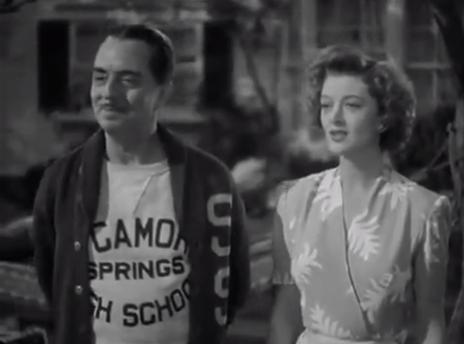
What is the occasion, you ask? Nick has a birthday coming up and what better way to surprise his parents (Harry Davenport and Lucille Watson) then popping in on them in his hometown of Sycamore Springs? It’s not the most comfortable of trips, crammed together with other passengers; before resigning themselves to the luggage car, for Asta’s sake, where he gets accosted by the local livestock. But be it ever so humble, say it with me, there’s no place like home!

The premise is plainly given but this might just be the most enjoyable installment since After the Thin (1936).  That is not to say the other entries were not amusing. They most certainly were. But there’s something gratifying about getting to know Nicky’s community a little better. Due to the passing of W.S. Van Dyke, it is Richard Thorpe who takes up the reins without too many noticeable hiccups or maybe there are just enough.

There’s the inevitable running into a plethora of old acquaintances of all sorts of ticks and demeanors. Most curious among them is the aptly named Crazy Mary (Anne Revere) or the starstruck young debutante Laurabelle Ronson (Gloria DeHaven). Nick takes each reunion in stride while also finding time to fix tables and fiddle with deadly hammocks all to the mild amusement of his better half.

The comedic range of gossip around town is astounding as the whole neighborhood drums up a story about how the town’s most famous citizen has returned to investigate a homegrown murder. It couldn’t be further from the truth, until it becomes true. What happens is the most ludicrous of murders yet, with a young man (Ralph Brooks) showing up on the Charles’ doorstep only to get the axe a minute later.

Mr. Brogan (Edward Brophy), a reformed greeting cards salesman, is always coming out of the bushes to give Nick a tip but of course, he didn’t see or hear the murder. Still, he provides his services to the amateur detective by pulling his wife away for an evening.  Myrna Loy in the humorous tailing sequence showcases her talents, making the scene into her own shining moment away from her husband. Though they are inseparable in one sense, the film benefits from these digressions as wayward as they might seem.

There are so many juicy tidbits to latch onto but one of the most crucial is a fateful painting of a windmill that Nora buys her husband as a birthday present,l due to some childhood significance. But there’s also a couple (Leon Ames and Helen Vinson) anxious about getting their hands on the piece for its perceived value. It’s no small coincidence the painting was attributed to the deceased victim.

At the Charity Bazar, the Charles make their appearance and Asta hops up on the counter to pay a visit to a house check girl in the periphery (I have no idea why this caught my eye). Meanwhile, Loy is forced into a jitterbug with an eager sailor serving as a convenient diversion. Nick doesn’t want her to be with him while he goes snooping around upstairs. And in these moments you see the allure of the Charles marriage.

The husband is the quintessential bachelor-type who nevertheless makes an affectionate husband and his beautiful Nora, a high-brow socialite, is ever the understanding wife. But beyond this archetypal pairing, you have the wryly comic tug-of-war between them as the smirking Nick always looks to throw his wife off the track and she always does her best to stay right there by his side.

In fact, the payoff looks different in the small town as everyone of possible motive is gathered into the drawing room but also it is Nora and not Nick who becomes the master of ceremonies, quelling their objections and keeping the audience under raps while her husband gets ready to make his appearance.

Given the crazy nature of the murder, it would be safe to reason the finale would be a little wild too and that assumption holds. But that cannot take away from what this film has to offer. Because what is The Thin Man without Nick and Nora Charles? It would be nothing and yet in this picture, they both continue to shine as they always did together. Even as the years progress, they don’t change all that much. The only thing that’s different is Nick has made strides with his drinking hobby which has been traded out for a flask of cider. One can only surmise the reason for this change was the wartime ration on liquor.

3.5/5 Stars


Shadow of The Thin Man (1941)

the shadow of the thin man 1.png

Little Nick Charles Jr. is growing up and his loving daddy, in lieu of fairy tales, reads to his son about the horse races. Some things never change. Despite an unfortunate stereotyped-laden portrayal provided by Louise Beavers, the picture quickly settles into another enjoyable jaunt.

In fact, it’s a perfect day for the races until Nick gets pulled over for speeding. That’s only the beginning. Because the cop proves to be a big fan of Mr. Charles. After all, if we haven’t realized it already, he is a household name. Everybody seems to know him. Policemen, conmen, jockeys, and anyone else you can possibly pull out of a hat. It makes no difference. By now, his wife never shows an ounce of surprise. She only smiles, nods, trades pleasantries and never says another word about it.

The recurring gags keep coming with yet another former acquaintance with a grubby nickname like “Fingers” running into Nick and inquiring if the dame he has in tow is his new girlfriend. It seems like no one ever thought him one to get married.

It’s all good fun and there’s even the return of Nick’s old buddy, old pal, Lt. Abrams (Sam Levene reprising his role). This sense of world building and the introduction of characters was always The Thin Man series at its best, but there’s also business at hand — a jockey named Gomez has been whacked.

However, Nick tries to avoid getting pulled into yet another case by patronizing the arts, namely a wrestling match. It’s one of the film’s most delightful diversions but there’s also a sneaking suspicion it must tie into the case somehow. The forces lurking in the shadows hang over the racetrack murder like a stench and they’ve got there hands in all the places, including the press. Maybe even higher up too.

A youthful Donna Reed makes an early appearance as a naive secretary and while still growing as an actress, there’s no doubting her sincerity that always shined through in all her work. With writers Albert Hacket & Frances Goodrich, then James Stewart and Sheldon Leonard also involved in earlier installments, and Reed being featured here, it does seem The Thin Man was a bit of a training ground for It’s a Wonderful Life (1946).

But back to the current business at hand. Molly’s beau Paul (Barry Nelson) is a prime suspect when murder strikes again. With the young couple right at the center of the mess, compassionate Nora wants her Nicky to get them out of it and that he does.

Also, tied up in the case are stuttering Rainbow Benny, famed acting instructor Stella Adler in one of her actual roles as Claire Porter, Frank Faylen as a nervous ticket booth operator, and you guessed it, a whole host of others.

Still, Nick finds time to get accosted by kids while taking Nick Jr. around on the carousel. While Asta’s best gag is getting trapped in a revolving door chasing after a fugitive. Myrna Loy doesn’t get as much screentime as she should but as usual she provides a calming and still slyly comic presence. The continuity provided by W.S. Van Dyke is there as well though this is the first script not penned by the screenwriting duo Hackett & Goodrich.

By now it’s all but inevitable. Everyone gets rounded up to the police precinct. Nick Charles takes center stage bringing wifey along and Lt. Abrams is in the middle of it all for good measure. But he’s really only the white noise and perfect stooge as Nick deduces his way to the finale as he always has. It’s true that the formula feels a tad overspent but seeing as Hollywood is used to beating dead horses to a pulp recently, this one doesn’t feel that bad. At least it’s a good time and we still have Powell and Loy as amiable as ever with a continous spritzing of humor.

3.5/5 Stars

After The Thin Man (1936)

after the thin man 1.png

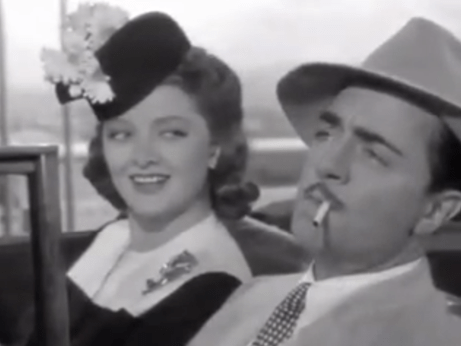
The reason to watch The Thin Man series was never murder. Sure, like its predecessor, this follow-up has the pretense of a mystery plot but that’s merely a trifle in comparison to the return of Nick and Nora Charles.

The novelty of this picture is no longer that it once more brings crime and comedy together because that’s what the original film did. We already have the formula, the groundwork set before us, and certain expectations. But what it does even in its opening vignettes is further develop its leads by transplanting the New York socialites to the world of San Francisco which brings with it different colorations and really an extension to this fanciful world that they live in.

William Powell and Myrna Loy are just delightful with teasing ever whip-smart interplay but we also see the class dimensions being played up too. All of a sudden, their marriage of such stark opposites comes into clearer focus and we love them even more.

Nick seems to know someone on every street corner most of them being hoods and shifty conmen begging the question just what he did in his previous life (I can’t ever remember being told)? Meanwhile, Nora comes from money and runs in a certain society that’s slightly averse to the constant verbal barbs and nose-thumbing of her husband. You see, he seems to have no respect for respectable folks. Her family can’t stand Nikolai as he’s called. But he loves his wife and she loves him.

The fact that the action is set over The New Year blesses the film with jovial gaiety and champagne bubbles that add a little pizzazz to your run-of-the-mill murder of passion. Meanwhile, the dubious Lychee Club takes its place front and center because a couple implicated persons are tied up with the establishment. One of them, named Dancer, runs the joint while his star performer Polly and her brother Phil also seem caught up in something shady. If you had to put a name to it you might call it extortion.

Then a slimy playboy (and unfaithful husband) is found murdered after a night carousing at the club with the chorus girl. That effectively gets his devastated wife accused of murder with her longtime beau (James Stewart) going to great lengths to defend her.

We could keep running off the list of suspects but to no avail, and it has the typically gung-ho cop Lt. Abrams (Sam Levene) understandably suspicious as he tries to make head or tails of the whole mess. Of course, he has Nick Charles on his side and a good thing too.

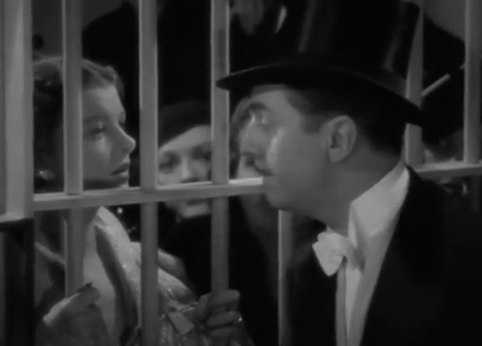
Asta is up to his old tricks running off with a vital clue and Nick’s up to his old tricks having his wife locked up in prison so that he can bail her out. Despite her longsuffering lot in life, she gets in some comic retribution of her own while maintaining a dazzling marriage full of mutual understanding.

Because, in one sense, Nick Charles is a complete imbecile, a habitual jokester, and yet he’s just serious enough to warrant some respect in the crime-solving trade and just sincere enough to hold onto his wife for posterity. Again, that’s all part of his charm. If he wasn’t so good at solving crimes, it’s doubtful people would give him the time of day. Though his wife does continuously and that’s what really counts. That’s the heartbeat of this entire franchise.

The Charles also realize humanity’s aspirations of sleeping the day away and it’s true they can get away with settling down for breakfast just as everyone else is finishing up dinner. That’s their lifestyle. I’m sure most of us hold a deep-seated desire for it in some cockeyed way. But most of us can’t solve murders on a whim either. So they get to be our surrogates on both accounts.

I won’t say he’s the epoch of amateur sleuthing, as the company includes the Sherlock Holmes, Miss Marples, and Jessica Fletchers of the world, but Nick Charles is one of the wittiest individuals to hold the mantle.

It must be noted that he was a creation of the Depression, a needed respite from the day-to-day, but you get the sense that today he comes off as a bit callous. Surely a man who knows so many undesirable characters was aware that there was a Depression on. And yet you see, that’s precisely the trick. In this world, such an event does not exist.

There’s no need to worry about it and this alternate reality instead gets to occupy itself with murder and excess, jokes and romantic patter. It truly is escapism and a gift to the masses. No wonder people loved Nick and Nora so much because it really does seem like they filled a need at the time.

While he’s not the center of attention nor is his role all that meaty until the final moments, James Stewart is nevertheless entertaining in this early part with a slam-bang finish that gives a glimpse of the passionate intensity he offered as an actor. It was full steam ahead for both him and The Thin Man series though you might say his future was a little more promising.

4/5 Stars

Meet Me in St. Louis (1944)

meet me in st louis 1.png

One thing that can be said of Meet Me in St. Louis is that it captures the milieu of an era while simultaneously being quintessential Vincente Minnelli. Every man, woman, and child is dressed to the tee and enraptured by love and the grand promises of the World Fair full of dancing the Hoochie-Coochie with their special Tootsie Wootsies.  It’s cheerfully opulent in such a fashion that some might consider it almost garish and others will deem it the height of turn-of-the-century elegance.

There’s no doubt that the director had one of the most phenomenal palettes of any filmmaker from any time period. Certainly, this extends to the mise en scene and the costumes adorning his stars — pulled right out of Sears Roebuck circa 1900. But the other crucial aspect is that Minnelli seems to handle his talent with kid gloves or at least he creates an environment for them to flourish.

Of course, front and center of the Technicolor extravaganza is Judy Garland who would marry her director the following year and you get the sense that she had fallen in love with how beautiful he was able to make her on film. It’s true that she’s a striking sight to behold, only magnified by the world she traipses through, surrounded by her kin and singing to her heart’s content.

Still, if the set design is such a grand expression of the film’s potency and visual appeal, it’s necessary to point out again that this is far from a Judy Garland show; there is an ensemble component even if she’s the scene-stealer.

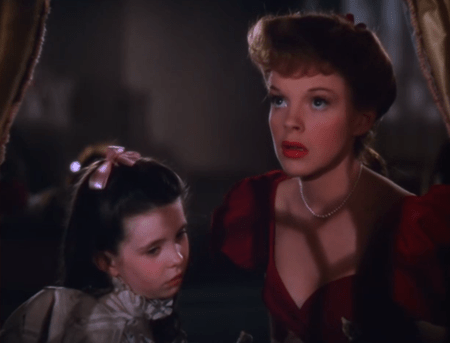
Margaret O’Brien is a riot because she plays little Tootie in the most ingratiatingly precocious way possible. Though it must be admitted she has a bit of a morbid side too. We meet her on an ice wagon telling a man how she’s going to give her doll a nice funeral and later on, of course, she takes the heads off all the snow people.

However, there’s also a whole Halloween interlude starring Tootie and their sister Agnes that feels more like a ghoulish Guy Fawkes day than its modern incarnation of door-to-door candy grabbing. Maybe Halloween has gotten tamer than we give it credit for. Put up against the film’s more mirthful moments, it comes off a tad alarming.

But then again, the story continually goes back to its roots in the centrality of the family unit. Its very integrity is in jeopardy of being disrupted when Father (Leon Ames) drops the news that they will be moving to New York from St. Louis. It comes off horrifically. It’s imperative to remember that in order for those heights to be so gay there must be a steady stream of romantic heartbreaks and personal roadblocks which the picture gladly provides.

There’s a lovely scene staged around the piano between Mr. and Mrs. Adams (Ames and Mary Astor) where like in so many other instances song becomes the perfect expression of the current mood. Based on where the camera is situated, the stairwell in the back is visible and you see the shadows of figures before they inch back into the frame and subsequently back into the family room. It’s a visual representation of the family staying rooted together even after a spat — constantly retracting — then contracting back together in continuous motion.

Without question, the well-remembered “The Trolley Song” is a giddy number that outshines any of the others but that’s because it is the summation of romantic euphoria that Esther (Garland) is feeling for her beau (Tom Drake). Meanwhile, “Have Yourself a Merry Little Christmas,” though hauntingly melodious, is quite easy for me to rip out of the context of this film.

meet me in st louis 2.png

Meet Me in St. Louis has never been a yuletide film for me in a similar fashion to how Holiday Inn (1942) is not so much attached to “White Christmas” or holiday cheer as the Michael Curtiz picture from 1954. Perhaps its influence isn’t as deeply rooted in my childhood recollections as some of its contemporaries. But then again, Meet Me in St Louis evokes Christmas in the same way that some of the cinematic adaptations of Little Woman (1933, 1949, or 1994) conjure up the season in the context of family. Perhaps that’s how it should be.

In its day, the film was a smash hit only to be outshined by that prior behemoth from David Selznick Gone with the Wind (1939) and it’s easy to draw up parallels if not simply visually speaking. Both films boast breathtaking imagery and extraordinary color photography for the era that even today can rightfully be considered landmark stuff. Still, that doesn’t mean that everything else has improved with age. Make the concessions where you will and the film can be a good-natured classic or even a Christmas perennial favorite. In my estimation its middling in both categories. Still, that can’t completely detract from its finer attributes. Namely Minnelli’s striking color scheme which remains second to none.

4/5 Stars

Boom Town (1940)

boom town 6.png

Clark Gable was anxious to do a movie about oil — wildcatters as they call ’em — because his father had been an oil man. Of course, MGM was looking to put him in such a picture too and when a certain story was published in Cosmopolitan it would prove the inspiration for Jack Conway’s Boom Town.

The most obvious attraction to this picture then and now is the copious amount of star power. We already mentioned MGM’s beloved Gable but Boom Town has Spencer Tracy, Claudette Colbert, and Hedy Lamarr all readily available. This would be the two men’s final film together out of three outings. It’s not so much that they didn’t like each other but the fact that they were both formidable attractions and Tracy was starting to command top billing.

In an industry consumed with A-list and B-list stars, MGM didn’t quite know how to go about keeping them together and so they never appeared in the same film again. I can’t say that it leaves me heartbroken.

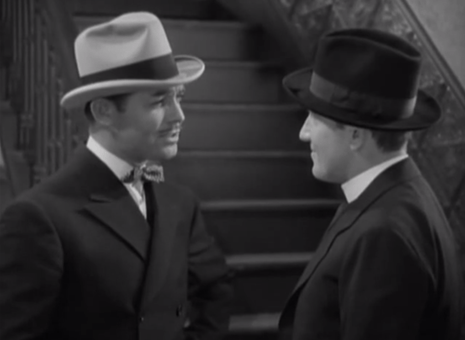
They meet on a plank crossing a muddy mining street. Whether it was purposeful or not you can’t help but recall the fateful meeting of Robin Hood and Little John. Except these two men share the same name. The local saloon keeper christens them Big John (Gable) and Square John (Tracy) respectively. They’re none too amicable at first but after a bar brawl that looks more like lawn bowling, they’re pals enough. Those type of things builds camaraderie in hard-bitten men like these.

Soon enough they are going halfsies on a piece of land “Shorty” has been aiming to drill on. Frank Morgan isn’t much help as the begrudging equipment salesman and so they take matters into their own hands. A lovable Chill Wills plays a drawling Sheriff with a penchant for cookbooks and a decent shot with a rifle.

The film could have been a gusher laden with drama but most of the blasts of energy are few and far between hidden under layers of good luck and hard luck, romantic interplay, and the ever-changing tides of the oil business. Some of these themes would be echoed again in works like Giant (1956) and There Will Be Blood (2007).

The most rewarding scene by far is watching Gable and Tracy brawl it out in an office. By now they’ve both been big men who have known both failure and success. But this strips everything down to the two of them and the woman caught between them.

boom town 8.png

I must admit that Hedy Lamarr’s part is rather uninteresting — little fault of her own — though most would note that she is as alluring as ever as the ingenious socialite and serial eavesdropper who helps McMasters take over the New York market.

Claudette Colbert is compelling enough in a role that reunites here with her It Happened One Night (1934) leading man, though the role was written initially for Myrna Loy and there is an innate sense that if she could have repeated her spectacular turn in Test Pilot (1938), this picture now transplanted to the oil fields would have been better for it. As it is Gable and Tracy do seem to command most of the attention. After all, this is really their story as we watch them rise, fall, and come back clawing again and again.

The final big moment, however, goes to Tracy standing up at the witness stand and even though he and McMasters have long since parted ways, pushed each other out of business, and even come to blows, he still manages to exonerate the man of any wrongdoing.

Because if nothing else they are both oil men with ideals of what the country might be if we take care of our limited resources for our children. You might call “Hogwash” but it’s a nice sentiment anyways and as usual, Spence delivers it with his typical candor that silences any naysayers. However, one wonders what the picture might have been if Colbert and Lamarr were given a bigger stake.

3/5 Stars

Test Pilot (1938)

test pilot 1.png

Test Pilot is a fine piece of time capsule filmmaking and there’s little doubt that the film showcases a dizzying array of airplanes that we very rarely see today. In that sense, it’s an aerial picture with some truly dazzling footage.

By 1930s standards, this is also an action picture, a sprawling exhibition that simultaneously has a pretty thin story in some patches. In fact, it’s too long for its own good. But it’s a character drama as much as an aerial show, which takes precedence over anything else, narrative included.

The screenplay was forged by Howard Hawks (who worked on several other flight films) and a whole host of others. Its overall success is not necessarily in any amount of tension that is created or a certain brand of visceral storytelling though there are undoubtedly some emotional moments, the brunt of the heavy lifting comes from the cast as they articulate the beats of the script.

It’s true that under veteran director Victor Fleming and a cast including Clark Gable, Spencer Tracy, and Myrna Loy, it’s difficult to find a more prestigious partnership out of MGM in the 1930s. This was pretty close to tops. Still, even in this dynamic, there were foreseeable problems. Spencer Tracy has a bit of a thankless job playing the faithful mechanic Gunner Morris, the character who is there to support his friend and he conveniently never gets the girl.

You can understand why Tracy could get a little tired of such roles because there’s no doubt that Gable is in one sense the main attraction as the eponymous “Test Pilot” Jim Lane. He was the great movie star of the age.

test pilot 3.png

However, Tracy was the acting powerhouse of the two and that’s the chafing at work once again in this picture. The stellar personality and the quality talent seesawing back and forth. Except Tracy’s stock had been rising year after year and by now he was a solid draw in his own right. It’s evident that he’s a formidable third wheel in the picture though he had his sights set on something slightly more gratifying.

In fact, he’s nearly invincible. Gable famously implored “Spence” to go ahead and die already because the actor milked his last words for all they were worth. However, even if this jousting match between the two male stars is most visible, out of the three I think Myrna Loy comes away having the most fun and getting the most out of the picture. It’s completely understandable why she cherished her work here.

She is the Kansas girl who has her head in the clouds like a ditzy farmer’s daughter watching as a man brings his plane down on her family’s land. He’s simultaneously an ungrateful lug and her shining knight. There’s something whimsical and wholly uninhibited about her that lets her meet a grouchy pilot out in the pasture with a wit of her own and yell her head off at ballgames like a seasoned fanatic.

Her performance runs the entire gamut from near screwball antics to deep heartfelt emotion. The dimensions there are at times difficult to read — even enigmatic. I think that’s why Jim falls for her. She’s in some ways just as tantalizing and fascinating to him as the air above.

Test Pilot also examines tragedy of such a pioneering and devil may care lifestyle — themes that Douglas Sirk would streamline in a picture such as Tarnished Angels (1956). Here we get the alluring frolicking fun of going where no man has gone before until it is tapered by the stark reality at hand. Icarus had the thrill of his life but it’s possible to fly too high or for your engines to blow out or for your instruments to fail. It’s a part of the lifestyle that pilots come to accept. They take the risk because the skies call out to them so earnestly. It’s their obsession.

Jim is one of those who has always followed that call. His story is really about his romance with two women. His wife waiting for him on the ground and the blue heavens which call out to him from above. It takes a reality check ripping something so dear away for him to realize he doesn’t mind being grounded. It was the one thing he swore he would never do and yet, in the end, he gladly does it.

3.5/5 Stars

San Francisco (1936)

san francisco 1.png

There was a time when San Francisco was synonymous with the earthquake. Before Rice-A-Roni, The Golden Gate, Bullitt, or heaven forbid, The Giants. For me, it’s hardly a major spoiler to say this film revolves around this tragic date back in 1906 (a strikingly recent 30 years before the film came out).

What the film does for most of its runtime is stack the bricks of the foundation while developing some kind of connection to the material through the world of that age. Because for destruction to mean anything there must first be context.

Clark Gable is Blackie (a name he also carried in Manhattan Melodrama), a man who runs a club in the dubious Barbary Coast sector of the city. It’s not a ritzy joint by any means but due to his outspoken nature, he’s a beloved pillar of society — especially when the society is a difficult place to live in.

Similar to the earlier film, it’s about people on the opposite side of the railroad tracks at least when their vocational calling is concerned. You see, Blackie can at best be called a saloon keeper moonlighting as a gambler and his best bud from childhood just happens to be a priest — Father Mullins (Spencer Tracy) — who runs the local parish.

An up-and-coming Mary Blake (Jeanette MacDonald) is hired on to sing San Francisco honky-tonk by Blackie because she needs work bad. Despite the prominence of the male actors, this was actually meant to be a vehicle for MacDonald and though she is no doubt vocally powerful, she’s not my favorite, blasphemous as it might be. Clark Gable didn’t like her much in real life for some reason.

Their relationship within the film proves to be a complicated one because she is a preacher’s daughter and her style of singing cannot find its true audience in Blackie’s place. She has the training of an opera singer who is far above the trash that’s she’s expected to peddle. But she is loyal to him and the favor he has shown her. She becomes a fan favorite.

That doesn’t make the tantalizing glow of the opera any less seductive nor her relationship with the man who made her any less difficult. Father Mullin tries to reform his good friend and he sees Mary as the perfect figure to help him in his crusade and yet in the same instance, he wants her to get away from Blackie’s influence. There are some happy times dancing in the park (“Would You”) but ultimately it seems she can find nothing but heartbreak in his presence.

san francisco 2.png

Meanwhile, Blackie is coaxed into making a run at the position of local supervisor to finally get some reforms including fire regulations. Father Mullins has long been trying to scrimp and save for an organ to have at the church. Without batting an eye Blackie donates one to his old pal. And that’s what makes this character fascinating given his paradoxical qualities.

He’s a tremendous force. He lives by a code and always has. But to him, religion is just a bunch of hocus-pocus making monkeys out of everyone. He’s a relativist. If that’s what you believe it’s alright by him. He won’t hold it against you for being a sap. But in his world, Blackie is number one.

Now that the context is set, the forthcoming impact is inevitable and it’s one of the great setpieces of its day. In fact, it’s a sequence so overwhelming even today and that import is placed on it because we have been so conditioned; it leaves us feeling truly shaken to the core. Yes, it’s a visual feat, to be sure, but there’s an equally crucial understanding to be had. There are consequences to this horrendously devastating disaster. It matters deeply. Not just the damage from the earthquake but the ensuing rash of fires that broke out all over town too.

I must admit I balk slightly at the film’s finale, however, as we see Blackie fall to his knees and pray to God after all the destruction he has experienced first hand. I want this transformation to be true as much as the next person but I couldn’t help thinking that this is often not how the world works or at least based on the little I know of humanity. Would a man who has no belief in a God all of a sudden drop to his heels and be made prostrate?

If anything he would seem more likely to lash out in anger. How could a loving God let this happen? How could He be silent with so much suffering? Those are the questions that ring out within me. Those are the burning thoughts that need an answer. And usually, I get them but in my own way. Still, what do I know?

Each person processes through grief and tragedy in different ways. I’ll begrudgingly give the film San Francisco its happy Hollywood ending. That might speak truth to somebody. There’s no doubt powerful emotions course through the scene based on all we have already witnessed thus far. I’ll willingly concede that. The emotional resonance in the wake of the visual horrors is unparalleled. It actually does make me feel something. That alone is something to marvel at. Not whether or not those emotions are logical or so-called correct. They very rarely are. I’m realizing now that that is okay.

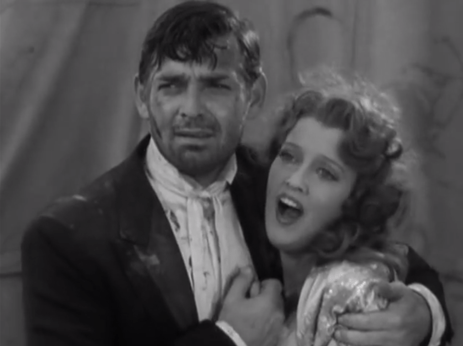
Although I must admit it’s rather strange that MacDonald belts out a few rallying lines triumphantly as Clark Gable holds onto her and he just walks forward silently. Somehow it lacks camaraderie. It was as if he was implicitly saying, “You can sing but you won’t get me to do it in a million years.” However, don’t let this completely detract from the moment.

3.5/5 Stars