Tarzan The Ape Man (1932)

tarzan the ape man 1Despite being dated and marred by the imprint of imperialism, this initial entry of the well-remembered Tarzan serial of the 1930s and 4os, based on the works of Edgar Rice Boroughs, is a surprisingly gripping pre-code tale of perilous adventure.

It feels a bit like a jungle cruise, a big game hunting African safari and a bit of Gunga Din all rolled into one. And it has many of those exotic adventure elements, set in the Jungles of Africa (though filmed in Florida, near Toluca Lake in Los Angeles, and on the MGM backlot). Perhaps it’s not Heart of Darkness, but buried in there somewhere is a great deal of commentary about that time and place. In fact, it doesn’t just bring to mind the work of Conrad but other Anglos like Rudyard Kipling, a staunch proponent of the prevailing philosophy of the White Man’s Burden. However, at least this film’s adventure makes no pretense as a mission of mercy. The expedition led by one James Parker (C. Aubrey Smith) is interested in the procurement of ivory pure and simple.

Political undertones aside, Tarzan The Ape Man is stirring good fun in the same vein as King Kong and other thrilling adventure dramas of the 1930s. It boasts treacherous mountain cliffs, murky depths full of hippopotamus and crocodiles and numerous tribes of natives residing in the dark recesses of the countryside.

But if those were the only draw of Tarzan, it seems that this film too would have faded into oblivion for its rather antiquated portrayal of a bygone era. But then we hear the first notes of the unmistakable, piercing cry of the ape-man.  That iconic sound that introduces us to the famed jungle hero is the stuff of legend and rather like the famed Wilhelm Scream years later, it’s taken on a life of its own.

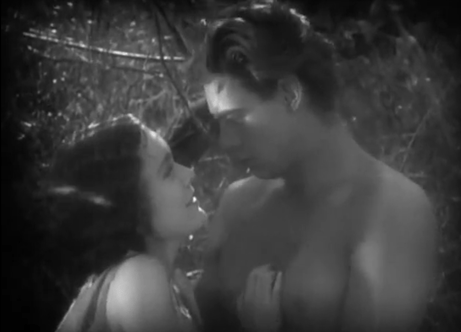
tarzan the ape man 2Furthermore, Johnny Weissmuller is not even the first Tarzan (purportedly the sixth incarnation) but he outshines all his predecessors who have been lost to history. It helped that he remains one of the most iconic Olympians and American swimmers of the 20th century, winning 5 Gold Medals. And he shows his prowess not only swinging from the treetops but in his true element,  gliding through the water.

Maureen O’Sullivan displays a certain amount of pluckiness while at the same time being feminine and fearful. Tarzan at first is a creature to be feared but she soon learns to trust him as he fights jaguars, lions,  and even apes to keep her safe. There’s the question of whether or not Jane Parker suffers from Stockholm Syndrome after spending so much time with this savage jungle man. But over time it does become apparent that she truly does love this chiseled man who is still much more naive and innocent than anyone she has ever known.

Back projections always make me cringe, still, the complete lack of CGI always brings a smile to my face. The elephants, lions, and tigers more often than not are the real thing and the scenes benefit from that, despite other instances that do look decidedly fake. More often than not those small details become overshadowed by the more impressive ones, namely the scenes of the elephants rampaging through the village or Tarzan duking it out with a few lions, despite his injuries. There’s something almost unsettling yet thrilling about it all for the simple assurance we have that it is essentially “real.”

But the final question remains, What’s worse, the black face and portrayal of the colonist tendencies (which were still a present reality) in this film or the modern Disney adaptation’s complete removal of any African characters. Either way, both are important talking points and, in both cases, Tarzan remains a perennially enjoyable hero, no matter the problems that still swirl around him.

3.5/5 Stars


The Father of the Bride (1950)

FatheroftheBride1950I’ve seen both versions of Father of the Bride and Steve Martin is fine and dandy but there is no better lovable curmudgeon than Spencer Tracy and he dons the role of the protective and skeptical father so effortlessly.

Furthermore, all down the line this production is an impressive gathering of talent with a radiantly young Elizabeth Taylor embodying the role of Kay, Joan Bennett leaving behind femme fatale roles for that of the level-headed mother and, of course, Vincente Minnelli positioned behind the camera. All in all, it’s a delightful light comedy that also finds time to say something heartfelt about the relationships of parents and their children, especially between fathers and daughters.

It’s rather like sitting back for story time as Tracy struggles with his shoes and begins to regale us with the recent happenings — the events that left his stately home looking like a hurricane disaster zone. It was all as a result of his daughter’s wedding. The event that is bound to challenge his sanity and bankrupt him in the process. But it’s for his “Kitten” so he’s willing to go through it out of his unwavering love for her.

First, he’s dubious of his future son-in-law, cringing at the thought as he shuffles through his memories of Kay’s many beaus. In his estimation, none of them was a winner, but then again, no one is good enough for his daughter. He’s not too excited about giving his daughter away nor by the prospect of supporting her good for nothing husband either. I’m sure most every father has the same conundrum to wrestle with. And it’s important to note that it’s played for comedic effect but never in a way that belittles these characters.

Minnelli was always a master of the color medium but here he still takes on the important role guiding us through the comedic moments with a deft touch and allowing us to track with the mayhem at large when necessary.

There are also some wonderful spots for veteran supporting players like the overly stuffy wedding coordinator Leo G. Carroll and the charmingly enthusiastic Melville Cooper as he guides the wedding rehearsal with a chaotic vigor.  Then, of course, there’s the prospective groom Buckley, played by the always affable everyman Don Taylor.

But everything must return to Tracy and Taylor because they are the nucleus of the storyline and as such, they work well together. Admittedly, Taylor might feel slightly out of place in such a family, but she is Elizabeth Taylor and she’s captivating all the same. Putting her together with Tracy means a lot of poignant sequences. Those moments where he comforts her, encourages her over a midnight snack at the dining room table, and finally, willingly gives her up to the man she has chosen to have and to hold for the rest of her life. To its credit, the film strikes a fine balance between comedy and heart always returning to this father-daughter relationship.

3.5/5 Stars

Random Harvest (1942)

220px-Random-harvest-1942There’s not a mean bone in Ronald Colman’s body. He’s the perfect gentleman and Greer Garson is his perfect counterpart. Theirs is the story of Paula Ridgeway and Smithy, or Charles Rainier and Margaret Hanson, or closer yet, both of these stories together. But there’s need for some explanation.

A man (Colman) returned from the great war with no memory to speak of, barely able to talk, and no family to vouch for him. His life is one of isolation in an asylum. Until the day he escapes and happens to run into Paula (Garson), a compassionate stage performer who never lets him alone again. She sees it in his eyes that he’s a good man, and watches over him rather like a guardian angel. His war injuries inhibit his speech, but Paula’s vibrant personality is the best possible therapy he could ever receive. She brings him out of his shell, making him feel like a man again. Marriage comes soon after and they are deliriously happy with a child on the way soon enough.

Then comes the fateful day that “Smithy” visits Liverpool to inquire about a new job. But a street accident leaves him shook up once more, and this time around he has no recollection of his last 3 years of life. Paula is forgotten and all he can recall are the trenches and his old family name, Charles Rainier. His relatives are all in a hubbub upon his arrival with his young step-niece Kitty (Susan Peters) taking an especially great interest in her uncle. He tries his hand in the family business and finds himself very handy at the work while young Kitty continues to correspond with him as she goes through school. She pleads and coaxes him to marry her, and since he is genuinely fond of her, he agrees. It seems like ages since we’ve thought of Paula, but this is the true tipping point of the film.However, at the last minute, Kitty calls off the marriage realizing it was always a dream. It would never work out.

In this stage of his life, Ronald begins to confide in his secretary who is strikingly familiar to the audience. But he has no idea who she might be,  except for Ms. Hanson, a highly competent, very beautiful woman. She doesn’t dare reveal her identity but here lies the portion of the film that tugs at the audience’s heartstrings. Paula or Margaret (whatever you want to call her) is caught in such a delicate and maddening predicament. She wonders if her love even has the capacity for happiness now. There’s little hope of getting out of this cycle, and yet as we would surmise from the very beginning, love wins out.

This film hinges on these faint wisps of memories and near deja vu moments that Rainer encounters. They are what separate him mentally from the love of his life who he isn’t even capable of knowing anymore. Their tragedy is not of their own doing or even due to human depravity. It is fateful circumstances outside of their control that keeps them apart, reminding us that oftentimes the world is unjust for no apparent reason.

Ronald Colman is always a wonderfully restrained actor who nevertheless is a pleasant lead. He’s even more muted here, and it works beautifully in juxtaposition with the vivacious energy of Greer Garson. In her own right, Garson is photographed in such a way that is so pure and unblemished with softened features that captivate the screen with true Hollywood glamour.

You can easily toss around words like sentimentality or schmaltz with a love story like this, but sometimes it’s better to let all the emotions of the film pervade your mind and overwhelm your senses. It’s an easy film to give in to and an easy film to forgive, because it’s main players are generally so likable. If modern actors tried their hand at such a masquerade, more likely than not, we would scoff at their attempt and then throw them out with not so much as a second glance.

But not so with Ronald Colman and Greer Garson. It’s not a waste of time giving them a couple hours because in that time they make us believe in love. True, it is an over-trod cliche, but in a cynical world that edges more and more towards a worldview of self-preservation and pessimism, maybe Random Harvest is what we need. It undoubtedly pumped invigorating life into wartime viewers and if you give it a chance, it can do the same today.

4/5 Stars

Review: Shop Around the Corner (1940)

Shop-Around-the-CornerA quaint, unassuming film, especially up against other more lavish Ernst Lubitsch works like Trouble in Paradise and Heaven can WaitShop Around the Corner still manages to be in the upper crust of romantic comedies — even to this day.
The story revolves around a little shop in Budapest run by the often curmudgeon and excitable owner Mr. Matuchek (Frank Morgan). Every morning he comes to open up shop and nearly every day he has something to complain about whether it’s his workers or the lack of business. His right-hand man is Alfred Kralik (James Stewart) who has been a diligent clerk in the store for well nigh nine years now.

He confides in his older colleague and friend Mr. Pirovich (Felix Bressart) that he has begun correspondence with a mysterious lady friend who was looking for a partner with whom to discuss culture and all the higher forms of art. Kralik is intrigued as he wants to expand his mind and he seems to have found his perfect match.

Meanwhile, the status quo gets shook up a bit when a Ms. Novak comes into the shop. At first, she gives off the sense of a flustered shopper, but in a matter of moments, she proves herself as a shop girl, acquiring a position even without a vacancy.

Over time, his relationship with Ms. Novak becomes increasingly more antagonistic, to begin with, because she wears a blouse unsuitable for the workplace. The prospect of his first meeting with his secret correspondent has Kralik on edge in expectation, but when he cannot sneak a peak, Pirovich looks for him and delivers a stunning revelation. It is, of course, Ms. Novak.

In such a way the dramatic irony begins as Kralik understands just who this girl is, and she continues to brush him off as the stiff, bowlegged man from the shop around the corner. Mr. Matuchek has unspoken problems of his own that cause him to abruptly fire Kralik, his most faithful counterpart. But their relationship is patched up and the crackerjack clerk gets his position back and then some.

There’s still the matter of Ms. Novak because he truly does feel something for her, even showing up at her home to see how she is getting on after calling in sick. It’s in this moment that she reads one of the letters in front of him. One of his letters.

Then, right before Christmas everything his bustling and busy in the little shop. All seems right as Mr. Matuchek is in good spirits with a Scrooge-like transformation for the holidays. He even winds up with someone to share a festive holiday meal with. It seems that Kralik has a fiancee and so does Ms. Novak. As it is Christmas they both try to leave the other on a positive note, and Klara goes so far as to mention her initial crush on her colleague. This then becomes the critical moment for Kralik as he still knows something she doesn’t. He frightens her stiff about her mystery man and then reveals him to be her pen pal. All it takes is a carnation in the lapel. She gets it right then. They embrace and share a kiss.

Although Stewart is far from a Hungarian clerk, he does exude a pleasant commonness, better than any other actor of his era. As such, he has the perfect demeanor and presence to portray Kralik, a man who seems altogether ordinary, although he certainly is more than meets the eye. Margaret Sullavan seems a generally forgotten leading lady, but there is an airy, almost ethereal quality to her. In real life, she proved to be difficult at times, but here she somehow fits rather remarkably with Stewart. The two leads prove to be adept sparring partners in Lubitsch’s altogether effortless romantic comedy.  It truly reconciles the lines between ideals and reality which allow two people, such as these, to fall in love for real.

4.5/5 Stars

Klara Novak: All my knowledge came from books, and I’d just finished a novel about a glamorous French actress from the Comedie Francaise. That’s the theater in France. When she wanted to arouse a man’s interest, she treated him like a dog.

Kralik: Yes, well, you treated me like a dog.

Klara Novak: Yes, but intead of licking my hand you barked.


Review: North By Northwest (1959)

1024px-North_by_Northwest_movie_trailer_screenshot_(6)Wedged between two landmark Hitchcock films in Vertigo (1958) and Psycho (1960), North by Northwest is iconic in its own right, but it boasts sprawling adventure and a bit of a lighter tone. It’s rather like Teddy Roosevelt wedged in between Jefferson and Lincoln on Mt. Rushmore but that comes later.

Supposedly the film was once to be called In Lincoln’s Nose, but when the now famous slanted North by Northwest logo hits the screen you instantly know you’re in for something extraordinary. The title sequence is wonderfully exciting given a boost by yet another impeccable score from Bernard Hermann.

This film is once again beautifully shot in color (VistaVision), but it covers more ground than Vertigo and has far more elaborate set pieces. The action begins ordinarily enough at an office building where advertising man Roger O. Thornhill (Cary Grant) makes his way out of the office. It’s a busy day at the office, but Roger has a dinner engagement and an evening at the theater to look forward to. His plans and his whole life are put on hold after he fatefully flags down a waiter.

His actions don’t go unnoticed and two menacing men lead him off at gunpoint as he tries to head to a phone. He is utterly confused, but we know it has something to do with the name George Caplan. These men think that’s who he is, and not to be persuaded otherwise, they take him to their leader (James Mason), who is very interested to meet him. Over the course of a harrowing evening, Thornhill is left on the edge of the road in a completely drunken state to die. But instead he gets brought in on a drunk driving charge and of course, no one will believe his cockamamie story, even his skeptical mother (Jesse Royce Landis).

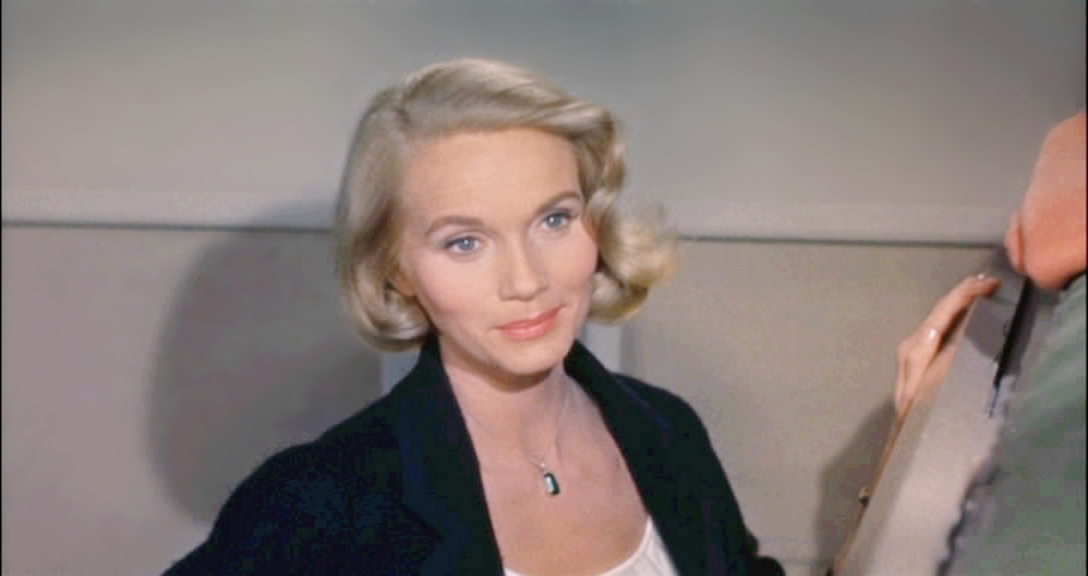
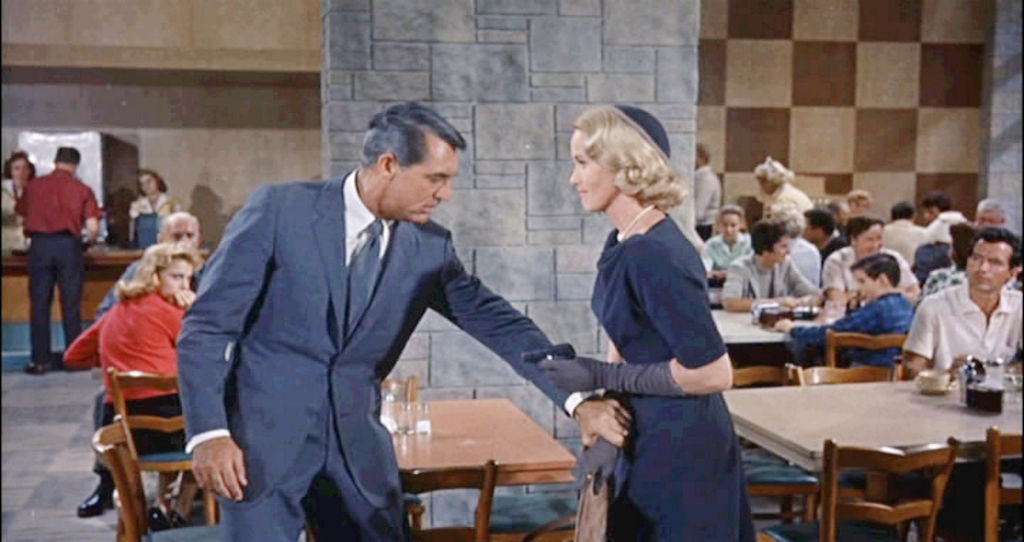
North_by_Northwest_movie_trailer_screenshot_(21)Next, it’s onto the U.N. Building to find out who Lester Townsend is, but of course, his captors are on his trail and just like that Thornhill is framed for murder and a fugitive on the run from the thugs and the cops. He tries to get away train ticket out of town, but in order to evade the law he ducks onto a train and meets the pretty blonde Eve Kendall (Eva Marie Sainte), who extends a favor. Little does he know what her angle is. Right now all he cares about is a little tete a tete and perhaps an amorous evening.

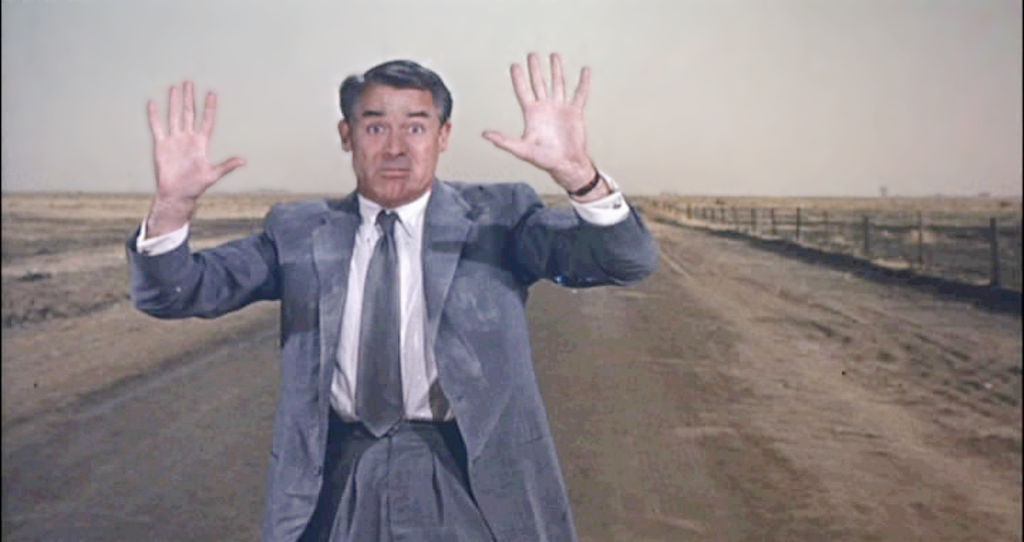
Kendall wistfully sends her new lover off to meet Caplan. Instead, he is met by a bi-plane and once again running for his life. But the build-up of this now iconic scene is wonderful. Hitchcock utilizes his background in silents to allow the scene to progress without hardly any dialogue and it unfolds ominously. However, he proves that even on an isolated roadside stop danger can still be present. Thornhill has new opinions of Kendall now and continues following the trail of Caplan which leads him to his old nemesis (Mason) and wouldn’t you know, Eve is by his side.

North_by_Northwest_movie_trailer_screenshot_(31)Roger feels like he has everything figured out, but he gets a visit from the mysterious Professor (Leo G. Carroll), who helps straighten him out with all the business surrounding the elusive George Caplan. With this new insight, Roger goes to the Professor to Rapid City and the one and only Mount Rushmore. It’s the perfect spot for a Hitchcockian finale to satisfy the director’s flair for the thematic.

North By Northwest is fun because we get to be right alongside Grant when he gets caught up in the whole mess. Although we see the picture a little more clearly than him, all the details are not handed over to us. So in a sense Hitch lets us in on a few secrets without showing us his entire hand. The staging is also wonderful whether it is the U.N. Building (with that marvelous aerial shot), or desolate Bakersfield, and even the soundstage set up to look like the surrounding area of Mt. Rushmore. It’s such a contrast to Rear Window and it uses the scenery very effectively similar to Vertigo.

Ernest Lehman’s script simply put is a lot of fun, because we have our villains, we have our romantic leads having a lot of great scenes together, and the pacing is surprisingly good. I am amazed how spry Cary Grant looks for his age (especially compared to aging Jimmy Stewart). Eva Marie Saint is great and in my estimation, she is the second-best Hitchcock Blonde following Grace Kelly, but you can easily disagree. James Mason plays yet another debonair villain and there are a handful of fun appearances by the likes of Martin Landau and Edward Platt.

One reason I’m constantly drawn to this film is that it feels rather like a road trip as we slowly cross the continental United States with Cary Grant. Furthermore, it’s simply good, unadulterated fun. There’s not a ton of analysis or commentary to mull over or to think deeply about (maybe some implications to the Cold War). But I’m content to sit back and watch with glee as a crop duster nearly clotheslines Cary Grant. Movies don’t get much better than this, seriously.

5/5 Stars

Review: A Night at the Opera (1935)

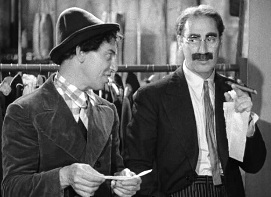
ANATOcontract“That’s in every contract, that’s what you call a sanity clause.” – Groucho

“You can’t a fool a me there ain’t no sanity clause” – Chico

The Marx Brothers had a set formula, where everyone else played the drama straight and they did whatever they wanted. So essentially there is no formula, lending itself to the anarchic comedy that they will be forever known for. However, if you put A Night at the Opera up against there earlier work at Paramount (this was their first film with MGM), you can see some important changes. Wunderkind Irving Thalberg wanted to give their films a more concrete plot line and in an effort to make them more sympathetic figures, all their antics were aimed at obvious “villains,” while they helped those who needed help. In this case, it was the aspiring opera star Rosa (Kitty Carlisle) and her beau Ricardo (Allan Jones), who get a helping hand from the boys.

This restructuring worked out because although the film plays out dramatically under the direction of Sam Wood, the Marx Brothers are still up to their old tricks, pulling off the same stunts that they used to. In fact, A Night at the Opera would be a very boring operatic drama by itself. Some of the interludes including song and dance are rather dull even in their extravagance. But Chico, Harpo, and Groucho inject the film with their brand of comedy that is difficult to top.

Groucho’s quips are aimed once more at the oft-abused Margaret Dumont. And then Harpo and Chico help befuddle the conceited opera star Lasparri, an Opera Company magnate (Sig Ruman), and the police among others.

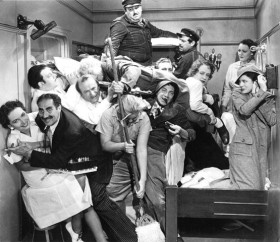
ANightattheOperaStateroomThe film borrows the stowaway storyline from Monkey Business (1931) so the brothers and their friend  Ricardo can follow the opera to New York. This lends itself to the now iconic stateroom scene where a total of 15 individuals are crammed together into Groucho’s tiny ocean liner abode.

Earlier on Chico and Groucho have fun drawing up and ripping apart a contract for their new partnership (including the famed Sanity Clause at the end). It ends up that the three fugitives are on the run from the authorities and Groucho is thrown out of his job finally.

But everything culminates at the opening performance at the opera and the Brothers are in high form. Chico and Harpo invade the orchestra pit, insert “Take Me Out the Ballgame” into the arrangement, and join the cast as a pair of gypsies. Meanwhile, Groucho delivers his usual quips from the box above, much to the dismay of all the patrons. To top it off, Harpo goes swinging up above the performance making a shambles of Lasparri’s big night, and Rosa and Ricardo are able to win over the audience. But it goes without saying, it’s the Marx Brother’s who steal the show. Groucho is as rude as ever. Harpo is always ready to knock someone out, and Chico is just waiting to join in on the ruckus. It’s comic mayhem at its apex.

4.5/5 Stars

Review: The Philadelphia Story (1940)

philadelphiastory1If there ever was a benchmark for the sophisticated, high-society brand of comedy, The Philadelphia Story is most certainly it. It’s less screwball because instead of Howard Hawks, George Cukor takes the helm and injects the film with his more refined sensibilities. It’s still very much hilarious and impeccably witty, but it’s not quite as scatterbrained as it could have been. Once more you have the iconic pairing of Cary Grant with Katharine Hepburn. Previously they had been in two other Cukor pictures (Sylvia Scarlett and Holiday) and of course Hawks’ romp Bringing up Baby. However, this time they’re joined by another cinematic titan in James Stewart and it proves to be a wonderful battle for command of the screen. The story ends up being a wonderful clash of classes and culture that also manages to illuminate a few bits and pieces of truth.

C.K. Dexter Haven (Cary Grant) had it out rather acrimoniously with his wife Tracy Lord (Katharine Hepburn) and now two years down the line, she is set to marry someone else. She couldn’t be happier to be rid of him and all his faults. Her new husband is a real “man of the people,” the wooden George Kittredge (John Howard), and he got his money doing an honest day’s work. In other words, he’s everything Haven isn’t when it comes to class and manners, but he’s also quite different than Tracy. But she doesn’t seem to mind. She’s on cloud nine to be rid of Haven.

Although Cary Grant does take a back seat at times, it’s only so he can manipulate and connive in the background, because he most certainly has an agenda. It’s great fun to watch. First, he brings in the folks from Spy magazine to do a full spread on the big wedding. There’s belligerent journalist Macaulay Connor (James Stewart) scoffing at all the opulence around him and then photographer Ms. Eilzabeth Imbre (Ruth Hussey), who has something complicated going on with her colleague.

They’re all here because the editor of Spy has a nice juicy expose piece on Tracy’s father and so C.K. advises her to go along with it. She suspects her old spouse has something to do with it, and it’s true, he didn’t put up much a protest when it came to taking part. However, Tracy’s not ready to let him ruin what she’s got going. She and her younger sister the crack-up Dinah (Virginia Weidler), put on a good show of upper-class snobbery to utterly bewilder their guests.

The funny thing is that while Tracy detests C.K. with the vehemence of the plague, her mother and sister quickly welcome the old gentleman back into their home with open arms. After all, what kind of trouble could he cause a couple days before the wedding, and Dinah is always game for a little chaos. She and C.K. have a mutual affection for each other. They’re both serial troublemakers.

After the surprise of Dexter wears off, the next person Tracy clashes horns with is the brusque newsman Connor, who is as turned off by her as she is annoyed by him. As she sees it, he’s invading her house as part of the paper’s plan to make her life miserable and steal away all her privacy. For him, she’s a stuck-up brat, who has had everything served to her on a silver platter in the west drawing-room. He thumbs his nose at the whole set-up. But a chance encounter at the library no less opens up a different side to these characters. Mike Connor is actually an accomplished poet far more skilled than his lousy journalistic pursuits would suggest. He learns just how perfectly imperfect she is.

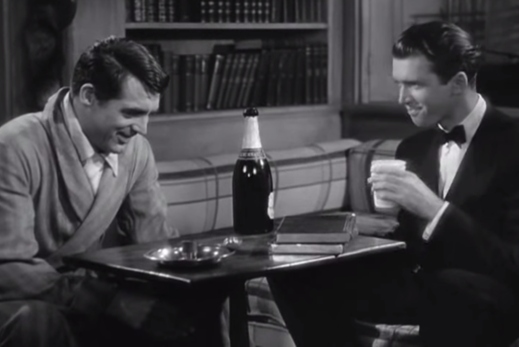
philadelphiastory2It’s at a party the night before the big day that things get particularly interesting. A lot happens when you fill people up with a little bubbly, some wine, and some early morning gaiety. Tracy is absolutely swimming in exuberance partially thanks to alcohol, partially because of the dancing, and maybe in expectancy of tomorrow’s high. But when things come a little loose around the edges, things happen that you regret. As it turns out Tracy doesn’t remember quite what happened that night, but Dinah saw all the good parts from her balcony. It involved a drunken Mike taking a jaunt to Dexter’s home at a godforsaken hour followed by Ms. Imbrie with an inebriated Tracy in tow. What this sets up is a wonderful little sequence where a hiccuping Stewart helps Grant orchestrate a plot to get back at Spy magazine editor Sidney Kidd. Then, Connor gets to spend the wee hours of the morning rambling on and on. It’s innocent enough, but quite the evening no less. It makes Kittridge quite distraught finding his bride to be in the arms of a man who is singing “Somewhere Over the Rainbow.” And of course, with such an unfortunate moment so close to the wedding it looks like things will be called off. But Kittridge is willing to make amends. It’s Tracy who realizes she has to break things off because ironically this man is too good for her.

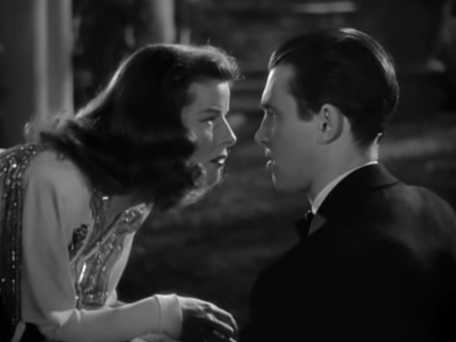
philadelphiastory3It looks like Haven has won, but in a split second Connor is proposing marriage and ready to tie the knot with Tracy to save the wedding. Once again Tracy makes a sagacious decision (which is surprising given her earlier condition). Hangovers on your wedding day are not usually a good thing. In this moment everything falls back into place as it should and as we want it to. These are characters that we grow to care about, despite their misgivings and class differences.

When reading up on this film I was astounded to hear that the film supposedly had no outtakes. Everything we see was as it was when it was first shot and that has to be a testament to the strength of these actors and maybe a little luck. It’s true that the film sometimes enters territory that feels unscripted and loose. That’s when it really gets fun. Stewart and Hepburn. Grant throwing a quick retort here and there. Imagine, this could have been a vehicle for Hepburn paired with Clark Gable and Spencer Tracy. I’m sure that would have been great, but the whole dynamic would be very different.

So who is the winner in this film? Grant as C.K. Dexter Haven? Hepburn as “Red?” Stewart as the “Professor?” The Philadelphia Story is a real winner for the audience. What more could you want in terms of high-brow comedy bursting with legendary star power?

5/5 Stars

Libeled Lady (1936)

Poster_-_Libeled_Lady_01Libeled Lady has screwball comedy written all over it and that’s perfectly alright with such a glorious cast. Myrna Loy and William Powell reunite once again (for one of their 13 pairings), but we also get Jean Harlow and Spencer Tracy. Amazing!

The set-up is easy and pretty self-explanatory. Warren Haggerty (Tracy) is the managing editor of the New York Evening Star, but while he is reluctantly getting ready to walk down the aisle, he gets the horrific news that the paper sent out a misinformed scoop by mistake. Now Haggerty is faced with a $5,000,000 libel suit from wealthy socialite Connie Allenbury (Loy), and it brings his weddings proceedings to a halt, much to the chagrin of his peeved fiancee (Harlow). This isn’t the first time that their big day has been postponed after all.

Stuck between a rock and a hard place, he goes to one of his former reporters, Bill Chandler (Powell), who really rubs Haggerty the wrong way, but he also happens to be a whiz when it comes to libel. He’s the only man who can get the paper out of the major jam so he leverages his position. Things go down like this. Chandler will ingratiate himself to Ms. Allenby and soon afterward Gladys Benton (Harlow) posing as his wife, will rush in on them. Presto! The suit will be dropped. Simple, right?

It’s the consequences that get even dicier. At first, Gladys absolutely despises being cooped up in a hotel with Chandler and she’s still fed up with Warren. But over time, the close quarters cause Chandler to grow on her. Meanwhile, Chandler tries to learn everything he can about angling, to charm Allenby’s father (Walter Connolly), who is a fishing aficionado.

From the start, his daughter has Chandler pinned as a fake (which of course he is), but by some act of heaven his act actually works and he wins them both over. Worse, Connie is falling for him and he’s reciprocating, but Haggerty is still waiting for the plan to be executed. Gladys is waiting impatiently for her “husband” who she seems to genuinely miss. It’s all a big mess to be sure.

The finale involves the four leads together for one final climactic barrage of pandemonium and spouse swapping. As you would expect everyone ends up with the right partner, but it was sheer craziness to get there. It had been a while since I had seen a screwball, and Libeled Lady is a striking reminder why the genre is so fun. It had me laughing pretty hard whether it was the utter absurdity of the fishing sequence or any of the other madcap moments. It boasts quite the cast too. It’s crazy to think that in only a year Jean Harlow would be gone, a short but vibrant career behind her.

4/5 Stars

Dinner at Eight (1933)

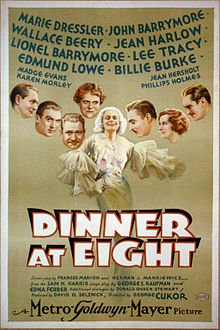
220px-Dinner_at_Eight_cph.3b52734Dinner at Eight is another all-star slug fest from MGM meant to capitalize and top the success of Grand Hotel from the previous year. This time around, well to do wife, Millicent Jordan is setting up a charming dinner party for a wealthy English couple Lord and Lady Ferncliffe who are traveling to New York. The hostess is frantically trying to figure out dinner guests for the big occasion because everything must be perfect. Observant viewers will notice that the high strung lady of the house is played by Billy Burke (more widely known as the Good Witch Glenda). Her husband Louis (Lionel Barrymore) is a kindly shipping magnate, who was hit hard by the depression, and his health is also failing as a result. Their daughter has problems of her own since she does not really love her fiancee and has fallen for the much older, and washed-up alcoholic actor Larry Renault (John Barrymore).

Next on the list of probable invitees is Carlotta Vance (Marie Dressler), the formerly prominent actress, who is now still in the twilight years of her career, but she still carries on a lavish lifestyle with furs and all. She is old friends with Louis, and she is always ready and willing to reminisce, fish for compliments, and offer a little sage advice on the side. She’s a character we like.

The most dynamic pair is most certainly Wallace Beery and Jean Harlow. They play the gruff, crooked businessman and his equally feisty wife, Dan and Kitty Packard. They’re hardly together because he’s working and she’s buying up clothes and caught up in an affair. When the two of them finally are together in the same room, they are constantly at each other’s throats. No punches or barbs are spared. And yet on the invitation to the Jordan’s they both pull their act together. He wants to meet the highly prestigious Ferncliffes, and she wants a chance to get dressed up. They’re quite the match.

With a title like Dinner at Eight, you expect the drama to take place around the table with the guests all seated together. However, that would be rather stuffy, I suppose, and instead, the dinner only acts as the culminating event to push the plot along. We actually never see the guests at the table, only the action leading up to it. Millicent is in a tizzy, especially when she hears the Ferncliffes have a change of plans. Her husband’s health is slowly deteriorating at the same rate as his company. The arrogant actor Larry Renault bickers with his agent about his next role. Honestly, this was the most unsatisfying of the threads, and it did ultimately end in tragedy. However, I’d be interested to know how close this parody actually came to John Barrymore’s actual life, because sometimes it’s hard to know how to parse the fiction from the reality when they seem to overlap.

Once all the guests are assembled it’s a rather ragtag group, but it is a fun mix of characters, and Millicent gets her cousin Hattie to attend along with her Garbo-loving husband who is unenthusiastic about the whole affair. It’s a satisfying overall result and an enjoyable enough ensemble that George Cukor directs with relative ease.

4/5 Stars

Grand Hotel (1932)

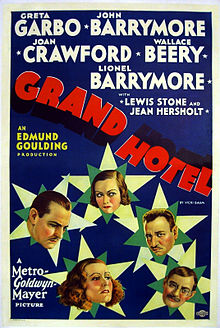
GrandHotelFilmPosterGrand Hotel is the epitome of a Hollywood superstar ensemble, and it would set the bar for all the films that would try to imitate and surpass it. Thanks to Irving Thalberg and the studio with more stars than there are in the heavens, MGM delivered a film that was a smash hit and after well over 80 years, it still remains an important visual relic.

The cast was beyond a contemporary viewer’s wildest dreams. It was that good. You had Greta Garbo, John Barrymore, Joan Crawford, Lionel Barrymore, and Wallace Beery among others. Nowadays many of these names do not carry as much clout (I must admit even to me), and the idea of a film starring numerous big names seems almost mundane. Just take a look at Oceans Eleven or The Avengers. But we must understand that at that time it was a stroke of genius because usually only one or two stars were set aside to be in a certain film. It was seen as the most commercially viable philosophy at the time.

Then came Grand Hotel: As Dr. Otternschlag (Lewis Stone)  muses it’s “always the same. People come, people go. Nothing ever happens.” It’s counter-intuitive but in some ways, that’s what makes this film so much fun. People love stories with fun vignettes that criss-cross and weave in and out. It’s even better when the stories contain the likes of Garbo and the Barrymores. Not to mention Joan Crawford.

It’s a fun world and a lasting tradition that many films have attempted to replicate because honestly, most audiences love these types of realities that they can escape to and in turn, be a part of. In this case, it’s this opulent hotel in the heart of Berlin full of bustling bellboys,  lavish suites, and all the pleasures life could afford.

Furthermore, the guests come from every walk of life imaginable making it all the more enjoyable to watch their intermingling and chance encounters. There is the prima ballerina (Greta Garbo), who has recently gotten cold feet and even canceled a show in her melancholy. It allows for Garbo to utter her famous line, “I want to be alone.”

Then there’s the baron (John Barrymore) who is also in desperate need of money. You might label him a cad because he resorts to theft several times, but if he is a thief he also has a heart of gold befriending and comforting nearly everyone he meets. He especially makes Ms. Grusinskaya very happy and it allows for some amorous scenes between John Barrymore and Garbo.

Next comes Mr. Kringelein (Lionel Barrymore) who is the lowest of all the individuals in the hotel, but since his imminent death is ahead, he is finally going to live a little and he finally gains some of the friends and respect that he has always wanted. On the other hand, Wallace Beery plays Preysing the big magnate who is trying to swing an important deal to keep his company afloat.  Mr. Kringelein is one of his nameless underlings who keeps his books. Preysing has little concern for the “little man,” until he is desperately in need of help.

Last, but not least, is a radiant and spry Joan Crawford as the stenographer. She’s far from the star, but she does seem to steal many of the scenes that she pops up in. Also, despite all the ups and downs, she gets the happy ending she deserves.

I must admit that Grand Hotel takes a little time to set the scene and pick up steam, but when it does it’s a lot of fun. You know it’s a special film when the two Barrymore brothers are acting together, playing two so very different individuals. Yet underlining every scene they share together is the indisputable fact that they are related.  You also have Garbo and Crawford in the same film without either sharing a scene with the other! For an updated take on this type of story give some attention to Wes Anderson’s Grand Budapest Hotel. Otherwise, this lavish 1930s production is worthwhile, because it really does feel like you’re watching film history.

4/5 Stars