
 It’s the bane of my literary existence, but I must admit that I have never read Joseph Heller’s seminal novel Catch-22. Please refrain from berating me right now, perhaps deservedly so, because at least I have acknowledged my ignorance. True, I can only take Mike Nichol’s adaptation at face value, but given this film, that still seems worthwhile. I’m not condoning my own failures, but this satirical anti-war film does have two feet to stand on.
It reads like a cast of millions: Alan Arkin, Martin Balsam, Richard Benjamin, Art Garfunkel, Jack Gilford, Buck Henry, Bob Newhart, Anthony Perkins, Paula Prentiss, Martin Sheen, Jon Voight, Bob Balaban, Peter Bonerz, Felice Orlandi, Jack Riley, Marcel Dalio, and even Orson Welles. And in truth, no one character disappoints, because no one character has to carry the brunt of this narrative.
Certainly, Yossarian (Alan Arkin), the disillusioned WWII bombardier, is our protagonist, but he needs people to react to and bounce off of. It’s the likes of Colonel Cathcart (Balsam) and Lt. Colonel Korn (screenwriter Buck Henry) his neurotic superiors and the pragmatic wheeler-dealer Milo Minderbender (Jon Voight) who make him that way.
Their world of bombing missions, valor, medals, and “The Syndicate” are utterly absurd just as they are, but they don’t seem to recognize it. That’s where the satire stems from, the critique of war, and all the wit. It seems like no coincidence that Mike Nichols released this film during the Vietnam Era. Like its compatriot, Robert Altman’s M*A*S*H, it finds a wickedly dark sense of humor in war. Because what is there to do with death and violence, but laugh and try to find some way to grapple with it?
 The Chaplain (Anthony Perkins) doesn’t feel like a man of the cloth at all, but a nervously subservient trying to carry out his duties. An agitated laundry officer (Bob Newhart) gets arbitrarily promoted to Squadron Commander, and he ducks out whenever duty calls. Finally, the Chief Surgeon (Jack Gilford) has no power to get Yossarian sent home because as he explains, Yossarian “would be crazy to fly more missions and sane if he didn’t, but if he was sane he’d have to fly them. If he flew them he was crazy and didn’t have to; but if he didn’t, he was sane and had to.” This is the mind-bending logic at the core of Catch-22, and it continues to manifest itself over and over again until it is simply too much. It’s a vicious cycle you can never beat.
In fact, each man involved must cope with their duties one way or another oftentimes through prostitution, jokes, or an obsessive almost numb commitment to duty. Yossarian tries all of the above rendezvousing with an Italian beauty and receiving a medal without any clothes on.
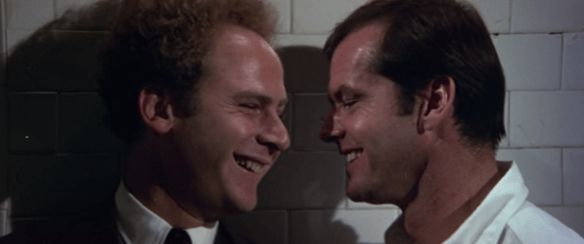
 But the tonal shift of Catch-22 is important to note because while it can remain absurdly funny for some time, there is a point of no return. Yossarian constantly relives the moments he watched his young comrade die, and Nately (Art Garfunkel) ends up being killed by his own side. It’s a haunting turn and by the second half, the film is almost hollow. But we are left with one giant aerial shot that quickly pulls away from a flailing Yossarian as he tries to feebly escape this insanity in a flimsy lifeboat headed for Sweden. It’s the final exclamation point in this farcical tale.
M*A*S*H certainly deserves a reevaluation, but Catch-22 just might be the best, or at least one of the best, anti-war films of the 1970s. Mike Nichols delivers once more with a wickedly funny indictment of global conflict using a classic of American literature for inspiration.
4/5 Stars
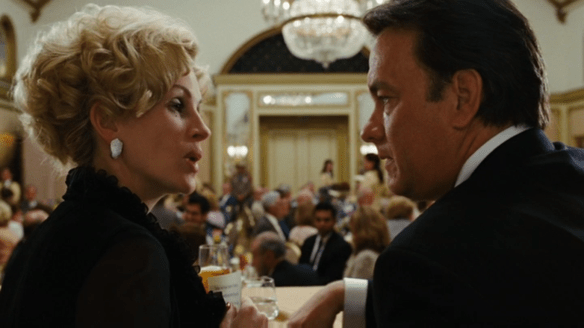 With Aaron Sorkin’s script as a road map, Charlie Wilson is a character that Mike Nichols can truly have fun with. You can easily see him getting an undue amount of delight in this man who was able to do such a momentous thing while simultaneously walking on the wild side. It had to be a good story to warrant the director’s cinematic swan song.
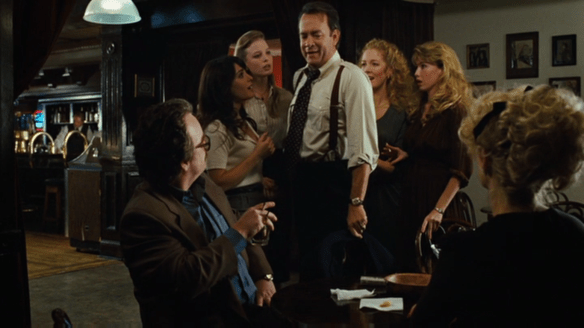 In the opening moments, it becomes obvious that Charlie Wilson is not so much an easily corruptible representative as he is a sexed-up man who enjoys charming female company. He’s “Good Time Charlie” for good reason. He surrounds himself with pretty young things, doesn’t mind playing around a bit, and even has a cocaine charge hanging over him after a potentially objectionable night in Vegas. In fact, the attorney looking into his case is, interestingly enough, one Rudy Giuliani.
 “If you had a choice would you either love a girl or have her love you?”
 “You’re living at home. Is that right?
 Then Mrs. Robinson coolly enters his life. It’s perhaps best signified when she tosses him the keys. They end up in the fish tank almost as if on purpose and after that she has him reeling for good. Soon he’s walking into the lion’s den (or lioness’s) as she expertly manipulates and elicits the precise response from him. In these moments the film is elevated by the awkward, huffing and puffing, and nervous chattering of Hoffman. We often forget the second part of his famed line, “Mrs. Robinson you’re trying to seduce me. Aren’t you?” His general naivete and hesitancy say it all.
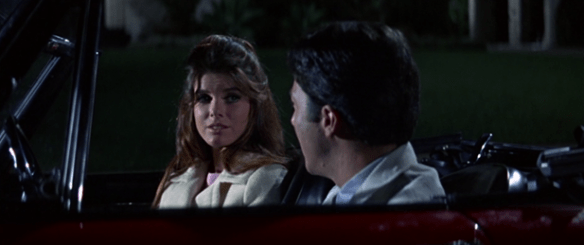 But when he meets Elaine Robinson and finally begins to connect with her on a peer-to-peer level, it’s something so profound to him. Having someone his own age that he can relate to, who feels the same unnamed apprehension and angst that strains on him. It’s what makes Ben become so mixed up. He has true feelings for her, while his affair with Mrs. Robinson only serves to poison all that could be good. And his illogical, unhealthy pursuit of Elaine continues to Berkeley where she is attending school. Still, Mrs. Robinson and her now estranged husband look to send their precious daughter far away from Benjamin Braddock.
 That’s what makes his final Herculean effort all the more climactic. He bursts in on her marriage to another man and whisks her off to another life altogether. A life that seems exciting at first, because, oh how great it is to be young and in love. But once they climb aboard that bus in their tattered garments, have a chance to sit down and really think about what they are embarking on, you see something else in their eyes. The laughter slowly dissipates and as they look around nervously, they begin to somber up. True, Ben is no longer alone in an airport terminal, he has a fellow traveler, but that does not make the future any less unpredictable or scary for that matter.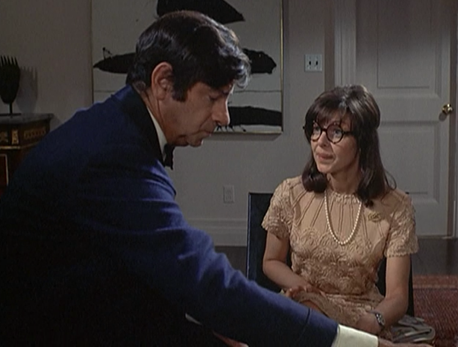

 may see this film as a comedy drama that is not in the category of great movies. However I feel if nothing else, The Graduate is culturally significant because it ushered in an age in the late 1960s where films focused on trying to attract younger audiences. Along with its good writing this film was one of the forerunners in using popular music in its soundtrack.
 4 Star Films