Review: Nashville (1975)

nashville3What to say about Robert Altman’s Nashville? It has a lot of songs and music so it’s technically a musical. It has its smattering politics and Altman is typically one for subverting the norm so you could call it a satire. There’s romance, drama, in-fighting, and star power certainly, but that hardly gets to the heart of the film.

In fact, Nashville has an ensemble bulging at the seams with 24 individuals billed in alphabetical order and their names called out at the beginning of the film as if someone is trying to sell us an album. It’s a little over the top, feels superficial, and it’s a little pretentious. Maybe the director’s trying to tell us something. Over the course of the following minutes, Altman gives us a picture of a few days in the life of the country music capital of the world, and he shows us all sorts of people.
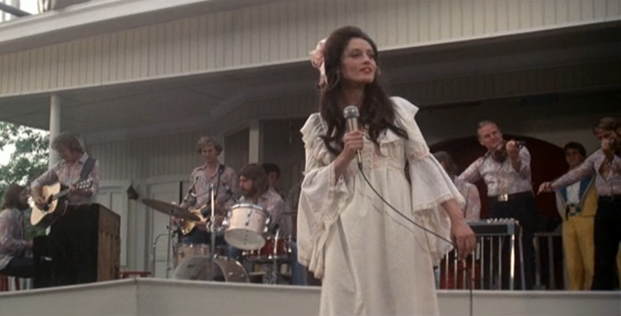
nashville1To name all of them would be tedious and would not give a whole lot of illumination as far as the plotting, but a few of the more prominent names are as follows: Barbara Jean, the sweetheart of Nashville, who opens the film receiving a warm welcome at the airport from her adoring public. But she is physically and emotionally fragile after recovering from a traumatic injury. Then there’s Haven Hamilton, who is an established country star, who still enjoys large popularity and political ambitions are on his radar. Jeff Goldblum, Lily Tomlin, Karen Black, Ned Beatty, and even Keenan Wynn all make appearances. So as you can see the cast is oozing through the cracks.

Their stories are constantly colliding, intertwining, and weaving in and out of each other. Making for a type of narrative that feels organic despite having a script. It feels like a realistic and truthful immersion into Tennessee reality. We even get appearances from a couple Altman regulars Elliot Gould and Julie Christie. Furthermore, it wasn’t much of a secret that the industry in Nashville did not take a liking to the film, but really is that any surprise?

Going into the film we already expect to get a look at the industry’s underbelly and we do, but it’s hardly seems sensationalized; it almost feels commonplace until the final moments. Singers griping, sleeping around, reporters ingratiating themselves to whoever they can find, and the general public coming from far and wide to be a part of the spectacle. It’s about what you expect from an industry that can be ruthless, superficial, and very rewarding to some. To those on the outside, it’s something to be fawned over.

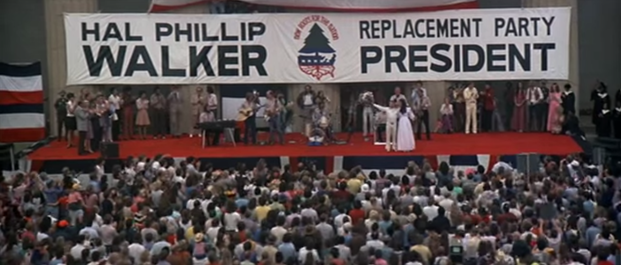
nashville2The story is framed with the political campaign of the unconventional Hal Philip Walker of the Replacement Party. You can see his van going all across town proclaiming his wisdom to the honest citizens of Nashville. Most of them could care less about politics. Even in the closing moments at a concert in the park with a big flag patriotically displayed on stage with a giant campaign banner underneath, you get the sense that no one has gone there for political reasons. They want to hear Barbara Jean, Haven Hamilton, and maybe tolerate anyone else who comes up on stage. In a sense, that’s the American way wrapped up in a nutshell.  Taken in that light, the way that Altman ends his film is not all that surprising. There has to be something to break up the normalcy. Subvert all that is good and patriotic. Throw a wrench in the every day, because after all his whole film has revealed everything that besmirches the industry. It’s just that it usually stays under the surface or is thrown away to be trampled on or forgotten. Take the no-talent Sueleen Gay, who stubbornly tries to make it in an industry that doesn’t want her.

I’m the first to acknowledge that I’m not much of a fan of country, except if it’s someone like Johnny Cash. So overall I find the tunes of Nashville to be homely and often tiresome, although I do appreciate the fact the actors wrote most of their own songs supposedly. The one exception I cite is Keith Carradine’s memorable tune “I’m Easy” which works as a simple ballad reminiscent of a Jim Croce-type singer-songwriter.

However, I don’t get hung up on Nashville‘s music too much, because this film represents so much more to me. It’s about the intermingling of people and the analysis and dissection of the relationships that are so closely entwined with the country music industry. Whether it’s the insiders or the fans who make them big, Nashville is a thoroughly interesting view of America circa 1975. Some things have certainly changed, fashion-related and otherwise, but I think we can all agree that a lot of things certainly have not. Politics, music, and most certainly people essentially exist as they always have.

4.5/5 Stars
Review: This is Spinal Tap (1984)

thisisspinal1Director Rob Reiner makes an appearance in his own film as documentarian Marty Di Bergi. It’s tongue in cheek, but no one seems to have told Spinal Tap or anyone else in the film for that matter. For all intent and purposes, they are a real band with a real camera crew following their every move. The lines between fiction and reality are very easily blurred, because Spinal Tap seems more legitimate than some bands that come together, with one original album attached to the film and two subsequent albums that followed. That’s the funny part, or maybe it’s sad, depending on how you see it. It mocks, it parodies, and it attempts for the overly-dramatic, and yet it doesn’t fall too far from the actual music industry.

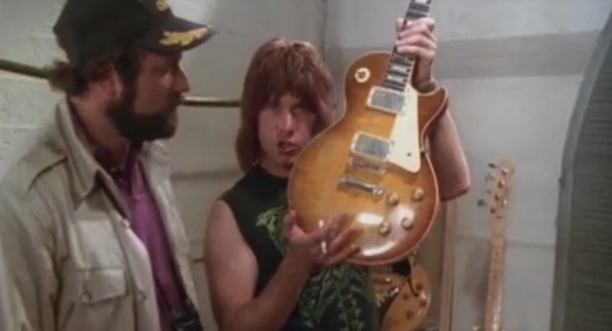
This mockumentary, rockumentary, or whatever you want to call it, follows Spinal Tap during their not-so-long-awaited tour in the States. Their trajectory mirrors all the great rock bands of their day and age. Right now they’re in the Zeppelin or Aerosmith stage, but led by their two founding members David St. Hubbins (Michael McKean) and Nigel Tufnel (Christopher Guest), they started a skiffle band back in Mother England. It was a humble beginning, with numerous arbitrary name changes, a hippy phase (much like the Beatles), and finally the genesis of their big-haired, hard rock 1980s persona. After all, their amps go up to eleven, one higher than the typical amplifier. They’ve cranked things up to new levels, but it doesn’t help that they’re album Smell the Glove is getting some negative backlash for its cover art.

What follows is a less than promising tour with failed autograph signings and malfunctioning props onstage. All the while, the immature musical nucleus of the band Nigel and David begin fighting. It feels very Lennon/McCartney and their Yoko Ono is David’s girlfriend Jeanine (June Chadwick). When their original manager quits in a huff, Jeanine steps in and things keep on going downhill. Bassist Derek Smalls (Harry Shearer) just seems like he’s along for the ride, and their most recent drummer is just happy he hasn’t met the unfortunate fate of spontaneous combusting like his predecessors. No one seems to care about the keyboardist Viv. Ain’t it the truth.

Then, the fateful day comes when the band splits up, or at least Nigel finally leaves having had enough of it all. But as they play second-bill to a puppet show at an amusement park in lovely Stockton, California, the boys realize they need Nigel back. Although the U.S. wasn’t too welcoming to them, they look to have a bright future in Japan with popular hits like “Sex Farm” “Big Bottom” and “Stonehenge.” They’re very popular over there, and of course, their amps still go up to eleven.

4/5 Stars

Inside Llewyn Davis (2013)

insidel2More often than not Llewyn Davis turns out to be a worthy character and I mean that in the sense that he is readily watchable. This probably isn’t the real folk scene of the 1960s, but it is the time and place seen through the Coen Brothers’ somber lens. Inspired by musician Dave Von Ronk, Llewyn is his own unique entity entirely. The film itself has a dreary look of washed out tones mimicking the days that most of us now know from black and white imagery. There are folk tunes wall to wall, befitting such a melancholy film, adding layers of melody and ambiance to this austere world of isolation.

In fact, we first meet Llewyn in a low lit bar singing the ode “Hang me, Oh hang me.” He’s not some budding talent or has-been. He had a partner once, who committed suicide by jumping off a bridge. They had a record that came and went out almost as fast. The unsold copies sit in a warehouse somewhere rotting away with the rats. That’s really Llewyn’s life. He’s couch hopping his way through Greenwich Village, a pitiful wanderer with the cat he was entrusted with in one hand and his guitar in the other. In the frigid winter air, he doesn’t even have a real overcoat. He can barely afford it.

insidel4The film goes so many places only to return to where it was. So much goes on without anything happening and so on. Llewyn has it out with Jean, a transformed and caustic Carey Mulligan, who doesn’t know who the father of her baby is. How it could ever be Llewyn’s doesn’t make much sense, since she seems to despise his guts. Why would she sleep with him?

Llewyn alienates his sister with his misanthropic outlook and foul mouth. He loses and tries to recover the cat of his folk-loving friends the Gorffeins. How they ever became friends we’ll never know. A spur of the moment trip to Chicago comes up and with it, there’s the token John Goodman performance that feels like an absurd aside to the entire plot. Then again, the film’s only plot is the wanderings of Davis, so if meeting passengers while hitchhiker marks his journey it seems pertinent.  A trip to the Gate of Horn for an impromptu audition turns out to be unfruitful and it is the film’s most difficult scene. Davis lays all his heart and soul out there in a poignant performance and all he gets from the producer Bud Grossman (F. Murray Abraham) is that he should join a trio. He’s not solo material.

insidel5Llewyn returns to Greenwich dejected and things continue going poorly for him. So we end up leaving him about where we started. Bob Dylan, Joni Mitchell, Joan Baez would come in time, but it’s the musicians like Davis that are a sadder tale. Those who faded away over the years. Who lay beat up in an alley for heckling a performance in a hole-in-the-wall bar. It’s the circle of life of a folk singer and you wonder if he would ever have it any other way. Undoubtedly this folk oasis was a more hopping, more welcoming place than the Coen’s painted it, but it does suggest something powerful.

Why would somebody subject themselves to this type of lifestyle? Unless they’re insane and like to suffer, it must be that they really believe in the music. They believe in bearing their heart and soul because the music makes them feel alive. Obviously, there is more to life than music, some would argue that point, but it is a brilliant starting point. We can respect someone who sticks by their convictions and their passions. Even if it means chasing through the streets of Greenwich Village looking for a cat. You would never see me doing that. Maybe if it were a dog. Maybe.

4/5 Stars

Once (2007)

once1Only sometime after the film ended did I come to the realization that we never learn the names of our two protagonists. And yet we build such a connection with them through music, through their bits of humanity, and from being a part of their lives for a short time. Because Once really does feel like a documentary. It feels like we’re meeting these people and peering into their lives for an hour an a half of sheer delight.

The guy (Glen Hansard) is an Irish street performer who can be found on the street corners, guitar case open, strumming away, hoping to get a buck or two. He’s good but nobody much seems to notice him. It’s as if people see you doing such a gig and think you must not be very important. I must admit I’m guilty of such a fallacy myself many a time.

But there is one person who does come up to him. It’s a girl (Marketa Irglova), very straightforward and direct, and we learn she is Czech. What could two such people have in common? Music. Of course. The universal language even more so than English. Because she obviously has an accent and he does too, to my American ears, but their music transcends cultures.

It’s easy to forget Once technically functions as a modern-day musical because more often than not the genre seems like a dying breed. The songs in this film are beautifully melodic, with wonderfully earnest lyrics, and equally well-wrought instrumentation. But it fits into the narrative and nothing feels like a forced plug to get our respect.

They’re laying it out there. Letting us into their homes and keeping all their feelings out in the open. Really they both have a humble existence, and each has had their own romantic pasts. He has memories of a love who now lives in London and despite her young age, the girl has a husband she left behind in her home country. It’s a surprise to him and the audience both.

once2Their ride on a motorcycle, for a brief instant, brought to mind the Vespa ride in Roman Holiday, although their excursion is a little less chaotic. There’s still an innate playfulness of people with wonderful chemistry and whether they are acting or not is anyone’s guess.

Everything goes back to the music though since that acts as the heart and soul of this story. When the pair of them are able to get a recording studio it looks like he might get his big chance. He invites her to sing because he really wants her to be a part of it. He rounds up a few more street musicians and they’re set. When they get to the recording studio and the tape starts rolling what follows is a performance bursting with passion and energy. You can feel the electricity.

It feels as if we’re on the ground floor of something special, unwinding right before our eyes and yet we don’t know exactly what is going to happen. He’s about to head off to London to show off his sample and perhaps catch up with an old flame. She is preparing to make amends with her husband. But before leaving the guy drops a very big present on her doorstep to thank her for all she’s done for him.

Their tune “Falling Slowly” plays in refrain summing up this music-infused love story. The question is, is this an actual love story? I would answer in the affirmative. There is no sex in the contemporary sense, but this film does most certainly have love, whether or not it becomes physical. And it acknowledges the clear distinction between sex and love. These are two people who deeply care about each other and share a connection more intimate than most people can manage.

4/5 Stars


Chariots of Fire (1981)

Chariots_of_Fire_beach“Now there are just two of us – young Aubrey Montague and myself – who can close our eyes and remember those few young men with hope in our hearts and wings on our heels.” ~ Lord Lindsay
I am hardly a world traveler but one of the places I fell in love with early on was the British Isles. London is a wonderful city with so many memorable landmarks from Big Ben to Buckingham Palace. Harry Potter to Sherlock Holmes. There are the Salisbury plains hosting the monolithic Stonehenge, and the Lake District which is undoubtedly some of the most beautiful country I have ever seen. No wonder Wordsworth and Blake were so enamored by it. However, St. Andrews Scotland has to be one of the most starkly beautiful places I have ever had the pleasure of visiting. It’s steeped in golf history due to the Old Course and despite being the home of a university, it is surrounded by a charmingly quaint town.

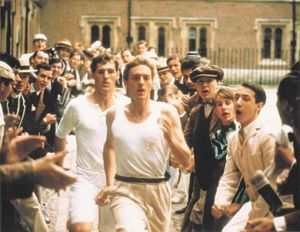
And of course, most pertinent to this discussion, its beaches became the perfect setting for the opening moments of the now iconic Chariots of Fire. Really it is so much more than its stellar theme by Vangelis because these sequences bookend a truly remarkable story. We enter the narrative in 1978 where two old men eulogize about the old days and their good friend Harold Abrahams who has recently passed.

Cross_and_HaversBack in the 1920s, a brash young Abrahams (Ben Cross) is about to enter university at Cambridge intent on becoming the greatest runner in the world, and taking on all the naysayers and discrimination head-on. He’s a Jew and faces the antisemitism thrown his way with defiance and a bit of arrogance. He’s a proud young man who loves to run, but more than that he loves to win. His best friend becomes Aubrey, a good-natured chap, who willingly lends a listening ear to all of Harold’s discontent. Soon enough Abraham’s makes a name for himself by breaking a longstanding record of 700 years, at the same time gaining a friend in the sprightly Lord Lindsay. Together the trio hopes to realize their dreams of running for their country in the Paris games of 1924. They are the generation after the Great War and with them rise the hopes and dreams of all those who came before them.
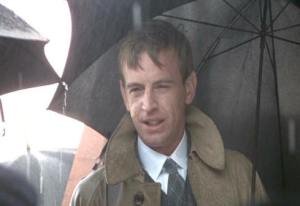
Charleson_as_LiddellSimultaneously we are introduced to Eric Liddell (Ian Charleston) a man from a very different walk of life. He’s a Scot through and through, although he grew up in China, the son of devout Christian missionaries. Everything in his life is for the glory of God, and he is a gifted runner, but in his eyes, it’s simply a gift from God (I believe God made me for a purpose, but he also made me fast. And when I run I feel His pleasure). His sister is worried about his preoccupation with this seemingly frivolous pastime, but Eric sees a chance at the Olympics as a bigger platform – a platform to use his God-given talent to glorify his maker while living out his faith. Abrahams is a disciplined competitor and he goes so far as to bring on respected coach Sam Mussabini (Ian Holm) to help his chances. Liddell is a pure thoroughbred with life pulsing through his veins, and of course, they must face off. It’s inevitable.
But this is only the beginning as all these men we have built a connection with travel across the sea for the Olympic Games grappling with their own anxieties and consciences. For Abrahams, it’s the prospect of failure and success. Failure will burn because his whole existence has always been about running — about winning. He has only a few seconds to justify his very existence. However, the fear of winning is almost greater, because at 24 years of age, where else is he supposed to go after winning a gold medal? It scares the life out of him. Liddell’s tribulation is of a different nature as he must stand true to his beliefs even if it seems to be sabotaging his own success. And of course, Aubrey and Lord Lindsay have their own successes and failures that run the spectrum. Perhaps most importantly these men prove their worth not only to their American opponents but the entire world. They can return home with their heads held high — champions of a feel-good tale to be sure.

Yes, this is a story about two strikingly different individuals, but Chariots of Fire becomes so engrossing due to all its characters. Aubrey resonates with me due to his general contentedness. Lindsay has an air of playful charm that is refreshing. Harold embodies my own hopes, fears, and anxieties. Eric reflects every person’s struggles with spirituality and personal conviction. In essence, the narrative goes back to the glory days to bring light to the universal and continual rise and fall of man. We’re far from perfect, but in spite of all our failures, there is still space for redemption.

The refrains of the theme music paired with William Blake’s majestic “Jerusalem” get me every time. I love being steeped in this atmospheric periodness and my heart yearns to be back in England so I can run on those very same beaches with wreckless abandon. But even if I don’t get there soon, I will be content in running life’s race to the best of my abilities wherever I am. That’s all that any of us can do.

“I have no formula for winning the race. Everyone runs in her own way, or his own way. And where does the power come from, to see the race to its end? From within. Jesus said, “Behold, the Kingdom of God is within you. If with all your hearts, you truly seek me, you shall ever surely find me.” If you commit yourself to the love of Christ, then that is how you run a straight race.” – Eric Liddell

4.5/5 Stars

Before Sunset (2004)

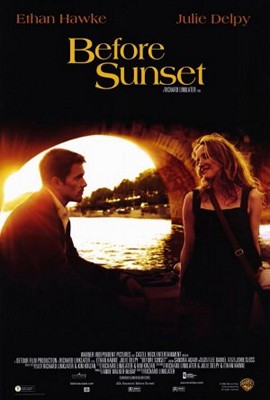
Before_SunsetIn this sequel to Before Sunrise we come back nine years later.

There is a certain degree of eagerness and nervousness as we wait to hear what happened in the months following Before Sunrise. We find out that Jesse and Celine did not actually meet 6 months after their first encounter. In all reality, what were we expecting? I myself had a secret hope that they would meet again. It’s the romantic in me, but that’s not how life ends up working out. Jesse showed up but the sudden death of Celine’s grandmother detained her. That’s one of the plights of this human existence.

Now Jesse is a writer who made a book about their evening together and one day in Paris while promoting his book there is Celine smiling through the window.

Here they are back together again nine years later with 1 hour to catch up before Jesse has to take a flight back to the States. With the passing of the years we now find ourselves watching an older, wiser, pair. They are both married now.

Jesse has lost the long hair and he is not quite so young in the face but it is still the same guy. Celine is still very pretty but more mature than the young French girl from the earlier film. Most importantly of all they still have a knack for deep, highly personal conversations.

A lot is covered as they chat through the streets of Paris. My most favorite moment however comes when Celine plays Jesse the Waltz she wrote. It is a beautiful little ballad in its own right and it shows her personal connection with Jesse that still lasts over all these years. What he encapsulated in his best selling book she documented in a song. We leave them once again as two slightly different people who still have a penchant for conversation, love and sentiment.

The film starts and like a blip on the radar it is already finished. In some regards it is rather disappointing, but not as unsatisfying as this short rendezvous must be for Jesse and Celine.

I have no bitterness, my sweet
I’ll never forget this one night thing
Even tomorrow, another arms
My heart will stay yours until I die

Let me sing you a waltz
Out of nowhere, out of my blues
Let me sing you a waltz

~A Waltz for a Night

4/5 Stars

Selma (2014)

Selma_posterMartin Luther King’s legacy will always be the “I Have a Dream” Speech. It’s a crowning moment in history with iconic images and soaring rhetoric. But Doctor King was far more than that. He was a minister, a social activist, and a champion of equality, justice, and peace. Selma is the film his story deserves, taking a magnifying glass to the events surrounding the 1965 march from Selma to Montgomery, Alabama which led President Lyndon B. Johnson to pass the Voting Rights Act of 1965.

So much had already happened. We had Rosa Parks, Sit-ins, Freedom Riders, Malcolm X, the march on Washington, the assassination of President Kennedy and of course the Civil Rights Act of 1964. In the upcoming years, there would be the further escalation of the war in Vietnam, riots in Watts, The Black Panther Party and the assassinations of both Robert Kennedy and Dr. King in 1968. The social unrest was far from over, just like it is not over now. That’s part of what makes Selma so poignant because it is certainly a necessary historical reminder and its relevance remains evident today.

Honestly, the film at times felt rough around the edges and not always the most aesthetically pleasing. For lack of a better word, it felt choppy. That was only a personal observation and not something to get too hung up on though. After all, at its core, Selma is about the characters and the moment of history they were living in. There were some spectacular performances starting with Englishman David Oyelowo as Doctor King himself. He exudes the quiet strength and displays the deliberate but powerful voice that made King the champion of all that was good and right. He is not a perfect man or perfect husband, but he was a man of God who remained true to his convictions and his friends and family.

Ever since I did some reading up on him, LBJ has always been a fascinating character to me, because he was the ultimate politician who was able to accomplish so much and yet he will always have a tarnished legacy due to Vietnam. He is played impeccably by Tom Wilkinson with the imposing figure, southern drawl, and strong will all there. LBJ is at odds with King on occasion and in him you can see a man with a job that no person would desire, trying to make political decisions that no one would want to. Somehow, through it all, the Voting Rights Act was still passed. Then, of course, you have other players like the living legend and present congressman John Lewis as well as Southern Governor and primary villain George Wallace, who seemingly turned his life around in his later years.

Even down to the smallest roles, Selma has power. We begin to see depictions of real-life individuals who lived in a world of fear and disempowerment. Where southern whites ruled with their racist ways and blacks looked for a much-needed answer to the death and suffering. Doctor King was able to lead the movement and yet he had help from friends and the common man as well — black and white. It is interesting how many of the figures who ultimately answered King’s stirring call to action were often pastors, priests, and other clergymen. It’s as if they realized that this was not just a race issue, it was a moral issue, an issue of justice, and ultimately a personal conviction. How could they live hypocritical lives of the status quo while so much was left to be healed in the South? We could ask the same questions of our society now.

The film interestingly enough led many songs to float through my head. There’s Sam Cooke’s “A Change is Gonna Come.” Bob Dylan’s “Only a Pawn in Their Game.” Dion’s “Abraham, Martin, John” and Barry Maguire’s “Eve of Destruction” to name a few fitting tunes.  For that matter, even the award winning anthem “Glory” could have been played during the film and that would have made sense. And yet Selma finds its sound in more traditional tunes that lend a true authenticity to the story that is surprisingly effective.

To say that Selma really resonated is a given. The images of force and brutality, bitter prejudice, billy clubs, and tear gas are still disturbing. They should be and they should never fail to outrage us. But I think there were several times where I was really struck with the weight of all of this. The first being when King kneeled down to pray and all the masses joined him. Such a display was so visceral and moving. Also, the archive footage showing the final march was a cheering reminder that equality and change by peaceful means are possible. Dr. Martin Luther King sadly did not make it to the Promise Land, but he led the United States and his people ever closer. For that, we all owe him an incredible debt of gratitude and for that very reason, we must never forget Selma.

4.5/5 Stars

Whiplash (2014)

2b478-whiplash_posterIf ever there was the Devil’s incarnate, it isn’t Terrence Fletcher (J.K. Simmons), he’s probably meaner and harder to nail down. In the world of musicians, there is no school more prestigious than Shaffer Conservatory in New York and that’s where young drumming prodigy Andrew Neiman (Miles Teller) finds himself learning the ropes. Like most of the people there, music is his life and it’s what drives him. His dream is to be the next Buddy Rich. Most people don’t know who that is, but he does and that’s enough.

Nieman thinks he’s made the big time when he gets made the alternative drummer in the orchestra of conductor Terrence Fletcher, a man who seems strict, but still highly passionate about music. Andrew looks to prove himself and let his talent shine through.

He has no idea what he’s getting himself into. He watches with surprise as Fletcher tosses a member of his band out for being out of tune in a rehearsal of Whiplash. Except it was the other guy, but Fletcher feels it’s just as well since the guy didn’t know he wasn’t out of tune. Obviously, he was not a true musician.

Thus, Andrew gets a taste of this sadistic treatment all in the name of art and music. He gets a chair hurled at him. He gets repeatedly slapped for being off tempo. It becomes clear all too soon that Fletcher is a merciless two-faced monster who does everything in his power to improve HIS band at all costs. He never ceases berating, belittling, cursing like a sailor, name-calling, and inducing physical harm. He doesn’t care as long as it leads to results improving overall performance.

About this time Andrew awkwardly asks out the cute girl at the movie theater, and they share an awkward date at a 2nd rate pizza joint. It’s a cute beginning with some real promise. As far as family goes, his dad is a loving man, but Andrew has some real familial conflict with his relatives. They see his aspirations as small potatoes, and he, likewise, sees them as nobodies who are full of themselves. It’s mutual distaste.

Andrew’s education continues on an intense path when, by a fluke, he becomes core drummer. Fletcher also calls Andrew out saying he needs to practice harder, and it becomes a game of survival of the fittest. Kill or be killed. Dog eat dog. Fletcher has no sympathy or emotional attachment. All that matters is fielding the best band he can. He works his three drummers to the point of pure exhaustion, hands bleeding, drenched in sweat before Andrew finally gets the tempo right just to his liking.

He has his chance once more, but on the day of the big Jazz competition, Andrew runs into some roadblocks and since he is hardly capable of playing, Fletcher gives Andrew the boot. The enraged drummer tackles him to the floor. Days later he is expelled from Shaffer while a lawyer is also digging around about Fletcher’s conduct. Andrew reluctantly agrees to blow the whistle on him and he has to go from there.

By this point, the question must be asked. Who is truly insane here? Yes, Fletcher is a nightmare and a tyrant of epic proportions. But what drives someone to do what Andrew does? He drums until his fingers are so ripped up they bleed through bandages. He breaks up with his girlfriend Nicole, all in the name of progress in his career. Perhaps craziest of all, he continues to follow Fletcher until his expulsion. It got to the point that he was losing all touch with reality because drumming was everything. Completely blinded by obsession, spiraling further and further into the abyss that was consuming him.

In many ways, those two were made for each other, and one day they meet on the outside. Andrew no longer a student and Fletcher now fired from his position. Now they just want to play music for the sake of music. Fletcher needs a drummer for a jazz festival he is competing in and Andrew obliges because he cannot stay away from it forever. Of course, his nemesis pulls one last dirty trick, but it was out of this scheme that Andrew realizes himself as a true musical artist letting his hands lead him on an emotional Odyssey of snares and cymbals. For one instant he has Fletcher’s approval and the euphoria of the beats rushes over him. This is all he ever wanted.

Whiplash is a film that is squirm-inducing. Utterly painful and terrifying to watch, thanks in part to the performances of J.K. Simmons and Miles Teller. Teller is inherently likable and that’s what made his turn in the Spectacular Now (2013) so gratifying. His character Andrew is on the complete opposite side of the spectrum, however. He’s utterly friendless and singly-minded, geared towards one thing and one thing only. Teller proved that he could play this role, and it is purposely left ambiguous what happens next. He lost his girlfriend and he got expelled, but what are we supposed to feel for him? Pity, sadness or disapproval?

J.K. Simmons was just WOW… Director Damien Chazelle did a remarkable job and likewise the editing of Whiplash exquisitely fit the theme of drumming. It is completely on form with its frenetic fury to its merciless cutting. It will not give us a break or let us relax as an audience, underlying the generally insane tempo of this film. The name “Whiplash” from Hank Levy’s composition was perfect. Melodious but completely unnerving.

4.5/5 Stars

To Sir, With Love (1967)

To-sir-with-loveStarring Sidney Poitier and set in London, the plot follows a former architect from British Guiana who becomes a teacher at a high school in a tough area. Early on Mark Thackeray faces a rebellious group of teenagers who dislike education and challenge authority whenever possible. He resolves to keep his temper and yet one day their actions are too vulgar for him and he loses it.

After that he develops a new strategy to treat them as adults and he teaches them practical skills they will need in the real world. He changes how they act and takes them on field trips so that even the most combative one Denham is won over. However, after an incident during gym class which he must diffuse, Thackeray loses the respect of much of the class. His mood changes slightly after receiving another job offer.

Later on in the gym class he is supervising he boxes with Denham. In the ensuing moments he wins Denham and then everyone else over once more. With the year finally over, Thackeray is invited to the year end dance where he is given a gift and serenaded with song (To Sir, With Love by Lulu)! Too choked up to speak he retreats to his office. After a chance encounter he resolves to continue teaching and rips up the other offer.

Besides a good theme in “To Sir, With Love,” Sidney Potier gives a great performance that makes this film both powerful and touching. If you want a small look into Swinging London this is one to watch. Although I am tempted to find fault in this film I find myself focusing on the positives and I will leave it at that.

4/5 Stars

Amadeus (1984)

bcd5e-amadeus1

A common film would content itself with developing a biopic on one of the greatest composers of all time reaching the heights of the musical field in the musical capital of the world in Vienna. A typical film might paint on a canvas paying homage to a legend who revolutionized music with his genius.

This story opens as the long-forgotten composer Antonio Salieri (F. Murray Abraham) attempts to kill himself. He gets laid up in a Psych ward where a man of the cloth visits him wishing to hear his story and so the old man obliges. It’s a story that makes light and lacks reverence thanks to its title character.

Salieri was a court composer of prestige and great admiration, but even he knew Mozart was the true master and the first day they met was forever ingrained in his mind. For being such a genius Wolfgang Amadeus Mozart (Tom Hulce) is a jerk, to put it bluntly. Spoiled, conceited, dirty-minded and armed with a cackling laugh, he is hardly the image of a musical mastermind. How could God bless this man with such talent? How could God taunt Salieri using such a man? He makes a mockery of art and yet he is the best there ever was. Salieri must have some kind of justice.

But all that lies under the surface. Mozart is brought on by his Majesty to develop a German libretto. Salieri’s tolerance for God is lost and he turns his back, beginning his passive attack. He shames Mozart’s wife (Elizabeth Beridge) and sends her off as he is looking to undermine his rival as discreetly as possible.

Mozart himself has little desire to take on pupils he deems a waste of time and instead busies himself with his most ambitious piece yet. His father comes to town and is not amused with his son’s conduct or his antics at a masquerade ball. He has none of the sensibilities of a man like Salieri, but what he does have are the talent and brilliance.

Always one to push the boundaries, Mozart’s latest piece is based on the Marriage of Figaro which was expressly forbidden by His Majesty. But due to his skill, Mozart is able to get by with bending the rules. Salieri acknowledges his genius. He knows brilliance when he sees it, but he becomes even more resolved to bring about the death of his nemesis.

After the death of his father, Mozart slowly spirals down into drunkenness and poverty. Salieri manipulates the situation even further to play on the man’s emotions and the desperate Mozart becomes mad composing a funeral requiem requested by a specter of a man. The mysterious figure is, of course, a moonlighting Salieri who no longer sees his actions as justice against Mozart but against God himself and he wants to win.

In a horrible condition, the bedridden Mozart constructs his last great piece with the help of an incredulous Salieri. But Constanze will have none of it and the manuscript remains unfinished because she distrusts Salieri. Just like that Wolfgang Amadeus Mozart suddenly passes away. He’s dead and Salieri can have no satisfaction, no piece of Mozart’s brilliance. God would not give him the satisfaction, resigning him to be the so-called patron saint of mediocrity. God supposedly got the last laugh.

This is a film that makes me want to revise the noted statement to “only the great die young” as the mediocre slowly fade into oblivion. Salieri faced a cruel demise of his own as Mozart instantly became solidified as a legend. That is the irony of life that is made clear no matter how accurate the facts are. Because in Amadeus, the facts are not the most important. Milos Forman gives us a spectacle that is as grand as Mozart’s greatest masterpieces. But this is perhaps, more importantly, a film about human nature. Salieri is a man so ingrained with internal desires.

He wants to play God. He wants all things to play out as he sees fit. His malevolence is focused on others. It is even focused on God. But, in reality, it reflects the pain of his own heart. Humanity has a desire for excellence to be fully actualized. That is a lofty goal and an impossible target. Because ultimately there will always be a hole left within us. It was so with Salieri

Mozart was one of the greatest and most well-known composers of a generation if not ever. He was not a good man (few are), and he met with death early. Salieri seemed moral and yet he himself was undermined by deep-seated avarice and covetousness. Despite still having life, the world was essentially dead to him. He thought God was laughing at him. Neither man won.

4.5/5 Stars