
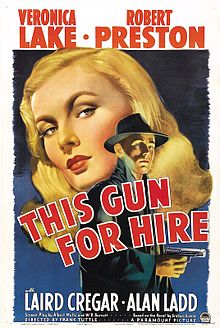
 Alan Ladd and Veronica Lake found themselves partnered together on numerous occasions partially out of convenience (at 5’6 and 4’11 they were a perfect height match) but also there’s a genuine chemistry between them. And it all came into being with This Gun for Hire an economical film-noir where Ladd wasn’t even one of the top-billed stars.
Those coveted positions above the title went to Lake and the relatively young buck Robert Preston with Ladd tacked on with an “Introducing” title card. It was his latest attempt to break into the film industry that had long relegated him to bit parts and uncredited cameos (ie. Citizen Kane). It worked.
His menacing thug Raven is the first character we meet and he soon proves his brooding menace is more than just show. He is a gun for hire after all and he finishes up some business for a client getting his payoff through a nervous and portly fellow named Gates (Laird Cregar). But the money is hot and Raven soon finds a price on his head. He’s been had and he’s not about the let that slide.
The main push from the law enforcement is led by none other than Michael Crane (Robert Preston) who has recently been vacationing with his girlfriend Ellen Graham (Veronica Lake). As he burns the midnight oil she has her own gig as a magician/nightclub singer while also taking on some clandestine activities — activities that’s she sworn not to tell anyone about — even her beau.
As we might expect with the tenets of noir, the film is a lot bigger than we are initially led to believe, not simply involving murder, but also treason and government secrets as Pearl Harbor is still fresh on everyone’s minds. In such a way, our three leads get tied up both literally and figuratively as Raven continues as a fugitive in search of the man who set him up.
He too crosses paths with Ellen and in her, he finds a kind of confidante who doesn’t immediately write him off, despite his deadly tendencies. Before her he only liked cats, the reason, they don’t need anyone, rather like him. But he’s also not about to reform, not until his work is done.
Although its transitions are at times choppy and awkward, there’s indisputably an intrigue that courses through This Gun For Hire that makes it a diverting bit of noir and its latter half is the pinnacle of the action as the dragnet closes in around Raven. For the 1940s, it was a crackerjack finale but unfortunately, it’s sullied now by an abrupt happy ending. No matter.
While Robert Preston is a fairly flat lead, Veronica Lake is her usual playfully sympathetic self and Laird Cregar plays the spineless oaf to perfection. His slimy sort is one of the reasons noir becomes so wickedly delectable. In fact, he’s perhaps second only to Alan Ladd’s characterization because over the course of the film Ladd systematically steals the picture, taking every little bit of limelight and making it count. Solidifying his stardom by playing a highly compelling heavy and essentially stealing the girl away from his male costar.
Edward G. Robinson, Humphrey Bogart, and perhaps most notably James Cagney, all played corrupt, crazed, and vindictive gangsters at one time or another. What sets Ladd apart is his utterly emotionless eyes. They’re still the eyes of a stone cold killer but there’s a vast emptiness there. Anyways it’s the perfect laconic performance for film-noir and while he never reached the heights of Bogart (also a former supporting player), Alan Ladd rightfully so gained recognition for his own career — most notably in Shane. But everything has to start somewhere and This Gun For Hire is precisely that film. His mark is all over it.
3.5/5 Stars

 From the haunting opening notes of a lullaby to the otherworldly aerial shot floating over New York, Rosemary’s Baby is undeniably a stunning Hollywood debut for Roman Polanski.
 It’s hard to grow tired of Bob Hope. In many ways, he’s a universal entertainer — transcending time — circumventing the decades with a brand of humor that is timeless. And the same goes for his iconic persona. He can quip with his lips like Groucho Marx but he’s more of a lovable dope. He likes to think he’s clever and when he lets his mouth run off Hope certainly is, in a cheeky sort of way. It’s just his characters who are always dumb.
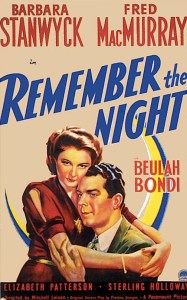 I find that many of the best Christmas movies aren’t really about Christmas at all — at least not in the conventional sense that we’re so used to. Not trees or presents or lights or even holiday sentiment although those might all be there.
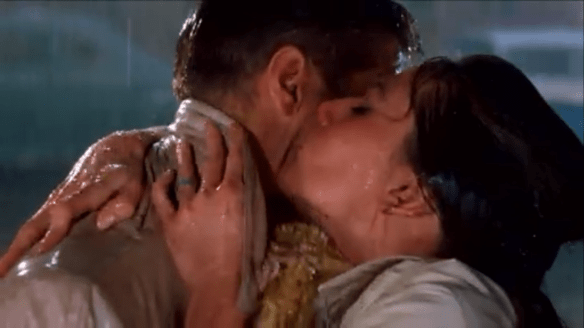
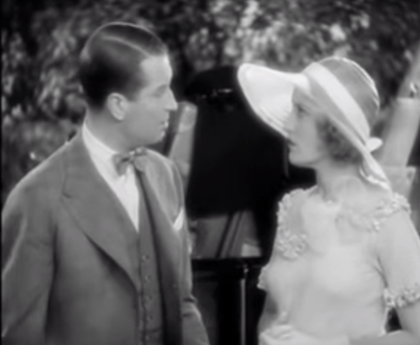 This is unequivocally the age of sound! That’s what this film proclaims from the rooftops with its symphony of syncopation as the world of Paris awakens from its slumber. Its opening rhythms are pure ingenuity and the glorious unfoldings never cease for the rest of the cheery production.
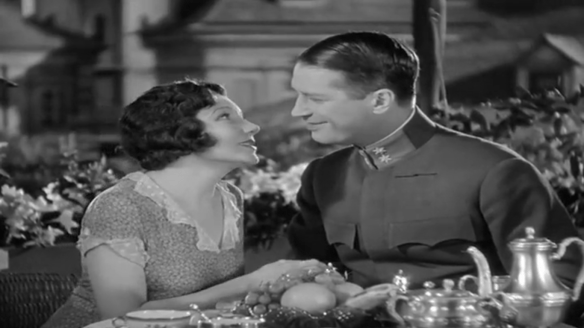 One would never think that one well-placed wink would change the course of an entire life or be the basis for an entire film, but on both accounts it is true. Ernst Lubitsch’s The Smiling Lieutenant represents all that is good and right about one of his films. It’s light and airy with a dash of charm and a tune in its heart. It’s light on its feet with humor and somehow maintains its self-respect, much like the man at the center of this one (Maurice Chevalier).
 But Lubitsch’s final twist is completely out of left field and a completely comic inversion of what’s supposed to happen — capping off his oeuvre of song, suavity, and sensuality in high fashion.
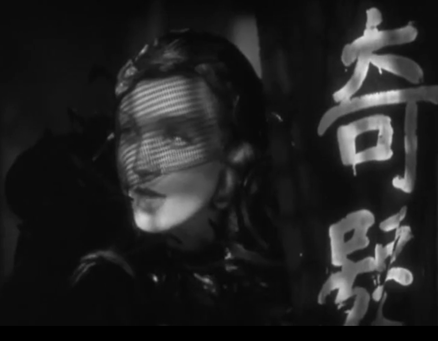 The same year as Grand Hotel there came another film, that while still boasting an ensemble cast felt far more intimate. In its day it was christened “Grand Hotel on wheels” and its narrative does unravel aboard a train. However, Josef von Sternberg’s film opens with a faceless atmosphere spilling over with the bustling commotion of a railway station. It takes a few moments to lock onto the characters we will be making the journey with, but we won’t soon forget them.
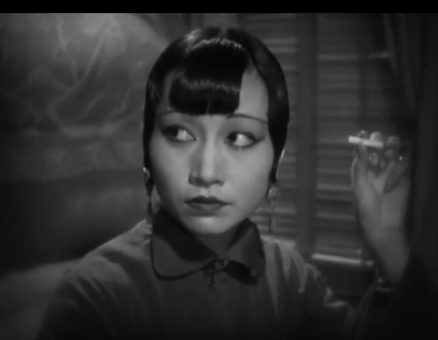 It is in these moments that are two female heroines must act. Hui Fei (Anna May Wong) so that she might defend the honor of herself and her country. Lilly so that she might express the great, expansive depths of the love she still holds for “Doc.”
 “I always did like a man in a uniform. That one fits you grand. Why don’t you come up sometime and see me? I’m home every evening.” ~ Mae West
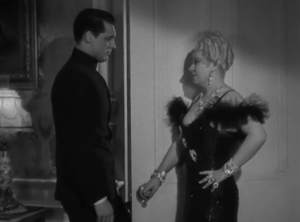 This is her film — her personal vehicle. She rules it that twinkle in her eye and a rapier wit coming from her mouth. Sometimes it’s not even what she says but how she says it (Why don’t you come up sometime and see me?). No one quite has a delivery like her. Whatever she says seems to carry implications and double meanings. In a modern culture that’s overwrought with sexual innuendo and bad taste, West led the trend when it was still in vogue. Back then, it was certainly controversial, but the box office doesn’t usually lie, and West did pretty well for herself, especially during the Depression era. There’s a reason that soldiers named their life vests after her. She was the queen of double entendres in the post-Shakespearian age, and she was ripe in the public consciousness. There was no one quite like her.
 4 Star Films