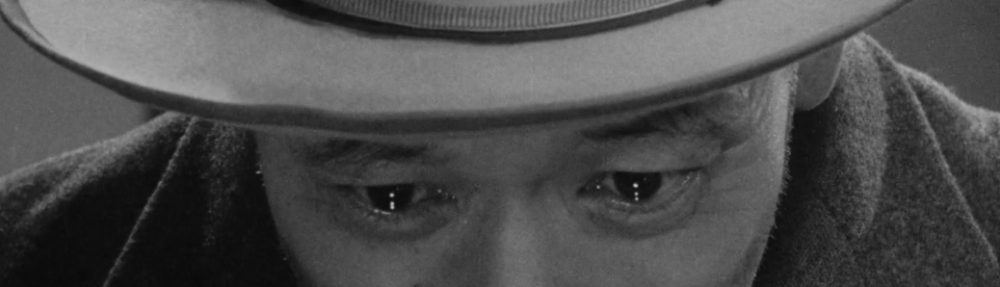
 “Heathens are not always low just as Christians are not always high.” – Gregory Peck as Father Chilsum
Tales of humble priests are more fit for the likes of a Bresson or Rossellini, but Hollywood proves it too can offer up a film with resonance along similar lines. It’s a more melodramatic tale, a historical and religious epic of sorts, carved out of the studio era mold, but its facets are auspicious and abundant. The script comes from veterans Nunnally Johnson and Joseph L. Mankiewicz.
It’s also hard to believe that it was this role as Father Chilsum that truly galvanized Gregory Peck’s career early on. Because if you look at him, he’s an imposing figure, kind-faced and calm. Still, there’s an unwritten maturity that seems to dwell beyond those eyes of his like he’s been doing this for a long, long time. It makes his playing an old man not all that unbelievable, in spite of any amount of makeup.
Keys of the Kingdom is also blessed by the studio system with the likes of Thomas Mitchell, Edmund Gwen, Vincent Price and a surprisingly adequate array of Asian performers including Philip Ahn, Richard Loo, and Benson Fong in an especially notable turn as the Father’s faithful right-hand man Joseph.
Despite having a loving family, Francis came from humble roots and tough beginnings illustrated by the long-held divide between Catholics and Protestants. Even as he resolved to join the clergy, his heart struggles with love and assignments that feel unfulfilling to his heart.
That is until he asks to be assigned as a missionary in a province of China. In the ensuing decades, he works to leave his mark of goodwill on a community, and he’s an upright man not looking for so-called “Rice Christians,” believing such bartering is a forgery for God. As his track record reflects, he’s a rather unorthodox as far as priests go, but he makes up for it with sincerity. His best friend is an atheist, a doctor from back home, and he’s not just concerned about the spiritual well-being his flock but their physical health too–all too soon becoming a trusted healer of the town, despite having little to no official medical training.
And although his gains are humble, he garners the respect of most everyone he meets. His fellow helper Joseph, the initially curt Reverend Mother (Rose Stradner) and even a republic soldier Major Shen (Richard Loo), who is amazed by the religious man’s resolve. True, his congregation is hardly a boon of religious conversions, but he begins an orphanage, taking in discarded children and nurturing them on the mission grounds. Many years later the Father Chilsum is to be sent back home for the sake of his health. It’s a bittersweet goodbye to this place he called home for so many years.
However, there’s a peaceful contentment to his character that Peck reflects so seamlessly. This was a man who came here to this foreign land with a vision that went beyond conversion rates. First and foremost, he cared about loving people well, and everything else was added to him.
3.5/5 Stars
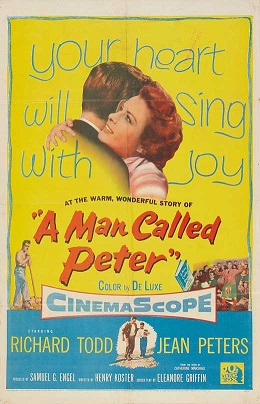 The film’s tagline reads, “Your heart will sing with joy” and that about sums up A Man Called Peter.
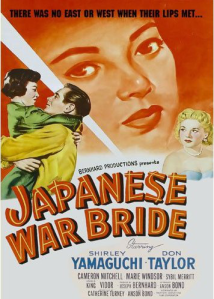 Much like Sam Fuller’s Crimson Kimono (1959), Japanese War Bride’s title carries certain negative stereotypes, however, its central romance similarly feels groundbreaking, allowing it to exceed expectations.
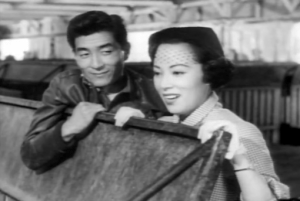 Jim looks to build up a happy life with her as he looks to take some of his father’s land to keep a home of his own and raise crops. Tae begins to acclimate to her new life and gains the respect of the Taylor family while making a few friends including the kindly Hasagawa siblings (Lane Nakano and May Takasugi) who work at a factory nearby. The icing on the cake is when Tae announces she’s pregnant and Jim could not be more ecstatic.
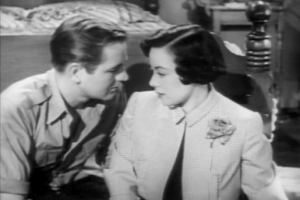 Japanese War Bride is continuously fascinating for the presence of Japanese within its frames. First, we have a rather groundbreaking and relatively unheard of interracial romance between the always personable average everyman Don Taylor and stunning newcomer Shirley Yamaguchi. Their scenes are tender and hold a great deal of emotional impact. It’s the kind of drama that has the power to make us mentally distraught but also imbue us with joy.
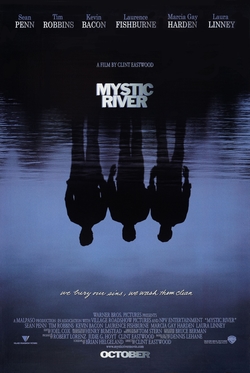 When you enter into the world of a film you often expect it to be perfect in your own minds-eye, following your own rationale to a logical conclusion. In that sense, Mystic River is invariably imperfect in how it ties up all its loose ends, but then again, what film really can bear that weight — and it’s all subjective anyhow. Instead, Clint Eastwood’s Boston-set drama builds off a story about three young boys and evolves into an engaging police procedural intertwining the lives and events of these three individuals. But it all starts with a game of street hockey.
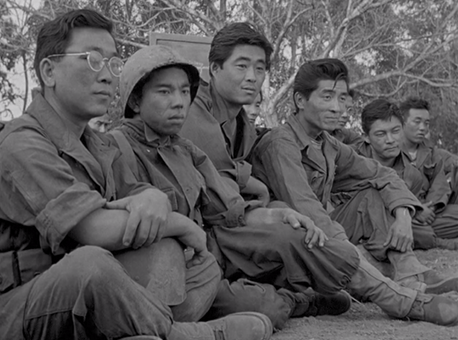 WWII is always a fascinating touchstone of history because it has some many intricate facets extending from the Pacific to the European Theater to the American Home Front and so on, each bringing with it unique stories of everyday individuals doing extraordinary things. One of the best-kept secrets is the 442nd Infantry Division later joined with the 100th and effectively making the first all Japanese-American fighting unit which served over in Italy and France.
 Citizen Kane is so often lauded for the simple fact that never before had a director had so much creative control on a project and exercised it in such an unprecedented fashion, especially given the state of affairs in the Hollywood studio system. It’s an enigma, a stunning debut and really an astounding miracle where all things aligned for an instant of so-called perfection.
 At first glance The Trial is a bare-boned parable, feeling gaunt and cavernous with empty sets and even emptier words. Everyone Josef meets talks him in circles, tirelessly — never leading to any significant conclusion, only the next diversion in his journey.
 If The Trial is a hodgepodge of talent, with the presence of Americans Orson Welles and Anthony Perkins, international sirens Jeanne Moreau, Elsa Martinelli and Romy Schneider, with European backing and source material from Kafka, then it is a thoroughly intriguing marriage all the same. This film is perhaps the greatest adaptation of the work of Kafka and not due necessarily to its faithfulness to its source material, but because it displays an unmistakably Wellesian vision. The cyclical nature of the legal system pales in comparison with the fascination that comes with watching the continual creativity that is projected up on the screen — this is a hollow dream of a film.
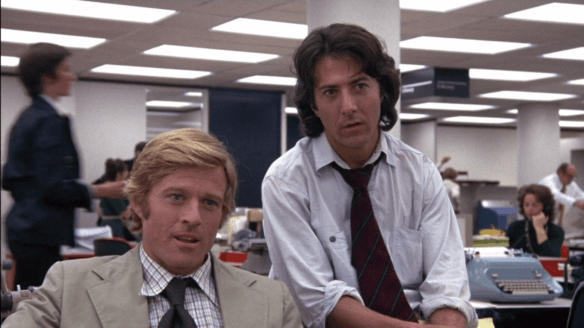 You couldn’t hope to come up with a better story than this. Pure movie fodder if there ever was and the most astounding thing is that it was essentially fact — spawned from a William Goldman script tirelessly culled from testimonials and the eponymous source material. All the President’s Men opens at the Watergate Hotel, where the most cataclysmic scandal of all time begins to split at the seams.
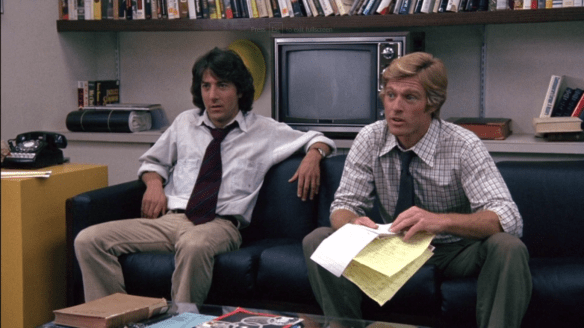 But it only takes a few breakthroughs to make the story stick. The first comes from a reticent bookkeeper (Jane Alexander) and like so many others she’s conflicted, but she’s finally willing to divulge a few valuable pieces of information. And as cryptic as everything is, Woodward and Bernstein use their investigative chops to pick up the pieces.
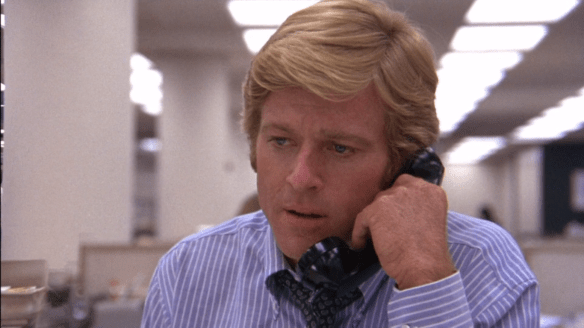 Gordon Willis’s work behind the camera adds a great amount of depth to crucial scenes most notably when Woodward enters his fateful phone conversation with Kenneth H. Dahlberg. All he’s doing is talking on the telephone, but in a shot rather like an inverse of his famed Godfather opening, Willis uses one long zoom shot — slow and methodical — to highlight the build-up of the sequence. It’s hardly noticeable, but it only helps to heighten the impact.
 The opening notes of Joan Jett hollering “Bad Reputation” made me grow wistfully nostalgic for Freaks & Geeks reruns. The hope budded that maybe 10 Things I Hate About You would be the same tour de force narrative brimming with the same type of candor. It is not. Not at all. But that’s okay. It has its own amount of charms that forgive the obvious chinks in the armor of this very loose adaptation.
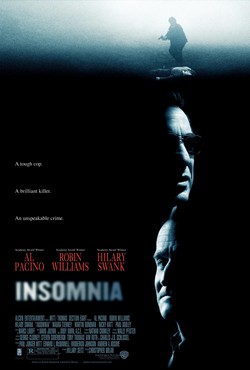 “You and I share a secret. We know how easy it is to kill somebody.” – Robin Williams as Walter Finch
 This was not the film I expected from the outset, and oftentimes that’s a far more gratifying experience. Nostalgia was expected and this film certainly has it, even to the point of casting the legendary funny man and cultural icon Don Knotts in the integral role as the television repairman.
