A Man Called Peter (1955)

A_Man_Called_Peter.jpgThe film’s tagline reads, “Your heart will sing with joy” and that about sums up A Man Called Peter.

Henry Koster was the director behind such underrated gems as The Bishop’s Wife and Harvey, and although this film is starkly more realistic, it shares the same unabashed earnestness of its predecessors. Its tone is similarly reverent of its subject matter, the story of the man Peter Marshall (Richard Todd), but that’s hardly a point of derision because its sincerity feels well-founded.

The narrative cycles through his changing life and times from his childhood days as a rebellious boy in Scotland to the defining moment when he truly resolved to follow God’s plan in his life. Following his days in seminary, he goes on to two parishes in Covington and Atlanta, Georgia. One church flourishes from humble beginnings and the latter, while boasting a large congregation is weighed down by apathy and financial problems.

It is there where Peter Marshall’s impassioned sermons begin to breathe life into the dead bones in the pews, leading people from near and far to take heed of his words. Like any charismatic speaker like a Dr. King or even a John Knox, his words are rich and passionate. To use a film term, the sermons become stirring monologues from the pulpit delivered unbelievably convincingly by Richard Todd.

He talks emphatically about the rationality of the Gospel and the idea of relying on a certain amount of faith.  He elucidates the character of the real Christ of the Gospels with tremendous vigor. He muses on human love and what that means for him and others — most of the young ladies present listen with baited breath.

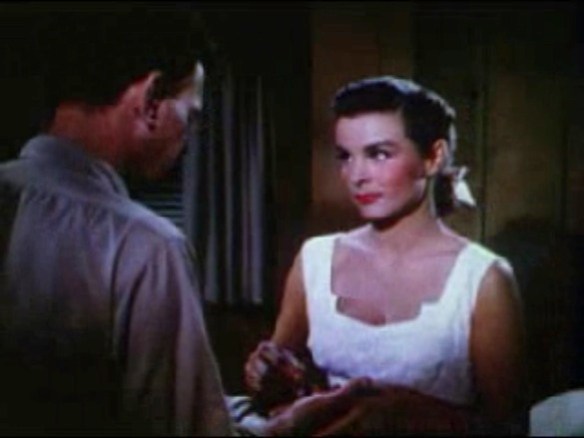
One such admirer and a longtime faithful parishioner is the young college gal Catherine Wood (Jean Peters), and it is no wonder she falls for him. However, initially, her love for him is not so much unrequited as it is unknown. That is until the day she comes to meet her hero face to face. Their love story is equal measures tearful and romantically splendorous as they come together, pursuing what they truly perceive to be God’s will.

And they lead a humble albeit happy life before Peter makes the biggest transition of his pastoral career, moving congregations to a historical relic of a church which formerly had presidents in attendance. Now it’s a building half full of old hypocrites and a handful of apathetic souls, but once more Reverend Marshall comes with a fervency in his sermons, while still exhibiting an underlying graciousness. For lack of a better word, he drops truth bombs. Some people aren’t ready to hear, but many are.

What follows is a radical religious revival throughout Washington D.C. His congregation becomes a young people’s church and a welcoming haven for governmental officials still kicking the tires of religious faith. But Peter Marshall welcomes all in and in turn has an exponential impact on not only his community but the very fabric of this nation. He becomes trusted counsel to Congressmen, plays ball with local children and helps set up a local canteen for outgoing soldiers.

By anyone’s standards, it seems like Peter and his faithful Catherine have done so much good. But as often happens, tragedy hits their humble family with a vengeance. Catherine is stricken with tuberculosis which keeps her bedridden for many months. But together they get through it and she recovers, only to have Peter be offered a position as the chaplain of the Senate. However, once more, bad things happen to good people and Peter suffers a coronary thrombosis. Only days later he’s dead and it truly feels that only the good die young.

It simply does not make sense, but if we look at Peter Marshall himself for guidance, he gives us a roadmap of how we can try and cope. Even when his wife is sick, he encourages her that God does not trade retribution with us. It’s not like all the weight of our past misdeeds are stacked up against us. Still, he cries out to his God with the illness of his wife like the psalmists of old. He doesn’t have to be content with suffering, and he’s not, but he’s also fearless in his own life. He lives with almost reckless abandon, because of a certain confidence in his faith.

For some, this religious biopic will be admittedly pious and slogging but there’s a surprising richness to Marshall’s story, embodied quite excellently by Richard Todd. Its colored frames are rich equally matched by Marshall’s own mellifluous brogue and personable humanity. Jean Peters subverts my expectations once again with heartfelt depth. It’s a film made in an age when shot lengths could linger, allowing us to ride the waves of a single performance or a bit of dialogue. But most astonishing of all, it’s quite easy to draw parallels to now, because as it happens, there’s nothing that new under the sun.

It should make us beg the question, what if pastors and their churches were living out these kinds of lives? Genuinely loving other people well and dramatically impacting the communities around them — in a sense breathing new life into tired and weary people. If Peter Marshall is any indication, there’s a possibility for dynamic change. Reverend Marshall passed away at the age of 46, but it’s easy to conclude that his was a life well-lived. If only we were all so lucky. Thankfully there’s still time.

3.5/5 Stars

Japanese War Bride (1952)

Japanese_War_Bride_VideoCoverMuch like Sam Fuller’s Crimson Kimono (1959), Japanese War Bride’s title carries certain negative stereotypes, however, its central romance similarly feels groundbreaking, allowing it to exceed expectations.

The film opens during the waning days of the Korean War. A man lies incapacitated in a hospital bed, but he couldn’t be happier because he’s met the love of his life. Maybe it’s war fatigue or something else, but he simply cannot take his eyes off the pretty young nurse Ms. Shimuzu (Shirley Yamaguchi).

And although prospects don’t necessarily look that promising, since duty calls, Jim leaves that hospital bent on getting that girl for his wife. He’s serious. So serious in fact that he goes straight away to convene with Tae’s grandfather (Philip Ahn) that he might persuade him for Tae’s hand in marriage. Although warning that the road ahead will be a difficult one, the sagacious man, relents, reluctant to stand in the way of this blossoming love.

It’s after the happy couple is picked up at the train station by family and settle into the old family home, that it becomes obvious that things aren’t quite the same. They’ll be more difficult than they first appeared.

Jim’s parents and brother are welcoming enough, but there is still a necessary period of gelling as they get used to their new family member. Even Jim encourages his petite young wife to be more assertive and embrace American culture fully. She does her best.

japanesewarbride2Jim looks to build up a happy life with her as he looks to take some of his father’s land to keep a home of his own and raise crops. Tae begins to acclimate to her new life and gains the respect of the Taylor family while making a few friends including the kindly Hasagawa siblings (Lane Nakano and May Takasugi) who work at a factory nearby. The icing on the cake is when Tae announces she’s pregnant and Jim could not be more ecstatic.

Still, what crops up are the subtleties of racism through slight snubs and bits of insensitivity. First, the skeptical sister-in-law (Marie Windsor) drops pointed remarks towards Tae. At first, they are so veiled, they seem only a passing wisp of a word, hardly worth acknowledging. But following one of the neighbors confessing how much she hates all the Japanese, it becomes evident that all is not right in Monterrey.

One moment Tae is getting accosted by a drunken merrymaker at a party who jokingly calls her a geisha girl. Then the family is scared, rightfully so, when Mr. Taylor receives a threatening letter. It voices the opinion of an unnamed “friend” about the fact that there are rumors floating around that Tae’s baby looks fully Japanese and she has been spending time with Shiro Hasagawa. A scandal of this kind will ruin Mr. Taylor’s reputation among his fellow growers. It will ruin him period.

But most important to this story, it infuriates Jim with a fiery rage. He’s angry at all the narrow-minded folks he used to call friends. He’s mad at his family and most of all Fran for her part in Tae’s distress. It’s in these most tenuous moments that  Tae decides to take her baby and seek asylum somewhere else to get away from the cultural chasm that has formed. Of course, they are reunited and there is a version of a happy ending, but it does not take away from the bottom line. They’ll still have to struggle against societal pressures and flat-out bigotry. However, if you’re in love, there are many rivers you are willing to ford and the same goes for Jim and Tae.

japanesewarbride1Japanese War Bride is continuously fascinating for the presence of Japanese within its frames. First, we have a rather groundbreaking and relatively unheard of interracial romance between the always personable average everyman Don Taylor and stunning newcomer Shirley Yamaguchi. Their scenes are tender and hold a great deal of emotional impact. It’s the kind of drama that has the power to make us mentally distraught but also imbue us with joy.

The film carries even more sobering underlying tension given the relative freshness of World War II. Mothers are still bitter about the deaths of their sons and that righteous anger is not discriminating between people. It only sees race. Meanwhile, Shiro and his sister reflect the times as Nisei, who were affected by internment and increased amounts of prejudice. While Shiro was imprisoned in Japan during the war, his family was interned at Tulare near Sacramento and his resentful father nearly had all of his land taken. Many other Japanese farmers were not so lucky.

For her part Marie Windsor plays her prime role as the antagonistic woman to the tee, effectively embodying all the small-minded, underhanded folks out there that live life without a genuine kindness for their fellow man. Poisoning other people’s mind just as they are poisoned, and it’s this type of rancor that leads to fear and bigotry. A breeding ground for hatred. In some shape and form, it still rears its ugly head to this day. What makes this film special is how it reflects the realities as it pertains to Japanese and Japanese-Americans. Veteran director King Vidor’s effort is a generally authentic and nuanced tale that pays his subjects the ultimate respect even in its more melodramatic moments.

3.5/5 Stars

Mystic River (2003)

Mystic_River_posterWhen you enter into the world of a film you often expect it to be perfect in your own minds-eye, following your own rationale to a logical conclusion. In that sense, Mystic River is invariably imperfect in how it ties up all its loose ends, but then again, what film really can bear that weight — and it’s all subjective anyhow. Instead, Clint Eastwood’s Boston-set drama builds off a story about three young boys and evolves into an engaging police procedural intertwining the lives and events of these three individuals. But it all starts with a game of street hockey.

After losing their ball down a gutter drain, the three lads sign their names in a slab of wet cement, only to be accosted by a formidable man who won’t take their small act of defiance. He yells at the most unnerved of the three to pile into the backstreet of his tinted car. The boy thinks he’s off to the police station, but these men have far more traumatic intentions for him. It’s three days before young David flees into the woods like a spooked animal disappearing into the fog.

It’s a harrowing entry point of reference, that only makes sense after flashing forward to the present. The three boys are grown up. Dave, still hounded by his past, is married and raising his young son. Although work is hard to come by, they’re eking by.After a stint in prison and the death of his first wife, Jimmy is remarried, running a local convenience store. Sean is the straight-arrow of the bunch and became a cop.

As is the case with youth and childhood friendships, the ties that bind us together are often severed with the passing of time as people grow up and drift apart. But those formative years never leave us and when these three men are subsequently thrown back together, their past resurfaces.

One evening when Jimmy is in the backroom of his shop his daughter from his first marriage, the vivacious Katie gives him a goodnight kiss, as she is about to go out with friends. That same night Dave spies her partying at the local watering hole, but before he goes home he gets into an altercation with a mugger — at least that’s what he tells his wife. Except the next morning, Sean is assigned to a local crime scene along with his colleague (Laurence Fishburne), and it looks to be a grisly ordeal.

From thence forward, the seeds of doubt begin to spring up in our minds. What did Dave really do? Who killed this girl full of life and exuberance? Jimmy wants to know those exact same answers, and he’s welling up with bitterness and discontent. Sean walks this fine line of doing his duty and treading lightly on this man he used to know well and now is practically a stranger. Meanwhile, Dave lives his apathetic little life, looking to obfuscate what happened that night with the help of his fearful wife.

But of course, when Jimmy catches wind of what Dave did, he puts two and two together and comes to his own convenient conclusions. He wants justice after all. Even when Sean and Whitey make crucial discoveries of their own, it’s too late to stop the wheels from turning. Jimmy’s mind is already made up.

To his credit, Brian Helgeland’s script adeptly keeps all its arcs afloat, crisscrossing in such a way that leads to more and more questions, because there’s ever a hint of ambiguity. Nothing is quite spelled out and that’s paying respect to the viewer. However, there are moments where Mystic River enters unbelievable or even illogical territory, near its conclusion. Still, that does not take away from its overall strengths as a magnetic character study and gripping procedural. Tim Robbins and Sean Penn especially give stellar turns, the first as a frightened and mentally distressed man, the other as a hardened ex-con with vigilante tendencies. The fact that each character is grounded by their families is a crucial piece of the storyline, tying them all together.

4/5 Stars

Go for Broke! (1951)

goforbrokeWWII is always a fascinating touchstone of history because it has some many intricate facets extending from the Pacific to the European Theater to the American Home Front and so on, each bringing with it unique stories of everyday individuals doing extraordinary things. One of the best-kept secrets is the 442nd Infantry Division later joined with the 100th and effectively making the first all Japanese-American fighting unit which served over in Italy and France.

But perhaps the most striking thing about this band of men was the inherent hypocrisy they unwittingly pointed out within America’s own society. As their loved ones sat enclosed in tar paper barracks and barbed wire fences within internment camps, these courageous lads went off to prove their allegiance to their country. Reflecting the very freedoms and liberty that America was founded on, in spite of the injustices that were thrown their way.

But really instead of simply reflecting the bad, Go for Broke! is a far more empowering story and Robert Pirosh’s film does a stellar job at showcasing these men with a great deal of respect. He had previously shown an aptitude for realistic war films like Battleground, and joining forces with Van Johnson once more, he delivers another authentic picture.

Going so far to fill out the rank and file of the film with real 442nd veterans, Go for Broke! begins with a newly promoted officer born and bred in Texas. At first, he shows a slight distaste in being called upon to lead a unit of Japanese, partly due to the fact that he was torn away from his buddies, the other simply a result of his own narrow-mindedness.

After all, he becomes the stand-in for the prototypical viewer and as his character slowly begins to evolve as they go through boot camp, then Italy, then France, the impact on the viewer is duly noted. Thus, although he proves to be an important figure, it should not be forgotten that in many ways the 442nd is front and center.

Among the men we get to know are the level-headed Sam (Lane Nakano) who has a girl waiting for him back in the states while his family remains interned as public aliens. Tommy is the runt of the group, a funny sort of fellow, who makes the ultimate sacrifice when he gives his beloved pig to a starving family. There’s the bespectacled college boy who was in the process of becoming an architect and the defiant Chick (George Miki), ready to fight with whoever crosses him. Far from being stiff, these men lend a certain realism to the film that elevates it to that of a fascinating historical artifact.

There are some wonderfully humorous moments that diffuse the conflict of cultural identity. The recruits of the 442nd walk up the gangplank as the soldier in charge struggles to read off their family names and as each man passes by he responds with a very basic anglicized name. George W. and Thomas H. In another moment an angry Van Johnson looks over at his second in command Oharra during a patrol to inquire what a Japanese word means. Without skipping a beat the man quickly apologizes, “Sorry sir, I don’t speak Japanese.” Only later as these soldiers become his loyal comrades does he learn what “Backatare” means. It becomes a film where soldiers from California and Texas can poke fun at each other, but that’s only because mutual respect builds between the 36th and 442nd.

Lt. Grayson reveals his final transformation when he enters into an altercation with his old pal Cully who has a heavy dose of bigotry. By the end of the film, the man’s still not exactly a saint, but his eyes are opened at least a little bit. And in the end, the 442nd comes to the aid of their brethren. The film concludes with one of their greatest triumphs, rescuing the lost battalion pinned down by the enemy on all sides. The casualty tolls were high, but in such moments the Japanese-Americans proved their grit and determination right alongside all the other fighting men. This is the film they deserved and the type of recognition that they deserve even today. It’s a shame that more stories like Go For Broke! have not been told, but it makes this one all the more important.

3.5/5 Stars

The Trial (1962)

thetrial1Citizen Kane is so often lauded for the simple fact that never before had a director had so much creative control on a project and exercised it in such an unprecedented fashion, especially given the state of affairs in the Hollywood studio system. It’s an enigma, a stunning debut and really an astounding miracle where all things aligned for an instant of so-called perfection.

But some people might assume Welles dropped off the face of the map, only to resurface as a rotund larger than life personality, hardly a cinematic auteur. And it is true, after that initial opportunity, he chased after freedom of artistic expression rather unsuccessfully. That does mean he never found it. Not by a long shot.

The Trial is indisputable evidence of that. It’s greatly under-viewed and that really is a shame, because within its frame you see the glimpses of that same master,  perhaps even more mature than he ever was in Kane.

The story grounds itself in the absurdist prose of Franz Kafka with Orson Welles delivering the opening narration in the form of Kafka’s parable “Before the Law,” setting the groundwork for the rest of the narrative. Anthony Perkins works seamlessly as Josef K. a tentative man set adrift in a world where he has been arrested and put on trial for a crime that is never revealed to him. He fluctuates easily between indignation and resigned timidity.

thetrial3At first glance The Trial is a bare-boned parable, feeling gaunt and cavernous with empty sets and even emptier words. Everyone Josef meets talks him in circles, tirelessly — never leading to any significant conclusion, only the next diversion in his journey.

There are some interludes in the film that could be characterized as dull, especially as we are getting acclimated to this storyline, or more precisely coming to grips with the fact that The Trial is not so much about Story. Kafka revels in the absurd rather than convention and Welles uses that surrealist absurdity as a vehicle for his own endeavors as a director.

Welles had his hands tied with lack of financial capital leading to only an abandoned railway station to work with, and he in turns transforms the space into a gloriously visual labyrinth. In his case limitations only meant further inspiration. In fact, his camera feels ever more inventive and engaging wherever it takes us within this surrealistic space. Large landscapes of dizzying scope mixed with confined, claustrophobic crevices. Further blanketed in light, utilizing a much simpler (as well as cheaper) black and white to develop an ever intricate gradation of field mingled with fascinating angles. These alone take a relatively bare scene and dress them up into something that is entrancing.

More than once, including the film’s final moments as  Josef looks to be headed towards death, it’s easy to be mesmerized because there are no clear narrative distinctions. Characters function as Kafka characters should, and Welles does the rest if you only give him your attention.

thetrial4If The Trial is a hodgepodge of talent,  with the presence of Americans Orson Welles and Anthony Perkins, international sirens Jeanne Moreau, Elsa Martinelli and Romy Schneider, with European backing and source material from Kafka,  then it is a thoroughly intriguing marriage all the same. This film is perhaps the greatest adaptation of the work of Kafka and not due necessarily to its faithfulness to its source material, but because it displays an unmistakably Wellesian vision.  The cyclical nature of the legal system pales in comparison with the fascination that comes with watching the continual creativity that is projected up on the screen — this is a hollow dream of a film.

So Orson Welles did get his artistic freedom, complete with a few surprising moments of cursing, international talent and meager funding that nevertheless gave him what he so desired. Welles ends the film with more narration and instead of running end credits he opts to list off all the names of his players. While the final intonations of his voice leave little doubt that this is his creation first and last, it also suggests that this is a personal film. Something outside of the realm of conventional Hollywood, but still very much worthwhile, even if it’s due mostly to form over content.

4/5 Stars

All the President’s Men (1976)

allthepresidentsmen1You couldn’t hope to come up with a better story than this. Pure movie fodder if there ever was and the most astounding thing is that it was essentially fact — spawned from a William Goldman script tirelessly culled from testimonials and the eponymous source material. All the President’s Men opens at the Watergate Hotel, where the most cataclysmic scandal of all time begins to split at the seams.

And Bob Woodward (Robert Redford) joined by Carl Bernstein (Dustin Hoffman) were right there ready to pursue the story when nobody else wanted to touch it. The Washington Post went out on a limb when no other paper would. Because if we look at the historical climate, such an event seemed absolutely ludicrous. Richard M. Nixon was the incumbent president. Detente had led to cooled tensions with the Soviets. And Democratic nominee George McGovern looked to be on a self-destructive path.

But the facts remained that these “burglars” had ties to the Republican Party and potentially the White House. It was tasked to Woodward and Bernstein to figure out how far up the trail led. And to their credit the old vets took stock in them — men made compelling by a trio of indelible character actors Martin Balsam, Jack Warden, and Jason Robards.

Woodward begins hitting the phones covering his notepad with shorthand and chicken scratch, a web of names and numbers. With every phone call, it feels like they’re stabbing in the dark, but the facts just don’t line up and their systematic gathering of leads churns up some interesting discoveries. Names like Howard Hunt, Charles Colson, Dardis, Kenneth H. Dahlberg all become pieces in this patchwork quilt of conspiracy. The credo of the film becoming the enigmatic Deep Throat’s advice to “Follow the money” and so they begin canvassing the streets encountering a lot of closed doors, in both the literal and metaphorical sense.

allthepresidentsmen3But it only takes a few breakthroughs to make the story stick. The first comes from a reticent bookkeeper (Jane Alexander) and like so many others she’s conflicted, but she’s finally willing to divulge a few valuable pieces of information. And as cryptic as everything is, Woodward and Bernstein use their investigative chops to pick up the pieces.

Treasurer Hugh Sloan (Stephen Collins) stepped down from his post in the committee to re-elect the president based on his conscience, and his disclosures help the pair connect hundreds of thousands of dollars to the second most powerful man in the nation, John Mitchell. That’s the kicker.

It’s hard to forget the political intrigue the first time you see the film. What I didn’t remember was just how open-ended the story feels even with the final epilogue transcribed on the typewriter. The resolution that we expect is not given to us and there’s something innately powerful in that choice.

allthepresidentsmen4Gordon Willis’s work behind the camera adds a great amount of depth to crucial scenes most notably when Woodward enters his fateful phone conversation with Kenneth H. Dahlberg. All he’s doing is talking on the telephone, but in a shot rather like an inverse of his famed Godfather opening, Willis uses one long zoom shot — slow and methodical — to highlight the build-up of the sequence. It’s hardly noticeable, but it only helps to heighten the impact.

Furthermore, some dizzying aerial shots floating over the D.C. skyline are paired with Redford and Hoffman’s voice-over as they are canvassing the streets to convey the type of paranoia that we would expect from a Pakula film. Because, much like the Parallax View before it, All the President’s Men holds a wariness towards government, and rightfully so. However, there is a subtext to this story that can easily go unnoticed.

The name Charles Colson is thrown around several times as a special counselor to the president, and Colson like many of his compatriots served a prison sentence. That’s not altogether extraordinary. It’s the fact that Chuck Colson would become a true champion of prison reform in his subsequent years as a born-again Christian, who was completely transformed by his experience in incarceration. And he did something about it starting Prison Fellowship, now present in over 120 countries worldwide.

It reflects something about our nation. When the most corrupt and power-hungry from the highest echelons of society are brought low, there’s still hope for redemption. Yes, our country was forever scarred by the memory of Watergate, but one of the president’s men turned that dark blot into something worth rooting for. It’s exactly the type of ending we want.

4.5/5 Stars

10 Things I Hate About You (1999)

10_things_i_hate_about_you_filmThe opening notes of Joan Jett hollering “Bad Reputation” made me grow wistfully nostalgic for Freaks & Geeks reruns. The hope budded that maybe 10 Things I Hate About You would be the same tour de force narrative brimming with the same type of candor. It is not. Not at all. But that’s okay. It has its own amount of charms that forgive the obvious chinks in the armor of this very loose adaptation.

True, its story reads exactly like a book or rather a play, William Shakespeare’s Taming of the Shrew to be exact, but 10 Things I Hate About You succeeds due to the chemistry and charisma of its players. There is a genuine concern on the part of the audience as we watch them go through the interludes and rhythms that we already foresee beforehand. This is not the reinvention of the wheel in terms of high school romance films — not by a long shot — but the script coauthored by Karen McCullah Lutz and Kirsten Smith is equal parts lithe and witty. There’s actually some life to it, even if the plot is an age-old rehash of the Bard. It makes knowing what will happen next of lesser importance and more crucial how the resulting events will affect our protagonists — how they will deal with the inevitable teen drama.

Because the set-up is simple. There are two sisters. For arbitrary reasons, one of the said sisters cannot go to a party unless her older sister is also present. That’s at the behest of their resident oddball father who’s also a bit of a worrywart. Important for this tale is that everyone in school seems to know the set-up too. The smart aleck cool kid Joey Donner is looking to bed the perky Bianca (Larisa Oleynik) for the very reason that she is untouchable. Meanwhile, the starry-eyed new kid Cameron (Joseph Gordon-Levitt) falls instantly in love with this blonde vision. He doesn’t realize he has competition.

However, it all seems for naught due to Bianca’s “shrewish” sister Katherine (Julie Stiles) whose acerbic outlook on life seems destined to lead to dismal isolation. It’s no wonder she curls up in her living room with Sylvia Plath. Still, not to be outdone Joey enlists the help of resident bad boy Patrick Verona (Heath Ledger) to win Kat over and get her on a date. So right there you have the basis for the entire film with our two sisters and two parallel love stories (or loathe stories) with the cool kid running interference while also putting Patrick on his payroll.

At this point, it’s not necessary to get into all the gory details because we’ve probably seen them all before. But for some strange unknowable reasons I accept its cliches and sappiness and that, once again, I credit to the cast. Ledger and Stiles work well together churning up the sparks, he by exemplifying an equal dose of good-natured charm and roguishness.  She is simultaneously able to balance the necessary contempt with genuine care. She cares for her sister, her father, and ultimately Patrick as well. Larisa Oleynik is a capable counterpoint to Stiles and although his role feels relatively minor, Levitt wins the sympathies of any person ever on the outside earnestly looking in.

A major highlight involves Ledger lip syncing to Frankie Valli with synchronized band accompaniment as he tries to win back Kat while concurrently evading campus security. It’s in such a devilishly charming (or dorky) moment where he seems to have won Kat over for good. Although that’s not quite the case, he has the audience on his side for a great deal of the time after that. It only takes the final act for Kat to get there too. It takes a literature assignment of gushy poetry about how much she hates him, for her to realize that she hates being without him even more. Is this destructive? Maybe, but this is a movie about teenagers and teenagers aren’t supposed to have everything figured out. That’s part of the reason why we still readily watch movies about them.

3.5/5 Stars

Insomnia (2002)

Insomnia2002Poster“You and I share a secret. We know how easy it is to kill somebody.” – Robin Williams as Walter Finch

As I come to understand it, calling Christopher Nolan’s film a remake of the Norwegian thriller of the same name starring Stellan Skarsgaard is not exactly fair. As a director with a singular artistic vision of his own, it’s only fair to say his thriller set in the icy outskirts of an Alaskan fishing village is a re-imagining of the material.

His tale follows a jaded sage of an L.A. cop who comes with his partner on a reassignment, but Dormer (Al Pacino) is also running away from something — something that undoubtedly has major repercussions on not only his life but the case he is about to be met with.

Getting acclimated to Nightmute is no easy task. The town is quiet and the local police are nice enough, including Bill’s old buddy and the overly zealous but industrious rookie Ellie Burr (Hilary Swank). To her, the estimable Will Dormer is a legend, the man you only read about in case files, not actually witness in person. She holds that kind of awe for him, but he just takes it in stride as he and his partner Hap (Martin Donovan) go about their business

Worst of all is the perpetual daylight. It’s something we take for granted, but in this story, the sun never truly sets. It’s always there. There’s no relief and, in a sense, it haunts Dormer. He struggles to sleep, he struggles when he is awake, because he hasn’t been able to sleep, and then the title Insomnia begins to make so much sense. It’s perpetuated to the extent that we begin to feel its effects on us as an audience. The story wears us down, making us into jaded individuals like Dormer (strikingly close to Dormir) and the fact that Al Pacino half-whispers his dialogue with his methodical delivery only aggravates the situation. Our vision is clouded just as much as his.

Set pieces are relatively few, but they are used to great effect. The ones that come to mind are a chase that ensues in the thick Alaskan fog, where the pursuer all too quickly becomes the helpless victim, the paranoia leading to a lapse of judgment. Another equally gripping chase sequence takes place over floating logs and that’s the first time we actually catch a glimpse of  Walter Finch (Robin Williams).

Otherwise, Insomnia is all about the mind games, as fatigue sets in and Dormer must reconcile all he knows and does. Maybe his lapse of judgment was really his innate desire, but the dividing lines are blurring.

Moral ambiguity becomes of great interest because in some ways our main players really are not all that different. Dormer has sidestepped protocol in order for his brand of justice can be enacted — the justice he thinks the people want. And he may be right, but there are consequences for any act and he quickly learns what that means for him.

By the end, we hardly know who is in the right and I think Dormer is as confused as us — or otherwise, he’s just too exhausted by this point to care either way. Robin Williams gives a surprisingly chilling and generally subdued performance. He is our villain in the general sense, but his villain looks suspiciously like a twisted, sick little man. Perhaps a far scarier reality.

Insomnia is the story of Will Dormer and Walter Finch getting twisted up in knots, and in both cases, each man loses a little more of their sanity. It’s in the film’s climactic moments that Ellie must make a choice, and Will implores her to make the right one. She’s the purest, most innocent character in this narrative, and if she falters then there is little hope. But Will succeeds in protecting the last shred of decency that still exists. A small victory, given his circumstances, but a victory nonetheless.

4/5 Stars

Pleasantville (1998)

pleasantville 1This was not the film I expected from the outset, and oftentimes that’s a far more gratifying experience. Nostalgia was expected and this film certainly has it,  even to the point of casting the legendary funny man and cultural icon Don Knotts in the integral role as the television repairman.

However, with this there was a degree of apprehension, because while paying homage to the past, Leave it to Beaver, Father Knows Best, Andy Griffith and so on, there seemed to be a certain amount of denigrating of such classics– a tongue and cheek way of approaching the quaint television past of the 1950s. There was little reverence for these admittedly quaint but still respected programs.

My fears were seemingly confirmed minutes later with black and white imagery being equated to repression as the beautiful colors of the town became unfurled with greater enlightenment and personal expression. But that’s not quite right. The story goes both ways. And to understand that we have to take a closer look at our two diverging main characters.

When Garry Ross’s film begins in the present day, David (Tobey Maguire) leads the life of a bookish TV nerd, watching old reruns and cataloging trivial factoids in the cavernous crevices of his mind. At this point he’s relationally stagnant and based on this social life, he looks to be going nowhere fast. His sister Jennifer (Reese Witherspoon) is on the complete opposite spectrum, infatuated with boys, imbued with sexual freedom, and dare we say a tad superficial.

But to make a long story short, these two siblings get thrown into the life and times of David’s favorite TV show Pleasantville, complete with black and white cinematography and vintage ’50s lifestyles. The interesting part is watching them learn how to find another part of themselves contrary to what they initially found their identity in. It means freedom of not only body but mind too and that extends to all the other people who they influence.

In a pinch, it also makes for a handy allegory on race, with literal color being of such a high concern among the paranoid townsfolk. Because as more people become “colored” it creates a degree of unrest in the community. They hold to the belief that “different” is not good — to be “other” is to be frowned upon. It’s Jennifer first and then David who begin to change the status quo, including their mother (Joan Allen), the local diner owner (Jeff Daniels) and many of the other teenagers.

So on second glance, Pleasantville is a film that says television reruns and nostalgia are quite alright, but then again, there’s so much to be lived and experienced in the present moment too. There will be bad just as there was bad before and there will be good things that will manifest themselves still more abundantly like previous generations. Those are the universal rhythms of life, and they should free us up to live with supreme confidence in who we are, breaking out of the tedium that is our comfort zone. And that’s a lesson that not only revels in the glories of previous generations but still gives us hope for the future millennium, now well underway over 15 years after Pleasantville was originally released.

It’s not a story without flaws, but it’s the fact that it has flaws that actually make it worth watching. We need a little bit of rain in our lives — the inconsistencies and the idiosyncrasies to add greater depth, not only to our character but in turn to our relationships. It then becomes absolutely necessary to come up with a clear definition of pleasant or even to concede that not everything can or should be pleasant. Because you need the darkness to bring out the full spectrum of colors — all those colors commonly referred to as human emotions.

4/5 Stars

Weekend (1967)

weekend1One of Jean-Luc Godard’s strengths is his capability of feigning pretentiousness, while still simultaneously articulating humor. His film opens with its first of many inter-titles, “A film adrift in the cosmos,” followed by the equally poignant “A film found in a dump.”

Our protagonists Roland (Jean Yanne) and Corrinne (Mireille Darc) are hardly protagonists at all, but curmudgeon bourgeoisie couple both caught up in affairs and preparing to out into the country in order to acquire Corinne’s rightful inheritance from her dying father. But this is never a character study and the actual arrival at the home of her parents is of little consequence. It’s another occurrence in a long string of events that Godard plays at with acerbic wit.

We are constantly reminded that this is an age of sexual revolution and political unrest–the class struggle against the tyranny of the powers that. In foreshadowing the events of the 68ers or even putting a finger to the social unrest, Godard is not alone. It’s how he does it that should be of note.

Weekend quickly becomes a discordant cacophony of sound and image that immaculately illustrates the dissonance of the decade.  Rather like a Tati film, Godard uses color prolifically, but it’s hardly as innocent as the former. The colors show the pools of blood and piles of wreckage scattered across the land–In one instance inane and another horrifying.

It’s the emblematic film of the modern age of noise pollution where Godard practically tortures us with the sound of car horns. Constantly adding to the general din. Not to mention the universal, ubiquitous road rage that overtakes everyone and leads to heavy carnage. Some seen, some unseen. Meanwhile, actors or real-life historical figures–the distinction is difficult–including St. Just (Jean-Pierre Leaud) wander the wasteland spouting off inconsequential rubbish in anachronistic garb.

weekend2Conflagrations engulf cars and human bodies while above the din comes the piercing screams of a woman bemoaning the loss of her Hermes handbag. We cannot take this anyway but humorous because it once again is yet another moment of utter insanity.

The French countryside becomes the perfect locale for an apocalypse mixed with a modern coup de’tait. There’s a call to arms for guerrilla tactics–a new French Revolution. Still, Roland and Corinne frantically hurtle towards their destination of Oinville. Their actions there are far from unexpected highlighting the baseness running through the entire film.

Once again it feels of little consequence that the pair is captured by a band of cannibalistic, free-loving revolutionaries. Cracking eggs on lifeless bodies and painting on naked ones. It’s pretty strange. Godard slips in a bit of love of the cinema as their call names include Battleship Potemkin, The Searchers, and Johnny Guitar. But there’s little point to it, only another pointless attribute in this narrative of volatile absurdity. But in that respect, Godard has hit his point home, by spurning convention as always and supercharging his film with political chops. It drags a bit in the second half, but he salvages it with the utter insanity of it all.

Furthermore, Godard and cinematographer Raoul Coutard are absolutely fabulous at utilization tracking shots to the nth degree in several instances, namely with the initial traffic jam extending for what feels like eons and then camera cycling through the town as the music plays in the background and our two travelers wait for their next ride. Let’s not forget the final moments of Weekend either, where Corinne has been transformed into a fellow commune member feasting on a scrumptious piece of meat with a fellow hippie. Her husband was not so lucky. There’s little to no need to say what happened to him.

4/5 Stars