Zootopia (2016)

ZootopiaDisney has scored again. On almost all accounts Zootopia is grade-A family entertainment. To address the elephant in the room, the film is rather formulaic in its hero’s journey and at times it feels like we are attempting to systematically check off all the necessary moments in the rise, fall, and redemption of our spunky heroine. However, there are moments of wit and grace that begin to slowly grab hold of us an audience. It, in turn, becomes ceaselessly inventive with this metropolis of anthropomorphic animals, whether it is the rhythms of daily life or the social issues present that look strangely familiar.

In truth, it works as a thinly-veiled parable for mankind in our present condition. The lines are not black and white, but predator and prey. True, there are differences and they give way to pernicious spells of racism or more aptly in this context, “specism,” but there is room for understanding and symbiosis, to use an ecological term. We could go back and forth for a long time about the actual mechanisms and minutiae of evolution and whether it makes sense or not, but the bottom line is that humans and animals have a lot in common.

Zootopia playfully makes that blatantly clear, and within all the subtle ribbing, it does have a broader message which is true of all great pieces of family-oriented animation. Movies have the ability to allow us to more fully understand the world we live in and that applies to children as well–in fact, they are even more malleable.

There are various other reviews alluding to Animal Farm, In the Heat of the Night, and Who Framed Roger Rabbit. All are interesting touchstones for this film, but obviously, all comparisons falter at some point. For me, Zootopia has surprisingly interesting social undertones to its drama that try to make sense of these things even for young viewers. That’s no small feat and perhaps even more praiseworthy it delivers it in a delectable story that follows in the footsteps of the best buddy films and police procedurals. It’s all wrapped up in the encapsulating animation of Disney that at points feels overwhelming, but the characters of Judy Hopps (Ginnifer Goodwin), Nick Wilde (Jason Bateman), and even the likes of Clawhauser give it winsome charm.

Everything from Sloths at the DMV to a raspy Godfather possum is on point, and the film continues with a stream of gags. However, we are always being drawn back to the journey of Officer Hopps as she tries to prove herself and solve the mystery behind the 14 missing animals. But if this was only her journey it wouldn’t be all that interesting. Thank goodness she has a buddy to cross her will, make her stop and think, and ultimately stand by her when the world isn’t a utopia anymore. I’m not sure what I think about Shakira’s presence in the film, but I’ll let it slide this once.

4/5 Stars

Nosferatu (1922)

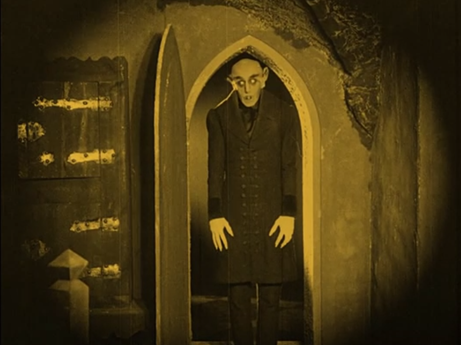
nosferatu1The hand of F.W. Murnau is less noticeable in this early classic of his, but Nosferatu still works seamlessly as a piece of drama and horror. In fact, it by now has become somewhat of a horror classic and the archetype when it comes to vampire movies, taking a lot of inspiration from Bram Stoker’s Dracula. I think one of the things that makes Nosferatu so gripping is the fact that it mixes the plausible with the supernatural making for this weirdly rewarding ride. Is it scary? No, not in the modern sense of the word.

But it’s a story steeped in Myth. There is mention of the Black Death, supernatural creatures, and a being that “suckles himself on the hellish elixir of their blood.” What wonderful imagery that develops a genuine awe in this devilish being. And yet in the same instance, we’re getting scientific explanations of venus fly traps and tentacled polyps acting as symbols certainly but also tying us back to the real world. These forces of nature are real, backed by science, and make a vampire just a little more conceivable.

Running through Nosferatu is a love story, and much like Sunrise, although Nosferatu is a “symphony of horror,” there is also a bit of a love song underlying the vampire tale. It lends this story some heart, because these characters, like our protagonist Hutter, actually have something to live for.

Nosferatu most certainly is a symphony, and along with the expressionistic images, it uses title cards as well as excerpts from ship logs, books, and letters to tell the story. One such inter-title card from Count Orlock reads: Your wife has a lovely neck. Hutter has little idea what he means (or pretends not to), but we know, making it a rather funny but unnerving comment. There’s something about knowing what is undoubtedly going to happen and being powerless to stop it. For instance, when someone acknowledges they have two mosquitoes bites quite close together that spells trouble to the audience, but we can only watch and wait.

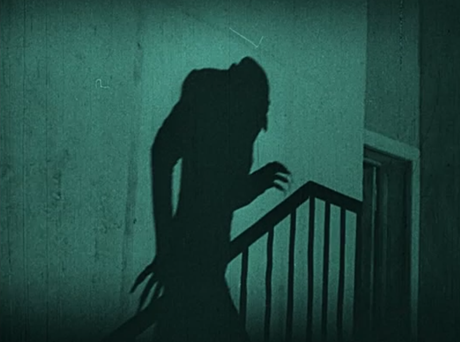
nosferatu2Because when Hutter first goes to offer Count Orlock a house we know it is bad news, to begin with, but it takes a long time for anything to actually happen. Orlock moves into the abandoned mansion across from Hutter and his wife, and that’s when the danger strikes close to home. There’s a madman in the hospital diverting attention, and Hutter winds up incapacitated so he is incapable of coming to the aid of his love. She is left vulnerable and the vampire has already proven what havoc he can wreak with the crew on a ship. Aside from Max Schreck’s frightening facade complete with pointy ears, bulging eyes, and menacing fingers, the vampire literally appears and disappears into thin air. There is a haunting aura built around him because he is something supernatural, something that we cannot understand except through myth. I found myself getting tense waiting for something that I was not sure about. That was the exciting part. It’s not a blood and guts, monsters jumping out of closets, kind of horror. It’s not ridden with cliches either because it was the one creating its own mystique.

It’s hard to believe how much popular culture has been derivative from Stoker’s Dracula, much like Doyle’s Sherlock Holmes, or Shelley’s Frankenstein. However, amidst all the vast works of Dracula and vampires, Nosferatu stands out. It represents the visual aesthetic of German Expression wonderfully, and it casts a long shadow. It’s hard not to, at the very least, admire its artistry and be taken aback by its legacy. In the realm of silent films, Nosferatu is a must, pure and simple. It doesn’t rely on bloodcurdling shrieks and screams, but the images begin to invade our consciousness. One seems fleeting and the other sticks with us.

4.5/5 Stars

The Last Laugh (1924)

lastlaugh1Without sound, silent films become almost a completely visual medium and there was no one more visually-minded than German director F.W. Murnau. Aside from the opening title card and a message to begin the epilogue, he stays away from that kind of aid to tell his story and instead relies wholly on the image. His film does, however, boast a vibrant score, so that fills the void in the absence of dialogue.

Emil Jannings, the rotund, mustachioed leading man, stars as the veteran hotel porter, who is demoted to bathroom attendant due to his age and frailties. And it’s true that he always seems bent over and perpetually weary, but it only gets worse when he loses his esteemed position as the symbol of The Atlantic Hotel. Before he stood beaming ear to ear in his prim and pressed uniform that reflected his status. Then, he winds up towel in hand, resigned to stay hidden away in the bathroom. Now everyone could care less about him. It’s a tragic trajectory that this story takes.

The film opens at the lavish hotel which feels very similar to the grand hotel, and this along with the man’s apartment building are the main locations that Murnau works with. And he does set up his scenes so interestingly, whether it’s around a revolving door in the hotel or the staircase in the apartment. He’s constantly giving us a perspective of things with wonderfully textured, layered shots exemplified sublimely in such moments as Jannings superhuman feat carrying the large chest. Murnau gives it a wonderfully dreamy, ethereal quality, the way he clouds the frame. He also uses his actors in dynamic ways to fill the space in front of us. It hardly ever feels static or boring for that matter, because there’s almost always something of interest to be looking at.

lastlaugh2This is a very heart-wrenching film, because, in a sense, at its core, it’s about aging gracefully and trying to navigate that season of life. Because, the reality is that, each one of us will grow old. Our bodies won’t be able to function like they used to. Our feet will grow weaker. Our eyes will become tired more easily. We can completely understand this man’s plight. He has pride and the shame of acknowledging his demotion is too much for him to bear. He tries to hide it, from the wife and from the neighbors, but, of course, they find out. His family is ashamed and his neighbors belittle him with glee. The saddest thing is this doorman is not a bad fellow, as illustrated by how he comforted a little girl who was being made fun of. He’s a good man, and he deserves better than this and yet life very often is not just. The gossips and the connivers seem to get ahead. The beatitude, the first shall be last, hardly ever seems to be true. In fact, the film pauses with the following title card:

“Here the story should really end, for, in real life, the forlorn old man would have little to look forward to but death. The author took pity on him and has provided a quite improbable epilogue.”

There is a major shift in tone as the doorman is left a huge sum of money rather unexpectedly, and he spends the days now eating heartily and generously tipping all his former colleagues at the hotel. It almost feels like a completely different story, and it’s the ending that we want as an audience. Except still lurking in the back of our minds is that this is very rarely reality. But there is some satisfaction that at least in this case Emil Jannings had The Last Laugh.

This film is literally a piece of film history that has thankfully been reconstructed for our viewing pleasure and I’m thoroughly glad it was. I’ve only seen Murnau’s Sunrise: A Song of Two Humans, which is magnificent. However, after watching this earlier work it made me realize I need to examine more of his filmography, including Nosferatu (1922), Faust (1926), City Girl (1930), and Tabu (1931).

4.5/5 Stars

The Graduate (1967)

thegraduate1“You’re living at home. Is that right?
Yes. 
Do you know what you’re going to do?
No.
Are you going to graduate school?
No.” ~ Elaine Robinson to Benjamin Braddock

As a recently graduated person, I thought it was only pertinent to return to this landmark film to see if I could glean any new insight. In many ways, the main premise of The Graduate always repulsed me. I couldn’t get behind the comedy because it seemed so at odds with what is going on onscreen.

But now I think I more fully understand Mike Nichols’ style as he leads us through Buck Henry’s script. There certainly is a wicked wit dwelling there, but there’s also more to it. He’s trying to undermine social mores and say something by switching tones on us. In this case, it seems like he’s talking to all those listless souls just set adrift after college. He was their elder, but in the characters of Benjamin Braddock (Dustin Hoffman) and some respects Elaine Robinson (Katherine Ross), young people found their equals.  People they could relate to in their own anxiety and at times apathy about the future. And it’s as much Elaine’s story as it is Ben’s since they both are riding off into the great unknown of their future together.

Thus, this isn’t just about an affair, though that did help to shatter the Production Codes. There is so much more that actually causes Benjamin to get involved with Mrs. Robinson (Anne Bancroft). The implications extend far beyond.While The Graduate‘s main hook seems rather curious, the rest isn’t all that crazy. In fact, it’s quite relatable.

We get our first view of Ben, sullen and anxious as he rides the moving walkway in the airport terminal. The haunting vocals of Simon & Garfunkel’s “Sound of Silence” ring in our ears, but there’s also that almost comical voice reminding travelers to use the handrails.

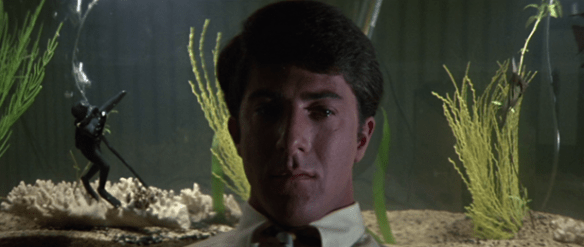
It’s when he touches down and gets home that things become all too real. He’s entering back into his parent’s world which is reinforced by this general theme of suffocation and in some sense alienation, fawned over by parent’s friends and encased in a scuba suit. Ironically, he’s no hippie or counter-cultural revolutionary, but he still feels at odds with the community he finds himself in. There’s a generational gap, and even Hoffman’s own portrayal is so contrary to this WASP society. In casting Hoffman, not a particularly handsome young man, an atypical example,  Nichols is ratcheting up the irony.
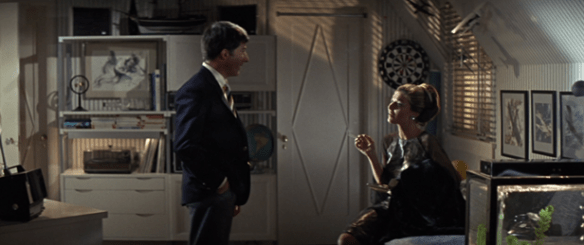
thegraduate2Then Mrs. Robinson coolly enters his life. It’s perhaps best signified when she tosses him the keys. They end up in the fish tank almost as if on purpose and after that she has him reeling for good. Soon he’s walking into the lion’s den (or lioness’s) as she expertly manipulates and elicits the precise response from him. In these moments the film is elevated by the awkward, huffing and puffing, and nervous chattering of Hoffman. We often forget the second part of his famed line, “Mrs. Robinson you’re trying to seduce me. Aren’t you?” His general naivete and hesitancy say it all.

I also made a startling discovery. Ben doesn’t have any friends! Or else, where are they? The inference perhaps being that he spent so much time being a track star, being on the debate team, and being editor of the paper that he never stopped to do the other things that college is all about. Building relationships with other human beings your own age. When he gets out and realizes his directionless anxiety, he tries to remedy it in other ways. The most obvious way is sleeping with Mrs. Robinson.
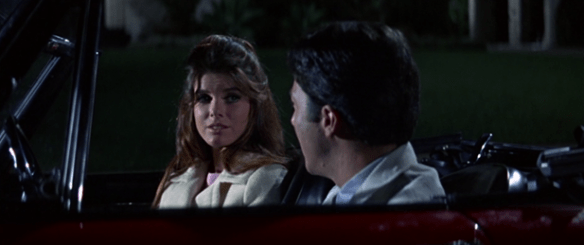
thegraduatesBut when he meets Elaine Robinson and finally begins to connect with her on a peer-to-peer level, it’s something so profound to him. Having someone his own age that he can relate to, who feels the same unnamed apprehension and angst that strains on him. It’s what makes Ben become so mixed up. He has true feelings for her, while his affair with Mrs. Robinson only serves to poison all that could be good. And his illogical, unhealthy pursuit of Elaine continues to Berkeley where she is attending school. Still, Mrs. Robinson and her now estranged husband look to send their precious daughter far away from Benjamin Braddock.

thegraduateThat’s what makes his final Herculean effort all the more climactic. He bursts in on her marriage to another man and whisks her off to another life altogether. A life that seems exciting at first, because, oh how great it is to be young and in love. But once they climb aboard that bus in their tattered garments, have a chance to sit down and really think about what they are embarking on, you see something else in their eyes. The laughter slowly dissipates and as they look around nervously, they begin to somber up. True, Ben is no longer alone in an airport terminal, he has a fellow traveler, but that does not make the future any less unpredictable or scary for that matter.

That is the life of a graduate. In so many ways feeling like an outsider, a foreigner in a land that you used to know. You’re living at home. You don’t know what you’re going to do and you’re not going to put off the decision by going to grad school. We’ve all been in a similar place one time or another and that’s why this film resonates, not only with the generations of the 1960s but even to this day.

What truly elevates The Graduate above Nichols’ other films, aside from this universal quality, is the stellar soundtrack courtesy of fellow New York natives Simon & Garfunkel, who became icons of the folk scene during the 60s and 70s. Their album Bookends is still a classic, featuring the fully polished version of “Mrs. Robinson.” While not all the lyrics are here in the film, it became an anthem, reflecting the gap created between the older generations and their kin. While the likes of “Sound of Silence,” “April Come She Will,” and “Scarborough Fair” lend themselves to the more introspective moments of the film like no score ever could. It’s part of what makes The Graduate a cinematic watershed of the 1960s.

4.5/5 Stars

The Shining (1980)

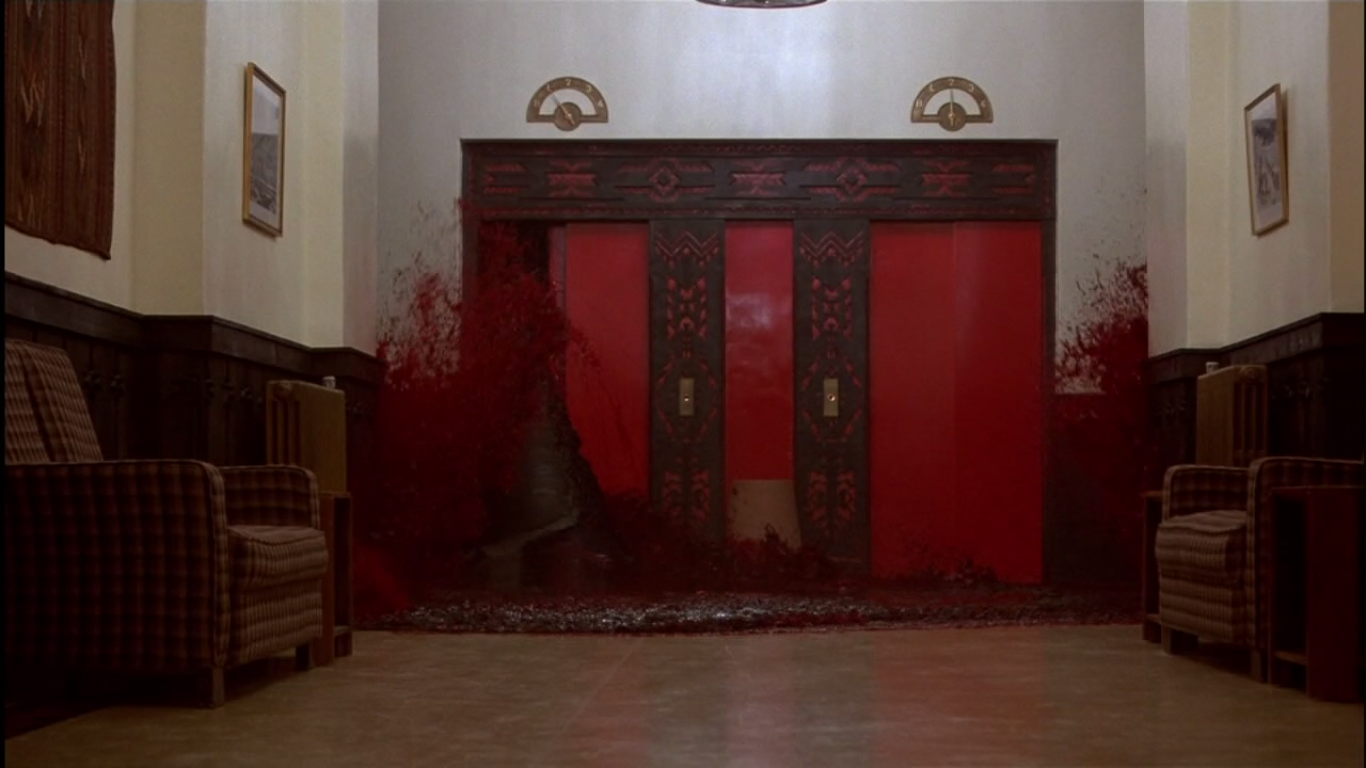
theshining3Stanley Kubrick is not generally known as a horror film director. His impact was far broader than solely one genre. How is it then that he made one of the enduring canonical films in the horror genre? It’s been over 30 years and people are still talking about The Shining — still using it in every kind of parody and homage imaginable. Like a Hitchcock or a Spielberg, he’s one of those directors with an eye for what’s thrilling as far cinema is concerned, but perhaps more so Kubrick deals in complexities. Ambiguity is his friend as much as the beautifully shot interiors of The Shining. He builds and constructs the perfect scaffold to work off of, and it’s full of tension and shock value, but it leaves the audience with questions. I watched Nosferatu recently and what I came out of it with was a conviction that it was not your typical horror film — it seems to follow you and haunt your thoughts in a sense. The Shining is a little more like a modern horror with frightening images, and yet it shares that same quality. You cannot help but ruminate over it or think about what you just saw and what it really means. Truth be told, I don’t know what to think about the cryptic ending and, in all honesty, I don’t care too much, although it makes for interesting discussion.

theshining1This film found its source in Stephen King’s novel (which I have not read). For the life of me, I had never thought of the significance of the title, but Scatman Crother’s character explains it in the same way that his mama had before him. “Shining” is being able to talk without your mouths. The little boy Danny Torrance has such an ability, and it proves to be the entry point into this film’s conceit. Not only is he able to say things without talking, but he sees things, horrible things, that other’s cannot — rather like The Sixth Sense (1999).

His father Jack (Jack Nicholson) and mother Wendy (Shelley Duvall) take him to a Colorado mountain getaway for 5 months of isolation, because it seems like a good deal. After all, Jack wants to get some work done on his book and he could use the unbroken solitude,  but of course, there’s an underlying tension that slowly builds as their time alone draws nearer. It’s done through the foreshadowing of cryptic images, violent tales of local folklore, and of course, a score that is constantly ringing in our ears. That’s the best way I can describe it. We know something is up.

So what does Room 237 mean? What about Grady and the bartender who serves Jack his drinks at the bar? They’re just as perplexing as Danny’s ability or the sudden change that seems to come over Jack. There are these perplexing moments that are difficult to account for whether it’s the initial introduction of the Chief (Scatman Crothers) and Danny, who he telepathically communicates with. Then, Jack Nicholson carries such a genial quality, and yet underlining all those Cheshire cat smiles is something deeply troubling.

theshining4Amidst the dreams and haunting images that blur the line between fantasy and reality, past and present, there is a strange fascination that develops for The Shining. Almost a morbid fascination, because we know something is wrong, but we keep watching anyway. We want to know what happens and furthermore, Kubrick’s visuals are often mesmerizing, although they remain indoors for the most part. His camera often trailing characters as if they are prey.

He pays his audience the final respect of not giving us everything and not tying up all the loose ends. We are left with images and photos ingrained in our mind’s eyes. Admittedly, Shelley Duvall is not an actress I usually pay great attention to, and certainly, this is Nicholson’s film along with Kubrick. He was made for such a twisted, layered role, that overflows with a certain level of affability and then becomes completely psychotic. It makes him far creepier than any villain clothed in black because Jack Torrance will openly kill you with a sing-song voice. That’s pure evil.

4/5/5 Stars

Review: Nashville (1975)

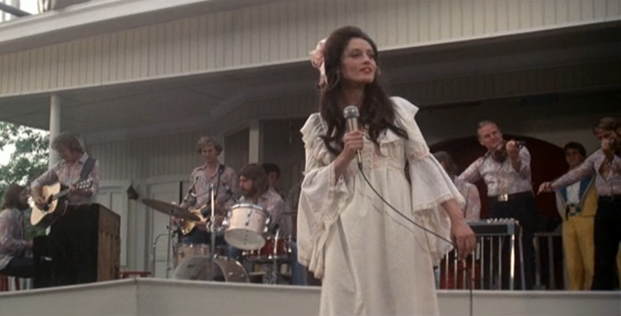
nashville3What to say about Robert Altman’s Nashville? It has a lot of songs and music so it’s technically a musical. It has its smattering politics and Altman is typically one for subverting the norm so you could call it a satire. There’s romance, drama, in-fighting, and star power certainly, but that hardly gets to the heart of the film.

In fact, Nashville has an ensemble bulging at the seams with 24 individuals billed in alphabetical order and their names called out at the beginning of the film as if someone is trying to sell us an album. It’s a little over the top, feels superficial, and it’s a little pretentious. Maybe the director’s trying to tell us something. Over the course of the following minutes, Altman gives us a picture of a few days in the life of the country music capital of the world, and he shows us all sorts of people.

nashville1To name all of them would be tedious and would not give a whole lot of illumination as far as the plotting, but a few of the more prominent names are as follows: Barbara Jean, the sweetheart of Nashville, who opens the film receiving a warm welcome at the airport from her adoring public. But she is physically and emotionally fragile after recovering from a traumatic injury. Then there’s Haven Hamilton, who is an established country star, who still enjoys large popularity and political ambitions are on his radar. Jeff Goldblum, Lily Tomlin, Karen Black, Ned Beatty, and even Keenan Wynn all make appearances. So as you can see the cast is oozing through the cracks.

Their stories are constantly colliding, intertwining, and weaving in and out of each other. Making for a type of narrative that feels organic despite having a script. It feels like a realistic and truthful immersion into Tennessee reality. We even get appearances from a couple Altman regulars Elliot Gould and Julie Christie. Furthermore, it wasn’t much of a secret that the industry in Nashville did not take a liking to the film, but really is that any surprise?

Going into the film we already expect to get a look at the industry’s underbelly and we do, but it’s hardly seems sensationalized; it almost feels commonplace until the final moments. Singers griping, sleeping around, reporters ingratiating themselves to whoever they can find, and the general public coming from far and wide to be a part of the spectacle. It’s about what you expect from an industry that can be ruthless, superficial, and very rewarding to some. To those on the outside, it’s something to be fawned over.

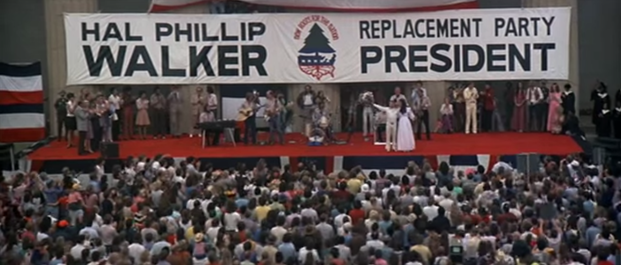
nashville2The story is framed with the political campaign of the unconventional Hal Philip Walker of the Replacement Party. You can see his van going all across town proclaiming his wisdom to the honest citizens of Nashville. Most of them could care less about politics. Even in the closing moments at a concert in the park with a big flag patriotically displayed on stage with a giant campaign banner underneath, you get the sense that no one has gone there for political reasons. They want to hear Barbara Jean, Haven Hamilton, and maybe tolerate anyone else who comes up on stage. In a sense, that’s the American way wrapped up in a nutshell.  Taken in that light, the way that Altman ends his film is not all that surprising. There has to be something to break up the normalcy. Subvert all that is good and patriotic. Throw a wrench in the every day, because after all his whole film has revealed everything that besmirches the industry. It’s just that it usually stays under the surface or is thrown away to be trampled on or forgotten. Take the no-talent Sueleen Gay, who stubbornly tries to make it in an industry that doesn’t want her.

I’m the first to acknowledge that I’m not much of a fan of country, except if it’s someone like Johnny Cash. So overall I find the tunes of Nashville to be homely and often tiresome, although I do appreciate the fact the actors wrote most of their own songs supposedly. The one exception I cite is Keith Carradine’s memorable tune “I’m Easy” which works as a simple ballad reminiscent of a Jim Croce-type singer-songwriter.

However, I don’t get hung up on Nashville‘s music too much, because this film represents so much more to me. It’s about the intermingling of people and the analysis and dissection of the relationships that are so closely entwined with the country music industry. Whether it’s the insiders or the fans who make them big, Nashville is a thoroughly interesting view of America circa 1975. Some things have certainly changed, fashion-related and otherwise, but I think we can all agree that a lot of things certainly have not. Politics, music, and most certainly people essentially exist as they always have.

4.5/5 Stars

Raiders of the Lost Ark (1981)

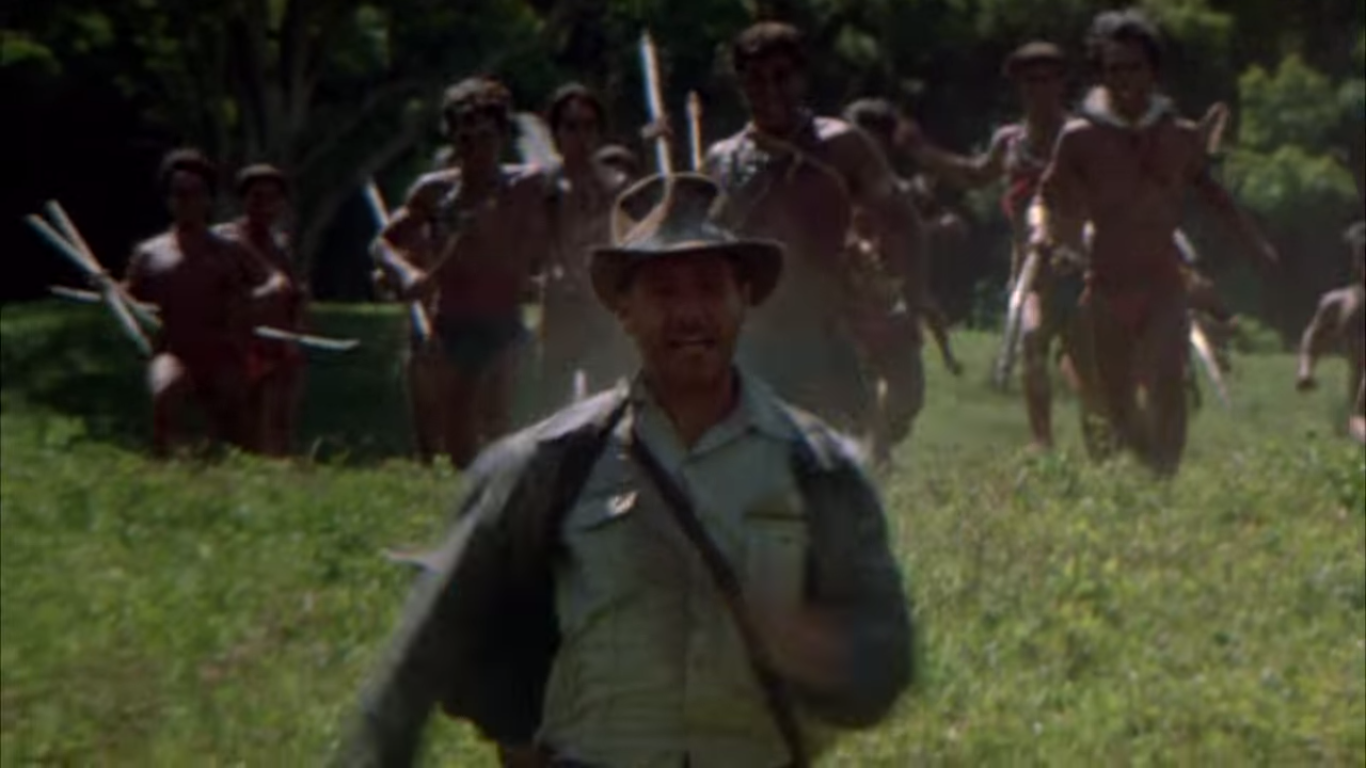
raidersof1I’m not one to rewatch movies too often — it’s simply not in my nature and I am still relatively young in my film affinity. That means there are still so many great titles to see and discover. But Raiders is one of the special films that I would gladly make room for every year at a couple times. Most of it has probably been said before, but to put it simply Spielberg’s collaboration with George Lucas is one of the greatest adventures put to film pure and simple. It takes inspiration from old action serials and there is something inherently classic about Indiana Jones and the world he inhabits. It is 1936, after all, and the perfect evil force in the Nazis is on the rise.

Raiders begins with an opening gambit that could standalone by itself with its introduction of Indy (Harrison Ford) as he tries to recover an ancient artifact. He dodges traps and outruns a boulder only to be thwarted by his old nemesis Belloq (Paul Freeman). That’s followed by one of the great cinematic panoramas as he makes a mad dance to his getaway plane where Jacques and his friendly pet snake Reggie are waiting. We don’t need much explanation because it just works.

raiderof2From then on we get a little more about Dr. Jones’s background as a professor in archaeology who is enlisted by two government men to impede the Nazis. Their goal is to recover the Ark of the Covenant because its supposed power would make their military might unstoppable. But most of us undoubtedly know that. Indy ends up tracking down the daughter of an old mentor who also happens to be his former flame, Marion Ravenwood (Karen Allen). They’ve got something still burning because although it is extremely volatile, you can see they still secretly care for each other. After they are paid a visit by the Nazis, Sallah (John Rhys-Davies) acts as their host and loyal guide in Cairo. That doesn’t stop Marion from getting kidnapped or Indy almost getting killed more than once. One of these times involved an iconic duel between a sword and a revolver (certainly not a fair fight).

raidersof3In fact, Raiders is made up of many of these memorable sequences that add up to something greater than their parts. It’s a full story surely, but it is built up from these varying vignettes. Indy gets thrown into a pit of snakes with Marion by his side. He nearly gets his head taken off by a chopper blade (you should have seen the other guy), and finally, he begins a high-speed chase for the ark on the back of a noble white steed. It gives him time to pull a few stunts on a truck as he whittles down the opposition single-handedly. The audience even gets an obligatory Wilhelm Scream once or twice.

What it all comes down to is tracking the Nazis to their island lair where they hope to test the great powers of the Ark. I’m not sure how biblical it all is, but it seems more like a Pandora’s box because far more trouble than good comes out of it when opened. But in his infinite wisdom Indy and Marion don’t do anything except keep their eyes shut. They’re tied up after all. And that’s how the raiders were stopped and Indy completed his treasure hunt. The Ark is in the hands of the government and they file it away with numerous other very important and highly secret artifacts. The perfect ending to a film that has humor, melodrama, supernatural power, and a good old-fashioned tale of good vs. evil.

It’s crazy to think that Tom Sellick was almost Indy if it were not for his commitment to  Magnum P.I. Because Harrison Ford, despite his many iconic roles, will forever be Indiana Jones, thanks to that hat, that whip, and that revolver. He’s an awesome adventurer-professor type. You don’t see that every day.

5/5 Stars

The Naked Kiss (1964)

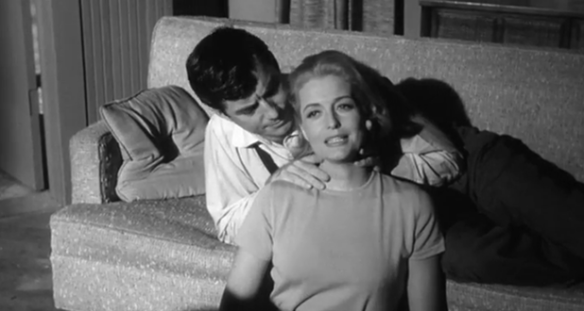
thenakedkiss1If you’re not at least mildly prepared for it, The Naked Kiss comes at you like a ton of bricks. A woman comes at the camera menacingly beating up a man, for a reason we don’t know. Then her hair comes flying off and there she is still swinging at him completely bald. It’s frightening, frenetic, and completely engrossing. From thence on, Sam Fuller has us in the grips of his story, even if we don’t quite know what it’s about yet. His hook has grabbed us.

It turns out the women we were so brutally introduced to is named Kelly (Constance Towers). A couple years down the road she looks strikingly different, with no sign of turmoil. Instead, she’s a sleek beauty working the streets of Grantville.

thenakedkiss2Of course, her first customer happens to be a police chief named Griff (Anthony  Eisley), who advises her to skedaddle out of town as quick as possible. He gives her the details on a cozy joint across the border known for their Bonbon girls. He thinks he’s got her pegged, but Kelly goes and does something even he wouldn’t expect.

She acquires a job at an orthopedic hospital for disabled children and quickly becomes a favorite in the ward. All the kids love her dearly, and she cares for them faithfully. But Griff still thinks she’s working an angle. His mind is closed off, looking for every opportunity to dredge up Kelly’s guilt. He wants to confirm everything he already knows about her, even if it’s not true.

Kelly’s stellar performance catches the eye of town millionaire J.L. Grant, who also happens to be a good friend of Griff’s. She and Grant hit it off on topics such as Lord Byron and Beethoven. Their time together turns into romantic dreamscapes of Venetian waterways.

At the same time, Kelly is extremely sympathetic to her fellow workers supplying money for a woman so she can keep her baby instead of getting an abortion. To naive young Buff, she warns of selling herself out and becoming a Bonbon (“You’ll be every man’s wife-in-law, and no man’s wife. Why, your world with Candy will become so warped that you’ll hate all men. And you’ll hate yourself! Because you’ll become a social problem, a medical problem, a MENTAL problem!… And a despicable failure as a woman”). It’s in these candid moments where Kelly reveals her scruples, although she’s not above vigilante justice, whether it involves her old pimp or the morally questionable proprietress Candy.

There are strangely peaceful lulls that only make the climactic moments in the film all the more dramatic. Fuller utilizes the children’s song from the hospital wonderfully with the hollow images he juxtaposes on screen. The song reverberates several times as a haunting marker of what Kelly has seen between a little girl and her soon-to-be husband. But that’s over with now. Kelly has deeper troubles to worry about afterward.

The Naked Kiss is a pulpy delight as only Fuller can deliver with twisted natures and deep-seated brokenness. He makes glorified trash which is often times far more engaging than the most polished blockbuster Hollywood can churn out. The seedy exterior almost always gives way to great depth. Even when you step back for a moment, it becomes obvious how implausible this story is. How does Griff not know about his best friend? Yet Fuller plays the drama so well we are completely engrossed.

thenakedkiss3The social commentary is there. The characters are interesting. Meanwhile, Fuller slices and dices through taboo subjects that would have horrified censors and yet he brings them to the forefront in such a way that hardly glorifies them, but actually gets them out in the open. Every detail isn’t written out, but Fuller throws us into the narrative and allows us to track with him. He puts a little faith in his audience.
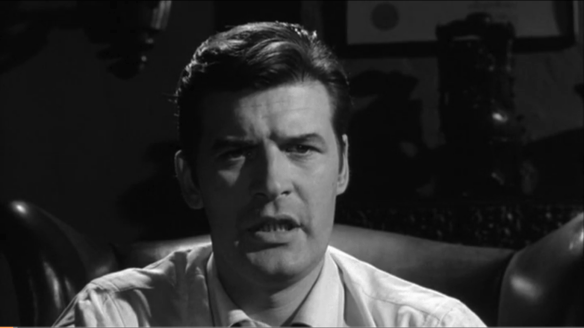
Constance Towers’ performance looms large in this film and she reminds me a great deal of Gena Rowlands. Her turn as Kelly is multifaceted and dynamic. Her look of genial charm just as easily turns into an icy gaze of contempt. Furthermore, she, much like Fuller, is willing to go to the streets and acknowledge all the dirt and grime there. She wants to clean it up, and she truly is the hooker with the heart of gold. Only such an easy categorization should not take away from Towers’ role at all. There’s more to her than a look, or a wig, or a body.  To paraphrase Grant, she’s the most interesting contradiction I’ve met in some time.

4/5 Stars

Shock Corridor (1963)

shockcorridor1“This long corridor is the magic highway to the Pulitzer Prize” – Johnny Barrett
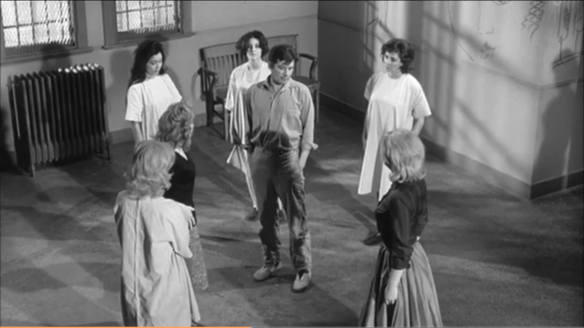
Being a jack of all trades, producer, director, screenwriter extraordinaire Sam Fuller also had a stint as a journalist. Therein lies his obvious stake in Shock Corridor, a film that looks frightening on paper, and is even more eye-opening in execution. True, this is not an altogether realistic film, but that’s what makes it such a stirring portrayal. It dives into the darkened recesses of a sanitarium showing us things we don’t want to believe. They probably weren’t all true, but there’s still that shred of doubt. We’ve seen enough One Flew of the Cuckoo’s Nest and read enough horror stories to know better. Fuller plays off that fear which intrigues us as much as it alarms.

Investigative journalist Johnny Barrett (Peter Breck) can see it now. If he infiltrates a mental institution he can dig up the truth on a murder case that occurred behind closed doors and was quickly hushed up. Such a piece of detective work could earn him the Pulitzer Prize easily, and the tantalizing prospect is too good to resist. His girlfriend played by Constance Towers pleads with him to back out, because she wants no part of the plan.

But he teams up with his editor Swannee and Psychiatrist Dr. Fong to cook up a backstory the people in charge will buy. Barrett gets coached in how to act and respond to every question. It’s a potential long shot, but just like that, they buy his sordid story of obsession with his sister thanks to a performance by Cathy. He’s in.

shockcorridor3Behind the pearly gates, there are brawls galore and noisy neighbors riddled with all sorts of neurosis, quirks, and ticks. There are the good cop and bad cop who help care for the patients and keep them at bay. Johnny even begins to have hallucinations of his girlfriend drifting through his dreams. He gets introduced to hydrotherapy, dance therapy, and even faces a traumatizing experience at the hands of women in the female ward.
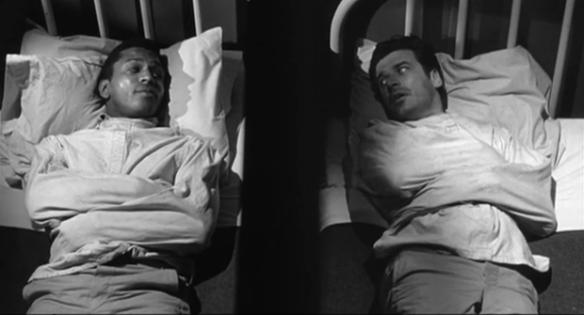
All the while, he is sniffing around for any information on the man named Sloan who was killed with a knife by a man in white pants. He makes his rounds questioning three different witnesses and amid their idiosyncrasies, they give him bits and pieces of fact. However, their own mental capabilities are clouded by traumatic war experiences, racist ramblings, and fear of impending nuclear war.

shockcorridor2The boisterous, tumultuous chaos of the ward does almost become maddening, even to the viewer. Johnny has a few angry outbursts of his own as the strain of the facility gets to him more and more every day. Electric shock therapy among the other treatments leaves him mixed-up, confused, and overtly paranoid. He’s hardly the man we met in that office so many days ago and even if he got the scoop he was looking for, at what cost? Shock Corridor has a thunderously disconcerting ending worthy of a Fuller production.
From casting Philip Ahn as a knowledgeable psychiatrist to the absurdity of an African-American obsessed with the KKK and Pro-White sentiment, Fuller once again does a lot on the racial front. He manages to represents Asians in a positive light and the character of Wilkes points to the still inherently twisted nature of southern white supremacists, even after the advent of such legislation as Brown v. Board.  Thus, once more he gives us a sensationalized story with a surprising amount of depth to it. No doubt he had a soft spot for journalism since that’s what he made his living off of at one time. But Shock Corridor implies that there is such a thing as crossing the line. It’s the utter extreme, but it’s cautionary nonetheless.

3.5/5 Stars

The Steel Helmet (1951)

steelhelmet1“What a fouled-up outfit I got myself into” – Sgt. Zack
Samuel Fuller always had an eye for the visually dynamic and a nose for controversy. His war picture The Steel Helmet was at the forefront of films about the Korean War, in fact, it was probably the first.

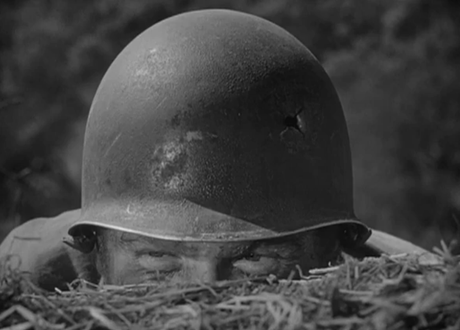
Despite, being shot in a few solitary days in California, he somehow managed to develop a generally atmospheric terrain overflowing with fog of war and overgrown with foliage. It’s an unsentimental, gritty, sweaty storyline. In other words, it’s very Fuller and its cynical lead is Gene Evans as the thick-headed Sergeant Zack weighed down by war-induced pessimism. He’s got a bullet hole in his helmet to prove it. He’s been good enough to last through this game of survival of the fittest thus far, and he hopes to keep it that way.

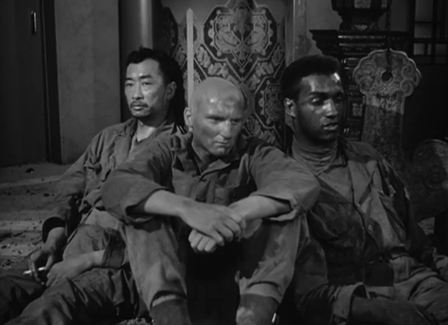
Zack picks up a peppy young South Korean, the original “Short Round,” and the sergeant reluctantly allows him to tag along as he continues his pilgrimage. Next, comes the African-American medic Corporal Thomson, who like Zack was the sole survivor of his unit. In the forest depths, they run into a band of soldiers led by the experienced Lt. Driscoll. Although Zack wants nothing to do with them, he agrees to stick around after they get pinned down by a couple snipers.

Their mission: to set up an observation post at a nearby Buddhist temple.  However, the road ahead includes booby traps and other menacing perils of war. They have one of their hated “gooks” waiting for them, and he causes some havoc before being captured. However, perhaps more insidiously he tries to undermine the men by going after Thompson and the “Buddha head” Nisei vet named Tanaka (Richard Loo). The wily enemy, in perfect English mind you, notes the hypocrisy of an American society where African-Americans can die on the battlefield, but then only get to sit on the back of a bus. He then suggests how he and Tanaka have a great  more in common, aside from their eyes, especially since the American government put Japanese-Americans in Internment camps

steelhelmet2But the old WWII vet simply acknowledges the facts and retorts with his own piece of trivia. In the all Japanese-American regiment the 442nd 3,000 Nisei “idiots” got the purple heart for bravery. All he knows is that he’s an American no matter how he’s treated. That doesn’t change. Once more Fuller delivers some of the most engaging portrayals of Asian characters ever and the discussions of race relations were way ahead of their time. Both Richard Loo and James Edwards are honorable characters who hardly fall into any common stereotype.

After staving off this psychological warfare, the band calls in an artillery barrage on some nearby snipers. But soon the enemy is swarming them and it’s a wildly thrashing, blasting battle to the death.  The fight scenes are sheer chaotic madness, but then again isn’t that what war often escalates to? It just doesn’t make sense. Billows of smoky haze engulfing the war zone. Whirrs, bangs, explosions, and every other sound imaginable except silence. That comes when the bodies are dead and strewn all over the battlefield. In truth, silver stars mean very little when you’re just trying to survive.

Fuller was prophetic by suggesting that there is no end to this story. He was right. It went on for a couple more years and ended in a cease-fire that still continues between North and South Korea to this day. He’s also one of the great economical filmmakers where less is most certainly more. What a stroke of brilliance that he could use a weeks time, the grounds of The Griffith Observatory, and a few minor actors and extras to create such a fascinating film.

4/5 Stars