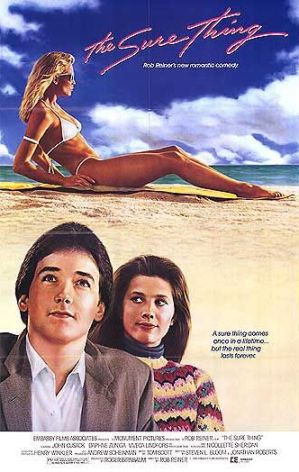
The Sure Thing (1985)

Sure_thingposterThe Sure Thing is one of the early works of both director Rob Reiner and young teen star John Cusack, and it proved to be a success for both parties. In the film, Walter Gibson and his friend Lance are heading off to college. Gib is heading to a stuffy school on the East Coast, while Lance is venturing off to the sun-soaked southern California shores with the female prospects at an all-time high. It doesn’t help Gib who has recently been striking out with the opposite sex, because, to put it bluntly, they don’t buy his astronomy inspired pick-up lines. He’s just too much of a jerk.

And so the two friends go off to their separate spheres and for Gib things do not end up too bad. His school’s not a bore, but he’s not getting the kind of action Lance has, not yet. That is until his friend tells him about a “sure thing.” The girl who is one out of a million and who is available, just waiting for Gib in California. So as any red-blooded American college student would do, Gib begins the cross-country trek over his Christmas Break.

The catch is this. He’s forced to travel with an overly enthusiastic couple obsessed with singing show tunes and that’s not the worst of it. His backseat companion is fellow classmate Alison Bradbury (Daphne Zuniga) who happens to be very attractive, but she also hates his guts.

She and Gib happen to be polar opposites, and they did not get off to a good start at school. She already has a boyfriend. She is always on top of her academics, and she never does anything outrageous. Gib is a showboat, prone to wildness that includes shotgunning beers and trying to pick up girls.

Their constant bickering and nagging find them sitting on the roadside in the middle of nowhere trying to thumb their way to California. And so it looks like they will go their separate ways, but they end up traveling together, broke, wet, and starving. Somehow they get there and along the way they begin to genuinely appreciate each other. There does not have to be anything between them. Of course, right before they get to their final destination a disagreement leaves them at odds. However, after spending so much time with someone like Alison, a sure thing just does not have the appeal it once did for Gib. He proves to himself that’s he’s not quite as shallow as he thought he was. If only Alison could know that.

The enjoyment of this film is not so much in discovering the result because any Joe Schmoe who has seen at least a handful of romantic comedies knows how the story is supposed to end. The true joy of the experience is how we arrive there with these two characters. In the back of our minds, there is a kind of peace of mind, because although they seem so far apart and at odds, we know where they will end up. We can take a little bit of enjoyment out of every single moment they spend together mundane or not. In many ways, the road movie feel of The Sure Thing brought to mind other similar storylines like Train, Plains, and Automobiles as well as It Happened One Night. I have to say I was pleasantly surprised by this film. Cusack pulls off the lovable jerk well and despite her initial stuffiness Daphne Zuniga is a lot of fun too.

4/5 Stars
Young Mr. Lincoln (1939)

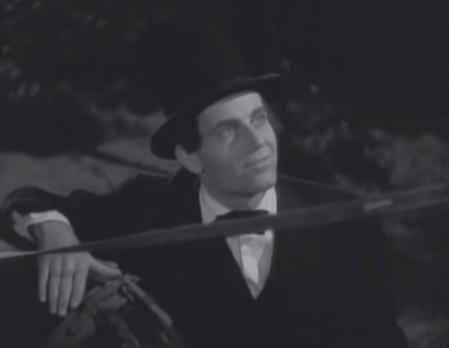
youngmr1Hailing from a year laden with numerous American classics, Young Mr. Lincoln is undoubtedly overlooked in deference to other titles like Gone with the Wind and The Wizard of Oz. Even John Ford’s own Stagecoach, starring John Wayne, overshadowed this autobiographical work headed by Henry Fonda. Then the next year they came out with The Grapes of Wrath and that title garnered praise for both men. But again, it seems like most have forgotten about Young Mr. Lincoln.

It really is a shame, because this is a quintessential Ford film, and Henry Fonda gives an iconic turn as one of the great historical giants of all time. Except instead of focusing on his major accomplishments, trials, or fatal death, this story contents itself with a simpler story. The focus is the fledgling law career of Abraham Lincoln, who back in 1857 is only a lanky country boy with a hankering for learning. He sees tragedy at a young age when people pass away around him and yet out of those formative years rises a man who is wise beyond his years, because he understands his fellow man and cares deeply about justice.

Lincoln is hardly a lawyer of any repute, and he seems hardly a political figure compared to the likes of the great Stephen Douglas. But the people respect him because he wins them over with his common sense and homespun witticisms. Aside from his ubiquitous top hat, he willingly judges pie eating contests, and play the Jew’s harp with feet reclined at his desk.  One of his dear admirers is the young socialite Mary Todd who takes an immense liking to him. He’s the kind of figure that the elite and common folk alike can truly respect.

So when two brothers are accused of murdering another man after a fight one night, it is Mr. Lincoln who avoids a lynching and appeals to the morals of the locals. He, in turn, promises the mother of the boys that he will do his very best to win their freedom and he does all he can to gain her trust.

When the trial begins he carefully picks the jury and faces off against a venerable prosecutor with much greater experience than himself. The mother of the accused saw the squabble, but she cannot bear to implicate her sons. Lincoln pleads on her behalf.  It also looks like the key witness and friend of the deceased man will put a seal on the case, but young Mr. Lincoln is not done yet.

Thus, the film ends and Lincoln is most certainly on the rise, but we get to imagine his future knowingly, on our own, because none of that length of the story is told. In that way, it’s rather interesting to juxtapose Ford’s film with Spielberg’s more recent biography Lincoln, starring Daniel Day-Lewis. They represent different generations of filmmaking, because the latter film takes a monumental moment in history, the passing of the 13th amendment, and places a magnifying glass to it. Focusing on all the individuals involved, and it is certainly going for an amount of period realism, starting with the impressive performance by Day-Lewis as our 16th president.

Young Mr. Lincoln is a lot simpler because it does not need to focus on the highlights. It takes as great of an interest in Abe’s origin story so to speak. On his part, Henry Fonda plays the role wonderfully using his mannerisms and plain speaking delivery to give a homey quality to Lincoln. He’s believable, but in a different way than Day-Lewis. It’s not better or worse necessarily, just different. That being said, Young Mr. Lincoln deserves a place among the exulted classics of that legendary year of 1939. Hopefully, it will continue to receive the respect that it deserves, because it is a moving and surprisingly very witty film. Probably in the way Abraham Lincoln was.

4.5/5 Stars

Love & Mercy (2015)

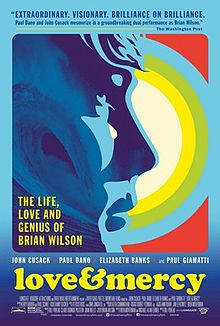
Love_&_Mercy_(poster)It’s a tough one. How do you do justice and even begin to scratch the surface of a living legend like Brian Wilson? His songs have brought joy to countless millions and numerous generations of music lovers. And yet out of all the joy he gave people, his life was steeped in so much pain and suffering. If anything became all too clear, it was the harsh reality of his life back then, but thankfully not now. At first, I didn’t understand the significance of the title (It’s the lead track of one of his albums back in 1988), but the words it hoists up are so perfect in describing his character.

I must say that I was a little skeptical of two actors playing Wilson. For those who don’t know, Paul Dano plays a young Wilson in the ’60s during his creative peak and familial turmoil. Then John Cusack picks his portrayal up in the ’80s when a messed up Wilson is being controlled by his quack psychiatrist Eugene Landi. They seem like two starkly different touch points, displaying two very different actors. Again, how could a director, in this case, Bill Pohlad, find cohesion out of this narrative chaos? But it works and ironically, that’s exactly what Brian Wilson did in his lifetime. That’s why he was such a mastermind.

As a young man his father abused him — hounded him to death. He suffered panic attacks, stopped touring, and embarked on some of the greatest musical odysseys anyone could ever hope to imagine.  We are thrown headlong into his genius during the Pet Sounds and Smile sessions. It might be a reenactment, but it feels like I am watching an artist at work. He’s on a different level, and it makes me appreciate each one of his songs even more. On a side note, I recently saw the documentary The Wrecking Crew, about the famed group of session musicians. And while they brought the skill in their craft, Wilson did truly bring artistic genius that was unique to him. That’s what, in many ways, caused a rift between him and his bandmate cousin Mike Love.

We are tossed back and forth from earlier past to later past as Wilson meets cars saleswoman Melinda Ledbetter (Elizabeth Banks) and embarks on a new journey as the manipulative Landi continues to drag him deeper and deeper into hell. In fact, sometimes it’s hard to imagine that this is the same Wilson and that is helped by Cusack’s performance. He is jumpy, helpless, muted, almost in a haze. But in him, you can see there is an immense vulnerability and capacity for love. That’s what Melinda sees as the layers get peeled back and that’s why it tears her apart seeing Brian suffer so.

As it turns out, Brian Wilson’s mind is not only a place of musical creation, but of fear, pain, and confusion. He was stuck between an antagonistic father and Landi’s manipulating presence. Whether it was the abuse, the drugs, the hallucinations, or a little bit of each, his story is one with a happy ending, and the film plays out that way. Isn’t it fitting that his immortal tune “Wouldn’t It Be Nice” closes the gates on this chapter of his story? It certainly is not over, still going, forever hopeful, and continuing to soar ever higher on a wave of positivity.

His genius astounds and now his resilience amazes me. He finally has found the Love & Mercy he deserved. Thank you Brian Wilson for gifting us such immortal tunes.

4/5 Stars

An Affair to Remember (1956)

anaffairto2An Affair to Remember (1956) has always been noted as a great American romance as far as I can ever remember, and I figured out that part of that was because it gets a mention in Sleepless in Seattle (1993). Whatever the reason, I finally got around to watching it and it is certainly an enjoyable weepy. Any film with Cary Grant as a romantic lead is usually, at the very least, charming and this one is too. He is a famed man on an ocean liner who has finally gone and gotten himself hitched. It’s big news and as soon as the ship touches down he is going to meet his love.

Quite by chance, he meets Deborah Kerr’s character and they are immediately taken with each other. Soon their friendship grows into an affectionate romance, and yet they feel uncomfortable in front of the other passengers who seem to be watching their every move with interest. They both know that once the boat reaches New York things will not be the same between them for some time.anaffairto4And so it is, but they had made one last plan to meet each other at the top of the Empire State Building. Grant makes it, but Kerr is detained for a very good reason. After seeing her in an awkward situation at the theater, Grant resolves to go see her and get to the bottom of what happened. It’s a tearful, albeit happy, reunion as they come back together.

If any of this feels familiar, like a rerun, that’s because it is. Leo McCarey actually made An Affair to Remember (1956) as a scene for scene remake of his earlier film Love Affair (1939). I never thought I’d say that I like a film with Charles Boyer more than a comparable one with Cary Grant, but it’s the truth. I’m not sure if it’s because I saw it first or that the film feels more intimate, but I really enjoyed Love Affair. An Affair to Remember is certainly elegant in color and Deborah Kerr gives a fine performance, but I was personally blown away by Irene Dunne as an actress. In fact, back in the day, Dunne worked quite a bit with Cary Grant (The Awful Truth, My Favorite Wife, and Penny Serenade).

So my advice is, go back and give Love Affair a watch. It’s still by McCarey with much of the same story so it’s really a personal preference what film you like more.

3.5/5 Stars

Terminator 2: Judgment Day (1991)

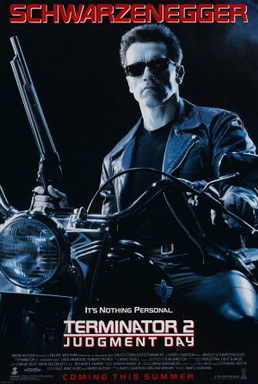
Terminator2posterBack in 1984 a strange life form came to earth in search of Sarah Connor and ultimately left a trail of destruction. It’s the same terminator (Arnold Schwarzenegger) who now shows up in the year 1991 intent on getting the right clothes, transport, weaponry, and cool shades to aid in the completion of his new mission. It’s the same terminator, except not really because he has been reprogrammed to protect young John Connor who will be the future savior of civilization as we know it. Right now he is a 10-year-old juvenile delinquent living with foster parents. His mother, the aforementioned Sarah Connor, is locked up tight in a mental institution after the events in the previous film.

But there also is a second more highly advanced terminator that Skynet has sent to assassinate Connor, and it becomes obvious that he is in grave danger. Both cyborgs converge on his location, and he flees with the help of his new found guardian. The terminator is programmed to listen to him and over time they form a bond with John teaching him slang (ie. the famed “hasta la vista baby”) and perhaps more importantly that he cannot kill everyone he sees.

They go to rescue Sarah from captivity on John’s bidding, but the other terminator has the same idea. The resourceful mother has plans of her own that are disrupted by witnessing her former executioner with her son close in toe. It’s all very confusing as they must alert her to the real danger and escape the present dangers.

Sarah leads them out of the city to the home base of a loyal friend who can give them resources and, above all, weapons. She sets her sights on Miles Dyson, the man who unwittingly developed the technology that would end in “Judgment Day.” In a fit of vigilantism, she mercilessly goes after the innocent man, for his work which would cause millions of future deaths. It takes the arrival of John and the Terminator to get her to calm down.

With Dyson’s help, they head to his office to destroy the prototypes for good, but they get a little company and it turns into a firework show complete with pyrotechnics and blockbuster explosions.

Yet again the shift-shaping, poly-alloy terminator pursues the trio and this time they are trapped inside of a steelworks. It’s a fitting locale for a desperate showdown with a wounded Sarah, a battered Terminator, and a thoroughly frightened John. Some last-ditch heroics finish off the futuristic assassin, but that is hardly the end of the story. John must say goodbye to his friend and probably the best male role model he’s ever had. He was a faithful companion to John, and he, in turn, came to understand why humans cry. There are just some things that cannot be expressed through words, protocol, or any type of rationale. The future is still to come, but at least for the present is safe.

I am unabashed to call Terminator 2 thoroughly enjoyable, because it embraces the fundamentals of a great sci-fi blockbuster, while never quite losing its human component. Perhaps we could have used more character development and less action, but the characters played by Linda Hamilton, Edward Furlong, and Arnold Schwarzenegger have enough depth to make them work proficiently. In fact, they are icons by now and I can understand why. James Cameron certainly knows how to develop thematic spectacle to the nth degree and this installment is no different. This sequel is bigger and better than the original 1984 film, which is a testament to not only the special effects but the story and characterizations. Hasta la vista Baby. Until next time anyway.

“If a machine, can learn the value of human life, maybe we can too” ~ Sarah Connor

4.5/5 Stars

Purple Noon (1960)

purplenoon4Right off the bat, there are two things that stick out about Purple Noon. First, you cannot help to notice the colors because the blues and reds pop like some vibrant 1960s painting. Then there’s Alain Delon who at the age of 23 made his rise to stardom, thanks to this film and Rocco and his Brothers (1960). As Tom Ripley, he finds a role that is fascinating in more ways than one.

During the first interludes of Rene Clement’s thriller, based on the Patricia Highsmith novel, I didn’t really know what I was watching or what to think. Tom was sent to Italy to bring the wealthy Phillipe Greenleaf back to San Francisco at the wishes of the man’s father who is paying Ripley. Their story begins as an entertaining jaunt through the city. They lounge at cafes, take carriage rides, and generally have fun living it up at night.

Tom is nothing like Greenleaf. He’s far poorer coming from a humbler background, but he is also much more resourceful and clever. When he takes a trip with the wealthy young man aboard his yacht, he finally hatches a plan to get what he wants. He abruptly stabs Greenleaf during a game of cards and the whole trajectory of the film changes in an instant. It began playfully absurd and quickly switches gears as a thriller involving murder, stolen identity, and deception.

purplenoon5

He plays up the tiff between Greenleaf and his girlfriend Marge, telling her that he is still angry and so he went off somewhere else without her. Thus, begins Ripley’s transformation into Greenleaf, forging a passport and signatures until he can pass off as the man himself. He starts dressing differently, spending more money, and continually acting as if he actually is Greenleaf. But things get difficult when he nearly runs into folks he knows, and Marge is desperate to know where her love is. These all prove problematic and yet Ripley skirts most of these entanglements with relative ease. It’s when a friend of Greenleaf’s named Freddie Miles figures out his charade that things begin to escalate because Tom’s only option seems to be murder. He commits the act coolly and plans his next move with calculated ease.

The police are after a murder, but it looks as if Tom has tied up all the loose ends and we find him relaxing reclined on the beach. He doesn’t know that the game is up, because of what the police found at sea.

The visuals of this film definitely do justice to the young Delon who is strikingly handsome with piercing eyes, but his turn is interesting in its own right because he was always so adept at playing the coolest of characters. He’s no different here and Purple Noon proved to be the initial boost to his storied career.

4/5 Stars

Kiss me Deadly (1955)

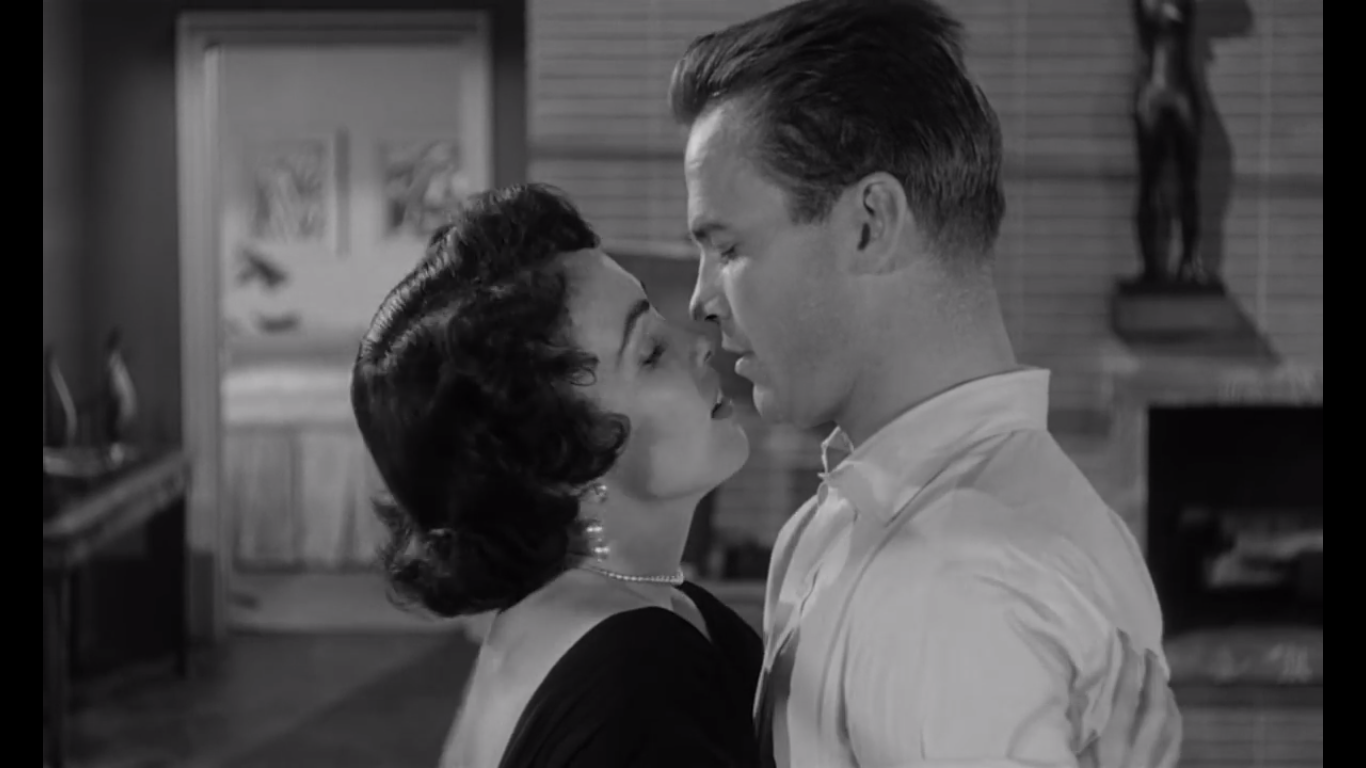
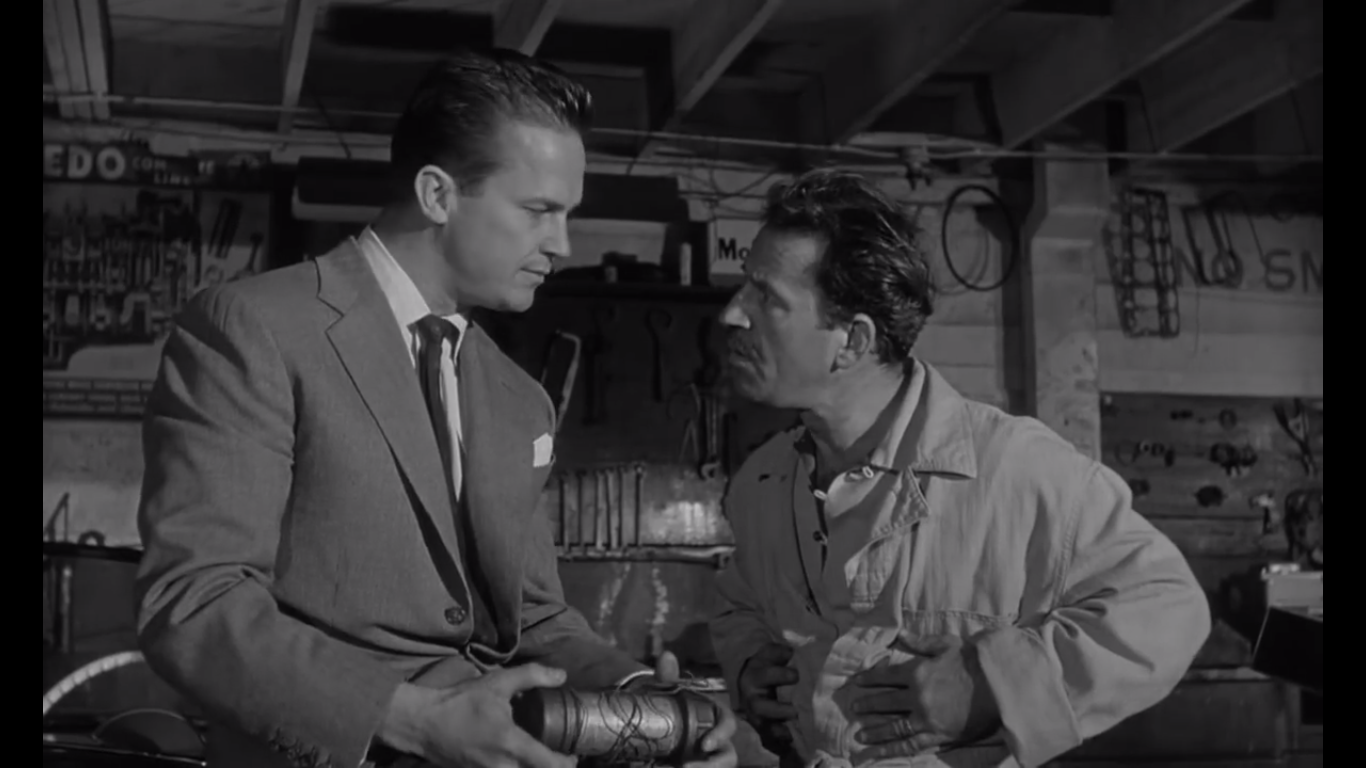
kissmedeadly1Set in L.A., the film stars Ralph Meeker as the callous and often corrupt P.I. Mike Hammer, adapted from the Mickey Spillane novels. One night while driving, Hammer picks up a frightened woman who begs him to remember her. They are forced off the road by thugs and the girl is eventually killed. Hammer wakes up in the hospital to his secretary girlfriend Velda (Maxime Cooper). He makes it his priority to find out what the mysterious woman was talking about. He meets up with opposition and a femme fatale, but Hammer keeps on going using strong-armed tactics. He finally tracks down a mysterious whats-it but then discovers that Velda was kidnapped. In the final confrontation, he finally learns who he was looking for and he finds out the consequences of the Pandora’s box in the hands of a deadly female.

Out of most of the prominent works in the canon, Kiss Me Deadly is probably the pulpiest of L.A. Noir. The images are rather like a historical time capsule of 1950’s Los Angeles with locations on Wilshire Blvd., Sunset Blvd, and even near Angels Flight. It has crisp black and white cinematography with many noticeably low angles underlying the sleekness, but also the paranoia wrapped up in this story. It arguably has the queerest cold open and ending of any noir, which I cannot help but remember.kissmedeadly2Ralph Meeker plays’s Mickey Spillane’s P.I. Mike Hammer to a tee. His husky voice perfectly fits the bravado of Hammer, a misogynistic brute prone to coercive action. Out of all the private gumshoes we’ve met, Hammer is probably the lowest — he’s a real scuzzball.

 Hammer throws women around like playthings and even his girl Velda has a double purpose. Yes, she is a lover, but she also makes a keen asset for business. As a P.I. specializing in divorce cases and marital problems, he’s not below giving business a little help. Velda willingly works on the husbands for him and he’s not above playing around with their wives. It’s a cozy little set-up.

kissmedeadly8That’s Hammer’s level and so when he gets caught up in the story of the mysterious girl Christina (Cloris Leachman), he has no idea what he gotten himself into. It’s a lot bigger than him and when the authorities throw around words like the Manhattan Project, Los Alamos, and Trinity he finally understands what its all about, but not really. In essence, Kiss Me Deadly is the quintessential film of paranoia in the Cold War nuclear age. We have a MacGuffin in the form of the mysterious Whats-it, but aside from that, we get few answers. Only a few deaths and some mighty destruction.

kissmedeadly4

Kiss Me Deadly has some great characters aside from Hammer and Velma. The thugs are played by the perpetually cross-eyed Jack Elam and the glowering Jack Lambert which turns out to be great casting. Also, the lively Greek-American Nick (Nick Dennis) is a great deal of fun with his enthusiasm and a lot of “Vavavoom!”

It’s an interesting dilemma because I have never loved Kiss Me Deadly, but director Robert Aldrich developed a film that is so persistently interesting. It was a film that was supposed to ruin young viewers for its moral depravity, sensuality and who knows what else. This film literally screams “Remember Me” and honestly I will not be forgetting about it anytime soon.

3.5/5 Stars

Christina: You have only one real lasting love.

Hammer: Now who could that be?

Christina: You. You’re one of those self-indulgent males who thinks about nothing but his clothes, his car, himself. Bet you do push-ups every morning just to keep your belly hard. 

You Only Live Once (1937)

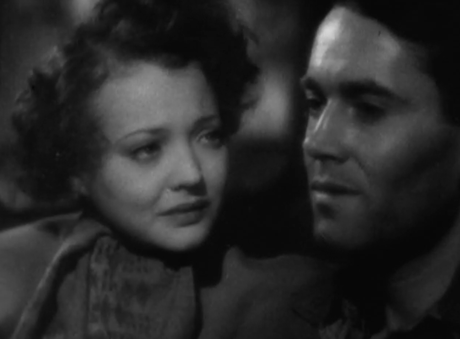
youonlylive1There are two types of lover-on-the-run narratives. There’s the Bonnie and Clyde/Gun Crazy extravaganza full of shoot-outs and bloodshed. Then you have the more sensitive approach of a film like They Drive By Night. You Only Live Once fits this second category thanks to two bolstering performances by Henry Fonda and Sylvia Sydney. Fonda is forever known for his plain, naturalistic delivery full of humanity. He has that quality as 3-time loser Eddie Taylor certainly, but he also injects the role with a somewhat uncharacteristic rage. In many ways, he has a right to be angry at a world that so easily writes him off and is so quick to pronounce guilt. There is very little attempt to rehabilitate the reprobate and Taylor is an indictment of that.

youonlylive2Secretary Jo Graham (Sylvia Sydney) is positively beaming the day they are releasing her boyfriend Taylor because he is finally getting the second chance he deserves. A glorious marriage follows soon after until reality breaks into the lovers’ paradise. Few people aside from Father Dolan and a few forward thinkers are willing to give Taylor grace. He is prematurely fired from his job and has no way to make the payments on the house that his wife has been sprucing up for him. Adding insult to injury, a brazen bank robbery is committed which he is wrongly accused of. It’s back to the clink and then the electric chair.

Jo is beside herself and Taylor is angered at the way the law deals with him. This justice is the most unjust imaginable, and he is about to pay the price. But Jo desperately gets him help and he tries to make a break for it.

youonlylive4That’s what makes a wire proclaiming his innocence all the more ironic because he will have none of it. He takes a man’s life and now his acquittal goes down the drain as quickly as he got it since he has a murder to his name. Eddie and Jo go off on the road together, looting banks and surviving the best they can with their newborn son. This is not two joyriding youngsters trying to get rich without an honest day’s work. Fritz Lang develops a more complex story with people who tried to live by the rules and found they were dealt an unfair hand.

As one of Lang’s earliest works in America, you can see some remnants of German Expressionism exported here with foggy clouds of mist engulfing the screen at times. His tale also has an interesting ambiguity suggesting that crime is not always black and white. Perhaps it has less to say about the moral degenerates or corrupt individuals in our society and more about the faulty structures that our justice system often get built around. It’s mind-boggling to think that this film came soon after the Depression meaning the bitter taste of those years was still fresh in peoples’ mouths. Nevertheless, this film is an interesting crime-filled character study.

4/5 Stars

All That Heaven Allows (1955)

allthatheaven4When I first saw the work of Douglas Sirk, I was immediately struck by how well it seemed to personify 1950s Hollywood. All That Heaven Allows (1955) is little different in its opulence and superficial soap opera tonalities. Except for this one, at times, feels a little like it should be a part of a Norman Rockwell Saturday Evening Post cover. Perhaps it glides a slightly more interesting line between high society country club members and quintessential middle America.

The two alternatives are contrasted in our screen couple played by Jane Wyman and Rock Hudson.

Cary Scott (Wyman) is a well to do, middle-aged widow with two grown kids off at school. She is often lonely and always sensible when it comes to the life decisions she makes. After all, she doesn’t want the local gossip blabbing about her life to all their society friends.

That changes rather gradually thanks to her seasonal gardener and professional tree-trimmer Ron Kirby (Hudson). He is a different sort of spirit who seems to be content with nature and his place in it as nurturer. Their acquaintance begins over a harmless cup of coffee and turns into an excursion to his humble abode. Over time, Cary is introduced to Ron’s brand of friends, all charming, down-to-earth folk who live life to the fullest without worrying about wealth or societal pressures. This is what she has been looking for, and he is the man she needs. So when Ron proposes marriage she readily accepts.

Now comes the task of putting it before the kids and then showing Ron to the local snarks. The socialites are no different with their sniggering and pointed remarks. There is no mercy for Cary and Ron. In fact, they are appalled by such a scandalous romance. The children who normally are rational and kind, do not mince words with their mother. Ned talks about the family honor, the legacy of their father, and their home. He cannot bear for his mother to supposedly throw all that away. Kay, on her part, is always getting caught up in psychoanalysis, but this time all rationale goes out the window after her boyfriend breaks up with her.  Under this built-in pressure, Cary reluctantly breaks off their marriage, mostly for the sake of the children.

allthatheaven2Except she is never quite the same and never feels like she did with Ron. Cary is resigned to staying in her lavish home, while reluctantly accepting the newest form of modern entertainment — a television. Christmas time is especially hard when she runs into Ron, but then the kids come home. That’s when she realizes her grave error and what comes next is exactly what you expect, with a few small diversions. Cary turns back to Ron, who has been in a funk of his own. Following an accident that was induced by Cary’s presence, Ron is bedridden and Cary rushes to his aid. This is the life she was meant for no matter what society says of her.

It’s pretty mushy, weepy stuff in a sense. That’s the superficial level of second-rate romance and picture-perfect technicolor. In fact, All That Heaven Allows is visually beautiful in a sickening sort of way. The town is too pristine, the seasons too perfect, the snow too puffy. And yet it all seems to be an impeccable supplement to Sirk’s moral drama. Ironically, this is not a moral tale about unbridled love between a woman and her younger lover. That would make complete sense. Instead, Sirk subverts that wonderfully, by suggesting the weight of the blame is on society and the peer pressure that permeates the upper crust.

Even if this film is a little too syrupy in its sweetness, I can manage a spoonful or two because there is a greater meaning to this frivolity. All That Heaven Allows is certainly an acquired taste, but it’s worth taking a chance on.

4/5 Stars

While the City Sleeps (1956)

whilethecity1While the City Sleeps has a brilliant cold open followed by a pounding title sequence, courtesy of Fritz Lang, that brings to mind a bit of Diabolique and Psycho. The rest of the film turns into a case to find the wanted lipstick murderer (based on a real killer), but that only holds part of our attention.

When newspaper magnate Mr. Kyne dies suddenly, his begrudging son Walter (Vincent Price) takes over intent on shaking up the status quo and putting his mark on the company. He soon turns three men against each other as they desperately fight for the new position of executive director. The first is veteran newspaper editor John Day Griffith (played by the always memorable character actor Thomas Mitchell). The second candidate is chief of the wire service Mark Loving (George Sanders) who is Griffith’s main competitor. Finally, in the third spot is Harry Kritzer who happens to have a secret ace in the hole. Each of them is tasked with finding out the real scoop about the serial killer, and it turns into a real tooth and claw ordeal. Within the glass cubicles, everything can be seen, but not everything is heard and that’s where the secrets get disclosed.

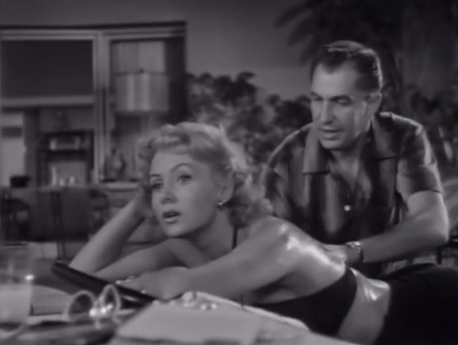
On the outside looking in, so to speak, is star TV reporter Edward Mobley (Dana Andrew), who agrees to help his friend Griffith by doing a little digging around about the murderer. He gets some tips from a cop friend Lt. Kaufmann (Howard Duff), and Mobley tries to smoke the killer out on air. However, it leads to the potential endangerment of his fiancée Nancy, who also happens to be Loving’s secretary. Loving has his love directed towards a female reporter named Mildred Donner (Ida Lupino), who attempts to needle Mobley for info. At the same time, the killer is on the move once more, with Nancy being an obvious target. Mr. Kritzer’s own romantic entanglements get him in trouble because he is seeing Kyne’s beautiful but detached wife Dorothy (Rhonda Fleming). Mildred finds out about them and they have some talking to do. Mobley also has some making up to do with Nancy after she finds out Mildred came to see him. It’s a big mess.

whilethecity3Mobley juggles everything from his love life to the big scoop and they apprehend the killer, but things at Kyne’s don’t wind up exactly the way they expected. Mobley looks to move on from the paper with Nancy, but even he cannot get away that easily.

While the City Sleeps is an underrated tale from Lang that is positively stacked with big names. Its pacing can be deliberate at times, but it is just as much an indictment of journalism as it is a thriller. The office is a web of deception with so many interconnections between these work factions. Those you would normally expect to be scrupulous seem to give up their honor in the face of this new promotion. In a sense, Mobley seems to be outside of this fray and yet he cannot help but get involved in it. It doesn’t help that nothing turns out the way it’s supposed to. Everybody seems to gain something, but nobody really wins the game.

I must say it was great to see Dana Andrews in one of these leading roles again and although their roles were smaller, Ida Lupino and George Sanders still were a deliciously stuffy and corrupt pair. I was never really a fan of Vincent Price due to the roles he normally plays, but I was inclined to like Howard Duff (Lupino’s real-life husband) in his turn as the policemen. It goes without saying that Rhonda Fleming is positively beautiful, but she also cannot be trusted. I guess that applies to about every character in this film. It’s certainly a cynical world out there that Lang paints, where the killer might be caught, but corruption is never fully quelled.

4/5 Stars