
Review: The Postman Always Rings Twice (1946)

Lana_Turner_in_The_Postman_Always_Rings_TwiceThe first time I saw this gripping noir, my least favorite part of the film probably was the title, and it still is. That’s saying a lot, and the film is adapted from the James M. Cain crime novel anyways, with the title included free of charge. Otherwise, Postman is a wonderful example of the film noir canon, and yet it lacks the elements of your more typical private eye mystery.

It trades dark streets of crime for a small roadside burger joint owned by a shrewd man and his noticeably younger wife. Bring a drifter searching for a quick buck and you have everything set for the deadliest of love triangles. At the tips are John Garfield as the rambling man Frank who initially couldn’t care less for his boss’s pretty wife. Then there’s Cora, the alluring girl who seems out of place in her life. Then you have the money-grubbing Nick (Cecil Kellaway) who seems naively oblivious to the whole situation.

At first, nothing seems to be afoot, and Cora is adamant about not getting involved with the new hand. However, ultimately things evolve. That’s not necessarily the exciting part. We expect the rapid and lurid love affair that soon besets Frank and Cora.  We expect, more likely than not, that Nick will either catch them or they will knock him off first. They choose the latter and its far from preferable. Soon the district attorney is down their throats with his own suspicions about the forbidden couple. He’s pretty smart too.

Sackett plays Frank and Cora off of each other. They’re both scared. Neither one wants jail or worst the gas chamber. Nora ends up being the only one prosecuted, but her sly lawyer (Hume Cronyn) is able to call his opponents bluff and get Cora off with hardly a hitch. The only problem is that Frank and Cora hate each other guts now. They are positively poisoned to each other.

The story could end there and it would be ironic enough, but it doesn’t. It has yet another act where Frank and Cora make up following the illness of her mother, the flourishing of her establishment after the trial, and a bout with blackmail. All seems to be better than it ever was, but fate can have a cruel sense of humor.

On one out of the ordinary car ride, Frank crashes and in the aftermath, Cora is left dead with Frank on the fast track to the gas chamber. And that’s where the title comes in. The Postman Always Rings Twice. In other words, if you don’t pay for your crimes the first time around, you always end paying up one way or another. Cora was killed and Frank faced execution. Neither one got off in the end.

Putting aside the Hay’s Codes need for justice to be dealt, this is a wonderfully sardonic tale and ultimately sensual noir for the 1940s. Lana Turner was never better dancing with relative ease between amorous sweetness and acidic intentions. And the moment she first shows up on the screen is one of the most eye-catching entrances by a femme fatale period. Although not the greatest of leading men, John Garfield is surprisingly credible opposite, Turner. He plays the hard-working everyman incredibly well. Hume Cronyn, for his part, plays his wily prosecutor wonderfully with a sly smile all the while. I cannot quite put a finger on it, but I like him.

4.5/5 Stars

How to Steal a Million (1965)

220px-HowtostealamillionHonestly, the main attraction of this film is its leads in Audrey Hepburn and Peter O’Toole as well as its director, the great William Wyler. Otherwise, this film is a fluffy, silly caper comedy with a touch of drama. It falls somewhere in between a rom-com and an art heist film where everyone in Paris speaks English. Go figure.

Nicole Bonnet’s (Hepburn) father Charles is a master forger of all types of art which he supplements his own vast collection with. Many of his pieces have been sold for a pretty penny at auction, and he has yet to be found out.

He loans out a family heirloom, Cellini’s Venus, to a local Parisian museum for a large exhibition. Meanwhile, Nicole catches someone in the act of burglary and it ends up being a handsome young gentleman (Peter O’Toole).  She is given a fright but ultimately is taken by the man who hardly seems the thieving type. She lets him go without calling the police even giving him a ride home.

Eventually, they cross paths again and she recruits him to help her steal Cellini’s Venus from the museum. She doesn’t tell him why, but she has her reasons and he willingly obliges. It’s all good fun after all.

The caper scenes are no more harrowing than the rest of the film. In fact, it gives the perfect setting for more comedy as the two burglars get locked in a broom closet together after closing time, while also repeatedly setting off the alarm. But it’s all part of the man’s plan, because, after all, he’s a professional. And their plan works. They get away with the statue and the following day the news spreads like wildfire.

In the end, Nicole finds out that Simon Dermott is actually a private eye specializing in art and criminology. He’s no thief and so this was his first heist too. She thinks she’s in for it now, but they’re too in love for that to matter. He explains himself to Mr. Bonnet who reluctantly agrees to end his forgery career on top.

The two lovebirds drive off madcap down the streets of Paris with a beautiful life ahead of them. There’s not much else to say except Hepburn and O’Toole are fun together, while the score of a young John Williams has a recognizable bounciness. Hugh Griffin seems slightly miscast to be Hepburn’s father, and the film is far from pulse-pounding, but these small facts do not negate from its overall charm.

3.5/5 Stars

The Revenge of the Sith (2005)

Star_Wars_Episode_III_Revenge_of_the_Sith_posterRevenge of the Sith was the film that all Star Wars fans were looking forward to. For the younger generations, it meant the closure of the trilogy we had grown up with. For older fans, it meant that the Star Wars saga might finally be complete in some sense of the word. All movies linked together in this crucial last piece that smoothed out any last ambiguities about how Anakin Skywalker evolved into the feared Darth Vader.

It was a pretty big deal because it would either close the series on a controversially sour note or with the type of visceral storytelling George Lucas inundated us with in the 1970s. This certainly is no Empire Strikes Back (the darkest film of the original saga as many know), but it was probably the most enjoyable installment of the new trilogy and that is the most genuine of statements. As pure fans we liked it, and it was a worthy installment full of action as well as personal conflict.

Is it even necessary to go over the plot of Star Wars? Before anyone answers, I will give a recap more for my own sake than anything else. The Clone Wars are still being waged against the Separatists and the tides are slowly turning. Anakin is now even more renowned as he continues to team up with his Jedi Master and mentor Obi-Wan. But Revenge of the Sith quickly turns into a story of inner turmoil and political unrest with young Skywalker caught in the middle.

He is secretly married to Padme, taken under the wing of Chancellor Palpatine and then called on by the Jedi Council to spy on the Chancellor. It’s a web of confusion, anger, and fear going way back to his mother’s death, visions of his wife dying and perhaps his unfortunate nickname “Ani” leading to masculinity issues. Anyways, that is the situation that he finds himself and ultimately Palpatine (as we always guessed was Darth Sidious) poisons Anakin, who slowly turns against his friends and the Jedi Council.

Although we always knew this moment was coming, it is still so satisfying and painful to see it play out. It leads to some sad deaths (ie. Mace Windu) and some of the most epic lightsaber battles, going so far as to pit friend vs. friend against the backdrop of lava and John Williams’ score.

It is very hard not to appreciate this moment in the narrative where we finally see how the Empire came into being. How Anakin became Vader. How Luke and Leia were split up and how Obi-Wan became a hermit in order to protect the boy. As far as the films go, the original trilogy will undoubtedly remain the favorites, but that does not take away from the entertainment and emotional energy of this film.

Sith take Revenge and Jedi simply Return to put things right. Now I have to go back and watch the original films because I would not mind a happy ending about now. The beauty is that the bleak conclusion of this film is not the end of the story. Thank goodness we still have Yoda.

4/5 Stars

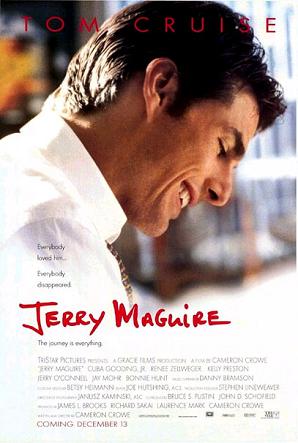
Jerry Maguire (1997)

Jerry_Maguire_movie_posterJerry Maguire is your typical feel-good sports story, but it has a different angle. The eponymous character, Jerry (Tom Cruise), is on top of the sports industry. Not as a player, executive, broadcaster, or anything like that, but as an agent. His job is to make his clients the big bucks and protect their interests while also thinking about his own. He’s constantly on the phone cajoling and soothing big time egos so they stick with him and do as he desires. A lot of it is a flattery game, and Jerry is the best of the best whether it’s face-to-face or over the phone. He knows how to play the game.

In a brief moment of so-called weakness, however, he writes an impassioned memo after he realizes he has gone away from his initial values of being a sports agent. The idealistic magnum opus he comes up with late one night is well received and yet it signals a real hitch in his career, even if he doesn’t know it yet.

He gets let go at his agency, and he struggles to hold on to any clients he can, but slowly, bit by bit, they leave him. First one, then two, and then on and on they went. When a top prospect leaves him it looks like Jerry is sunk. And then there was one. Loud-mouthed, prima donna Rod Tidwell (Cuba Gooding Jr.) known for famously uttering the phrase, “Show me the money!”

All the while, unassuming single mom Dorothy Boyd (Rene Zellweger) buys into his dream when no one else will and in the process, she begins falling in love. He’s not quite at the same place she is however.

Jerry Maguire is invariably sad, but it is an ultimately uplifting look at the sports drama told from the sidelines which are still chock full of drama, conflict, and romance in its own right. By consolidating and getting smaller, Jerry learns what is truly important. He finds who his true friends are in Rod and Dorothy. And he learns what it means to truly love someone, not only in a cheesy romantic sense (You had me at hello), but as a true blue friend.

So although not always a great film, Cameron Crowe’s story holds some of the same sensibility of Say Anything… and Almost Famous. It shows that something as big and blown up as professional sports can always be brought down to a more basic level of humanity. It falls somewhere in between films like The Blind Side and Moneyball and that’s not necessarily too bad a place to be.

3.5/5 Stars

“And I’m free, I’m free fallin'”

Me & Earl & the Dying Girl (2015)

Me_&_Earl_&_the_Dying_Girl_(film)_POSTERI can say unflinchingly, without a single waver in my voice, that this is the best new release I’ve seen this year. Truth be told, I have not seen a whole lot of new films this year, but even if I had, Me and Earl and the Dying Girl would be the best by far.

The title in itself exudes a quirkiness that continues in a steady stream throughout the film. The same quirks can be found in our main protagonist, the self-proclaimed awkward, pale, rodent-faced high school senior Greg (Thomas Mann). He’s gone through high school with the mission of ingratiating himself to all and befriending no one. At this point in his high school career, the closest thing he has to a friend is Earl, who he simply considers his “co-worker,” since they develop homage short films together (ie. A Box of ‘Lips Wow). That’s another thing. Greg is obsessed with film: He eats up anything from Werner Herzog or The Archers thanks to the influence of his father (Nick Offerman). His other “friend” is the chill history teacher Mr. McCarty with an office that is the lunchtime oasis for Greg. But that’s about it.

That is until his doting mother (Connie Britton) forces him to go visit a girl who has been diagnosed with Leukemia. It’s a very forced scenario and both Greg and Rachel know it right from the get go. They haven’t even hardly talked since kindergarten. But, despite that, the two of them hit it off and Greg begins this doomed relationship with this dying girl.

The next 209 odd days or so Greg navigates this friendship and all that goes with it, while also developing a film for Rachel on the urging of the classmate that he is infatuated with. But do not get me wrong, this film does not fall into some contrived love triangle or sordid high school drama. It has a far broader more mature scope than that.

Yes, this is a high school teen film. Yes, it is a coming-of-age story, but it boasts so much more. It’s a film about films, a film about friendship, a film about regret, and most importantly a film about what it means to be alive. And yet, all the while, it tries to sidestep the normal tropes we expect.

Greg and Rachel have two very different perspectives. Two very different lots in life, but somewhere in between all of that, amidst the fear, laughter, and even anger, they find some special connections.

There is so much to appreciate about the film and for me, it starts with the character of Greg, because in some ways he was analogous to me in high school. I too was a nomad who traveled from group to group never being fully known. I found a passion for film and slowly began to learn about Kurosawa and Bergman among others. It was not until senior year where I finally began to feel comfortable in my own shoes and that was the perfect time for a new adventure in college. Thus, I resonate with Greg, because although he is certainly not me, he’s the most relevant high school character I have seen in a long while.

As for Connie Britton and Nick Offerman, both of them have some nice scenes that add a lot to this story. One as the over-involved mom who generally cares and the other as a free spirit of a dad who likes exotic food, bohemian garb, and art-house, not to mention the family feline Cat Stevens.

With great films, it is always difficult to pin them down, and the same can be said for this one. It has an awareness of film history that is unequivocally refreshing and unheard of for a genre potentially aimed at teenagers during the summer months. It has its own heartfelt crescendo that in some respects reminded me of Cinema Paradiso. In all other facets, it works beautifully as a teen dramedy and it does a better job in that niche than most. Miraculously, it couples humor and quirks with touching notes that are relevant to the here and now, while somehow still being universal. Also, do not get me started on the music, which is absolutely fantastic.

I look forward to seeing it again sometime soon!

4.5/5 Stars

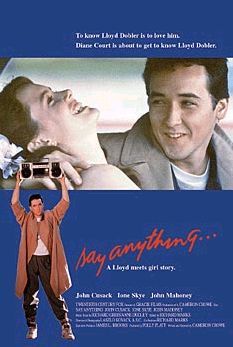
Say Anything… (1989)

Say_Anything“How’d you get Diane Court to go out with you?”
“I called her up.”
“But how come it worked? I mean, like, what are you?”
“I’m Lloyd Dobler.”

She’s a brain, he’s not, sounds simple right? For such a basic premise Say Anything… has surprising depth. A lot of this is a credit to the performances of John Cusack and Ione Skye, along with the script by Cameron Crowe. The story is this: high school is over and the unknown future is what looms ahead. For Diane Court that means college, a fellowship in England, and the like. For Lloyd Dobler, we do not know what that means and he doesn’t either. For the moment he still has time, and he wants to use that moment to pursue Diane, the seemingly unreachable girl.

First of all, you have to understand how insane that goal is for a guy like Lloyd. He is a lover of kickboxing, The Clash, and he is an average student who lives with his sister and little nephew. Diane is the class valedictorian, doted over by her loving father, and she is a surprisingly sweet girl who dresses well and is a cut above. Not in a million years is he supposed to get her, but I said that already.

Anyways, Lloyd is a straightforward and to the point kind of guy, so he simply calls her house to ask her out. She finally gives into to his requests, and they go to a party to celebrate the end of their high school career. For him, it’s their first date, and she sees it just as a very nice evening. Diane leaves with a new found appreciation for Lloyd because he’s not like other guys. He periodically checks on her during the party to make sure she is alright and points out broken glass on the pavement for her to avoid. He is a gentleman in a trench coat, a strangely vulnerable figure.

Lloyd’s only future plans are to hang out with Diane as much as possible and as far as career plans he is not really sure. When everyone else, even his high school counselor, worry about the future, he always seems strangely, even naively, content.

Diane and Lloyd are slowly growing more and more connected and intimate. However, when Mr. Court goes under criminal investigation things begin to change. At first, everything is the same, with Lloyd teaching Diane how to drive stick shift and Diane growing more and more comfortable with him. And yet, with the familial situation at hand, she feels it necessary to break it off with him, leaving him a pen to write her with. Lloyd is especially wounded, confessing to his sister over the phone, “I gave her my heart and she gave me a pen.”

Soon enough Mr. Court’s account is cut off and in some ways, I felt strangely sorry for the man, but more so for Diane. One day Lloyd comes by with his boombox in tow, standing outside her window in one last monumental act of devotion. Nothing happens right then. Diane is still struggling with her father who it turns out has been swindling his elderly clients, but all for her future. She feels lied to and the only person she could run to is Lloyd, so she does and he takes her back.

Later on, he sees her father in prison and shares that his plan is to go to England with her, despite all the objections that come with it. The two jet-setters are together again proving all the doubters wrong. They wait for the ding of the smoking sign signaling the beginning of the rest of their lives.

This is perhaps one of the greatest high school romances ever, because it is far from the typical superficiality. Lloyd Dobler is played so wonderfully by John Cusack. You cannot help love this lanky guy who is fearlessly straightforward and willing to take a chance. Ione Skye is a bit overshadowed, but she is still convincingly sweet as the victim who finds the perfect guy. John Mahoney’s character is a despicable man and yet it is a credit to him that he actually makes us feel a bit of pity, for an instant. Obviously, the boombox scene is iconic, but I think it is the little things about Lloyd that make this film great. Every person could probably take a page out of his playbook by being honest, vulnerable, and most definitely loyal.

4.5/5 Stars

Review: The Shawshank Redemption (1994)

ShawshankRedemptionMoviePoster (1)This film originated from a Stephen King novella called Rita Hayworth and Shawshank Redemption. The actress actually does play into this movie and her famed hair flip from Gilda even makes a memorable appearance. However, the shortening of the title not only simplifies things, but it refocuses the film on what it is all about. You guessed it. At its core, Shawshank is about the redemption of one man who would never let his hope or ardent spirit be quelled. That man is the memorable, but generally unassuming, Andy Dufresne (Tim Robbins).

His story began back in 1947 when he was put on trial after being accused of riddling his unfaithful wife and her lover with bullets in his drunken rage. We see bits and pieces of what happened, but not everything. Andy quietly maintains his innocence, but he is dealt two back-to-back life sentences in the Shawshank state penitentiary.

When he gets there initially he looks to be a pushover, not ready for the dark recesses and the harsh reality that is prison life. In his typically smooth mode of voice-over, Morgan Freeman, as camp grifter Red, recalls when he first set eyes on this man. He didn’t know it then but Andy would prove to be a life-changing acquaintance, and he also proved to have more guts than Red was expecting.

They first cross paths when Andy comes to Red inquiring about getting a rock hammer and Rita Hayworth. Red obliges and these trinkets allow Andy to shape rocks to form a chess set. The poster goes up on his wall and others soon follow. He’s a man who always strives to stay busy, and he never lets his circumstances get him down.

It doesn’t come easy though because the local prison gang christened “the sisters” are used to getting their way with any inmate they cross paths with. Andy is not one such individual, and he pays the price, receiving beatings on multiple occasions. Still, he keeps on living and ultimately makes a name for himself by providing tax advice for one of the most notorious guards. It’s after this specific moment when he wins a round of beers for his mates that they begin to see the extraordinary individual in their midst. He goes by the credo, “Get busy living or get busy dying.”

Following his own words to a tee, Andy begins to prove his worth and earn respect as he gives tax advice to many of the prison attendants and guards. Even the hypocritical warden uses his services to keep his finances and office in order.

Andy is also transferred from doing grunt work to helping the aged prisoner Brooks in the library. It’s a step up and unprecedented in the history of the prison, but then Andy is truly special. After Brooks is released and tragedy strikes his life, Andy continues to improve things. He regularly writes his representative for funding so he can get more books and his work finally pays off. He also sets up a program so prisoners and workers alike can gain the equivalent of a high school education.

As the years pass, the prisoners get older and the posters change on Andy’s wall from first Rita, to Marilyn, and finally Raquel. About that time, a young prisoner named Tommy finds himself in prison and all the old timers like his energy. Andy resolves to get the young man an education and Tommy, in turn, shares some potentially life changing evidence with Andy. But it all comes to naught. The warden maintains his tyrannical reign and the defenseless Tommy is struck down.

Andy begins to lose some of his privileges as the warden starts to clamp down on him again by throwing him into solitary confinement for two months. When he gets out, Andy’s hope is still alive, sharing with Red about his dream of someday going to Zihuatanejo in Mexico to live in solitude. Red thinks it’s all folly, but agrees to do something for him if he ever gets out.

Then during an upcoming roll call, all of a sudden, just like that, Andy Dufresne is gone for good. To add insult to injury, he used his business acumen to stick it to the warden who is investigated by the police. Andy has the last laugh.

After so many rejections and denials, Red finally gets his parole and he looks like a mirror image of Brooks, a man who grew to know the Shawshank as his only way of life. It looks pretty fast and grim on the outside now. But Red has a purpose that Brooks did not, in Andy. He keeps his promise to Andy and rendezvous with his old friend.

Shawshank is a thoroughly engaging film and it works because of the performances of Tim Robbins and Morgan Freeman. Robbins acts as such a bright light despite his solemnity and subtlety. He is unceasingly upright;  the perfect contrast to this prison which is a vile, disgusting place full of corruption and violence. Freeman is the cynic and in many ways, he stands in for the audience. He wants to believe in a man like Andy as much as us, but the world initially tells him he cannot. However, Andy proves Red and the world wrong, by redeeming what has fallen. I can never get over that truth because it is such a powerful message told in such an engaging way.

4.5/5 Stars

Review: Rear Window (1954)

Hitchcock_stills_0006_rear-windowWho in their right mind would make a film that takes place in a courtyard? Rear Window has always been fascinating from a technical standpoint, and Alfred Hitchcock is certainly not “The Master of Suspense” for nothing. He uses the confined space of a single Greenwich Village courtyard with an incapacitated individual to truly build the tension to immeasurable heights. The events within the film are often highly bemusing as Hitchcock has a wicked sense of humor, whether Jefferies is trying desperately to scratch that itch or the conversation turns morbid as he tries to eat breakfast.

The script has so many great little moments of back in forth repartee; some supplied by the always dynamic Thelma Ritter who plays the nurse with a lot of advice and opinions about rear window ethics: “We’ve become a race of peeping toms. What people ought to do is get outside their own house and look in for a change. Yes, sir. How’s that for a bit of home-spun philosophy.

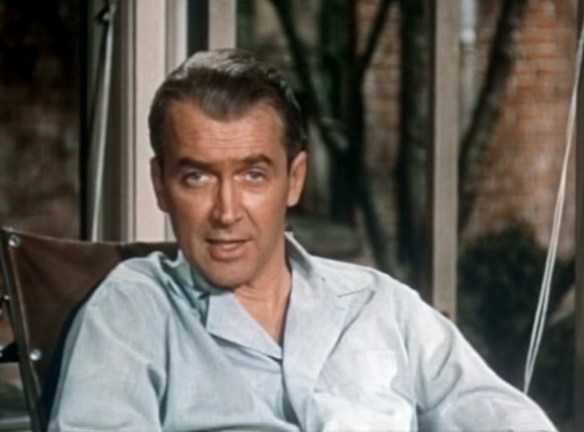
James Stewart is always a pleasure, but this time around he is perhaps at his most constrained as famed photographer L.B. Jefferies, who is laid up in his apartment for weeks on end with a leg in a cast. He got the injury thanks in part to his last big photo shoot where he ran in front of an oncoming race car. With nothing better to do, he spends his idle moments people watching and getting to know his neighbors. That’s one way to put it at least. As an actor, Stewart is stuck and relegated to conveying his whole performance through his gaze and the dialogue he speaks to those few who come in and out to see him. Most of what he’s doing is simply looking across the way and yet it works.

His neighbors are as follows:

There’s Ms. Torso who is an aspiring dancer and always the target of many men. There’s Ms. Lonelyheart who never can find the love she so desires. A washed-up composer spends the entire film trying to figure out his newest project (even getting a visit from Hitchcock himself). There are the newlyweds who hardly ever leave their bedroom because they’re doing something… Then, comes the older couple on the second floor with a cute little dog and the sculptor who lives below.

Most interesting of all is the couple directly across the way from Jefferies’ because that’s where a long-suffering husband and his wife live. All seems normal, to begin with, however, Jefferies begins to have his suspicions thanks to circumstantial evidence and no sign of Mrs. Thorwald. His first thoughts immediately shoot to murder, but it seems highly unlikely. Day and night he continues to watch seeming to get more evidence, only to have his theories crushed, and then gain new hope through more evidence.

James_Stewart_in_Rear_Window_trailerThe interesting part is that as an audience we are fully involved in this story. We see much of the picture from Jefferies’ apartment, because there is no place to go, and so we stay inside the confines of the complex. In this way, Hitchcock creates a lot of Rear Window‘s  plot out of actions occurring and then the reactions that follow. We are constantly being fed a scene and then immediately being shown the gaze of Jefferies. It effectively pulls us into this position of a peeping tom too. Danger keeps on creeping closer and closer as he discovers more and more. The narrative continues to progress methodically from day to night to the next day and the next evening.
In the climactic moments, he finally faces the man who he always looked in at from the outside and yet by the end the roles are reversed with Jefferies space being fully invaded, and yet he can do little to flee, because of his cast. Hitchcock cuts it in such a choppy and chaotic way which breaks with the smooth continuity of the rest of the film, but it works so wonderfully in stark juxtaposition.

This is one of the main appeals of Rear Window because it has this Hitchcockian story of murder, mystery, and suspense. However, I am constantly eager to revisit this story, since there are so many other intricacies that are of interest.

Although the film uses a score by Franz Waxman, the majority of the sounds heard are diegetic and they either are street noises or music wafting around the courtyard from one of the apartments.  Also, there is only one small outlet to the outside world. At times, it becomes fun to survey what is going on whether it is kids playing on the street corner or cars passing back and forth. It builds this sense of realism suggesting that this world that has been created is larger than this one set full of apartment buildings.

Another important element is themes of romance and love. Jefferies comes into the film with issues in his own love life. His girl is the elegant and refined Lisa Fremont (Grace Kelly), who seems perfect, too perfect in his estimation. In his mind, they just don’t seem compatible enough, and he cannot see marrying her. It’s something they have to work through because she truly loves him.

Really every character essentially has a different outlook on love and different struggles, because romance is never an easy thing. Like the lyricist’s song, it is so often fragmented, but in their case, Jefferies and Lisa seem to figure things out just as the song finally gets finished. The moment where you can see it in Jefferies’ face that he is both impressed and worried for Lisa’s safety seems to be the time when things change. He realizes his love for her since she is very dear. He quits his thinking and his analyzing of their relationship, as gut-wrenching emotions take over when she is caught. In a sense, he listens to Stella’s earlier advice: “Look, Mr. Jefferies, I’m not an educated woman, but I can tell you one thing. When a man and a woman see each other and like each other they ought to come together – wham! Like a couple of taxis on Broadway, not sit around analyzing each other like two specimens in a bottle.”

Wendell Corey, in his supporting role as Jefferies’ friend and the police detective, is a man who can be a skeptic and still prove his loyalty as a friend. They can be at odds and still poke fun at each other with mutual affection. It feels real. Raymond Burr as the villainous Lars Thorwald works well too because he is certainly an angry, unfriendly grouch, but he does not seem altogether evil. It shows how easy it is for the lines to be blurred.

rear-window-first-shot-of-gkAbove all, Grace Kelly shines opposite Jimmy Stewart. There’s no one quite like her, so elegant, eloquent, with a touch of playfulness and adventure. She is willing to fight for her man and even go out on a limb for him (ie. breaking into Thorwalds’ apartment). One of the film’s most extraordinary images, out of many, has to be when a shadow covers the face of Stewart as he rests. Then there is a close-up of Kelly, her face slowly descending towards him. It’s hard to forget and for the rest of the film, she attempts to not let him forget her.

It’s not often easy for me to make statements like this, but Rear Window has to be close to my favorite film of all time. Yes, I said it. It never gets old for me, and I pick out new things every time. It’s more than just a mystery thriller. Hitchcock made it a technical marvel that is also steeped in themes of love and ethical questions. The players are the best of the best from James Stewart, to Grace Kelly, to Thelma Ritter, all down the line. It’s at times deliberate, but never boring, completely immersing the viewer into this drama as a firsthand witness. It’s the type of cinema we just don’t get every day because it has everything and it cuts to the core — to the most visceral level. That is the sign of cinematic greatness.

5/5 Stars

Lost In Translation (2003)

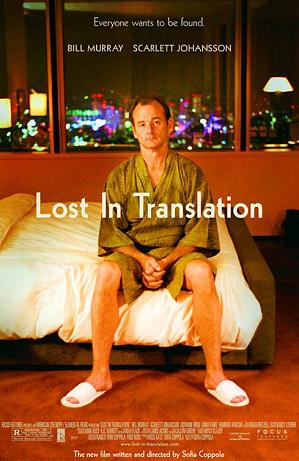
Lost_in_Translation_posterStarring Bill Murray and Scarlett Johannson with direction by Sofia Coppola, this film is set in the fast-paced, technological, and modern world of Tokyo, Japan. That is where Bob and Charlotte find themselves and they both are lost, simply going through the motions of life. He is a middle-aged, former movie star filming a whiskey commercial. She is a newly-married wife of a fashion photographer. Despite their age differences, they find out that they have a lot in common. Over the week they spend time together in Tokyo and become friends. When the time comes for Bob to leave neither one wants their time to end. They say goodbye but do not forget each other. This film was enjoyable because it portrayed two people who could be good friends without getting romantically attached, at least in the conventional sense.

I must say that this type of friendship intrigues me. It is understandable that if you go to a foreign country alone it would be nice to have someone you could at least converse with, without any barrier getting in the way. It might be at Narita airport for a moment, at a Hotel, or walking the streets of Shinjuku.  It would act as a comfort in a world like Tokyo that is so fast paced and high stress. These unusual circumstances could throw together two very different people, with little in common except the language they speak. That is something that does not happen every day.

Needless to say, after gaining the opportunity to visit Tokyo two years in a row it has given me some new insight. I can now wholly empathize with Bob and Charlotte because although I knew a few people, Tokyo is such a highly populated, fast-paced world that seems so easy to get lost and overwhelmed in. There is so much to see, so many lights, so many hurrying folks, so many subway lines, so many surgical masks, so much etiquette, and so much technology. True, some of my ancestors were Japanese but the language still baffles me, making it very easy to get “Lost in Translation.” Being in Tokyo it also helped me realize that it is not only tourists who get lost. It has been over 10 years since this film came out and a lot can happen in that time like more Starbucks and McDonalds on every corner.

Despite the westernization and technological advancement, Tokyo also has a time-worn aspect, and its people are often worn as well. They might not be lost because of a literal language barrier. However, they, like Bob and Charlotte, are often lost because they have difficulty getting close to their peers. Often they, like the two protagonists, seem to be searching for someone to talk to, but in their case manners keep others at arm’s length. Coppola’s film gained an even more personal note now that I have walked in these places and interacted with or at least walked alongside the Japanese people. They like anyone else can be “Lost in Translation,” it just might be a different type of “language” than what we struggle with. They too are humans who have their share of struggles, worries, joys, hopes, and dreams. Hopefully, this type of understanding will help us transcend any barriers so we no longer find ourselves “Lost in Translation.”

4.5/5 Stars

Review: The Odd Couple (1968)

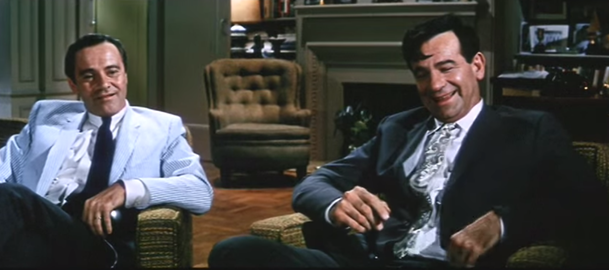
8ca16-oddcouple1By now The Odd Couple is rather like returning to an old group of friends. Jack Lemmon and Walter Matthau never had a better pairing than their turns as Felix Ungar and Oscar Madison. The roles seem to fit each man to the tee or at least they make them their own. Lemmon is as hilarious as ever playing the neat freak, hypochondriac who was recently divorced. He drove his wife crazy because he cooked better than her, cleaned more, and was allergic to her perfume. She had to put on his aftershave instead. Then, there’s Matthau reprising his stage role of Oscar the slob of a sportswriter with an affinity for messiness. Droopy jowls courtesy of Matthau. Put them together and you have some of the greatest comedic fireworks ever, and it’s so simple. You see, all the poker playing gang is nervous that Felix will commit suicide, which he attempts during the film’s opening sequence, but he cannot get the window open. Thus, Oscar obliges to take in his buddy with the rest of the buddies keeping a wary eye on Felix. It’s hilarious to watch them because they really care about Felix, but they have no idea how to act around him. They think every move will be his last.

Oscar does not know what he’s gotten into since Felix cleans up after him, follows him with an ashtray when he smokes, does the dishes, vacuums, sprays air freshener incessantly, and even distracts Oscar from a triple pay while telling him the evening’s dinner plans. Then there’s Felix allergies, his high maintenance, and yes, his pouting. He even ruins weekly poker night with cigar smoke replaced by fresh air and disinfected playing cards.

Bring in the twittering Pigeon Sisters Gwendolyn and Cecily and you’re bound to have more laughs, until Felix the killjoy hurts the mood. Now we truly begin to see Oscar’s sour side which was mostly saved for his former wife Blanche. Now it is specially reserved for Felix and his maddening cleanliness that’s gone too far. Oscar has a nervous breakdown and blows his top chasing Felix out. But Oscar is not a bad guy, Felix is his friend after all, and so enter the poker buddies once more to go searching for Felix. He has been taken in by the Pigeons and the two friends make up. As it turns out, the two men rubbed off on each other, but there’ no chance of completely changing them. They will always be The Odd Couple, just separate now.

The Odd Couple has such a wonderful mythology surrounding it thanks to Neil Simon’s play, the film adaption, and then the television show. Furthermore, it is one of those very special cases that was great on both the big and small screen, since Jack Klugman and Tony Randall were wonderful in their own right. Focusing on this film, the dialogue is not forcing the humor, and it ultimately leads to genuinely funny lines coming out of the circumstances. The poker playing buddies are a riot from Florida-bound Vinnie (John Fielder) to nervous cop Murray (Herb Edelman). The opening of the film is made by Neal Hefti’s theme, and I’ve got to say, the sequence where Felix has his sinus attack is priceless. Without fail it puts me in stitches everytime as the weirded out Oscar looks on along with everyone else. I cannot help but love The Odd Couple. By now it’s too ingrained in me and that’s fine by me.

4.5/5 Stars