The Bad News Bears (1976)

c75ba-bad_news_bears_1976The Bad News Bears is the quintessential sports movies about a ragtag group of misfits and losers. If there was ever a worthy heir to Charlie Brown’s club it was these fellows, but that’s not the end of it. Rome wasn’t built in a day, and the Bears pick up the slack after numerous drubbings. They somehow acquire Morris Buttermaker’s reluctant pitching prodigy Amanda (Tatum O’Neal), and their new star is town delinquent Kelly Leak (a boy who smokes cigarettes and rides a Harley). They begin to climb the ranks, and Buttermaker realizes his squad has a fighting chance to make it to the championship game.

Things become more and more competitive culminating in the final showdown against the hated Yankees, coached by Roy Turner (Vic Morrow). Buttermaker has recently become a hard-nosed jerk solely focused on winning, but he has a mid-game change of heart. He lets his boys play, clears his bench, and the results are good if not great. However, The Bad News Bears can be proud that they left their heart out on the field, and the Yankees will be going down the next year for sure. The most important thing is that they played together as a team with a lot to be proud of.

Walter Matthau has enough of the lovable grouch in him to make it work, although he does have the foul mouth to go with it. Amanda is the perfect counter for Buttermaker because they both have spirit and fiery impudence. O’Neal perfected the pout after Paper Moon (1973) and it’s still going strong here. However, she is not the only one. On a team that is populated by a few nerds and weaklings, there also are a share of sharp tongues and real potty mouths.

Carmen is a nice touch during the rout scenes,  and it makes me think they never heard of the mercy rule, but I guess it is the 1970s and we have to have drama after all. This is far from a kids movie, but it probably resonates with the many adults who played organized baseball as kids.

The film is a satire of American’s Pastime for this audience because even on the smaller stage of Little League the game often gets blown way out of proportion. It becomes a question of are we playing it for the love of the game or to win at all costs (even if it means family turmoil). Morrow’s character epitomizes just how far parents will go because they become so involved in the lives of their kids. Wanting to live vicariously through them, they push their children until they can no longer be kids, but must be perfect instead. The Bad News Bears choose to play the game for fun as it was meant to be played, and that is partly thanks to Buttermaker. They are not done yet though because there are still many more life lessons to be learned. I’m not sure if I said this yet, but this film actually made me laugh a lot since it began as a comedy of errors and only then did it turn into a satire. The comedy was certainly present, but not the most important.

4/5 Stars
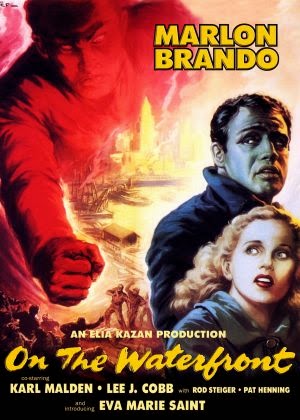
Review: On The Waterfront (1954)

8542a-on_the_waterfront_poster“They always said I was a bum, well I ain’t a bum Edie.” That is what washed up prizefighter Terry Malloy (Marlon Brando) must try and prove to himself and others for the entirety of this crime-drama. On the Waterfront is ultimately his story of conscience and redemption that we watch unfold. It’s not pretty, but you’ll soon see for yourself.

Living on the waterfront is a tough existence. The mob decides who works and who won’t. Longshoremen are expected to be D & D (Deaf and Dumb) or else they have something coming. That’s how big shot Johnny Friendly (Lee J. Cobb) and his boys can run the entire area. They utilize fear and money to keep the working masses at bay. No matter what police or the crime commission might try to do, they have no hold on the waterfront. It’s a jungle out there and if you want to survive you look out for number one, don’t ask questions, and live another day.That is Terry Malloy’s philosophy and it suits him just fine. His brother Charley is Friendly’sright-handd man and he’s made a good life for himself thanks to his brains. Terry is more brawn than brain, and he does what his brother says. One night he blows the horn on a young man named Joey because he called out Johnny Friendly. That same evening Joey is knocked off, literally. Terry tries to justify it. He only thought they were going to “lean on him” a bit. With that incident begins Terry’s inner battle.

The moral compass of the film is supplied by two people. Edie Doyle (Eva Marie Saint) returns to her town from school with her beloved brother Joey now dead. She cannot understand why no one else will speak out about it or do anything to carry his cause. It is ultimately Father Barry (Karl Malden) who does just that realizing that his parish is the waterfront. He must fight against the injustice of the mob and hope others will join him. It’s a tall order. At the first meeting he holds in the church, a window gets busted, and thugs wait outside for people to beat up on. Terry was sent by Johnny to check it out and it is there that he meets Edie. He is immediately taken by her, and she warms to him. She sees him differently than the others without knowing what role he had in her brother’s death. The Father and Edie encourage Terry to testify at the crime commission after another man is killed in an “accident.”

Friendly can’t have a canary and its Charley’s job to straighten out his brother. That’s when they take their fateful car ride. Terry spill his guts (I coulda had class. I coulda been a contender. I coulda been somebody, instead of a bum, which is what I am, let’s face it. It was you, Charley.) and Charley responds the only way he knows how. He saves his little brother who he has always looked out for and pays the price.

Now Terry has his reason to testify and soon enough he goes before the crime commission to call out John Friendly. He has broken the waterfront code and gone canary. All respect for him is gone and Friendly wants his hide, but Edie is overjoyed in him. Finally, Terry has left the shackles on the waterfront and freed his conscience. He confronts the big man himself and is beaten to a pulp. But as Father Barry says he may have lost the battle, but he won the war.

Before getting to Brando, I must acknowledge the other players for their stellar performances. Eva Marie Saint is just that, a saint, and she gives a heartfelt performance as Edie. It is her love and care that leads Terry to turn himself around because she sees a little piece of humanity left in him. Karl Malden has perhaps one of his finest roles as the Father who represents a man of the faith remarkably. He is no joke, and he does not cave to hypocrisy. His waterfront sermon is one of the most powerful moments:

“You want to know what’s wrong with our waterfront? It’s the love of a lousy buck. It’s making the love of the lousy buck – the cushy job – more important than the love of man! It’s forgettin’ that every fellow down here is your brother in Christ!”

However, Rod Steiger’s poignant scene with Brando in the car is similarly extraordinary, because he realizes where he has failed. He does not need the words. He just stays silent, and we see it on his face. He is the one who pays for the mistakes, though, and he is far from a bum. Then, of course, there is Marlon Brando himself. He is often hailed one of the greatest actors of all time, but he usually played corrupt undesirables or rebels. Terry Malloy is perhaps his best role, and he is the good guy for once. He must struggle to do what is right by him, and he must struggle to prove himself to others. Brando plays him with some much genuineness, heart, and vulnerability at times. He is far more than the brusque meat head we take him for initially.

Elia Kazan was a champion of hard- edged dramas especially in the 1950s and he never succeeded more so than with this film. The black and white cinematography with perpetual fog drifting in fits the dire mood nicely and Leonard Bernstein’s score further compliments the drama. This is a fine example of Classic Hollywood cinema which was praised back then and lauded now. Our fake blood may have gotten better, but otherwise, it’s hard to top this film.

5/5 Stars

The Mating Season (1951)

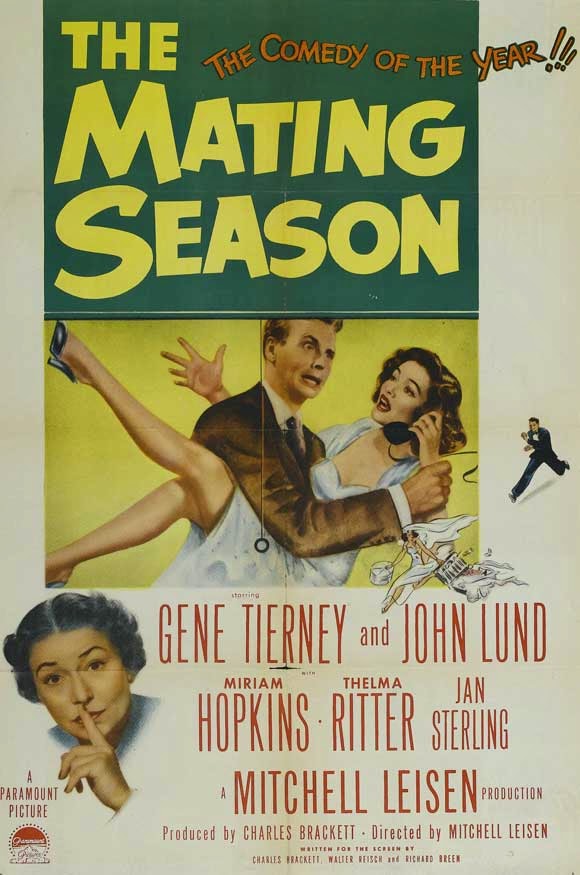
b3d8e-the-mating-seasonThelma Ritter was always a scene-stealer, upstaging the stars, but perhaps it is no more evident than in this comedy starring Gene Tierney, John Lund, and Miriam Hopkins. She runs a hamburger stand in New Jersey, talks plain, and works hard. Her son Val McNulty is a college graduate and a kind, gentlemanly figure who also loves his mom for who she is.

In one of the fastest meet-cutes/courtships I have ever seen on film, Val marries the lovely socialite Maggie, a woman above him in status who falls for him, because he is nothing like the stuffy upper crust she is used to dealing with.
In a classic screwball type development of mistaken identity, Ellen McNulty arrives to live with her son after her stand was closed down. But when calling on the house she is mistaken for a cook, and she willingly plays along with the mistake in order not to embarrass her son. Imagine his surprise when he sees her and yet he does not explain who she is. She tells him to play along with the little deception and Val reluctantly goes along with it.
When Maggie’s own stuffy mother (Miriam Hopkins) comes into town, she disapproves of her daughter marrying below her and nothing will make her like Val. Just think what would happen if she knew who Ellen really was?
One evening the unlikely couple goes to a party held by the Kalinger Family who run Val’s firm. There Maggie is insulted and runs out of the party in a huff. The lady she has a spat with is a prestigious person, and Val forces her to apologize. Needless to say, the marital sparks fly. However, things heat up even more when Maggie finds out by accident who Ellen really is. Now Val has a lot of explaining to do and his wife feels lied to. She is furious that he would think her too proud to welcome in his humble mother. Maggie gets ready to leave for Mexico, a destination for attaining an easier divorce.
Interestingly enough, it is an unlikely outsider in Mr. Kalinger Sr. (Larry Keating) who gets the couple back together through a shameless ploy. However, they are not the only unlikely love story, he has a budding romance of his own.
Mitchell Leisen seems to be a little-known director, but after seeing this film I was quite impressed. This movie works because of the conflict in class and the complications and laughs that come out of it. It is this type of conflict that hearkens back to the scatterbrained screwball comedies of the 1930s. Perhaps it is a little hard to believe that Lund was Ritter’s son, but they had enough chemistry to make it seem plausible. It was also hilarious to see Gene Tierney struggling in the kitchen, and Miriam Hopkins was a decent inclusion playing Maggie’s opinionated and overblown mother. Call me plebian if you want, but I know which mom I would take…
4/5 Stars

Review: 12 Angry Men (1957)

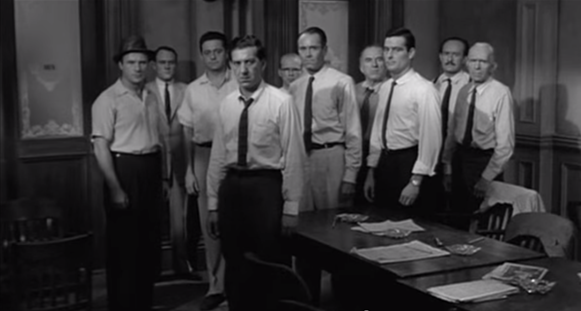
ebd81-12angrymen1With a title like 12 Angry Men you might come away with the false idea that all the characters in this film are the same, emotionally and otherwise. That is far from the truth. The reason a film like this stands up even today is because the fellows who sit down around that table are everymen that each and every one of us can relate to in some way. Yes, they are all male and all white, but they reflect little bits of us and our own humanity.

But getting down to the specifics, what is 12 Angry Men really and truly about? If you want to break it down, all it boils down to is 12 men gathering in a room to talk out a murder case. It sounds pretty dull and it had the potential to be so. In fact, calling it a courtroom drama is partially a misnomer because we hardly spend five minutes there before the jury is deliberating. We see the members of the jury, hear the final statement of the judge, and get a last look at the young defendant.

What comes next is the beginning of the decision-making process and seeing as it looks like an open and shut case, an initial vote is called for. If everyone agrees, this boy will be sent to the electric chair for killing his father. The vote is taken and it is 11 to 1 with one man holding out. Juror Number 8 (Henry Fonda), an architect, cannot bring himself to send the boy off without talking some more and so, begrudgingly, they do talk.

That is where the true heart of this film comes out, through the discussion and back and forth of the characters. They get around to evidence like the switchblade which the boy supposedly dropped. There were two witnesses: One being an old man living downstairs and the other a middle-aged woman who lived across the train tracks. Then, there is the business about the boy’s flimsy alibi about going to the movies. All are hotly debated and quarreled over.

It just happens to be the hottest day of the year and about an hour in it starts pouring cats and dogs. Tempers reach their apex, feelings are hurt, and major prejudices are revealed. The beauty of this film is not simply the sentiment that the jury switches its decision. The beauty truly comes from this wonderfully colorful ensemble of actors under the direction of Sidney Lumet in a confined space. But before mentioning the direction it is important to acknowledge the players because they are the heart and soul of this story.

Juror # 1: (Martin Balsam) He is the foreman who moderates, and he tries to keep the discussion civil with a relatively calm demeanor. All we know about him is that he is an assistant coach for a high school football team.

Juror # 2: (John Fielder) He is one of the younger members of the jury and a quiet individual with a timid voice. He is a banker.

Juror # 3 (Lee J. Cobb) The main driving force of conflict, he holds out when everyone else switches their vote. He is a businessman who also has familial issues with his son that come into play.

Juror # 4 (E.G. Marshall) A rational and measured broker, he holds that the boy is guilty until some facts are laid out that make him think otherwise.

Juror # 5 (Jack Klugman) A meek man and Baltimore baseball fan who also has a fiery side as well. It comes out that he grew up in the slums when he was a kid.

Juror # 6 (Edward Binns) A straightforward and kindly painter who is respectful in his conduct.

Juror # 7 (Jack Warner) The jokester of the group who makes his living selling Marmalade. He is looking forward to a Yankees baseball game and tries to push the proceedings forward as fast as possible.

Juror # 9 (Joseph Sweeney) The eldest member of the jury and the first to side with Juror # 8. He has a fighting spirit and also some thoughtful observations on the case.

Juror # 10 (Ed Begley) A loud-mouthed older man with a penchant for insults and unsavory remarks about foreigners.

Juror # 11 (George Voskovec) He is a watchmaker and the foreigner in the group. However, he is obviously quite intelligent and passionate about American democracy. He takes seriously the duty that comes with being a juror.

Juror # 12 (Robert Webber) Lastly comes the wisecracking man in advertising who tries to lighten up the conversation. He is the major flip flopper in the group.

A mention now must be made of Sidney Lumet’s direction, because for his first film he was extremely bold to film it essentially in one room. He does it so wonderfully, however, because the confined space only heightens the drama thanks to his progressive change in camera angles. They start above eye level and slowly get lower as the drama increases. He is very rarely stagnant either, having the camera on the move or cutting to different characters. A great example of this is the tracking shot as the jurors enter the room. We are introduced to almost every character in such a fluid, natural way that sets up the story nicely.

There is so much else that could be said about Fonda’s performance and individual actors who I admire, but I will leave this discussion by saying that this is one of the greatest ensembles I have ever seen brought together. The intensity they created makes me want to get up right now and serve on a jury. Too bad I already served my jury duty this year!

5/5 Stars

Review: Roman Holiday (1953)

Joe: Today’s gonna be a holiday.
Princess Ann: But you want to do a lot of silly things?
The answer is yes, yes we would!! That is the beauty of this film, which plays out as a lovely jaunt through Italy with two favorites in Audrey Hepburn and Gregory Peck. With Hepburn being practically unknown at this point in time, it made her a wonderful choice to play Princess Ann. She was someone without any prior identifying roles making her young princess seem plausible. William Wyler took a chance on an unknown and he certainly hit the jackpot.
Gregory Peck on his part was always a strong leading man and an All-American type, perfect to play Joe Bradley. However, he also exuded gentlemanliness,s so despite the fact that the princess spent the night in his apartment we know nothing went on.  He had no ulterior motives bringing her to his apartment and even when he arranges to get an article out of her we know that is not who he is.
The film itself consists of wonderfully connected vignettes incorporating the Roman culture and landscape. Princess Ann leaves behind the hospitality of Joe in order to explore a bit before she goes back to her real life. In order to get that major scoop, he tails her and finally invites himself to tag along, so beginning the real fun. Princess Ann gets her beautiful locks cut by a friendly barber and buys some gelato from a street vendor.
 
Soon she takes her first puff of a cigarette, takes in the glory of the Coliseum, rides a Vespa through the hectic streets of Rome, and winds up in police headquarters with some explaining to do.They finish up their afternoon on a more thoughtful note at a wall of wishes originating during World War II.
 
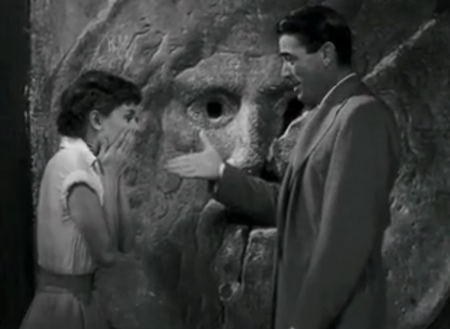
One of the best moments occurs at the mouth of truth, a great stone statue, which you are supposed to stick your hand in before it eats it up. In a moment of sheer fear Princess Ann or Audrey Hepburn, I’m not quite sure who looks on in horror as a screaming Bradley removes his arm and his hand is gone. Up comes the hand from the coat sleeves and the jokes on her. It has absolutely no bearing on the plot but it makes us love Peck and Hepburn even more.
 

To finish off the evening the two companions and Irving (Eddie Albert) cause a ruckus at a dance aboard a barge before swimming away to safety. There Ann finds love and a soaking wet kiss to go with it. But it is at that moment when the laughs stop and the romance begins that everything becomes all too clear. This wonderful day cannot last forever. There is a moment, after one final embrace, when they have to say goodbye for good.

This is not one of those “love at first sight” stories, but it is a different sort of fairy tale where two individuals share an enchanting day together and fall in love. Every Cinderella story must end and so does this one (Anna: At midnight I’ll turn into a pumpkin and drive away in my glass slipper). They must eventually come back down to reality with Princess Ann fulfilling his duties and Joe moving on with his career.
 
Joe’s major newsflash is not a thing anymore. The whole day means too much to him and being the buddy he is, good ol’ Irving understands that. Speaking of Irving, he deserves some discussion. Eddie Albert’s character is spilled on, stepped on, knocked over, tripped, and through it all remains the perfect buddy for Gregory Peck.  Even his little car is a riot, not to mention his inconspicuous tiny cigarette camera and his sly efforts at photography in every type of circumstance. Irving shares a great deal of double talk with Joe which somehow gets past the unsuspecting princess. However, by the end of the film, the princess is also a cohort in their memorable adventure with commemorative photos included! 
 
When Joe Bradley walks out of the grand palace he leaves content knowing that he shared something special. No one else needs to know (aside from Irving) about the fairy tale they shared and that is the beauty of it all. It is just their little secret, their Roman Holiday. 
 
5/5 Stars

Review: Butch Cassidy and the Sundance Kid (1969)


Not that it matters, but most of it is true…

The film opens with some old sepia-toned footage of a notorious gang from the turn-of-the-century and that is when we meet our two anti-heroes Butch Cassidy (Paul Newman) and the Sundance Kid (Robert Redford). Butch is the brains behind the operation (I got vision and the rest of the world wears bifocals) and Sundance is the brawn, with the most accurate gun in the West.

They make a living robbing banks and trains, but due to their lifestyle, they seldom come out ahead. Life becomes more difficult with tumult within the gang, a crackdown by the authorities and a price tag on the heads of Butch and Sundance.
Soon it becomes evident that their life of crime will never be the same with a professional tracker on their tails and a posse formed to see them hang. They are chased through hills, rock, water, and the like before finally getting away in one final desperate attempt at escape.
With one last brilliant piece of inspiration, Butch decides they should head for Bolivia to lay low, and soon enough they pack their bags and bring along The Kid’s girl (Katharine Ross) to the promised land of South America. They get more than they bargained for thanks to the language barrier and a lack of decent plunder. However, even abroad, their legend grows, winning them the new moniker “Banditos Yanquis.” The pair takes a stint on the right side of the law for once, but it somehow seems bleaker than their early days as bandits. It is evident that the hourglass is running out on them. And so it does, but not without one final glorious battle to cement the aura around two legends of the West.
I will not go so far as to call Butch Cassidy and the Sundance Kid a masterpiece because I have read too many reviews to know that there has been a great deal of division over the film. I can only speak from my own experience when I say that I quickly grew to love this story. This appreciation stems from the spot on chemistry of Paul Newman and Robert Redford. Their outlaws are not your typical thugs but lovable buffoons you cannot help but cheer for through all their screw-ups and pratfalls. Paul Newman has his ever-present mischievous smile plastered on his face, and Redford plays the cool and collected Kid to the tee. Perfect casting for the roles and to think it might have been Steve McQueen and Warren Beatty.
 
They got together again in The Sting, which was another good film, although I will always be partial to their first collaboration. William Goldman’s script can only be described as a fun romp that accentuates the comradery of Butch and Sundance. The musical score by Burt Bacharach with the inclusion of “Raindrops Keep Falling On My Head” is often at complete odds with what we have come to expect with classic westerns, but that suits the film just fine.
 
You see this is not your typical western by any means. It’s not supposed to be. Butch and Sundance are working in the twilight of the West. The horse is soon to be replaced with the future: the bicycles. Bank vaults are becoming more complex, fervor for the Spanish-American War is at its peak, and lawlessness is no longer going to be tolerated. Whether people realize it or not, this film is one in a final wave of classic westerns that finally petered out in the 70s. Now the western genre, just like the West before it, is dead. A dying breed of genre much like film-noir or even musicals.
 
That’s why Butch Cassidy works for me. People have criticized the constant change in tones, but this story never claims to be the absolute truth, and it would not be the same film if it did. This story of outlaws is not a history lesson but a legend about two infamous bank robbers. There are moments where we love these antiheroes and moments where we do not know quite what to think of them. They become disillusioned and beaten down by the changing times. Their ambush in Bolivia has only one apparent conclusion. It ended in a bloody and violent death. However, we do not have to see that for the sake of the legend of Butch Cassidy and the Sundance Kid. In one mythical moment, they regained their previous status. They went out as they came in, and they will forever be remembered as Butch and Sundance of the Hole in the Wall Gang. They have since been replaced by superheroes on the silver screen, but in their day and age, they were the original supermen — tarnished as they were.
What is amazing is that the film has not only resonated with audiences for generations, but with the leads themselves who really identified with their roles. That is perhaps the greatest compliment to its characters. 

5/5 Stars 

Holiday (1938)

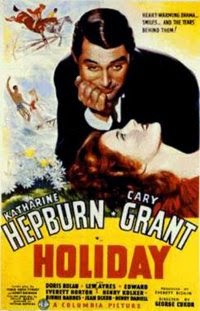
2c3de-holiday_posterJohnny Case (Cary Grant) is a happy go lucky fellow who is crazy in love with the girl of his dreams. He returns to town telling his friends the Potters that he has plans to marry this girl he met 10 days ago at Lake Placid! He is ecstatic and not afraid to show it.

However, he must become acclimated with her family and their lifestyle. Most important is gaining the approval of her sometimes stuffy and always money-minded banking father. Julia Sefton is by all accounts a lovely girl who seems to truly return Johnny’s affection. Honestly, though he is not quite used to her type of society. He makes his entrance by arriving through the servant’s door and wanders around the stately manor marveling at all the trappings. Doing the rounds he runs into her drunken but genuine brother Ned (Lew Ayres). Then, there is sister Linda (Katharine Hepburn), the so-called black sheep of the family, although her only fault is being an energetic free-spirit.

Immediately she and Johnny hit if off, and she soon realizes that her sister has a real catch on her hands. The wedding is finally agreed upon by Mr. Seton, and a big New Year’s Eve Party is thrown much to Linda’s chagrin. The night of the big to do there are two parties that take place. Downstairs all the snobs and high society mingle with Julia parading Johnny around. Upstairs is a different matter where the quarantined Linda is eventually joined by the Potters,  Ned and even Johnny.

The little gathering gets quashed and that is not all. Father and daughter are adamant that Johnny works at the bank and make money because that’s what any respectful husband would do. They take little heed of Johnny’s dream to take a holiday once he has raised enough money to live off of. He just wants to live life free of distractions for awhile, but they just do not understand. Finally, Johnny is feeling too restricted by all the obligations to bear it any longer, because he simply cannot live that way. Again, both father and daughter do not understand. But Julia does, and she finally realizes what she must do. It’s time to take a holiday.

Here is a formidable trio in Cary Grant, Katharine Hepburn, and director George Cukor. It makes me beg the question, how this film has become so overshadowed by Bringing up Baby and The Philadelphia Story? Johnny Case is a wonderfully vibrant role for Grant, and his acrobatics alone are worthwhile viewing. Hepburn on her part plays an equally spirited individual but without the scatter-brained or feisty edge that she often carried. Instead, she is just wonderfully footloose and fancy-free. Edward Everett Horton and Jean Dixon are an absolute riot, and I would love to have friends like them. Lew Ayres role was rather an odd one, but both Doris Nolan and Henry Kolker had an adequate amount of stuffiness to pull off their parts. That juxtaposition was necessary for the film to work and it did.

4/5 Stars

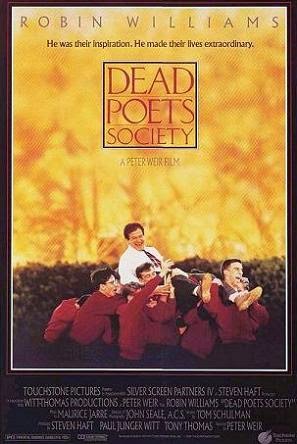
The Dead Poets Society (1989)

24bb0-dead_poets_societyDirected by Peter Weir and starring Robin Williams in a career-defining role, the film opens with the commencement of a prestigious all-boys school. There the boys say tearful goodbyes to their parents and get reacquainted with their chums. The strict and disciplined class regiment soon starts and everything is business as usual for these driven boys. 

However, their new English professor John Keating (Robin Williams) was a former student of Welton, and his teaching style is far from ordinary. His pupils first find him strange and then come to admire his methods. He instills them with the phrase “carpe diem,” has them rip out the stuffy introduction to their poetry textbooks, gets them to see the world from on top of their desks, and encourages them to call him “O Captain, My Captain.” Above all, he leads his students to seize the day, and think for themselves in the process.

 A group of his students re-launch the illegal Dead Poets Society that Keating himself had been a part of as a lad. There they share their thoughts, feelings, and ideas freely in defiance of the school. Charlie (Gale Hanson) for one puts an illicit article in the paper only to follow it by an audacious act that receives retribution from the Headmaster. Knox (Josh Charles) somewhat accidentally meets a girl who he immediately falls head over heels for. However, she already has a boyfriend, but the undaunted Knox will not be deterred, and he keeps seeing her. Against his father’s wishes, Neil (Robert Sean Leonard) takes up acting in a play only to receive his father’s immense disapproval later on. The outcome of this is tragic, and it ultimately leads to an investigation of Keating. Everything seems bleak for the boys as they either rat on Keating or risk expulsion. 

Keating is released and English returns to the same monotony. However, Keating’s impact cannot be destroyed that easily, and in one last act of the defiance the boys stand up for their Captain led by the formerly timid Todd (Ethan Hawke). I must say that although the film’s ending was inspiring, it left me wondering what the consequences were. Also, I did not really understand the point of The Dead Poets Society. The title would seem to be more aptly Carpe Diem. Putting that aside, there are some good performances here, and Robin Williams is truly a pleasure to watch. He could be my English teacher any day. There are some good lessons to be learned here too. Take note boys. 

4/5 Stars

Review: The Spectacular Now (2013)

Looking back a year later…

The moment Aimee Finicky appears onscreen is perhaps the most remarkable instant out of many great moments in this film. The light must have been exactly perfect and everything seems calm and serene. The only thing we focus on is the initial meeting between two individuals, and that’s all that matters. That anxious face obscured by the light. That voice tinged with worry and relief. As an audience, we have our first encounter with the girl that the same Sutter who is sprawled on the ground, will fall for over the course of the film. However, right now he can’t remember who she is. There could not have been a better meet cute.

Fast forward to the ending of The Spectacular Now. So much has taken place in a short span of 90 minutes, it’s hard to keep track of it all. Just like much of the high school experience. Aimee and Sutter have been on an emotional roller coaster which Sutter has succeeded in derailing, but he has a new resolve and he will not waste this opportunity in the now.

There she is walking down the steps of her new college. Pleasant looking as always, undoubtedly with thoughts of academia swirling around pushing her past memories into the back of her mind. Then, all of a sudden they’re all right in front of her again in the form of Sutter.

There is a look on her face that is almost indescribable and it seems apparent that words are about to form on her lips, and the film cuts away. It is absolutely maddening as an audience who has become so invested in the story of these two high schoolers.

For some reason, this final shot of Aimee reminds me of The Tramp’s final reaction in City Lights. It might be a stretch but in both situations, there is a tinge of hope, but there is still this uncomfortable feeling of the unknown. And yet if we had known the resolution both these films would have lost some of their allure and City Lights is Chaplin’s masterpiece. As of right now The Spectacular Now is a little blimp on the radar in 2013. Shailene Woodley and Miles Teller might change that with the rate they are going. They certainly do not have the weight of the one and only Charlie Chaplin, but I am sure both of them are destined for numerous other great performances.

4.5/5 Stars

A Man For All Seasons (1966)

a4d49-a_man_for_all_seasonsSir Thomas More had the misfortune of getting in the way of perhaps one of the most notorious kings in history, and it proved costly. It is the early 1500s in England, and the Reformation has shaken the world but Henry VIII (Robert Shaw) has his own plans for the church in his country. He is bent on getting his marriage annulled by the pop,e because young Anne Boleyn will be much more likely to give a healthy heir to the throne.

A Man For All Seasons focuses on the position of More who at the time was Lord Chancellor of England. First, in talking with Cardinal Wolsey, More resolves not to sign the letter to the pope on the king’s behalf, because it goes against his conscience. Later, in his dealings with Thomas Cromwell, More resigns rather than to sign an oath making Henry VIII the supreme leader of the church in England.

Except there is more to it than that. More certainly was not a dissident or a rebellious political figure. Far from it. At least in the film, he is portrayed by Paul Scofield as a constantly even-keeled and gracious man in all circumstances. When a young man named Rich (John Hurt) sold More out for a high title, in a Christ-like response More has only pity for the fellow. Selling his soul for the world is worse enough, but Rich did it for Wales.

Not even the pleading of his newly-wedded daughter (Susannah York), or his strong-willed wife (Wendy Hiller) can change More’s conviction as he wastes away in the Tower of London. Sir Thomas went calmly to his death confident that his faith in his Lord would give him eternal peace. He died there for a seemingly trivial reason at the hands of men who used to be his friends. But he died with his conscience intact.

As I acknowledged, Paul Scofield is such a serene force during the storm of this film. The portly Orson Welles and Leo McKern seem to fit their roles well, and Robert Shaw has enough bluster to pull off Henry VIII. A young John Hurt turns in a fine performance as the Judas of the film and Nigel Davenport is commendable as More’s exasperated friend the Duke.

Adapted from a stage play, here is another highly acclaimed film from director Fred Zinnemann. Perhaps it is the period drama, but this film strikes me as very English and it did very well for itself. I suppose because it’s a tale that is universal and audiences love to identify with men such as Sir Thomas More. Zinnemann was always superb at capturing the inner struggles that humanity is often forced to confront, and he did it once again here.

4/5 Stars