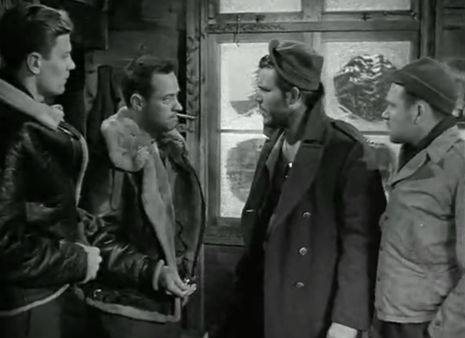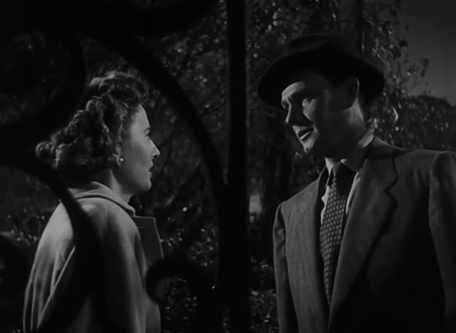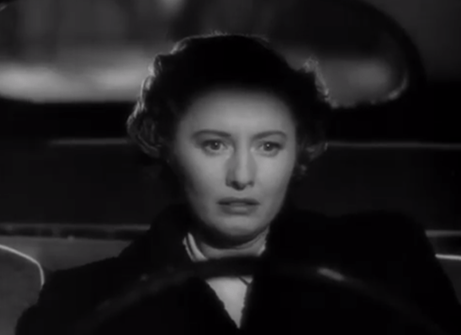
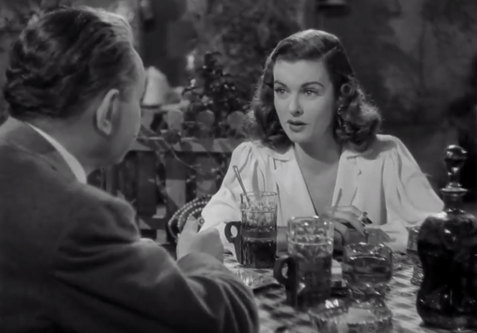
Review: Scarlet Street (1945)

scarlet street 2.png

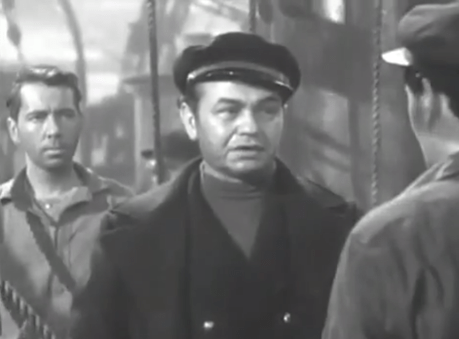
Scarlet Street is an obvious reunion picture bringing together Fritz Lang, Edward G. Robinson, Joan Bennet and Dan Duryea among others from the prior year. Dudley Nichols’ story, while taking elements from La Chienne, which had already been made into a film by French master Jean Renoir in 1931, is elevated by its own unique elements.

A party is being held for one Christopher Cross (Robinson) in appreciation for his many years of faithful service at his company. As a gift, he is bequeathed a fine watch. That’s what he has to show for the last 25 years. However, he has two unfulfilled dreams from when he was young. The first was to be an artist and well, the second, was to have a beautiful woman look at him with love in her eyes. He’s never experienced that warm sensation before.

It happens the way it always does with a single moment of instantaneous decision. He intervenes when a thug is beating up a lady and he’s pleasantly surprised to find the lady to be quite ravishing. There sits Joan Bennett unlocking her jaw and surveying the damage to make sure she can flaunt her face another day, dolled up in her raincoat. In these initial interludes, she’s playfully provocative and endearingly colloquial (“Jeepers”). In fact, she’s utterly charming when you first get to know her. But that’s not to say she takes her latest conquest too seriously. She’s already got herself a man.

Oblivious and lonely, Chris begins to open up gushing about all the things about art and love that’s he’s always kept bottled up. But Kitty makes him feel like a happy schoolboy again because she seems to take a genuine interest in him as a human being. You see, Chris is a model of that inherently human desire. He is hardwired like all of us to crave some form of intimacy or better still to be fully known by someone else in a way that is complete and vulnerable

Little does he know that not everyone is so trusting and sincere as him. Sometimes people are only looking to get something out of you — to use you — and that’s much of what this story is about. That’s what makes it a noirish film at all. Certainly in the hands of Lang reteamed with cinematographer Norman Krasner they paint enough in darkness and billowing smoke. But anyone will tell you film noir is not just a look but a sensibility, a worldview, and an outlook.

Chris Cross begins so innocent and unperturbed by the world even as he feels something is missing in his life. But, when it’s all said and done, he gets absolutely decimated and crushed into the ground unmercifully.

scarlet street 4.png

She has another love; he’s abusive and knocks her around but she doesn’t seem to mind. He’s got something she likes that her roommate Millie (Margaret Lindsay) rolls her eyes at. They probably deserve each other. At any rate, in Kitty’s eyes, Johnny’s a real man whereas Chris is a piddling old fool, at first a plaything, then a cash cow, and finally a nuisance. Johnny coaxes his “lazy legs” to see how much she can weasel out of him. She’s oh so charming and he’s a light touch. Chris would literally go to the moon and back for her if possible.

His home life is continually suffocating him. Rosalind Ivan is tasked with the same nagging wife role from The Suspect (1944) this time torturing a meek Robinson instead of an angelic Charles Laughton. The results are very much the same. A man can only take so much flack

But the other angle has to do with Chris’s art. He’s maintained the hobby even as his wife considers it a waste of time and threatens to throw away all his work as it clutters up her house. However, Kitty gets ideas that Chris is some bigshot artist. Knowing nothing of painting, she tells Johnny about it and he convinces her to let him try to sell the pieces.

They wind up stumbling on something outstanding rather incredulously. John Decker’s idiosyncratic and still striking compositions fill in for the amateur painter’s style. Soon, Kitty’s fronting for Chris’s work without his knowledge to make a profit and suck him dry. By now she’s even got enough of a reservoir of his monologues to repurpose his sincere words for monetary gain. Soon she has a prestigious art collector interested and a local critic eating out of her hand. Meanwhile, Chris still has nothing simply a lingering devotion to Kitty that will only break his heart.
scarlet street 1.png

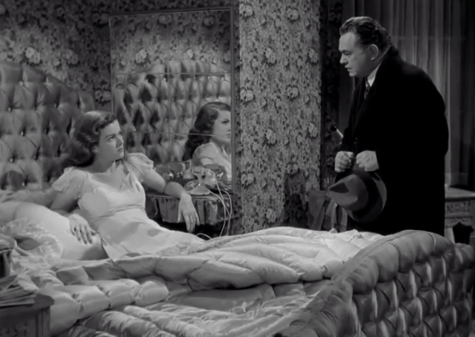
A galvanizing moment, where Chris’s delusion or his innocence comes to bear, occurs during a chance visit to Kitty’s apartment to announce his marriage is terminated and he’s a free man. She turns away from him and he tries to comfort her in her despair. Saying that they’ll go away together, make a new life, and start anew. But then she turns around and those tears instead turn out to be derisive laughter. The one person he thought he could trust betrays his emotions and wounds him to his core. Because this relationship too, proves to be an utter lie as she tears him down in the most humiliating fashion. It’s more than he can bear.

One can gather that everything else happening to Chris is all but a blur as the trajectory of his life soon finds him spiraling into the gutter. As one convenient commuter on the train puts it, “We each have a courtroom in our heart, judge, jury, and executioner.” It’s this sense of conscience that is shown to tear Chris apart in totality. He can never return to be his former self.

Here we see once more thematic elements common to Lang involving the complex and often flawed wheels of justice. But it’s only a mechanism for the most perplexing elements as Chris is haunted by the specters of his tormenters, trapped in his own private hell.

Robinson was probably just as aware as anyone the similarities between this and Woman in The Window (1944) and he was no doubt looking forward to moving on to something different. One could wager a bet that Bennett and Duryea are the real standouts because there sliminess is what makes the picture take.

They linger over its frames and they do so much to ruin Chris. In this day and age, I don’t know if we’re as appalled by their activities as in the 1940s where the picture was even banned locally. Now I think we see it and we’re overly conditioned to what seems mild fare or we’ve come to terms with the fact humanity has much evil within them. You cannot witness something like Scarlet Street, however ludicrous it might seem and think for one moment human beings are inherently good. It just doesn’t work.

What I appreciate about this picture more than anything is how it has the gumption to never pull a punch. Woman in the Window (1944) had a conceit and ending that worked given its psychological underpinnings. The way Scarlet Street resolves itself is no less fitting in choosing to be so very conflicted and ambiguous. If Chris was not a pitiful specimen before, he certainly is now.

4/5 Stars
Review: The Woman in The Window (1944)

woman in the window 1.png

The first time I ever saw The Woman in The Window it always struck me as odd. Here was the fellow who was known as a gangster through and through and yet he was playing a bookish professor buried in his work and obsessed about psychoanalytic theory. His idea for a fine time is conversing with his intellectual friends (Raymond Massey and Edmund Breon) at the Stork Club. He’s the epitome of middle-aged solidity and stodginess as he so aptly puts it.

But in confronting these very things, you realize Robinson might have enjoyed any opportunity to get away from what everybody seemed to peg him as — to exercise a certain amount of elasticity as an actor — to be the antithesis of his image. This is all mere conjecture, mind you, because as the story progresses, you realize the character is a bit mundane.

Regardless, veteran Hollywood screenwriter Nunnally Johnson spins a story of psychological intrigue as his first showcase for his newly founded production firm International Pictures. This Fritz Lang effort along with a handful of others would instigate the stylistic categorization of “film noir” by French critics in the post-war years. There’s little doubt it fits many of the fluid conventions of noir. Though overshadowed by the even more sinister Scarlet Street from the following year, it is a genre classic in its own right.

As alluded to already, it’s also steeped in psychology. In fact, it gets knee deep in it from the opening moments in such a fashion that we know it will remain all but integral for the entire run of the narrative. Professor Wanley is enraptured by an image, a portrait of a woman to be exact, and it elicits the same spell Gene Tierney would have in Preminger’s Laura (1944). But of course, it is the woman being animated for real that brings true life to the movie and it’s no different here.

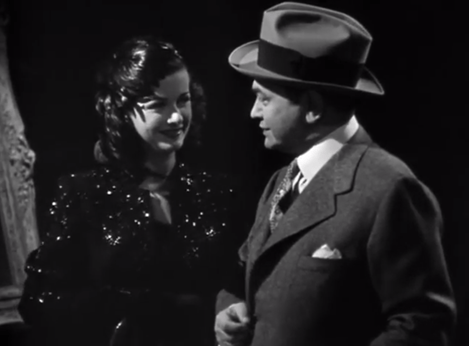
This brings us to the part that’s actually the most gratifying and probably would have been the most enjoyable to play. That of the eponymous woman staring back through the window. Joan Bennet is positively bewitching and grouped with Scarlet Street (1945), it remains some of the defining work of her career, which is hardly something to be dismissive of.

As best as it can be described, she has a pair of those coaxing, inviting eyes. Bennett, to a degree, seems to play up her Hedy Lamarr appeal with jet black hair but her looks are her own as is the spellbinding performance and it works wonders starting with the man on the screen opposite her.

He foregoes a burlesque show to engage in some “light” after dinner reading of Song of Songs. Though he’s probably looking at it from a purely academic perspective, one can gather that between his psychological theories and the fairly explicit poeticism of his reading, he’s got quite the cocktail brewing in his mind.

He gives the portrait another look as he’s about to head home, as is his normal tendency. In this particular instance, the woman is present in the flesh and they share some complimentary words. That leads to drinks and then a venture to her apartment to wind down the evening perfectly innocently.

However, instantly his life is transformed into a living nightmare as they are interrupted by a scorned boyfriend with a horrid temper going at Richard who has no recourse but to strike his adversary down in a frantic attempt at preserving his own life. It was self-defense but the damage has been done and the results are not-so-conveniently lying on Ms. Reed’s carpet.

Even with these turn of events, the professor takes them in stride, systematically and semi-rationally coming to a decision that while risky just might be the most beneficial plan of action, at least in theory. There is much that needs to be done. He enlists Alice to clean up the crime scene by both getting rid of blood and incriminating fingerprints. Any evidence that would implicate either of them must be done away with methodically.

He puts it upon himself to dispose of the body, which is no small task as the dead man has a massive frame. It takes up a lot of space and causes him some grief. He gets rid of it but not without incurring a cut and a rash of poison ivy while also leaving behind some clues that indubitably will have a bearing on the case.

However, he also has the rare privilege of being so close to the district attorney and the head of the homicide department to see first hand how they’re getting on with the case. If anything it unnerves him more assuming he will soon incriminate himself with a minor slip of the tongue or worse yet be found out in his clandestine activities due to the thorough investigation underway.

Dan Duryea has a small-time role playing what he was best at, a sleazy enforcer looking for blackmail or any other dishonest way to make a buck. Thankfully his part would be expanded upon in Scarlet Street as he came back for a second helping. His career is composed of an interesting trajectory even earning him a few starring spots in his later efforts like Black Angel. He’s an underrated talent who made classic Hollywood and noir in particular that much more engaging. One could wager it’s Bennett and Duryea who really clean up shop as they would do again the following year.

To mollify the production codes, Fritz Lang settled with the ultimate cop-out ending. While it would normally disgruntle me, the sheer lunacy of it all and the fact the picture is so embroiled with themes of the human psyche makes it marginally okay. If anything, the fact there was a superior followup the next year takes the sting out of it. Still, there’s no downplaying that Woman in The Window was crucial in laying the groundwork of what we now consider film noir, complete with murder, femme fatales, fatalistic heroes, and shadowy extremes courtesy of cinematographer Milton Krasner. What’s not to love? It’s certainly worthy of a second dose.

4/5 Stars

The Sea Wolf (1941)

sea wolf 1.png

“Better to reign in hell than serve in heaven” – John Milton in Paradise Lost

Though some noir film layered in London fog is probably up for contention, otherwise, there’s arguably no movie murkier than this atmospheric sea-faring delight from Michael Curtiz. But what puts it above and beyond some of its contemporaries, especially swashbucklers like a Black Swan, has to do with a variability and surprising depth of characterization for what feels like such a minor vehicle.

From the framework of Jack London’s novel, screenwriter Robert Rossen has cleverly repurposed the material and made it thoroughly well-suited for the cast at hand, expanding the roles for his stars. For most of its running time, in fact, the story is aboard the ominously named vessel, “The Ghost,” while maintaining an unwavering level of intensity.

Certainly the aforementioned climate plays into it because it can exude a level of impending menace. Still, you can only get so far on that. There needs to be legitimate emotional resonance and some amount of real even complex conflict at the core if a glorified chamber piece like this is to stay afloat. Thankfully, due to its characters, it does. At any rate, we are provided several fascinating figures to try and comprehend.

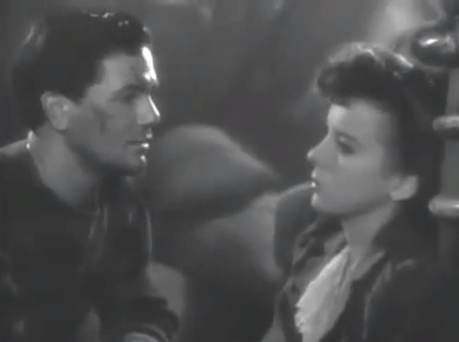
John Garfield is one of them, a fiery sailor named George Leach who is on the run and he doesn’t care where he ends up. In his case, he winds up a lowly cabin boy. Again, he doesn’t care.  Meanwhile, Ida Lupino is escaped from a woman’s reformatory and seeks the corroboration of a fiction writer named (van Weyden) as it ends up, their voyage is ill-fated following a collision that sets off a deluge of water leaving them hopelessly shipwrecked.

In the aftermath, they are picked up by the schooner “The Ghost,”  its tyrannical captain Wolf Larsen (Edward G. Robinson) leading a crew of no-good and hard-bitten seamen. Barry Fitzgerald excites as the knife-toting cook who’s as ornery as you’ve ever seen the plucky Irishman. The writer is brought on as cabin boy given the rude awakening that the captain has no designs to drop him off onshore. His vocation and unwavering monotone are perfect for conveying this impartial point of view for the benefit of the audience. Meanwhile, John Garfield embittered with a chip on his shoulder is forced to take on harder labor and his anger smolders against everyone.

sea wolf 2.png

The girl, Ms. Webster (Lupino) is deathly sick and the swacked and constantly unstable doctor (Gene Lockhart) seems to be of little help. His nerves as a physician look completely shot. By some miracle, he’s able to get sober enough to nurse the lady back to health, of course, when she makes her first public appearance looking to be the picture of propriety, the seafaring men are quick to see through her. She’s another unwanted sea rat just like all of them.

It’s plain to see she’s not about to earn any favors and the same goes for the other newly acquired deckhands. They have few rights as the sea captain runs the ship with a dictatorial hand. In all affairs he controls everything and he can be a ruthless taskmaster with his boys carrying out his every order with a rowdy mania, even turning against their own when given a chance.

However, although Wolf is a tough man, he nevertheless has an inscrutable side well-read in Milton and knowing a past of innumerable hardship. It’s these very traits that make van Weyden crucial as someone who is able to get closer than the others in order to try and tease out who Larsen really is.

A mass of contradictions, with a brain and a need for dignity in a harsh world but he also has a vengeful brother hanging over him, avowing to blow him to smithereens. If there is any regret in Larsen, he’s resolutely set his course and rarely looks back, making sure to maintain his supremacy over his men in all circumstances. His philosophy is purely self-serving.

But even he begins to crack. The film is laden with claustrophobic and seasick-inducing interiors depicting living hell on the waves with Larsen lording over it with an iron fist. Of course, with mutiny afoot instigated by Leach, finally able to exercise his lust for authority, there’s bound to be drama, even as he begins to carry a torch for Ruth.

Because later he, Ms. Webster, and van Weyden look to escape only to have their provisions sabotaged by Larsen, and “The Ghost” is ultimately ambushed by its mortal enemy. The hourglass is running out. But even as the captain goes down with his ship, a near pitiful figure now, he looks to take as many others down with him as he can. In opposition to such selfishness, a contrasting force of sacrifice is called for.

4/5 Stars

Note: The cut I watched was the shortened 1947 cut. The restored cut was reissued in 2017 at its full length of 1 hour and 40 minutes. This was the theatrical cut before it was edited to fit on a double bill with another Curtiz picture The Sea Hawk (1941).


Barbary Coast (1936)

barbary coast 1.png

The production itself was fraught with some turbulence thanks to the contentious relationship between Miriam Hopkins and Edward G. Robinson. The latter actor was irritated how his costar was constantly trying to increase her part and keep him off balance with frequent dialogue changes. Regardless, the talent is too wonderful to resist outright.

How Howard Hawks ended up directing Barbary Coast is anyone’s guess, somehow getting involved as a favor to his screenwriting buddies Ben Hecht and Charles MacArthur who spent numerous rewrites crafting something that the production codes might actually condone, overhauling the original novel’s plot points immensely.

Hawks has no major stake in the production and as such it hardly stands up with his most engaging works. Still, it does hold some merit demonstrating from the outset it’s a fast-moving, thick-on-atmosphere, period adventure set out in 49ers era California. That environment is enough to make a generally engaging yarn even if the narrative threads run fairly thin.

But the world is fully animated. Alive with honky-tonk pianos, crooked roulette wheels, and hazy city streets paved in mud. Just about what you envision gold country to be like, at least viewed through the inspired dream factory of old Hollywood. The blending of genre is a fine attribute as the picture is a mixture of historical drama, romance, comedy, adventure, and western themes sharing some relation to San Francisco (1936) and The Sea Wolf (1940), along with the lawless towns in Destry Rides Again (1939) or even The Far Country (1954).

A ship lands in the notorious San Francisco Bay, among its passengers a strangely out of place lady (Miriam Hopkins) and a gentlemanly journalist, Marcus Aurelius Cobb (Frank Craven). They are met with quite the reception committee of local undesirables.

Walter Brennan is a standout as the scrounging, toothless, eyepatch-wearing Old Atrocity preying on unsuspecting outsiders who happen to make their way to the streets of San Fransisco. Mary Rutledge is in town to join her fiancee who messaged her to come out and meet him as he’s struck it rich. She promptly finds out her man is dead, no doubt knocked off by the crooked Louis Chamalis (Edward G. Robinson).

With his restaurant the Bella Donna and adjoining gambling house, the ruthless businessman rakes in the profits by robbing prospectors of their hard-earned caches and getting tough when they object to his dirty practices.

Miriam Hopkins, both radiant and sharp, isn’t about to snivel about her lost prospects and heads straight away to the Bella Donna to see what business she can dig up for herself. There’s little question she causes quite the stir because everyone is taken with this newly arrived white woman — including Louis. As Robinson’s character puts it, she has a pretty way of holding her head, high falutin but smart. That’s her in a nutshell as she earns the moniker “Swan” and becomes the queenly attraction of the roulette wheels.

It’s there, an ornery and sloshed Irishman (Donald Meek in an uncharacteristic blustering role) gets robbed blind and causes a big stink. Louis snaps his figures and his ever-present saloon heavy Knuckles (Brian Donlevy) makes sure things settle down.

He’s sent off to do other jobs as well. In one such case, he shoots someone in the back but with a mere Chinaman as an eyewitness in a kangaroo court presided over by a drunk judge, there is little to no chance for legitimate justice. Then there’s the manhandling of free speech by forcibly intimating Mr. Cobb in his journalistic endeavors and nearly demolishing his printing press for publishing defamatory remarks about the local despot. Swan is able to intercede on his behalf as Cobb resigns himself to print droll rubbish and it seems Louis has won out yet again.

barbary coast 2.png

Joel McCrea has what feels like minuscule screentime and achieves third billing with a role casting him as the romantic alternative, a good guy and yakety prospector from back east who is as much of an outsider as Ms. Rutledge. He’s eloquent and strangely philosophical for such a grungy place. He’s also surprisingly congenial. It catches just about everyone off guard. First, striking up a serendipitous friendship with the woman and gaining some amount of rapport with Chamalis for his way of conversing.

Though the picture stalls in the latter half and loses a clear focus, the performances are nonetheless gratifying as Robinson begins to get undermined. Vigilantes finally get organized using the press to disseminate the word about Louis and simultaneously battle his own monopoly with an assault of their own.

One man must die for the right of freedom of speech to be exercised while another man is strung up like an animal. Our two lovebirds get over the lies they told each other looking to flee the ever-extending reach of a jealous lover. Chamalis is not about to let them see happiness together. The question remains if they can be rescued in time from his tyrannical clutches. The dramatic beats may well be familiar but Barbara Coast still manages to be diverting entertainment for the accommodating viewer.

3.5/5 Stars

Little Caesar (1931)

Little_Caesar.JPG

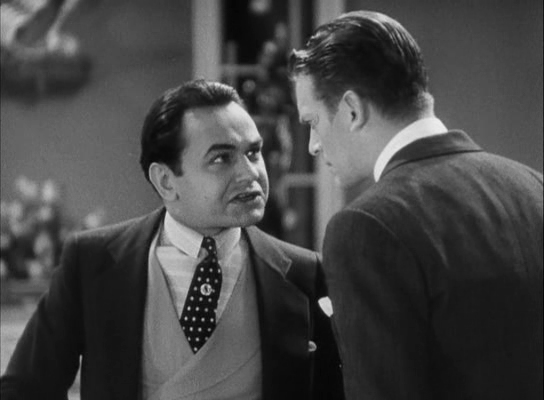
When I was a kid we had an old VHS of Bugs Bunny shorts and one of the caricatures in a gangster-themed storyline — although I didn’t know it at the time — was undoubtedly Edward G. Robinson. That voice. That mug. That smug self-assuredness. They’re inimitable. Even then I knew the image without knowing who this garbled-mouthed gangster actually was. Watch Little Caesar and it’s all right there. In fact, without Little Caesar, one could step out on a limb and say that Bugs Bunny cartoon would never have been made. Though, Robinson was an indomitable personality. One way or another he would have broken through.

As it was, Robinson made a lasting impression in his big break, the picture that would make him a star just as its contemporary The Public Enemy (1931) did the same for James Cagney also at Warner Bros. True, it served as both a blessing and a curse typecasting the stars with their audiences. Still, both men led impressive careers which, at least on occasion, allowed them to break out of the mold and really show who they were as actors. And the beauty of their successes had nothing to do with an imposing physical frame but rather a sturdiness and commanding tenacity that made them into electric performers full of captivating stage presence.

With an opening quotation from Matthew, “All who take the sword will perish by the sword,” we are immediately tipped off this will be a moral tale right from the outset, an act of condemnation not glorification. However, that cannot completely neutralize the unadulterated gangsterism of Litte Caesar. Far from it.

With all these early Warner Bros. crime films we can define the arc of the story by an ambitious lug who’s willing to do whatever it takes to rise to the top, showcasing both guts and gats when necessary. It takes both to get ahead. Rico (Robinson) is a little guy who’s not content with his lot in life so he resolves to change things. He heads to Chicago with his buddy Joe (Douglas Fairbanks Jr.) to see what they can make of themselves.

Already they are on diverging paths as Joe looks to return to his first love of dancing, even finding a capable ally and love interest at a local club. Olga (Glenda Farrel) makes a new lease on life possible for him. But such a life would never do for Rico. He’s already set his sights on big-time crime, moving up the ranks with local mobster Sam Vettori.

Joe is roped in for a job as the inside man and reluctantly he goes along with it. But on the same night, New Year’s Eve, Rico guns down the crime commissioner during an otherwise straightforward hold up of the Bronze Peacock. It has heady implications as the local authorities look to clamp down.

As best as I can describe it, there is a stripped-down unsentimental bent to the action line going through the movie. The talking pictures still feel like a new phenomenon recorded on Vitaphone — a bit rigid and visually unimaginative — but in some respects, it aids in the characterization of the gangster underworld. It’s hard-edged, lacking any sense of freedom of movement or ideals. They play by a “you’re either with us or against us” mentality and they are not about to let you forget who your friends are. Rico and Joe provide the diverging alternative lifestyles available as one tries to go straight and the other becomes more crooked by the hour.

The character of Tony is another convenient case study for the movie as the local mob’s getaway driver who begins to lose his nerve and have remorse for his part in it all. It is his saintly mother who not offers him spaghetti but tries to remind him of his former life when he was a good boy. Convicted to the very core of his being, he goes to the priest for confession. But Rico will have none of this blubbering. His retribution is sure and swift as it’s always been, culminating in an OG drive-by shooting.

A gang war erupts when a failed hit is instigated on Rico. Instead, he and The Big Boy are able to consolidate power and he continues to rise up the ranks. All throughout his ascension, Rico lives by streetwise slogans like, “I ain’t afraid of nobody.” “The resident bosses are getting so they can dish it out but can’t take it anymore.” And of course, “the bigger a man becomes, the harder he falls.” It’s all but inevitable.

His words are prophetic because at some time Rico’s got to face the music and he does. Like The Public Enemy and Scarface, what sets these pictures apart is not necessarily that they glorified crime because you can make the case each tries to hammer home the moral crime doesn’t pay. And yet with the exhibitions in violence and the uninhibited pursuit of power by antiheroes like Cagney, Muni, and Robinson, the public latched onto them and propelled them into being big stars. Without the pre-code era, we would lack some of the legendary mystique of Rico.

In the end, riddled with Tommy gun fire, he looks up into the heavens, exclaiming those now immortal lines, “Mother of Mercy, is this the end of Rico?” With that, he breathes his last. But the miracle of celluloid means that now 85 years onward Edward G. Robinson’s performance lives on.

3.5/5 Stars

Eighth Grade (2018)

Eighth_Grade.pngIt’s not exactly The Godfather but in its opening monologue, using the awkward tween, like-laden mouthpiece of Kayla, Bo Burnham re-exerts his creative voice on the media landscape. What is more, in a world becoming continually more obsessed with relevance, shareability, and trends, Eighth Grade promises something of actual substance.
Because it dares to do what few films have done (or done well), which is enter the perilous trenches of middle school plagued by all the anxiety, bodily changes, and nervous stuttering that goes with such turbulent territory.

Looking into Kayla’s face for as long as we do — every painful tick and averted gaze — we realize this message to “Be Yourself” on her channel is as much of a rallying cry for her than for anyone else. But that’s precisely the point, isn’t it? We live life for affirmation and to know we are not alone.

I can still recall when I was in middle school (10 years ago now), which must feel like eons for middle schoolers right now. But the big new gizmo was the iPhone. MySpace was just becoming a thing of the past as the Facebook storm began to creep in. By the time of my final year in high school, Instagram was on the scene.

Now people (even me) don’t really use Facebook. We’ve moved onto Instagram, Snap Chat, and new uncharted frontiers. In the social media age proliferating with Instagram stories, Youtube vlogs, podcasts, snap stories and whatever else that is new and novel, there is a hyper-awareness of technology, surpassing anything we have yet to see.

Our daily brand — how we showcase ourselves to the public — is so important as is second-guessing every text and emoji to make sure they make us come off in the right light. In fact, even by the movie’s conclusion, we feel saturated. But the truly sobering aspect is seeing how it so directly overlaps with my own life and the lives of friends as we navigate this age. It’s not too far removed from us.

Eighth Grade is also a film that greatens my resolve to go on a technology detox in some shape or form. Kayla, constantly scrolling, plugged in with earbuds, is not so much a bygone figure but a mild reflection of many of us — even those of us who are older.

But on the Middle School front, there are also instantly recognizable vignettes from rubber bands on braces to health class and superlatives within the student body. It is these relatable elements causing Eighth Grade to mirror Boyhood in how it capably recalls a certain time and place.

And like Edge of Seventeen, there’s a fascination in the bad boy who by any subjective standard is arguably the most uninteresting specimen of the opposite gender in the entire pack. It’s the way our adolescent brains function causing us to channel people through a very specific filter.

Initially, the movie feels more low key and less edgy than aspects of middle school I remember around the fringes. However, there also manages to be ample truth. Though everyone has diverse experiences, there are other elements proving themselves universal.

There’s the invitation to the pool party which is in itself ripe with so many potential humiliations. The over the shoulder slow track as Kayla plods along tentatively is one of Burnham’s favorite tricks to get inside her character — epitomizing just how much of an unconfident, introvert she is among her peers.

It turns out to be a bit like a three-ringed circus but not in some outrageous way — in the everyday idiosyncratic, cringe-worthy way we no doubt experienced in our own lives. We are allowed to observe the silly flirting rituals of the genders. How a girl’s mother invites her 50 “best friends” to the party thereby netting a veritable lode of presents.

Then we are reminded of how fledgling teenagers coexist (or don’t) with their parents. What follow are the well-established angsty, taciturn evasion tactics. It’s one of the strange mysteries of the universe. Everyone else’s parents are fine but the moment we hit a certain age our own parents find a way of wheedling under our skins and our own issues and insecurities meets head-on with these people who love us and often try our patience.

In the darkness, in front of a glowing screen — not only the circadian rhythms are thrown out of whack — but with technology literally when we wake up (phones as alarm clocks) and web surfing before bed, there’s room for concern. There is little space left over for quiet. We are never alone. Never allotted time to simply exist, undistracted.

In one moment Kayla utters the cutest prayer about the first day of her high school “audition.” If we were to take it seriously, her prayer is answered in the form of Olivia, a bubbly high schooler, who instantly puts her shadow at ease. But while Olivia is easy and kind and inclusive, her friends are a shoddy bunch.

Between them, we have the confrontation of this idea of micro generations — how quickly things change now — and how we are “wired differently” based on when we grew up. Middle schoolers versus high schoolers, then college students, and now an old fogey like me out of college.

An awkward interaction becomes progressively creepier in the darkened back seat of a car when she is getting driven home by a boy. In fact, it turns into a traumatic experience. No young woman should have to deal with something like that in an already harrowing world. It breaks the heart because we know there is a truth to it.

Kayla gratefully finds another worthy friend in Gabe — who is the dork to trump all dorks — but he’s also a person of quality because he’s never destructive or narcissistic. There is an authentic warmth to him which makes him worth having in your corner. When he asks Kayla if she believes in God, munching on fries and chicken nuggets it’s matter-of-fact, if not candid.

The conversation feels so forced and awkward but they are both on equal footing, worrying and concerned and so it makes every weird observation or odd behavior part of the new, accepted status quo. None of it matters. They are friends.

These moments trigger brief wisps of memories where I wish I could go back to those days armed with a few of the things I learned now. Being content in my own skin enough to take leaps of faith, being bold, and making an idiot of myself more often. It works when you have people in your circle who aren’t trying to play a superficial popularity contest with you. They’re the definition of what a friend actually is if you look it up in the dictionary, instead of a convenient social conception.

In the end, I couldn’t help wishing Eighth Grade was a television program instead of a film. I’m not sure if this is a negative conclusion to come to. All I can consider are my warm memories for The Wonder Years and then Freaks and Geeks, which both gave us such meaningful articulations of a certain time in life. Kevin Arnold’s voiceovers as his adult self are a thing of legend. And Kayla gives us a similar entry point through her vlog. But it doesn’t feel as visually cinematic as it does episodic.

Burnham’s finest scene is probably the pool party because like other films before it, he’s able to use that arena to give us something about our main character. To some degree though, the film is full of astute and highly personal insights, there is something tiring about montage, vacuous pop music paired with voiceover.

Then again, if there was anyone qualified to look at this material in this manner, it probably is Burnham who himself began as a YouTube personality. There is an instantaneous bit of truth he can inject into the movie and even if this was all it was, there is something to it. If it connects with some kid on a meaningful level, I would consider it to be an unequivocal success.

Elsie Fisher is a name I recall from Despicable Me but in this live-action performance, she brings the crucial unassuming charm to push the role into a believable world. A connection is made thanks to her and when the credits roll we want Kayla to be herself knowing full well how special she is. Mr. Rogers isn’t in vogue with middle schoolers or high schoolers and yet there is such lasting veracity in one of his most famous affirmations.

“You make each day a special day. You know how? By just your being you. There’s only one person in this whole world like you. And that’s you. And people can like you exactly as you are.”

I think we could all use more words like these in our lives. Replacing Twitter feuds with uplifting words of praise seems like a worthwhile tradeoff. It only takes one voice to start a movement.

4/5 Stars


Executive Suite (1954)

executive suite 1.png

Executive Suite is a story of the high rise corporate jungle where on a daily basis it’s a Darwinian experiment not only pitting company against company but, on a microscale, man against man. After all, in the most cynical sense, that’s what free market capitalism is.

Top to bottom, the film boasts rich reservoirs of talent from sure-handed director Robert Wise and screenwriting newcomer Ernest Lehman who would soon be a hot commodity in the industry thanks to the likes of The Sweet Smell of Success (1957) and North by Northwest (1959).

It also proves to be an All-Star cast if there ever was one,  stacked with at least 10 easily recognizable names rounding out a lineup which could go toe-to-toe with any other drama of the decade on talent alone. Such a bevy of stars hearkens back to the golden years of MGM in the 1930s before television was ever a thing and they had as many stars as there were stars in the sky.

Today Executive Suite admittedly doesn’t get much coverage as a drama because, in spite of its vast ensemble, it’s not necessarily grandiose or vibrant, even compared to later Wise successes like West Side Story (1961) and The Sound of Music (1965). However, this in no way should downplay its striking qualities and there are some compelling ones.

Out of all the stylistic choices, one of the most noticeable ones and, subsequently, unusual decisions for the era is the absence of any form of traditional musical scoring. In this regard, we could say the scenes are not manipulated by any amount of sonorousness. What we see is making some claim at authenticity with street noise in lieu of diegetic sound and Chet Huntley introducing our narrative set in the upper echelons of a skyscraper.

Though a bit gimmicky by today’s standards, Wise does immediately catch our eyes with an extended POV shot taking on the perspective of an unseen big wig name Bulliard, the formidable head of Tredway Furniture Co. He’s coming back to town and has slated a meeting for that same evening, upon his return. Except something highly unsuspected happens. One might blame the taxing strain of his work but he winds up dropping dead in the street. Some scrounger conveniently picks up his discarded wallet, making any form of identification more difficult for the police.

The company is thrown into an uproar following his sudden and untimely death, especially because there is no true contingency plan as the deceased had no single, hand-picked second-in-command.

Nina Foch is the secretary managing a vast network of information, funneling down to all the executive suite. She is the runner between offices and boardrooms, relaying the information to all the necessary contacts as Bulliard’s right-hand assistant.

executive suite 2.png

They gather for their impromptu meeting. There’s Frederick Y. Alderson (Walter Pidgeon), a career man who has been by the side of his friend Mr. Bulliard for many, many years now. Loren Shaw (Frederic March) is a relatively new addition to the company but as chief controller and a shrewd numbers man; he’s been able to up the annual earnings at Tredway as of late.

J. Walter Dudley (Paul Douglas) is the charismatic head of sales who could talk anyone into buying just about anything. He’s that good. Of course, his dirty little secret is he’s been embroiled in an affair with his secretary (Shelley Winters).

The ambitious young family man Don Walling (William Holden) holds a more hands-on position in the factory, overseeing design and development while the old warhorse, Mr. Grimm (Dean Jagger), is in charge of manufacturing. However, with their product going down in quality to cut expenses, he’s got an idea to retire. He holds no pride in his work anymore.

Between all these men and the opportunistic snake-in-the-grass, George Caswell (Louis Calhern), we have the gathering of the top brass and quality acting talent. It’s a bountiful proposition getting all these people in a room together. And when the news breaks it’s essentially an exhibition of “who died and made you king” as the factions scramble into action, assembling to vie for some form of supremacy.

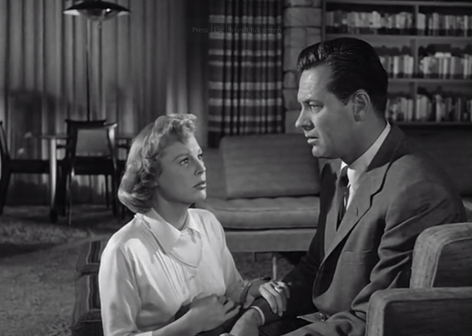
Shaw is the first man spurred into action in the wake of Bulliard’s death because though Alderson holds private aspirations, he resigns himself to acquiescence. But that doesn’t mean they’re going down without a fight. Walling plays the number games late at night trying to figure where everyone stands. He confides in his wife (June Allyson) and plays catch with his son but his work-life balance is suffering. His wife worries the instability will bury him professionally.

It’s true the names are continually interchanging thanks to dirty politics and a plethora of finagling, leveraging, and leaning to line everything up for the impending nominations session to be undertaken on a closed ballot.

executive suite 4.png

In a man’s world, it’s fitting that Barbara Stanwyck would be the only woman with any sway on the meeting of the mind’s thanks to her stock holdings in her father’s company, which Bulliard helped appreciate. She doesn’t have much screentime but her very financial capital makes her crucial to the picture as an unpredictable swing vote. Her wild card and some late arrivals obscure the resolution to the last possible instant in thrilling fashion.

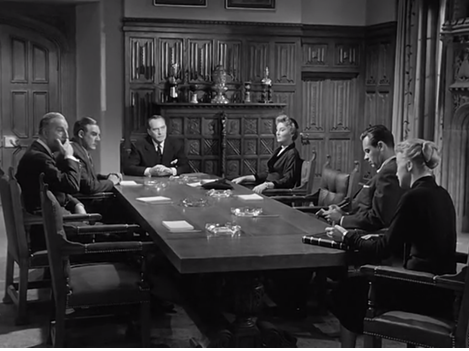
It’s true Henry Fonda was up for a part in the movie and that inkling gives me a rather obvious realization. Executive Suite does play like a bigger, loftier version of 12 Angry Men (1957). Especially in its most crucial minutes. Far be it from me to say people sitting around a boardroom table cannot be interesting because once more I was invested in what decision was arrived upon and I knew it took every one of those actors around that table to make it stick.

Someone has to rise to the occasion and that person is William Holden, positioned as the initially hesitant one, dismissed as still inexperienced, and yet he has a vision the others lack. He’s not a tired old man. He’s not driven solely by profits or bitter over past affronts.

He’s looking beyond to new territory and a future where the company can prosper not simply because of penny-pinching but an actual pride in the quality of the product they can offer their customers. If you wanted to make a sweeping statement, you could say he, even momentarily, redeems the American Dream, a symbol of the American everyman with his white picket fence, beautiful wife, and high ideals. That is until the next board meeting happens. But I would like to think he is capable as a leader for change. It’s true we need people like him in this world of ours.

4/5 Stars

Review: Stalag 17 (1953)

stalag 17.png

I grew up with Hogan’s Heroes reruns on our Magnavox analog television. In fact, at one point it was my favorite show because it had such a colorful cast, it was perennially entertaining and utterly goofy to the extreme. But others have understandably decried the show because they see it finding humor in something that is not very funny. They contend it was making light of the Holocaust and WWII on the whole. Although I do believe this is an oversimplification and I don’t have time to tackle it right now, it’s still an important dialogue to have. I will defer to others for the time being.

The point of discourse I want to take up is Billy Wilder’s Stalag 17 because it’s obvious there would be no Hogan’s Heroes without this P.O.W. comedy-drama. The plots, even the characterizations, are eerily similar, close enough to prompt plagiarism lawsuits. But the difference is Hogan functions as pure zaniness carried by the strength of its ensemble where the Germans are utter buffoons. That’s the hallmark of characters like Sergeant Schultz (John Banner) and Kommandant Klink (Werner Klemperer) who are both lovable imbeciles. They will never be allowed victory over Hogan and his allies.

In Wilder’s hands, a P.O.W. camp is silly and light-hearted at times, yes, but it’s also equally dark and cynical. Because what would a Wilder picture be without some pointed comic venom? Two obvious points of reference would have to be the wartime comedy directed by his idol Ernst Lubitsch, To Be or Not to Be (1942), which some would argue employs morbid humor. Then there’s Grande Illusion (1937) starring Erich von Stroheim (featured in Sunset Boulevard) as a prison camp commander who can easily be contrasted with Otto Preminger’s Colonel von Scherberg. In both, you have those evident counterpoints of humor and tragedy exquisitely executed.

Stalag 17′s opening escape attempt of two men is snuffed out by machine gun fire just waiting to mow them down. It’s the definition of unsentimental and it is the first of numerous breakdowns in communication. There is a rat somewhere. There has to be.

stalag 17 2.png

Then, the picture is back to its belly laughs supplied most obviously by Harry Shapiro (Harvey Lembeck) and his tubby, scruffy buddy Animal (Robert Strauss). They spearhead all of the shenanigans, including a daring attempt to break into the prison camp of Russian women to sneak a peek. You see, Animal’s deeply broken up by his unrequited love for Betty Grable. They bicker with the resident Sergeant Schultz (Sig Ruman), another Hogan’s Heroes precursor, who good-naturedly chortles at all their ribbing. Surely this isn’t anything like how Stalags actually operated?

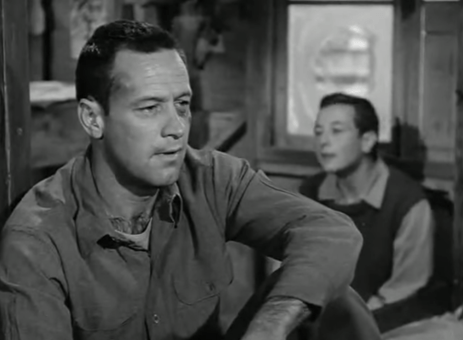
Wilder’s trademark biting wit is most fully realized in Sefton. For the part he was initially reluctant to take, William Holden donned a crew cut and scruff generally masking his normally dashing features. But this was hardly the aspect making him uneasy about the role.

Sefton is a textbook undesirable. He openly trades with the enemy in an effort to make himself as comfortable as possible. He bets a boatload of cigarettes the two fugitives won’t make it out of the camp and when it proves morbidly correct, he makes a killing.

Likewise, he’s the local wheeler-dealer, maintaining the Stalag 17 rat race turf complete with betting for all the servicemen. His other enterprises include a distillery — a flamethrower of sumptuous potato peel schnapps — and “The Observatory” where all the boys eagerly line up for a tantalizing look at the Russian delousing shack. Conveniently, he’s also the obvious culprit when a stoolie is suspected within their ranks.

It takes all kinds to liven up the joint and make it into a space with real drama to go along with so many lighter notes. We already mentioned Harry and Animal but the Barracks chief is the always reliable Hoffy (Richard Erdman), head of security is Peter Graves, Duke (Neville Brand) is the rough and tumble one who’s not squeamish about having a fist fight. There’s a blond brainiac, the catatonic one, the amputee who uses his spare space to sneak materials in and out of the barracks, and the nasally mailman with a voice to top all voices.

stalag 17 3.png

When a new prisoner named Dunbar (Don Taylor) gets brought in with his copilot (Jay Lawrence), who has a penchant for spot-on impersonations, they receive a hero’s welcome. After all, they helped to sabotage enemy armaments on their way to being captured. But the information leaks continue with their radio being confiscated and Dunbar being called in for questioning, due to his treacherous activities. The SS is coming to take him to Berlin for questioning. If he’s ever going to come out alive the P.O.W.s must make a last ditch effort to try and get him to safety.

Meanwhile, Sefton gets a going over by the whole barracks, which is quickly overshadowed by Christmas in the camp complete with carols, dancing, and parading full of gaiety. It’s meant to lull us into a false sense of security as Sefton is put in his place and things are good again. It all conveniently diverts from something else. Sefton’s not the culprit. Someone else has been communicating with the Germans and tipping them off.

The final confrontation is when the film really puts it all on the line. We find out who the perpetrator is and Sefton’s vindicated in everything, even going out as a kind of hero. Except to the bitter end, he’s never redeemed as a human being. He’s as hard-edged and acerbic as ever and yet to the folks at homes, he’s who will be cast a hero because he did something brave. Holden was uncomfortable with this as much as we are as an audience but Billy Wilder was unflinching and ultimately right in creating this dissonance.

If anything, Stalag 17 as realized by Billy Wilder and his team is a reminder of the harshness and utter absurdity of war. This is how he conceives it — a man who lost his parents to concentration camps and was sent over to his former land to help rebuild it. He probably knew as much as anyone how horrible the Nazi atrocities were but to memorialize every attribute of the Allies as noble would not document the whole truth.

If Sefton’s the poster boy of the war, then we have to take a deep hard look out our ideals and what we stand for. Because, of course, he was the only one not taken in. Everyone else was so quick to accuse him and to see what they wanted to. It’s almost as if a film documenting an aspect of WWII was in the same breathe suggesting what was afoot with the red scare in the rising fury of the Cold War. Heaven forbid a person we don’t like or don’t agree with is not so easy to demonize as “other.”

It’s far too scary to concede they’re probably just like us. They just didn’t have the decency to hide it. Perhaps they’re better because they were not swayed by the clouded judgment of others.

So if I watch Stalag 17 and become turned off by this incongruity between the historical setting, the lightness in tone, and the shock of a generally unsympathetic lead, maybe it says more about my conception of the world than anything wrong with Billy Wilder’s admittedly incisive picture. It’s a scary admission to make but it just might be true.

4.5/5 Stars

The File on Thelma Jordon (1950)

the file on thelma jordon

There is arguably no director who is, in retrospect, more important to the film movement that became classified as film noir than German emigre Robert Siodmak. His name isn’t quite as well known as the Billy Wilders or Fritz Langs necessarily but one can contend his influence on this style is without equal.

While not his greatest achievement, The File on Thelma Jordon is yet another example of the man’s proclivities for deliciously shadowy melodrama which, while not always plausible, is more often than not incessantly intriguing.

In this particular case, we are involved with a local district attorney (Wendell Corey). He is a man who loves his wife while not being too fond of her overbearing father. In fact, Cleve conveniently stays away from home whenever the in-laws are around. It’s certainly complicated his marital relationship as of late.

One such night he stays at the office to knock a few back only to cross paths with a Ms. Thelma Jordon (Barbara Stanwyck) who mistakes him for someone else as she recently inquired about protection for her paranoid aunt — a woman fearful of burglars. On the verge of a real bender, he invites her for a drink and they spend some time together. She’s just what he’s been looking for to fill the void in his life.

Meanwhile, his wife is going away with the kids for a summer at the beach house and he hates to see them leave; he really does. Maybe he knows deep down they are slowly drifting apart and his urges to see the other woman are all but insurmountable. He can’t fight it much longer. There used to be someone — an estranged one-time husband named Tony — but he’s purportedly no longer around. Cleve brushes him off and they keep seeing each other whenever possible.

But their relationship hits a dramatic turn one evening. She calls him up in the thick of night and he comes at her beck and call. They slink in the shadows as she breaks the news to him. Her aunt has been killed by an intruder; the old woman’s worst fears coming to fruition with priceless jewels being stolen from the safe.

The situation is complicated by a frantic Thelma who panicked by altering the crime scene and failing to call the police. Now the man across the road has his interest piqued and comes over to investigate. In the heat of the moment, they must hastily cover everything up as Cleve rushes out of the window and Thelma feigns sleep. It’s all part of an intense interlude coursing through the middle of the picture making the collective heart of the audience pulse with anxiety.

What follows is a murder inquest and then a trial with Ms. Jordon standing as the defendant. She’s got herself a stone-cold and exacting lawyer who could care less about her guilt or innocence. In his mind’s eye, she is innocent and that’s how he plans to win her case regardless.

Meanwhile, Cleve gets put in a very sticky and uncomfortable situation as he finds himself made the prosecuting attorney on the case. As the two sides try to legally sway the jury, the identity of a mysterious Mr. X still swirls around the case, and Cleve tries everything to throw the case in the most indirect ways possible. It’s a perilous balancing act where he will lose something regardless. Siodmak milks it for all its tension as the frenzied proceedings press on with the media jumping on it like ravenous wolves. Someone’s got to be a fall guy. Stay the course and you might be surprised in how the case resolves itself.

Wendell Corey could always be called on for steady and at times wry support but that being so, it’s refreshing to see him in a substantial leading role playing opposite a true professional. They work capably together as the story relies mostly on their two performances.

Barbara Stanwyck is great when she’s bad. Phyllis Dietrichson is the epitome of this fact, remaining one of the crowning achievements of her career. Though a lesser-known incarnation, Thelma Jordon is worthy of some notoriety in her own right.

However, the sublimeness of Stanwyck here is how she never really feels slimy or full of guile, even in the stages when the books are all but closed on her case and we get a fuller picture of who she is. The whole time we are kept constantly guessing and fluttering this way and that in indecision. More than once she surprises us.

The trick to a femme fatale like herself is never consciously deciding to be destructive. She’s doing what she personally believes to be right even if it’s due to a lapse in judgment or an impending sense of fear. I’m sure there was some greed in there too but we all harbor a little bit deep in our hearts somewhere.

So though it ends with a malaise that can only be film noir, there is some sense of rightness in the way everything goes down. It’s not to say there’s not a bite to the picture. When the file closes on Thelma Jordon two lives have been deeply affected forever with far-reaching repercussions. There’s no changing that.

3.5/5 Stars

No Man of Her Own (1950)

no man of her own 1

Helen Ferguson (Barbara Stanwyck) is slighted by her slimy boyfriend who ditches her for a blonde and the only thing he offers her in return is a train ticket out of town. What can she do but take it dejectedly with barely any money, 8-months pregnant, without any future at all? She’s in a lowly state. That is until she is befriended by the perky Patrice Harkness (Phyllis Thaxter) and her genial husband (Richard Denning), who quickly lift her spirits through their continual ebullience.

The first sign of melodrama comes with a horrible train crash that leaving both Harknesses dead but Helen survives waking up in a hospital to find that her baby was saved. Except there’s a catch and, mind you, it’s the pivot point on which the weight of the whole story balances. In the commotion-filled aftermath of the crash, Helen is mistaken for Patrice, the young wife her purported in-laws have never met before. Now she is in their home to be taken care of.

Of course, at first, Helen is scared. She has nowhere to turn and so she goes along with it as her baby for the moment has a roof over his head. As time progresses, she comes to grow deeply affectionate of Mr. and Mrs. Harkness. The kindly matriarch (Jane Cowl) is so taken with her new daughter-in-law it all but consoles her in the loss of her son. Meanwhile, her other boy Bill (John Lund) takes a deep liking for his sister-in-law and does everything to make her feel welcome in the foreign environment. You can tell he genuinely cares about her. It’s no act.

However, the film also explores themes that Alfred Hitchcock’s Strangers on The Train (1951) would traverse only a year later with strains of blackmail and the specters out of her past coming to ruin the life Helen has created for herself.

Her no-good ex is interested in what she has landed in and what he can get out of it. First, it’s money to keep her secret, then it’s marriage so that he can get in on her cut of the Harkness fortune if ever it comes her way. He’s a filthy parasite and she knows there’s only one conceivable way to be rid of him. You know if already: murder!

But far from getting tossed out by the Harknesses or being completely undone by Morley, Helen, Patrice, whatever you wish to call her, is able to salvage a life for herself because of compassionate folks who are willing to accept her no matter her background. They even get knee deep into her plight, even die for her. The extent of their kindness leaves her forever grateful and hopeful that some form of human love still remains possible for her. Even the prospects of a murder rap seem surmountable.

The ending has one of those final cherry-on-the-top-of-the-sundae resolutions allowing everything to tie together in a nice bow. Some people might find it silly but I rather liked it. It gives the storyline one ironic twist of fate perfectly suited for this turbulent strain of drama. The police are satisfied. Crime didn’t pay. Our romantic leads get to stay together. All is right with the world. After such bleak beginnings, it’s almost laughable.

Despite being an utterly preposterous conceit, Barbara Stanwyck rides it out with her usual measured commitment to her craft both sympathetic and to the degree possible, believable. In the latter half, she’s an absolutely pasty mess personifying a woman terrified about being found out in her lie and subsequently rejected by the ones she’s worked so hard to love.

Director Mitchell Leisen, though given his penchant for finely wrought romantic comedies and an eye for costumes and interiors, shows he is no less capable in this woman’s picture, keeping it afloat even as it cycles through all sorts of implausibilities. I was generally fond of John Lund in The Mating Season (1951) as well, though it’s true he’s all but overshadowed by his female costars in both movies. However, when the people in question are the caliber of Barbara Stanwyck, Gene Tierney, and Thelma Ritter it’s quite understandable.

3/5 Stars