
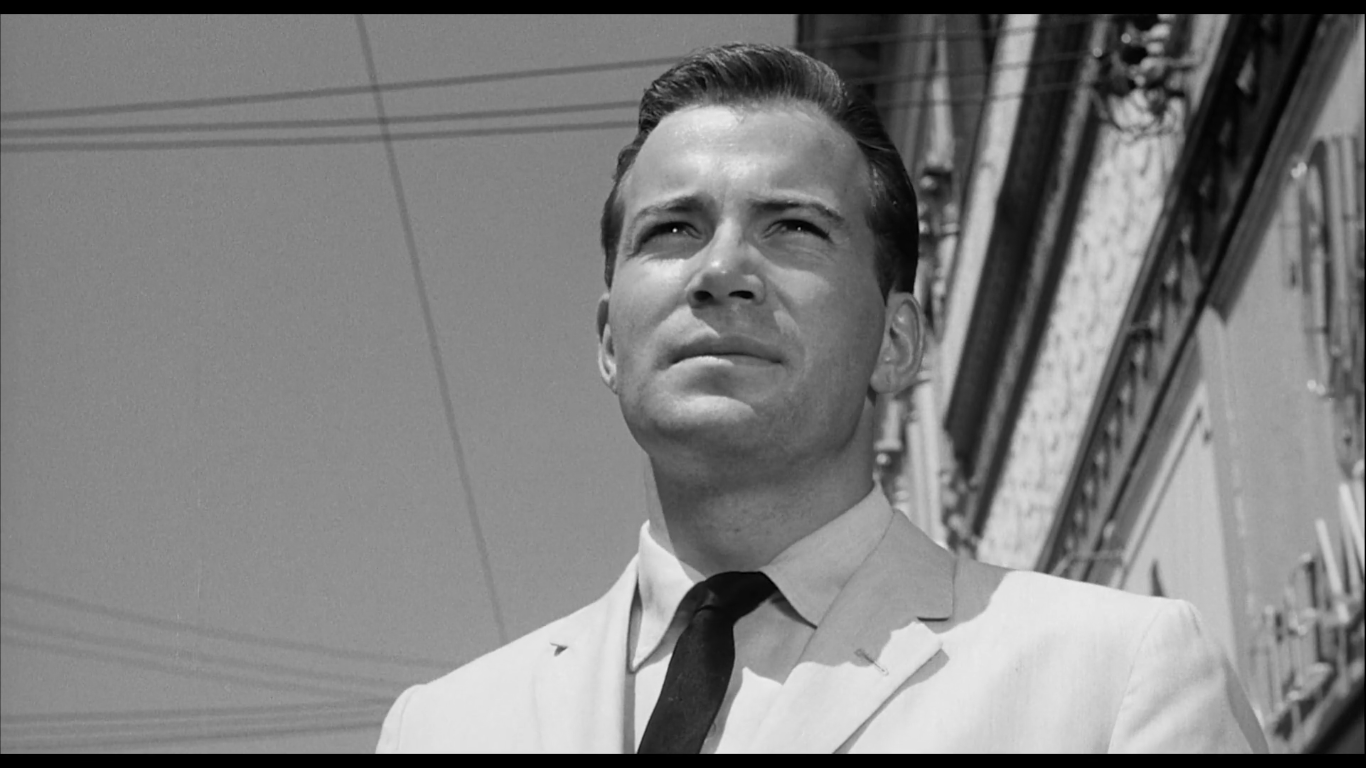
Before he became a caricature of his former self, even before the days of Captain Kirk and pop culture canonization, The Intruder is a reminder of something else in William Shatner. He still feels ripe and almost dangerous with a charisma that has yet to be calcified or even corroded by time.
The same could be said of Roger Corman at least if you only have a perfunctory understanding of his career like me. He is the master of fast and cheap entertainment turned out for profit at a rapid rate. Surely, The Intruder doesn’t fit into the patchwork of his career.
Before we blandly christen him the “King of Schlock,” a more nuanced observation seems to be in order, considering both his talents and his ambitions. Others must speak to this more knowledgeably. All I can say is that this specific film totally obliterates any preconceived notions of what we are getting.
Shatner stars as Adam Cramer, a self-described social reformer with a skeevy look in his eye to go with a cool disposition. He’s headed out on the latest bus to help the locals fight the government implementation of integration in the town’s high school. Under the guise of the freedom-loving Patrick Henry Society, he’s ready to stir up some action. Give me Liberty or Give me Death (though mostly death). In other words, a real creep.
He sets up shop at the local hotel — it bleeds with crusty southern hospitality — feeling like a stronghold for a racist status quo. He’s put up by a sweet ol’ lady while his next-door neighbors, a gregarious salesman (Leo Penn), and his flirtatious wife (Jeanne Cooper) don’t leave much to the imagination. We know what they’re doing and they don’t much care who knows it. It’s a good thing because the walls are especially thin in a place such as this.
Although the film is primarily white-centric, for a white audience, there are some black characters playing crucial roles on the periphery. One is the local minister, a man of faith who takes his calling seriously. He exhorts the youngest members of his congregation in meekness and prays over these 10 lambs from his flock. He’s well aware they are about to enter the valley of the shadow, a space no young person should have to be subjected to. Still, the letter of the law in some ways falls on their side in the face of threat and injury.
One evening on a grand old southern estate Cramer holds a rally to rile up the townspeople, spewing all sorts of epithets, and appealing to their spirit of discontentment. The NAACP is a communist front, headed by a Jew. It’s all a sham. The government can’t be trusted and The Patrick Henry Society is tasked with preaching the truth — at least his version of it.
As we watch the masses be swayed and he skillfully plays them like a marionette with public opinion in his palm, the deviousness comes into full color. He’s a Lonesome Rhodes-type figure who uses his own magnetism to get what he wants.
When the whites, armed with their newfound ammunition, take to the streets ready to victimize a black family driving home the movie becomes too real. It’s almost like the film was overly cognizant of its time with an incisiveness toward the hot-button issues of the age. Even today it feels gutting to watch whether fiction or not. The images strike too close.
Shatner riding in a hooded caravan with a gang toting a cross through the black community is horrifying. There’s a faceless dynamiting of a church with the faithful minister left for dead. The only other time I recall something comparable in mainstream Hollywood was the mobbish vitriol in Phenix City Story a few years earlier. To Kill a Mockingbird is wistfully nostalgic in comparison. Right or wrong, The Intruder has no such illusions.
Cramer is a man who happily takes a prison sentence telling a wealthy backer (Robert Emhardt) to never underestimate a jail sentence — remember Socrates, Lenin, Hitler… How you can conflate all these men says so much about you. And of course, there’s no mention of Dr. King. This is not the kind of man to dignify a fellow reformer on the other team with an acknowledgment.
The most curious figure (aside from Cramer) is Tom McDaniel (Frank Maxwell). He’s a southern man. He’s been inculcated with the prevailing sentiments of the South, but he also seems to have a higher standard. It’s partially because he’s the herald of the local news — he has journalistic standards — but there’s something else we have to spend time with him to figure out. His wife disagrees. Grandpa wants to disown him. His daughter (Beverly Lunsford) is probably still trying to make sense of it all. Regardless, he believes the law must be carried out.
I don’t know if we ever get a clear indication of why. Although he’s not the only one we can say this about. I’m not sure if we ever get a precise reason for Cramer’s actions either. He’s not a Southerner and there’s never a clear indication he’s truly aligned with the white community, at least not when it gets right down to it. He’s not a Southerner. But he knows he can manipulate them for his purposes.
My fear is that the film is still too much the pipe dream of well-meaning moviemakers where southern guilt all of sudden turns a few solitary individuals into men and women of conscience. Maybe this is historically true. I don’t know, but for all the stories that ended like this with a life saved and a wolf in sheep’s clothing defrocked, we know that history was not always so forgiving. It is strewn with the names of men and women who were degraded, intimidated, and often killed.
That’s why part of me rumbles with a deep sentiment that must be acknowledged. It wants to cry out and warn folks not to see this movie. The inclination begins when they threaten to flip a black family’s car and reverberates again when a young white woman gets coerced into crying rape against a fellow black student named Joey (Charles Barnes).

There’s almost something indecent and profane about it as it echoes things that really came to pass. It’s this fine line I don’t know quite how to reconcile. Because I’ve rarely seen a movie this fierce and unflinching for the era, and yet in the same breath is this what is required then or now? It’s an open-ended rhetorical question. I don’t know the answer.
If the box office receipts are testament enough, the movie didn’t make much of a dent but for entirely different reasons. Roger Corman seems to have made his own implicit response. He never made another such picture again instead relegating his talents to Vincent Price Poe dramas and other such fare blessing the film world in another way. Yes, it was cheap entertainment, but also a breeding ground for some of the up-and-coming stars of the New Hollywood generation.
He did in fact make his own diagnosis of the film’s lack of success, which might be telling if not altogether definitive:
“I think it failed for two reasons. One: the audience at that time, the early sixties, simply didn’t want to see a picture about racial integration. Two: it was more of a lecture. From that moment on I thought my films should be entertainment on the surface and I should deliver any theme or idea or concept beneath the surface.”
Still, with a man’s face buried in the grass, a man fallen from grace head first, The Intruder totally reframes my perceptions of the now chubby anachronism of Shatner’s persona. I won’t say it redeems it so much as it augments it with a kind of duplicitous venom. It’s a new astounding contour to his career.
I’m still not sure if that’s a hearty recommendation or not. This is a very triggering film and a deeply onerous watch. The discerning viewer should make their own judgments. Because for some this kind of burden might be necessary. For others, it might be too heavy to bear.
4/5 Stars
Note: This review was written before Roger Corman’s passing on May 9, 2024

 4 Star Films