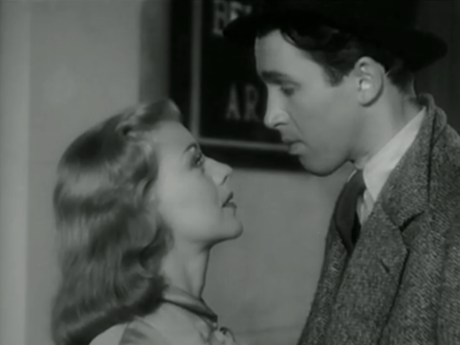
Man’s Favorite Sport? (1964) Starring Rock Hudson and Paula Prentiss

MansfavoritesportposterMan’s Favorite Sport was meant to be a Cary Grant and Katharine Hepburn reunion that never materialized. Because, of course, put together with Howard Hawks that only means one film — the most outrageous, cockamamie, frenzied escapade ever captured on celluloid — Bringing up Baby (1938).

Rock Hudson and Maria Perschy (I still don’t understand the necessity of her character) even do a reenactment of the famous restaurant wardrobe malfunction scene. The whole thing is unfair really. It’s not so much that Hudson’s not capable in his own right but Cary came first and so we’ll ever be comparing him. It’s best to drop that right from the beginning.

Obviously, the Grant-Hepburn movie never came into being as Hepburn never got involved and Grant, now at the tail-end of his career was hesitant about such a youthful leading lady. He chose to do a rom-com thriller called Charade (1963) instead and faced similar concerns opposite the other famous Hepburn, Audrey that is.

But back to Rock Hudson and what we got instead. When put toe-to-toe with the Doris Day comedies, it mostly holds its own given Howard Hawks’ own long affiliation with the screwiest brand of romantic comedies. From Twentieth Century (1934) all the down to I Was a Male War Bride (1949), Monkey Business (1952), and of course, Man’s Favorite Sport.

Paula Prentiss, husky-voiced and armed with rapid-fire ammunition of the Katharine Hepburn persuasion, does a fine job riddling Rock Hudson with her incessant craziness. So much so that her male counterpart can’t get anything in edgewise, constantly harried and exasperated in every conceivable way. It all signals an imminent love story in their future.

Whereas Day was usually dismayed by some aspect of Hudson’s behavior, it’s Prentiss who holds the prodding role and therefore the most license to cause chaos. She had recently graduated from a plethora of pictures pairing her with Jim Hutton, including such enjoyable trifles as Where The Boys Are (1960) and The Horizontal Lieutenant (1962).

As far as their support, John McGiver has a thatched roof that’s constantly shifting tectonically. It’s gotten to the point that he doesn’t care much. He’s the one who decides his ace employee, Roger Willoughby (Hudson) of Abercrombie and Fitch will join a fishing competition for positive publicity.

It was all dreamed up by a dynamo of a public relations lady Abigail Page (Prentiss). But the catch is the famed fishing expert has never been in a lake before, much less touched a fish in his life. He can’t fish. He can’t even swim. So when Abigail finds out she has even more leverage and agrees to teach him everything he needs to know. We already foresee that turning out just marvelously.

Then, there are two quibbling old-timers who are also contending for the laurels of the fishing tournament. After all these years, it’s a joy to see Roscoe Karns and Regis Toomey still have it like the old days. Even if they’re probably a little slower and grayer around the edges, the charming witticisms are still there. Best remembered for Hawk’s El Dorado (1966), Charlene Holt has a small part as the put-upon girlfriend who constantly has the utter misfortune of seeing her man in the most compromising situations with other women.

Because in some form Man’s Favorite Sport? is a rom-com of emasculation as Willoughby is constantly overwhelmed by Ms. Page from the very first beat. Even unwittingly, she holds the power in the dynamic as he’s plagued by her craziness and inadvertently comically harrassed around each turn. Every moment, from her initial stealing of his parking spot to criticizing his kisses, sends him reeling.

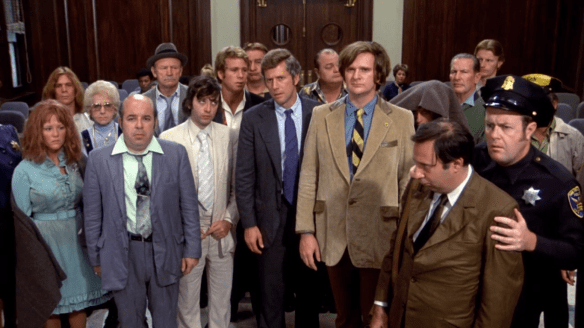
Although overlong, the picture continually saunters along, highlighted time and again by a substantial number of splashes and pratfalls. Mirroring William Powell’s fishing escapades in Libeled Lady (1936), Hudson finds his line and himself dragged along by a major catch. In another instance, he’s falling out of a tree only to land a whopper. We have black bears on road bikes, inflatable dungarees, and water-bed hijinks. In fact, he’s unwittingly leading the competition, exceeding his own expectations, though, he still has Abigail Page to contend with.

It’s like two locomotives colliding head-on — as much as a neo-screwball romantic comedy about a fishing expert who knows nothing about fishing and must learn from a woman who constantly antagonizes him can possibly be. That’s exactly what it is. At least if the locomotives can kiss and make up in the end. Man’s Favorite Sport? Sure. Rock Hudson’s not any good at fishing anyway so it suits him just fine.

3.5/5 Stars
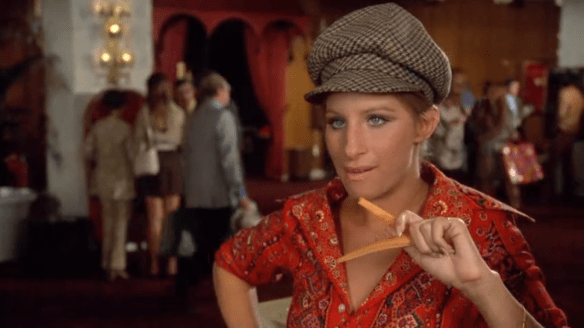
Review: What’s Up, Doc? (1972)

whats up doc 1.png

I’ve always been fascinated with individuals who have blurred the line between the film critic and actual contributors to the industry. Notable examples, of course, being the boys at Cahiers du Cinema, Frank S. Nugent, James Agee, Paul Schrader, even Roger Ebert, and certainly Peter Bogdanovich.

It’s this bridge between the intellectual and the actual practicality of the craft that seems so crucial. Because Bogdanovich might come off as an erudite individual who would end up making stuffy philosophical pictures. But What’s Up Doc is nothing like that. He loves the cinema and it shows.

Yes, this movie becomes a tossed salad of cinematic references and yet in the midst of the chaos, there is the finest rejuvenation of the screwball genre we’ve probably ever received. If neo-screwball were to be readily adopted in academic circles, you just might have to start the conversation here. It’s crazy; it’s destructive; it goes careening out of control. Maybe it’s just me, but I find it genuinely uproarious like a sprawling sitcom episode. It’s what the genre was made to be.

“You’re The Tops” plays, as the credits roll, sung by Barbra Streisand in a very casual manner that hints at the enjoyable jaunt we are about to undertake. Using the most basic terminology to break down the picture, What’s Up Doc is essentially a comic shell game. Except the shells are replaced with four identical plaid overnight duffles and the con is simultaneously being pulled on everyone on the screen and in the audience alike.

One bag holds the prized rocks of a musicologist Howard Bannister (Ryan O’Neal) who is traveling to San Francisco from his conservatory in Ames, Iowa to vie for the prestigious Larabee Grant. If he is lucky enough to reel in the award, it will help fund his research on the musical properties of igneous rocks. Don’t ask me to explain.

The other case comprises the possessions of one Judy Maxwell (Streisand). It’s not the contents of her bag as much as her whirlwind personality that will wreak havoc on the picture. Then, a third bag holds one lady’s prized collection of jewelry and the fourth holds secret government documents. Again, don’t ask.

But everyone seems to have a shtick. That’s a product of a screenplay crafted by Buck Henry, David Newman, and Robert Benton. There’s a repetition to the script’s comedic cadence that puts an indelible stamp on the material. Coming from such people like Madeline Kahn it can almost drive you insane while O’Neal is playing a stereotypical sterile intellectual type that generally goes against his well-suited image.

Still, with some people playing the film straight, or at least as flat and square as they come, it makes other people pop even more. Is that Barbra Streisand I hear? She drives us crazy but in a different way — arguably a much better one.

whats up doc 2.png

She throws the anal Eunice (Madeline Kahn) off the scent and winds up accompanying Howard to his important dinner to schmooze Mr. Larabee (Austin Pendleton) and outfox the competition represented by the snobbish Hugh Simon (Kenneth Mars). Alone Howard wouldn’t stand a chance but taking on the name Burnsy and masquerading as his fiancee, this intolerable girl who accosted him in a gift shop essentially wins him the grant.

Pendleton is an utter dork but there’s also something personable about him. He finds Burnsy to be just delightful and soon they’re on a first name basis. Howard’s trying to explain all the mix up as the real Eunice attempts to claw her way into the affair putting on a hissy fit. Meanwhile, Howard doesn’t know what to do because Burnsy’s got him all turned around amid the ruckus.

Various side plots continue crisscrossing as people sneak around the periphery involving the aforementioned travel packs. A concierge and the house detective are in cahoots to abscond with the priceless treasure trove of glittering gems. Meanwhile, a mysterious man is tailed every which way by another man saddled with a golf bag as a measly attempt at a disguise. It would be astoundingly absurd if we weren’t already distracted by everything else going on in front of us. As it is, these diversions only succeed in adding to the cacophony of it all. A perfect visual articulation comes in the form of a hallway lined with doors, leading to rooms, and the people inside.

whats up doc 5.png

It comes to an abrupt end when they all wind up in Howard’s room with one girl out on a ledge, his outraged Fiancee asking him to turn the TV down, and everyone else making a cameo appearance. What follows is the total annihilation of a hotel room suite, a fitting foreshadowing of coming attractions.

Even if it can’t quite reach the same heights, What’s Up Doc is unabashedly homage to Bringing Up Baby (1938). We have a man’s coat being ripped, dinosaur bones being traded out for rocks, and the similar antagonizing relationship between our leads. However, I didn’t realize that we also have much of the character dynamic from The Lady Eve (1941) because Streisand like Barbara Stanwyck before her has an incredible aptitude for manipulating her male conquest. Katharine was the whizzing hurricane of constant disaster. Stanwyck was whip-smart. Streisand channels a decent dose of both legends.

The Larabee Gala hosted at Frederick’s estate proves to be the beginning of the floor show as the camera leaps into action and the final act kicks into a frenzy of slapstick, flying pies, and all sorts of comedic violence.

This might be blasphemy, but as much as I admire Bullitt (1968), Bogdanovich’s film might feature my favorite car chase through San Francisco. It involves a famed giant pane of glass, wet cement, offroading down stairs, a Chinese dragon, and a big splash in San Francisco Bay among other visual kerfuffles. We even have a courtroom drama on our hands!

The laundry list of other references is nearly endless from Cole Porter to nods to Bogart and “As Time Goes By” in Casablanca. Ryan O’Neal even drops a fairly inconspicuous “Judy, Judy, Judy” in the airport terminal, no doubt a nod to Cary Grant’s misattributed catchphrase.

His plane is leaving to return him to his life of everyday tedium. But between in-flight Bugs Bunny shorts and one lethally pointed barb aimed at Love Story (1970), there’s also one final smooch. And we’re done. This is a movie you’re lucky to survive. It’s certainly laced with references, and, more importantly,  it’s a successful giggle fest. The screwball comedy proves to be alive and well in San Francisco.

4/5 Stars

Love Crazy (1941)

love crazy 1.png

Love Crazy puts William Powell and Myrna Loy in their wheelhouse as the lithe and sprightly romantic partners placed at the center of this screwball comedy.  Steve Ireland (Powell) is in a terribly good mood getting home in his taxi singing ditties as he makes his way up to surprise his wife Susan on their wedding anniversary.

All of which is an encouraging change of pace because Hollywood often made the nagging of marriage look like a real ball and chain. For once that’s not the case. They want a romantic second honeymoon full of dancing, escapades, and a dinner served backward. It’s the fact that he can never get enough time with his wife to suit either of them. Well, there you have the film in a nutshell anyway.

Except storytelling 101 tips us off that the film will have to begin swinging like a pendulum in such a way that both our lovebirds in this connubial comedy will no longer be so inseparable. The main instigators prove to be his overbearing mother-in-law who inserts herself into all their plans. The other is a former flame, Gail Patrick at the most delightful I’ve never known her to be, who playfully cajoles him to have some fun. She’s married but acts as if she’s still single and ready to mingle.

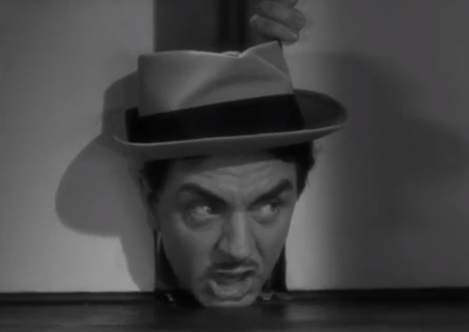
You would think he already had more excitement than he could take getting trapped in the elevator shaft with this frisky female and the elevator boy (Elisha Cook Jr.). Proving I’m no comic snob, I heartily enjoyed watching Powell’s head get clunked around. It’s a resoundingly hilarious image.

love crazy 2

However, he forgot about who was waiting for him back home. It’s the lesser of two evils to sneak out for a drink with Isobel and while his wife has to step out he uses his worst possible lifeline to get away from his aggravating mother-in-law. It doesn’t take too much for the root of doubt to sneak up and it only gets worse when Ward Willoughby (Jack Carson) is introduced as a studly archer in an undershirt. What else? Now both spouses have someone to be jealous of.

It hearkens back to the days where the sitcom hadn’t been invented yet because we didn’t have TV so instead, there were films like this which function around all the most cringe-worthy bits of comedic irony, namely mistaken identity and all sorts of misunderstandings. But like its predecessor from the year prior, I Love You Again, the steam slowly begins to evaporate off about midway through.

Because the main subplot becomes the whole plot in a way that provides some gags but on the whole feels tired and worn out. I want to see Powell and Loy together or at least more of Patrick and Carson who actually bring a lot of comedic chops to the picture. In fact, one of the more hilarious wrinkles involves Powell getting the other man interned at the sanitarium only to have him escape later. But it means very little to the integrity of the story. That’s part of what makes it so enjoyable.

Otherwise, Powell plays up his insanity to string along his wife so she can’t divorce him. His main showcase is at a party where he emancipates a fleet of hats trying to play up his looney side, followed thereafter by a string of other coincidental mishaps. His wife knows it’s a game but the man he’s christened “General Electric Whiskers,” who he met at the party, is actually a doctor who thinks he’s very sick indeed.

This all feels like fairly uninteresting fluff. Meanwhile, the film’s finale relies on another bout of concealed identity but to its credit, it circles back on the things that made it laudable before, entering back into the apartment complex. There the chaos of all those individuals from earlier is heightened in close proximity with a supposed crazy man on the loose and the police after him. They are aided by Willoughby and Steve is helped first by Isobel and then his wife.

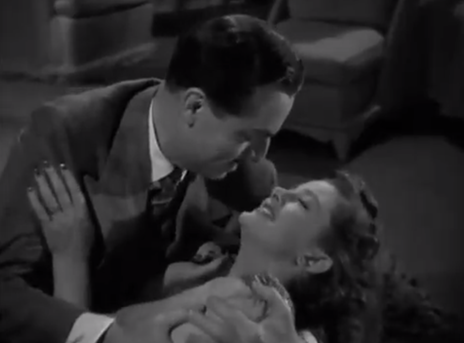
But the crowning piece of comedy has to do with Powell’s ultimate masquerade as he even sacrifices his beloved pencil-thin mustache for the sake of it all. While not particularly inspired by today’s standards, Love Crazy boasts Powell and Loy in as fine a form as ever. That is enough to enjoy the picture even in its middling moments.

3.5/5 Stars

Midnight (1939)

midnight 1939.png

“You’re in a fine mess! You got to get a divorce from a man you’re not even married to!”

It was only a recent revelation that Claudette Colbert at times feels far too sophisticated to be playing beautiful hitchhikers or penniless taxi passengers as she does in It Happened One Night (1934) and this film, Midnight. Though it’s easy enough to explain away.

The screwball comedy has always thrived on incongruities as much as it did on the class divides between the rich and the poor. Where the extravagance is almost laughable in its boorish decadence and the little men still have lives seemingly worth living because they are free from societal pressures. After all, making just enough money to scrape by is nothing short of paradise.

In this way, Claudette Colbert was the perfect person to tiptoe this line because she could be cosmopolitan and was glamorous with all those other snooty folks. But she’s also a comedienne like the normal folks, seeing the humor and working it for the laughs just as much as she’s willing to do things that seem normal. A walking enigma she might be but she also makes Midnight a sublime comic fairy tale as our uproarious modern-day Cinderella.

One of her cohorts and romantic partners is Don Ameche, the Parisian cab driver Tibor Czerny who begrudgingly opens up his livelihood on wheels for her as a random act of kindness. As we mentioned before the smartly dressed Eve Peabody has no penny to her name or a franc for that matter.

But what she does have is audacity and it buys her a ticket into a lavish gathering as one Madame Czerny put on by some rich somebody or other. It doesn’t much matter since it’s all only a pretense anyway. Billy Wilder and Charles Brackett’s script unwittingly created the original party crasher plot.

Eve finds herself at a snobby patronage of the arts where the impassioned man at the piano plays either Chopin’s 12th Prelude or his 11th Etude. Again, it doesn’t much matter but it’s hilarious all the same.

What happens subsequently subverts expectations nicely. Instead of getting tossed out of the proceedings she winds up the fourth in a bridge game of rebels warring against tepid entertainment.

There’s the debonair Jacques Picot (Francis Lederer), Marcel (Rex O’Malley) the man who nearly gave Eve a fright by fetching her, and Helene Flammarion (Marry Astor) a married socialite who is more than a little buddy-buddy with the dashing Monsieur Picot.

The charade becomes increasingly awkward the longer it keeps going and going and going. Every Cinderella has her midnight. The real joke comes when the fanciful game finally ends only to be replaced with a new reality as a true to life Baroness. She has no idea how it happened and that’s where our last important party comes in — her fairy godmother so to speak.

Mr. Georges Flammard (John Barrymore) witnessed Eve putting on a nervous floorshow and was intrigued. Now he watches her masquerade continue and he sees how they can help each other out. It has nothing to do with a desire to fool around. On the contrary, in an attempt to undermine his wife’s philandering he wants to bankroll Eve’s little white lie a while longer until she can win Jacques over and pull him away from Mrs. Flammard. It works quite well too.

Meanwhile, the entire cabbie population of France looks for the mysterious girl at Tibor’s behest. It proves to be equivalent to any missing persons agency in town and it comes with made to order traffic jams to boot.

Midnight turns into a magnificent floorshow as all parties collide in an immaculate perfectly timed collision. Eve and Mr. Flammard’s joint ruse looks like it might soon be ousted by Marcel and Mrs. Flammard who are intent on finding the truth about this curious baroness. But the whole fantasy is saved by a dazzling entrance by one well-tailored gentleman, Baron Czerny.

Now a new round of sparring back and forth begins. It’s full of glorious escapades, riotous telephone conversations with fictitious daughters, and Eve and Tibor trying to one-up each other with tall tale after tall tale. One thing Eve has going for her is Mr. Flammard still in her corner working his magic and John Barrymore puts on a fine showing in the film’s latter moments — his devilish eyes still gleaming as bright as ever.

Monty Wooley is introduced into the plotline in the ultimate piece of pitch-perfect casting as an opinionated but easily swayed judge. Thanks be to Classic Hollywood where pompous Americans can preside over a Parisian divorce court. But what matters is the right people get together. So screwball and fairy tales can still coexist. Wilder would prove it once more with Balls of Fire.

John Barrymore has always struck me as the tortured talent of the silver screen. One could contend that he was the most prominent member of the Barrymore dynasty except whereas his siblings Lionel and Ethel aged gracefully he burned out. Midnight came a little too soon for him.

It’s been a longheld fact that Billy Wilder and his writing partner Charles Bracket gifted two quality scripts that were ultimately directed by Mitchell Leisen. The integrity of the work was compromised to the point that Billy Wilder vowed to become a director himself so no one could mess with his material and when the material being messed with was Midnight and Hold Back the Dawn (1941) it begs the question how would the same magnificent films have ended up in Wilder’s hands?

Nevertheless, the actors are a fine gathering of talent while the script does wonders with the typical Wilder-Brackett combination that squeezes innumerable wit out of its wonky plotline. Billy Wilder must always get the last word in and his scripts always do. This one is no exception.

4/5 Stars

My Man Godfrey (1936)

my man godfrey 1.png

There’s a key moment in My Man Godrey where the ditzy Irene Bullock (Carole Lombard) giddily announces to her mother, “Godfrey loves me. He put me in the shower!” Her mother’s response could best be described as one of indignance but it’s a barrel of laughs for the audience. Because this film is full of off-the-wall remarks which taken out of context are so peculiar you don’t even want to attempt to understand.

That’s the beauty of this screwball comedy from the often underrated Gregory La Cava, best known for this picture and the following year’s Stage Door. Otherwise, the script is courtesy of Morrie Ryskind a veteran of some of the Marx Brothers’ comedies.

It opens as a biting satire of the affluent masses occupied by inane decadence and a multitude of frivolous diversions from scavenger hunts to parading livestock around in front of their friends. The screenwriter’s efforts were well worth it no doubt but the cast indubitably breaths incredible gales of life into the material with each battling for laugh after laugh.

The following interludes repeatedly exhibit perhaps the wackiest, most melodramatic family of comedy from most any decade. It comes from having too much time on their hands, too much money, and not enough sense. They’re a real screwy bunch. We meet the two Bullock daughters (Lombard and Gail Patrick) as they try and outdo each other in the middle of the previously mentioned scavenger hunt, searching out “a forgotten man.” They have no concern for who he is and how he lives. Only that he might win them the game.

Still, the said man plays along and somehow finds himself hired on by young Irene as the family’s latest butler to not only spite her older sister but also so that she might have a protege and maybe due to an inkling of a girlish crush. It makes little sense, only to say her mother’s protege is a musician named Carlo (Mischa Auer) who is good for very little except offering up the pretense of culture and eating them out of the house.

But Godfrey proves to be just about the best butler that the Bullock’s ever could muster, navigating their morning routines of hangovers and playing straight-man to the incessant chaos that constantly swarms around him. On their part, they are so self-absorbed and oblivious, they never seem to question how perfectly he has transformed into a butler. Surely, he cannot actually have been “a forgotten man” from off a trash heap? But no, they don’t concern themselves with such things. It goes unnoticed.

It seems like each member of the family has their special calling card.  They are a bunch of bubbleheads and Carole Lombard is the queen of them all, though mother (Alice Brady) is equally effervescent and a tad asinine. That’s  a part of her charm. She also flatters very easily.

Meanwhile, the other daughter Cornelia (Patrick) is more acidic, purring like a feline ready to pounce and make her sister pay for whatever trivial affront she’s perpetrated. Because, truthfully, they’re just a whole clan of boorish rich people who have no idea what’s happening to the world on the outside — if that point has not already been asserted enough. They’ve probably never heard of The Great Depression much less felt its true effects.

Mr. Bullock (Eugene Pallette) probably has it the worst as the long-suffering father — the nearest thing to a sane individual in the entire family. Still, you can’t live in a house of such madness and not have a few unhinged moments of your own. He’s constantly finding himself piping up amid the bedlam his gravelly voice trying to secure even a moments peace. He rarely succeeds.

Again, Godfrey is the calming force that brings a modicum amount of stability to such a place. He along with the veteran maid Molly (Jean Dixon) navigate the choppy waters of melodrama every day as Irene becomes increasingly infatuated, her emotional outbursts becoming more frequent, and Cornelia looking for any way to possibly make his life miserable to get him fired. Still, he goes about his duties.

And that’s part of the joke at the core of this film. The “forgotten man,” this tramp coming up against their own upper-class sensibilities and coming out looking like the true human being with brains and class and culture. Except it’s really a joke within a joke because maybe Godfrey is more than we first perceived him to be. In fact, he’s a lot more.

Pair such a raucous cast with some top tier comic patter that sizzles with wit and you’ve just happened upon the most wonderful mess imaginable. There might be other screwball comedies I enjoy more, but few are as hairbrained as My Man Godfrey and that is a grand word of praise for this brand of comedy. If it’s not stark raving bonkers it can hardly claim the name screwball honestly. No such problem exists here.

William Powell is a natural in this role showcasing that typical dry wit of his that effortlessly pokes fun at these people but also seems to appreciate them for all their shortcomings even finding time to truly respect them in the sincerest of ways. As per usual, Carole Lombard is so over the top to the nth degree with her sniveling zaniness spilling over into every scene.

In the past, I mistook her performances as a sheer annoyance but now I see how perfect she is for such a part. There’s an overwhelming commitment to the craziness that pays heavy dividends and by the film’s end, she’s overrun everyone with her energy — even Godfrey. He has no rebuttal.

For a time she was the greatest screwball actress though over the subsequent years the likes of Katharine Hepburn, Jean Arthur, Rosalind Russell, and Barbara Stanwyck gave her a run for her money. Still, there’s something undeniable about being the first and, in many ways, she was that woman.

If there were any residual ill feelings between Powell and Lombard now three years out from their divorce, there’s no visible animosity and together they succeed in forging My Man Godfrey into a classic screwball through and through.

4.5/5 Stars


Bachelor Mother (1939)

bachelor mother 1.png

Of course, Bachelor Mother is a blatant oxymoron and it’s a perfect summation of that vestige of a genre the screwball comedy — a genre that’s about marriage and divorce and the gray areas in between conveniently skirting past issues such as adultery or people “living in sin” as it were. The norm was not a genre of divorce but of remarriage.

As such this Ginger Rogers vehicle has her playing a woman who doesn’t actually have a child out of wedlock but it’s assumed as much and that’s where the roots of the comedy get their traction. Because therein dwells so many societal taboos that are subsequently turned into marvelous fodder for misunderstanding though no actual moral statutes have been broken. It’s that line of dramatic irony that the rom-com, in general, has always needed in order to survive.

Just think how perfectly it all happens. In one moment Polly Parish (Ginger Rogers) finds herself laid off from her department store gig just in time for Christmas and between the unemployment agency and home she happens upon a lady leaving a cute little bundle of joy on the doorstep of the local orphanage. She says it’s not hers. She found it somewhere and now she’s leaving.

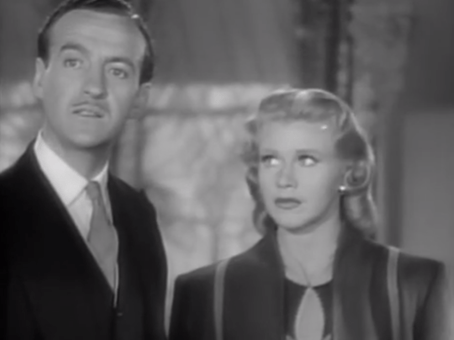
But Ginger Rogers being our concerned heroine can’t just let the baby sit there so she takes a course of action, delivering the child inside and enlightening the staff about the situation. Of course, they all believe she’s simply shirking her maternal responsibility and running out on her child and they pass the news along to David Merlin (David Niven), one of her former employers.

By now, Polly is already long gone. She’s agreed to take part in a dance competition at the local hall the Pink Slipper. There’s $50 in it for her and her partner Freddie (Frank Albertson of It’s a Wonderful Life prominence) if they can win. Waiting, babe in arms and valet in tow, Mr. Merlin tries to rectify the situation and get Polly to take back her child.

If the film was born on the steps of the orphanage, then it is solidified right here as a full-fledged screwball comedy of motherhood and misconstrued circumstance. Polly finds herself called into Mr. Merlin’s office and is offered her old post as long as she takes her child back. Still, they don’t listen to her renunciation so she has no course but to become a mother, after all, babies are cute. They can’t be that much work…

The fact that this is a screwball and not so much a domestic comedy is made clear by the fact the baby is more of a plot element than an actual character and Rogers and Niven find time to fall in love even with the added strain of motherhood.

What seems to do it is a lovely night together on New Year’s Eve which is highlighted by an extended gag where Niven introduces Rogers as his date from Sweden who conveniently does not speak a lick of English. It’s punctuated by the definitive punchline of the film. Simultaneously, Rogers struts her stuff all night long (though we miss Fred Astaire) in a reverie of pure joy.

But that’s not all that’s capped off amid the pandemonium of the festivities. Love Affair is far from just the movie up on the nearby theater billboard. It’s also something coming to fruition between our two stars. However, if this was the end it could hardly claim the name screwball. That’s when the baby comes in. J.B. Merlin (Coburn) finds his son with this single mother and draws conclusions of his own and…he’s very happy to be a grandfather and not so happy with the spineless conduct of his son.

What follows is a mad dash by our two leads to try and conjure up other stand-ins for a game of Who’s the Father? Three eligible contenders are brought in to play the charade. We already know Merlin, then there’s the dancing fiend and disgraced floorwalker Freddie, and the landlady’s bespectacled son.

In the end, everything is squared away nicely and the corkscrew comes full circle. Though Charles Coburn plays a very small part it proves to be a crucial one. Meanwhile, I adore Ginger Rogers and once more following Stage Door and Vivacious Lady, she proves in yet another film her genuine skills as an actress of immeasurable smarts and humor. Sometimes I’m admittedly unfair to David Niven — he’s never been the most compelling actor — but he’s fine in this picture.

This film also shares much the same world as the Devil and Miss Jones (including Charles Coburn) and the toy store environment provides the perfect arena for a terrifically comical shoplifting sequence full of excitement. It’s this movie to a tee. Positively quacking.

3.5/5 Stars

Vivacious Lady (1938)

vivacious lady 1.png

The first moment Pete Morgan (James Stewart) actually catches sight of alluring nightclub singer Francey (Ginger Rogers), the gangly botany professor proceeds to knock over a drink cooler. He’s enamored. In the movies, it’s that magical trope called “love at first sight.” For other pictures that’s where they go to die as the two loved birds get wrapped up in the throes of romance exploring New York City together. With Stewart and Rogers as our guides, there’s no place we’d rather be. Soon they are married and on their way to meet the parents in the idyllic town of Old Sharon.

Except they never get there or rather they get to the town but Pete never gets to the part about telling his parents he’s married. Charles Colburn is bullish as Peter Morgan Sr. the obdurate, overbearing intellectual who will not allow his son to get in a word edgewise. That’s aggravated by the fact that in his typical manner Stewart is always beating around the bush, never quite able to get the words out and so the happy news never finds an audience.

Besides Mr. Morgan has his sights on his son marrying the prim and proper Helen (Frances Mercer) while he turns his nose at the blonde woman that his nephew Keith (James Ellison) is traipsing around with it — that undoubtedly unsophisticated creature who also happens to be his actual daughter-in-law!

Thus, begins the film’s longest digression as wife becomes a student for the sake of being close to her husband and Pete tries his darndest to break the news to his parents while still getting time with his wife. But the guise of student and teacher isn’t helping much. They probably broke the whole code of conduct book on student-teacher relations circa 1938.

One of the favorite hot spots for late night extracurriculars just happens to have an outboard motor right next to it and it can make quite the din if accidentally pulled. Otherwise, Pete has an awful time trying to see his wife as the lobby clerk (Franklin Pangborn) is a real stickler and so the only access to her room is of a clandestine nature up the fire escape.

And still his father won’t listen to him and his former fiancee is still trying to nab him. It’s getting so hopeless that Francey thinks it might be best if she leaves Old Sharon behind for good. A memorable dance party with the parents in Francie’s room proves the kicker. Though she forms a bit of a rapport with the kindly but frail Mrs. Morgan (Beulah Bondi in 1 out of her 5 turns as Stewart’s mother), an indignant Mr. Morgan will have none of this tomfoolery.

Soon enough Francey decides to leave town of her own accord.  But even at the cost of his professorship if need be, good ol’ Jimmy Stewart won’t let her get away that easily. Whether or not this film drags a bit in the latter half is beside the point because you couldn’t have two more likable stars than Stewart and Rogers nor a Hollywood director more competent than George Stevens in balancing the breadth of slapstick comedy and romantic drama.

If the material is simply adequate enough, they are the type of talents that take us along and we will willingly be their audience through every complication. It’s our privilege.

In case there was any doubt whatsoever Ginger Rogers is awesome and it’s put on full display when she has a slap fight with her archnemesis before taking her in a headlock. If you liked her before simply for dancing prowess, she proves to be a savvy cat fighter as well.

Jimmy Stewart was still in the fairly latent stages of his illustrious career but Rogers recommended him for the role and he provides his homespun charm and length to every frame like we are accustomed to seeing from him. Not to mention his forays in home brewing. They’re quite impressive.

The only major blot on the film is an appearance of the prolific Willie Best playing his typical googly-eyed waiter — the walking stereotype that always feels like a cringe-worthy addition to any picture of old as does a cameo by Hattie McDaniels. At least there weren’t any chinamen. Not that there’s much consolation in that. Shall we just say that Rogers’ vivacity and Stewart’s universal affability make for a quality viewing experience and leave it at that?

4/5 Stars

The Rage of Paris (1938)

752px-The_Rage_of_Paris_Poster

It’s one of those anomalies of life that only a few days before I write this, the renowned Danielle Darrieux celebrated a century on this earth and I watch a film from some many years ago that showcases her budding screen presence. While so many others deteriorate with age, she seems the epitome of aging gracefully. Perhaps it’s the French way in some respects.

But going back into her catalog of films and finding The Rage of Paris you see a fairly straightforward romantic comedy that’s sweet, adorable, cute all those apt superlatives but there’s that one thing stands out nigh 80 years later. I am always squeamish about praise sounding shallow but at 21 years of age, this young actress who came on the world stage with Boyer in Mayerling is a bouncy precocious beauty–a real looker–absolutely mesmerizing to watch as bright eyed and bushy tailed as she manages to be.

Yes, the script follows that time-honored tradition often found in these types of screwball storylines where two individuals who initially despise even to look at each other ultimately fall madly in love and into the same bed with the wedding bells chiming soon thereafter. It’s that sexual tension that is able to develop some sort of romantic passion that gets audiences invested supposedly.

However, as the years have rolled on and I’ve seen more films by Henry Koster I have grown affectionate of his very particular outlook. There’s a certain vein that runs through all the material that he directs–an inherent good-natured charm to it no matter the topic that is always and fundamentally enheartening. He never leaves you melancholy because each picture ends with a smile.  That’s the greatest compliment I can honor him with.

So despite the typical nature of the material, Koster’s always sincere perspective and Darrieux’s intoxicatingly endearing performance as a gold-digging yet genuine French model make this one a minor winner.  The class divide that always seemed to find its way into screwball plots of the 1930s such as this (sentiments left over from the Depression no doubt), helps to complicate matters but also allows for the necessary amount of empathy to be developed for not only Nicole, the girl desperately trying to find a husband just to survive, but also her main opponent Jim (Douglas Fairbanks Jr.) who has a rustic background of his own.

To be honest, for me Fairbanks doesn’t hold a candle to his father or Darrieux for that matter but the film does have a wonderful assortment of supporting players. The most important ones include Nicole’s core conspirators the worldly wisecracker Helen Broderick and her maitre d’ accomplice (Mischa Auer). All minor criticisms aside and barring any complaints about being overly sentimental or somewhat predictable, The Rage in Paris really is the paragon of a cute picture. I bow in deference to Danielle Darrieux’s career and thank my lucky stars that unabashed sentimentalists like Koster are still available in this oft cynical world that we live in now.

3.5/5 Stars

Divorce Italian Style (1961)

Divorceitalian.jpgI never thought I’d get so fed up with hearing the name “Fefe.” But it’s true. There’s a first time for everything. In fact, Fefe is the name of our main character played so magnificently by Italian icon Marcello Mastroianni. In my very narrow view, he still very much epitomizes Italian cinema for me.

As for the film, a Sicilian Baron Ferdinando finds himself in rather an unfortunate conundrum — at least from his point of view. He relates through voice-over his family dynamic, with his parents, his soon to be engaged sister, his doting wife (Daniela Rocca), and of course his beautiful ingenue cousin Angela (Stefania Sandrelli). Aside from not being particularly enthralled with married life, the bigger problem is that Ferdinando is infatuated with Angela. He can’t take his eyes off her.

For those who are paying attention this comedy from director Pietro Germi, at times feels strikingly similar to the screwball comedies of Classic Hollywood where men such as Preston Sturges made light work of society by skirting censorship and building a barrage of gags almost to the point of being incomprehensible. But they might also conjure up comparisons with the darkly funny Ealing comedies out of England. And it’s true that films like Divorce Italian Style also carry a very particular name, “Commedia all’italiana” or comedy in the Italian way.

What becomes evident in a film such as Divorce Italian Style is the pointed attack on Italian social mores — the very framework that the culture is built on — and all involved are poking fun. Morality, class distinction, even the institution of marriage, are all dissected satirically as our protagonist goes through his life dreaming of knocking his wife off and living happily ever after with Angela — a girl that shares his affection — if only society didn’t say otherwise (she gets whisked to a life in a convent to maintain her purity).  Not to be deterred, the Baron attempts to hitch his wife up with a suitable suitor and as the shameful scandal finally breaks over his wife, he secretly jumps for joy. He’s getting a step closer to what he wants.

Meanwhile, the men about town all ogle at every girl that happens to walk by. Fefe’s old man is constantly harassing the maid, and more than once he walks in on his sister and her beau making out passionately.  There’s even a theatrical screening of Fellini’s La Dolce Vita (also starring Mastroianni) which literally seems to break any form of censorship in the town. The crowds flock to it joyously — men and women alike — because they want to see the lavish romance projected up onto the screen.

Mastroianni is not surprisingly a long way off from his debonair lovers taken the likes of La Dolce Vita, La Notte or 8 and 1/2. He goes through the film with a certain comedic despondency. He’s hardly a real figure. Comic and dismal with overblown ideas of how to make his existence invariably better. It’s quite a display because while it’s easy to laugh it’s also rather pitiful.

So Divorce Italian Style is perhaps even more audacious than the screwball comedies of the 30s and 40s. Because it gives the plotting Fefe the “happy” ending he was hoping for. It actually gives it to him, but the comic (or sad) thing, in the end, is that his girl is already playing footsies with another man. You see if we look at what is going on here,  he’s never going to find contentment. The ultimate irony, if there was a sequel, is that it would probably show Fefe actually trying to kill his wife because she’s cheating on him. Then it wouldn’t be so funny.

Yes, the strict societal pressures put on the members of this Sicilian community undoubtedly deserve to be questioned. There is so much obvious hypocrisy bubbling up through the layers of society and it makes for provocative comedy. But also there’s something to be said for living life under some sort of moral framework. Otherwise, life is purely about our pleasures, what makes us feel good, what our desires are and oftentimes those fail to regard what is beneficial for others. Needless to say, I’m partial to “Marriage,” not “Divorce” Italian Style — or any other way for that matter. However, I won’t even try to tackle the whole marrying your cousin thing. This is a comedy after all and Stefania Sandrelli is quite pretty. I don’t blame “Fefe” too much. He’s only human.

4/5 Stars

Review: The Lady Eve (1941)

theladyeve3“You have the darndest way of bouncing a fellow down and bumping him up again” ~ Henry Fonda as Charles Pike

The story goes that screenwriting wunderkind Preston Sturges penned The Lady Eve with Barabara Stanwyck in mind. He promised her a great picture and he most certainly delivered a stellar screwball like only he could. It plays off the archetypal biblical temptress with comic effect, and it finds the greatest of comic couples in Stanwyck and Henry Fonda. They both are iconic stars, but the narrative works so well, due to that, but also the fact that the film constantly undermines the typical plotting. As the title suggests the woman is really the focal point of the film — she’s the one in control.

In this instance, Stanwyck is shady trickster Jean Harrington, who joins forces with her equally conniving father (Charles Coburn) to take people to the cleaners in any way possible. They’re real smooth operators with cards and any other type of con you could think of. A luxury ocean liner seems like the perfect place to set up their business. Out of all the many high profile passengers, one man stands a head above the rest. His name is Charles Pike (Henry Fonda). He keeps his nose buried behind a book, tries to avoid the gazes of all the pretty girls, and has a penchant for reptilian wildlife after getting back from a long expedition. He also just happens to be the heir to a gargantuan Ale fortune. That’s what catches everyone eye, including the beautifully sly Stanwyck.

theladyeve2In fact, we have a brilliant introduction to her as she narrates the scene unfolding in front of her with the aid of her compact mirror. She trips up the bumbling bachelor and their introduction is the first exclamation point in a bumpy relationship. She’s ready to play him and marry rich and famous, because he’s a pretty naive fellow, and stiff around the ladies. Fonda’s nervous charm proves the perfect recipe for success as he is constantly being overwhelmed by Stanwyck’s frenetic barrage. His defenses are down and he hasn’t the foggiest what has hit him. Either he was really that uncomfortable or otherwise, he does a superb job of faking it since there’s never another moment where he’s not being fondled or manipulated.
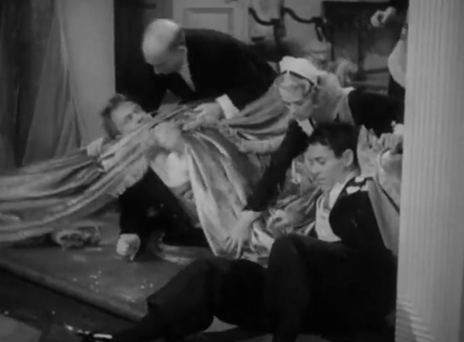
Jean is very quick to get cozy with “Hopsy” (after alcohol and not a rabbit), but something strange begins to happen. For some strange, ludicrous reason she begins to fall for her mark — this goofy guy with loads of cash. That certainly was not in her cards, yet she doesn’t seem to mind. What follows are some wonderful card playing antics between Charles Coburn and Barbara Stanwyck as she tries to stave off her father from pulling one over on her new beau. But of course, just as Pike is getting his sea legs he catches wind of the whole charade quite by chance, and he’s quick to turn off Harrington for the fraud he thinks she is.

theladyeve4The story could end there, but Sturges has set his story up perfectly for a killer second act. Jean plans a perfectly sneaky revenge plan to get back at “Hopsy” by posing as the British niece of another con man (Eric Blore). He uses his own wily charm and influence to get them an invitation to the Pike household for dinner. There we see several other great character actors in action including Horace Pike (Eugene Pallette), and the perennial sourpuss Muggsy (William Demarest). Jean shows up now as the Lady Eve and successfully convinces her “Hopsy” that she is a completely different individual. The film works wonderfully on this axle of ludicrousness because  young Pike is completely befuddled and awestruck again. He goes thudding, clanking, and crashing all evening long, a true victim of love. Pike thought he lost one girl for good and here’s another even better prospect. A whirlwind romance follows and everything is falling into place beautifully. There’s a frantic montage in preparation for the big day and then it happens. They get hitched. Afterwards, it’s all done and the two lovebirds are on a train barreling down the tracks interspersed with the long laundry list of all Eve’s beaus from Angus, to Herman, and Cecil and so on. It’s Charles’ worst nightmare, and he hopes to get out of it as quickly as possible.

But then by chance, he runs into the first girl, who is, of course, Stanwyck as well. He’s genuinely happy to see her, and they embrace like nobody’s business. Being the honorable man that he is, Pike acknowledges that he is, in fact, married now, but the joke’s on him. She is too! It’s an entirely irregular ending, but that’s screwball comedy for you.

theladyeve1What makes Sturges’ film so wonderful is all the parts making up the whole. His script is perfectly contrived mayhem. He sprinkles it with his typical slapstick, his loudmouthed stock company lends an added layer, and his typically lightning-quick repartee is brought to life by his leads. Stanwyck was the quintessential leading lady of the 1940s and in 1941 she was in fine form (Balls of Fire and Meet John Doe). She can dance so effortlessly between dynamic comedy to heartfelt drama that is positively palpable.  She overshadows Fonda in a sense, but they still work together, because he is her perfect foil, the precise innocent fool to fall into her web of feminine wiles. She can muss up his hair, manhandle him, and completely manipulate his feelings. Yet we still like both of them in spite of it. They are a hilarious match, and there’s space for some passionate canoodling as well. It’s probably one of the most perfectly wonderful, utterly dysfunctional relationships we could ever hope to see put on screen.  By continually whipping out punch line after punch line to the very last quip, Sturges makes this comedy look positively effortless.

4.5/5 Stars