Keaton and Lloyd

I have been well acquainted with the films of Charlie Chaplin which always seem to couple romance and comedy so nicely with the character of the Tramp.

However, I had seen very little of Buster Keaton and I had only heard of the name Harold Lloyd. Recently I have finally had the pleasure of taking in more of their work and I must say I have a new appreciation for them. With their respective films it is understandable how they were able to give Chaplin a run for his money. Keaton always appears as a solemn figure whether he is a Confederate soldier, a detective, and so on. He does not try and win our sympathy or affection but he is always determined to take on whatever his world throws at him. His various hilarious and often life-threatening antics cause us to cheer for his characters and in turn we also grow to respect Keaton for his talent as an actor and a director. (Recently I have been able to see Sherlock Jr., Steamboat Bill Jr., and Our Hospitality).

Then, there is Harold Lloyd, the number three man of the silent era comedians. Lloyd had his own persona that he developed to perfection. He was the nerdish fellow who always wore the same pair of glasses and the same hat. He makes us laugh because of his naivete and various antics including scaling a building only to dangle from a clock (Lloyd actually only had eight fingers to accomplish this feat because of an accident). This  causes us to empathize with him much like we would with Chaplin, but their styles could never be confused with each other. (I was able to watch Safety Last! and The Freshman).

That is the beauty of these three men because each one created his own legend and so each one is an icon in his own right. People might fight over who is the best of the group, but really there is no comparison since they all went in different directions. Although these films may be an acquired taste, I hope to be able to watch more in the future sometime!
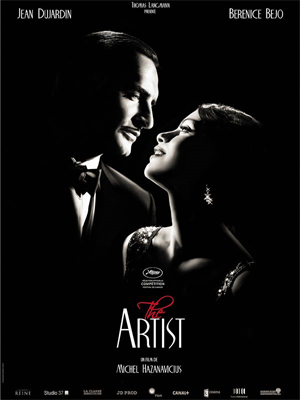
 

The Artist (2011)

7cfee-the-artist-posterWith a cast of all nationalities and backgrounds, this film is a breath of fresh air for many reasons. Ironically, this freshness comes in a contemporary age thanks to a look back at a former age. In black and white and almost completely silent, the movie begins in 1927. George Valentin (Jean Dujardin) is a Hollywood star of the silent era. Quite by accident he makes an up and coming star out of Peppy Miller (Berenice Bejo). Soon she makes the transition to stardom in talkies as Valentin slowly fades away. However, Peppy never truly forgets him and in different ways she tries to help him. Unfortunately, George is a proud man who loses his wife, sends his loyal chauffeur away, and will not accept the charity of Peppy. Eventually her kindness pays off however and George is no longer forgotten. All the cast including John Goodman and James Cromwell do a wonderful job at expressing emotion since this film is so unique. Because there is hardly any spoken dialogue, the score takes center stage and I think it succeeds wonderfully in setting the scene whether it is playful, dramatic, or simply silent. There are also many devices used by the director Michael Hazanavicius that help convey the story without a need for words whether it is staircases, sinking quicksand, or a trampled film poster. Furthermore, he draws great influence from films like Sunset Boulevard and Singin’ in the Rain to give this new film a touch of nostalgia. In fact, The Artist brings up so many names and films in my mind it’s wonderful. Douglas Fairbanks, Jean Harlow, the dog from The Thin Man and The Awful Truth, The Dueling Cavaliers and Lena Lumont, just to name a few. Perhaps most importantly of all the film causes me to be empathetic towards the forgotten stars like Buster Keaton and Norma Desmond. It makes Chaplin’s ability to make silent pictures during the talkie revolution seem even more impressive as well. In a year that also gave us Midnight in Paris, this film also revels in the past history of the 1920s, but perhaps more importantly it too is able to suggest a certain hopefulness in the future. In a world that is often loud and busy this film was a nice respite.


 5/5 Stars


City Lights (1931)

In this Charlie Chaplin film we follow the Tramp as he romances a blind flower girl and is befriended by a crazy millionaire. In line with all the great Chaplin silent films, this one has many comedic moments but also sentimentality. In one scene the Tramp might find himself dragged along with the millionaire or fighting in a boxing match. However, the next sequence he might be sharing a very nice moment with the girl who only knows him by his voice and kind deeds. Fittingly, in the final moments of the film, the flower girl who can now see is reunited with the humble tramp who showed her so much kindness. Overall this was a very good film and it seemed to have a wonderful balance of humor and romance. It proves that sound is not always needed if you are a good storyteller.

5/5 Stars

Other Chaplin films I may watch in the future include The Kid (1921), The Circus (1928), and The Great Dictator (1941)

The Gold Rush (1925)

3c3f8-the_gold_rushIn this Charlie Chaplin flick we follow the little man or the Tramp as he prospects for gold in the Yukon. All alone and cold he stumbles upon a cabin where a corrupt man lives. However, the weather wreaks havoc and the Tramp finds himself eventually left with a fellow prospector. After a time the two friends split up. In the city the little man finds love while his former partner meets up with trouble on the road. Eventually they  do reunite, strike it rich, and become millionaires. Along the way there are many characteristic Charlie Chaplin antics. It is extraordinary, because for a film that is not a “talkie,” The Gold Rush is surprisingly complex with humor, drama, and romance. If you take into consideration the era of this film, it is very good.

4.5/5 Stars

Charlie Chaplin will be continued in the next review…

Modern Times (1936)

Arguably the first great superstar of film, Charlie Chaplin was the man known simply as the Tramp in his silent movies. For this reason Modern Times seems like the perfect bridge between the early silent era and the age of talkies starting in the late 1920s. Chaplin had many successes earlier including The Gold Rush (1926) and City Lights (1931). However people wanted to hear talking and soon enough everyone would have to make the transition or else die out. Because of Chaplin’s popularity he was able to make one last great silent picture. From that point on however it got a lot louder in theaters.

In this film the iconic Tramp character finds himself up against modern technology and the Great Depression. The whole movie seems to be critiquing factories, the police, the economy, and even modern film by using little actual dialogue. With that being said, this is a great film which exhibits everything that made Chaplin famous. He still has that walk, that mustache, and new hilarious antics to accompany everything else. Yet again there is a love story, between a tramp and a beautiful homeless girl played by Paulette Goddard (Only in the movies). Despite all the hardships they face this resilient pair amazingly still have hope. Fittingly, in the end the two lovebirds walk off into the background, seeming to bring the end of the Chaplin era, but also leaving us with a feeling of hope for the future.

5/5 Stars