My Night at Maud’s (1969)

nightatmaud's1I love the forum that is created in international cinema where all things can be debated and discussed without fear of what the audience will say. Hollywood caters to the audience and that more often than not means that thrills are given greater weight than substance. Eric Rohmer worked at Cahiers du Cinema alongside French New Wave visionaries like Jean-Luc Godard and Francois Truffaut, but he joined the game a little later than his colleagues with a different style. Rohmer took his pseudonym from director Erich von Stroheim and British novelist Sax Rohmer. He was a highly educated man and that comes out in his films.

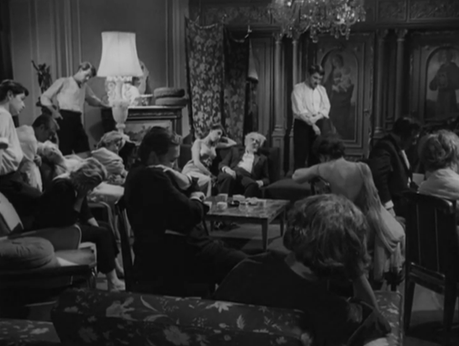
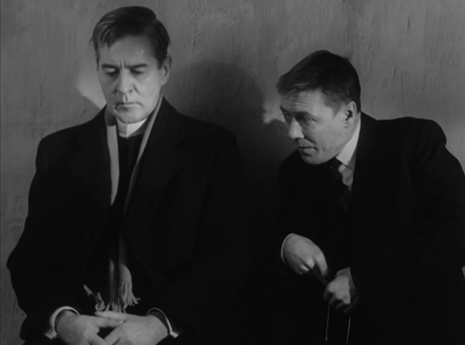
My Night at Maud’s comes from the perspective of a man, who we have a sneaking suspicion might be a lot like Rohmer.  Jean-Louis (Jean-Louis Trintignant) is a reserved, highly religious, intelligent man. He attends mass on Sunday, bumps into an old school chum on the street, and willfully enters a discussion on all sorts of philosophical topics.

Whereas Godard interest himself in the lowly gangsters, the streetwalkers, or the lovers on the run, Rohmer’s character are in a completely different stratosphere. They are a higher slice of society, and it shows in what they spend there time philosophizing about. In fact, there’s a lot of discussion stemming from Pascal’s wager on whether or not it is beneficial to believe in God. Although he can be a bit of a clown, Vidal is also a philosophy professor and ready and willing to delve into such topics. He holds hypotheses on the meaning of life, and he’s considered where hope comes from. These are intelligent beings and deep thinkers, and by transference, they lead us to think. They drop by on Vidal’s friend Maud (Francoise Fabian), who is a divorcee, irreligious, and most certainly a free thinker. She’s also beautiful, and she likens there little late night convo to the salons of old as they gather around her bed to raise their conjectures.

nightatmaud's4I feel like I have known people like Jean-Louis, and I cannot help but like them. He’s a fairly resilient Christian, but not a perfect example mind you, and yet he feels far from a hypocrite. With his new dialogue partners, he speaks of his past love affairs and how they can exist with his religious convictions. Maud rather matter-of-factly labels him a “shame-faced Christian” and a “shame-faced Don Juan,” because he’s not fully committed or acknowledging of either. And yet she generally likes him a lot. He likes her company too and so they can continue talking in a genial manner. She pokes fun and ribs but never attacks. And she openly brings up numerous different ideas about Christianity. There are things that feel very human, but not very Christian to her. Maud asks if Christians are judged by their deeds? She assumes there is a bookkeeping aspect of Christianity where good deeds are weighted versus sin. Several times the rather obscure term of Jansenism is thrown around a bit in reference to the theology of Dutchman Cornelius Jansen. It surely is difficult to keep up we these folks at times, but it’s well worth it.

Maud has her own preconceived notions about religion, while Jean-Louis has some delusions about romance. He thinks he’ll meet a pretty blonde Catholic gal and fall in love. It sounds utterly preposterous and yet then he meets Francoise (Marie-Christine Barrault) after his night at Maud’s. She’s the perfect embodiment of everything he’s ever dreamed of in a romantic partner. They seem like a good pair, although she is still in school, they are intellectual equals with similar personal convictions.

nightatmaud's5Sure enough, 5 years down the line they are married with a young son. Jean-Louis has not seen Maud for many years now, but quite by chance they bump into each other on the beach. Both pick up where they left off as if no time has passed because it’s so easy for them to converse. Francoise is noticeably uncomfortable around Maud, but nothing more is said about it. Jean-Louis moves on and plays contentedly with his family on the beach. Maud heads back up the hill as cordial as ever. This is an ending that is made powerful in its subtleties above all else because Jean-Louis and the audience realize something about Francoise. Yet there is no need to voice those conclusions because all that matters to him is that he is happy.  It toes a soft line between romance and drama, instead resorting to a beautiful exchange of ideas. Noticeably, in Rohmer’s film, there is no score so the dialogue is elevated to the level of music. It fills the void using deep, introspective and personal forms of verbal expression.

4/5 Stars

The Exterminating Angel (1962)

exterminating1In a sense, I’m scared to be confronted with Bunuel’s films more often than not, because even to this day they are surprisingly subversive. But with The Exterminating Angel, there is a different sort of apprehension to be faced altogether. It is a fascinating film because it shows the descent of humanistic man into the depths of his primordial nature. However, it builds off the cruelest and most interesting practical joke ever conceived. It’s played on a group of people within the confines of the frame and the audience watching in equal measures.

Of all places, it starts at a dinner party where good etiquette, manners, the upper class, and culture all collide. Luis Bunuel seems to have a preoccupation in placing his subjects around a table because really there is nothing more human than sharing a meal together. Although, he finds ways to make it interesting and in this case wickedly absurd. The table becomes an arena for gossip, loaded barbs, harbored feelings, and ruffled feathers.

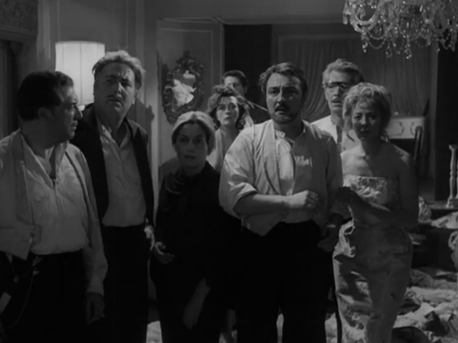
It’s quick to enter an almost surreal state as all the guests are unable to leave the confines of the room. We take things for granted so easily, but in their world leaving the room is not a given, even if it seems so straightforward to us. Some force is keeping them where they are, although we never see it or hear any mention of it. Our only inference is that there is some outside force holding them there. They are literally haunted by specters with a shroud hanging over them — an Angel of Death if you will.

exterminating2This prolonged period of isolation lends itself to the degradation of all pretenses. The animalistic tendencies replace all shreds of decency. All the dirty little secrets that lurk under the surface then begin to rear their ugly heads. Honestly, it’s hard to keep them at bay in such close proximity, for prolonged periods of time, because people see the real you. It becomes hard to hold your tongue, to keep those biting words from slipping out, especially when fatigue and hunger sets in. As many of the men and women begin to falter, the good doctor represents all things rational and seemingly honorable. But when he is cast aside it reflects an end of human dignity. These individuals who were once so high, have fallen such great heights. Lambs get taken to slaughter and pipes are busted just for even the smallest taste of water.

It strikes me that this film is literally a picture of hell. No, it’s not the fire and brimstone picture we are accustomed to, but instead, it is a hell created by the individuals themselves, feeding off their own evil and pride, and accentuated by their prolonged purposelessness. Just think, it takes a woman named Leticia (Silvia Pinal), to break all her companions out of this cycle they have become stuck in. She realizes the utterly pointless loop they are caught in and breaks them out of it with a few powerful pieces of induction. Also, could there be some symbolism in her nickname “Valkyrie” (The chooser of the living and the slain)? I think so.

exterminating3They leave the room just as easily as they entered it. It happens so unremarkably in fact that some might feel duped, and I would not blame them. Why did we watch this group of socialites remain in a room for an hour and a half if they could have gotten out this easily? But if you ask this question you miss out on the whole mind-bending aspect of Bunuel’s main conceit. We cannot fully understand; we can only marvel at the fact that something that we take for granted like leaving a room, doesn’t work so simply. Do I understand it, certainly not, but it makes for an amazingly powerful and frightening study of human nature. This is also a film that does not let off. In fact, although we finish one cycle, it looks like another one is about to begin with a few clergy trapped for another inexplicable reason in their cathedral with many parishioners. Outside a riot forms as another herd of lambs makes its way to the chapel. It’s as depressing as it is funny in some unnerving sort of way. Not only has Bunuel played a joke on his characters, but his audience as well. This time I didn’t mind all that much.

4.5/5 Stars

The Silence (1963)

thesilence4Mention of God and spirituality, faith and healing, feel completely unrelated to a film that’s seemingly devoid of all of those things. And yet if we place this Ingmar Bergman film alongside his two previous efforts Through a Glass Darkly and Winter Light, The Silence has just as much to say about such topics. The irony of this film is that it says a lot by saying the inverse–nothing. As the title implies, the two sisters who are the focal point of this film speak nothing of God or any kind of faith. God too is silent. No miraculous sign takes place to salvage this storyline. It is what it is, and yet Bergman again works so powerfully once more– even if it’s not quite his intention.

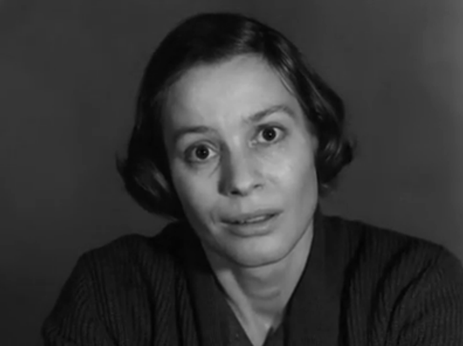
Ester (Ingrid Thulin) is the practical, rational sister, who is also very sick. In fact, it is her health that interrupts their vacation so that they wind up in a hotel in a foreign land. Anna (Gunnel Lindblom) is her sister, the sensuous one who is not afraid to flaunt her body. There’s also a boy, the 10-year-old Johan, who is along for this adventure as well. At first, I assumed that Ester was his mother, but it turns out he’s Anna’s son. It makes for another interesting dynamic because although she can be very touchy-feely with her boy to the point it almost feels uncomfortable, she does not show him a lot of affection. More often she’s aloof or tells him to go off and play somewhere alone.

thesilence1Things are even worse with Ester because for some reason we don’t really know, they have a strained relationship. You get the sense that they both disapprove of each other for different reasons. Ester’s too restrained. Anna’s too provocative. Their vices come in different forms as well. As Johan entertains himself throughout the hotel, shooting his pop gun, meeting some little people and a friendly old porter, his mother and aunt try and medicate themselves.

Ester combats her illness and bedridden state with cigarettes and alcohol, which probably only help in numbing her senses and blackening her lungs. Anna puts on her most tantalizing outfit and goes out on the town, ready for some quick and easy sex to gratify herself. Again, both sisters dwell on completely different ends of the spectrum, but they really seem to end up in the same place. There is no space or need for a God or spirituality in their lives because they’ve filled the void with other things.

thesilence2Meanwhile, Johan seems like a normal little boy, who is looking for affection and yet he doesn’t seem to get it, at least not typically. His mother and aunt might truly desire to connect with him at least sometimes, but more often than not it feels like he’s just left to fall through the cracks. He’s easily forgotten.

The sisters part ways after a confrontation where Ester comes in on Anna with her lover. They lay it all out with brutal honesty and the next morning Anna takes Johan with her on the train. Ester cannot bear to be left this way, and as spasms begin to overtake her, she acknowledges a great many of her fears. She’s not ready for death. Anna rides off with little interest in her sister and no doubt, little interest in thoughts of death.

When The Silence came out, it was, no doubt, risque for its frank depiction of sexuality and yet the way Bergman looks at such a  topic, suggests that it is not a superficial perspective. What any type of behavior does, really, is to provide a fuller, broader picture of the human who acts it out. Anna and Ester undoubtedly have their insecurities, fears, and desires. We see them acting out on those desires often, and we see their insecurities come out when they fight with each other. It’s yet another fascinating dissection of life, although it looks vastly different than its two predecessors. Bergman’s Persona a few years down the line also seemingly builds on the study of this film, even utilizing a similar dynamic. That’s not to say that The Silence is not worth a look in its own right. It takes on the subject of “faith,” ironically enough, by showing a complete absence of it.

4/5 Stars

Winter Light (1963)

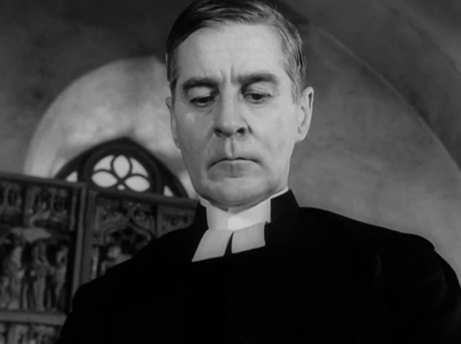
winterlight1In the second leg of Ingmar Bergman’s Faith Trilogy, he gets right to the core of all matters of faith. He takes an up close and personal look at a man of the cloth named Tomas (Gunnar Bjorstrand), who shepherds a small congregation in a rural Swedish town. Such is the life of a clergyman, as with any life, where there are rough patches and emotional highs that rejuvenate you, but mostly rough patches. In fact, he is going through such a spell when the film begins. We survey his humble little chapel, and there are only a few scattered members of the community present. Half seem disinterested and Tomas himself speaks words of spiritual truth and yet it seems like he is only going through the motions. Does he actually believe these benedictions and words that he is proclaiming? I’m not sure he even knows for sure.

He’s been withstanding a winter period of his life personified by the icy weather engulfing his humble city on a hill. It reflects his own heart and mind which are going through a season of extraordinary indifference. On top of that, he’s fighting a bad case of the flu, and he is discontent in God’s silence. Where is God? Why is He not more present in his life?  Why does he not more clearly reveal himself? Is there any power left in prayer? They are honest questions from a man struggling with faith, and it’s the epitome of an existential crisis. Bergman seems to be churning up all the thoughts creeping up in his own mind, and it’s very human — extremely honest.

Tomas has little in the realm of advice or comfort to offer his parishioners. For instance, when the depressed fishermen Jonas (Max Von Sydow) comes to the pastor after contemplating suicide, given the state of the world in the nuclear age, Tomas has little to say, because in order to encourage others you have to be encouraged. There’s nothing that can be done if the well you’re running on goes dry. You cannot sustain yourself that way. About all he is able to offer are a few downward glances because there’s no conviction left in him.

winterlight2On a personal note, Tomas lost his beloved wife and now he deflects the affections of local teacher Marta, who herself does not believe in God, but still, she loves Tomas dearly. In a deeply heartfelt letter, she confesses her true feelings for him, and he responds with very little acknowledgment. He cannot bear the townsfolk talking about them, and he still misses his wife dearly. It doesn’t help when he gets tragic news about Jonas.

Winter Light never reaches a clear conclusion, because life is hardly ever like that. In fact, there is an underlying irony that becomes apparent in this story. After Tomas lashes out against Marta and tells her to let him be, it becomes all too clear that Marta, though she does not believe in God, is in a sense, living a better life. They are both lost in the throes of winter still, but she at least has the capacity for love and vulnerability. Tomas’s apathy seems to be a far greater plight since he feels trapped in a labyrinth of idiotic trivialities, as he puts it.

winterlight4The sexton Algot brings up an interesting point about the suffering of Christ. His physical suffering must have been immense, but how much greater must he have suffered when everyone deserted him. The disciples didn’t understand a thing he said, Peter denied him, everyone else deserted him, and he was even forsaken by God. It suggests the importance of our interactions with one another. In the days of our lives, it becomes so easy to continue constantly in the endless cycle of life. Never getting outside of it and relating to our fellow man. Falling into apathy and indifference, which is especially easy when tough times hit.

Bergman does it again, delivering a film full of philosophical depth and questions that force the viewer to ruminate over their own condition, whatever their background or beliefs might be. Sven Nykvist’s photography is beautifully austere once more, and it adds a certain visual depth to the director’s trilogy. It’s stark, pure, and piercing with gorgeous shades of black and white.

4.5/5 Stars

Ordet (1955)

Ordet1955screenshotCarol Theodor Dreyer’s Ordet is a deeply thought-provoking, spiritual foray into the realms of faith and love. However, it is as much about doubt as it is faith, as much about discord as it is about love. It shows a spectrum that, while irrevocably Danish with its actors and setting (a bit reminiscent of Bergman), still has a universality that correlates to the contemporary world we live in. This later work by Dreyer is deliberate in pace, simple in its misce-en-scene, but the life is breathed into it by the characterizations and a beautifully subtle approach to depicting them.

The story is based off a play by Lutheran Pastor Kaj Munk, which was first performed in 1932. The majority of the tale takes place on a rural farm belonging to aged and bearded widower Morten Borgen. Aside from being a farmer, he is a prominent member of his community and a devout Christian. Now he contents himself smoking his pipe as he has three grown sons and a couple grandchildren.

His first son is happily married to a wonderful woman and mother of two, but he himself is struggling with belief in a God, and he acknowledges lacking faith in such things. His wife continues to encourage him, but he knows that such news will deeply trouble his father.

Johannes, the middle son, began believing he himself was the incarnation of Jesus Christ after deluging himself with the works of the famed Christian existentialist Soren Kierkegaard. So now he goes around spouting off scripture and calling out those around him for their lack of faith. What makes it so mesmerizing is the dazed sincerity behind each word. He truly believes what he is saying.

Finally Borgen’s third boy, Anders, is deeply taken with a girl named Anne from the nearby town, but of course her father Peter is from a different sect, and so everyone knows that neither father would willingly agree to a marriage.

These are the problems that plague the Borgen family, so they are undoubtedly commonplace in any spiritual community. Dreyer depicts it all in very mundane terms but not as unimportant, not without a deft hand and sensitive touch.

There is one scene in particular that comes to mind. The young girl Inger, a namesake for her mother, comes up behind her uncle Johannes and with all sincerity, in her eyes and voice, she begins to ask him to raise her mother from the dead. They talk about it for a time and while they talk pensively the camera slowly makes a spiral around them. Now if this was Tarantino (in Django for instance), he would need to bring attention to his camera and the scene loses all of its impact, because he’s a director who is often about as subdued as a toothache. But with Dreyer there is a sensitivity to his movement that’s gracefully smooth, accentuated by his long takes, with a simple backdrop, and pinpoint lighting.

Between the bickering over Ander’s betrothal and the sudden decline in the condition of the pregnant Inger,  there is a lot of soul searching to be done and problems to be parsed through. In a sense, it looks like any life full of conflict, pain, and unforeseeable suffering. It’s all there and it hurts the Borgen family and turns neighbor against neighbor. This film has so many different worldviews and philosophy colliding at once. There are those who are devout in their faith, but their faiths differ. There are those who doubt it all or want cold hard facts. Some have blind faith and others are off-putting with their message. Then there those who seem content in their spiritual lives even though they are not perfect people. So essentially we have almost every iteration or cross-section of society, at least to some degree. It makes for an interesting battleground, but within that, it’s interesting how these characters start to find common ground and build rapport instead of breeding bitterness.

Furthermore, the final moments of the film are so surprising in their sincerity as they are for what actually happens. It’s in a sense wholly unbelievable, but we don’t disbelieve it — in fact, we want it — because we have followed this film thus far. What happened felt so close to home and so the ending, although somewhat unusual, feels right. It’s a strikingly beautiful conclusion to a film that speaks to our doubts, questions about faith, and ultimately our capacity to love and be loved.

This is the sort of film that would probably never see the light of day in Hollywood. It’s either you make God’s Not Dead or something that has no spirituality in it whatsoever. Ordet goes far beyond the depth of such films and it is better for it. I will not say I agree with everything that each character says, but that’s the point, because they all come from different perspectives. The best we can do is come and try to understand what others think so we can move forward from there. But spiritual conversations matter.

4.5/5 Stars

Intolerance (1916)

800px-Intolerance_(film)His ambitious follow-up to The Birth of the Nation a year before, D.W. Griffith’s Intolerance boasts four narrative threads meant to intertwine in a story of grand design. Transcending time, eras, and cultures, this monumental undertaking grabs hold of some of the cataclysmic markers of world history. They include the fall of Babylon, the life, ministry, and crucifixion of Christ, along with the persecution of the Huguenots in France circa the 16th century.
The stories are stitched together and become only a few touchstones in a contemporary tale of a young man and woman battling against the bleak world around them. The Dear One must try and recover her child from the clutches of a society crippled by corruption, while her husband must battle against a criminal past that looks to ruin his life forever. Each setting has its lulls and crescendos that fluctuate between the mundane and the overtly bleak.

Although some of the religious undertones are somewhat simplistic they still have some resounding power in their successive notes. A Christ subjected to the crucifixion sent there by hypocritical Pharisees. A mother crying to God that she might recover her child because the corrupt and evil seem to be having their way with her. These are the low points of despair. But just as Babylon fell at the hand of Cyrus the Great, our hero The Boy escapes the business end of the hangman’s noose literally by a matter of seconds. It’s perhaps the most intense and ultimately gratifying moment in a film that runs the gamut emotionally.

The film’s four arcs are certainly not in equal parts or equal in impact, but nevertheless, they suggest the complex plotting that Griffith was attempting to experiment with and it’s still quite impressive even by today’s standards. He takes such a broad, universal theme like intolerance and gives it legs in the form of a story that crosses time and space, cultures and languages to really meet all people where they are at. I will stop short of calling it overlong, because Intolerance is one of the truly epic films out there, and while it’s possible to lose a bit of the film’s cohesion, it nevertheless is an impressive endeavor.

So perhaps it’s true that he made the film due to people’s criticism of The Birth of the Nation — though it seems rightly justified. Still, even to this day, the film stands as an emblem of something more and perhaps the best “sequel” to a film of such a dubious nature. It cannot cover up for the sins of the former film, but it can certainly overshadow them. History has looked kindly on Intolerance and if it is not more widely known than its predecessor than it certainly deserves to be.

You could argue that D.W. Griffith was the first person to really explore the language that is film, as a mode of artistic expression. Because, although it may have cleaned Griffith out and ended up an unfulfilled commercial flop, there is no doubt that this colossal silent left an indelible mark on the industry. Perhaps Hollywood took note and began to turn away from the single-minded vision of auteurs in favor of a regimented machine that churned out a commercial product. That ‘s the Classic Hollywood period for you. However, Griffith perhaps unwittingly created many of the rules and dimensions that Hollywood would take to heart and systematically put to work in its future works. Furthermore, a case can be made that Griffith also set the groundwork for European cinema that often gave birth to loftier, more artistically inspired works altogether. Thus, the influence of Griffith cannot be understated. He was vastly important to the medium of film as we now know it.

4.5/5 Stars

Spotlight (2015)

Spotlight_(film)_poster“They say it’s just physical abuse but it’s more than that, this was spiritual abuse.”

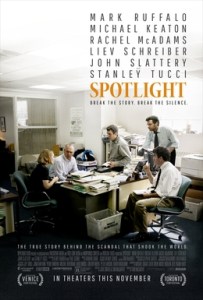
I wrote a piece tracing the obvious parallels between All the President’s Men and Spotlight, two films that I could easily see both shaking the very framework of American society through their very candid portrayal of journalism. When actually getting to see Spotlight the connections became even more prominent. Our narrative begins, not in Washington D.C., but in Boston Mass, 1976. It even goes so far as having a Ben Bradlee connection. Bradlee Sr. worked with Woodward and Bernstein while the Big Throat story was breaking. Of course, numerous years later Bradlee Jr., continuing the family profession, was working at the Boston Globe and becoming an integral part of what was going on there.

But enough with similarities, this film, written and directed by Tom McCarthy, deserves its own personal set of commentary. Spotlight is the investigative unit of the Globe and as such their work is not for the quick news flash, but grinding out long, detailed stories, although at times it takes a while to latch onto a juicy tidbit.

However, a new, rather stiff editor named Marty Baron points the team towards a story where a lawyer is accusing a local Cardinal about doing nothing after he found out a local priest was sexually abusing children. It’s a problematic scenario that deserves a little more time, but at this point, it’s an isolated event. It’s one man’s evil. One man doing nothing to remedy an outlier in the Catholic Church.

What follows is as troubling as it is imperative storytelling. The members behind the Spotlight team are not arrogant, self-righteous people, or figure pointers, only truth seekers. That’s their job, after all. The cast is well rounded and credible while no one figure steals the spotlight, literally. Michael Keaton is their leader “Robby” who has close ties with the community even going to high school across the street. Mark Ruffalo is the integral member Michael Rezendes who not only writes the story but has the important task of trying to needle a local attorney for information and documents that can blow the story wide open. Meanwhile, Sascha Pfeiffer (Rachael McAdams) carries out numerous interviews of her own in this multiple-pronged assault for the truth.

Their investigation looks to victim organizations, lawyers, priests, and a psychotherapy specialist. If it’s not obvious already, Spotlight makes it painfully clear that this is not a story of a few isolated incidents but an entire epidemic. This is the whole country — the whole world. It makes you positively squeamish and it’s perturbing in its brutal honesty. There’s no way for it to be sanitized and that’s indubitably frightening. We should be angry, we should be grieved, it should be abrasive to our senses.

It’s bringing to light an entire conspiracy of corruption. There are no paper trails, evidence is swept under the rug, and person upon person remain tight-lipped either due to guilt or shame. Humanity is drawn to darkness, but we want things to be brought to light. It’s the dissonance of what it is to be a person — the constant battle going on in our own human hearts. This isn’t meant to be about individual finger pointing, but an indictment of a system. An indictment of what we all are capable of. If it’s not being able to maintain the celibacy requirement, then it’s a pastor addicted to pornography, or a man sleeping with someone else’s wife. They’re different scenarios, but the people behind them are all similarly broken.

With the narrative of Spotlight cataclysmic events such as 9/11 shift focus, but they cannot fully distract from the bleeding that is still going on behind the scenes. There’s still a need to get to the root of the problem and they do. Mark Ruffalo’s character talks about having some deep down inclination that he will one day go back to the church and then came the day that all that came crashing down as they prepared to break the story. All his hopes went unrealized. It has to be an abysmal feeling. These are folks living in a secular world and a Church that falters so greatly is of little comfort. God is a distant deity, not a personal one, so it seems.

When the story hits the pavements you know that all hell is going to break loose, but what really happens is that all the pain, suffering, and shame has finally received the spotlight it deserves. The major realization is not that one person is the problem or even that another person is the problem. But the most frightening revelation Spotlight offers up is that we’re part of that problem. That’s tough news to swallow and this is a film that does it with immense credence and poise. Perhaps the toughest moments of the film come when the lights have died down and we see the staggering numbers of just how many cities were rocked by similar scandals. If you’re like me you see cities that are all too familiar. A film of this magnitude begs for some kind of response from its audience. It’s up to the viewer to decide what that will be — whether social, spiritual or something else entirely.

This is a potent film of the highest nature that lifts up journalism as a noble profession, while simultaneously rocking its audience with a real-life narrative of substantial magnitude. I’m not one prone to bloated statements, but this just might be the best picture of the year. Its impact has been duly noted.

4.5/5 Stars

Viridiana (1961)

220px-Viridiana_coverLuis Bunuel like another cinematic auteur, Ingmar Bergman, seems to often fill his films with religious imagery and themes, but whereas Bergman appears to have genuine questions about his own spirituality, Bunuel is all but content to subvert all such depictions for his own purposes. He has a wicked sense of humor with the opening crescendos of Handel’s “Messiah” playing over the credits only to come back later when his film is at its most tumultuous.

The story opens, of all places, in a convent with a pretty young novice (Silvia Pinal) preparing to take her vows. But she is ordered by her superior to visit her long-estranged uncle. She is reluctant but goes anyways to his mansion in the country as a courtesy.

There she meets the lonely old man (Fernando Rey), isolated in his great home with only a few servants surrounding him. In young, vibrant Viridiana he finds joy and dare we say, love because in her face he sees the likeness of his now long deceased wife. She embodies the objects of all his passions and desires that he forgot so long ago when he was widowed. However, Viridiana is aloof and will show no affection towards him, ready to stay only as long as she has to. But he wants her to stay, needs her to be by his side forever, obsessing about her, and using all means necessary to keep her in his midst. It’s disconcerting how far he takes things, even lying to his niece that he took advantage of her in her slumber. Now if she leaves the house, she can never be the same woman she entered as, even if what Don Jaime is false. In the end, she does pack her bags in a tizzy and her hopeless uncle takes his life.

Now the life of a nun seems impossible, her life all of a sudden becoming tainted by these events. So she resigns to do the next best thing by taking her Uncle’s home and opening up its doors to the less fortunate — the beggars and the sickly. It’s a nice sentiment, but it doesn’t turn out especially well. She also becomes connected once more with her Uncle’s illegitimate son (Francisco Rabal), who has a more cynical view of the world. He sees her piety with an air of contempt.

In the chaotic interludes that follow, the house is torn to shreds by all the benefactors of Virdiana’s charity. While she is away, they make for themselves a rich feast, “A Last Supper,” pulling out all the stops like table clothes, fine china, and wine. What ensues is utter debauchery that Bunuel plays for laughs all the while Handel reverberates over the din.When Viridiana returns and sees the degeneracy around her she slowly dissolves into a shell of who she used to be. She’s been broken and much to her cousin’s delight, she’s lost her ardor, now jaded by all that is around her.

It’s a depressing conclusion suggesting that charity is all in vain because there is a degree depravity that courses through all people. In some sense, I find a Bunuel film more uncomfortable and disconcerting than most any, because he displays the most surreal, idiosyncratic, and even perverse things as comical. He lacks reverence and reveals the darker side of humanity all with a smile on his face. His style of filmmaking is abrasive because it rubs up against social mores and has fun with the baseness of mankind. If we note that before going forward, it still seems possible to learn from him and be a tad mystified by his work.

4/5 Stars

Calvary (2014)

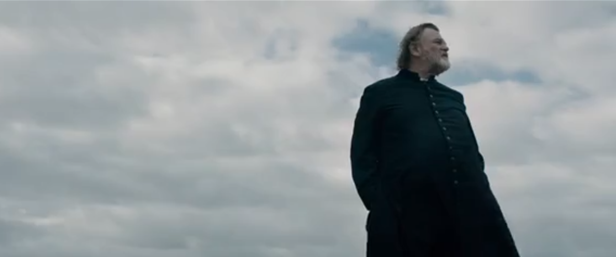
calvary1We meet Father James (Brendan Gleeson) as he sits listening to one man’s confession, but it turns out that this confession is more of a threat. The unseen figure threatens to kill the Father by the end of the week, not for anything he has done, but because the world is an unfair, ugly place. The vengeful man had a traumatizing experience as a boy that rightly so alienated him from the church. The Father listens and does the most humanly thing possible. He doesn’t act as if he has the solution to all the problems, he can’t attempt to fix what has already happened, so he simply acknowledges it and extends his sympathy.

The same goes for the threat of death. He’s not sent into some hysterical fit of terror or rage. He continues through his life, making his rounds through the community to the people in his parish. He goes to their shops, their places of residence, and the bars. You can tell he truly cares for the people around him, but there is an underlying jadedness to everything he does. You can see it on his face wherever he goes. But it doesn’t come from a lack of conviction or faith in his God like father Tomas in Bergman’s Winter Light. James is a priest for the modern age, and it all makes sense if you look around his town.

True, this film starts off with a death threat to a priest, but it’s hardly a mystery because James knows who the Judas is. What’s really paramount are all the people he interacts with. They are the ones who are truly sucking the lifeblood out of him, not the threat of death. The young people are fully engulfed in a secular world and have little notion of how religion plays a role in life. They’re not against it so much as they’ve lived a life without it.

The adults are perhaps worse because they look at the Father and his calling with a cynicism. They say his way is finished. They scoff, belittle, and make light of him for no good reason. Simply because they have no need for Him or his faith. This is the modern world after all. Butchers, bartenders, mechanics don’t need someone to repress them and act as a moral compass. That’s so archaic and constricting.

Meanwhile, they stand by as his church is razed to the ground and they do nothing. The throat of his beloved dog Bruno is slit and Father James is left to weep alone. There are a few characters on the outskirts, who seem to care for him, and one happens to be his daughter Fiona. She too has grown up in the secular world, but they love each other dearly. Her serious contemplation of suicide is yet another anxiety plaguing her father’s life.calvary2Interestingly enough, Father James notes how there’s much more talk about sin rather than virtues. He realizes that forgiveness is highly underrated and that is something that he learns a great deal about over the course of his week. Whether it’s in easier circumstances when responding to his daughter or invariably more difficult forgiving all those hard-hearted individuals around. Or perhaps the most difficult of all, forgiving the man who is going to kill him.

The Father makes his way to the beach ready to meet his assailant as a stoic solitary figure, not simply ready to meet his executioner, but ready to meet his maker. This is a dark and heavy film, but certainly not without merit. It’s weighed down by cynicism, but at its core is a man of immense strength and personal conviction. He’s not a perfect example of a man of faith, but does anybody really want a perfect example?  It’s an impossible expectation, but Father James is a living example. Living, breathing, and dying. A man who was just as prepared to forgive those who despised him as much as he loved those ones who actually cared. Kudos to Brendan Gleeson for a truly stirring portrayal.

4/5 Stars

Chariots of Fire (1981)

Chariots_of_Fire_beach“Now there are just two of us – young Aubrey Montague and myself – who can close our eyes and remember those few young men with hope in our hearts and wings on our heels.” ~ Lord Lindsay

I am hardly a world traveler but one of the places I fell in love with early on was the British Isles. London is a wonderful city with so many memorable landmarks from Big Ben to Buckingham Palace. Harry Potter to Sherlock Holmes. There are the Salisbury plains hosting the monolithic Stonehenge, and the Lake District which is undoubtedly some of the most beautiful country I have ever seen. No wonder Wordsworth and Blake were so enamored by it. However, St. Andrews Scotland has to be one of the most starkly beautiful places I have ever had the pleasure of visiting. It’s steeped in golf history due to the Old Course and despite being the home of a university, it is surrounded by a charmingly quaint town.

And of course, most pertinent to this discussion, its beaches became the perfect setting for the opening moments of the now iconic Chariots of Fire. Really it is so much more than its stellar theme by Vangelis because these sequences bookend a truly remarkable story. We enter the narrative in 1978 where two old men eulogize about the old days and their good friend Harold Abrahams who has recently passed.

Cross_and_HaversBack in the 1920s, a brash young Abrahams (Ben Cross) is about to enter university at Cambridge intent on becoming the greatest runner in the world, and taking on all the naysayers and discrimination head-on. He’s a Jew and faces the antisemitism thrown his way with defiance and a bit of arrogance. He’s a proud young man who loves to run, but more than that he loves to win. His best friend becomes Aubrey, a good-natured chap, who willingly lends a listening ear to all of Harold’s discontent. Soon enough Abraham’s makes a name for himself by breaking a longstanding record of 700 years, at the same time gaining a friend in the sprightly Lord Lindsay. Together the trio hopes to realize their dreams of running for their country in the Paris games of 1924. They are the generation after the Great War and with them rise the hopes and dreams of all those who came before them.

Charleson_as_LiddellSimultaneously we are introduced to Eric Liddell (Ian Charleston) a man from a very different walk of life. He’s a Scot through and through, although he grew up in China, the son of devout Christian missionaries. Everything in his life is for the glory of God, and he is a gifted runner, but in his eyes, it’s simply a gift from God (I believe God made me for a purpose, but he also made me fast. And when I run I feel His pleasure). His sister is worried about his preoccupation with this seemingly frivolous pastime, but Eric sees a chance at the Olympics as a bigger platform – a platform to use his God-given talent to glorify his maker while living out his faith. Abrahams is a disciplined competitor and he goes so far as to bring on respected coach Sam Mussabini (Ian Holm) to help his chances. Liddell is a pure thoroughbred with life pulsing through his veins, and of course, they must face off. It’s inevitable.

But this is only the beginning as all these men we have built a connection with travel across the sea for the Olympic Games grappling with their own anxieties and consciences. For Abrahams, it’s the prospect of failure and success. Failure will burn because his whole existence has always been about running — about winning. He has only a few seconds to justify his very existence. However, the fear of winning is almost greater, because at 24 years of age, where else is he supposed to go after winning a gold medal? It scares the life out of him. Liddell’s tribulation is of a different nature as he must stand true to his beliefs even if it seems to be sabotaging his own success. And of course, Aubrey and Lord Lindsay have their own successes and failures that run the spectrum. Perhaps most importantly these men prove their worth not only to their American opponents but the entire world. They can return home with their heads held high — champions of a feel-good tale to be sure.

Yes, this is a story about two strikingly different individuals, but Chariots of Fire becomes so engrossing due to all its characters. Aubrey resonates with me due to his general contentedness. Lindsay has an air of playful charm that is refreshing. Harold embodies my own hopes, fears, and anxieties. Eric reflects every person’s struggles with spirituality and personal conviction. In essence, the narrative goes back to the glory days to bring light to the universal and continual rise and fall of man. We’re far from perfect, but in spite of all our failures, there is still space for redemption.

The refrains of the theme music paired with William Blake’s majestic “Jerusalem” get me every time. I love being steeped in this atmospheric periodness and my heart yearns to be back in England so I can run on those very same beaches with wreckless abandon. But even if I don’t get there soon, I will be content in running life’s race to the best of my abilities wherever I am. That’s all that any of us can do.

“I have no formula for winning the race. Everyone runs in her own way, or his own way. And where does the power come from, to see the race to its end? From within. Jesus said, “Behold, the Kingdom of God is within you. If with all your hearts, you truly seek me, you shall ever surely find me.” If you commit yourself to the love of Christ, then that is how you run a straight race.” – Eric Liddell

4.5/5 Stars