
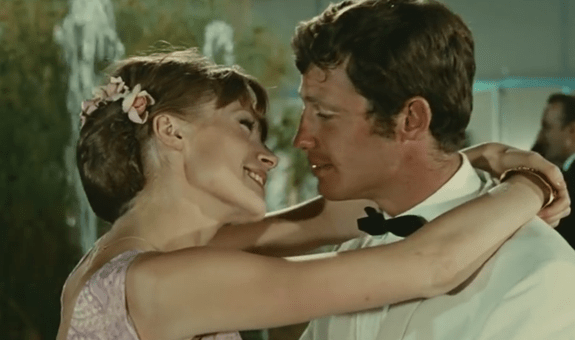
That Man from Rio is a find. It’s a dazzling picture that’s as comedic as it is entertaining bursting with a Brazilian energy that brings to mind the Bossa Nova rhythms of Sergio Mendes somehow married with the world of James Bond. And it’s true, there’s without question a major debt to be paid to Dr. No and From Russia with Love. It’s a good old-fashioned international thriller in the most delightful sense.
Jean-Pierre Belmondo is one of our intrepid albeit reluctant heroes–more of a Gilligan than a masterclass spy–a bungling Bond if you will. In fact, Adrien is fresh off a stint in the air force with a week’s worth of leave. And he’s planning on some nice relaxing R & R with his best girl our spunky heroine Agnes (Francoise Dorleac). But that all quickly goes to hell.
Because he doesn’t know what’s going on while his train is rolling into the station. A mysterious statue belonging to the indigenous Maltak peoples of the Amazon Rainforest is purloined from its place at a Parisian museum in the wake of a silent murder. It’s in these opening moments that the film feels strikingly similar to the following year’s caper comedy How to Steal a Million starring Audrey Hepburn and Peter O’Toole.

However, the story rapidly leaves behind the museum corridors for territory more at home in, if not Bond films, then certainly Tintin serials. Most memorably pulling from his adventures in South America as well as snatching some eerily similar plot points from Herge’s Prisoners of the Sun and Red Rackham’s Treasure.
Belmondo quickly is thrust into the ruckus as our comical and nevertheless compelling action hero who can be found riding a commandeered motorcycle through the Parisian streets in pursuit of his kidnapped girlfriend.
He’s more than once seen pitifully chasing after a car on foot and his being in the air force must explain why he’s utterly lacking in hand to hand combat skills, more often swinging wildly with blunt instruments and getting knocked to the ground for his efforts. There’s a bit of Indy in him with his own personal Portuguese Short Round, the local shoeshine boy and if rumor serves as fact it’s no surprise that Spielberg supposedly saw the film nine times in a flurry of infatuation. If the influences of Tintin can be seen in Rio, then the film undoubtedly inspired Raiders and its sequels, making it no surprise that Spielberg would produce a Tintin picture of his own.
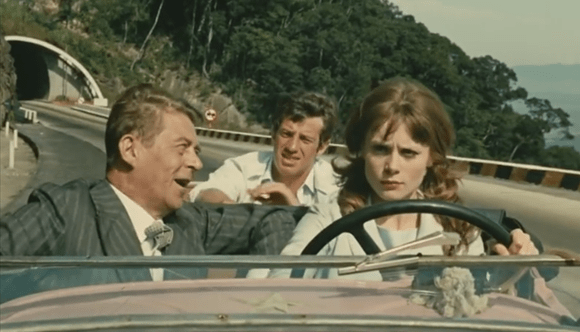
The madcap antics are in one sense reminiscent of It’s a Mad Mad Mad Mad World also featuring trains, planes, and automobiles of every color and description. It too has an outlandish progression of events that nevertheless make for a thoroughly entertaining adventure.
The stolen statue and murder lead to kidnapping and a spur of the moment trip to Rio where Adrien somehow snags a ride on a flight so he can catch up to his girlfriend. But soon they’re both on the lamb, looking for the missing statue and trying to rescue Professor Catalan (Jean Servais), a friend of Agnes’s late father who as luck would have it, also winds up kidnapped. That’s about all you need to know to latch onto to the workings of the plot as they surge ever onward through crazy chase scenes, frantic escapes, bar fights, and whatever else you could possibly imagine.
Phillippe de Broca’s film right from its opening credits boasts gorgeous photography that positively pops making the most of Parisian streets and most certainly the luscious Brazilian locales that still somehow purport a grittiness. There’s the juxtaposition of the worn street corners that at times feel cavernous and somehow still manage to be quaint with a tropical affability thanks to the myriad locals and tourists who inhabit the world.
Having first become acquainted with Francoise Dorleac in The Young Girls of Rochefort opposite her sister Catherine Deneuve, it was easy to consider her the lesser star despite being slightly older. That’s how hindsight gives us an often contorted view of the past. After all, following her own tragic death in a car crash, her sister Catherine has gone on with an illustrious career that has kept her at the forefront of the public consciousness as one of France’s preeminent cinematic treasures.
But after seeing The Soft Skin and now Our Man in Rio with Cul de Sac still to see, it could easily be questioned whether or not Dorleac or Deneuve was a greater star early on as both were involved in some stellar projects. Umbrellas of Cherbourg probably still gives Deneuve the edge but a film like Rio and its star at the very least deserve a brighter spotlight.
Alongside Belmondo, Dorleac is his comic equal as they gallivant frantically every which way both pursuing and being pursued. And from both actors, there’s an obvious exercising of their comic chops that really becomes the core of this film even with its certain amount of intrigue. In truth, they both perform wonderfully and their work here serves as a light, refreshing change of pace. Do yourself a favor and enjoy it.
4/5 Stars
 n the last decade or so arguably the greatest action/spy/thriller franchises have been Jason Bourne, James Bond, and Mission Impossible. To their credit, each series has crafted several passable films fortified by a few real stalwarts of the spy thriller genre. Although many of these series thrive on gadgetry, set pieces, and a cynical tone more at home in the modern millennium, one thing that set some of the better films apart were interesting female characters.
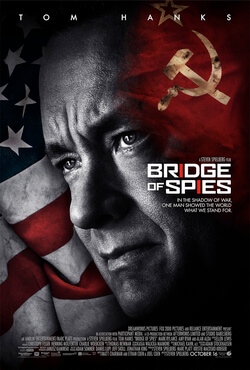 Steven Spielberg is this generation’s
  While
While  Whereas the previous Torn Curtain was generally concerned with life behind the Iron Curtain, Topaz is decidedly more continental moving swiftly between Russia, France, America, Cuba, including a few pitstops at international embassies. However, the film does end up spending a lot of time focused on Cuba which can very easily be juxtaposed with the East German scenes in the former film. Hitchcock once more creates an illusion of reality using the Universal backlot and the adjoining area to craft Cuba, and he makes into a place of sunshine and romantic verandas, but it also runs rampant with totalitarian militia. It’s perhaps more exotic and welcoming than East Germany, but no less repressed. In both cases, they become a perilous locale for our protagonists. Still, rather unlike the previous film, Topaz lacks a truly A-list star like Paul Newman or Julie Andrews.
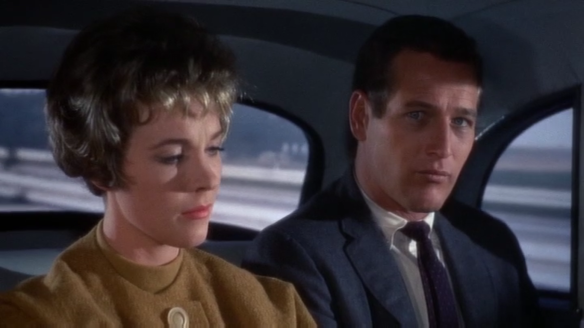 Torn Curtain was
  However, when you watch any Hitchcock film you do wait to be dazzled with some twist or trick because he was always one to bring humor and fascinating aesthetic qualities into his films. Torn Curtain has a few such moments that quickly come to mind. The most prominent has to do with the editing of the sequence in the farmhouse. It is here where Gromek is murdered by Armstrong and the housewife, but it is cut in such a fascinating way. It contrasts with Psycho’s shower sequence quite easily as they try and murder him first by strangling and then anything they can get a hold of whether it’s guns, knives, shovels. There is no score to speak of. Soon it becomes a methodical rhythm of cutting between contorted faces as they slowly but surely move towards the stove. The brutality and length of the ordeal suggest how ugly and laborious it is to kill a man. Hitchcock certainly does not glorify it in any sense.
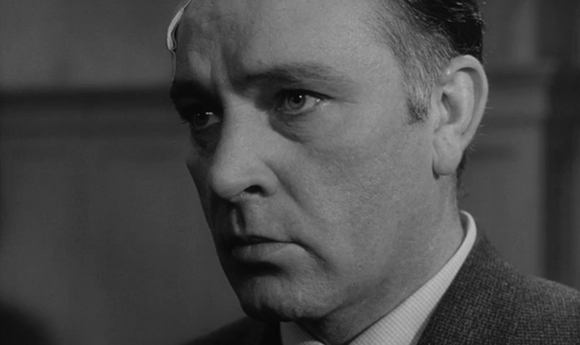 Adapted from the John le Carré novel, this is a black & white spy thriller that personifies cold war paranoia in ways that Bond never could. Richard Burton is an operative working in Berlin before being demoted to a librarian job. It looks like our narrative is heading in a direction hardly fit for a spy film. Its intentions are not so obvious at first, and it keeps its audience working for the rest of the film.
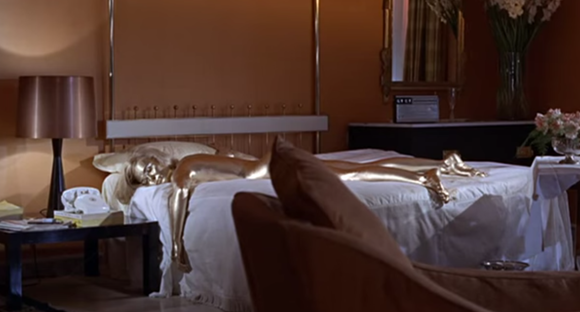

 4 Star Films