
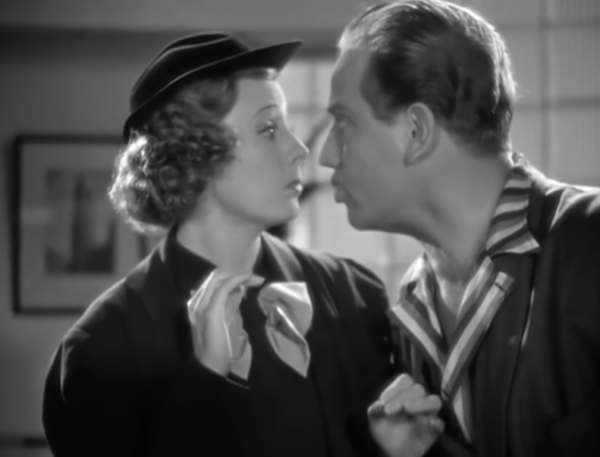
Screwball comedies, like film noir, have a fairly devoted following and although they were very much of their time, they still have descendants and influences on the movies coming out today.
Many of the heavy hitters from the 30s and 40s are household names, but I thought it would be fun to highlight a few titles that fewer people might think about in conversations surrounding screwball comedies. Let me know what you think!
Theodora Goes Wild (1936)
Irene Dunne is a great person to start this list off with because I always enjoy her films and yet she oftentimes feels woefully forgotten. In this zany vehicle, she is the eponymous title character who, while living a life of propriety in a small town, actually moonlights as quite the titillating author. Her life gets flipped upside down when one of the city slickers (Mervyn Douglas) finds out her secret.
Easy Living (1937)
It’s true a whole movie can be born out of a fur coat dropping from the sky, and it builds into a wonderfully raucous narrative thanks to the wonky scripting of Preston Sturges. Jean Arthur and Edward Arnold make a fine pair and send the town into a tizzy when rumors start circulating about the extent of their relationship. Ray Milland also proves why he was a much sought after rom-com lead.
It’s Love I’m After (1937)
It’s a dream cast with Leslie Howard, Bette Davis, and Olivia de Havilland in a dream scenario: a love triangle dressed up with Shakespearean theatricality. What better bedfellow for screwball comedy as Howard puts on a performance to rebuff a starstruck fan girl and earn back his jealous co-star. Eric Blore is stupendous as per usual.
True Confession (1937)
It’s courtroom drama meets screwball romance with Carole Lombard giving one of her most frenzied performances as a serial fibber who pleads guilty to an egregious crime so she can drum up some publicity for her husband (Fred MacMurray), a struggling lawyer in need of a big case. Una Merkel and John Barrymore show up to supply some added character.
Merrily We Live (1938)
Here is a movie that’s good-naturedly built out of the mode of My Man Godfrey. It’s about a family of idle rich: Constance Bennett, Billie Burke, Clarence Kolb, and Bonita Granville, of all people! They’re a constant whirlwind of ditzy entertainment around the breakfast table, and they quite unwittingly pull a passerby (Brian Aherne) into their comic vortex. Chaos ensues.
Vivacious Lady (1938)
Ginger Rogers and Jimmy Stewart have a glowing chemistry. However, their recent marriage has a wrench thrown into it when they head home to meet the parents. The word never got to them, and Charles Coburn, in one of his most obstinate performances, will never approve. Ginger uses all her tricks to woo her husband’s family over and fight off any rivals with her unparalleled catfighting skills. It’s as delightful as it sounds.
The Rage of Paris (1938)
Spunky Danielle Darrieux and Douglas Fairbanks Jr. spar across social lines with your typical screwball romance riddled with conflict transplanted to Paris and the French countryside. What Henry Koster brings is his usual heart-warming tone, and with support from the likes of Helen Broderick and Misca Auer, the material receives a dose of extra comedic oomph.
The Devil and Miss Jones (1941)
Here is the original undercover boss with the always cantankerous Charles Coburn slinking around his own department store. Not only does he come to understand his employees’ dissatisfaction with their work, through the eyes of Jean Arthur and Robert Cummings, he also learns what real friendship is. The movie is blessed with that wonderful one-two combo of uproarious antics and genuine heart.
Let me know what screwball comedies you would include!
 Like the fella says, in Italy for 30 years under the Borgias they had warfare, terror, murder, and bloodshed, but they produced Michelangelo, Leonardo da Vinci, and the Renaissance. In Switzerland they had brotherly love – they had 500 years of democracy and peace, and what did that produce? The cuckoo clock.
 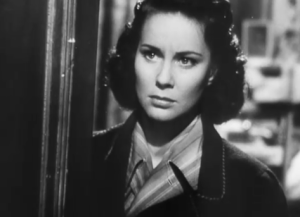 Joseph Cotten is surprisingly compelling as the poor, unfortunate stiff and it’s hard not to feel sorry for him in his ignorance because we can relate with him. Alida Valli is striking as the aloof beauty who nevertheless has an unswerving affection for her former love that remains the only joyous thing in her current existence. Then, of course, there’s Orson Welles as the charismatic myth of a man–arguably the most intriguing supporting character there ever was even if it’s mostly thanks to the legend created by those who knew him.
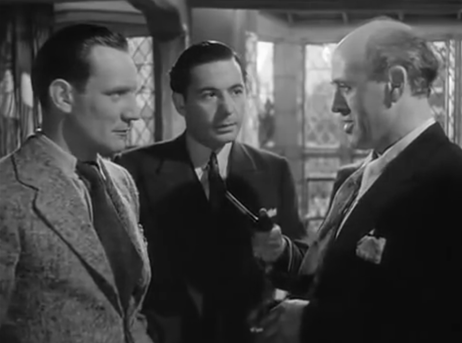 Green for Danger gives murder mysteries a good name because it is drawn up excellently but also with a degree of charm and that should not be taken too lightly or maybe it should. But either way, there’s no doubt that director Sidney Gilliat’s tale based off of a novel by Christianna Brand is quality entertainment.
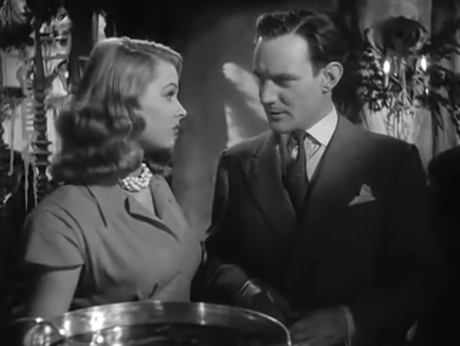 He comes in and steals the film but he does have some enjoyable castmates to work off of. Dr. Barnes (Trevor Howard) the anesthesiologist and the suave surgeon Mr. Eden (Leo Genn) are both in love with the same girl and understandably so. The attractive Nurse Freddi (Sally Gray) is a real prize but only one among a taut nursing staff including the fragile Nurse Sanson and the always lively Nurse Woods (Megs Jenkins). Before the Inspector arrives on the scene they are the true backbone of the storyline and it’s confirmed early on that the murderer comes from within their ranks. The age-old puzzle is left, to decipher who the culprit is and for what nefarious purpose.

 4 Star Films