The Bicycle Thief (1948)

Enzo_Staiola_in_Bicycle_ThievesThe original title in Italian is Ladri di biclette and I’ve seen it translated different ways namely Bicycle Thieves or The Bicycle Thief. Personally, the latter seems more powerful because it develops the ambiguity of the film right in the title. It’s only until later when all the implications truly sink in.

Vittorio De Sica’s film is unequivocally emblematic of the neorealist movement.The most notable traits are the images taken straight off the streets of Rome, depressed and forlorn as they are. The setting truly does act as another character, adding a depth to the film that cannot be fabricated. You can’t fake some of these scenes either whether it’s Antonio scavenging for his bike in the pouring rain or the sheer mass of humanity that is found in places like the Piazza Vittorio.

It’s all there out in the open, with an apparent authenticity. In its simplicity, it feels like a real story with real people. This too is aided by De Sica casting non-actors in the main roles. In fact, Lamberto Maggiorani’s gaunt face is somewhat unremarkable (sharing some resemblance to Robert Duvall). Put him next to a poster of Rita Hayworth and it becomes even more evident. Still, he too feels human in a way that Hollywood stars just cannot quite pull off. It’s easy to believe him and invest in his story.

The same goes for his young son Bruno. He’s one of the cutest precocious kids you’ve ever seen, reminiscent of Jackie Coogan in Chaplin’s The Kid. But it’s also his point of view that makes this film even more tragic later on. This father-son relationship has weight to it.

And that makes Antonio’s dilemma that much more perturbing and ultimately so traumatic for the audience. De Sica’s film is so humble and yet its depths are ripe with so many universal truths and moments of sincerity.

Here is a man trying to provide for his family. His wife, his son, and his baby. Work is hard to come by in the post-war years. Any opportunity is a good one and Antonio gets that. But he needs a bike. His wife sacrifices her sheets so he can get his bike — so he can maintain their whole livelihood as a family.

That’s why it’s so crushing. Everything hangs in the balance of this unfortunate but seemingly mundane event. When Antonio’s bike is stolen it truly means tragedy because there is no lifeline, no direction to turn.

And he does his best to recover his stolen property. Going to the authorities, rounding up his friends to search for it, even tracking down the boy who undoubtedly nicked his bike, but none of it leads to a successful conclusion.

Another day finished with no hope for tomorrow, no money to bring home to his family so they can eat and live. He’s got nothing — a reality that’s made painfully obvious when he and Bruno sit down for dinner at a restaurant. They eat a meager meal as those just behind them gorge on a full buffet of courses. Bruno eyes them longingly and his father tries to lift his spirits, secretly knowing that he can never offer that to his boy.

It puts his lot into a jarring perspective, suggesting the state of the affairs in Italy. But what makes the Bicycle Thief truly timeless is not its scope or what it says on a grand, majestic scale. It’s an intimate film and perhaps the most personal story ever put to film. In a matter of a few moments, it says more with the moral dilemma of Antonio than many lesser films conjure up in a couple hours.

And because this is not a Classical Hollywood film, it does not sell out to its audience. There is no obligation to the viewer to keep them from being downtrodden — because that might rub them the wrong way and actually evoke a searing response. But there can be beauty in that and De Sica’s film is certainly beautiful for precisely those reasons.

It feels real, it feels honest, and rather than sugar coating the world, it draws up a reality that is almost as old as the world itself. So yes, this film is so-called “Neorealist” and yes, it most certainly makes good use of its contemporary setting of Rome in the 1940s. But if any film can claim timelessness Bicycle Thief might just be the best bet because at its core are the type of issues that are not unique to time, space, language, or any other man-made barrier. Every person knows what it means to steal — to battle with their conscience — upending the moral framework that guides their lives. That hasn’t changed even if the context has and that makes The Bicycle Thief continually relevant.

It ambushes us with the same emotional wallop each and every time. I mentioned Chaplin before briefly, but it didn’t occur to me until some time later that we leave our characters walking off into the sunset rather like Chaplin’s Little Tramp, except it’s a very sad sunset indeed.

5/5 Stars

The Earrings of Madame De… (1953)

MadamedeposterThe Earrings of Madame De…, in essence, feels like the perfect incarnation of an Ophuls’ film. In fact, sometimes I forget that Ophuls is actually German because his films are full of French sentiment. I mean that not because of their cast, although we do have Charles Boyer and Danielle Darieux, but more so due to the fact that his films are about elegant, melodramatic romances that fit the decadence of Parisian high society. For instance, in Madame De… Danielle Darrieux is positively swimming in luxury, whether it means dresses, furnishings, or especially jewelry. Materially her husband Andre (Boyer), a French general, has lavished all the worldly possessions upon her. Except that’s not what she wants. At least that’s not what will make her happy. She may be obsessed with the material, but even the material which she so desires is ultimately poisoned over time. Over time Andre cannot even win her over with trinkets and gifts. She cares little for the eponymous earrings until they come from her true love Baron Donati (Vittorio De Sica).

These are the same earrings that she sold to pay off a debt. The same earrings that Andre reacquired from the jeweler and then made the rounds once more. Ophuls said himself that he was drawn to this narrative because “there is always the same axis around which the action continually turns like a carousel. A tiny, scarcely visible axis: a pair of earrings.” And really it is a fascinating plot device that ties the entire narrative together, while also seeming to reflect the utter frivolity and triviality of it all. How can these earrings hold so much weight to one person? And yet that’s only the face value, because, to begin with, they are only an object to be coveted and maybe cherished. Over time they become a token, a symbol of true love and Louise gives them away to the parish because she no longer needs them. She has some notion now of what true love actually feels like.

For the majority of the film, Andre is forever civil with her. He knows that she does not really love him, and he even has time for a mistress on the side. He handles her opportune fainting spells and little charades with grace and at times amusement. But when he gets a hint at Donati’s relationship with his wife, he does what any honorable gentlemen would do. He’s indignant of his rival and builds a huge feud out of nothing. What follows is a duel and the rest is history.

Madame De… probably does not get as much acknowledgment as it should, because Ophuls was a champion of so-called “Women Pictures,” which actually take on the point of view of women, in an industry that’s so male-dominant even to this day. Thus, Madame De… is a little different in perspective, and it tries to hide all of its tragedy behind superficiality. It makes for an interesting lesson in romance and the female psyche. Yet again the director shows his immense affinity for staircases turning them into the personal playground for his camera. He loves to twirl, pirouette, and glide just as much as Louise and Donati do as they dance the night away at the ball. De Sica is a champion director in his own right, but it was especially fun to see him in front of the camera and he seemed an apt player opposite his costars. The worthy equal of Boyer and a suave love interest on top of that. There’s nothing more romantic than Danielle Darreux dreamily repeating to him, “I don’t love you, I don’t love you, I don’t love you.” The sad irony is that those words ring true with her actual husband as reflected by a pair of earrings.

4.5/5 Stars

Sunflower (1970)


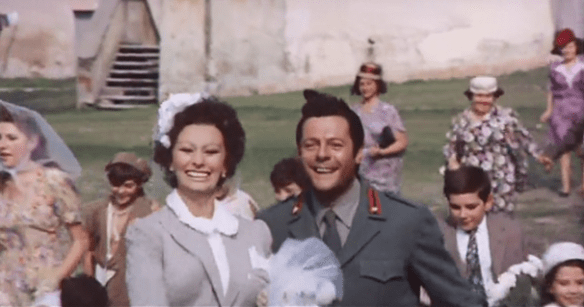
sunflower

Vittorio De Sica is at the forefront of Europe’s most accessible filmmakers of the 20th century and that’s because the stories he crafts are heartfelt, moving, and also enter comical territory with ease. Sunflower pairs him once again with two of Italy’s Titans Sophia Loren and Marcello Mastroianni, and as you would expect the film starts off full of passion, playfulness, and a little pasta. It’s the dawn of WWII and the frisky pair is in love, deciding to get a quick marriage so they might get a 12 day leave before Antonio has to ship out.

In a sense, this is a kind of war film, because Anto gets sent off to the Russian Front and we get a glimpse of the harsh realities there. We are treated to some newsreel style war footage all the while veiled with a billowing red flag. Sunflower is not a film about the politics of the war per se, but rather the effect that war has on people and their relationships.  It can heighten passion, tear people apart, and change lives for good.

When the news comes home that the war is over, there is a flood of relief and then everyone including Giovanna (Sophia Loren) frantically begins the search for their kith and kin. Worried mothers and wives bring their long-cherished photos into train stations clinging to the hope that just one person passing by will be able to give them some fragment of hope. That’s what Giovanni gets and it’s not much, but a jaded soldier who suffered alongside Anto tells her the last time they were together, he was freezing to death in the snow. Her first reaction is to berate him, but he’s too tired to care by now. So she prepares for the journey to Russia to find the whereabouts of her long-lost love. She will not take no for an answer, but what she finds is more painful than even she could expect. It’s a different type of scar, a different type of hurt that no one could foresee.

sunflower1In some respects, Sunflower feels like a precursor to Life is Beautiful (1997), because both films are full of hopefulness, but they both exist as heart-wrenching stories. They deliver the same moving swells of emotion, but for different reasons. Sunflower ends up feeling a little like Umbrellas of Cherbourg in its tragedy. But the title seems to suggest, maybe, just maybe, like the old adage says, out of the ashes beauty can still rise. All the pain and suffering are only the fertilizer for flowers to spring up from the desolated earth. A memorial of what has happened, but also a harbinger for the future.

This is truly an international film because although it’s in Italian, it was partially shot in Russia (a first for the USSR) and features Russian performer Lyudmila Savelyeva in a prominent role. But the lovely score comes courtesy of America’s own Henry Mancini, rounding out this film perfectly. It’s another pleasant surprise from Vittorio De Sica.

4/5 Stars

Marriage Italian Style (1964)

Marriage_Italian_StyleI had never seen any of De Sica’s later work and with the quintessential pairing of Sophia Loren and Marcello Mastroianni this seemed like a perfect place to start the journey. The character Domenico is easy to dislike from the beginning because he constantly floats in and out of the life of the former prostitute Filumena who is ironically devoted to him.

The film relates the struggles of matrimony and family in Italy as Filumena tries to support her family while struggling with Demenico who is never truly ready to commit to her. In fact he becomes absolute fed up with her after a trick marriage, but that is just the beginning.

I can only imagine what Divorce Italian Style will be like (which also features Mastroianni). Without question Sophia Loren is certainly the driving force in this film.

4/5 Stars

Yesterday, Today and Tomorrow (1963)

Yesterday,_Today_and_TomorrowThis is the lightest of any De Sica film I had seen up until this point and interestingly enough it was split up into three narratives. The first one follows a woman who continually gets pregnant in order to avoid going to jail, but after seven kids, the toll is too much on her jaded husband. Needless to say there is a happy ending.

The second tale follows a superficial socialite with a Rolls Royce. She ditches her cars as quickly as she ditches her lovers. Although the story does not go very far it is easy to see she is a snob used to getting her own way. Ironically a humble man would in many ways be too good for her.

The final vignette follows an amiable prostitute as she befriends a young man destined to join the clergy. However, he becomes smitten and so she must do her best to encourage him to continue his calling.

That really is only the basics, but it was certainly enjoyable to see Sophia Loren and Marcello Mastroianni in three separate roles playing off of each other in different ways. They reflected three very different walks of life and three varying relationships mixing a great deal of humor with a few more somber moments. All in all it was fairly enjoyable.

4/5 Stars

The Best Films of Vitorrio De Sica


1. The Bicycle Thief
2. Two Women
3. Miracle in Milan
4. Shoeshine
5. Marriage Italian Style
6. Yesterday, Today and Tomorrow
7. Umberto D
8. The Garden of the Finzi-Continis
9. The Children Are Watching Us
10. The Gold of Naples
11. A Brief Vacation

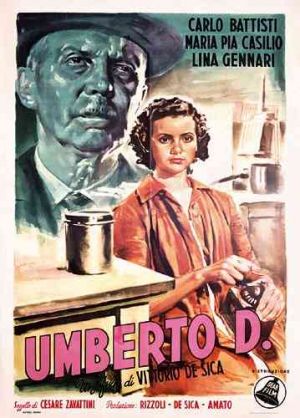
Umberto D (1952)

ed3e0-umbertod

This Italian neo-realist film directed by Vittorio De Sica, with many untrained actors, is about an elderly man scraping by off his pension. His landlady wants to evict him and his only real friends are a maid and his dog Flike. Much of the movie follows him as he tries to pawn belongings for money. He is a very proud man with a respectable past, but now times are tough. We watch as he goes to the hospital, has his home taken out from under him, and then he tries to give away his beloved dog. This film at times can be very bleak but Mr. Umberto is resilient to the end.

4/5 Stars

The Bicycle Thief (1948)

This Italian post-war neo-realist film, directed by Vittorio De Sica, is about a man who has his bicycle stolen and then must find it in order to continue working. Antonio Ricci is a man desperate for a job and he is fortunate enough to get an opportunity. However, he needs a bike and he sold his trying to provide for his family. He gets enough money to buy it back and he starts his days work pasting posters up in Rome. While his back is turned his bicycle is stolen and the culprit gets away. Because it is his livelihood Antonio desperately searches first with his friends and then with his son Bruno. After much looking he believes he has found the thief but with no proof the boy gets off. As the day ends Antonio chooses the one option left with no avail. This film is wonderfully simple and beautifully realistic. You feel deeply for this man who is by no means perfect, in fact he has many faults. But he is simply human. In a sense we are left with a cliffhanger ending that leaves us anxious for him.

5/5 Stars