The Birds (1963) – Alfred Hitchcock

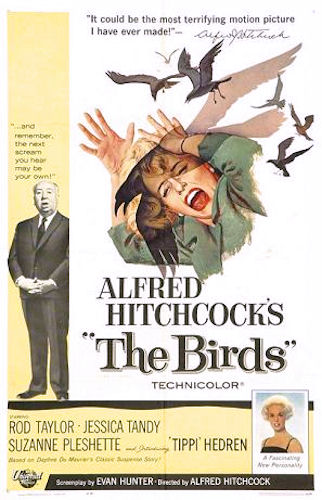
ebc31-the_birds_original_posterDirected by Alfred Hitchcock and starring Tippi Hedren, Rod Taylor, and Suzanne Pleshette, this film follows the journey of a rich woman who travels to Bodega Bay in order to visit a man who intrigues her. This love story is already odd to begin with and then add thousands of berserk birds to create far more chaos. Everything is innocent enough at first but Hedren gets attacked by a seagull. Everyone brushes it off but the next day at a birthday party a wave of birds attack. A couple of deaths and many injuries occur causing tumult all over the bay. The birds keep on attacking in cycles so the citizens must either try and flee or barricade themselves in their homes. Soon the threat of the birds seems overwhelming and Hedren and her new relations must fight to survive. Although this film ends with the family finally escaping in Hedren’s Ashton Martin Coup, the birds still sit there as ominously as ever. With the use of special effects and no score, this film sends shivers down the spine. However do not think it is just a horror flick. Much like Psycho it is also a very well made film.

4.5/5 Stars


The Wrong Man (1956) – Alfred Hitchcock

9c899-the-wrong-man-posterDirected by Alfred Hitchcock and starring Henry Fonda and Vera Miles, this film, based on a true story, is about an innocent man who is falsely accused of armed robbery. Manny is an unassuming musician who lives with his family in New York and barely scrapes by paying the bills. Unfortunately he closely resembles another man who held up a local insurance office. The police are called and then a few witnesses label Manny as the culprit. A coincidence on a writing sample seem to solidify his guilt and so he is jailed. Manny’s wife and family scrounge up the money for bail and a lawyer is found to represent him. Manny tries to prove he was on vacation during the incident but his three acquaintances are either dead or cannot be found. However, Manny has another alibi that his lawyer thinks may stand up in court. At the same time Rose begins to blame herself and her mental health deteriorates forcing Manny to put her in a sanitarium. His first appearance ends in a mistrial but Manny is still in despair. Finally good fortune strikes him when the real robber is finally caught. Manny is free but not without horrible consequences. I have to say Fonda is always so sympathetic in these type of roles and Miles has a good dramatic performance. Although it is lesser known, this film shows the diversity of Hitchcock. Here he essentially makes a documentary and it is just as powerful as many of his other great films in its own way.

4/5 Stars

Sunrise: A Song of Two Humans (1927)

Directed by F.W. Murnau, this silent film follows the lives of a man and his wife. A woman from the city meets the man and suggests that he drown his wife and sell his farm so they can be together. Then, the man takes his innocent wife out on the lake with evil intentions. He is about to go through with it, but ultimately cannot. The wife flees and they take a trolley to the city. The man asks for her forgiveness, and they walk through the city finally reconciled.

Over the day they get their picture taken, go in a barber shop, and have fun at an amusement park. They travel back home by boat and then a massive storm hits. The man searches for his wife to no avail, and then he encounters the exuberant city woman. In his anger, he begins to choke her, but his wife is still alive! He rushes to her bedside and they kiss. This film is wonderfully complex and artistic for a film without any talking. Unlike Chaplin or Keaton this is a great dramatic silent film that does not utilize slapstick comedy, and yet it still finds ways to be funny.

I had forgotten just how funny this film is in parts, and it nicely complements the very memorable love story. Visually this film is extraordinary with its multitude of landscape and city scenes that often overlap and are superimposed on one another. In this aspect, it reminds me of the experimental visuals of Keaton’s Sherlock Jr.

However, this film is very atmospheric and more emotion-filled than the other film. Furthermore, despite the lack of real dialogue, it is almost a misnomer to call this movie “silent.” It most certainly features sound, which often dominates certain sequences and also adds a great deal of feeling to the romance and cityscape. Sometimes it is the chime of bells, the honking of horns, intense background music, or just lively street chatter.

Despite the general story of redemptive love that dominates Sunrise, there are also some charming asides during the visit to the city. Each and every stop has a surprise, whether it is a suitor in the barbershop, the couple posing for the camera, the slipping of a strap on a lady’s dress, or a drunken pig on the loose at the carnival. Ultimately, the film reverts back to this song of two humans, and the temptation of the city and that type of woman loses its luster in comparison to nature’s sunrise and the innocent wife. It is a wonderful allegory and Murnau skillfully develops the cinematic space in unconventional and interesting ways.

5/5 Stars

Strangers on a Train (1951) – Alfred Hitchcock

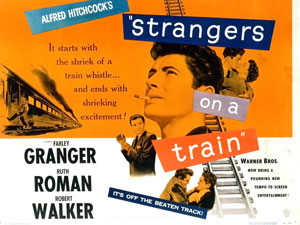
a7d8f-strangers_on_a_train_28film29In one of Hitchcock’s most intriguing thrillers, we watch events unfold as two distinctly different men meet each other. One is an unassuming tennis player and the other a wild-living rich kid. They both have the same desire though, to have someone out of their lives. With this in mind, Bruno proposes swapping murders. He will kill the tennis player’s unfaithful wife and Guy in turn will murder Bruno’s domineering father. Bruno goes ahead with the plan while Guy brushes it off and soon forgets it. Only too late does Guy find out what has happened and he is suddenly faced with a great dilemma . He does not want to commit murder but Bruno relentlessly shadows him expecting it to be done. In the final showdown the two men face off and Bruno is still adamant that he and Guy were always in it together. This film is great for many reasons, including the often unconventional cinematography, the intriguing characters who blur the line between good and evil, and of course the carousel scene at the end is always memorable. Farley Granger and Robert Walker both deliver very good performances that are probably the best of their careers.

5/5 Stars

To Be or Not to Be (1942)

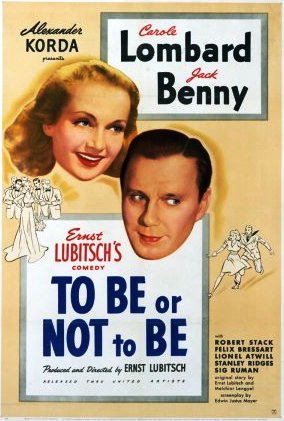
Starring Jack Benny and Carole Lombard with director Ernst Lubitsch, the film follows a group of actors in Poland during the outbreak of World War II. All too soon their act seems to be in jeopardy and they must put on the most important performance of their lives. Benny and Lombard are a husband and wife acting duo, who with the help of their troupe must stop a spy from giving damaging information to the Nazis. With the help of their acting and disguises, they are able to pull off the monumental task. This satire is so extraordinary because it made fun of the Nazis and found humor in that subject at the same time their villainy was occurring. Benny certainly seems out of place in Poland and he is not much when it comes to performing Hamlet, but I suppose that’s part of his charm. He is so vain and suspicious of his wife and yet he ends up a hero.

When I first saw this film I expected major laughs and it really does not have that, at least not in the way that Chaplin lampooned Hitler in the Great Dictator. Here Lubitsch weaves a somewhat darker story and yet it causes us to smile because of this Polish acting troupe that embodies the words of Shakespeare that “All the world’s a stage.” He meant it to be metaphorical but they take it to heart and their acting turns into reality. The bit player Greenberg goes as far as reciting the Jewish part of Shylock from the Merchant of Venice and it ultimately saves their lives. As such the film often switches back in forth from stage to actuality and pretty soon it is hard to separate them. The the plight of these people was close to Lubitsch, but he also was adept at the romantic comedy. Thus, despite the constant bickering and the trials faced by Joseph and Maria Tura, we cannot help but laugh at their love story. To Be or Not to Be is not your everyday comedy, but instead it occupies its own unique niche. Hopefully no one walks out on it!

4/5 Stars

Rope (1948) – Alfred Hitchcock

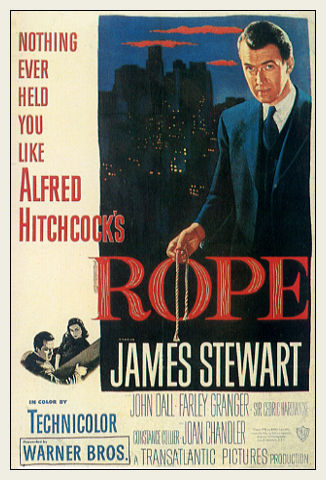
eeca4-rope2What is the perfect murder? Hitchcock seemingly toys with this question in Rope . Starring Jimmy Stewart, Farley Granger, and John Dall, the latter two are students who murder their peer from university. Their only reason for doing it however is to see if they can get away with the crime. To complete their little experiment, they invite the boy’s family, his girlfriend, and other guests over to dinner, right in the room where they committed the murder. As an after though they invite their former professor (Stewart) who is the only one who would be able to catch them. At first Stewart does not suspect anything but eventually he becomes suspicious without letting on. Finally, the students lose their cool and Stewart catches them red-handed. This quickly puts an end to the perfect crime. This film is interesting because it was made to look like it was shot on one reel. Hitchcock’s movies are often known for the editing and yet this film was shot almost like a play in very long takes.

4/5 Stars

Spellbound (1945) – Alfred Hitchcock

Directed by Alfred Hitchcock and starring Gregory Peck and Ingrid Bergman, the film follows the complicated story of an intelligent lady doctor skilled in psychoanalysis. Bergman’s character is very focused on her work and often withdrawn. That soon changes when she meets the new doctor (Peck) whom she falls for. However, soon Bergman realizes he is not the real doctor and further uncovers his state of amnesia used to forget his past. Trying to keep him out of the hands of the police, she takes Peck to her former colleague and they try to delve into his dreams. When Bergman finally seems to have all the answers unexpected complications arise. Now she must save her patient and lover before it is too late. Hitchcock’s directing, a great score, collaboration with Salvidor Dali, and good acting make this film worth seeing. Michael Chekhov is certainly good for a laugh or two as well.

4/5 Stars

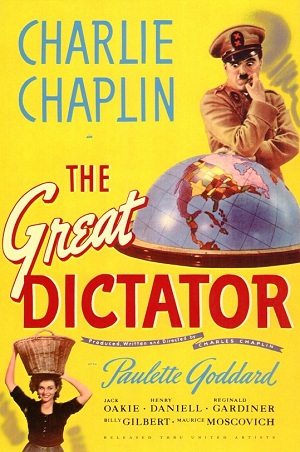
The Great Dictator (1940)

ac211-the_great_dictatorStarring Charlie Chaplin with Paulette Goddard, this satire blatantly critiques Hitler and the Nazis. The film opens during WWI where a little solider (Chaplin) saves an important military man. However, as a result he lands in a hospital with amnesia. All the while the power hungry dictator of Tomania, Adenoid Hynkel (also Chaplin) is on the rise. The man with amnesia returns to his barber shop in the Jewish ghetto and there he catches the eye of a beautiful girl Hannah. However, as Jews they are not safe, and even when things start improving, quickly Hynkel puts down his iron fist. The barber and another dissident are imprisoned, Hannah is in trouble, and Hynkel is ironing out his differences with Benzino Napaloni. However, after a gutsy escape, the barber poses as Hynkel and makes an impassioned plea to the people.

I see this film as a drama full of pathos. It is important to realize that is is not trying to make light of the situation but it is in fact condemning what Hitler was doing at the time. I think that is part of the brilliance and universality of Chaplin’s films. He could balance drama and comedy so aptly, making it possible for him to tackle this controversial topic head on. Furthermore, even though this was his first true talkie he still kept one foot in the silent age in his portrayal of the barber (very similar to the Tramp), and yet he also acknowledged the very present danger of Hitler. This film has some wonderful moments, but I think the two that really stick out are the opening speech by Hynkel which blatantly derides Hitler’s mannerisms and rhetoric. Then, in a complete 360, Chaplin gives his powerful speech aimed to rally mankind. Overall, it is a stellar duel performance from Chaplin and Goddard is as radiant as ever. That mustache certainly did not hurt the film either!

5/5 Stars

Lifeboat (1944) – Alfred Hitchcock

Directed by Alfred Hitchcock and starring Tallulah Bankhead, the film follows the passengers of a liner who escape in a lifeboat after the ship is sunk. Together they try and survive in order to make it back to civilization. Along the way they must make many difficult decisions. This includes saving the life of a German who sank their boat as well as amputating a man’s leg. Through it all there is ongoing conflict among the people who would normally be genial. However, their circumstances are by no means ordinary. By the end they are so desperate and crazed they seemingly turn against some and fall in love with others. This technical challenge of such a small setting did not disable Hitchcock’s storytelling ability. Written by John Steinbeck, the film’s story is an interesting view of humanity during World War II. This movie also includes Hitchcock’s most ingenious cameo of any of his films.

4/5 Stars

Shadow of a Doubt (1943) – Alfred Hitchcock

08054-original_movie_poster_for_the_film_shadow_of_a_doubtIn one of Hitchcock’s earlier American films starring Joseph Cotten and Teresa Wright, Uncle Charlie comes to visit his niece namesake “Charlie” and the rest of the family. Initially the whole family seems to be in a funk until they find Charlie (Cotten) is coming to visit them in Santa Rosa. However, what they do not know is that he is a wanted murderer. Over time “Charlie” (Wright) becomes suspicious of her uncle and finally comes across the truth. Her uncle figures out what she knows and decides he must get rid of her. Living in constant peril, “Charlie” finally is forced to face him. In the ensuing struggle she fights madly for her life. With the constant discomfort and suspense, Hitchcock proves how powerful thrillers can be even in the home. Cotten and Wright both do a very good job in this film. Supposedly this was Hitchcock’s favorite among his own films. I think it certainly one of the best of his lesser known movies.

5/5 Stars