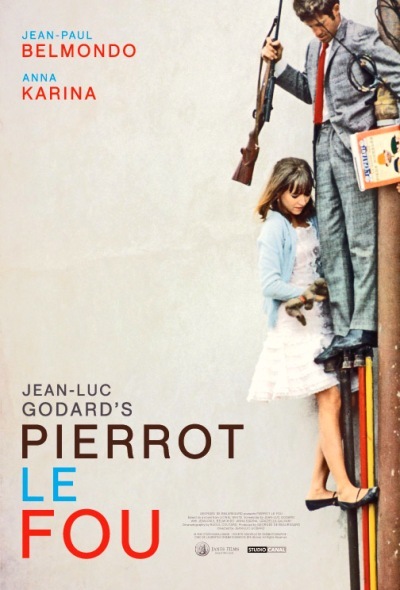
Pierrot Le Fou (1965)

Directed by Jean-Luc Godard and starring Jean Paul Belmondo and Anna Karina, this film is chock full of poetic musings, literary allusions, pop culture images, and so on. Belmondo is a Frenchman who is unhappy with his life and marriage. When a young woman he is already acquainted with comes to watch his child, they eventually elope together. Ferdinand goes with Marianne to her apartment only to find a corpse and they must flee the scene from two gangsters. Now on the run, the two lovebirds are intent on living life and making their own Hollywood inspired movie that they can both star in. Their aspirations lead them to live a wild life on the move, but finally they settle down for a awhile in the French Riviera. Ferdinand is content with a quiet life of philosophizing but Marianne is discontent with this life right out of a Robert Louis Stevenson novel. They finally move on and stop at a night club where they face one of their pursuers. After some mishaps Ferdinand and his girl get separated. Finally they are reunited only to have Marianne turn on “Pierrot” for her real boyfriend. The final moments are filled with gunfire, a suitcase full of money, blue paint, and dynamite. You could say that everything blew up in Ferdinand’s face, and you would be quite correct.

4/5 Stars

Band of Outsiders (1964)

Directed by Jean-Luc Godard, this film follows a young woman who meets two  crooks in an English language class. Through narration we learn that she told them about a cache of money she knows of and so they get her to help them swipe it. They both fight for her affection and ultimately the thug Arthur wins out. Despite Odile’s apprehension at taking the money from her aunt’s home, they continue to get the plan ready. Arthur’s uncle now wants in and then the plan changes again because the owner of the money is gone a day earlier. From this point everything begins to go wrong and after a horrible botched attempt the three culprits flee the scene with little to show for their caper. Arthur makes up an excuse to return and Odile and Franz drive off but they return when trouble seems imminent. Back at the house Arthur is confronted by his uncle and there is more bloodshed. Afterwards Odile and Franz again flee heading to South America while the narrator promises a sequel in the near future. This film unabashedly proclaims to be Nouvelle wave even going so far as having it printed on a store banner. Again, Godard combines his love of American pulp fiction and artistic experimentation to create yet another tragic tale. The film gives a nod to Hollywood crime films and also features several famous sequences. Some high points include the moment of silence, the spontaneous dance in the café, and of course the run through the Louvre. In my mind, Pulp Fiction owes at least something to Godard right here.


4/5 Stars

Contempt (1963)

Directed by Jean Luc Godard and starring an international cast including Brigitte Bardot, Michel Piccoli, Jack Palance, and Fritz Lang, this film within a film is Godard’s personal examination of the cinematic world. It opens with the shooting of a scene only to have the camera turn to face on the audience. Then begins a story where a screenwriter married to a beautiful woman is called upon to write a new screenplay for an adaption of the Odyssey. The producer is a vain and loud mouthed American who quickly has his eyes on the producer’s wife. Other members in this production are the real life legendary director Fritz Lang as well as the producer’s personal female assistant. Things begin to turn for the writer after he leaves his wife with the American playboy. She begins to become distant and she finally acknowledges that she no longer loves him. One of the famous extended sequences focuses on the argument they have inside their residence. In the course of the scene their relationship begins to crumble and finally goes beyond repair. This turn of events is very obviously paralleled in the Odyssey by Odysseus and Penelope. In the end the wife leaves with the producer and screenwriter is left in Italy to help finish up the film alone. Little does he know what has happened. Fellini’s 8 ½ may be a greater film about a filmmaker and his art, but I think “Contempt” is important because Godard focuses a great deal on the conflict between the commercial films of Hollywood and the art films of Europe. His film is more about each individual person who together make a film production possible, and he brings it to the screen with one of his best casts.

4.5/5 Stars

Vivre Sa Vie (1962)

ef6de-vivresavieposterDirected by Jean-Luc Godard and starring Anna Karina, this French film shot like a documentary begins up close and personal in the life of a 22 year old woman named Nana. In 12 separate scenes we slowly are given a view into her life. She goes from leaving her husband, trying to get into the movies, and then finally begins prostituting herself for easy money. All the while this beautiful young lady struggles with men. Here interactions sometimes leave her somber and other times light-hearted. Through it all she tries to live her life the way she sees fit. She might be playing pinball, working in a record shop, viewing a movie, or attempting to pick someone up. She is so alluring in a quiet sort of way and as observers we begin to feel pity for her more than anything. In the end tragedy strikes and all of a sudden it is no longer her life to live. This film had moments where it became talkie however the narrative divided into 12 sequences and the constantly swiveling camera were major attributes. Furthermore, this film appears as if it will be an in depth character study and yet by the time it abruptly ends we hardly know much of anything about Nana besides what is on the outside. In real life Anna Karina would be Godard’s wife for a time and he used her in many of his works.

4.5/5 Stars

Breathless (1960)

5cad1-c380_bout_de_souffle_movie_posterThe debut of Jean-Luc Godard and starring Jean-Paul Belmondo with Jean Seberg, this film was influential in helping to jump start the French New Wave. The story begins with a small-time thief named Michel stealing a car and then killing a policeman  Quickly, he becomes a fugitive in need of money. This brings him in contact with an American journalism student he had met before. They spend time together with Michel professing his love and Patricia still feeling unsure whether or not she truly loves him back. In a final act of reassurance Patricia betrays Michel and he is chased down by the authorities. He is a far cry from the American movie stars and crime films he idolizes. With its jazzy score, bilingual dialogue, jump cuts, and Parisian scenery, this film is chic and cool. It paid homage to Hollywood but it also paved the way for a new era of films starting in the 60s. The film is perhaps not as impressive to today’s audiences but it certainly has a look that you have to appreciate. Godard was ahead of his time because he went against all conventions that had been set up for cinema and he thereby revolutionized the film world.

4.5/5 Stars

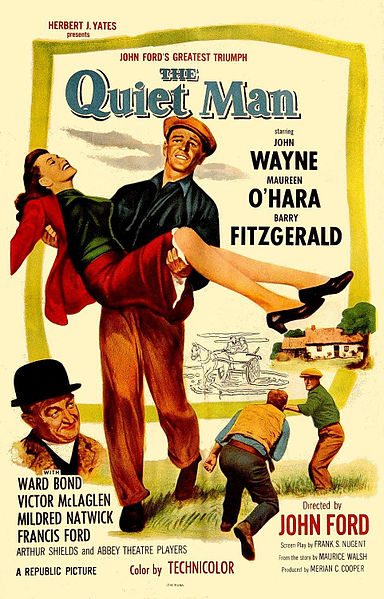
The Quiet Man (1952)

Starring John Wayne and Maureen O’Hara with director John Ford, the film follows an ex-American boxer as he returns to his roots in Ireland. Soon he is befriended by the proper yet kindly folk in the quaint town. Also, a beautiful red-haired girl catches his eye one day. Fireworks start between the American and the proud brother, so he will not condone the courtship or marriage of his sister. Finally, Wayne does gain his wife but she is unhappy without her dowry and she believes her husband is a coward since he will not fight for it. Little does she know the past he tried to escape, but once he gets it off his chest, he does fight. Through the exciting event both men grow fond of each other and the town gets a kick out of the entertainment. O’Hara and the rest of the cast including Barry Fitzgerlad are wonderful as the Irish folk, all playing off the Quiet Man.

5/5 Stars

Cool Hand Luke (1967)

92bba-cool_hand_luke_posterIn one of his most memorable performances, Paul Newman is Luke Jackson a man put on a chain gang for cutting the heads off parking meters while drunk. Despite the weary and monotonous regiment, Luke will not be cowed and he always keeps his positive demeanor.

Originally the newcomer, Luke quickly earns the respect of everyone including Dragline (George Kennedy), whether he is boxing, eating 50 hard-boiled eggs, or bluffing his way through a card game. Even though he is never quite successful, Luke never stops trying to escape either. His numerous clever attempts lead the Captain (Strother Martin) to utter his famous words about their “failure to communicate.” After multiple escape attempts Luke gets beaten, berated, and tortured.

However, he proves that you can never destroy his spirit no matter how hard yo try and so the ending is inconsequential. So ultimately “Cool Hand Luke” is a winner and a likable one at that.

It is necessary to acknowledge this solid ensemble cast including the likes of Dennis Hopper, Wayne Rogers, Ralph Waite, and of course Joan Van Fleet. Furthermore, there is seemingly no film that better depicts the dirt, grime, heat, and humidity that comes from working in a southern chain gang. The cinematography makes even the audience uncomfortable and a shower seems all but necessary.

Although the focus is often on the indefatigable character of Luke it became evident that this is often a taxing and difficult film to watch especially in the second half. In many ways Luke is the savior of these men in the chain gang and he sacrifices a lot of himself so that they might have some hope. Thus, this film is not just about the highs but the lows as well and Paul Newman plays every moment adeptly with the coolness that Luke Jackson embodies.

5/5 Stars

Leave Her to Heaven (1946) – Film-Noir

Starring Gene Tierney and Cornell Wilde, this film noir is certainly unique. The movie is completely in color, it takes place in quiet locales, and it features a nice family with a new son-in-law. However, Tierney delivers a chilling performance as the jealous and deranged wife who falls for the author Richard Harland (Wilde) and she will not let him go. At first Ellen seems nice enough but all too soon we see the extent she will go to be the only one in Richard’s life. Soon her treatment of others perturbs him and she in turn gets jealous of the attention he gives to her sister. In her final act Ellen commits suicide and tries to pin it on her sister. Even from the grave it seems like she will never give up Richard. However, as we learn from the flashback, this is the first time she did not end up winning. This film is less about action and more about the characters. I must admit Tierney seemed like the greatest villain of all time sitting there callously in the boat and ironically Jeanne Craig became more beautiful the colder Tierney got. Tierney was in a lot of great movies but I think this has to be her best performance because in most of her other movies the audience adores her and here we openly despise her. We cannot wait for her to be left to Heaven so justice can be dealt.

4/5 Stars

How Green Was My Valley (1941)

Starring a cast including Roddy McDowell, Walter Pidgeon, Maureen O’Hara, and Donald Crisp, with director John Ford, the film is told from the eyes of a young boy (McDowell) from a Welsh mining family. Huw has five older brothers, an older sister, and two strong but goodhearted parents. As times get tougher, he sees one brother get married and two others leave for America. Huw faces his own struggles recuperating from an injury and surviving his schooling. Along the way he is aided by the kindly preacher (Pidgeon). However, soon he sees his family torn apart even more when his sister is unhappily married off, a brother is killed, and two others lose their jobs. Then, finally when his sister returns, the town folk start a scandal, and Mr. Morgan becomes trapped in the mine. It does end on a good not and the family stays resilient. This film is full of adversity but more importantly it has warmth and good people. The camera work is excellent and the Welsh singing is memorable.

4.5/5 Stars

Charlie Chaplin’s Little Tramp Who Could: Looking Back after a Century

Before the man with the mustache was Ron Burgundy and even before the Tramp was associated with a dog in a Disney flick, there was another. It has been a century since Charlie Chaplin first developed his Tramp character who is arguably one of the most well-known cultural icons of all time. His persona will forever be identified with that hat, that cane, and of course that mustache.

Charles “Charlie” Chaplin developed his most famous incarnation over a period of years as he worked in The Keystone Film Co. as a stock character. Movies were still a very new fad and Hollywood was the home of the infant movie scene.
 
 In his earliest appearances the Tramp was a comical drunk and a troublemaker. However, it would take just a number of years to transform him into a sympathetic bumbler who lit up the silver screen and filled movie halls with uproarious laughter. Chaplin ingeniously developed his character in such a way to elicit a wonderful balance of humor and empathy from audiences.

Many things have become obsolete over the past 100 years. Take Woodrow Wilson, The Model T, and World War I to name a few of the high points. How is it then that the Tramp has seemingly continuously remained in our collective cultural consciousness? I’m not just saying people are still sitting back in theaters to see his antics either. His image pops up everywhere mundane; you can even buy posters of him at Ikea!
 
Obviously in the film community Chaplin’s Tramp is still highly regarded as well. His films regularly place high on polls by the prestigious Sight & Sound Magazine as well as the American Film Institute. However, perhaps even more important than those accolades is the impact that the Tramp has had on our culture, and I do not just mean America but the entire world.
 
Maybe not everyone is an acclaimed film critic who has seen everything Chaplin (I certainly have not); however I think most people, no matter what their background, can relate to The Tramp in one way or another. His seemingly harmless vagabond image makes us laugh, smile, and perhaps even feel better about ourselves. We say to ourselves, “Wow, if things were this bad in the 1920s or 30s, I really do not have much to complain about.” Now that might be somewhat of an oversimplification of that time, but I think that is part of the reason he’s still fresh today.
 
The Tramp is the epitome of those old silent movies, with melodrama, romance, slapstick, and oh yeah, no talking. Ironically, it might be this last point that is the key to Chaplin’s success with the Tramp. No talking means no language barrier; culturally, socially, or even with the passing of the years, even 100 years. 
 
Back then when times were good and bad he was the world’s every man and although times have changed, he still has remained the same every man that each one of us are able to relate to. In this respect he is a mustached, shuffling paradox, because he reflects a bygone era and yet he still relates to us in our modern world. Amazingly, it seems that this little, funny looking man still has the extraordinary power to make us laugh, sympathize, and see ourselves through his humanity; even the most cynical of us.
 
I would challenge you; nay implore you to try a Chaplin film just once. Before you get too indignant or nervous let me say one thing. Start out with some of his later works like Modern Times or The Great Dictator, which has talking, and work your way back if you like it. Or start out with a short film and work your way up, that’s good too.
Either way I think you might just find yourself captivated by this little man. Perhaps he isn’t the simplistic silent star that you assumed him to be after all. Then again maybe you’re not feeling it the first time through. That’s alright because I would wager a guess that he might just be around in another century if you want to give it another go then, but don’t hold me to that.

My musings were inspired by this article:


http://www.latimes.com/entertainment/movies/moviesnow/la-et-mn-charlie-chaplin-tramp-classic-hollywood-20140126,0,4224217.story#axzz2tEoS53ac