The Searchers (1956)

d4eb3-the_searchersOne of John Wayne and John Ford’s best westerns respectively, The Searchers follows an ex-Confederate soldier (Wayne) as he looks for his niece Debbie, who was taken by Indians when they killed her parents. Now Wayne and a young man played by Jefferey Hunter must look for her and bring Debbie home. With an almost obsessive desire, Wayne’s character Ethan Edwards vows to find her. Along the way, the old vet and young man have conflicting personalities that get in the way. Even when they finally find her, she has become more Indian than white, and Edwards seems bent on killing her much to Hunter’s horror. In the end, the gruff but courageous searcher shows his true colors.

A great western, and simply a wonderful film, The Searchers has a lot to offer with great action, Monument Valley scenery, and of course John Wayne. The supporting cast is good as well, including Vera Miles, Natalie Wood, Ward Bond, John Qualen, Hank Worden, and Ken Curtis.

There are some pivotal scenes in this film that I think really get to the core of what it is about, and Ford constructs a multitude of scenes which are simply a joy to observe as they unfold. One turning point has to be when the two Searchers look over a few white girls that the cavalry recovered from the Comanche. One of the girls gives off a childish screech, which causes Ethan to turn around, and Ford’s camera closes in on his scowling face half covered by shadow. Here is a proud man who would not surrender during the end of the Civil War. Here is a man full of prejudice and vengeance. Here is a man who shows glimpses of kindness, and here is a man who knows pain. It is complicated because he heads out after Debbie seemingly in an act of love. But soon it seems that it has become his vendetta, and Ethan has simply become bent on revenge. It takes his final confrontation with Debbie to reveal the true depth of his character.

Undoubtedly this is one of the preeminent American westerns, but I think you could also call it a social commentary on racial prejudice. Furthermore, The Searchers influence ranges from the plight of Luke Skywalker in Star Wars to the music of Buddy Holly (“That’ll be the Day”). I think fittingly enough the film ends with Wayne framed in the doorway, walking off into the distance. After all, he is a searcher, and you cannot expect a man like that to stay put.

5/5 Stars

Shirley Temple Black

With the passing of Shirley Temple Black just yesterday, it made realize that sometimes we do not appreciate people as much until they are gone, which is unfortunate. Now I want to go back and see some of her performances because the only one I have seen in its entirety is probably Heidi. Recently however I did see part of the Bachelor and the Bobby-Soxer and I realized why she was so popular. She was a good little entertainer to be sure, but at her core was this cheerfulness and sweet disposition that resonated with audiences. I hope to discover more of that soon.

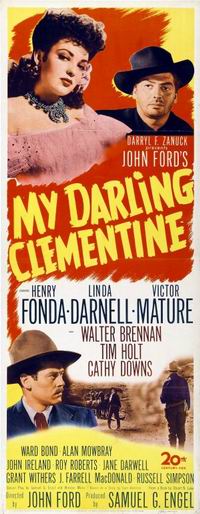
My Darling Clementine (1946)

Directed by John Ford and starring a cast including Henry Fonda, Linda Darnell, Victor Mature, Walter Brennan, and Ward Bond, the film retells the story of the gunfight at the O.K. Coral. Wyatt Earp (Fonda) is herding cattle with his brothers near the town of Tombstone. However, his youngest brother is killed and the cattle are stolen. From that point on Earp becomes Marshall and encounters a gruff old man with his sons, a fiery song girl, the complex Doc Holiday, and Doc’s former lover Clementine. As Marshall, Earp has his share of conflicts but the town slowly begins to improve under his supervision. However, the Clanton’s lash out and thus starts the legendary gunfight at the O.K. Coral. This is a classic western, with a host of good characters, memorable scenery, and Henry Fonda in a solid leading performance as the larger-than-life Earp. Although this may not one of my favorites in the genre, John Ford proved once again that he knew how to make a classic western.

4/5 Stars

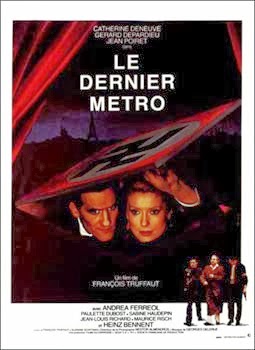
The Last Metro (1980)

Directed by Francois Truffaut and starring Catherine Denueve and Gerard Depardieu, the film opens with the very French-sounding love song “Mon amant de Sant Jean” playing over the credits. We find ourselves in occupied France during WWII where a little theater is struggling to stay open. The  famed Jewish director Lucas Steiner has been forced to flee from the Nazis although in reality he is actually hiding in the cellar of the theater. In his absence his wife Marion has taken up his role of running the theater while also continuing to act. Early on we are introduced to the young actor Bernard who is chosen to play one of the new roles in the upcoming production. At the same time Marion must try and acquire the permit to stay open from a man whom she despises, the art critic Daxiat, who has anti-Semitic beliefs. They do stay open however, and with the director’s notes of Lucas they prepare their show and open to great success. Many of the French come to their shows as an escape before they take the Last Metro home. However, at their performance Daxiat gives them a harsh review and it angers Bernard. His actions ultimately jeopardize the theater and as a result his relations with Marion become strained. As if that were not enough some Gestapo come to the theater searching for Lucas and they must rush to hide him. Needless to say the film ends on a positive note but the film is not so much about resistance against the Nazis compared to the struggles of a theater to survive. Denueve gives a moving performance and although this is not Truffaut’s best, it is admirable. As the audience, not only do we watch a movie, but we watch the play within the movie and then the drama behind the play, so Truffaut  takes us a little deeper.

4/5 Stars

Hiroshima Mon Amour (1959)

72bd9-hiroshima_mon_amour_1959This film is not only a seemingly early form of the French New Wave, it also has many qualities of a documentary, and it is certainly an international film. The film opens with a one night stand between a French actress and a Japanese architect who rendezvous one night in Hiroshima. In the short time they spend together, she reflects on her memories of the city that was not too long ago devastated by the atomic bomb. He often rejects her recollections but nevertheless, he cannot bear for her to leave and he continues to pursue her. Eventually in the course of their time together she relates her days back in the town of Nevers in France. During the occupation, she had a beau who was German and was eventually killed. The events and aftermath haunted her even many years later. They spend some of their time together walking the streets of Hiroshima and with their time running out they vow to remember each other by Hiroshima and Nevers respectively because their real names are never mentioned. This film begins very much like a documentary on Hiroshima but very quickly it turns into a character study focusing on ideas of love, memory, and personal identity. This film is more about art and expression and it uses quick flashbacks to replicate the past with voice-overs bringing the audience back to the present. That being said it should be treated as such because it truly is a masterpiece from Alain Resnais.

4.5/5 Stars

Go for Broke (1951)

Starring Van Johnson along with a handful of WW II vets, this film looks like your average war film. It follows this group of soldiers from their initial training all the way to deployment. Then, we follow their exploits in Italy and France that coincide with their everyday interactions. However, this film is very significant because it actually tells the story of Japanese Americans in the 442nd infantry unit. They not only faced the enemy on the battlefield, they also had to deal with a great deal of prejudice within the armed forces. However, as with the example of Van Johnson, the Budha-Heads were able to win respect because of their courageous fighting. In the climatic moments of the film these men save a lost division and then return home as heroes. Since I am half-Japanese it was exciting for me to come across this film because this kind of topic has not been covered often. The fact that it actually had Nisei actors and was  made quite soon after the war is also amazing.

3.5/5 Stars

The Grapes of Wrath (1940)

472a2-wrathposters141I must admit this film directed by John Ford and starring Henry Fonda, surprised me in a positive way. This movie seemed like it could potentially be another Citizen Kane  (a movie so inflated with praised that it becomes a letdown when actually viewed). However, The Grapes of Wrath  in fact has a fairly good story adapted loosely from John Steinbeck’s novel. You come out of it feeling the strength of the Joads as well as the inhumanity they face traveling from the Dust Bowl in Oklahoma to California. Still, there is hope that they will endure it all in the end. Fonda gives a solid performance as the plain-speaking, young man Tom Joad. Jane Darwell also gives a very moving performance as his Ma . Some may say this movie has its slow parts but it also has some very good moments that reflect genuine humanity.

4/5 Stars

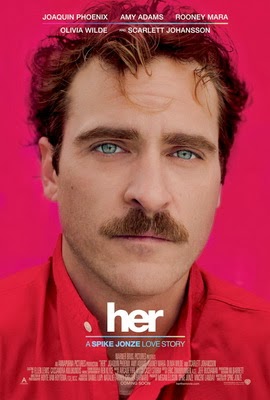
Her (2013)

e69ce-her2013posterHer is a film that examines hyper-technological culture through a lens that has been around for centuries: romance.  In a not so distant future Los Angeles, Theodore Twombly is a craftsman of greeting cards. The only difference is he dictates personal messages, which are then transcribed by computers to be given to loved ones. He himself is going through a rough patch in life after a breakup with his wife and it has left him taciturn and distant.
Then one day he purchases the new OS or Operating System. Samantha, as she is called, is a very high level of artificial intelligence (Siri on steroids), who is able to openly communicate, do tasks, and even show emotion to some extent. Even though she does not actually have a tangible body (unless you count Theodore’s phone), he still finds a way to become enchanted by her. Not only can she check his emails, but Samantha also has access to vast amounts of data that allow her to evolve with Theodore, and she soon becomes his closest confidant and companion. Her desire to constantly discover the world invigorates Theodore, who is constantly used to the same technological, yet monotonous existence. Ironically, he develops his deepest relationship with Samantha, because she reflects how lonely technology has made him. 
Real human interaction seems foreign and awkward, whether it is with his estranged wife, work friends, or a blind date. For that matter sexual relations have also been perverted and, in a sense, trivialized by technology. Theodore’s complicated relationship with Samantha brings these and many other realities to light. 
Samantha can never truly be Reality. She can never have physical contact. This causes Theodore to put greater focus on the other aspects about her. Yes, she is not a normal human, but her knowledge on everything and her curiosity opens up numerous beautiful avenues for them to explore together. It could be love letters, the music she is composing, or even the sensation of ambling down a street. 
Ultimately, there is a downside to technology because despite being in an advanced future it cannot fully emulate the human experience and as Theodore painfully discovers there are terrible complications in relation to Samantha. 
This can be a difficult film, a strange film, and at times even a crass film, but for the most part Spike Jonze gives us a very thought-provoking piece that is pertinent to this social media and technologically saturated culture that is also our everyday reality. The world shown to us is washed out in its pastel shades, and yet it does not seem too far removed from us. 
It certainly brings up some interesting dilemmas about Her, whoever she may be. How do you reconcile technology whether computers, phones, video games, etc. with the human interactions that still make up (or should make up) most of our existence? For Theodore, Samantha leaves him with wonderment for life and an inquisitiveness which allows him to unplug a little and truly live in the present. 
Joaquin Phoenix gives a wonderfully nuanced performance, but everyone really wants to see, or rather, hear Scarlett Johansson as Samantha. Others who take on smaller but crucial roles are Amy Adams, Rooney Mara, Chris Pratt, and Olivia Wilde. Her is invariably melancholic but undoubtedly powerful stuff all the same.
 
4.5/5 Stars

Stagecoach (1939)

Directed by John Ford and starring a young John Wayne, this classic western opens with various people boarding a stagecoach for various reasons. The passengers include a drunken doctor, a prostitute, a soft-spoken whiskey salesman, a gambling southern gentleman, an impatient banker, and the wife of a cavalry officer. Driving up top is Buck and the Marshall rides with his eyes open for the wanted Ringo Kid (Wayne) and the threat of Apaches. Despite their differences and the imminent danger, these people are forced to push on toward their destination together. They face unexpected challenges including hostile Apaches, but they finally do reach the town of Lordsburg. After the arrival, Ringo must figure out his relationship with Dallas while also facing the foes that are waiting for him. He does what he has to and ultimately his friends show their true colors. This film is a great character study with very good scenery, stunts, and action. As Wayne’s first big role, it is easy to see how he became a star after this performance. He was supported nicely by the likes of Claire Trevor, Andy Devine, Thomas Mitchell, and John Carradine. Without them and other like them this classic would lose the character depth that makes it work so well.

5/5 Stars

Maximilian Schell

With the passing of Maximillian Schell yesterday I felt it necessary to say a few words about him. First off, if you have never seen Judgment at Nuremberg take a few hours out of your day and go see it. He gives an absolutely electric performance as a lawyer defending Nazi judges. Perhaps the most extraordinary part is the cast he was vying for attention with. There was Spencer Tracy, Burt Lancaster, Richard Widmark, Marlene Dietrich, Judy Garland, Montgomery Clift, a young William Shatner, and a couple Hogan’s Heroes regulars. Despite all the star power here there is no doubt in my mind that Schell commanded the screen with this breakout role. If ever there was someone who deserved best actor he certainly did.

I must admit that this is the only film of Schell I have seen but hopefully someday down the road I will see more. I know for a fact that I want to see Nuremberg again not only for his performance but for its historical importance.