Review: Jules and Jim (1962)

jules et jim 1.png

Jules and Jim breaks out of the gates with a frantic burst of energy giving off the effect of a comedic circus act or a whirling carousel and at times it functions as both. Champion of the French New Wave, Francois Truffaut, at 29 years of age injects the film with this kind of frantic lifeblood tearing through the material and time with almost reckless abandon. If Breathless (1960) was not the title taken by one of its contemporaries, this picture could have just as easily taken the name.

You see, Truffaut takes Henri-Pierre’s Roche’s autobiographical novel, the work of an old man, and transforms it into a period piece shot by a young man. The distinctions reveal themselves in full force.

It’s a cinema of attraction with whips, tracks, freezes, jumps, and flies constituting a fluid adventure that’s given free reign to go in so many directions thanks to the versatile camerawork of Godard regular Raoul Coutard as well as connecting voice-over narration (provided by Michel Subor) and a score courtesy of George Delerue.

Still, as Truffaut lets us sink into his story things come more clearly into focus but never so they reach a point of complete clarity. He never dwells too long on a moment or an idea. Instead, choosing to move through the lives of his protagonists touching on so many moments and relationships and ideas. Thus, in one sense Jules and Jim never slogs but it also still functions as a fairly compelling work of historical drama covering a lot of terrain in a condensed amount of time. Some may find that off-putting others will welcome it as a refreshing permutation of the Hollywood status quo.

The year is 1912. An Austrian named Jules (Oskar Werner) and a Frenchman named Jim strike up a friendship that feels like the perfect representation of the deep lasting bond that can form between two individuals. They are young men with a great many of the same interests and a comparable outlook on life.

They’re always benevolent toward one another, they never fight, and they share a mutual satisfaction in the arts while diverting their time at the gymnasium, playing dominoes, and of course, in the company of women. From there one of the great cinematic friendships is forged for life. Though tested, not even a woman can tear their bond asunder…completely. At least not in the way we might expect.

It all begins when they become enamored with a statue, an opaque figure with a pleasant smiling face that captures them so much so that they must go and see it for themselves. But far more striking is the woman they meet back in France who embodies that same bewitching quality.

They meet Catherine (Jeanne Moreau) as they have met many other women in the past for tea or an afternoon of trivialities and conversation. Except Catherine is one of the few that stays with them. Of course, she is personified by none other than Jeanne Moreau that monumental beauty and one of the undisputed queens of the Nouvelle Vague alongside Anna Karina in Godard’s early works.

There’s a frisky and lithe vivacity that carries her through the film’s earliest scenes as she dons her disguise as Thomas frolicking through Paris in one of the most iconic and enduring sequences of the cinema. An overwhelmingly attractive abandon radiates out of her. Truffaut has set Moreau up as such with his narrative and she does the rest.

However, still, as the story continues to progress and she marries Jules and they make a life together with a daughter named Sabine, there are other qualities that come to the fore. Namely, her maturity with a hint of sophistication that still leaves space for that same carefree vigor continually coursing through her and garnering the undivided attention of the camera.

In the complete inverse of the film’s title, you find its true attraction and the figure who makes the whole story what it is.  Jules so aptly puts it that she’s “a force of nature that manifests itself in cataclysms.” She’s so very uninhibited.

Thus, Jules will love her for a lifetime and Jim will count her among his very closest companions but still, she is a complicated creature and perhaps Truffaut is playing out his own mesmerization and subsequent befuddlement with women. Catherine is an epitome of that. She has other lovers. She openly cavorts with Jim who wants to love her even as he wants to stay true to his best friend. She constantly does what is least expected but that goes with the territory of Truffaut’s invention.

As such, it is less of a conventional love triangle and more precisely a menage a trois as the French might say. This is not so much about dramatic conflict as it is tragically sad in the end. Because this is a film about friendship as much as it is love and it’s a dream friendship as much as it is a romantic fantasy. Maybe it’s possible for both to exist partially in the forms projected onscreen and yet Truffaut fills both with so much that we easily yearn for.

There’s the song “Le Tourbillon” that Moreau sings and it quite remarkably ties into this film. The words come from her lips gayly, describing a woman who could very much represent Catherine and then a lover who are both “Each blown their way by the whirlpool of days.” There’s not a better way describing the course of this film.

It’s consumed with so many interludes and subsequent shifts that are almost matter-of-fact from the breakout of the Great War to its ultimate resolution or the marriage of Jules to Catherine and her eventual affectionate advances toward Jim.

Within these segments, it occurs to me that the film hardly comes off like a drama. Still, there are moments of comedy and undoubted tinges of bitter tragedy. But what we’re left with is what Truffaut best described himself — a bit of a knowing paradox of tones.

“When humor can be made to alternate with melancholy, one has a success, but when the same things are funny and melancholic at the same time, it’s just wonderful.”

It is another of the great tragicomedies of cinema like a Citizen Kane (1941) or 8 1/2 (1963) but there’s no doubt that this is Truffaut’s own rendition and it remains the heart & soul of the Nouvelle Vague for its defining visuals that have ingrained themselves in the cultural landscape the world over.

4.5/5 Stars
Review: Notorious (1946)

notorious 1.png

I never put much stock in a Hitchcock title out of force of habit or lack thereof because he never seemed to. But thinking on Notorious I came to the rather unextraordinary epiphany that it refers to lovely Ingrid Bergman as much as any Nazi, at least from a certain perspective.

In the film, she plays the daughter of a Nazi war criminal who was put on trial and found guilty. She, however, is not implicated in his deeds. Instead, busying herself with having a good time, drinking, dancing, laughing — all the superficial pursuits that can distract her from a post-atomic world. You might even say her reputation precedes her and that provides the framework for how others see Ms. Huberman. Namely, one government agent named Devlin, put on her case and writing her off early on as a certain kind of woman.

There’s that initial shot at one of her parties where all the guests are dancing and drinking and everything’s jovial and there Cary Grant sits on the edge of the frame just his profile identifiable to us. And the beauty of the scene is that Ingrid Bergman starts talking to him but instead of showing us his face Hitchcock elects to wait until everyone is gone and they’re sitting together in the next scene. But already there’s this implicit sense that there’s something unusual about this man even without putting words to it.

In the subsequent scene, we get our first view of Cary Grant and Ingrid Bergman together and how wonderful they look. But Bergman’s character makes an off-handed remark about love songs, about how they’re a bunch of “hooey.” Of course, that pertains to this film and where it will decide to go in the realms of romance, but in my own mind, I see it also functioning as a reaction to Casablanca’s “As Time Goes By” — a film where lovers fell in love partially because of a song.

It’s easy to put the title of a spiritual sequel on Notorious for numerous reasons. Once again we have Bergman and Rains in crucial roles and then trading out Bogey for another legend in his own right, Cary Grant. The paranoia of Casablanca is replaced with the sunnier disposition of Rio de Janeiro which nevertheless is underlined by a certain looming Cold War menace. In this case, instead of the letters of transit, we are provided a Hitchcock MacGuffin, including a bottle of wine, some uranium, and an iconic UNICA key.

But if nothing else these minor remarks can put the debate to rest conclusively. Notorious is a spectacular film in its own right and it enters some similar yet still uncharted territory in accordance with the waters Casablanca chose to ford a few years prior. Meanwhile, Grant has glimpses of his previous self from other films but soon enough he falls into the role of cool and calculated federal agent Devlin in what feels like a true departure.

There’s that supremely unnerving shot as we take on the perspective of a disoriented Ingrid Bergman as Grant walks into the room and hangs over her in a strangely alarming way. Everything is setting up the dynamic at this point.

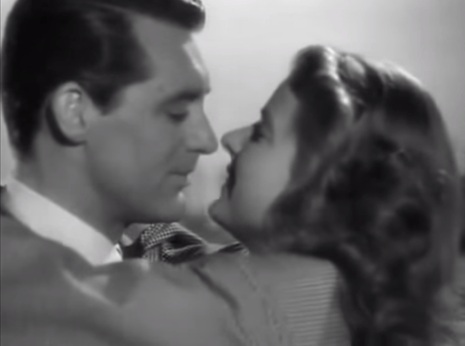
Still, others will remember the extended make-out session that made history by upholding the Hays Code ” three-second rule” while simultaneously perfectly encapsulating nearly an entire romance in a matter of four or five minutes. There was little else to be said because it was all seen in that one sequence and Hitchcock could proceed with his conceit.

Because, ultimately, Hitchcock’s picture is built around this idea: The American government has a little job to be done and Alicia and Devlin are caught in the middle. Thus, it becomes that time-worn idea of love versus duty. In one sense, Devlin’s caught in a terrible position and yet in the other he treats Alicia so badly — and it’s not simply that this is Alicia but this is beautiful, sweet Ingrid Bergman that he is pushing away. Still, in pushing her away, it’s leading her toward the objective.

He’s simply not willing to dictate anything because that means being vulnerable. Very simply he’s not willing to open up.  Cary Grant has never felt so icy, so aloof, and so unfeeling. Then, on top of this, Sebastian (Rains) looks a far more agreeable fellow cast in such a light. He genuinely loves this woman even if she is a spy. It makes for a conflicted viewing experience.

Though there is a juncture in the film where Devlin is beginning to shift his way of thinking. But as if on cue (undoubtedly) one line of dialogue out of Alicia’s mouth during a racetrack exchange (“You can add Sebastian to my list of playmates”) poisons his whole frame of mind again. His prior opinions of Alicia are confirmed and he sours to her — never giving her the benefit of the doubt from that point forward — and ultimately torturing her so that there is no other choice.

Just like that, she goes through with it. Instigating her relationship with Alexander Sebastian (Claude Rains) and succeeding so thoroughly that she’s married to him soon enough. For the U.S. government this is a smashing success but for Alicia and Devlin it’s nothing of the sort.

The descending stairwell crane shot is textbook Hitchcock and so often cited but it’s for that very reason. He so directly points us toward the cues of the scene and he does it with his usual technical elegance.

He gives us a party but it’s a party underlined with so much tension because there are stakes that go beyond the nominal appearances. There’s the fact that Devlin’s one of the party guests but also Alicia has that all important key that proves to be their chance to figure out what Sebastian is hiding. But it also makes them far more suspicious.

Beset with paranoia as much as illness she’s suffocated by the presence of her husband and mother-in-law. It looks like Devlin will never come to her. But he does. We’ve seen this before. Cary Grant comes to her bed as she lies there disoriented and looks up into the eyes of this man looking to be her savior instead of opting to use her. At least on one account, the tension has been resolved.

But in the same breath never has there been so much sympathy as for Claud Rains in the closing moment indicative of how Hitch has even given his purported villain a chance to be sympathized with and Rain’s typically compelling performance does precisely that. So even in this final moment, Hitchcock is playing with us giving us that Hollywood ending that we desire and at the same time undermining it in a wonderful way that’s both suspenseful and artistically arresting.

Notorious just might be the Master’s purest expression of his art lacking the micromanagement of Selznick in Rebecca (1940), the technical experiments of Rear Window (1954), the psycho-sexual layers of Vertigo (1958), the man-on-the-run motif of North by Northwest (1959), or even the low budget and marketing frenzy of Psycho (1960), while still garnering the highest production values in its day.  The results speak for themselves, positioning Notorious as one of the definitive romantic thrillers by any standard.

5/5 Stars

Review: Spellbound (1945)

spellbound 1.png

The Fault… is Not in Our Stars, But in Ourselves… — William Shakespeare

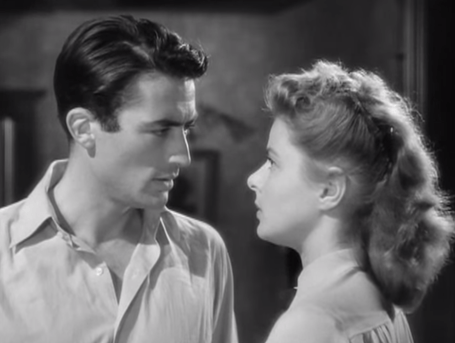
It’s so easy to adore Ingrid Bergman and it’s no different in Spellbound. Yes, she starts off as an austere psychiatrist purely interested and invested in scientific thought and practices in psychoanalysis. However, by the film’s conclusion, she evokes the passionate vitality that made her so beloved in pictures such as Casablanca (1942) and Notorious (1946).

The eminent Gregory Peck was still in the dawn of his career and while not your typical Hitchcockian hero, he is Gregory Peck a handsome actor with tremendous presence and a quiet dignity that made him an acting favorite for years to come, shortly to gain the reputation of an undisputed superstar. Put two such icons together and it’s honestly very difficult not to be won over, especially in a Hitchcock picture.

In fact, I’m predisposed to empathize with both of them from the very beginning and to thoroughly enjoy this picture even if it’s hardly the best of Hitchcock or the respective stars. But the story about the female psychiatrist Constance who falls in love with her colleague and subsequent patient one Dr. Edwards does have its share of enjoyments without question, aside from the names above the title.

As with any solid Hitchcock movie, there’s psychological duress and the man is implicated in a murder that he must run away from even if it’s proved he is innocent. So Spellbound is no question a romance and a bit of a mystery wrapped up neatly in a psychological thriller.

Michael Checkov the famed Russian stage performer (and nephew of Anton Chekhov) plays Dr. Brulov, Constance’s old mentor — a charming sort of gentleman who is impertinent but oh so sweet to his friends  — exhibiting the most jovial of personalities.

Even today, there still is a certain logic to psychodynamic therapy as there is to cognitive behavioral therapy that seems believable depending on how it is utilized and who is practicing it. Thus, though there are jumps Spellbound makes that are a little bit preposterous or a little too easy to resolve — like the perfect correlation between dreams and reality — there’s still kernels of truth in this film and it must be lauded for tackling the ideas of Freud in ways that were fairly groundbreaking for their day.

It also boasts the famed dream sequences inspired and partially orchestrated by the acclaimed surrealist artist Salvador Dali. His imprint is undeniable on the images that Peck recounts, reminiscent of the Persistence of Time and other similar works. Even Hitchcock would continue to address these topics with an arguably more Hitchcockian dream sequence in Vertigo and some similar analysis at the end of Psycho to assess Norman Bates.

Of course, Hitchcock films are at their best when the plot is working in spite of dialogue. Though the script is composed by Ben Hecht who has a long list of wonderful accomplishments, there’s also the influence of the overbearing hand of David O. Selznick on the picture meaning it relies perhaps too much on verbal explanation instead of Hitchcock’s own timeless setpieces or visual approach to cinema. Still, he does manage a few perspective shots that are particularly interesting providing us the frame of reference of several of his characters in key moments.

There’s also the benefit of Miklos Rozsa’s particularly elegant score which nevertheless is less a Hitchcock score as Bernard Hermann would famously compose later. In some respects, it suffocates the drama though it does include the cutting edge use of the Theremin, this marking one of its earliest appearances in a film score.

But ultimately, Spellbound does have a delightful false ending, as things slowly spiral down into despair only to find their new conclusion as all the puzzle pieces of Peck’s character begin to fit together. His exoneration is followed by the ousting of the real perpetrator, another quintessential Hitchcock villain.

The summation seems to be that though humanity might be wrought with shortcomings, many of them buried so deep inside, love does have an uncommon power to heal old wounds. The fault might be in ourselves but that need not be the resolution of the story.

3.5/5 Stars

Review: Rope (1948)

rope 1.png

Rope’s title sequence is composed of your prototypically serene establishing shot. But really, you could not have a more unique and in some sense unnerving picture. It was Alfred Hitchcock’s first foray into Technicolor and it’s quite the looker as are the beautifully constructed backdrops that spice up the mise-en-scene for this glorified stage play.  He also busied himself with camera set-ups in an effort to shoot the picture as near to a single take as was possible with the technology of the time. He actually “cheated” a bit by splicing segments of film together at intentional breaks to give the effect of continuous motion. Still, it’s an impressive endeavor all the same.

But the experiment is twofold both behind and in front of the camera. It’s all a reworking of the murderers Leopold and Loeb, two affluent students who succumbed to Nietzsche’s superman complex. The project was an early script by playwright Arthur Laurents penned from an adaptation by Hume Cronyn, a Hitchcock regular in several earlier pictures (Shadow of a Doubt and Lifeboat).

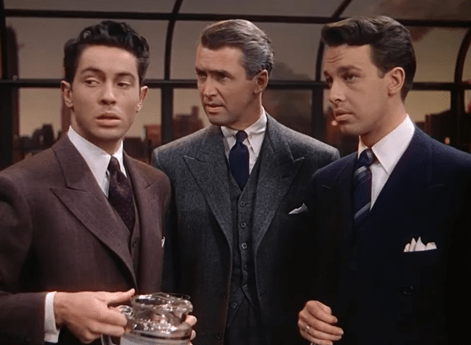
In this case, Brandon (John Dall) and Phillip (Farley Granger) are looking for the perfect victim in the perfect murder. Where murder is a crime for most men but a privilege for a few — like themselves.  It all begins with a shockingly graphic opening for the 40s that rips away any shred of upper-middle-class sensibilities put upon us by that establishing shot. It’s all a ruse.

The assertive, far more charismatic Brandon also happens to be the main architect pulling along the flighty Phillip into his little experiment.

The act of throwing a small get-together against this exhilarating backdrop proves tenuous because of the insidiously dark deed that Hitchcock has made his audience privy to. Otherwise, this would be a run-of-the-mill picture of cocktails and hor ‘d oeuvres. But underline it with a murder and it’s a completely different proposition altogether.

Their exhibition comes as little surprise from two men who are snobbish, entitled jerks. Their lives are so dull that they stoop to murder to see if they can be brilliant enough and brazen enough to pull it off, going so far as inviting their most astute mentor played by none other than James Stewart.

Though I enjoy him as much as the next fellow, Stewart does feel oddly out of place in this film and within this role of Rupert. He seems to know it too. Nevertheless, Hitchcock would find far superior uses for him in due time.

There are also a couple knowing winks to the sinisterly attractive James Mason (a future Hitchcock collaborator) who is conjured up to do battle against the dreamboats Erroll Flynn and Cary Grant by a few admiring partygoers. Of course, no one seems to take into account that they have Jimmy Stewart right in their stead.

We begin to feel for Janet and Kenneth two schoolmates who have been used in the game. She is soon to be engaged to the formerly eligible David. Kenneth was the beau she was with before he broke it off. Now their lives are manipulated just like the late boy’s father who is also invited to the gathering.

Rupert proves that he knows something’s afoot not that it’s all that difficult to see Granger’s character slowly coming apart at the seams. Alcohol hardly helps his unstable demeanor. It becomes a showdown with his two pupils but he could have never expected this. It’s on this level that Rope is thoroughly troubling. It’s in this way that we begin to understand why Nietzsche might have been troubled by his own conclusions. There is little hope in this conception of the world.

Simply put, the film is dour to its core. It has no heart and in that sense, Jimmy Stewart does not feel at home within its heartless frames. The charade falls short for these very reasons. Though it’s technically ambitious, it doesn’t quite manage that perfect Hitchcock balancing act of crime mixed with wit. There’s no way it can with such a worldview.

Still, Rope shows, if anything, that Hitchcock is never complacent, always looking for the next great challenge. That is one of the many reasons that we still hold him in high regard as one of the foremost directors of any age. Because even a callous film such as Rope is worth seeing.

3.5/5 Stars

Avengers: Infinity War (2018)

Avengers_Infinity_War_poster.jpgEntering into the latest Avengers blockbuster I felt like I was missing something thanks to a cold open that places us in an unfamiliar environment. It’s a feeling that has come upon me on multiple occasions previously.

Not only because as a mild enthusiast I’ve missed a stray entry here and there but I also easily forget interconnected events and after a certain point, why bother? We have come to accept there will always be another Marvel movie.

Yes, this is the culmination of 10 years that began inauspiciously with Iron Man in 2008 only to balloon into a skyrocketing phenomenon that will not disappear any time in the near future. Superheroes like Iron Man, Captain America, Thor, Hulk, and so many others have reemerged as integral parts of the public consciousness. And many fans have been waiting with bated breath for this day and they will wait again and again for future movies like it. That’s an established fact. Regardless, they can breathe a sigh of relief and thoroughly enjoy themselves with this realization of all their dreams up on the big screen. It will hardly disappoint.

To describe the plot of Infinity War is almost arbitrary as SPOILERS in this day and age are guarded against like the plague but here is a nibble anyway. Thanos (Josh Brolin), a being who has long been alluded to, is finally on the scene. The opening sequence is a microcosm of what he hopes to do on a cosmic scale, leveling half of the remnant left over from Asgard.

As a supervillain, he has a vision for the world that’s not too unbelievable. He seems to have been acquainted with Thomas Malthus’ work (even unwittingly so) while holding a contorted view of what empathy is. What others term mass genocide he deems an indiscriminate mission of mercy — killing half the universe’s population will mean resources are more widely available for everyone else left alive. He proves to be one of the most interesting characters within the narrative for the very fact we have barely met him before.

Infinity Stones also become of utmost importance again as Thanos must add them to his collection so he can rise to the stature of a demigod and dictate the outcome of all life with the snap of his finger. That’s some kind of power! The stones themselves are exquisitely color coordinated. One is safeguarded by Dr. Steven Strange (Benedict Cumbertach), another is implanted in Vision (Paul Bettany) and fiercely protected by his girlfriend the Scarlet Witch (Elizabeth Olsen). The Soul Gem brings Thanos back in contact with his two stepdaughters Gamora (Zoe Saldana) and Nebula (Karen Gillan) with grave consequences.

Everyone else who makes an appearance (and at times a lightning-quick cameo) relies on a viewer’s running tabulation of everything up until this point in the MCU. And though you’ll probably enjoy seeing these characters that you have some familiarity with — and you even laugh throughout — there is a sense they are only vague contours. There are too many of them for the resonance to run deep and personal. It really only works if audiences have bought into the machine and already have some background with these heroes in place. The scarier thought is if viewers do not. Infinity War would be void of any meaning. All flashes of imagery, destruction, and hyper-frenetic editing. Any other actual amount of personality would be absent.

Some people live and others die but to confess I didn’t much care whether any of these characters perished is one of the most unfortunate realities of the movie. It’s not that I know they are coming back necessarily or anything of the sort. I admit to being fickle. I can’t remember why I should care about these characters. Because for some so much time has passed since I had any connection with them. To watch them become collateral damage has little resonance with me. I’m numb to it.

I won’t make allusion to archetypal literature like Hamlet or film references like Star Wars or Harry Potter because in some ways that would denigrate that material. Am I being a bit harsh? Perhaps I am. In fact, it was Hary Potter and The Deathly Hallows (2010) we have to thank for this current reality followed close behind by The Hunger Games and The Hobbit. Stories like these coincidentally begun the practice now popular in the industry.

It was no longer about simply having sequels but milking a movie for all it was worth — breaking them up into pieces — making films that were meant to be a part of a greater whole.  It’s not a film so much as a commodity. Differing from the earlier examples like The Godfather movies or even The original Star Wars trilogy — those were pictures that very much could stand on their own merit. Not that they were not enriched and more fully realized with their later installments but we could consider them alone.

Infinity War comes out of this philosophy where a film was never meant to be taken by itself. Everyone knows it. The producers, the directors, the actors, and the audience.  By now as a collective assemblage of viewers, it seems like we’ve been cowed into submission.

I for one watched the movie and never quite relished it — there was nothing all that new or novel — and yet I was never bored per se. However, even my newest favorite superhero Black Panther felt like he was now fit into the Marvel mold. Nothing surprised. Nothing ignited a deep-seated exhilaration inside me. A Stan Lee cameo comes and goes.

Though the picture does promise action and verbal sparring which it delivers handily. In fact, if you consider the screenplay by writing duo Christopher Markus and Stephen McFeely, they do an admirable job with both the monumental juggling act and crosscutting of multiple storylines. The same can be said for the other dynamic duo directing, brothers Joe and Anthony Russo who must perform the same type of orchestration that would have buried a single director in his grave.

Still, there is an uncanny feeling the picture is made up of two kinds of scenes. You have action sequences packaged nicely with all the trimmings and CGI to your heart’s content. Then you have in contrast many stagnant sequences with all these big names standing around in a single location talking it out usually over some point of conflict, sprinkled with a few jokes or exposition that feels all too familiar. The well-timed comic relief disguises how run-of-the-mill everything is.

That’s what’s Marvel has in many ways perfected. In this regard, there’s nothing lacking and if it’s what you signed on for now 10 years ago (without even realizing it) it takes little hesitation to say you will be satiated at least until the next Marel movie and the next installment of Infinity War in a year’s time.

However, I couldn’t help but leave the experience feeling slightly lackluster about the affair. Because in many ways Infinity War is the culmination of a generation of films and really the emblem of where Hollywood continues to head. Sure, we have yet to get the second half of our story but if this is any indication of what we have to look forward to in the future, it does look like a fairly blasé fate at that. Though the jokes and the pyrotechnics are present in full force, there is little magic — that certain amount of intangibility lifting entertainment above the mediocre and allowing it to capture our imaginations. My only question is — as someone unread in Marvel comic literature — what could the Deus ex Machina possibly be?

3.5/5 Stars


Saboteur (1942)

saboteur 1942.png

“It’s my duty as an American citizen to believe a man innocent until he is proven guilty.” 

I stand corrected. Maybe Foreign Correspondent (1940) is not Alfred Hitchcock’s most patriotic movie. Maybe it’s Saboteur, made two years later. Or maybe they are both made by the fact that they are more than mere propaganda and that’s what makes them still worthwhile today. This is, above all, another thriller by the same man who continually tinkered with the genre in the subsequent years.

The narrative starts with wartime industry which has hit its boon since there are Nazis and Japanese to fight. Defense Plants have become a crucial part of the war and also part of everyday life for the average American. Robert Cummings is the epitome of one, a fresh-faced lad who all of the sudden finds himself wanted for the murder of his best friend which happened after a ruthless act of sabotage. In this respect, Saboteur is a more elegant version of Hitchcock’s predecessor Sabotage (1936).

There’s a wonderful sequence where our protagonist has hitched a ride with a gabby truck driver who consequently looks a bit like James Cagney. Every subsequent thread of conversation and even the passing billboard, all points back to everything that’s gone down so far. The man’s trying to run away but he can’t. Fugitives never have been able to as far back as Jonah. They always have to face the music.

Barry Kane follows the one wild lead he has involving a man played by Norman Lloyd (a future Hitchcock partner in Alfred Hitchcock Presents) and it lands him at a stately ranch that feels like quintessential Americana — it’s a luscious slice of West Coast leisure. But it’s another delicious instance where Hitchcock allows villains to live lives not unlike our own with families, babies toddling around, and swimming pools. Except these people also happen to be involved with conspiracies threatening national security in the wake of WWII.

After, a harrowing escape from the police with a swan dive off a bridge, Kane continues his journey. Saboteur quickly becomes another entry in Hitchcock’s innocent man-on-the-run canon and while not the tip of the spear, it’s thoroughly entertaining for the very fact that it remains on the move as it jumps from place to place. In fact, there are obvious shades of 39 Steps (1935) and North by Northwest (1959) in place as it goes literally from coast (California) to coast (New York).

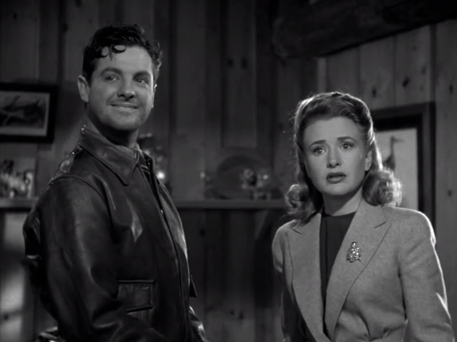
And in each location, we meet a row of interesting side characters whether a trucker or the sagely blind man and a band of eclectic circus vagabonds. But the most important is the stalwart Patricia Martin (Priscilla Lane), initially looking to turn in this traitorous criminal with his hands cuffed together until she realizes that’s not who he is.

The director and his writers use the whole film to tell tiny parables about America where the circus can function like our democracy or a decision to not turn in a man can merely be an exercise in basic human rights. In these moments the film evokes the kind of patriotic messages that feel unconvincing when viewed now. Even Cummings brief stint on the soapbox facing off against his sophisticated foe is an obvious call-to-action.

But for 1942 it makes complete sense and that hardly takes away from the thriller that Hitchcock still manages to spin because though war might be afoot and Film serves different purposes on the Homefront, it can still function as entertainment. Hitchcock was one of the greats in that capacity. A murderer is set loose in a movie theater during a crime picture and the action leads us most iconically atop the standard bearer of American freedom and equality, Lady Liberty herself. Once again, it’s the perfect Hitchcock ending even if that’s more in going with the style of the entire picture thus far rather than pure execution.

3.5/5 Stars


Tokyo Sonata (2008)

Tokyo Sonata 1.png

I can’t even begin to comprehend what it’s like to get laid off in Tokyo. In any city, any place, any circumstance it’s one of the feelings which would instigate the formation of a lump in your throat. But Tokyo is swarming with so many people and so much competition; it seems like you would be practically swallowed up. I’m surprised there are any available jobs at all.

That’s what makes it especially demeaning for Ryuhei Sasaki (Teruyuki Kagawa) to go to the unemployment office. He’s long held an administrative job in a prestigious company but when he is suddenly let go, Mr. Sasaki finds that he is overqualified for any amount of work offered him at the agency. Surely, beggars can’t be choosers but no matter how many times you’ve had that phrase shoved down your throat, it doesn’t make such a reality any easier. A janitor is a far cry from a cushy desk job.

By an act of serendipitous chance, he happens upon an old school chum who has been stricken by the same fate and yet being three months in he’s seasoned at the lifestyle of keeping up appearances even as he attends the food line with the homeless. He still dresses in his suit, carries his briefcase, and feigns taking business calls. It’s an unnerving dichotomy that Ryuhei soon readily adopts as well.

But behind every man, there is usually an entire family and Tokyo Sonata is very much a dissection of the Japanese familial unit after a stressor is applied. All parties are affected. But we see the cracks even before the news breaks.

Kenji, the youngest child is caught in class with an erotic manga which he vehemently denies owning. But as an act of retaliation, he calls out his teacher in front of the class for reading similar material on the train. He purportedly saw him and the man has no defense. They meet later in a quieter exchange and his teacher simply states, “Let’s stop poking each other’s wounds and ignore them.”

It’s a morose response to deep issues of loneliness and isolation and while this particular instance pertains to love and sexual intimacy we can take this very same outlook and apply it to many of the film’s dynamics. If we keep things hidden and disregard them things might still work out.

On a whim, Kenji wants to play the piano and yet it’s for a very understandable reason. It’s because of a girl. He has a crush. Well, actually it turns out to be the woman teacher and she’s twice his age and recently divorced but that doesn’t stop him from using his month’s lunch allowance to pay for lessons without his parent’s knowledge. Again, the family operates in secret deceptions. Little white lies and overall detachment.

The eldest son, Takashi, by some peculiar circumstance, is signing up for the American military as a non-citizen for deployment in The Middle East. Of course, he too has moved forward with the plan without consulting his parents. He ambushes his mother with the news quite suddenly because he needs her written approval. He knows that she is the easier touch and doesn’t even bother telling his father at first because he knows full well the response that will come.

Their home life as represented by the dinner table feels like such a sterile environment and that’s in a scenario where none of the chinks are showing. No one says anything in fact. I feel sorry for the woman of the house. As both wife and mother, Megumi (Kyōko Koizumi ) is dutiful and maternal. She’s not necessarily aloof but the world around her feels so unloving and unfeeling. It’s hard to make a contented life for yourself when the entire atmosphere is dictated by the man of the house based on cultural precedence alone.

When the deep-rooted concept of saving face goes so far it means lying to your family I think there’s a problem. Because the lie can’t be kept forever. And even when the people close to you (or not close to you)  don’t let on, eventually they know. It’s devastating to watch since it lacks any of the normal benchmarks we use to measure devastation. It reveals just how matter-of-fact something like this can be. The response is a non-response.

I know full-well that these types of circumstances play out; I’m not sure if I buy every last bit of execution in Tokyo Sonata. It feels a little too contrived. And yet even in the things that feel too perfectly planned there’s no doubt some truth. How everyone in their own way is trying to pull something off behind everyone else’s back. There is distrust in every corner of the house. If even things that aren’t altogether bad are hidden, what about the ones that are catastrophic like losing your job or little dirty secrets like reading racy manga? Multiply that across an entire society and you can readily predict the unnerving implications.

It is a picture where everyone wants to wake up and find out that it is all a bad dream and it very well could be. This is Tokyo Sonata’s true departure from any pretense of the real world and in these moments while the film loses some integrity as a true-to-life drama it undoubtedly gains some inscrutability from visions of hallucinatory nightmares. At these crossroads, we see the clearest articulation of Kiyoshi Kurosawa’s background in J-Horror.

But in the end, the darker mood gives way to the most subdued of crescendos born out of an unassuming performance of “Claire de Lune.” It’s one of the few moments of palpable warmth in the film and it embodies the incomparable magnetism that music has. I can’t think of a better way to salvage Tokyo Sonata. It’s a purposeful statement of not feeling the need to say anything directly. Impeccable for a culture such as this. Maybe it serves to only exacerbate the problem. But change is incremental. It will not happen overnight. This just might be a baby step toward a more personable future.

3.5/5 Stars