The Thing Called Love (1993): River Phoenix and Samantha Mathis

Seeing the Twin Towers on celluloid always brings a bit of a wistful reaction because there presence represents so much. It feels like a line in the sand and there are those who know that far better than me. The last time I recall having this sense was watching Peter Bogdanovich’s They All Laughed, and it’s little surprise The Thing Called Love begins with a very similar visual shorthand.

It says so much in a matter of moments as we watch Miranda Presley (Samantha Mathis) wearing her Yankees baseball cap, ride the greyhound bus with her guitar case by her side. Bogdanovich returns to another salient element of They All Laughed because The Thing Called Love is also a film enmeshed in the country music scene. New York might feel like an unusual mecca, but Nashville is not. That’s where Presley (no relation to Elvis) is heading. She’s got grand aspirations like so many wide-eyed dreamers.

Our hearts drop a little bit when the bus pulls into the parking lot of the Bluebird Cafe. It’s given the start to many fledgling talents and yet the line of eager musicians ready to audition quashes any optimistic expectations. Miranda’s no doubt destined for an arduous journey ahead.

Mathis and her real-life boyfriend at the time, River Phoenix have a meet-cute born out of circumstance. He jumps out of his truck late for the weekly auditions and pulls her into his lie so they can squeeze into the lineup. She doesn’t take kindly to his tactics and let’s him know.

It would be so easy to dismiss or even roll your eyes at these obligatory moments in the script. They feel to clean and conventional, but somehow the metanarrative and the candor of the young performers make it feel worthwhile.

Miranda gets her first rejection only to fall in with a community of her peers. She meets her momentary acquaintance James Wright (Phoenix) when he does a rendition of his tune “Lone Star State of Mind.” The track was actually written by Phoenix himself, an enthusiastic musician in his own right.

Their relationship is one mostly born of looks and mysterious glances that suggest so much in a way that is tantalizing and hardly anchored. Meanwhile, the Stetson-wearing Kyle (Dermot Mulraney) takes an immediate shine for Miranda, and it reveals itself through candid conversation and encouragement. Perhaps she knows as much as anyone else that he likes her. When you’re feelings are so genuine it’s hard to keep them concealed.
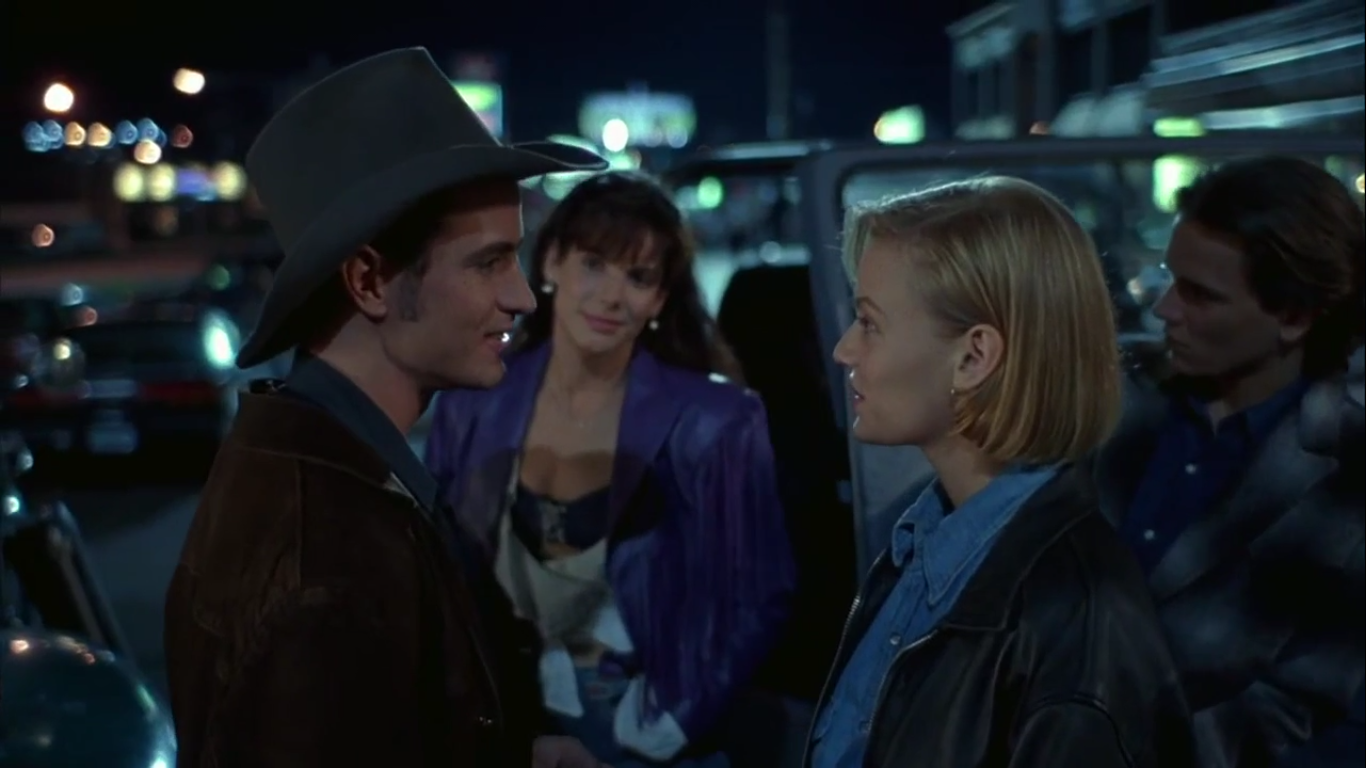
The movie feels need to make it into a love triangle as Miranda resigns to dance with Kyle and settle in a sense. But James is the mercurial artist with a caddish, manipulating charisma. He’s good with the lines to feed her even as he’s good with lyrics to sing in front of an audience and record deals he’s trying to finagle his way into.

There’s no continuity to him, and yet it’s hard to judge his intentions because even with mixed signals, he does seem to be drawn to Miranda. In one scene in the studio, he mostly ignores her and then in the heat of his performance, he pulls her onstage for an impromptu duet in front of the audience. He even takes her to a drive-in screening of The Man Who Shot Liberty Valance, and they write a song together. I suppose the rivalry between John Wayne and James Stewart for the affections of Vera Miles is a Hollywoodized version of our story.

Their trajectory is exemplified by wanderlust and spontaneity. James pulls Miranda away from her new gig waiting tables at the Bluebird so they can make the pilgrimage to pay tribute to the King. They must hold the title for one of the most unconventional wedding ceremonies as they get hitched in a Memphis supermarket, dancing the night away as the rain comes pouring down outside. It’s life without consequence.

However, cohabitation as a married couple is fraught with conflict. They weren’t meant to live this way with their personal dreams pulling them apart, and their marital expectations far from unified. James’s capricious tendencies reassert themselves, and Miranda feels defeated.

In the wake of an argument, she seems all but prepared to leave her dreams behind. She quits her job and hops on a bus back home only to turn right back around with one last mission to accomplish. She holds up in a cafe to pen her latest song, and as anyone who’s tried to conjure the creative muse knows, some ethereal inspiration just comes to her. Out of nothing something is born fully formed.

She plays her song, singing lucid and tender, all colored by her newfound heartache and experience. It’s not for anyone else, only an audience of one, and yet it’s through this creative paradox her songs finally discover an audience.

One of the movie’s most agreeable assets is Sandra Bullock who was still on the way up with Speed and While You Were Sleeping in her near future. She’s not immediately identifiable as a loquacious southern belle — it’s not what we immediately attribute to her persona — but it’s easy enough to like her candor.

And if Linda Lue Linden is a foil for Miranda, then Dermot Mulroney’s portrayal of Kyle fits opposite River Phoenix coming to represent not only a physical juxtaposition but a philosophical one as well. What holds them together is a love of country music even as their friendship is now complicated with the suggested ambiguity of a ménage a trois. Not everything is resolved.

Nashville will always be the ultimate film about the country music industry for how wide-ranging, pointed, and tender a portrait it is in the hands of Robert Altman. I won’t even feign a comparison with The Thing Called Love because it is a movie for a new generation reaching out to realize their dreams. And while it paints in this tangible atmosphere of southern twang and steel guitar, it’s best as a story of close-knit relationship.

I’m not sure if anyone would call me a staunch champion of Peter Bogdanovich’s films. I do like them a lot, and it does feel like a handful of them got a bad rap through faulty marketing and unfortunate circumstances.  If They All Laughed was marred by the Dorothy Stratten tragedy, then, The Thing Called Love carries the specters of River Phoenix’s untimely death.

He was in the company of his siblings, his girlfriend Samantha Mathis, at the club partially owned by Johnny Depp, as they performed some of his songs together. It seems like such an ill-fated conclusion. This isn’t the way life is supposed to end. For fans of River Phoenix, The Thing Called Love stands as a final testament to his talents, and it’s an unmitigated pleasure to see his passions for music and acting blended together. If the movie’s not his best, then it’s still a fine way to remember him.

3.5/5 Stars
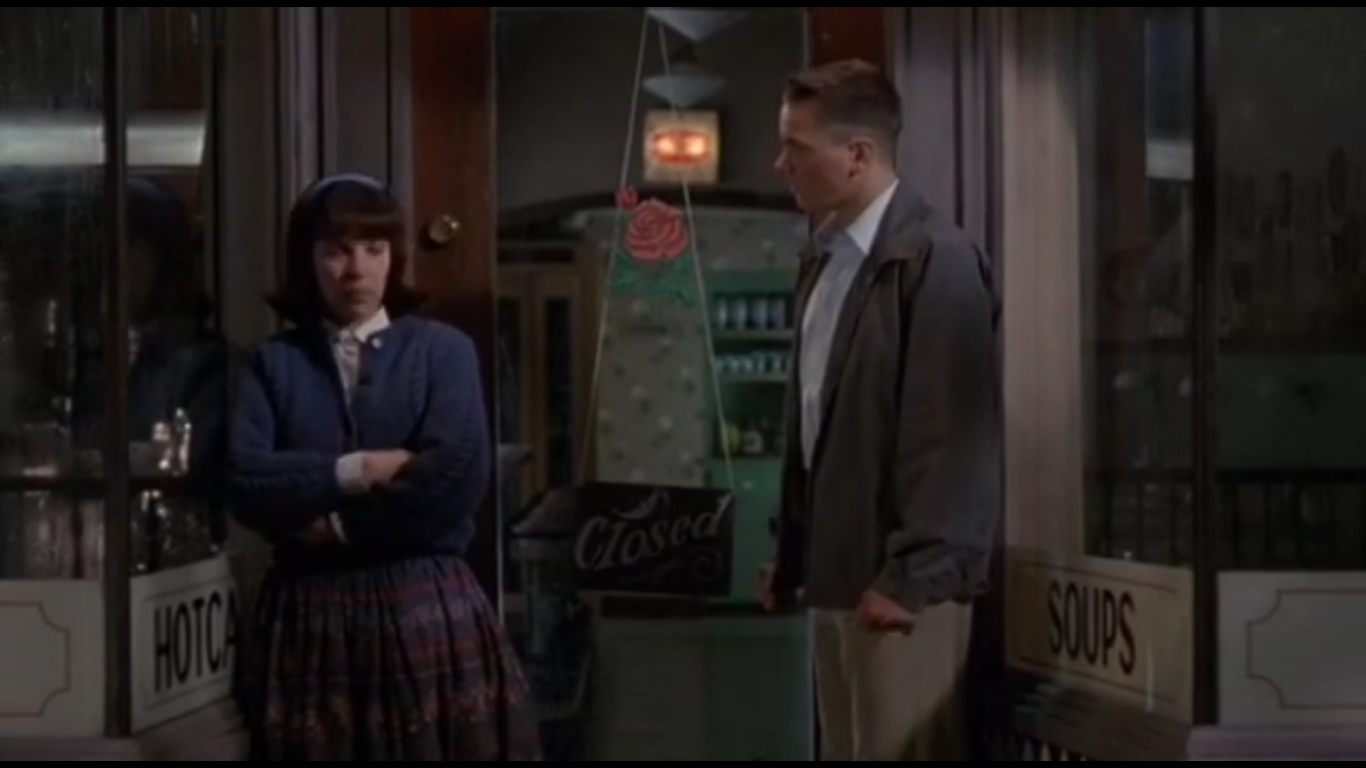
Dogfight (1991): River Phoenix and Lilli Taylor

If you’re a bit of a finicky nerd for cultural context like myself, you realize right when we hear Brenton Wood’s “Oogum Boogum Song” wafting down the city street from a car radio, we can carbon-date the scene to around 1967. A marine steps off a bus with a slight limp. He must have been in Nam, but we don’t know what waits in front of him.

Nancy Savoca’s Dogfight gets its name from a particularly uncomfortable ritual where a group of soldiers looks to scrounge up the ugliest girl they can find for an evening to dance and (hopefully) win the crown for finding the hag to rule them all.

The story takes us back to November 1963 on the eve of JFK’s assassination. The Vietnam conflict has yet to escalate and in the youthful age of Camelot, the peace corps, space races, and enduring American exceptionalism, the world still feels very naive indeed.

We are inundated by the rowdy bravado of four youthful marines, led by Eddie Birdlace (River Phoenix), who have a short stopover before heading overseas. The collective group mentality that bonds them fast and fierce also churns up this festering culture of vitriol and misogyny.

It’s probably just as much a part of what will give them a fighting chance to stay alive. Because even their boyish cajoling and catcalls ring with untrained naivete. They have yet to see death in the face, and for now, they feel indestructible.

Birdlace is just one of the boys, bellicose and burning with rage and impudence. Phoenix wears this quality behind his eyes to go with his high-and-tight haircut and the casual profanity permeating every conversation. He’s constantly operating through an economy of fear, payback, and entitlement. That means a snooty waiter gets dressed down with such a pointed outburst that not even Ferris Bueller could have conceived.

But he also knows how to turn on the charisma in a smarmy sort of way. It sets the stage for their competition as he winds up in a late night coffee shop trying to romance the young woman working the after hour shift.

Lilli Taylor transforms from a moody rocker in Say Anything or even her animated turn in Mystic Pizza, in a change involving more than a poofier hairstyle. Her entire constitution is different. She falls quite easily into her role as a sensitive waitress with dreams of folk singing and maybe meeting a boy to love. We believe that she might just fall for him. He could make her fall for him. But she’s also not a moron. She’s sincere and sees through the insensitive game.

It makes for an uncomfortable evolution as we sympathize with her compromising position and also watch Birdlace grow increasingly conflicted. This girl is a lot more than he assumed (and it’s not just about her looks).

The most compelling comparison I could offer is The Clock starring Judy Garland and Robert Walker. They’re both films about capturing a moment in time with a relationship that has a defined, even finite, beginning and end lending this heightened sense of meaning to every interaction.

Dogfight‘s vulgar and much more a movie for the ’90s even as it’s a film for the Vietnam era so different than the WWII reality Vincente Minnelli developed decades earlier. There’s often something a bit twee about these period efforts partially because we’re accustomed to experiencing the world through the nostalgia of black and white.

Dogfight also provides a more cathartic resolution. I’m not sure if it’s too rushed or what it adds exactly, and yet as an audience member, it gives us some form of wish fulfillment seeing two people reunited in a changed world. It makes the ambiguity of the prologue a bit clearer. There’s a purpose to the time jumps.

It can be summed up in an image: Birdlace is the one who’s come back from the shores of Vietnam 4 years later. He finds that same cafe and limps in. There she is. Surely she wasn’t waiting all this time? And yet they share an embrace in that cafe that’s long and awkward — extended out. The way Phoenix hunches over on her shoulder almost feels like the posture of a little boy. That’s it. We want to believe that these kinds of small, intimate connections are in fact possible in the unknowable chaos of the world at-large. It’s a vein of hope in a tumultuous world.

Phoenix’s career was always morphing and maturing in all manner of ways. In hindsight, we can watch how he took early nebbish roles like Explorers and Family Ties guest spots only for Stand by Me to be a stepping stone to a varied future. Running on Empty garnered critical acclaim, but then he zigzagged his way through an array of projects as diverse as I Love You to DeathDogfight, My Own Private Idaho, The Thing Called Love, and yes, even Indiana Jones and The Last Crusade.

He never seems to be duplicating himself, and it makes for a mostly enthralling viewing experience. Because here is a performer who seems locked in and totally engaged with not only his craft but the poetry of moviemaking and at such a formative age too. Dogfight is an imperfect film built out of period artifice, but it also has these pockets of magic thanks in part to Phoenix and Taylor.

3.5/5 Stars

Mask (1985): Eric Stoltz and Cher

Peter Bogdanovich lost his girlfriend Dorothy Stratten to tragedy in 1981 and after the release of their picture together, They All Laughed, it was anyone’s guess if he’d ever be able to return to directing.

I’ve heard an often-repeated anecdote that he ultimately decided to take Mask as his next project as a way to honor Dorothy. The reason isn’t immediately obvious. However, he explains that Dorothy was fascinated by the Elephant Man, who shared the same condition as Rocky in Mask. But she was a highly sought after beautiful woman. How could she relate?

It seems that extreme ugliness and extreme beauty by the world’s standards puts you outside of the normal purview of society. It’s not something individuals asked for. They are born with it or given it by circumstance, and as a result you have the world’s prying eyes looking at you. So both of these films are about this kind of social “others,” who must make an existence for themselves in a world where they’ll never quite fit in.

The greatest epiphany of Mask is how Rocky (Eric Stoltz) does exactly that. We’ve seen movies about people lashing out because of the hand they’ve been dealt. This is a reasonable reaction, but this movie is never about that.

It’s my own human inadequacies making it so I look at him and feel discomfort. But it’s a classic example of not judging a book by its cover. Outward appearance doesn’t define the mark of an individual.

The brilliance of this teenager is how he rewrites the script and subverts the expectations around him. He’s the personification of all our outcast inclinations when we’re in middle school and high school. None of us would have envied him during those formative years. And yet he rarely gets rattled by any of it, even when he might have the most excuse to do so.

Rocky has a level of supreme confidence so in a manner of weeks teachers know he can succeed and look after himself and his fellow students come to appreciate his wit and his near-Encyclopedic knowledge. He has a high view of himself and this allows him to be self-deprecating. I like the idea that we don’t think less of ourselves, but we think of ourselves less often. It makes our lives centered around others.

Part of this is the family unity around him. They support him and love him for who he is even as he does yeoman’s work to look after his mother. It’s almost as if he’s her guardian sometimes with the lifestyle she leads, a holdover from the ’60s with drugs and a conveyor belt of male suitors.

Cher is a powerful force and she always has a natural charisma in front of the camera that suggests so much about her. Although their relationship is the backbone of the whole movie, they have an entire motorcycle gang to watch out for them including the old family friend and Cher’s past lover Sam Elliot.

He’s a quiet enigma of cool, but with his laidback demeanor and a “Moustache Rides” tee, a character who could easily be a vehicle for outside conflict becomes more of a stabilizing force.

Rocky is even granted one of the loveliest adolescent romances of the 80s as he begrudgingly decides to spend his summer volunteering at a camp for the blind meeting Diana Adams (Laura Dern).

It’s reminiscent of City Lights with a love story based on personality and kindness as opposed to superficial appearance. In other words, it is a deeper bond and even as she’s an equestrian girl with an affluent background and he’s been raised on the road with a motorcycle gang, they relate on what’s most important.

I couldn’t help myself and seek out the writing on the wall. Rocky can’t last forever. In real life Roy L. “Rocky” Dennis passed away at 16 years old. If you didn’t know him you might think this was merciful and yet having watched his life play out on screen, we see the tragedy of it. He was such a loving, vibrant, jovial force to behold. He could have accomplished so much. And one can only imagine his mother was devastated. Because her boy was special and the bond they held was incomparable.

Bogdanovich augments the story with his trademark use of dietetic sound to fill out the world on top of some of Bruce Springsteen’s finest tracks. I watched the director’s cut which included a few extra scenes and all I can say is that I’m thankful to Bogdanovich’s conviction to get his version out there without compromise. This included working with Springsteen himself to get the original recordings licensed for the rerelease. It pays heavy dividends.

Regardless of the director’s shortcomings, I will dearly miss his classical sensibilities as a filmmaker. He made films imbued with joy and melancholy. Both speak to me and surely I’m not the only one because life becomes a subtle dance between a panoply of emotions.

Like the masters of old, he was able to take a story and personalize it so the core themes are somehow made manifest and evident in his own life. It’s a lovely brand of storytelling, and it allows Mask to constantly ambush us with some winsome surprises. This is how movies should be.

4/5 Stars

Running on Empty (1988): River Phoenix, Fire and Rain.

I know only very little about River Phoenix’s upbringing but somehow it’s easy for me to make the leap from his real-life existence to his family in this movie. Running on Empty has to do with an unconventional upbringing.

Danny Pope (that’s his real name) has grown up with his little brother and two parents Annie (Christine Lahti) and Arthur (Judd Hirsch), who have lived on the run from the feds since the early 70s. They were implicated in an anti-war protest at a napalm plant that left a janitor dead.

The Popes are a tight-night clan in spite of their unusual circumstances or because of them. Somehow in this environment of constant flux and fresh identities, they’ve managed to raise two boys who are loving and smart.

Danny enrolls in a new school and immediately distinguishes himself on the piano. He seems like an obscure prodigy because no one knows anything about him and his benevolent music instructor (Ed Crowley) gets little information on him. Still, he’s talented and generally considerate. He doesn’t play into the expected stereotypes of a malcontent.

He also makes the acquaintance of the teacher’s daughter (Martha Plimpton) who has a much more jaundiced view of education and musical appreciation. She’s used to a more typical lifestyle and yet she’s drawn to the new boy, not out of an act of rebellion against an overbearing father or anything like that. Danny is genuinely decent and kind. She immediately likes him, and they spend time together. She wants to get to know his family too and so she does.

I was a bit disappointed Jackson Browne’s tune “Running on Empty” has no place in the movie, but they may have done themselves one better with James Taylor’s “Fire and Rain.” Their celebration of Anne’s birthday turns into a dance party in the dining room; there’s something spontaneous and joyous about it.

It encapsulates the best aspects of the movie where we’re suspended in these moments of relational goodness. To be a part of the scene feels organic and the characters become all the more real in front of our eyes. We enjoy their company.

Martha Plimpton has a James Dean Rebel Without a Cause poster in her bedroom and somehow Phoenix carries some of the same ethos. There’s the morbid similarity in that they both died young and yet more than that, it has to do with a palpable emotional investment in their roles. It’s more like music than it is blue-collar craftsmanship and their brand of sensitive masculinity feels off the charts.

Phoenix has an emotional maturity and precociousness that feels wise beyond his years and still wracked with inner demons. Here he must carry the burden of his parents’ life. It also fuels the budding romance that Phoenix and Plimpton were an item in real life.

Christine Lathi still feels mostly underappreciated as an actress. She’s a loving mother, a strong wife, and the scene where she has a teary reunion with her father after many years is lachrymose but never totally saccharine. They supply just the right amount of heartbreak and tenderness.

Judd Hirsch deserves his plaudits as well though if you’re like me you appreciate him for being the stabilizing force on Taxi. He plays the part so well that sometimes you forget he’s an actor’s actor.

I’m reminded of his rapport with Timothy Hutton in Ordinary People and his scenes with Lahti and Phoenix here. He always gives off this aura of street smarts. He’s tough and able to spar, but it’s never totally untethered from his unerring heart. He cares and somehow he’s able to make his audience feel his concern.

What I appreciated most is that Running on Empty never feels over-reliant on its political elements which are often relegated to the background in favor of far more sensitive developments of character. It would be so easy to succumb to drama. Instead, it chooses a more nuanced road as Danny starts to put down roots and gets encouraged to apply to Julliard. Suddenly, his lifelong anonymity is bumping up against his youthful dreams of a normal future.

Director Sidney Lumet was always a fine filmmaker and one of the most enduring because he was a workman and he knew how to rehearse, he was smart, and made compelling movies. Running on Empty is never one of the most high profile mentioned, but it leaves space and feels attuned to the family at its center and their relationships. This is why I go to the movies to be shown people’s humanity up on the screen and then be uplifted by it.

The movie hardly dwells on its ending. Perhaps we could have done with a bit more resolution, but it does itself proud with a refrain of James Taylor’s “Fire and Rain” pulled from an earlier scene. It’s as if the chorus of singing voices — the family all joyful and gay — is a concrete reminder that that bond will never be broken even as they move on.

There’s something satisfying about discretely reaching back and referring to the movie’s most poignant moment. Because it means so much and these are the kind of memories we carry with us wherever we go. Family is forever.

4/5 Stars

Pump Up The Volume (1990): A Gen X Jeremiad

Pump Up The Volume is a movie that tackles the existential malaise of the generation beyond After Hours and Something Wild. I’ve never been particularly good at charting the shifts in generational demographics, but the film is definitely an adolescent jeremiad for Gen Xers.

In truth, I only learned about the movie from a work colleague who is a generation older than me. The sense of upfront and personal alienation spoke to him as a high schooler and probably a whole generation of the discontented.

Although Allan Moyle’s movie doesn’t make the rounds too often, you can immediately sense its cult appeal and also a certain level of prescience in speaking to the teenager’s dilemma. I’m not sure if it’s merely a post-war phenomenon, but it’s certainly something Millennials, Gen Zers, and whoever else follows can certainly resonate with.

Harry Hardon (Christian Slater) is a local DJ who hits the airwaves at 10 pm sharp every evening cued by his theme song, Leonard Cohen’s “Everybody Knows,” and backed by a steady flow of alternative music, personal commentary, and raunchy gags. He’s garnered quite a devoted following.

Within the confines of the film, he builds a cult of personality as a nighttime provocateur, and it’s so easy for him to represent the profane bombastic nature of youth. His viewership cuts across high school cliques to encompass nerds, punkers, beautiful overachievers, and everyone in between. Because everyone of a certain age can identify.

As he puts it, parents, teachers, TV, Movies, and magazines tell you what to do, but you know what you have to do — your purpose is to get accepted, get a cute girlfriend, and think of something great to do the rest of your life.

For those crying out for an alternative, less conventional existence, it can feel like a suffocating road to the American Dream. It’s easy to feel lied to or at the very least feel like school and the world haven’t fully prepared you for the brunt of angst weighing on your mind.

Christian Slater is required to do a lot of the heavy lifting throughout the film, and it relies on his charisma because in many of his scenes, he’s just speaking to an audience out in the dark somewhere (both over the radio and in the movie theater). Somehow it works though DJing is only a small aspect of his life.

By day, he’s Mark Hunter a disenchanted teen. His father is on the school board, they’re in a great district, but he’s also the new kid on the block and doesn’t have any friends. He exists on the outskirts mostly unseen as a diffident disciple of Lenny Bruce stuck in his own thoughts and unable to socialize. By night, well…he comes alive.

Samantha Mathis almost feels like a bad girl version of Molly Ringwald, dark-haired, pretty, and spunky as Nora De Niro. She, like all the rest of her peers, is captivated by Harry because of what he represents to all of them. It becomes her mission to figure out who he is as she scrounges around school and sends letters to his P.O. Box as bait. Eventually, she learns the identity of their mild-mannered Clark Kent.

It does feel like Pump Up The Volume is on the cusp of a new decade while still channeling the remnants of ‘80s film culture. There’s a War Games-like wunderkind ingenuity where a single teenager seems capable of taking on all manner of adults, government organizations, and what have you even as he muddles his way through the usual adolescent romance and alienation.

It escalates following a classmate’s suicide and a broader probe within the highly-touted school as the principal looks to bring down an iron fist on any troublemakers and keep her pristine reputation. The only problem is that the masses are getting more and more unruly and brazen as they rebel against the school’s primary enforcer, Mr. Murdock.

Then, the FCC is on Mark’s trail prepared to shut down his clandestine operation. It’s not a game anymore. We’ve gone large-scale. If you’re like me, you’re always under the assumption he’s going to be caught; they’re going to nab him, and still, he always finds a way to outsmart them.

I couldn’t help likening Harry to a prophet of the airwaves, a Howard Beale for the angsty teenage population as he exhorts them to “Do something crazy!” But what I appreciate about the movie is how he eventually kicks his version of a nihilistic spiral.  Early on he opined that “Being young is sometimes less fun than being dead.” Then, he changes his mind. Hang in there he says. It can only get better.

He and Nora take his radio show on the road for one last evening of insurrection before signing off for good as the local teenage population’s cult hero. He becomes a legend in his own time and even if his frequency dies, there’s a nation of others to rise up and take his place.

I’m not sure what the contemporary implications of Pump Up The Volume were; it could have been negligible at best, but even though this movie is not always talked about, there’s a sense it spoke into the zeitgeist of the times.

It’s not a large production, it didn’t make a ton of box office, and it hardly has the enduring reputation of John Hughes’s most prominent works. Part of this might owe to its coarser even darker subject matter, though it’s rarely bandied about with the same frequency as Heathers. But this very same punk mentality wrapped up in the anxieties of the suffocating structures of high school, middle-class meritocracy offers a foreboding portrait of the future.

It still manages to be a movie of common ground, reassurance that we are not alone, and that the days ahead can get better. It’s not a movie about stewing in death and insecurities but acknowledging them and putting them to rest. In their place, we can have romance, friendship, and camaraderie.

I’m not for glorifying delinquency per se, but it is a movie, after all, and Slater makes it quite an intoxicating thrill. Especially when we don’t have to witness the aftermath or live with any consequences. Somehow, he can ride off as the hero we always wanted, knowing deep down inside maybe we have something inside ourselves that can still be expressed — it’s waiting to be expressed. Whatever your opinion, it’s fairly optimistic, and this is in its favor all these years later.

3.5/5 Stars