

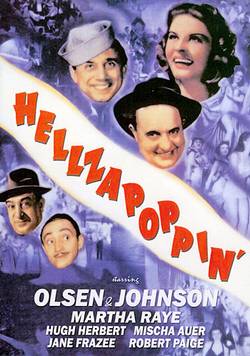
 It essentially begins with a fourth wall break. That’s all you need to know. Because that gives you exactly an idea of what you’re in for with Hellzapoppin’ or rather it gives you no idea whatsoever what you’re in for but really they’re one in the same. I’ve seen the movie and I still don’t quite know what it was.
If you wanted to put labels on it, I think it would be relatively safe to say that this is a comedy. In some small way, it transplants the feel if not the entire success of Ole Oleson and Chic Johnson’s Broadway hit of the same name. And Hellzapoppin’ was a big hit. It only makes sense that Hollywood would want to try and commoditize it.
But fearful of such a fearless anything goes endeavor the studio got cold feet and wanted some “substance” too. And not to be outdone the film’s two stars gave them a plot, ironically, about Ole and Chic finding a plot for the movie they’re in. So there you have it. Problem solved and everyone’s happy. The two nutcases go from an opening routine in hell with a steady barrage of gags to a mediocre plotline at a stately mansion still strung out with a line of gags and it wears its movie within a movie reality right on its sleeve, brazen enough to bring in its director and plucky screenwriter (none other than the always imposing Elisha Cook Jr.). So it’s as close to an “Anything Goes” musical as you can actually get. Yes, you heard that right. Cole Porter eat your heart out.
Anyhow, it’s a testament to the front half of the film, it’s so wonky and zany with wall to wall gags, non-sequiturs, and bits that by the film’s latter half it just cannot maintain that same frenetic pace. And how can you blame it? It does absolutely, insane, inane, and absurd things in the course of an hour or so.
To begin with, it’s barely functioning as a story or if it is a story only for the purposes of its fourth-wall breaks, sight gags, stupid puns, slapstick, and general stretching of all narrative conventions for the sake of some guffaws. But it also happens to be absolutely uproarious in nearly all the right ways — a sheer delight of pure nuttiness.
It’s a comedy disguised as a musical on top of a romance all wrapped up in a metanarrative that will make you scratch your head again and again. You’ll have no idea what you’re watching. You’ll question if the real-life director (not the one in the film) went through a midlife crisis, or if the scriptwriter (again, not the one in the film) was on something, or the projectionist (also not the one in the film played by Shemp Howard) accidentally spliced together multiple reels from different movies right before the film was sent for mass production.
As such, there are no comparisons to be made. Nothing comes close. Maybe Night at the Opera (1935) is the closest I can come– somehow matched with the fourth wall breaking of Rocky and Bullwinkle serials and the metaness of some of Community’s most self-aware episodes. Unfortunately, that’s the best I can do.
When you keep throwing mud up against a wall hoping it sticks comedically speaking, making funny faces, having random people walk in front of the camera, talking to people behind said camera, inserting a storyline to give the pretense of narrative, using every kind of prop imaginable, all while taking some allotted time for song and dance and random asides, this is what you get. Nothing more. Nothing less. That’s all I can say. Because there’s no possible way to even begin to describe what this is. It’s Hellzapoppin. That’s what. Just watch it. Unless you’re Stinky Miller. Then, go home. Your mother’s calling you (wink, wink)…
3.5/5 Stars
 In style if not entirely in execution The Lineup exhibits some similarities to Murder by Contract from the same year. Both films choose to take hit men as their main characters and it becomes a surprisingly intriguing way to look at a crime. Because the killers are a certain brand of sociopath who make film criminals all the more compelling based on not only on the way they carry themselves or the actions they take but the very words that leave their lips.
 In my profession, there is neither good nor bad. There is innocence and guilt. That’s all. ~ Denis O’Dea as the Police Inspector


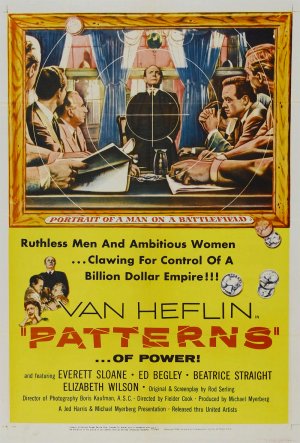 Patterns has little right to be any good. It takes place almost exclusively in interiors. Boardrooms, offices, hallways, at desks, and in elevators. But thanks to a fantastic teleplay from Twilight Zone mastermind Rod Serling, this little picture exceeds the meager expectations placed on it. In fact, it was a major hit when it came out as a live television drama, so successful that it was performed a second time and subsequently developed into this film version.
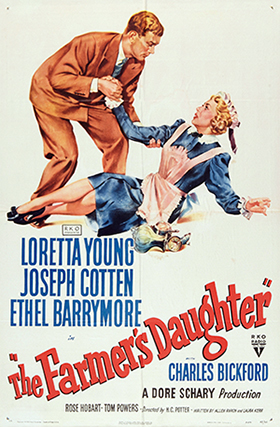 Whatever our criticisms of the previous generations, there’s still something within me that sees something uniquely compelling about films of old. Hollywood in the 30s and 40s could sugar coat, they could oversell the drama, but there was also a general decency that pervaded many of those films.
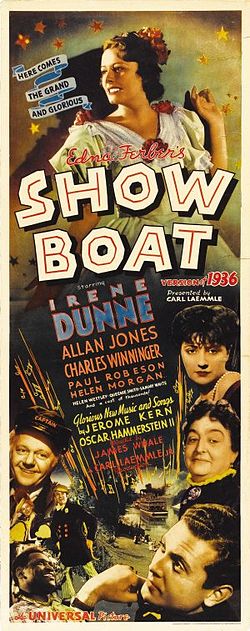 Most of what I know about riverboats can be gleaned from Mark Twain, Davy Crockett and the River Pirates, and that ever beloved Snoopy incarnation The World Famous River Boat Gambler. The 1936 musical Show Boat falls into that very same rich tradition but some clarification is in order.
 Like the fella says, in Italy for 30 years under the Borgias they had warfare, terror, murder, and bloodshed, but they produced Michelangelo, Leonardo da Vinci, and the Renaissance. In Switzerland they had brotherly love – they had 500 years of democracy and peace, and what did that produce? The cuckoo clock.
  Joseph Cotten is surprisingly compelling as the poor, unfortunate stiff and it’s hard not to feel sorry for him in his ignorance because we can relate with him. Alida Valli is striking as the aloof beauty who nevertheless has an unswerving affection for her former love that remains the only joyous thing in her current existence. Then, of course, there’s Orson Welles as the charismatic myth of a man–arguably the most intriguing supporting character there ever was even if it’s mostly thanks to the legend created by those who knew him.
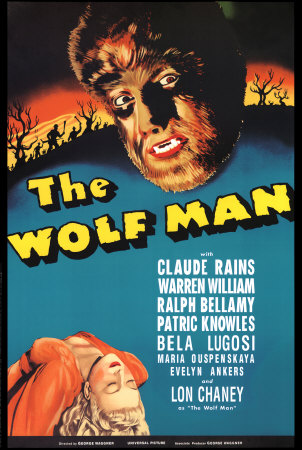 Even a man who is pure in heart, and says his prayers by night; May become a wolf when the wolfbane blooms and the autumn moon is bright.
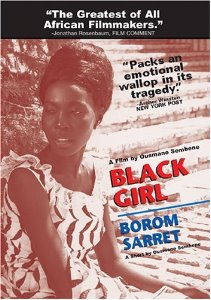 What’s fascinating about this film is how it manages to give voice to those who are normally silenced and even in her subservience this narrative powerfully lends agency to a young Senegalese woman’s perspective. Because even when she is silent and words are not coming out of her mouth and her status ultimately makes her powerless, the very fact that her mind is constantly thinking, her eyes observing and so on mean something. Inherently there’s a great empowerment found there even if it’s only known by her and seen by the outside observer peering into her life. That’s part of her. We are given a view into what she sees. We can begin to understand her helplessness and isolation. Where she came from and the life she left behind. Giving up the master narrative of the entitled and shown the flip side of the world for once.
 4 Star Films