

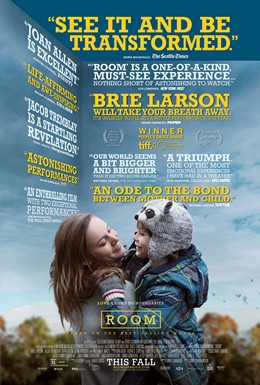
 Brie Larson has been on my radar for a while, ever since The Spectacular Now and Short Term 12. But she’s also a personal favorite who deserves to be in the company of other such shooting stars as Jennifer Lawrence, Shailene Woodley, Miles Teller, and Michael B. Jordan just to name a few.
Some of us already knew Larson had great performances on tap, but Room was just the ticket to get more people to finally prick up their ears and take notice.
From the annals of contemporary literature comes a story that asks us to buy into a premise that constantly unravels and unfolds until we are opened up to entirely new worlds. Ironically enough, it comes from shedding all falseness, getting outside of the box, and getting back to the old world — the real world.
Jack (Jacob Trombley) has spent his entire existence in Room with Ma (Brie Larson). Television has become his main educator and he believes in magic realms beyond Room that exist within the world of T.V. In truth, he has an utterly false sense of reality, but how could he not? All he knows are the dimensions of Room with a little skylight to peer out of and a tiny closet where he keeps his bed. His hair is overgrown like a little Samson and Ma tries to keep him fit and healthy the best way she knows how.
But Jack cannot quite comprehend what is happening around him, after all, he’s only 4. After his birthday, Ma decides it’s time to try and explain it to him. They are being held in Room against their will. A man name Old Nick kidnapped Ma, continually abuses her, and keeps her locked up. She doesn’t give Jack all this, but all he needs to know is that Nick is bad and they must try to escape. That is enough.
In essence, Ma fabricated this reality to keep him out of harm’s way. This bubble, known as Room, is all Jack has ever considered to be real. The rigidity and the regiment are what his life runs on. Now it’s time to leave the rabbit hole behind and relearn how the world ticks.
The initial conceit brings to mind Bunuel’s Exterminating Angel whereby the main characters are simply unable to leave a room — but the reason is arbitrary. Here Ma and Jack are able to get help and reacquire their freedom. But being outside of the confines of that space does not make life any easier.
Jack is an inquisitive, skeptical little boy, who even has moments of belligerence. However, when getting to the outside he clings to Ma like never before, because she is the only human form he has ever known besides Dora the Explorer and his imaginary dog.
Although the camera work feels rather shoddy at times and unextraordinary at best, the film nevertheless evolves into a human drama and its true substance dwells therein.
There’s a matter-of-factness to Trombley’s voice-overs that deliver his honest observations of all that exists around him. The aftermath of abuse is volatile. Director Lenny Abrahamson’s film removes any notions that life can simply be normal again in a normal world with normal relationships because that’s just not true. It cannot be. The mundane is never as simple as all that. There are complications and confusions. Room‘s latter moments are quieter, more tender, and even more heart-wrenching. But there’s also searing pain and red-hot altercations. They’re about survival in the wake of something so horrible like abuse, but it’s also about surviving all the repercussions that follow.
For Jack, that means making discoveries with a fresh, innocent pair of eyes. There is absolute sensory overload with new and novel stimuli flooding his senses constantly. He’s subjected to new sights, sounds, words, and the entire world that he hardly ever knew. He even needs to learn how to play like a little boy.
For Joy it involves dealing with what’s going on in her head and coping with pain that has been festering for years, causing her to lash out at her family. Even interviews cause her to question her own choices that are now fully solidified with the passing years. Could she have reacted differently? Did she have Jack’s best interests in mind?
The relationships of father, mother, and daughter, mother and son, dredge up pain and hurt. However, a suicide attempt and a stay in the hospital for Ma, reveal Jack’s child-like faith in what it means to live. They are two wounded individuals. One who has entered into a world that he has never known, and the other trying to settle into a life that now feels so distant and foreign.
Room is about two people making their way in the world. It succeeds not simply because of its anchoring performances, but due to the fact that it is willing to dwell in the difficult, heart-wrenching, and even mundane places. In those areas it speaks of love and strength that allows even the smallest most damaged goods among us to shed any shackles that inhibit our joy in life. Love knows no boundaries. That doesn’t make it easier. It’s just the truth. Ma and Jack are able to give up their baggage — reconciling the old with a new way of life.
4.5/5 Stars


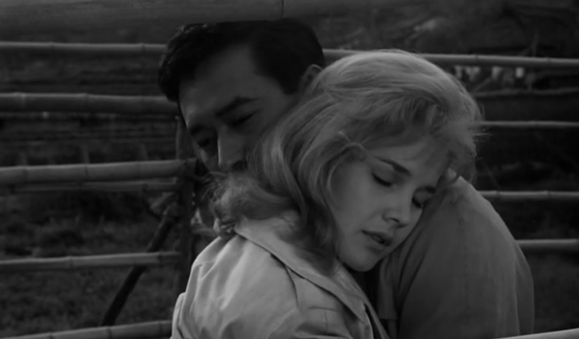 Bridge to the Sun is one of those films that was ahead of its time. Its main actors are hardly remembered by modern audiences. The top-billed leading lady, Carroll Baker, was probably more notorious for her controversial persona in films like Tennessee’s Williams’ Baby Doll than she was famous. James Shigeta was a pioneering Japanese-American actor, who was once told, “If you were white, you’d be a hell of a big star” (The Slanted Screen). He aged gracefully but was slowly relegated from leading roles to bit parts. Belgium director Etienne Perier was only a slight blip on the Hollywood radar. When it came out in 1961, its narrative based on the memoir of Gwen Terasaki ended up being an abysmal flop. Honestly, it’s not all that surprising, because the public was not ready for such a film, and its candid depiction of interracial marriage. Now, with a fresh pair of eyes in the 21st century, Bridge to the Sun looks quite extraordinary. Certainly, this is a love story, but under very different circumstances, in a very different world. Although it was made in the classical Hollywood mode, it still manages to groundbreaking, not necessarily due to its form, but thanks to its content. Because Bridge to the Sun places an Asian man and a Caucasian woman together, as they navigate two starkly different cultures both tottering on the brink of war.
 In truth, this film does not shy away from showing their affection, even though it undoubtedly made some viewers squeamish at the time. More than once Gwen and Terry embrace in intimate moments that signify the deep-rooted love that holds them together. Sometimes it’s far from easy. For instance, when they first travel to Japan, Gwen finds it difficult living in a culture where women are meant to be wholly subservient to their husbands. She’s fine with the bowing and the taking off of shoes even, but not being allowed to speak her mind is about the limit.
 Gwen and Terry cannot stay mad forever, especially with the birth of their little girl Mako. In fact, it is actually in a moment when their family is in danger of being pulled apart that Gwen shows her true resilience and loyalty as a wife. Pearl Harbor has just blown up and that means there is a freeze on all Japanese aliens. Terry is stuck at the embassy about to be deported, and an FBI agent advises Gwen that she would be much better off staying in the states. But as she converses with him you can see the determination in her eyes. She knows what it means to go to Japan. Her daughter as a child of mix race will be scorned, and Gwen herself will be looked down upon if not endangered by her status as an American citizen.
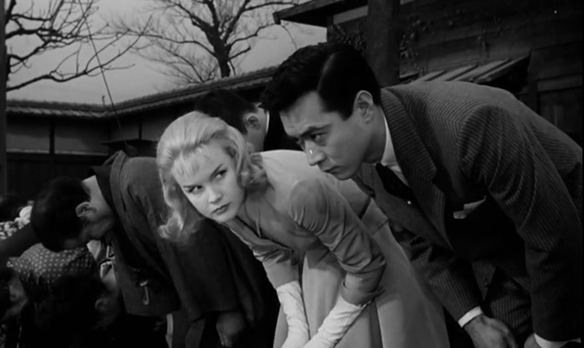 lously these individuals salvaged their marriage and preserved their family. Meanwhile, the world around them would not make the necessary concessions. It allowed cultural differences to define relationships, and ultimately increase the void between nations. The rubble of WWII was eventually cleared and new hope was built upon that foundation. In reality, the chronicles of the Terasakis was an emblem of that hope. Inherent in their story is the possibility that two people and two nations really, can be reconciled and even thrive together. Perhaps the United States was not ready for such a message to come out of Hollywood, even as late as the 1960s, but nevertheless, it seems like a message we can certainly take to heart today.
 “I don’t like anybody pushing me around. I don’t like anybody pushing you around. I don’t like anybody getting pushed around.” Van Heflin as Sam Masterson
 17 or 18 years later a full-grown Sam Masterson (Van Heflin) decides to return to his old stomping grounds, Iverstown, on a whim. He’s surprised to learn that the “little scared boy on Sycamore street” is now District Attorney (Kirk Douglas). And he’s now married to Martha Ivers (Stanwyck). She and Sam had something going long ago, but he’s all but forgotten it by now. He’s made a living as a gambler who has a pretty handy dandy coin trick, but really Heflin’s character could be anything.
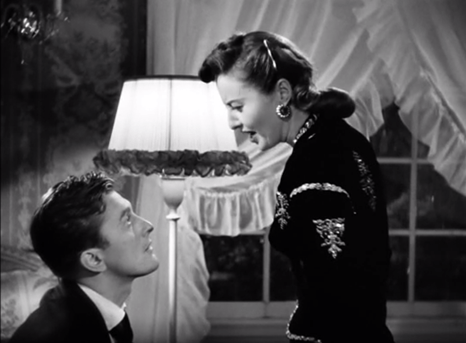 We don’t actually see Barbara Stanwyck’s face until 30 minutes into the film, but it doesn’t matter. She as well as
  Honestly, although Stanwyck is our leading lady, it’s quite difficult to decide whose film this really is. Van Heflin and Barbara Stanwyck are at its core, but then again, Scott and Douglas do a fine job trying to upstage them. There’s a polarity in the main players, meaning Stanwyck and Heflin have the power, and the other two are the subservient man and woman respectively. However, the film really becomes a constant tug-of-war. Douglas is not just a spineless alcoholic. There’s an edge to him. Scott seems like a softy and yet there’s an incongruity between her persona and that prison rap that hangs over her. Heflin seems like the one relatively straight arrow because as we find out, Stanwyck is fairly disturbed. She’s no Phyllis Dietrichson and that becomes evident in yet another climatic conflict involving a gun. But she’s still demented, just in a different way.



 Perhaps
 A quaint, unassuming film, especially up against other more lavish Ernst Lubitsch works like Trouble in Paradise and Heaven can Wait, Shop Around the Corner still manages to be in the upper crust of romantic comedies — even to this day.
