Unknown's avatar

About 4 Star Films

I am a film critic and historian preserving a love of good movies. Check out my blog, 4 Star Films, and follow me on Twitter @FourStarFilmFan or Letterboxd. Thank you for reading!

Review: West Side Story (1961)

westside1Look at West Side Story through a simple lens and you might see a Shakespearian classic given a 1950s facelift and set to music. It might seem antiquated, perhaps not as politically correct as we have come to expect, and maybe a bit regressive. However, this musical based off of the bard’s famed Romeo and Juliet is most definitely a thematic spectacle pulsing with song and dance. It’s full of romance, full of angst, all expressed through the motions of the human body. In an age where we often feel like we have come so far and know so much, maybe a film like this is good for us if we take a step back for a moment.

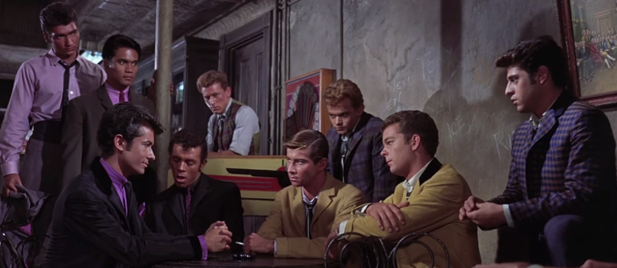
Robert Wise’s film opens over the skies of New York and we are quickly introduced to the two competing forces that rule the streets with a “snappy” opening number. You have the local street gang, the Jets made up of delinquents of New York and the Sharks consisting of young immigrant Puerto Ricans. They hate each other for different reasons, but the bottom line is that they hate each other, and there’s no other way to slice it. A tiny scuffle broken up by Lt. Schrank and Officer Krupke is only a small tremor of what is to come, but it sets the tone.

The Jet’s leader Riff (Russ Tamblyn) is looking to have a rumble with their bitter rivals and the neutral territory at the local dance is the perfect opportunity to set things up. Although people are having fun and it’s a grand ol’ time you can tell there’s unrest between the factions bubbling under the surface. The indubitably funny John Astin makes a valiant effort to get them all to be friends, but it doesn’t work so well. Bernardo (George Chakiris) the leader of the Sharks accepts the offer to have a war council because he wouldn’t mind getting a piece of one of the Jets.

The glue that holds the narrative altogether, of course, is the romance that buds on the dance floor when our star-crossed lovers Tony (Richard Beymer) and Maria (Natalie Wood) first meet. This is important because Tony use to be a Jet and is still the best friend of Riff. Meanwhile, Maria happens to be the younger sister of head Shark Bernardo. This is a relationship that’s not supposed to happen and yet their inhibited, naive passion disregards all else. He’s obsessed with a girl named “Maria.” That’s all he has, a name to go with a face and yet he’s infatuated. The singing of “Tonight” reflects how caught up in this dream they really are. And finally “I Feel Pretty” is Maria’s own exuberant reaction to the turn of events.

As an aside, Richard Beymer supposedly wanted play Tony rougher around the edges instead of a hopeless romantic, but ultimately it seems alright that he did not. Only because this film is not simply a drama where a nuanced performance would be suitable, but it is also a musical and a romance. In many ways, we need his character to be as love-struck and idealistic as he is. Because his song and his love story are a striking contrast with the world he and Maria live in.

westside2With the rumble afoot the following night, it can only spell trouble for all involved. The moment that Tony promises Maria that he will try to stop the fighting, he is part of it. Things turn out as he could never have imagined. In fact, no one wanted things this way, revealing how big a difference one single day makes. Tragedy hits with a vengeance, making this a marvelous piece of cinematic expression, but also a jarring indictment of this broken world we live in.

All the choreography in the film is directed by Jerome Robbins, and it is beautiful to see the melding of something so graceful like ballet crossed with the street gangs of New York. There’s something inherently contradictory about it and yet the culture, as well as the angst, is revealed so beautifully. It can be smooth and slick with a group of buddies or violent with arms flailing, heads contorting, and bodies all over the place. But it’s never vulgar, the people might be, but the dance never is. It is always enjoyable to see George Chakiris dance, and he’s not the only one, from Rita Moreno to a whole host of others. They move with such grace but it is never dull because it has feeling. And that extends to their entire performances. In fact, Chakiris and Moreno are probably the most enjoyable, because they are far removed from the dreamy-eyed couple of Tony and Maria.

The composition by Leonard Bernstein is obviously outstanding and this is one of the famous soundtracks in musical history including the “Jet Song”, “Maria”, “Tonight”, and “I Feel Pretty.” However, I think I was especially interested in “America” and “Gee Officer Krupke.” The first puts to song the two conflicting perspectives that lead to civil unrest. There’s the idea that America is this land of opportunity and yet there’s also a negative flip side to this ideal. Also, the second song in a comical way, comments on the treatment of the youth of America. From a film that might seem outdated, it has some pretty frank analysis of the never-ending cycle that goes on.

westside3In fact, if we give our society a good hard stare, have things really changed? Are our discrimination and racism better than that of Lt. Schrank or just veiled behind greater open-mindedness? Are people still hating one another, even when they might be more similar than they realize? Is our society working towards collective good or are we slowly “killing” it through our acts of hate? Even a likable fellow like the drugstore owner Pop (Ned Glass) brings into question those who are against the violence but don’t really seem to do much about it. Words don’t act unless the people behind them do. That can go both ways.

All this pops into my mind because of a musical from over 50 years ago where, yes, Natalie Wood was, unfortunately, playing a Puerto Rican. But hopefully, we can look past that for a moment and see the artistic merit here and then think for a moment what themes we might glean from this West Side Story.

4.5/5 Stars

Review: The French Connection (1971)

frenchcon5There is a pervading gritty realism to William Friedkin’s French Connection that undoubtedly took some cues from the French New Wave and the Neorealist movements. Hand-held cameras are taken to the streets of New York and to the train terminals. There is literally trash piling up in the gutters, old dilapidated bathroom stalls, and worn out facades all over the city. It’s urban, depressed, and a place of crime. In many ways this film is like Bullitt for New York, in fact, Steve McQueen was even offered the lead.

However, this time around our main cop is Popeye Doyle (played by Gene Hackman) and his partner Cloudy Russo (Roy Scheider). Both play a key role, but Popeye (the man with the hat) is of the greater interest. He’s a wise guy, belligerent, barking, loud-mouthed hot head, often driven by obsession in his job. He also happens to be an undercover cop in the narcotics division. He’s used to getting dirty and using the rough stuff when necessary. After all, it’s a jungle out there and there’s no room for pushovers.

From the get-go, we come to understand that this story has a French Connection, in Marseilles to be exact, and we know who is involved (Fernando Rey). We just cannot quite pick out all the details. Simultaneously, on a hunch, Doyle and Russo start running surveillance on a guy they happen upon in a club. Things don’t quite add up since he runs a deli called Sal and Angie’s by day and lives it up at night. An undercover informant also tips Popeye off to a big shipment of heroin that’s coming in.

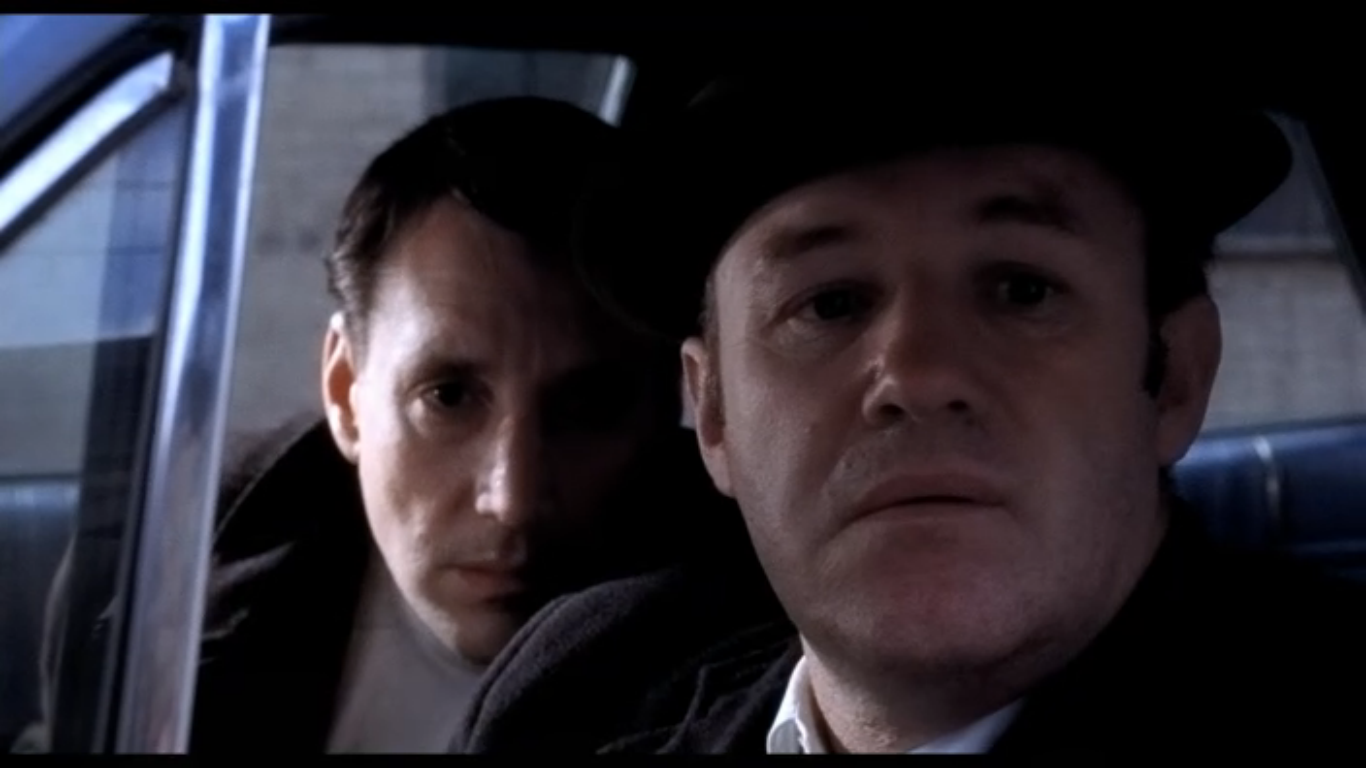
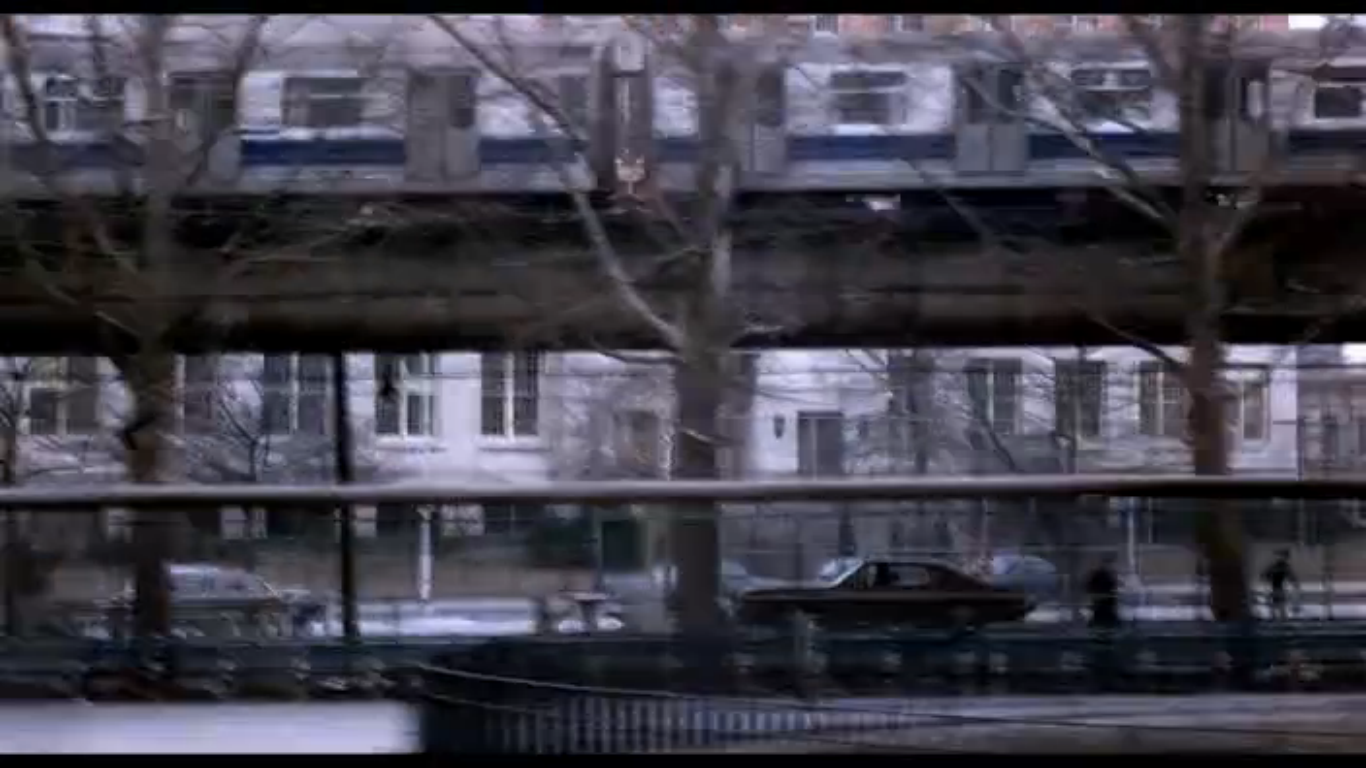
frenchcon9Sal Boca has to be into something and so a game of tailing begins on the streets after he and his French contacts are spotted together. Frog 1 named Charnier (Rey) has Popeye on his tail only to shake him adeptly. That’s only the beginning, however, after a sniper comes after Popeye and yet another chase ensues. The fugitive boards a train and Doyle commandeers a car to follow close behind. Thus, was born one of the greatest car chases of all time and it doesn’t even involve two cars. After the adrenaline of that moment has worn off Doyle and Russo are on another stakeout and this time impound a car belonging to frog # 2 Henri Devereaux. Popeye has a gut feeling that the vehicle’s dirty and they literally tear it apart end to end, with little luck. But he’s a force of nature and very little will get in the way of his obstinate drive.

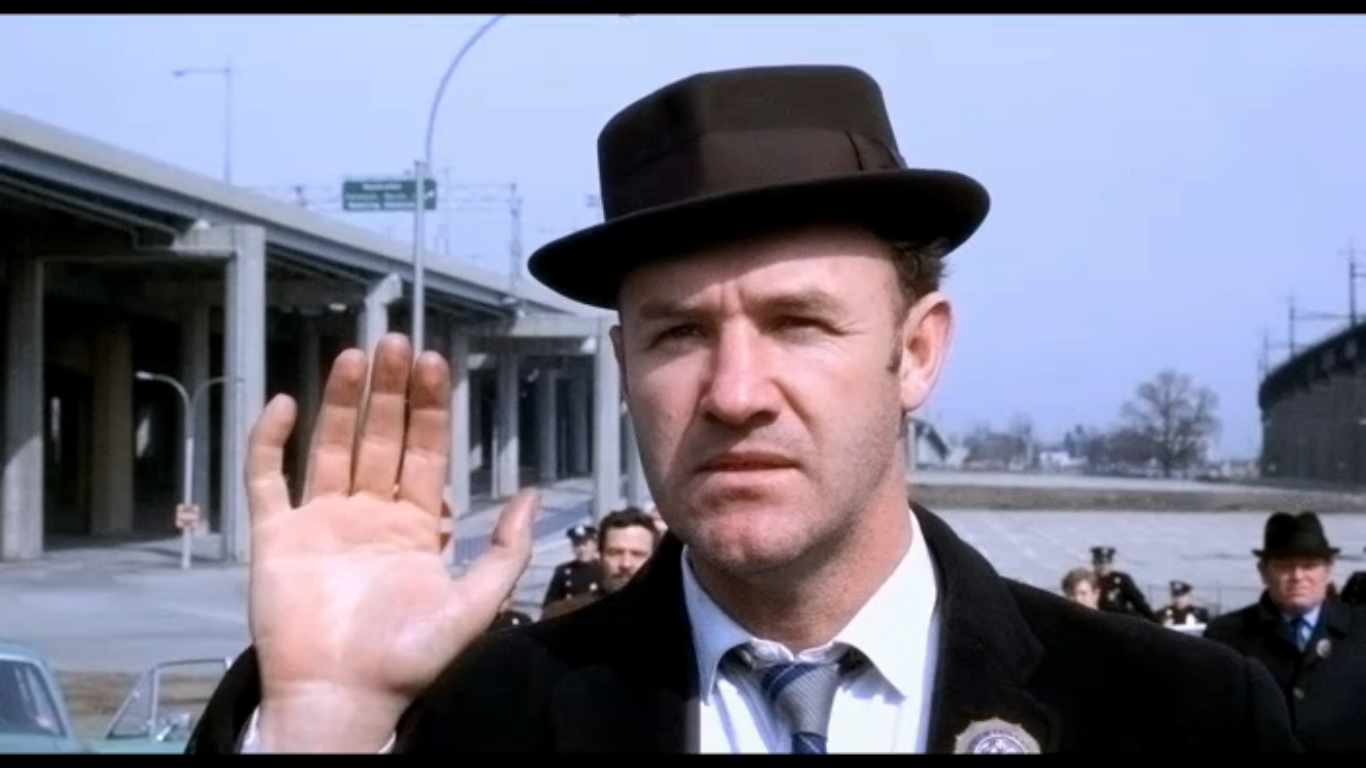
frenchcon11When the drop finally takes place everything goes off smoothly enough, but there’s a roadblock, and Popeye is waiting for them with a playful wave. He’s got them now. The final roundup leads him into an old warehouse as the hunt continues, but The French Connection finishes open-ended. Sal was gunned down, the meeting was busted, but not everyone was caught, and Charnier seems to have vanished into thin air. To top it off, Doyle shoots the wrong man and without flinching continues his obsessive hunt.

Friedkin’s film was partially based on true events from the 1960s and the two men the story was patterned after actually are featured as the boys’ superior Walt Simonson (Eddie Egan) and federal agent Bill Mulderig (Bill Hickman), who has a longstanding dislike for Doyle. Their presence in the production of this film helps to lend to the realism and nuances that the film is able to take on. The score isn’t all that noticeable, but it’s a tense arrangement that adds some underlining anxiety to some scenes. Stakeouts get more interesting than you would ever give them credit for. Really on the simplest level, this film is about one man’s hunt, his obsessive chase, which at times no longer seems about justice at all, but personal vindication.

4.5/5 Stars

Atonement (2007)

atone2Without any prior knowledge and given what we know to begin with, it looks like Atonement will be a love story revolving around the characters of Keira Knightley and James McAvoy. They are, after all, the big stars in this WWII era romance based on the Ian McEwan novel. We expect to become enraptured in their passionate love affair that is to be indubitably broken up by war. However, it becomes evident very quickly that this is really a tale about a young girl  and budding author, played through the years in succession by  Saoirse Ronan, Romola Garai, and Vanessa Redgrave. It is her point of view and her part in this narrative that becomes most important, although we do not have any indication as to why to begin with.

So in front of the peering eyes of Briony Tallis, her older sister Cecilia (Knightley) and the son of the family housekeeper Robbie Turner (McAvoy) start something which Briony cannot fully comprehend and understand. What is it that is really going on around her? An intricate manipulation of time and place begins, relating the story from a number of perspectives, but always returning to Briony. How does Cecilia really feel towards Robbie, who is in a sense below her, but still proud? Briony knows she has feelings for the housekeeper’s son, but how is she to react when she finds her sister and Robbie crammed up against the bookcases together. Then, when a pair of pesky twins goes missing a search party begins. Again Briony sees something that she cannot fully understand, and yet she makes a judgment that will unwittingly tear apart two lives. There is constantly an inquisitiveness, a confusion in her expressions that is absolutely spot on.  And in these moments the score is suffocating with its pounding, clanging, and banging.

atone3Robbie gets sent away, torn from his love Cecilia, and Britain is on the brink of war. When the two lovers finally get a chance to see each other, he has joined the army in order to be released from prison, and she is working as a nurse.  But it’s a heartbreaking separation because although the passage of time is condensed for us, we can easily see the reserved, hesitant quality in both of them. How are they supposed to react? It’s difficult to hold onto the same feelings, maintain the same type of passion when you’re separated by the years. Cee reaches out to touch his hand, and he avoids her slightly. You cannot exactly blame him, but there is a tinge of sympathy for her.

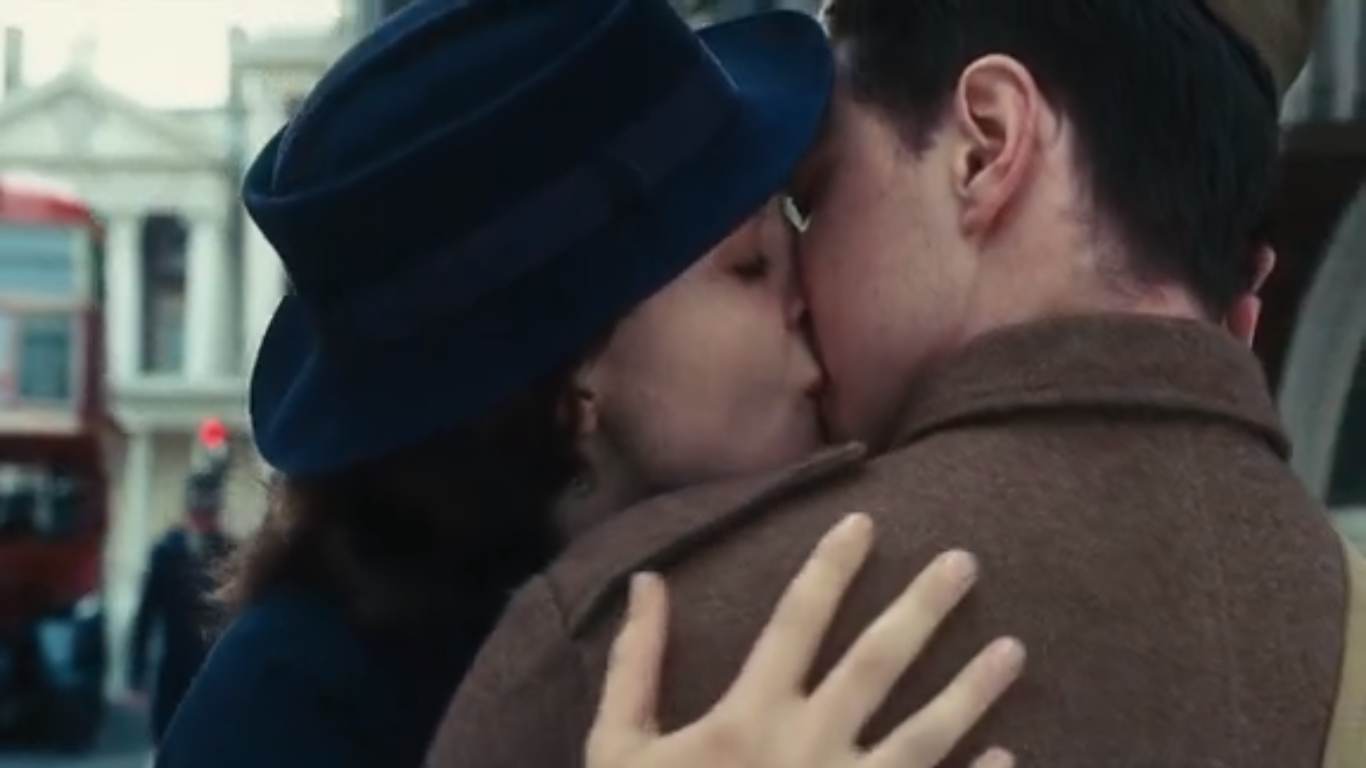
But their romance is quickly renewed and heightened once more in a matter of days, only to have the war this time pull them apart. And it’s something that’s very hard to rebound from. Robbie ends up in the middle of France and when he finally discovers the coast with a couple of comrades they come across all the forces at Dunkirk getting ready to retreat. For those engaged with WWII history, Dunkirk was in one sense a wounding blow to the English ego, but also a testament to their resilience. The men are beaten and battered, but escape the Nazi onslaught to fight another day. And yet we don’t see the fighting. With a wonderfully dynamic tracking shot director Joe Wright gives us an eye into the tired and wounded masses. And it’s somber, chilling, melancholy, and still strikingly beautiful in the same instance.

atone5Back home, Briony is now working in a hospital almost as penitence for wrongs and soon the hospital is inundated with wounded from the retreat. She is quickly thrown into action comforting a dying French soldier with a penchant for the soft refrains of Debussy. Then, comes the pivotal confrontation where Briony, now older, faces her sister who has refused to talk with her. And Robbie is there too. Together they painfully and angrily point out what the young girl had done to both of them. It’s heart-wrenching to the nth degree and yet the final revelation makes it all the more painful.

Now many years down the line, Briony, who is now much older (Redgrave) and an author of 21 books, is interviewed about her final novel Atonement. It lays out the events of the whole film, and she explains her reason for writing such a story. She wrote it to be read by the public certainly, but most importantly she wrote it for Robbie and Cee. To give them closure and the dignity that they deserved.

So you see, it’s the book within the book really or more correctly Ian McEwan writing a novel called Atonement featuring a fictitious version of the same work. In a sense, I do feel manipulated by this film, but do I mind? Not really. I don’t hold it against the film because it tells its story with so much beauty and grace.

4/5 Stars

Galaxy Quest (1999)

Galaxy_Quest_posterGalaxy Quest might be a kitsch homage to all things Star Trek and Star Wars, but that’s the secret to its unequivocal success. It stands on the laurels of its campy fun which it wears as a banner like all the Trekkies and Star Wars fanatics it looks to pay tribute to.
The film opens in the days before international comic cons and crisscrossing social media connections when nerd culture was still highly prevalent, but perhaps not as refined, and dare we say trendy, as it is today. People dress up in costumes, dote over their heroes, and let the fantasy worlds flood into their lives. It’s like they forget those worlds aren’t real. Or are they?

The crew of the NSEA Protector has been off the air for well nigh 18 years, but they attend a Galaxy Quest convention in order to milk the franchise for all its worth. By now most parties involved are fed up with these shallow, superficial roles they were forced to dawn all those years ago.

Daryl Mitchell was the boy genius Lt. Laredo piloting the ship and has by now outgrown his part, only being remembered as the precocious kid he used to be. Alan Rickman is the intelligent Klingon-like Dr. Lazarus, and yet by this point in his career, he hardly deigns to play such a tacky part. He would be much more lauded on the Shakespearian stage, and he’s long been tired of his role as the only alien member of the crew. Tony Shalhoub is the crew’s even keel tech the very un-Asian Sgt. Chen. Meanwhile, Sigourney Weaver is the dumb blonde whose only job is relaying information from the computer to her commander, while in real life she’s assertive and miffed by Jason Nesmith’s cavalier attitude. She’s not the only one. And as the nucleus of it all is our Captain Kirk, our William Shatner, a pompous, showboating celebrity who doesn’t know when it’s time to hang up the towel, Jason Nesmith aka Peter Quincy Taggart.

The behind the scenes turmoil that they are going through is necessary and for these characters to find themselves they must go on a hero’s journey. They must actually go on a real galaxy quest and in the ensuing adventures they cease being actors donning roles begrudgingly, but they actually begin to believe in the parts they are playing. They grow closer to the people they portrayed on screen and as a result grow closer together as a real-life television crew.

The peaceful Thermian people represent all those alien species in the vast galaxies who have ever needed a savior. The crew of the Protector, although caricatures, represent all the heroic ensembles that have ever graced the silver screen. They’re petty, insecure, and unskilled, but they still manage to succeed and we’re cheering for them all the time with dopey grins plastered on our faces. Even Sam Rockwell, a young, insecure extra who doesn’t want to die at the end of the episode gets his chance, and as an audience, we wholly relate with the audacious nerd Justin Long who is able to help his heroes on their greatest mission yet.

Is this a tacky, sentimental, melodramatic space opera? Most certainly yes, and yet we would not want it any other way. What it goes out to do, it does very well and that is better than plenty of other parody films floating around out there.

“By Grabthar’s hammer, by the suns of Warvan, you shall be avenged!”

R.I.P. Alan Rickman, you will be dearly missed.

3.5/5 Stars

Days of Heaven (1978)

Days_of_heaven1You can see Terrence Malick’s fingerprints all over this film and that’s certainly not a bad thing. It has his eye for the breathtakingly beautiful visuals and there is almost a spiritual quality of reverence to its pacing and tone. Slow, methodical, and ultimately deeply impactful. And there are so many Biblical parallels that can be taken hold of as well.

It’s as if Malick cannot bear to be stuck indoors. He hates having walls surrounding him especially when a camera is involved. He takes considerable interest in the sky, the landscapes, and creatures inhabiting the space around him. It’s not just his human subjects either, but everything of all shapes, sizes, and sounds. He cares about the exterior more than the interior, the earth and the heavens rather than anything made by the hands of man. It’s that type of approach that allows for such breathtaking visuals from Nestor Almendros and Haskell Wexler because the priorities are set. The sky is literally the limit.

The story opens during the presidency of Woodrow Wilson and a young man named Bill (Richard Gere) is forced to flee his mining job for Texas taking along his girlfriend Abby (Brooke Adams) and his younger sister Linda. They travel around hitching a ride on a train looking for work until they finally find seasonal jobs at a Texas ranch in the fields. Life is relatively tranquil, although the work is hard. Bill maintains that Abby is his sister to keep people from getting ideas, but they are very close.

However, the young reserved owner of the ranch is instantly taken by her. She does not share his feelings, but a marital union is formed on the advice of Bill. After all, then she would have a cut of the man’s inheritance and the farmer doesn’t suspect a thing. So in this way, the love triangle is put into place, and yet relations still remain genial between everyone. This is a life they can get used to, especially for young Linda. That is until the man notices the intimacy of Bill and Abby and it angers him deeply. It’s only exasperated because Abby is starting to have feelings for him causing the web of romance and feelings to become ever more complicated.

And of course, on the day of the locust, the final restraints holding the farmer in place are released, and he unleashes on Bill with all his wrath. He is incensed beyond reason and once again Bill finds himself in another incriminating situation which he must flee from. Abby must start over with a new life and Linda finds herself at a boarding house. It’s not where we thought we would leave them, but it nonetheless satisfies as a half-resolution. It might as well be.

Many might notice that the narrative of Days of Heaven is rather thin, being held together by the meandering narration of Linda Manz. All this took Malick over 2 years to weave together into cohesion and it may not be a perfect fit, but it was thoroughly captivating because his film-making style is so visually robust. It’s often shot at gloriously magical times of day where the outlines of people and things become beautiful contours or stylized shapes. The sky is often bursting with color or warm like a painting of pastels. Those are the images that you are left with.

On her part, Brooke Adams is a natural beauty much in the same way of a Katharine Ross. Richard Gere is necessary with his playful and still fiery ways. Sam Shepard has a plainness and a calmness to him, but he really made this film with his explosion of emotion at the end, because something needed to break through the muted characterizations. It changed how we see him and really ups the tension of a generally restrained film.

4.5/5 Stars

Review: Rocky (1976)

rocky2The original installment of the popular franchise, Rocky was the pinnacle, and despite innumerable remakes, it still has never been eclipsed.  World Champion heavyweight Apollo Creed (Carl Weathers) even outlines why Rocky is, in fact, so popular. There’s nothing more American than an underdog story. A bum, an Italian Stallion, duking it out with the big boys and getting a shot to prove himself. From Creed’s point of view it’s all part of the act, a fine publicity stunt to bring in the public, but the film Rocky works on a similar principle. Most people relate to Rocky (Sylvester Stallone), and maybe at the very least, they can find it within themselves to root for his character even if he’s different then them. The beauty of this film is that Stallone and his creation were unknowns. They were nobodies. By the time all the sequels came out he certainly had garnered a following, but some of the intrigue of this whole narrative was lost in the process. He no longer felt like a long shot.

Furthermore, this film could have easily been a run-of-the-mill boxing movie. We’ve seen acclaimed performances in them before from people like Brando or even Kirk Douglas and John Garfield. But the character of Rocky makes all the difference, allowing the old standard to work once more. He’s a bum like most of the film boxers we ever became acquainted with, and he’s a little short in the brains department, but perhaps without even knowing it he good-naturedly embodies the spirit of his native Philadelphia. We cannot understand what he grunts half the time, but his actions reflect “The City of Brotherly Love.”

rocky1He cares about others on a level that some people don’t dare, and it even creeps into his work as an enforcer when his boxing prospects aren’t good. He doesn’t like being hurt or made fun off, but at his core, he’s a gentle spirit. He can’t bring himself to break a man’s fingers, he wants the kids to get off the streets and uphold their reputations. Above, all he constantly cracks jokes to the younger sister of his best friend Paulie (Burt Young). Her own brother won’t give Adrian (Talia Shire) the time of day, but despite her timidity, Rocky pops in on her everyday holding one-sided conversations at the pet shop. It doesn’t feel like simple common courtesy. He really likes her and grows to care about her. So really if this movie was just about boxing it would probably have faded away with so many other like-minded movies.

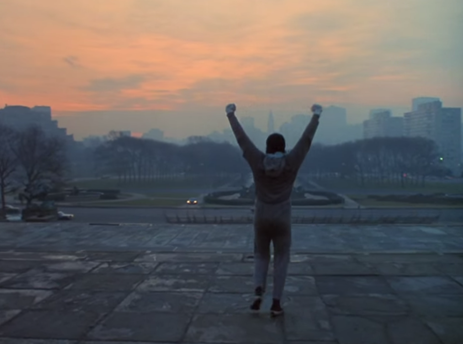
In the narrative, Rocky goes through all the hoops and finally reconciles with veteran trainer Micky Goldmill (Burgess Meredith), who looks to live vicariously through Balboa. He also deals with Paulie, who is prone to drinking which leads to volatile outbursts. And he even grapples with the media attention that comes courtesy of a bout with Creed. The montage of his training has become a thing of legend, hands outstretched with Bill Conti’s “Gonna Fly Now” ringing out over the steps below him.

Then there’s the showdown that the whole film culminates to and it’s nothing unusual, nothing we wouldn’t expect, but that’s the beauty of it because we want it anyway. We finally see everything on the line. Everything that Rocky has been working for is either to be realized or dashed to pieces. Well, the ending is a bit of a cop out, but you need some way to start the next sequel, right? This storyline is simple, almost naive in a way, but sometimes films like that are enjoyable and necessary. Every once and awhile we need a good underdog story to lift our spirits.

Sylvester Stallone burst onto the scene in lovable fashion and just like the film itself, I’m not sure he ever topped his original characterization of Rocky. He might be a broken coconut upstairs, but he certainly has a lot of heart. Humor me for just one moment because I have to say it at least once, “Yo Adrian!”

4.5/5 Stars

Room (2015)

Room_PosterBrie Larson has been on my radar for a while, ever since The Spectacular Now and Short Term 12. But she’s also a personal favorite who deserves to be in the company of other such shooting stars as Jennifer Lawrence, Shailene Woodley, Miles Teller, and Michael B. Jordan just to name a few.

Some of us already knew Larson had great performances on tap, but Room was just the ticket to get more people to finally prick up their ears and take notice.

From the annals of contemporary literature comes a story that asks us to buy into a premise that constantly unravels and unfolds until we are opened up to entirely new worlds. Ironically enough, it comes from shedding all falseness, getting outside of the box, and getting back to the old world — the real world.

Jack (Jacob Trombley) has spent his entire existence in Room with Ma (Brie Larson). Television has become his main educator and he believes in magic realms beyond Room that exist within the world of T.V. In truth, he has an utterly false sense of reality, but how could he not? All he knows are the dimensions of Room with a little skylight to peer out of and a tiny closet where he keeps his bed. His hair is overgrown like a little Samson and Ma tries to keep him fit and healthy the best way she knows how.

But Jack cannot quite comprehend what is happening around him, after all, he’s only 4. After his birthday, Ma decides it’s time to try and explain it to him. They are being held in Room against their will. A man name Old Nick kidnapped Ma, continually abuses her, and keeps her locked up. She doesn’t give Jack all this, but all he needs to know is that Nick is bad and they must try to escape. That is enough.

In essence, Ma fabricated this reality to keep him out of harm’s way. This bubble, known as Room, is all Jack has ever considered to be real. The rigidity and the regiment are what his life runs on. Now it’s time to leave the rabbit hole behind and relearn how the world ticks.

The initial conceit brings to mind Bunuel’s Exterminating Angel whereby the main characters are simply unable to leave a room — but the reason is arbitrary. Here Ma and Jack are able to get help and reacquire their freedom. But being outside of the confines of that space does not make life any easier.

Jack is an inquisitive, skeptical little boy, who even has moments of belligerence. However, when getting to the outside he clings to Ma like never before, because she is the only human form he has ever known besides Dora the Explorer and his imaginary dog.

Although the camera work feels rather shoddy at times and unextraordinary at best, the film nevertheless evolves into a human drama and its true substance dwells therein.

There’s a matter-of-factness to Trombley’s voice-overs that deliver his honest observations of all that exists around him.  The aftermath of abuse is volatile. Director Lenny Abrahamson’s film removes any notions that life can simply be normal again in a normal world with normal relationships because that’s just not true. It cannot be. The mundane is never as simple as all that. There are complications and confusions. Room‘s latter moments are quieter, more tender, and even more heart-wrenching. But there’s also searing pain and red-hot altercations. They’re about survival in the wake of something so horrible like abuse, but it’s also about surviving all the repercussions that follow.

For Jack, that means making discoveries with a fresh, innocent pair of eyes. There is absolute sensory overload with new and novel stimuli flooding his senses constantly. He’s subjected to new sights, sounds, words, and the entire world that he hardly ever knew. He even needs to learn how to play like a little boy.

For Joy it involves dealing with what’s going on in her head and coping with pain that has been festering for years, causing her to lash out at her family.  Even interviews cause her to question her own choices that are now fully solidified with the passing years. Could she have reacted differently? Did she have Jack’s best interests in mind?

The relationships of father, mother, and daughter, mother and son, dredge up pain and hurt. However, a suicide attempt and a stay in the hospital for Ma, reveal Jack’s child-like faith in what it means to live. They are two wounded individuals. One who has entered into a world that he has never known, and the other trying to settle into a life that now feels so distant and foreign.

Room is about two people making their way in the world. It succeeds not simply because of its anchoring performances, but due to the fact that it is willing to dwell in the difficult, heart-wrenching, and even mundane places. In those areas it speaks of love and strength that allows even the smallest most damaged goods among us to shed any shackles that inhibit our joy in life. Love knows no boundaries. That doesn’t make it easier. It’s just the truth.  Ma and Jack are able to give up their baggage — reconciling the old with a new way of life.

4.5/5 Stars

Drive (2011)

drive1You always think of the man in the getaway car as the wimp. Why else is he supposed to keep the engine running instead of helping with the job? Well, not anymore. Ryan Gosling completely demolishes that myth with Drive. It’s a neo-noir of sorts, but don’t get the wrong idea. This isn’t your conventional Hollywood action flick. Albert Brook’s corrupt thug sans eyebrows says he used to back sexy European action films and that’s ironically enough what Drive is. There’s a new age electronic score to match the stylized action. Silky smooth slo-mo mixed with golden illumination of the characters and the L.A. nightscape.

Although he’s really a stunt driver and spends his spare time working as a mechanic for the shop owner (Bryan Cranston), the Kid (Gosling) works jobs on the side as a getaway car driver, and he’s the best of the best. He proves it in the opening minutes, perfectly timing his escape with the conclusion of a Clippers game. It makes disappearing into the night that much easier.

He keeps things in check, keeps his cards close to his body, and at times reminds me of Alain Delon in Le Samourai. He’s not quite so icy cool, almost serene, and yet that can disappear in a flash. So still, so slight of word and movement, and yet behind the wheel, he has so much purpose. He doesn’t use a gun. His methods are more brutal, and he only uses them when absolutely necessary. Such a role gives me a newfound respect for Ryan Gosling. He really does seem to have the true ability to take on some interesting roles of varying degrees and intensities.

drive2All the characters around him are not necessarily fully developed entities on their own, but they function as more of an essence, developing this stylized world. Carey Mulligan is the aloof woman next door with the far-off gaze and quiet demeanor. There is an aura around her much like the Driver, maybe because they don’t talk much. There’s a mystery to them. Oscar Isaac and Christina Hendricks have relatively short screen time, but they play pivotal roles in the film and they lend credence to the story because even if they’re no good, we have at least a little empathy towards them. And then Albert Brooks and Ron Perlman are real crud of the earth who we don’t mind seeing suffer. It may not be a nice thing to say, but it’s undoubtedly the truth. The Driver seems outside of this fray at first, but he ends up getting involved in it whether it’s because of Irene or her husband’s botched robbery attempt. It becomes his business and it proves cataclysmic.

Aside from Le Samourai, there’s a bit of Bullitt here thanks to the ultra sleek car chases, and maybe even some Point Blank, another film that functions as a dreamy, unconventional thriller. We never see the inside of whatever jobs are being pulled, but it actually builds the tension as we sit on the outside waiting with the driver. He’s all business as the audience sits sweating it.

drive3What this film has and what I am not necessarily a proponent of, is the brutality and stylized gore. It fits the overall tone of Drive, but it does rub against me rather abrasively in a way that seems to make a spectacle of violence. That’s something that I don’t want. But then what is that saying about me? Do I find violence more palatable when it looks like an ugly and vile act? Yes, certainly, but I think I like it best when it is implied because that in itself seems perhaps even more stylized, and far less offensive.

But nevertheless, this story that parallels the fable of the scorpion and the frog is an engaging, albeit jarring ride.  You can help someone, you can want no part of them, but they will come right back and sting you because it’s in their nature. This is a story of relationships, of destruction, and a man who kicks it into high gear.

4/5 Stars

Fargo (1996)

fargo1The Coen Brothers have always been an interesting case for me. I admit that there are still a lot of their films that I wish and need to see. Films like True Grit and Fargo I find thoroughly enjoyable or at least passable, but they do not completely resonate with me. However, I certainly respect them as writers, directors, and auteurs, because they know the lineage of film as a medium and they have their own unique way of approaching movies. It’s often clever, unique, and carries a wickedly funny tone no matter their subject matter.

Fargo is arguably their greatest work, following a kidnapping and murder investigation that involves Fargo, North Dakota and Minneapolis. William H. Macy is your standard Midwestern dupe Jerry Lundegaard, who makes an honest living selling cars. However, there’s another area of his life that’s not so honest. He’s in desperate need of money; we don’t know the reason, but he has resolved to hire two men to kidnap his wife. It doesn’t make much sense to the audience or the easily agitated crony Carl (Steve Buscemi). However, Jerry has a rich father in law with the necessary funds to bail out his daughter. And so it goes.

Except after the deed is done Carl and his taciturn accomplice Gaear get stopped by a highway patrolman and things are downhill from there. Murder, and blood, and more murder, all on a snowy Minneapolis evening.

The next morning pregnant cop Marge Gunderson (Frances McDormand) leaves her hubby and heads to the scene of the crime where she quickly pieces together the turn of the events. The search is on for the vehicle, and she questions a couple of prostitutes who aren’t much help except pointing out one of the men was “funny looking.”

Meanwhile, everything is falling apart on Jerry’s end with his father in law and he even gets paid a visit by Gunderson. When the drop finally does take place, Carl is livid when he is met by Wade instead of Jerry. He’s not messing around and neither is Jerry. Crime scene number 2 is set up. Carl finds a snowy locale to bury the payoff and heads back to the cabin, but he’s about had it with Gaear and the feelings are mutual.

Meanwhile, after a disturbing meeting with an old high school classmate Mike Yanagita (a rather troubling performance by Steve Park), Marge decides to question Jerry once again, and this time she gets somewhere. The reunion with Mike sets something off in her head.  Another tip eventually leads her to Gaear and his friendly neighborhood wood chipper. Being the pro-cop that she is, Marge subdues the culprit and gets an ABP out on Jerry which leads to his arrest. After a successful day at the office, it’s back to fast food and tv in bed with her loving husband Norm.

Fargo, to its credit, exudes a Midwestern charm thanks to all its colloquial “You betchas, darn tootin’s, heyas”, and so on. Perhaps most effectively it mixes the mundane and the violently shockingly in one pot of inspiration. The two-pronged story following two very different worlds somehow meets in the middle amidst all the improbability. The Coens start the film off labeling it as “based on a true story” and that opening statement had many people tricked. I myself was taken in the first time I saw it because however outrageous the following events are we trust the words of the filmmakers guiding us. And in the characters of Marge, Jerry, and most everyone else there is a charm or normalcy that feels so familiar. Thus, the Coens could get away with such outrageous plotting, because it so often felt grounded in truth.

4/5 Stars

Bridge to the Sun: An Analysis of a Cross-Cultural Romance (2015)

bridgetothesun shigeta baker 7Bridge to the Sun is one of those films that was ahead of its time. Its main actors are hardly remembered by modern audiences. The top-billed leading lady, Carroll Baker, was probably more notorious for her controversial persona in films like Tennessee’s Williams’ Baby Doll than she was famous. James Shigeta was a pioneering Japanese-American actor, who was once told, “If you were white, you’d be a hell of a big star” (The Slanted Screen). He aged gracefully but was slowly relegated from leading roles to bit parts. Belgium director Etienne Perier was only a slight blip on the Hollywood radar. When it came out in 1961, its narrative based on the memoir of Gwen Terasaki ended up being an abysmal flop. Honestly, it’s not all that surprising, because the public was not ready for such a film, and its candid depiction of interracial marriage. Now, with a fresh pair of eyes in the 21st century, Bridge to the Sun looks quite extraordinary. Certainly, this is a love story, but under very different circumstances, in a very different world. Although it was made in the classical Hollywood mode, it still manages to groundbreaking, not necessarily due to its form, but thanks to its content. Because Bridge to the Sun places an Asian man and a Caucasian woman together, as they navigate two starkly different cultures both tottering on the brink of war.

bridgetothesun6In truth, this film does not shy away from showing their affection, even though it undoubtedly made some viewers squeamish at the time. More than once Gwen and Terry embrace in intimate moments that signify the deep-rooted love that holds them together. Sometimes it’s far from easy. For instance, when they first travel to Japan, Gwen finds it difficult living in a culture where women are meant to be wholly subservient to their husbands. She’s fine with the bowing and the taking off of shoes even, but not being allowed to speak her mind is about the limit.

This sentiment is reflected perfectly in a sequence right after some guests solemnly file out of Terry and Gwen’s home after a dinner party. Gwen is dressed in traditional garb with an annoyed look plastered on her face, and her husband silently glowers behind her. Their home is quiet and still, the light all but gone from the dark interiors. Finally, she turns around and breaks the silence by voicing her annoyance.

What follows is a single medium shot that frames both our protagonists and then a classic shot-reverse shot paradigm perfectly captures the ensuing quarrel between the married couple. It’s seamless, hardly extravagant, and it allows all the focus to fall on the verbal blows being dealt during their marital tiff. There is also great irony in how Gwen is dressed in a kimono and wig, while at the same time pushing back against the cultural expectations.  The intonations of her voice are high-pitched and enraged while Terry’s retorts are low and authoritative in juxtaposition.

One of the most telling lines comes when Gwen positively erupts after Terry chides her to keep her mouth shut, “according to custom.” The major distinction is that this is his custom and not her own. A cultural gap has developed. One set of customs feels antiquated, the other modern. One set seems honorable, the other blunt. There is this obvious dissonance between them, and in many ways, these two individuals are a perfect embodiment of the chafing that is going on globally. Except the important difference is that Terasakis manage to compromise, while the world around them plunges ever deeper into conflict.

bridgetothesun3Gwen and Terry cannot stay mad forever, especially with the birth of their little girl Mako. In fact, it is actually in a moment when their family is in danger of being pulled apart that Gwen shows her true resilience and loyalty as a wife. Pearl Harbor has just blown up and that means there is a freeze on all Japanese aliens. Terry is stuck at the embassy about to be deported, and an FBI agent advises Gwen that she would be much better off staying in the states. But as she converses with him you can see the determination in her eyes. She knows what it means to go to Japan. Her daughter as a child of mix race will be scorned, and Gwen herself will be looked down upon if not endangered by her status as an American citizen.

Her blubbering aunt implores her not to go, but in one of the film’s most impactful close-ups, Gwen tells Aunt Peggy off. She is not about to be split up from her husband – not after all they have gone through. It is in this other high intensity moment that we see her for who she truly is. She’s not about to be constrained by the cultural expectations placed upon her, and it goes both ways whether they are Japanese or American.

Mrs. Terasaki traverses the gauntlet of jeering crowds with all the other Japanese wives. She’s an easy target in the sea of Japanese, and the racist slurs are aimed just as scurrilously at her as anyone else, perhaps even more so. A noose hangs around the neck of a grotesque caricature of Tojo outside the fence, and still Gwen goes bravely on, covering her daughter’s ears, and comforting Mako the best she can in the hateful tumult. In this moment, we have yet another fascinating intersection of cultures. Gwen, a Caucasian woman from Tennessee is being transported along with alien immigrants back across the ocean like one of “the enemy.” She willingly gives up her status, her comfort, and even her very safety to hold her family together.

Of course, the situation in Japan is not ideal either, and the Terasaki’s have it rough. When they arrive abroad there is the same discrimination and the myriad of strange looks. Terry’s loyalty is questioned as he tries to mediate between the two warring nations. The ethnicity of his wife doesn’t help, and the fire bombs raining down from up above don’t exactly calm their nerves. But again and again, Terry and Gwen prove to be a resilient couple.

With the war in high gear, the Terasaki’s eke out an existence, while Terry does his best to avoid imprisonment from his own government. Meanwhile, the bullets and bombs continue to rain down, even in the countryside where the family now resides. On one such occasion, Mako is scampering through town with a friend and “the enemy” strikes. To his credit, Perier convincingly pieces together aerial footage with what is occurring down below. Airplane motors whirr menacingly. The Terasakis race towards town frantic to find their daughter. The planes begin their descent followed by waves of bullets as Japanese soldiers get in position to fight back. It’s utter chaos with smoke, fires, overturned vehicles, fleeing people, and finally dead bodies. The death toll includes soldiers and a little child. Mako lives, but her best friend perishes trying to salvage a doll. It’s in this climatic moment that all the Terasakis are huddled together after both parents rush to protect their girl and give aid to the dying friend. The fighting persists and both look up. First, Terry yells out something almost completely stifled by the noise, and then with Mako cradled in her arms, Gwen screams, “No More!” at the top of her lungs in exasperation.

Miracubridgetothe4lously these individuals salvaged their marriage and preserved their family. Meanwhile, the world around them would not make the necessary concessions. It allowed cultural differences to define relationships, and ultimately increase the void between nations. The rubble of WWII was eventually cleared and new hope was built upon that foundation. In reality, the chronicles of the Terasakis was an emblem of that hope. Inherent in their story is the possibility that two people and two nations really, can be reconciled and even thrive together. Perhaps the United States was not ready for such a message to come out of Hollywood, even as late as the 1960s, but nevertheless, it seems like a message we can certainly take to heart today.