Unknown's avatar

About 4 Star Films

I am a film critic and historian preserving a love of good movies. Check out my blog, 4 Star Films, and follow me on Twitter @FourStarFilmFan or Letterboxd. Thank you for reading!

A Christmas Carol (1951)

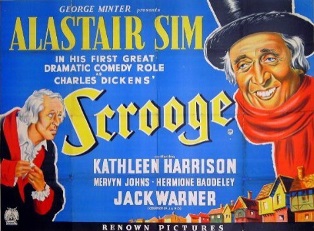
Scrooge_–_1951_UK_film_posterOftentimes during the holidays, we are quick to label someone a “Scrooge,” almost jokingly because it’s a moniker that’s somehow lost a great deal of its magnitude with overuse and the passage of time. However, if we look at this film, so wonderfully anchored by Alastair Sim, and even Charles Dickens original work from which it is derivative, we would adopt a much wider definition of the word “Scrooge.”
Surely it is the archetypal Christmas tale and one of the most widely adapted works. Off the top of my head, I can think of versions from 1938, ’51, ’70, ’84, and 2009, not to mention countless retellings by Disney, Mr. Magoo, the Muppets, and Bill Murray no less.

We all know at least a little of the legend of Ebenezer Scrooge, and we can come up with a rough composite of what he must be like. He’s money-grubbing, has no spirit, and hates Christmas. If you say any of this you would be, in fact, most heartily correct, but there’s so much more to his character and his story. It’s far more universal than perhaps I would even give it credit for.

The narrative is beautifully elongated with the device of the three specters represented by the Ghosts of Christmas Past, Present, and Future respectively. Of course, it takes the apparition of his long-deceased partner Jacob Marley to scare Ebenezer out of the status quo — out of exactly the kind of person we assume him to be. But the key is he wasn’t always about the “humbugs” and lack of charity towards the poor and needy.

We learn about his story more in depth by the illumination of the first ghost. Scrooge began, a relatively humble young man, but his sister Fan had great affection for him, and he found a young woman named Anne, who loved him in spite of his lowly status. Money did not define their happiness — in fact, they were happier without it. But the way of the world back then was, and still is now, the pursuit of happiness by way of money. In a sense, although Scrooge greatly admired his generous employer Fezziwig, he became scared by the ways of the world. Once joining forces with another ambitious gentleman Jacob Marley, the two of them pressed their advantages when necessary and expanded their assets exponentially. The sweet, savory call of money quickly seduced them and as a result hardened their hearts. You see in the moments where Scrooge loses his sister and breaks off his engagement, that they are so emotionally charged even in the present. He hasn’t quite found a way to alleviate the pain because not even money can satiate that hurt.

The ghost of Christmas present shows him the inside of the humble Cratchit home, bringing to mind his previous comments about prisons and workhouses — as one of their foremost supporters. But the Cratchits, and specifically young Tiny Tim give a humanity to the common man like he has never seen before. He realizes that he has failed miserably in doing one of the most basic things — loving his fellow man and taking care of the widows and orphans. Scrooge still clings to the most poisonous belief that he is too far gone and he cannot be redeemed. That’s why what the Ghost of Christmas Yet to Come shows him scares him the most. The pictures he sees ahead of him are haunting and all too real, but it makes his opportunity at a second chance all the sweeter.

In truth, when Scrooge wakes up from his dream-filled slumber he’s giddy almost to the point of insanity, but Alastair Sim is so brilliant to play his part that way. His character change is so radical because his paradigm has been completely overturned. It shows in how he interacts with his world whether it’s his housekeeper, a lad on the street, his nephew, or even the long-suffering Bob Cratchit. Ebenezer Scrooge represents the hope of Christmas when mankind begins living for their fellow man instead of all the fortunes in the world that will only grow old and dusty. Thus, before calling someone “a Scrooge,” it is best to take note of what you’re saying and then get the whole story. People are a lot more complex than we often give them credit for. That becomes obvious even in this streamlined Christmas classic of only 86 minutes.

4/5 Stars

The Bishop’s Wife (1947)

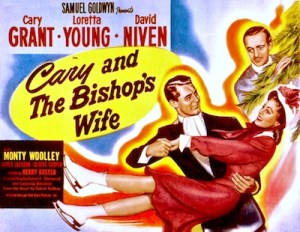
Cary_and_the_Bishop's_Wife_posterAlthough its theology probably isn’t sound, rather like It’s a Wonderful Life, The Bishop’s Wife nevertheless utilizes its central plotting device wonderfully.
Imagine if on a whim an angel came to your rescue, and then imagine that the angel is named Dudley and looks and acts like none other than Cary Grant. In this case, the person in need is a distraught Bishop named Henry Brougham (David Niven). He is right in the middle of a major undertaking to build a new cathedral, and his primary benefactor Mrs. Hamilton (Gladys Cooper) is being a thorn in his side. The building project has consumed all his time and efforts, causing him to neglect his radiant wife Julia (Loretta Young), their little daughter Debbie, and the people from their old parish.

Director Henry Koster crafts a whimsical and rather sentimental film much in the same mold as Harvey (1950) which came three years later. This time Dudley is the character who exists outside of worldly convention. He is constantly kind, always patient, never hurries, and is always helpful to everyone in need be it blind man or bishop. In truth, everyone adores him, because after all, he is an angel. Everyone, that is, except Henry who needs him most. Henry unwittingly asked for help and now he has an angel in his midst, but Dudley will not allow that to be revealed to anyone else. It’s an unnecessary detail, and besides, he has much more pressing matters like attending to Julia and assisting Henry with his work. To her, he is purely a radically pleasant and good-hearted individual. With such positives, there hardly needs to be any explanation, only wonderment.

He takes Julia through the old town she used to live in happily with Henry. They meet old friends like the blustering Professor Wutheridge (Monty Wooley), who Dudley also happens to give inspiration to. He makes little Debbie a ringer in a snowball fight, and he and Julia are joined by a chipper taxi driver (James Gleason) in an ice skating adventure. Even a check in on the humble cathedral at St. Vincent’s leads to an angelic rehearsal by the local boy’s choir. Meanwhile, Henry is absent, attending to other matters.

Of course, he is as bitter and distressed as ever by his plight — his attention still skewed in the wrong directions. Even when Dudley goes to grumpy old Mrs. Hamilton and totally redeems her perspective in order to feed the hungry, Henry hardly seems pleased. His artifice, his tower is now even farther from being completed.

The final scenes of Bishop’s Wife are key because it’s in these moments where we see the change in Henry. Cary Grant might seem obviously miscast for this role, and in truth, it was originally supposed to go to Niven who was to play opposite the equally angelic Teresa Wright. But Grant’s debonair side is important for this final act because it makes sense when he makes a pass at Julia. It fits his screen persona as the suave bachelor, angel or not. You can debate whether he was actually in love with the beautiful mortal, or if he was just doing it to get a rise out of Henry. Whichever way you see it, for the first time Henry is driven to fight for his wife out of love and because of the human emotion that still pulses through his veins. Finally, he drops the peripheral and looks at what is central, his family and friends. Dudley, or Cary Grant, takes one final approving look and walks off in the snow. His work here is done. Peace on Earth and Goodwill towards men.

4/5 Stars

“We forget nobody, adult or child. All the stockings are filled, all that is, except one. And we have even forgotten to hang it up. The stocking for the child born in a manger. It’s his birthday we’re celebrating. Don’t let us ever forget that. Let us ask ourselves what He would wish for most. And then, let each put in his share, loving kindness, warm hearts, and a stretched out hand of tolerance. All the shining gifts that make peace on earth.”

~ Final Message given by Henry (David Niven)

Elf (2003)

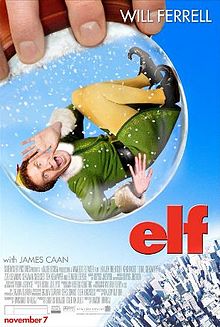
220px-Elf_movie“The best way to spread Christmas Cheer is singing loud for all to hear.”

Elf is truly a Christmas miracle. It’s a relatively modern Christmas classic (a bit over 12 years old) that holds its own in a season usually dominated by old perennial favorites. Yet, again and again, it constantly excites, mesmerizes, and bedazzles in more ways than one.

Will Ferrell is the major treasure of Elf because, without his child-like wonderment and sincerity, this film could go downhill all too quickly. Buddy walks into female locker rooms, walks around New York in an Elf suit eating discarded gum, and calls his grown-up father “daddy” in a musical serenade, after all. But to his credit, Ferrell goes for it wholeheartedly completely engulfing himself in a magical realm that bewitches every other character who decides to join him. Everyone else walks in abject reality, but Buddy like Elwood P. Dowd (Harvey) or Dudley the angel (The Bishop’s Wife) exist outside of that and when they rub up against everyone else, they leave everyone, including the audience, changed.

From the outset, Elf comes right out of a storybook as Papa Elf (the venerable Bob Newhart) recounts how a human and his adopted son saved Christmas. Of course, it starts out as a sorry tale, because truth be told Buddy cannot figure out what his purpose in life is. What is he good at? What are his talents? For all the other elves it’s obvious: they make toys.

But when Buddy finally learns of his secret past he leaves his papa behind in a tearful goodbye, gains some sage advice from Santa (the equally venerable Ed Asner), and heads off on an iceberg to find his real father in the Big Apple.

There must be a catch, and there is a small one, Buddy’s father Walter Hobbes (James Caan) is on the naughty list. In fact, he’s a real Scrooge working slavishly day after day as a children’s book publisher. But you see Buddy doesn’t see people for their faults and that’s the secret of Ferrell’s success because his innocence and irrepressible will towards his fellow man is contagious. New York might be a culture shock and Hobbes as well as his young boy Michael are not too thrilled with Buddy’s arrival, but that’s because he’s so foreign – so nice. Ultimately, he becomes the best thing to happen in their life.

In truth, Buddy goes transforming New York systematically whether it’s the Hobbes’ home, Gimbel’s Department Store, or wherever his feet take him. And of course he finds love in his world-wearied coworker Jovie (Zooey Deschanel) and saves Christmas, but that’s nothing unexpected. It’s not the results, but how we get there that counts – all those quotable moments in between.

Too often I feel bludgeoned to death by all the new takes on the Christmas season annually jostling for my affection. But the beauty of Elf is that it pays its respects to the past, thereby solidifying its own timelessness in the present. It doesn’t have to be the next big thing, but it is something that I would gladly sit down and watch annually, because of its spirit and seasonal charm. We get nods to A Christmas Story and Ralphie, an homage to George Bailey on the Bedford Fall bridge, and even Miracle on 34th Street (Buddy working at the rival Gimbels).

The music never steals the show but it does accent some sequences nicely including the voices of Louis Prima, Stevie Wonder, Ella Fitzgerald, Frank Sinatra, and so on. Each character fits well in director Jon Favreau’s narrative. The manager (Faizon Love) is a crack-up. The hired Santa (Artie Lange) is a thug. Peter Dinklage is an angry elf. James Caan is grumpy and cynical. Zooey Deschanel is pretty and cynical. Ed Asner is an endearing grouch. Bob Newhart has his usual stuttering charm. And Ferrell wraps it all up nicely with a pretty bow. Although it does completely sidestep the origins of the Christmas holiday, Elf does what it set out to do very well. It exudes Christmas spirit unabashedly.

“Christmas spirit is about believing, not seeing.” – Ed Asner as Santa

4/5 Stars

Calvary (2014)

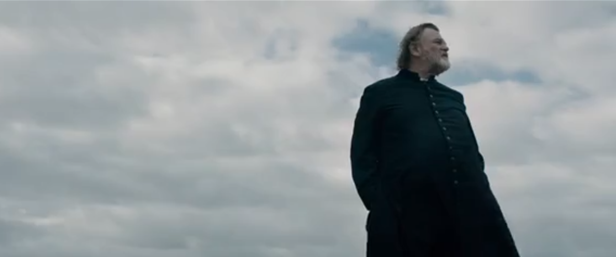
calvary1We meet Father James (Brendan Gleeson) as he sits listening to one man’s confession, but it turns out that this confession is more of a threat. The unseen figure threatens to kill the Father by the end of the week, not for anything he has done, but because the world is an unfair, ugly place. The vengeful man had a traumatizing experience as a boy that rightly so alienated him from the church. The Father listens and does the most humanly thing possible. He doesn’t act as if he has the solution to all the problems, he can’t attempt to fix what has already happened, so he simply acknowledges it and extends his sympathy.

The same goes for the threat of death. He’s not sent into some hysterical fit of terror or rage. He continues through his life, making his rounds through the community to the people in his parish. He goes to their shops, their places of residence, and the bars. You can tell he truly cares for the people around him, but there is an underlying jadedness to everything he does. You can see it on his face wherever he goes. But it doesn’t come from a lack of conviction or faith in his God like father Tomas in Bergman’s Winter Light. James is a priest for the modern age, and it all makes sense if you look around his town.

True, this film starts off with a death threat to a priest, but it’s hardly a mystery because James knows who the Judas is. What’s really paramount are all the people he interacts with. They are the ones who are truly sucking the lifeblood out of him, not the threat of death. The young people are fully engulfed in a secular world and have little notion of how religion plays a role in life. They’re not against it so much as they’ve lived a life without it.

The adults are perhaps worse because they look at the Father and his calling with a cynicism. They say his way is finished. They scoff, belittle, and make light of him for no good reason. Simply because they have no need for Him or his faith. This is the modern world after all. Butchers, bartenders, mechanics don’t need someone to repress them and act as a moral compass. That’s so archaic and constricting.

Meanwhile, they stand by as his church is razed to the ground and they do nothing. The throat of his beloved dog Bruno is slit and Father James is left to weep alone. There are a few characters on the outskirts, who seem to care for him, and one happens to be his daughter Fiona. She too has grown up in the secular world, but they love each other dearly. Her serious contemplation of suicide is yet another anxiety plaguing her father’s life.calvary2Interestingly enough, Father James notes how there’s much more talk about sin rather than virtues. He realizes that forgiveness is highly underrated and that is something that he learns a great deal about over the course of his week. Whether it’s in easier circumstances when responding to his daughter or invariably more difficult forgiving all those hard-hearted individuals around. Or perhaps the most difficult of all, forgiving the man who is going to kill him.

The Father makes his way to the beach ready to meet his assailant as a stoic solitary figure, not simply ready to meet his executioner, but ready to meet his maker. This is a dark and heavy film, but certainly not without merit. It’s weighed down by cynicism, but at its core is a man of immense strength and personal conviction. He’s not a perfect example of a man of faith, but does anybody really want a perfect example?  It’s an impossible expectation, but Father James is a living example. Living, breathing, and dying. A man who was just as prepared to forgive those who despised him as much as he loved those ones who actually cared. Kudos to Brendan Gleeson for a truly stirring portrayal.

4/5 Stars

Phoenix (2014)

Phoenix_(2014_film)_POSTER

Speak low when you speak, love
Our summer day withers away too soon, too soon
Speak low when you speak, love
Our moment is swift
Like ships adrift we’re swept apart too soon
~ Speak Low (1943)

Anyone who’s watched a Christian Petzold film already knows that he crafts fascinating almost spellbinding films and that quality rests greatly on the laurels of Nina Hoss. Phoenix is yet another film that is a mesmerizing enigma.

It’s positively entrancing with its pacing — where you almost get lost within its minutes. Because although time never moves fast you quickly lose track as the mind is soon overwhelmed with a plethora of questions. In fact, all the time while you’re watching it all you can do is question. Implausibilities all but fade away in the presence of such uncertainty. If anything they get lost in the rubble.

It feels as if we’re trying to construct our own truth, which is almost maddeningly impossible because none of these characters seem ready to divulge any information. The past is a black shroud that everyone is reluctant to talk about. It makes sense because that soon after what do you say about the Holocaust? How do you cope or even begin to acknowledge the horrors that went on? It’s only 50, 60, 70 years later that we’ve finally been able to broach the subject as outsiders — people who did not experience those events firsthand. It’s easier for us to try and talk about it because we can never fully comprehend the climate. What would we have done? What would have happened to us? What would our lives have looked like in the aftermath?

The characters in Phoenix are beings in that post-war wasteland with specters hanging over them, and lives scarred by pain and suffering. They’re trying to salvage their existences the best they can, but they’re hardly existing as they did before the war. But allow me to backtrack for a moment.

Nelly (Nina Hoss) is physically maimed so horribly that her face is constantly covered in bloody bandages. Petzold does us a favor by not showing her visage before she gets reconstructive surgery. Like the shadow of the Holocaust, we are forced to imagine it on our own which is far more powerful. This is what her face looks like and this is perhaps how it happened.

What we do know is that she was arrested on October 4th, 1944 and her husband Johnny was as well. But Nelly’s faithful friend and guardian angel Lene says that he betrayed her. That’s what she believes, and yet upon hearing this news it hardly alters Nelly’s response. She’s still intent on finding him and picking up all the pieces. When she has a little more strength she begins wandering about the American sector looking for any signs of her former beau.

It turns out that Johnny works as a waiter in a cabaret Hall called Phoenix. When he first sets eyes on Nelly — it’s not his wife that he sees, but a wonderful impostor. She’s a woman who is strikingly similar, but her face is different. She’s the perfect accomplice as Johnny, or Johannes as he now goes tries to secure his dead wife’s assets.

What follows is his mission to make her into his old wife.  In many ways, it works as an inversion of the Vertigo conundrum. He thinks he’s making this woman into his deceased wife, and he coaches, dresses, and shapes her more in the image of Nelly. However, this hardly feels like an obsessive desire of dashed love, but a project to get him closer to his final goal. It’s not that sentimental, but Nelly follows along with the whole thing benevolently. To be close to Johnny is enough. But how does she even begin to break the news? Perhaps most frightening of all what will Johnny’s reaction be? After all, the wartime has changed them both.

So if you want to break it down to its most basic roots, Phoenix feels rather like a Holocaust film meeting Vertigo. But in essence, it defies that type of simple categorization. It lacks the odious horror of flashbacks and the glossy Hollywood production values of the latter. It fills its own niche altogether that even channels some of the darkness of noir. And there is no cathartic moment of emotional release. Instead, we are forced to watch as the characters bury their thoughts and feelings deeper and deeper. Perhaps they lie there somewhere under the surface. However, these are not histrionic people. They feel common and every day led by the performances of Hoss and Ronald Zehrfeld.

In this way, the performances are muted and repressed. In fact, there is little headway in the film and few epiphanies until the very end. That’s when for a few brief solitary moments things fall into place. We don’t know what will happen afterward, and in a way, we are suspended in the moment — left to ponder so many things. You could either make the case that Phoenix has shallow characters, or that there is so much depth within them that we cannot even begin to understand — like icebergs still partially submerged.

Many wonderful films lose so much of their magic because they dispel too much — give away too many of their hard-fought secrets. But Phoenix makes us work through everything, and it can be hard going certainly, and yet it is a thoroughly gratifying experience. We watch movies to be moved. We watch movies to be perplexed. We watch movies to acknowledge our wonderment in the human condition because it is a complex quandary that continually reveals new bits of enlightenment. Phoenix might leave us with more riddles than answers, and we should be content in that reality. That’s part of the magic.Like the mythical Phoenix of old, in a way, these characters try and die to their old selves, and rise out of the ashes a new.  Life is never that easy — always being clouded by doubts as our pasts come back to haunt us. It’s how we deal with that past that matters most.

4.5/5 Stars

Barbara (2012)

Barbara_(2012_film)If you’re acquainted with director Christian Petzold you probably know what you’re in for. A character study that is deliberate and systematic in its execution, courtesy of Nina Hoss, and moreover impactful in more ways than one. In this film, the narrative mode of the period piece certainly serves Petzold quite well. The setting is East Germany circa 1980. The settings are wonderfully stark. Depressed representations of a bygone era and yet somehow still strangely beautiful for depicting a simpler age. As Americans, we have a certain perspective that includes Cold War sentiment, boycotting the Moscow Olympics, and the like. But it’s a much different even intimate picture on the inside.

Our person of interest is the eponymous Barbara, a nurse stationed in Berlin, who tried to get an exit visa to the West. Now she has been transferred to a rural locale to continue her work with close surveillance by the Stasi. Her primary colleague is chief physician Andre Reiser, who is genial, but from the get-go Barbara is aloof. She does not want friends and she knows anyone could be working with the police.  She goes about her work being the best nurse she can possibly be, treating patients humanely. Most notable is Stella a girl from a labor camp, who is suffering meningitis, and finds a comforting figure in Barbara. From then on she is the only person Stella trusts.

In her free time, Barbara can often be seen smoking, riding her bike, or taking the train, but there is always a purpose to her activity. It’s in quiet defiance of her plight — an active form of rebellion as she tries to rendezvous with her boyfriend from the West in an effort to reconnect with him. Unknowingly Dr. Reiser grows continually fonder of Barbara and continues to be nice to her because she is quite remarkable. Together they try and decipher what is wrong with a young man who is recovering from a suicide attempt. But of course, his necessary surgery coincides with Barbara’s set date of escape. What follows is far from melodrama, but it is a far tenser slow burn as we watch events unfold. Our heroine does something that will alter her future although we cannot know for certain. Sometimes the best place to end a story is inside our own minds, and that is true with Barbara.

It’s a film that can make you squirm, but also make you think and feel. The German scenery is often breathtaking, the perfect landscape for bike riding, and the birds chirp blissfully in the background. It is the ultimate irony that in such a peaceful land so much suppression and pain takes place. But then again there can be so much joy taken out of something so minute as a masterwork by Rembrandt, proving that the human spirit cannot be fully quelled even there.

In the film’s nuances, you are apt to find beauty and also great depth of character. Not just in Nina Hoss, who is once again brilliant carrying an air of mystery mingled with moroseness that lingers on her face. This might be a poor comparison, but Hoss reminds me in some respects to other European starlets like Juliette Binoche, Irene Jacob, and Julie Delpy, who all carry a fascinating aura around them. The truth is American actors, in general, have to use so many words and in this way, they lose some of their allure. Nothing is left unspoken. Nothing is left untrod. But with Barbara, we do not know her ins and outs, what she is thinking, or even how her story ends.

Next on the watch list is Phoenix, the latest Petzold/Hoss collaboration. It goes without saying that I am beyond excited.

4/5 Stars

The Incredibles (2004)


The_IncrediblesCertain superhero storylines are beginning to overstay their welcome. Spiderman, The Fantastic Four, and even The Avengers spring to mind. The remarkable thing is the fact that this wildly popular genre headlined by numerous wildly popular franchises does not appear to be leaving us anytime soon. And when the prospects of monotonous superhero film after monotonous superhero film get a little too much, it’s rather comforting to return to The Incredibles. Yet again Pixar proved they knew how to craft animated films with great storytelling, but also a depth of character.

Over a decade ago now Brad Bird helmed a project that would introduce us to a very different batch of superheroes. Yes, they began as individuals named Elastigirl and Mr. Incredible, but soon enough they ceased being that. But these weren’t a ragtag alliance like the Avengers or the Guardians of the Galaxy. They were something perhaps more broken and complicated – a family.

Back in the glory days, the superheroes were civil servants held in high regard – one of the foremost of those being Mr. Incredible (voiced by Crag T Nelson), but they soon fell out of favor due to scandal and public controversy. Thus, they drifted into obscurity and their aliases quickly became their real life.

This is where this story gets interesting, as Bob and Ellen Parr, as they are known now, are living life with three kids. Ellen (voiced by Holly Hunter) is happy to give it a go and live the normal everyday existence, but Bob yearns for something more than rush hour traffic and a cramped cubicle in a thankless job. And when he gets a mysterious message with mission impossible-like implications. He is indubitably intrigued.

He begins moonlighting again, sneaking around behind Ellen’s back not wanting to needlessly worry her. He touches bases with his old friend and colleague Edna Mode (Bird himself), who supplies him with a new super suit sans cape. It’s just like old times with the super getting the respect he once garnered from everyone, and his family is happy and healthy. Everything is looking up.

But of course, behind these missions of his is something a little more sinister than he could have ever imagined. Of course, when his wife catches wind of it she expects something completely different – their marriage must be failing. That’s the only possible reason for him sneaking around.

Thus, mother and two stowaways head to a volcanic island smoldering with destructive peril. Mr. Incredible meets his match and is brought low as his past mistakes finally catch up to him. He realizes his weakness and more importantly how much his wife means to him. He could not go on without her. However, his wife and kids do not wallow in their predicament as they try and save the world from the dastardly deeds of the begrudging supervillain Syndrome. It’s in this final showdown that Mr. and Mrs. Incredible are back in their element with their compadre Frozone (Voiced by Samuel L. Jackson). Except now they are joined by their speedy son Dash and their invisible, force-field wielding daughter Violet, who both feel confident in their skin.  A giant mechanical robot is no match for such a crew, especially when they’re a family.

True, these characters have superpowers and special abilities, but then don’t we all in some way, shape, or form? This is a story about the nuclear family when that dynamic is blowing up, and a story about being comfortable in your own skin, in a society that often makes that difficult. So Pixar does the seemingly superhuman yet again by delivering up a popcorn-action-adventure-family film, that still somehow holds up to multiple viewings. It’s retro cool, quotable, and gives its voice actors space to gel. They breathe life into this story, while their contours come alive on screen. It’s a childhood favorite and for a very good reason.

4.5/5 Stars

The Station Agent (2003)

220px-Station-agent-posterLife takes all sorts of people. Otherwise, our everyday human interaction would have no meaning, no real importance. But when each person brings something different to the table, that’s when life gets interesting. We need the introverts, the extroverts, and every shade in between. That’s really what The Station Agent is about. It’s made up of a ragtag cross-section of humanity. Each one’s a different puzzle piece and you wonder how they ever got together. But they all get thrown into one box in the sleepy town of Newfoundland, New Jersey, and these people wind up living life together. Maybe it sounds rather banal, but the result is actually quite rewarding. I don’t exactly find trains exhilarating, but if you have somebody to share them with they’re not so bad.

The central character in our film is a train aficionado and reserved man named Finbar (Peter Dinklage). He’s been gifted a ramshackle shack bequeathed to him by the elderly proprietor of the hobby shop he used to work at. They both shared a contentment in silence and a deep affection for trains. Fin has seemingly lost his only friend in the world, and he resigns himself to silence because he assumes that all people ever notice about him is his size. They don’t seem to care about the person inside the body and he doesn’t want to take a chance. But that’s before he meets the genial dynamo Joe (Bobby Cannavale), who runs a coffee cart out in the boonies. It’s absolute torture for such a vibrant personality, and he jumps at the chance to have someone to talk to nearby.

The quiet little man constantly deflects any attempt by Joe to become acquainted and yet it never fazes him. First reluctantly and then wholeheartedly Fin allows Joe on his long walks along the train tracks, and Joe breaks down the barriers. The unlikely pair gets even more unusual when they add middle-aged artist Olivia (Patricia Clarkson) into their ranks after she nearly runs over Fin several times. Like her two new acquaintances, she has personal issues to work through on her own. But that doesn’t mean she has to live life alone, and with Joe being the glue, these three have something going that truly blossoms into friendship.

Two of the other pieces of the puzzle include the inquisitive girl Cleo, who shares Fin’s fascination with trains and builds an instant connection with him as children often can with other people. She’s direct, innocent, and she accepts Fin for who he is. Then there’s Emily (an almost unrecognizable Michelle Williams), the local librarian, who adds another layer to the town’s charm. She is pretty, but also very sweet and open to talking with Fin. Really she’s just looking for someone to listen since she’s going through a pregnancy with a boyfriend who is bad news.

It’s easy to respect The Station Agent because it’s not a story where romance heals all wounds. There are two such moments when the film could have easily become that, but Tom McCarthy has a greater respect for his characters than that. They don’t get caught up in needless romantic entanglements for the sake of drama. Their interactions are more nuanced and sensitive than that. Because Joe might make jokes, but behind that veneer is a deeply caring heart.

Noticeably McCarthy also has a great respect for quiet. His film is full of solitude as much as it is full of human interaction. That might be off-putting to some, but it makes the story all the more powerful, juxtaposing the idle chatter with tranquility. On his part, Peter Dinklage gives a breakout performance as a man who realizes he can let people into his life. Because in life true friendship can form between people of all colors, shapes, and sizes. We have to give out a chuckle when this unlikely trio is sitting on the porch talking about Fin’s love life one last time. Not in a million years would we expect to be sitting there with them enjoying the moment. But it happened and we do. In many ways, it’s a lot like life.

4/5 Stars

Review: Taxi Driver (1976)

taxidriver1Well. Whatever it is, you should clean up this city here, because this city here is like an open sewer you know. It’s full of filth and scum. And sometimes I can hardly take it. ~ Robert De Niro as Travis Bickle

Taxi Driver‘s Travis Bickle is an American icon representing anyone and everyone who has ever felt like an outcast, outsider, or misfit. He’s the perfect embodiment of any of the angst or disgust that might surge through our veins at any given time. Except before I ever saw Martin Scorsese’s film, I always assumed him to be a thuggish villain. But his character is more complex than that. He’s far more relatable than I would have initially given him credit for.

The film actually opens feeling like the pilot of the Sitcom Taxi or something. There’s Bernard Hermann’s beautifully cool jazz-infused score and then the illuminating lights of an average New York evening. It feels strangely peaceful in spite of all that is going to go down.

Travis is an ex-Vietnam vet who takes a taxi driving job for the strangest of reasons. He just wants something that will have him working long hours and he isn’t too particular about what part of town he ends up in. From the get-go, he strikes the audience as a quiet almost silent observer of all that takes place around him on the streets every night. He’ll sit around with a couple cabbies as they chew the fat, but he’s essentially isolated — a repressed young man who doesn’t really express himself. His existence feels tragic and lonely, certainly not deadly.

taxidriver2There is a small beacon of hope when a pretty campaign volunteer named Betsy (Cybil Sheppard) catches his eye, and he has an extremely awkward interaction with her but it lands him a date. But Travis just doesn’t quite know how to act, he hasn’t learned what it means to be in a relationship and he has an error in judgment while they are out. However, he doesn’t see it that way. He feels his attempts at kindness were completely rejected.

Then, he also begins to notice a young hooker out on the streets and his next mission is to get her away from there back home. He thinks it’s the right thing to do and he means well but young streetwise Iris (Jodie Foster) doesn’t seem to want his charity. So once again Travis seems unwanted and not needed when he is trying to do something nice.

Travis even acknowledges to his colleague Wizard that he’s getting all twisted up inside and confused. He’s distraught and he has no way to deal with it so his outlet includes a heavy strength regimen and loading up on a ton of guns. Never a good sign, but it his mind’s eye it’s all to clean up the streets of the scum of the earth.

However, first he attends a rally for a presidential candidate that Betsy will be at and he has intent to cause harm, but he backs out at the last minute and goes to Plan B confronting Iris’s pimp Sport (Harvey Keitel) and shooting him. The inner demons of Travis are unleashed as he goes off, but his delusions of grandeur reassure him that this is all for Iris. This is for her good. All this bloodshed.

taxidriver4The final moments after his rampage have Travis receiving a letter from Irises parents who are grateful for his actions to save their daughter from corruption. Then, a fully recuperated Travis finds Cybil sitting in the back seat of his taxi cab in all her glory. It’s beyond his wildest dreams, which begs the question is this reality, or is this just a clever construction of his own brain? Another delusion of grandeur. It’s a wonderful open-ended finale.

Paul Schrader’s script is a wonderful character study giving introspection into one troubled man’s psyche. However, there is controversy on two fronts. It’s rumored that John Hinckley Jr. who tried to assassinate Ronald Reagan was influenced by this film and also the finale seems to reflect many people who commit mass shootings. Oftentimes they are people who are deeply troubled and are looking for some type of attention. But with that desire comes often deadly consequences.

taxidriver3Martin Scorsese’s film has also received pointed criticism for its violence which is hard to downplay. However, Taxi Driver remains interesting because it is not bloated with killing (in fact only one scene is actually bloody). Most of the film has to do with relationships or lack thereof because a lot of what Travis does is watch and listen. It might be Martin Scorsese in a cameo as a jealous husband or a presidential candidate asking Bickle’s opinion from the back seat. Furthermore, like any warm-blooded boy, he knows that Cybil Sheppard is a dream girl. And he has enough compassion to want Iris to have a normal childhood. It’s just that his conscientiousness is misdirected and subverted.

The film resigns itself to following this one man in the wasteland that is New York. It’s starkly beautiful and thought-provoking placing a troubled anti-hero in front a canvas of urban realism. I could never condone his behavior, but then again I could never be completely against him either.

4.5/5 Stars

Review: Eternal Sunshine of the Spotless Mind (2004)

eternalsunshine1In truth, I always thought this film had a well-suited title for its material. It was rather unusual and unique. There was not much more to think about otherwise. But when you actually think about it, whether or not you consider Alexander Pope’s poem from which it originates from, there is great truth that can be gleaned from this phrase “eternal sunshine of the spotless mind.” In fact, it’s truth that points to the heart and soul of Charlie Kaufman’s story.

As humans who love and love to love, there is also the equally likely chance that we might lose that love, or have it come crashing back down upon us. Thus, if we lived with a mind never cluttered with such a thing as love and all the complexities, pain, and emotions that go with it, then could we not be forever happy? There would be nothing to darken our mood, as ignorance truly is bliss. Except in that statement, there is something inherently wrong, because to be human means to be thinking and feeling creatures of reason. Take that away from us and we are little more than animals. But with our minds, we can do so much that is worthwhile. Perhaps we get hurt in the process, and yet that brings to mind another long overused epithet. It’s better to have loved and lost than to have never loved at all. It’s a paraphrasing of Tennyson I think.

This is a great place to enter into this film — this absurdly idiosyncratic vision of screenwriter Charlie Kaufman and director Michel Gondry. Initially, the story of Eternal Sunshine of the Spotless Mind is a great mess — a great web of confusion. The tone is a bit melancholy only to be injected with a heavy dose of whimsy. A man quite suddenly boards a train and meets a free-spirited girl. It’s a meet-cute, and yet there’s a strange sensation that this is not the first time they have met.

Over time everything begins to fall into place just like memories hidden away in the human mind. In fact, that’s exactly like this film. Joel (Jim Carrey) is a subdued, often lonely man, who decides to get rid of his memories, especially when he learns that his former girlfriend Clementine has done the same. He just wants to be able to get over her. But as part of the process, all his past memories come flooding back from the most recent to the oldest. Each and everyone seems to include Clem in one way or another. It’s quite the strange sensation, although Joel does begin to get used to it. That doesn’t mean he likes it.

eternalsunshine2He swims in and out of consciousness between the past and then the present that is going on outside his head. The voices inside his head, or more aptly, the voices right outside his head come from two engineers (Elijah Wood and Mark Ruffalo) from a company in charge of erasing his memories. They create a map of them so they can remove the memories later.

Paranoia sets in as Joel’s past disappears, and he attempts to stop the inevitable erasing of all his recollections. They’re lucid dreams or more like lucid nightmares accompanied by paralysis. However, Joel goes off grid into the deep cavernous expanses of his brain. Entering places where his deepest desires and deep-seated feelings hide. It might be buried in his childhood, humiliating ordeals he was put through, or his most intimate memories of the girl Clementine.

This film is most certainly inventive, but it becomes endangered of relying too heavily on a concept or a gimmick in a way that gets in the way of the love story. Although that does happen at times, in general, Eternal Sunshine functions in great capacity. While being utterly original, it still manages to be anchored by the story of Joel and Clementine. That is due to the wonderfully restrained performance of Carrey paired with Winslet’s dyed-hair and unfettered turn as Clem.

eternalsunshine3Finally, the narrative folds over on itself again as Joel’s mind returns to the present — a present without any recollection of Clementine. They meet again and there’s a strange sensation in the air. It’s a true deja vu moment that has them befuddled and confused. Will they go through with their relationship even when they find out about their rocky history?

Perhaps the most troubling thing about Eternal Sunshine is that it feels liberating, but it’s liberation without the prospects of romance going anywhere. How do we know that Joel and Clem won’t fall into the same ruts they did before? However, maybe that’s exactly the point. Love often means taking risks and stepping out when it’s hard. The great unknown can be daunting, but without it, there could be no joy or hope in life, only mindless interactions with arbitrary meaning. Love is worth the risk for Joel and Clementine. It’s the same for most people. Therein lies the beauty behind it.

4/5 Stars